PRESENTATION ON
BANKING SYSTEM IN INDIA
PRESENTED BY :
MALLA VENKATA SAI
190209120018
INTRODUCTION
• A bank is a financial institution that provide banking and other
financial services to their customers such as accepting deposits
and providing loans.
• A banking system also referred as a system provide by the bank
which offers cash management service for customers ,reporting
the transactions of their accounts and portfolios, through out the
day
RESERVE BANK OF INDIA
• The reserve bank of india is a central bank and was established in
April 1, 1935 in accordance with the provision of reserve bank of
India act 1934.
• The central office of RBI is located at Mumbai. since
nationalization in 1949.
• The RBI act 1934 was commenced on April 1, 1935.
• To regulate the issues of banknotes.
BANKING SYSTEM IN INDIA
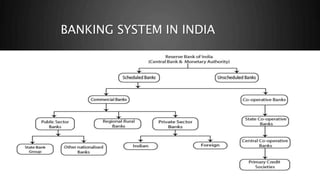
Scheduled banks :- scheduled banks are those banks whose name
appears in the 2nd schedule of reserve bank of India act, 1934. non-
scheduled banks
Non-scheduled banks :- are those banks whose name doesn’t appear in
the 2nd schedule of reserve bank of India act, 1934.
BANKS UNDER SCHEDULED BANKS
A)Commercial banks they are the banks mainly deal with commercial
banking : -operations like acceptance of deposits and granting loans to the
public. they are mainly classified into four:- scheduled banks commercial
banks co-operative banks
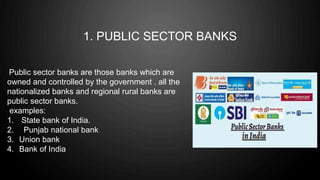
1. PUBLIC SECTOR BANKS
Public sector banks are those banks which are
owned and controlled by the government . all the
nationalized banks and regional rural banks are
public sector banks.
examples:
1. State bank of India.
2. Punjab national bank
3. Union bank
4. Bank of India
2. PRIVATE SECTOR BANKS
Private sector banks these banks are owned and controlled by private
institutions or individuals and not by the government. Examples ICICI
HDFC axis bank etc.
3. FOREIGN BANKS
Foreign banks these banks are formed and registered in foreign countries
and have their head office in foreign country.as far as India is concerned,
any bank registered outside India and have a branch in India is a foreign
bank. examples Yes bank Citi bank Hsbc Deutsche bank etc.
4. REGIONAL RURAL BANKS
Regional rural banks regional rural banks (rrbs) were established by
regional rural banks act, 1976 with a view to satisfy the banking facilities
and credit needs of the rural people. examples; Andhra Pradesh Grameena
Vikas Bank, Chaitanya Godavari Grameena Bank, Kerala Grameen Bank
etc.
B) CO-OPERATIVE BANKS
Co-operative banks these are banks where co-operative societies that are
formed at a state or district level have a share of more than 51%. these are
primarily set-up for the purpose of services the farming community
1)URBAN CO-OPERATIVE BANKS
Urban co-operative banks the term urban co-operative banks (ucbs),
though not formally defined, refers to primary cooperative banks located in
urban and semi-urban areas. these banks, till 1996, were allowed to lend
money only for non-agricultural purposes. this distinction does not hold
today.
examples:- Karnataka state co-operative bank , Maharashtra state co-
operative bank
2. STATE CO-OPERATIVE BANKS
State co-operative banks state co-operative banks are the apex co-
operative institution in a state . they are federations of district co- operative
banks, and they monitor the activities of all co- operative banks in the state.
examples:- Kerala state co-operative bank Orissa state co-operative bank
West Bengal state co-operative bank
3. NATIONAL BANK FOR AGRICULTURE AND
RURAL DEVELOPMENT
National bank for agriculture and rural development (NABARD) was
established as an apex bank that provides finance for agriculture and rural
development.

THANK YOU

Banking system in India

  • 1.
    PRESENTATION ON BANKING SYSTEMIN INDIA PRESENTED BY : MALLA VENKATA SAI 190209120018
  • 2.
    INTRODUCTION • A bankis a financial institution that provide banking and other financial services to their customers such as accepting deposits and providing loans. • A banking system also referred as a system provide by the bank which offers cash management service for customers ,reporting the transactions of their accounts and portfolios, through out the day
  • 3.
    RESERVE BANK OFINDIA • The reserve bank of india is a central bank and was established in April 1, 1935 in accordance with the provision of reserve bank of India act 1934. • The central office of RBI is located at Mumbai. since nationalization in 1949. • The RBI act 1934 was commenced on April 1, 1935. • To regulate the issues of banknotes.
  • 4.
  • 5.
    Scheduled banks :-scheduled banks are those banks whose name appears in the 2nd schedule of reserve bank of India act, 1934. non- scheduled banks Non-scheduled banks :- are those banks whose name doesn’t appear in the 2nd schedule of reserve bank of India act, 1934.
  • 6.
    BANKS UNDER SCHEDULEDBANKS A)Commercial banks they are the banks mainly deal with commercial banking : -operations like acceptance of deposits and granting loans to the public. they are mainly classified into four:- scheduled banks commercial banks co-operative banks
  • 7.
    1. PUBLIC SECTORBANKS Public sector banks are those banks which are owned and controlled by the government . all the nationalized banks and regional rural banks are public sector banks. examples: 1. State bank of India. 2. Punjab national bank 3. Union bank 4. Bank of India
  • 8.
    2. PRIVATE SECTORBANKS Private sector banks these banks are owned and controlled by private institutions or individuals and not by the government. Examples ICICI HDFC axis bank etc.
  • 9.
    3. FOREIGN BANKS Foreignbanks these banks are formed and registered in foreign countries and have their head office in foreign country.as far as India is concerned, any bank registered outside India and have a branch in India is a foreign bank. examples Yes bank Citi bank Hsbc Deutsche bank etc.
  • 10.
    4. REGIONAL RURALBANKS Regional rural banks regional rural banks (rrbs) were established by regional rural banks act, 1976 with a view to satisfy the banking facilities and credit needs of the rural people. examples; Andhra Pradesh Grameena Vikas Bank, Chaitanya Godavari Grameena Bank, Kerala Grameen Bank etc.
  • 11.
    B) CO-OPERATIVE BANKS Co-operativebanks these are banks where co-operative societies that are formed at a state or district level have a share of more than 51%. these are primarily set-up for the purpose of services the farming community
  • 12.
    1)URBAN CO-OPERATIVE BANKS Urbanco-operative banks the term urban co-operative banks (ucbs), though not formally defined, refers to primary cooperative banks located in urban and semi-urban areas. these banks, till 1996, were allowed to lend money only for non-agricultural purposes. this distinction does not hold today. examples:- Karnataka state co-operative bank , Maharashtra state co- operative bank
  • 13.
    2. STATE CO-OPERATIVEBANKS State co-operative banks state co-operative banks are the apex co- operative institution in a state . they are federations of district co- operative banks, and they monitor the activities of all co- operative banks in the state. examples:- Kerala state co-operative bank Orissa state co-operative bank West Bengal state co-operative bank
  • 14.
    3. NATIONAL BANKFOR AGRICULTURE AND RURAL DEVELOPMENT National bank for agriculture and rural development (NABARD) was established as an apex bank that provides finance for agriculture and rural development.

  • 15.