Presented By….
Umakanta Karan
Shaista Begum
Rajendra Mohalik
Srusti Rupa Thatoi
Deepak Lenka
Arpita Panda
Jashlin Mishra
Chinmaya Ojha
Debasis Dash
Why We Choose This Topic….?
 Banking is the life blood of trade, commerce and
industry.
 Now- a-days, banking sector acts as the backbone
of modern business.
 Development of any country mainly depends upon
the banking system.
INTRODUCTION
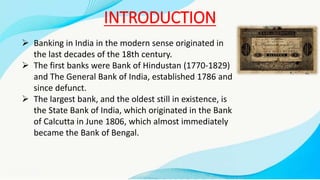
 Banking in India in the modern sense originated in
the last decades of the 18th century.
 The first banks were Bank of Hindustan (1770-1829)
and The General Bank of India, established 1786 and
since defunct.
 The largest bank, and the oldest still in existence, is
the State Bank of India, which originated in the Bank
of Calcutta in June 1806, which almost immediately
became the Bank of Bengal.
WHAT IS BANK….?
 Bank, an institution that deals in money and its
substitutes and provides other money-related
services.
 In its role as a financial intermediary, a bank
accepts deposits and makes loans.
 It also provide financial services, such as
wealth management, currency exchange and
safe deposit boxes.
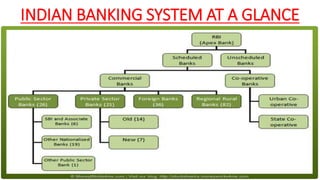
INDIAN BANKING SYSTEM AT A GLANCE
Reserve Bank of India (RBI)
 The Reserve Bank of India was established on 1 April 1935
by the recommendation of Hilton Young Commission.
 This is India's central bank and regulatory body
responsible for regulation of the Indian banking system.
 It is under the ownership of Ministry of Finance,
Government of India.
 There are two types of bank comes under the RBI, those
are,
 Scheduled Bank
 Non-Scheduled Bank
Scheduled Bank
 Any bank which is listed in the 2nd schedule of the
Reserve Bank of India Act, 1934 is considered a
scheduled bank.
 As per the rules, the bank's paid-up capital and raised
funds must be at least Rs. 5 lakh.
 Scheduled banks are also members of clearing houses.
 Scheduled banks are two types,
 Commercial Bank
 Co-operative bank
Commercial Banks
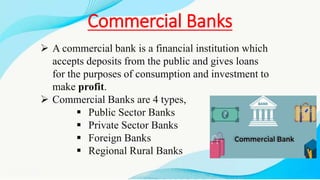
 A commercial bank is a financial institution which
accepts deposits from the public and gives loans
for the purposes of consumption and investment to
make profit.
 Commercial Banks are 4 types,
 Public Sector Banks
 Private Sector Banks
 Foreign Banks
 Regional Rural Banks
Co-Operative Bank
A co-operative bank is a small-sized, financial entity,
where its members are the owners and customers of
the Bank.
They are regulated by the Reserve Bank of India (RBI)
and are registered under the States Cooperative Societies
Act.
In India, there are 1482 urban co-operatives banks and 58
multi-state co-operative banks.
Some co-operative banks are,
 The Odisha State Co-operative Bank Ltd.(OSCB)
 The West Bengal State Co-operative Bank Ltd.
Non-Scheduled Bank
 Non-scheduled banks by definition are those which are not
listed in the 2nd schedule of the RBI act, 1934.
 They don't conform to all the criteria under clause 42, but
dully follow specific guidelines as laid down by RBI.
 Banks with a reserve capital of less than 5 lakh rupees
qualify as non-scheduled banks.
 The non-scheduled banks are,
 Baroda City Co-operative Bank.
 Bangalore City Co-operative Bank.
 Phagwara's Capital Local Area Bank Ltd.
Challenges for Banking Industry
 Increasing Competition
 Losses in rural branches.
 Large over-dues.
 Corruption.
 Non-Performing Assets
 Political pressures
Contribution to Economy
 Control over the Inflation and Deflation.
 According to Business Standard the Banking sector
has generated employment to the tune of 1.57
million.
 Capital Formation.
 Creation of Credit.
 Channelizing the Funds to Productive Investment.
 Finance to Government.
Future Of Banking Industry
Banking sector has one of the most significant share in
shaping up Indian Economy.
Banks mobilize the dormant capital into the productive
purposes and thus play a lead role in expanding the money
supply of the economy.
Banking is the life blood of an economy, so now days there is
not predictable to our economy without the banking sector.
And also the involvement of AI and ML into the banking
sector we can predict that our banking sector has move into
the next level.
PAST 10 YEARS NIFTY BANK INDEX
Conclusion
• Banking sector in Indian has given a positive and
encouraging responses to the financial sector reforms.
• banking holds a crucial role in our day-to-day life. We
must adhere to the banking system as responsible
citizens.
• The financial sector reforms have brought India
financial system closer to global standards.
Indian Banking System.pptx

Indian Banking System.pptx

  • 1.
    Presented By…. Umakanta Karan ShaistaBegum Rajendra Mohalik Srusti Rupa Thatoi Deepak Lenka Arpita Panda Jashlin Mishra Chinmaya Ojha Debasis Dash
  • 2.
    Why We ChooseThis Topic….?  Banking is the life blood of trade, commerce and industry.  Now- a-days, banking sector acts as the backbone of modern business.  Development of any country mainly depends upon the banking system.
  • 3.
    INTRODUCTION  Banking inIndia in the modern sense originated in the last decades of the 18th century.  The first banks were Bank of Hindustan (1770-1829) and The General Bank of India, established 1786 and since defunct.  The largest bank, and the oldest still in existence, is the State Bank of India, which originated in the Bank of Calcutta in June 1806, which almost immediately became the Bank of Bengal.
  • 4.
    WHAT IS BANK….? Bank, an institution that deals in money and its substitutes and provides other money-related services.  In its role as a financial intermediary, a bank accepts deposits and makes loans.  It also provide financial services, such as wealth management, currency exchange and safe deposit boxes.
  • 5.
  • 6.
    Reserve Bank ofIndia (RBI)  The Reserve Bank of India was established on 1 April 1935 by the recommendation of Hilton Young Commission.  This is India's central bank and regulatory body responsible for regulation of the Indian banking system.  It is under the ownership of Ministry of Finance, Government of India.  There are two types of bank comes under the RBI, those are,  Scheduled Bank  Non-Scheduled Bank
  • 7.
    Scheduled Bank  Anybank which is listed in the 2nd schedule of the Reserve Bank of India Act, 1934 is considered a scheduled bank.  As per the rules, the bank's paid-up capital and raised funds must be at least Rs. 5 lakh.  Scheduled banks are also members of clearing houses.  Scheduled banks are two types,  Commercial Bank  Co-operative bank
  • 8.
    Commercial Banks  Acommercial bank is a financial institution which accepts deposits from the public and gives loans for the purposes of consumption and investment to make profit.  Commercial Banks are 4 types,  Public Sector Banks  Private Sector Banks  Foreign Banks  Regional Rural Banks
  • 9.
    Co-Operative Bank A co-operativebank is a small-sized, financial entity, where its members are the owners and customers of the Bank. They are regulated by the Reserve Bank of India (RBI) and are registered under the States Cooperative Societies Act. In India, there are 1482 urban co-operatives banks and 58 multi-state co-operative banks. Some co-operative banks are,  The Odisha State Co-operative Bank Ltd.(OSCB)  The West Bengal State Co-operative Bank Ltd.
  • 10.
    Non-Scheduled Bank  Non-scheduledbanks by definition are those which are not listed in the 2nd schedule of the RBI act, 1934.  They don't conform to all the criteria under clause 42, but dully follow specific guidelines as laid down by RBI.  Banks with a reserve capital of less than 5 lakh rupees qualify as non-scheduled banks.  The non-scheduled banks are,  Baroda City Co-operative Bank.  Bangalore City Co-operative Bank.  Phagwara's Capital Local Area Bank Ltd.
  • 11.
    Challenges for BankingIndustry  Increasing Competition  Losses in rural branches.  Large over-dues.  Corruption.  Non-Performing Assets  Political pressures
  • 12.
    Contribution to Economy Control over the Inflation and Deflation.  According to Business Standard the Banking sector has generated employment to the tune of 1.57 million.  Capital Formation.  Creation of Credit.  Channelizing the Funds to Productive Investment.  Finance to Government.
  • 13.
    Future Of BankingIndustry Banking sector has one of the most significant share in shaping up Indian Economy. Banks mobilize the dormant capital into the productive purposes and thus play a lead role in expanding the money supply of the economy. Banking is the life blood of an economy, so now days there is not predictable to our economy without the banking sector. And also the involvement of AI and ML into the banking sector we can predict that our banking sector has move into the next level.
  • 14.
    PAST 10 YEARSNIFTY BANK INDEX
  • 15.
    Conclusion • Banking sectorin Indian has given a positive and encouraging responses to the financial sector reforms. • banking holds a crucial role in our day-to-day life. We must adhere to the banking system as responsible citizens. • The financial sector reforms have brought India financial system closer to global standards.