RECENT  TRENDS IN BANKING
INTRODUCTION What is banking? Position of bank in Indian economy. Multitasking entity. Nationalisation of bank.
The first bank in India, though conservative, was established in 1786. From 1786 till today, the journey of Indian Banking System can be segregated into three distinct phases. They are as mentioned below: Early phase from 1786 to 1969 of Indian Banks Nationalisation of Indian Banks and up to 1991 prior to Indian banking sector Reforms. New phase of Indian Banking System with the advent of Indian Financial & Banking Sector Reforms after 1991.  HISTORY OF BANKING SECTOR IN INDIA
The following are the steps taken by the Government of India to Regulate Banking Institutions in the Country: •  1949 : Enactment of Banking Regulation Act.  • 1955 : Nationalisation of State Bank of India.  • 1959 : Nationalisation of SBI subsidiaries.  • 1961 : Insurance cover extended to deposits.  • 1969 : Nationalisation of 14 major banks.  • 1971 : Creation of credit guarantee corporation.  • 1975 : Creation of regional rural banks.  • 1980 : Nationalisation of seven banks with deposits over 200 core.  STEPS TAKEN BY THE  GOVERNMENT
The commercial role of banks is not limited to banking, and includes: issue of  banknotes . processing of payments by way of telegraphic transfer,  EFTPOS , internet banking or other means  issuing  bank drafts  and  bank cheques   accepting money on  term deposit   lending money by way of  overdraft , installment loan or otherwise  providing documentary and standby  letters of credit  ( trade finance ), guarantees,  performance bonds , securities underwriting commitments and other forms of off-balance sheet exposures  safekeeping of documents and other items in  safe deposit boxes   currency exchange  acting as a 'financial supermarket' for the sale, distribution or brokerage, with or without advice, of insurance, unit trusts and similar financial products  WIDER COMMERCIAL  ROLE
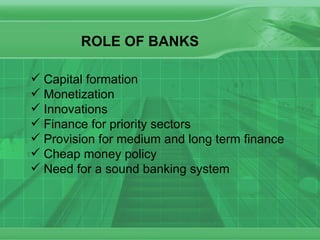
ROLE OF BANKS Capital formation Monetization Innovations Finance for priority sectors Provision for medium and long term finance Cheap money policy Need for a sound banking system
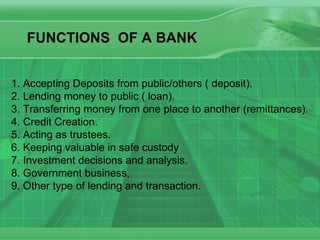
FUNCTIONS  OF A BANK 1. Accepting Deposits from public/others ( deposit). 2. Lending money to public ( loan). 3. Transferring money from one place to another (remittances). 4. Credit Creation. 5. Acting as trustees. 6. Keeping valuable in safe custody 7. Investment decisions and analysis. 8. Government business, 9. Other type of lending and transaction.
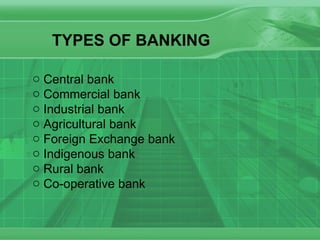
TYPES OF BANKING Central bank Commercial bank Industrial bank Agricultural bank Foreign Exchange bank Indigenous bank Rural bank Co-operative bank
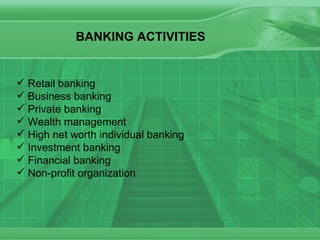
BANKING ACTIVITIES Retail banking  Business banking Private banking Wealth management High net worth individual banking Investment banking Financial banking Non-profit organization
BANKING CHANNEL Branch ATM Mail Telephone Online Mobile video
 

Banking Sector

  • 1.
    RECENT TRENDSIN BANKING
  • 2.
    INTRODUCTION What isbanking? Position of bank in Indian economy. Multitasking entity. Nationalisation of bank.
  • 3.
    The first bankin India, though conservative, was established in 1786. From 1786 till today, the journey of Indian Banking System can be segregated into three distinct phases. They are as mentioned below: Early phase from 1786 to 1969 of Indian Banks Nationalisation of Indian Banks and up to 1991 prior to Indian banking sector Reforms. New phase of Indian Banking System with the advent of Indian Financial & Banking Sector Reforms after 1991. HISTORY OF BANKING SECTOR IN INDIA
  • 4.
    The following arethe steps taken by the Government of India to Regulate Banking Institutions in the Country: • 1949 : Enactment of Banking Regulation Act. • 1955 : Nationalisation of State Bank of India. • 1959 : Nationalisation of SBI subsidiaries. • 1961 : Insurance cover extended to deposits. • 1969 : Nationalisation of 14 major banks. • 1971 : Creation of credit guarantee corporation. • 1975 : Creation of regional rural banks. • 1980 : Nationalisation of seven banks with deposits over 200 core. STEPS TAKEN BY THE GOVERNMENT
  • 5.
    The commercial roleof banks is not limited to banking, and includes: issue of banknotes . processing of payments by way of telegraphic transfer, EFTPOS , internet banking or other means issuing bank drafts and bank cheques accepting money on term deposit lending money by way of overdraft , installment loan or otherwise providing documentary and standby letters of credit ( trade finance ), guarantees, performance bonds , securities underwriting commitments and other forms of off-balance sheet exposures safekeeping of documents and other items in safe deposit boxes currency exchange acting as a 'financial supermarket' for the sale, distribution or brokerage, with or without advice, of insurance, unit trusts and similar financial products WIDER COMMERCIAL ROLE
  • 6.
    ROLE OF BANKSCapital formation Monetization Innovations Finance for priority sectors Provision for medium and long term finance Cheap money policy Need for a sound banking system
  • 7.
    FUNCTIONS OFA BANK 1. Accepting Deposits from public/others ( deposit). 2. Lending money to public ( loan). 3. Transferring money from one place to another (remittances). 4. Credit Creation. 5. Acting as trustees. 6. Keeping valuable in safe custody 7. Investment decisions and analysis. 8. Government business, 9. Other type of lending and transaction.
  • 8.
    TYPES OF BANKINGCentral bank Commercial bank Industrial bank Agricultural bank Foreign Exchange bank Indigenous bank Rural bank Co-operative bank
  • 9.
    BANKING ACTIVITIES Retailbanking Business banking Private banking Wealth management High net worth individual banking Investment banking Financial banking Non-profit organization
  • 10.
    BANKING CHANNEL BranchATM Mail Telephone Online Mobile video
  • 11.