TABLE OF CONTENT
• Banking & Bank
• History of Banking
• Revolution of Banking
• Role of banking sector
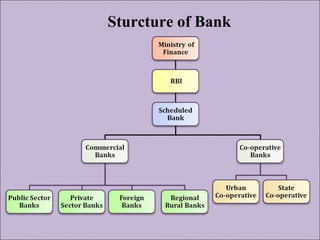
• Structure of Bank
• Public-Sector Banks
• Private-Sector Banks
• Top player in Banks
• GDP Growth rate in India
• Growth of banking sector in India
 In simple words, Banking can be defined as the business
activity of accepting and safeguarding money owned by
other individuals and entities, and then lending out this
money in order to earn a profit.
BANKING & BANK
 Bank is a financial institution that undertakes the
banking activity i.e. it accepts deposits and then lends
the same to earn certain profit.
 Banking is the business conducted or services offered by a
bank.
HISTORY OF BANKING
 Bank of Hindustan – 1770 - first bank at Calcutta under
European management.
 In 1786 General Bank of India was set up.
 The first bank purely managed by Indian was Punjab
National Bank, established in Lahore in 1895.
 However, the first Indian commercial bank which was
wholly owned and managed by Indians was Central Bank
of India which was established in 1911.
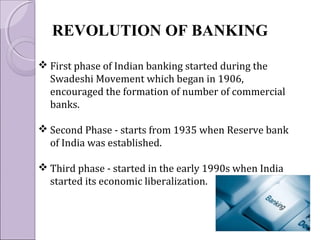
REVOLUTION OF BANKING
 First phase of Indian banking started during the
Swadeshi Movement which began in 1906,
encouraged the formation of number of commercial
banks.
 Second Phase - starts from 1935 when Reserve bank
of India was established.
 Third phase - started in the early 1990s when India
started its economic liberalization.
Banks
Accept deposit
from individuals,
corporate etc.
Borrow money
from Financial
institutions, RBI,
Other Bank etc.
Raise Funds in
equity, foreign
markets etc.
Loans to
individuals,
corporate, RBI,
other banks,
financial
institutions etc.
Regulatory
Requirement
Cash reserve with
RBI (CRR-6.5%)
Statutory Liquid
Assets (SLR-
21.25%)
Other Service
Debit card, Credit
card, Magic card,
Current, Saving,
Demat A/c.
Other Investment
in Bond, Equity,
MFs; Trading,
Forex, etc.
ROLE OF BANKING SECTOR
Sturcture of Bank
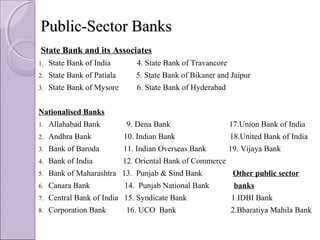
Public-Sector BanksPublic-Sector Banks
State Bank and its Associates
1. State Bank of India 4. State Bank of Travancore
2. State Bank of Patiala 5. State Bank of Bikaner and Jaipur
3. State Bank of Mysore 6. State Bank of Hyderabad
Nationalised Banks
1. Allahabad Bank 9. Dena Bank 17.Union Bank of India
2. Andhra Bank 10. Indian Bank 18.United Bank of India
3. Bank of Baroda 11. Indian Overseas Bank 19. Vijaya Bank
4. Bank of India 12. Oriental Bank of Commerce
5. Bank of Maharashtra 13. Punjab & Sind Bank Other public sector
6. Canara Bank 14. Punjab National Bank banks
7. Central Bank of India 15. Syndicate Bank 1.IDBI Bank
8. Corporation Bank 16. UCO Bank 2.Bharatiya Mahila Bank
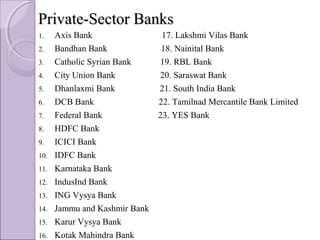
Private-Sector BanksPrivate-Sector Banks
1. Axis Bank 17. Lakshmi Vilas Bank
2. Bandhan Bank 18. Nainital Bank
3. Catholic Syrian Bank 19. RBL Bank
4. City Union Bank 20. Saraswat Bank
5. Dhanlaxmi Bank 21. South India Bank
6. DCB Bank 22. Tamilnad Mercantile Bank Limited
7. Federal Bank 23. YES Bank
8. HDFC Bank
9. ICICI Bank
10. IDFC Bank
11. Karnataka Bank
12. IndusInd Bank
13. ING Vysya Bank
14. Jammu and Kashmir Bank
15. Karur Vysya Bank
16. Kotak Mahindra Bank
TOP PLAYER IN BANK
PUBLIC SECTOR PRIVATE SECTOR
SBI Bank HDFC Bank
Bank of Baroda ICICI Bank
Punjab National Bank Axis bank
Canara Bank Kotak Mahindra
Bank of India Induslnd Bank
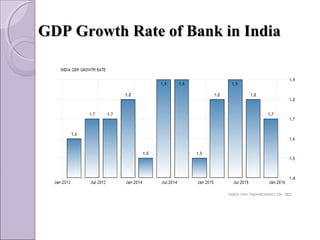
GDP Growth Rate of Bank in IndiaGDP Growth Rate of Bank in India
GROWTH OFGROWTH OF BANKING SECTORSECTOR
ININ INDIA
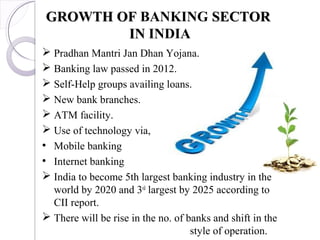
 Pradhan Mantri Jan Dhan Yojana.
 Banking law passed in 2012.
 Self-Help groups availing loans.
 New bank branches.
 ATM facility.
 Use of technology via,
• Mobile banking
• Internet banking
 India to become 5th largest banking industry in the
world by 2020 and 3rd
largest by 2025 according to
CII report.
 There will be rise in the no. of banks and shift in the
style of operation.
WEBLOGRAPHY
www.rbi.org.in
www.list of banks.com.
http://www.rbi.org.in/portal/documents
/41076/60023/1403247921331_RBI_ANNUAL_
REPORT_ENGLISH_2013_14.pdf/8a2bc6bb-
a7a4-405d-98ec-a3749731bf76
Banking Industry

Banking Industry

  • 2.
    TABLE OF CONTENT •Banking & Bank • History of Banking • Revolution of Banking • Role of banking sector • Structure of Bank • Public-Sector Banks • Private-Sector Banks • Top player in Banks • GDP Growth rate in India • Growth of banking sector in India
  • 3.
     In simplewords, Banking can be defined as the business activity of accepting and safeguarding money owned by other individuals and entities, and then lending out this money in order to earn a profit. BANKING & BANK  Bank is a financial institution that undertakes the banking activity i.e. it accepts deposits and then lends the same to earn certain profit.  Banking is the business conducted or services offered by a bank.
  • 4.
    HISTORY OF BANKING Bank of Hindustan – 1770 - first bank at Calcutta under European management.  In 1786 General Bank of India was set up.  The first bank purely managed by Indian was Punjab National Bank, established in Lahore in 1895.  However, the first Indian commercial bank which was wholly owned and managed by Indians was Central Bank of India which was established in 1911.
  • 5.
    REVOLUTION OF BANKING First phase of Indian banking started during the Swadeshi Movement which began in 1906, encouraged the formation of number of commercial banks.  Second Phase - starts from 1935 when Reserve bank of India was established.  Third phase - started in the early 1990s when India started its economic liberalization.
  • 6.
    Banks Accept deposit from individuals, corporateetc. Borrow money from Financial institutions, RBI, Other Bank etc. Raise Funds in equity, foreign markets etc. Loans to individuals, corporate, RBI, other banks, financial institutions etc. Regulatory Requirement Cash reserve with RBI (CRR-6.5%) Statutory Liquid Assets (SLR- 21.25%) Other Service Debit card, Credit card, Magic card, Current, Saving, Demat A/c. Other Investment in Bond, Equity, MFs; Trading, Forex, etc. ROLE OF BANKING SECTOR
  • 7.
  • 8.
    Public-Sector BanksPublic-Sector Banks StateBank and its Associates 1. State Bank of India 4. State Bank of Travancore 2. State Bank of Patiala 5. State Bank of Bikaner and Jaipur 3. State Bank of Mysore 6. State Bank of Hyderabad Nationalised Banks 1. Allahabad Bank 9. Dena Bank 17.Union Bank of India 2. Andhra Bank 10. Indian Bank 18.United Bank of India 3. Bank of Baroda 11. Indian Overseas Bank 19. Vijaya Bank 4. Bank of India 12. Oriental Bank of Commerce 5. Bank of Maharashtra 13. Punjab & Sind Bank Other public sector 6. Canara Bank 14. Punjab National Bank banks 7. Central Bank of India 15. Syndicate Bank 1.IDBI Bank 8. Corporation Bank 16. UCO Bank 2.Bharatiya Mahila Bank
  • 9.
    Private-Sector BanksPrivate-Sector Banks 1.Axis Bank 17. Lakshmi Vilas Bank 2. Bandhan Bank 18. Nainital Bank 3. Catholic Syrian Bank 19. RBL Bank 4. City Union Bank 20. Saraswat Bank 5. Dhanlaxmi Bank 21. South India Bank 6. DCB Bank 22. Tamilnad Mercantile Bank Limited 7. Federal Bank 23. YES Bank 8. HDFC Bank 9. ICICI Bank 10. IDFC Bank 11. Karnataka Bank 12. IndusInd Bank 13. ING Vysya Bank 14. Jammu and Kashmir Bank 15. Karur Vysya Bank 16. Kotak Mahindra Bank
  • 10.
    TOP PLAYER INBANK PUBLIC SECTOR PRIVATE SECTOR SBI Bank HDFC Bank Bank of Baroda ICICI Bank Punjab National Bank Axis bank Canara Bank Kotak Mahindra Bank of India Induslnd Bank
  • 11.
    GDP Growth Rateof Bank in IndiaGDP Growth Rate of Bank in India
  • 12.
    GROWTH OFGROWTH OFBANKING SECTORSECTOR ININ INDIA  Pradhan Mantri Jan Dhan Yojana.  Banking law passed in 2012.  Self-Help groups availing loans.  New bank branches.  ATM facility.  Use of technology via, • Mobile banking • Internet banking  India to become 5th largest banking industry in the world by 2020 and 3rd largest by 2025 according to CII report.  There will be rise in the no. of banks and shift in the style of operation.
  • 13.

Editor's Notes

  • #2 Images
  • #3 http://en.wikipedia.org/wiki/Banking_in_India http://en.wikipedia.org/wiki/State_Bank_of_India
  • #4 In simple words, Banking can be defined as the business activity of accepting and safeguarding money owned by other individuals and entities, and then lending out this money in order to earn a profit. However, with the passage of time, the activities covered by banking business have widened and now various other services are also offered by banks. The banking services these days include issuance of debit and credit cards, providing safe custody of valuable items, lockers, ATM services and online transfer of funds across the country / world. It is well said that banking plays a silent, yet crucial part in our day-to-day lives. The banks perform financial intermediation by pooling savings and channelizing them into investments through maturity and risk transformations, thereby keeping the economy’s growth engine revving. Banking business has done wonders for the world economy. The simple looking method of accepting money deposits from savers and then lending the same money to borrowers, banking activity encourages the flow of money to productive use and investments. This in turn allows the economy to grow. In the absence of banking business, savings would sit idle in our homes, the entrepreneurs would not be in a position to raise the money, ordinary people dreaming for a new car or house would not be able to purchase cars or houses.
  • #5 The origin of western type commercial Banking in India dates back to the 18th century. http://www.preservearticles.com/2012020722874/essay-on-the-major-banking-developmentsreforms-after-independence.htmlBank of Hindusthan established in 1779 was the first bank at Calcutta under European management. In 1786 General Bank of India was set up. The oldest Public Sector Bank in India having branches all over India and serving the customers for the last 145 years is Allahabad Bank. The first bank purely managed by Indian was Punjab National Bank, established in Lahore in 1895.  However, the first Indian commercial bank which was wholly owned and managed by Indians was Central Bank of India which was established in 1911. Four banks started operation during the period of Swadeshi Movement and so this was known as “Cradle of Indian Banking. This was the first phase of Indian banking which was a very slow in development. The Second Phase starts from 1935 when Reserve bank of India was established.  The third phase of development of banking in India started in the early 1990s when India started its economic liberalization.
  • #6 The origin of western type commercial Banking in India dates back to the 18th century. Bank of Hindusthan established in 1779 was the first bank at Calcutta under European management. In 1786 General Bank of India was set up. The oldest Public Sector Bank in India having branches all over India and serving the customers for the last 145 years is Allahabad Bank. The first bank purely managed by Indian was Punjab National Bank, established in Lahore in 1895.  However, the first Indian commercial bank which was wholly owned and managed by Indians was Central Bank of India which was established in 1911. Four banks started operation during the period of Swadeshi Movement and so this was known as “Cradle of Indian Banking. This was the first phase of Indian banking which was a very slow in development. The Second Phase starts from 1935 when Reserve bank of India was established.  The third phase of development of banking in India started in the early 1990s when India started its economic liberalization.
  • #7 Trust is the most important element for a bank to survive. People keep money in a bank only when they trust that it will be given back to them as and when they demand the same on at least on the date of maturity in case the same has been given in the shape of fixed deposits. Of course, there are other reasons also for which people prefer to keep money in a bank rather than keep at home in their own safe. They can earn some extra money when the money is kept in saving or fixed deposits. Moreover, they can make payment by issuance of cheques and need not carry money for their day to day needs.
  • #11 http://www.rediff.com/money/slide-show/slide-show-1-success-story-10-best-banks-in-india/20140131.htm http://www.accuity.com/useful-links/bank-rankings/ http://en.wikipedia.org/wiki/Chairman_of_State_Bank_of_India
  • #13 http://www.slideshare.net/sojsisytas/trends-and-technology-in-banking?related=2