Banking SectorThe Promising futurePresented by:ZeeshanShaikhSurya RanaPrashantVermaParvazShaikhTahaaLokhandwala
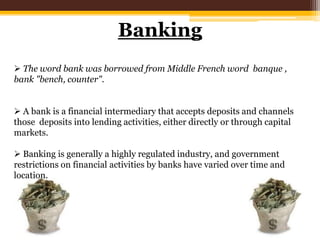
Banking The word bank was borrowed from Middle French word  banque , bank "bench, counter".
 A bank is a financial intermediary that accepts deposits and channels those  deposits into lending activities, either directly or through capital markets.
 Banking is generally a highly regulated industry, and government restrictions on financial activities by banks have varied over time and location.

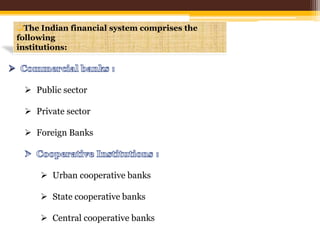
Commercialbanks :
Public sector
Private sector
Foreign Banks
Cooperative Institutions :
Urban cooperative banks
State cooperative banks
Central cooperative banksFinancial institutions :
All-India Financial Institutions (AIFIs)
State Financial Corporations (SFCs)
State Industrial Development Corporations (SIDCs)
Nonbanking Financial Companies (NBFCs)
Capital Market IntermediariesReserve Bank of IndiaThe central banking system of  India
 Controls the monetary policy of the rupee as well as currency reserves
The main monetary authority of the country
The manager of exchange control
The bank issues and exchanges or destroys currency and coins not fit  for circulation
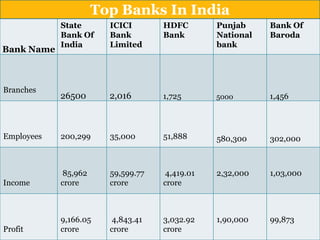
 1. State Bank of India Group:Largest state-owned banking and financial services company in India, by almost every parameter - revenues, profits, assets, market capitalization131 Foreign offices in 32 countries across the globe21000 ATMs and SBI group(including associate banks) has about 45000 no of ATMs26500 branches, inclusive of branches that belong to its Associate banks29th most reputed company in the world according to Forbes
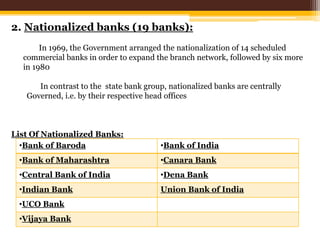
2. Nationalized banks (19 banks):      In 1969, the Government arranged the nationalization of 14 scheduled	commercial banks in order to expand the branch network, followed by six more in 1980               In contrast to the  state bank group, nationalized banks are centrally         Governed, i.e. by their respective head offices List Of Nationalized Banks:
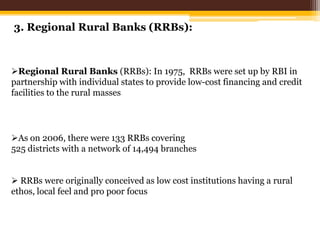
3. Regional Rural Banks (RRBs):Regional Rural Banks (RRBs): In 1975,  RRBs were set up by RBI in partnership with individual states to provide low-cost financing and credit facilities to the rural masses
As on 2006, there were 133 RRBs covering 525 districts with a network of 14,494 branches RRBs were originally conceived as low cost institutions having a rural ethos, local feel and pro poor focusPrivate Banks in IndiaPrivate banking is a term for banking and other financial services provided by banks to private individuals
In the early 1990  government embarked on a  policy of liberalization, licensing a small number of private banks    These came to be known as New Generation tech-savvy banks, and includedGlobal Trust BankThus, public sector banks revived to take up leading role in the banking structureIn 1980, the GOI nationalized 6 more commercial banks, with control over 91% of banking business of India
  Liberalization along with the rapid growth in the economy of India, revitalized the banking sector in India
Then Housing Development Finance principle' approval from the HDFC became the first to receive an  invite from (RBI) to set up a bank in the private sector
  Have made the banking services more efficient and customer friendly
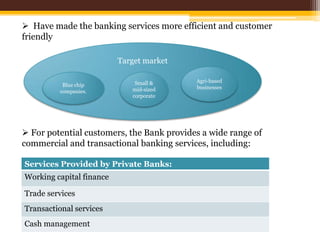
 For potential customers, the Bank provides a wide range of commercial and transactional banking services, including:Target market Agri-based businessesBlue chip companies.Small & mid-sized corporate
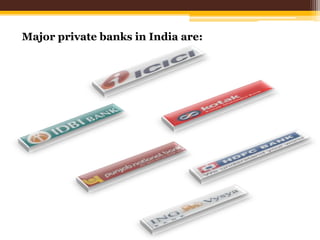
Major private banks in India are:
Foreign BanksForeign Banks are not new phenomena in Indian bank in system. Standard Charted Bank started its operation in 1858 and Citi Bank opened its branch in India in 1902However, globalization and economic policies implemented in late 1980s encouraged many international banks to open their shops hereAt almost all the international banks are operating in India
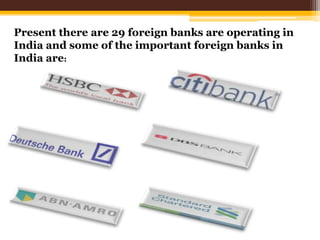
Foreign banks in India have brought the latest technology and new banking practices. This helped the domestic banks to improve their performance and provide better customer serviceAnd it has led to Employment Generation in IndiaPresent there are 29 foreign banks are operating in India and some of the important foreign banks in India are:
3-6-3 Rule – An unofficial banking rule !!3-6-3 is an “UNOFFICIAL RULE” under which the banking industry once operated  and which alludes to it being noncompetitive and simplistic.
Banking industry of the 1950s, 1960s, and 1970s is often described as operating according to a 3-6-3 rule .
The rule basically explains:
How bankers would give 3% interest on depositors’ accounts
Lend the depositors money at 6% interest and
Then be playing golf at 3pmThis alludes to how a bank’s only form of business is lending out money at a higher rate than what it is paying out to its depositors..

Banking sector

  • 1.
    Banking SectorThe PromisingfuturePresented by:ZeeshanShaikhSurya RanaPrashantVermaParvazShaikhTahaaLokhandwala
  • 2.
    Banking The wordbank was borrowed from Middle French word banque , bank "bench, counter".
  • 3.
    A bankis a financial intermediary that accepts deposits and channels those deposits into lending activities, either directly or through capital markets.
  • 4.
    Banking isgenerally a highly regulated industry, and government restrictions on financial activities by banks have varied over time and location.
  • 5.
  • 6.
  • 7.
  • 8.
  • 9.
  • 10.
  • 11.
  • 12.
  • 13.
  • 14.
  • 15.
    State Industrial DevelopmentCorporations (SIDCs)
  • 16.
  • 17.
    Capital Market IntermediariesReserveBank of IndiaThe central banking system of India
  • 18.
    Controls themonetary policy of the rupee as well as currency reserves
  • 19.
    The main monetaryauthority of the country
  • 20.
    The manager ofexchange control
  • 21.
    The bank issuesand exchanges or destroys currency and coins not fit for circulation
  • 22.
    1. StateBank of India Group:Largest state-owned banking and financial services company in India, by almost every parameter - revenues, profits, assets, market capitalization131 Foreign offices in 32 countries across the globe21000 ATMs and SBI group(including associate banks) has about 45000 no of ATMs26500 branches, inclusive of branches that belong to its Associate banks29th most reputed company in the world according to Forbes
  • 23.
    2. Nationalized banks(19 banks): In 1969, the Government arranged the nationalization of 14 scheduled commercial banks in order to expand the branch network, followed by six more in 1980 In contrast to the state bank group, nationalized banks are centrally Governed, i.e. by their respective head offices List Of Nationalized Banks:
  • 25.
    3. Regional RuralBanks (RRBs):Regional Rural Banks (RRBs): In 1975, RRBs were set up by RBI in partnership with individual states to provide low-cost financing and credit facilities to the rural masses
  • 26.
    As on 2006,there were 133 RRBs covering 525 districts with a network of 14,494 branches RRBs were originally conceived as low cost institutions having a rural ethos, local feel and pro poor focusPrivate Banks in IndiaPrivate banking is a term for banking and other financial services provided by banks to private individuals
  • 27.
    In the early1990 government embarked on a policy of liberalization, licensing a small number of private banks These came to be known as New Generation tech-savvy banks, and includedGlobal Trust BankThus, public sector banks revived to take up leading role in the banking structureIn 1980, the GOI nationalized 6 more commercial banks, with control over 91% of banking business of India
  • 28.
    Liberalizationalong with the rapid growth in the economy of India, revitalized the banking sector in India
  • 29.
    Then Housing DevelopmentFinance principle' approval from the HDFC became the first to receive an invite from (RBI) to set up a bank in the private sector
  • 30.
    Havemade the banking services more efficient and customer friendly
  • 31.
    For potentialcustomers, the Bank provides a wide range of commercial and transactional banking services, including:Target market Agri-based businessesBlue chip companies.Small & mid-sized corporate
  • 32.
    Major private banksin India are:
  • 33.
    Foreign BanksForeign Banksare not new phenomena in Indian bank in system. Standard Charted Bank started its operation in 1858 and Citi Bank opened its branch in India in 1902However, globalization and economic policies implemented in late 1980s encouraged many international banks to open their shops hereAt almost all the international banks are operating in India
  • 34.
    Foreign banks inIndia have brought the latest technology and new banking practices. This helped the domestic banks to improve their performance and provide better customer serviceAnd it has led to Employment Generation in IndiaPresent there are 29 foreign banks are operating in India and some of the important foreign banks in India are:
  • 35.
    3-6-3 Rule –An unofficial banking rule !!3-6-3 is an “UNOFFICIAL RULE” under which the banking industry once operated and which alludes to it being noncompetitive and simplistic.
  • 36.
    Banking industry ofthe 1950s, 1960s, and 1970s is often described as operating according to a 3-6-3 rule .
  • 37.
  • 38.
    How bankers wouldgive 3% interest on depositors’ accounts
  • 39.
    Lend the depositorsmoney at 6% interest and
  • 40.
    Then be playinggolf at 3pmThis alludes to how a bank’s only form of business is lending out money at a higher rate than what it is paying out to its depositors..