

Balaji Murugan Gowri shankar SARAVANAN.P SARAVANAN.S Sesha raja
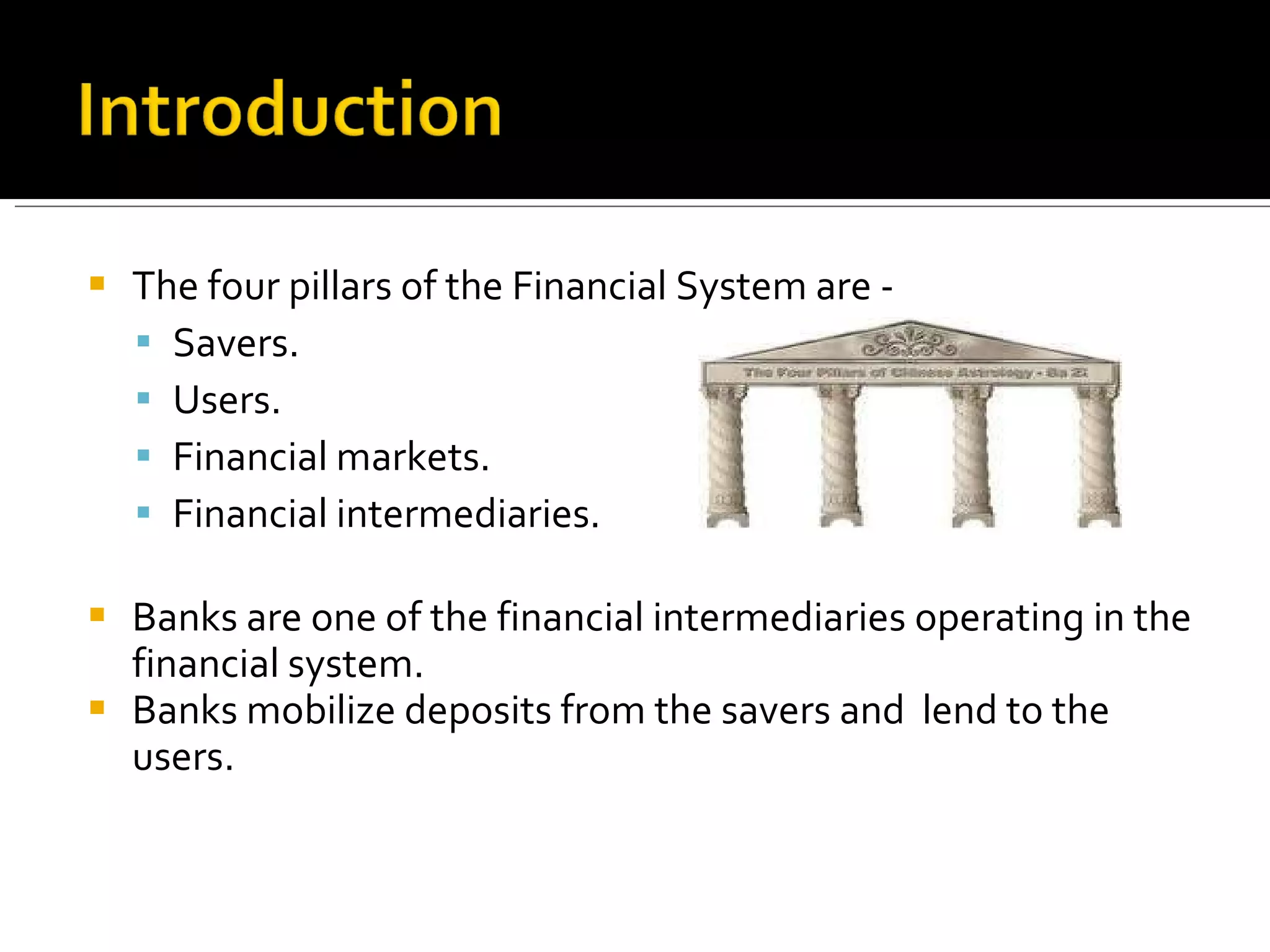
The four pillars of the Financial System are - Savers. Users. Financial markets. Financial intermediaries. Banks are one of the financial intermediaries operating in the financial system. Banks mobilize deposits from the savers and  lend to the users.
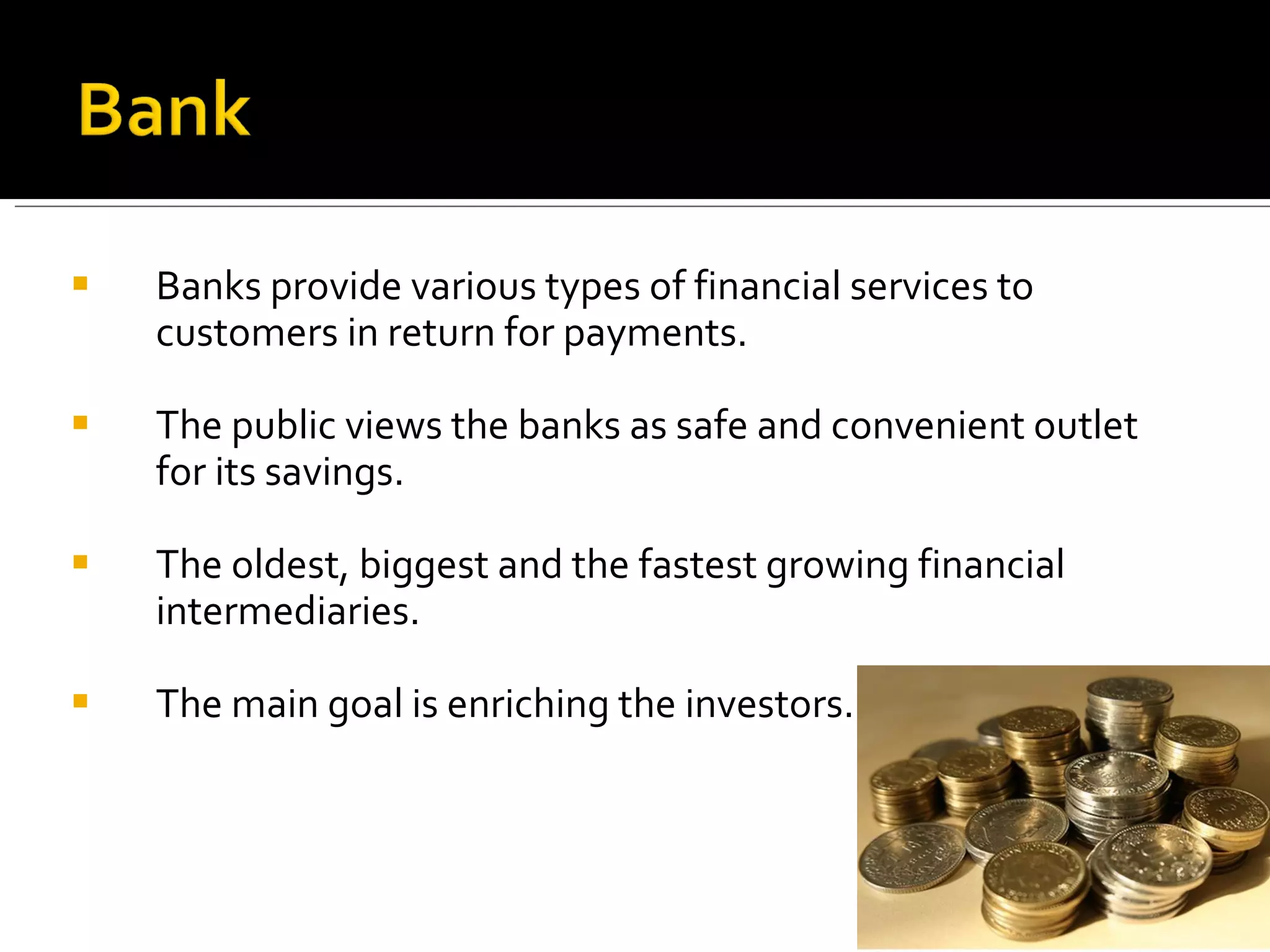
Banks provide various types of financial services to customers in return for payments. The public views the banks as safe and convenient outlet for its savings. The oldest, biggest and the fastest growing financial intermediaries. The main goal is enriching the investors.
Banks borrow money by accepting funds deposited on current accounts, by accepting term deposits, and by issuing debt securities such as banknotes and bonds. Banks lend money by making advances to customers on current accounts, by making installment loans, and by investing in marketable debt securities and other forms of money lending. Banks target huge investment. Lend huge fund. Long term relationship.
Maintenance of different types of deposit accounts  e.g: savings, fixed  and  current  accounts Collection of checks, bill of exchange and other instruments  ( inland and foreign) Providing financial guarantees
Remittance facilities by issue of drafts, mail transfers, and  telegraphic  transfers Providing safe deposit and safe custody(locker) facilities Purchase and sale of securities
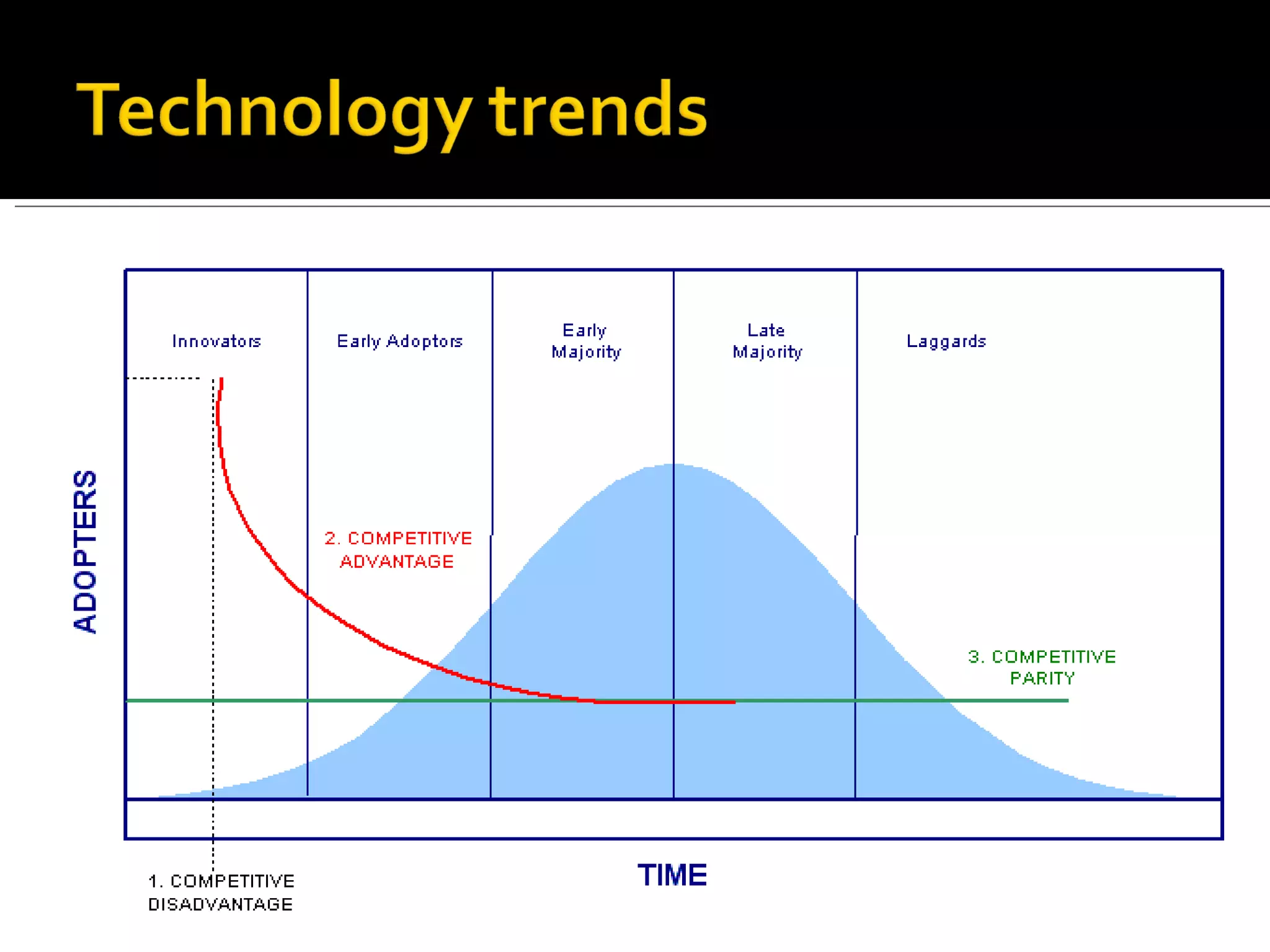
Market driven competitive system Technological incorporation as a new drive. Out of the 27 PSBs, nearly 15 banks have fully computerised their branches. (2010- IBA magazine) Core banking solution
Local service through global standards. Schemes for deposit mobilization a. Certificate of Deposit(CD) b. Savings Scheme c.  Minor Savings Scheme d.  Monthly Interest Income Schemes e.  Annuity or Retirement  Schemes f.  Farmers Deposit Schemes g.  Insurance linked savings bank accounts h. Innovative Deposit Schemes
Wide range of new services like credit cards, international debit cards, etc. Automatic Extension Deposit Scheme Para-banking activities like insurance, mutual funds, sale of gold coins, etc. Mobile Banking Online banking
 
Safety Personal relationship was there between the banker and the customer Knowledgeable employees who can handle all the banking operations
Liquidity problems at times. In traditional banking the customer has to visit the branch of the bank in person to perform the basic operations. Pace of operations was time consuming Fixed timing operations- eg. 9am -2pm Document management was a challenging process.
Rural population welcomes traditional banking than modern banking due to personal relationship Growing nature of our economy. Small traders opt for traditional banking. Fear of acceptance of online banking due to spammers, hackers etc.
Emergence of new technologies  Robbery  Increased traffic and pollution in urban areas making the customers to go for E-banking NBFC as competitors
 
Providing consultancy in matters like taxes and choosing the right investment. Minimal transaction costs through adoption of technology. Anywhere and anytime banking Fast response times Improved management and accountability
Banker charging high rates of interest at the time of granting loans Not enough balance in the customer’s accounts leading to insufficient funds Customer relationship management is poor, since there is less physical presence of bankers. Prone to technological breakdowns – eg. Debit cards getting stuck in ATM.
Scope of expansion in rural areas. Opportunities in credit cards, consumer finance and wealth management on the retail banking. Consumers will increasingly demand enhanced institutional capabilities and service levels from banks Trading opportunities in commodity and commodity derivatives. Hybrid capital- perpetual bonds, FII and NRI investments
Online banking prone to hackers. Loans becoming Non performing assets. Defaults in retail banking- eg. Credit Card fraud Majority of Rural populace are not fully ready to embrace technology.
 
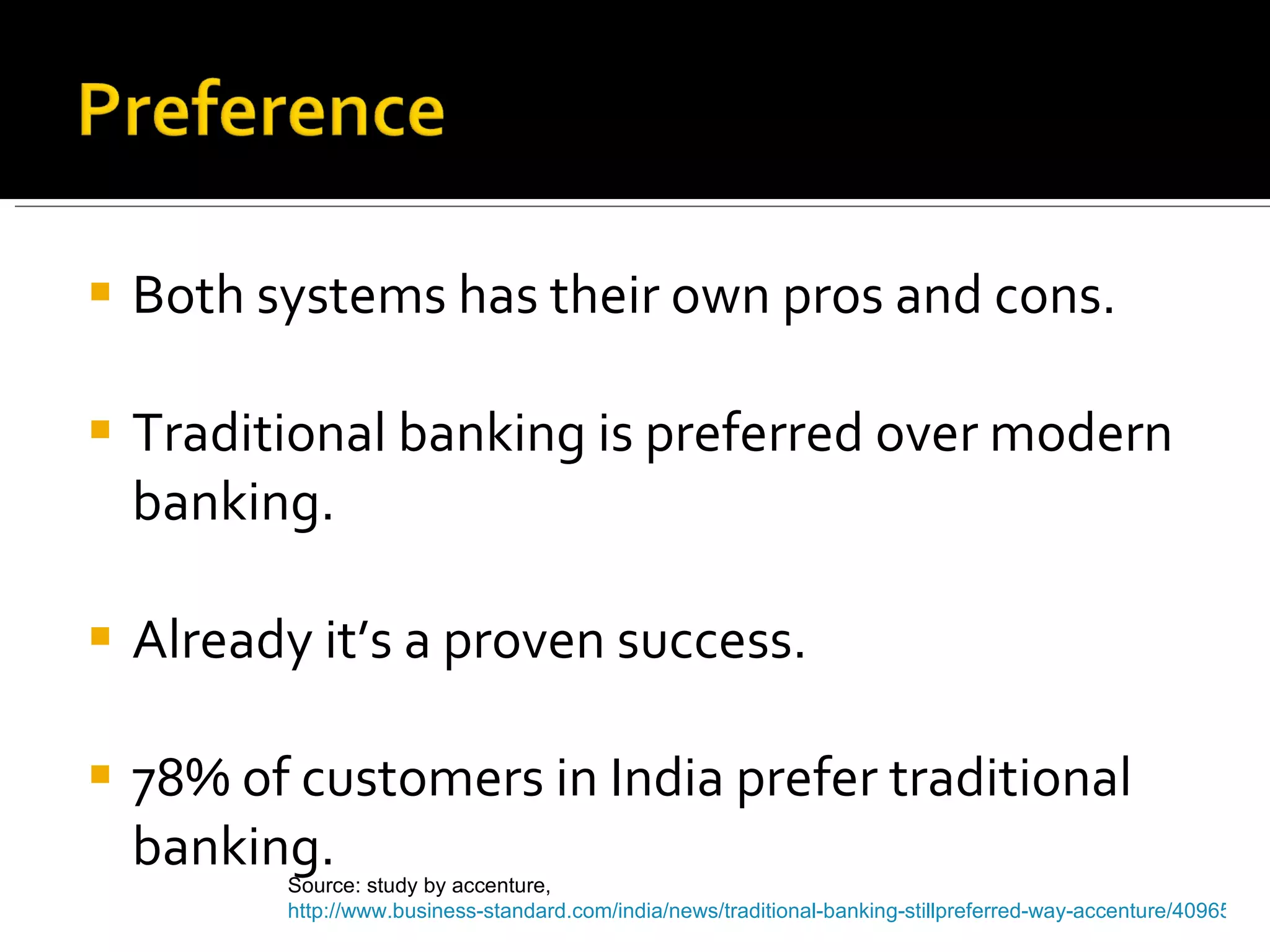
Both systems has their own pros and cons. Traditional banking is preferred over modern banking. Already it’s a proven success. 78% of customers in India prefer traditional banking.  Source: study by accenture,  http://www.business-standard.com/india/news/traditional-banking-stillpreferred-way-accenture/409657/
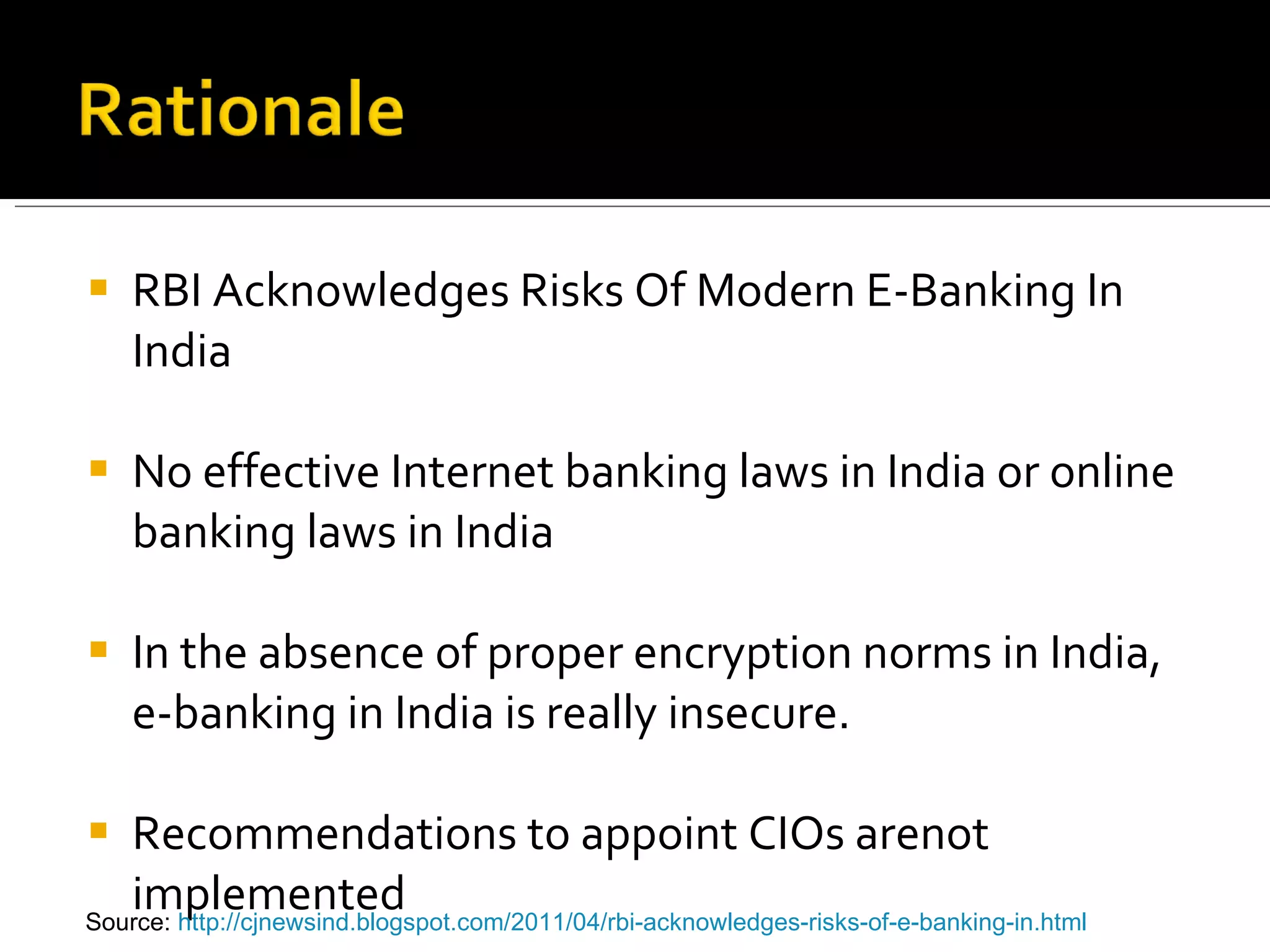
RBI Acknowledges Risks Of Modern E-Banking In India No effective Internet banking laws in India or online banking laws in India In the absence of proper encryption norms in India, e-banking in India is really insecure. Recommendations to appoint CIOs arenot implemented Source:  http://cjnewsind.blogspot.com/2011/04/rbi-acknowledges-risks-of-e-banking-in.html
 
 
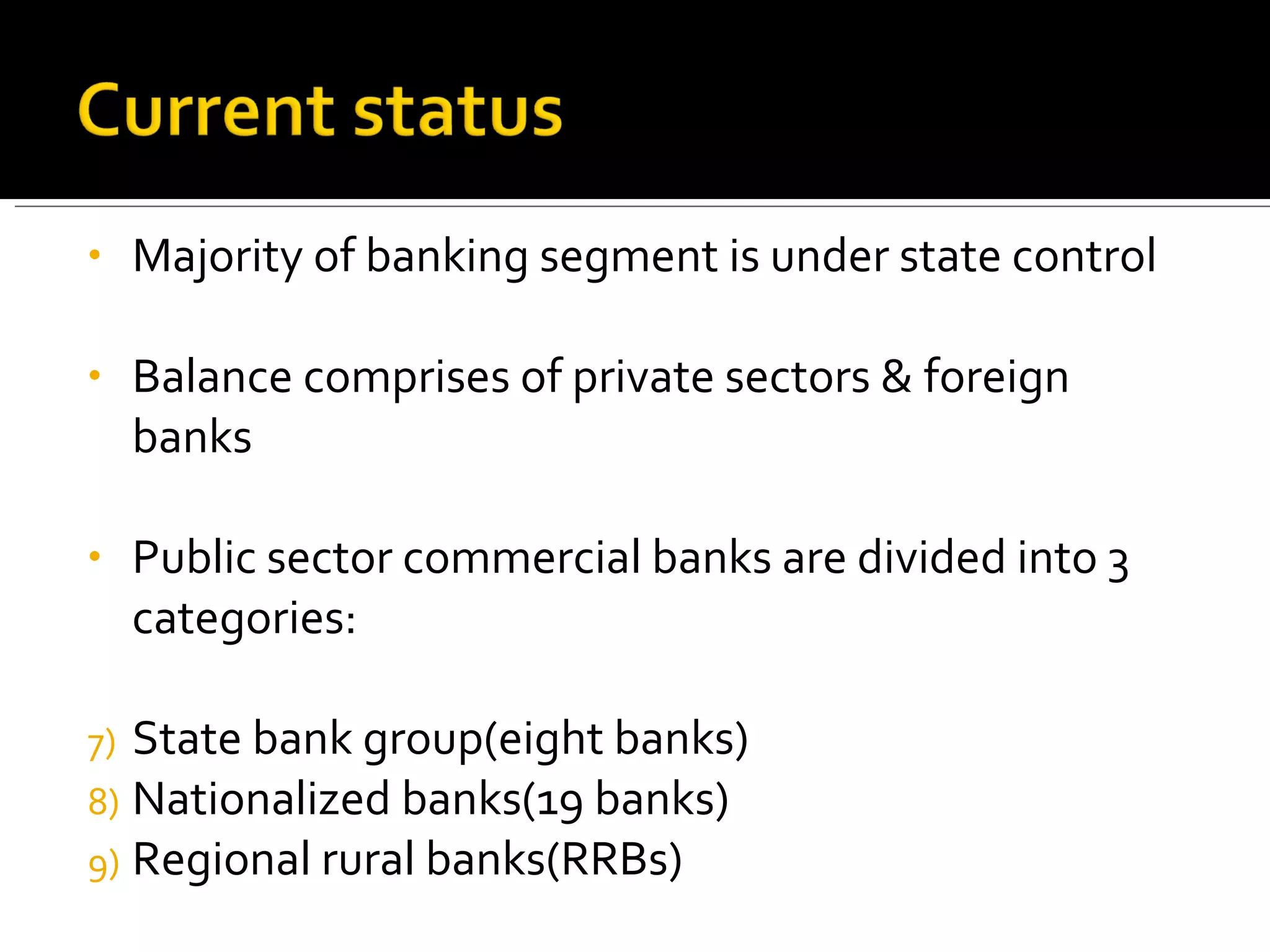
Majority of banking segment is under state control Balance comprises of private sectors & foreign banks Public sector commercial banks are divided into 3 categories:  State bank group(eight banks) Nationalized banks(19 banks) Regional rural banks(RRBs)
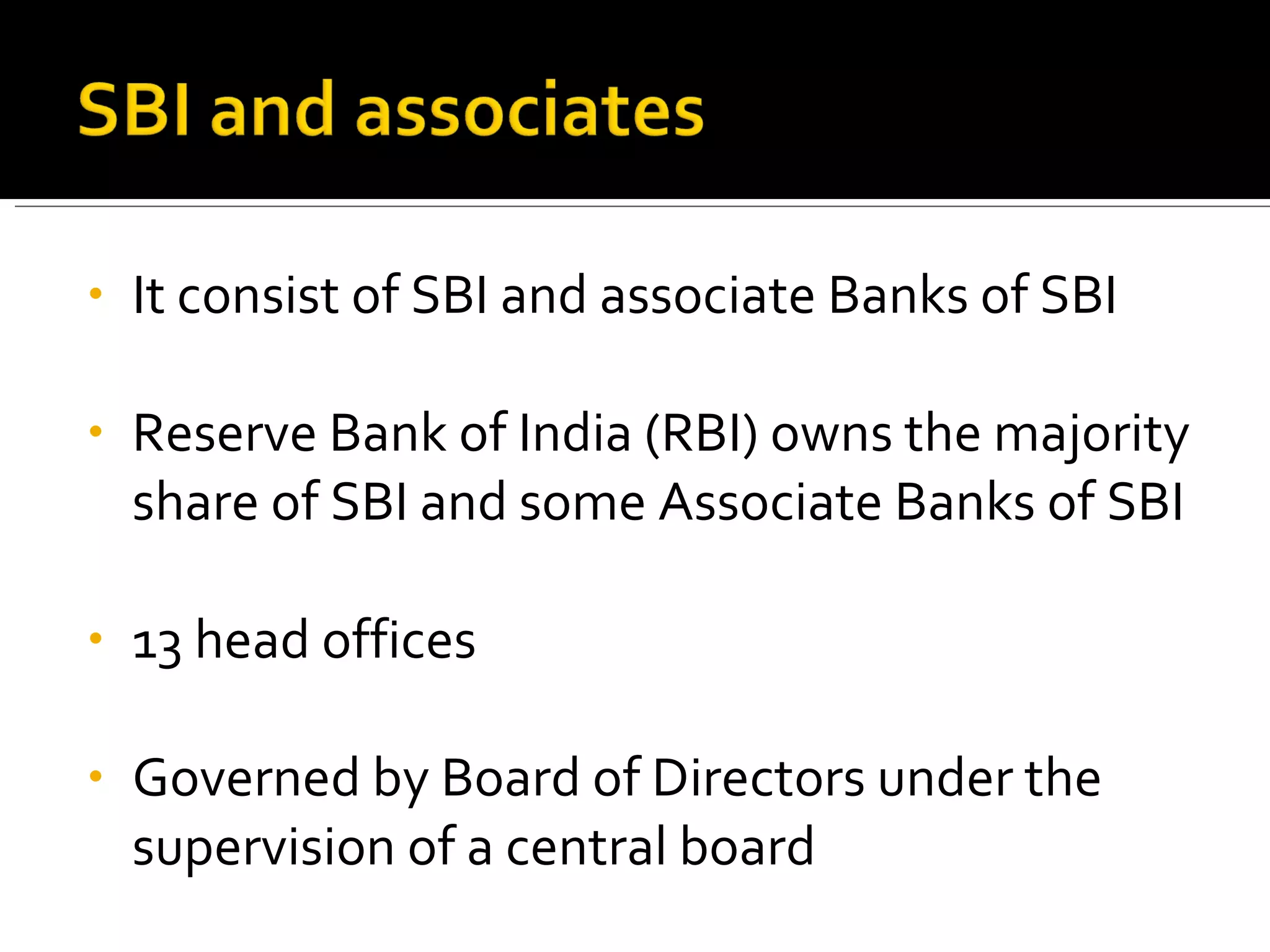
It consist of SBI and associate Banks of SBI Reserve Bank of India (RBI) owns the majority share of SBI and some Associate Banks of SBI 13 head offices Governed by Board of Directors under the supervision of a central board
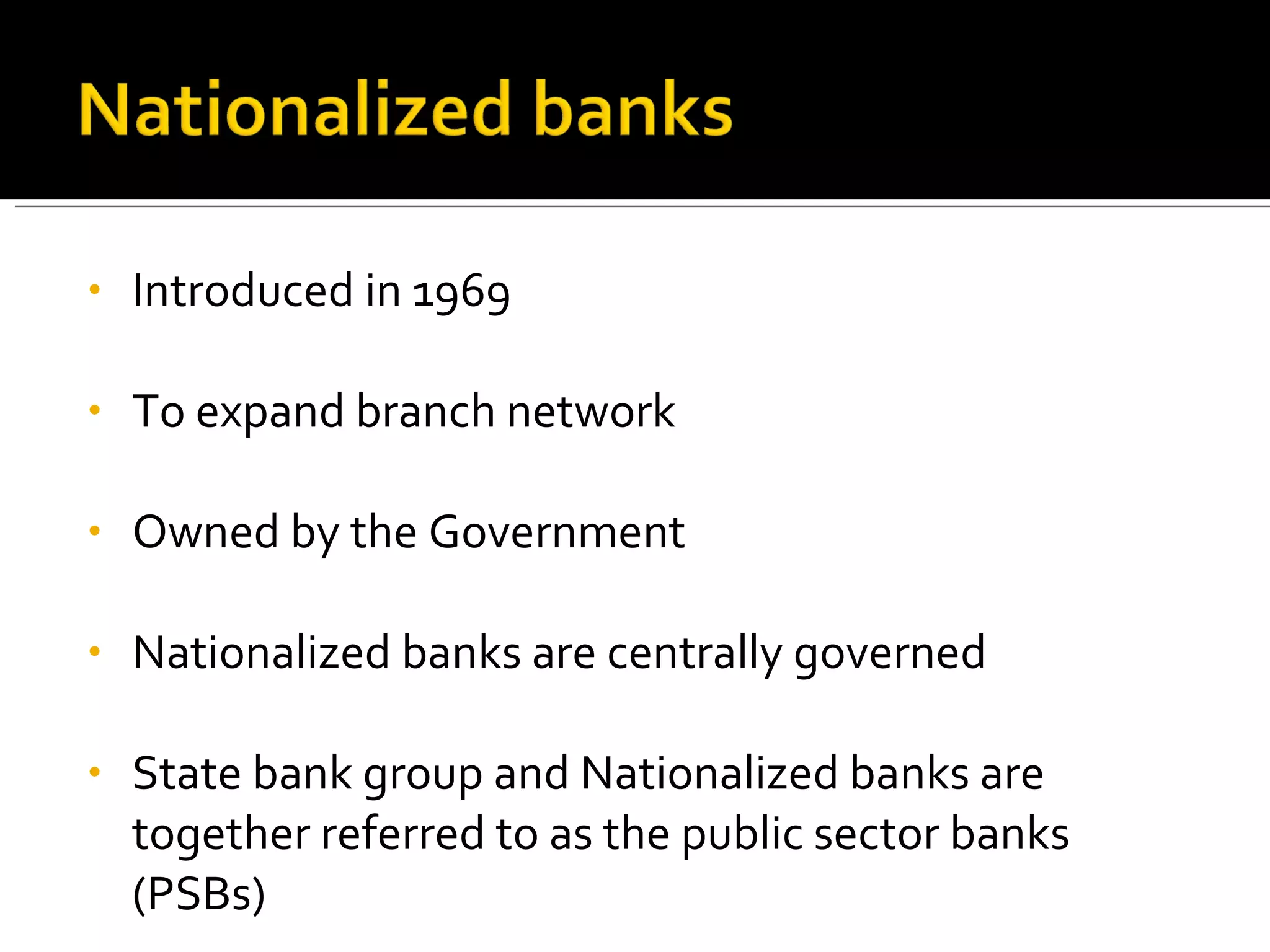
Introduced in 1969 To expand branch network Owned by the Government Nationalized banks are centrally governed State bank group and Nationalized banks are together referred to as the public sector banks (PSBs)
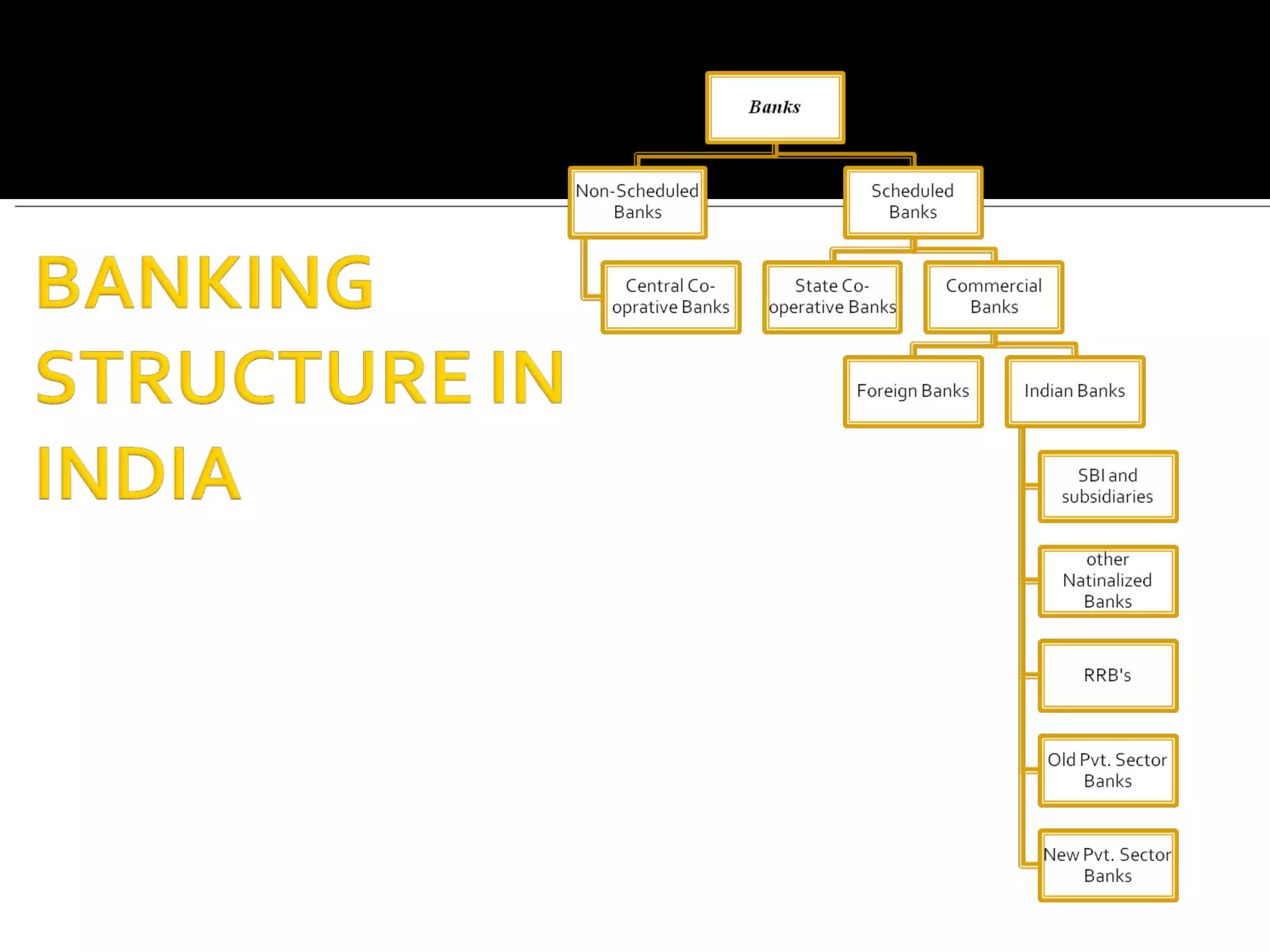
Regional Rural Banks (RRBs). Cooperative banks. Private sector banks. Foreign banks.
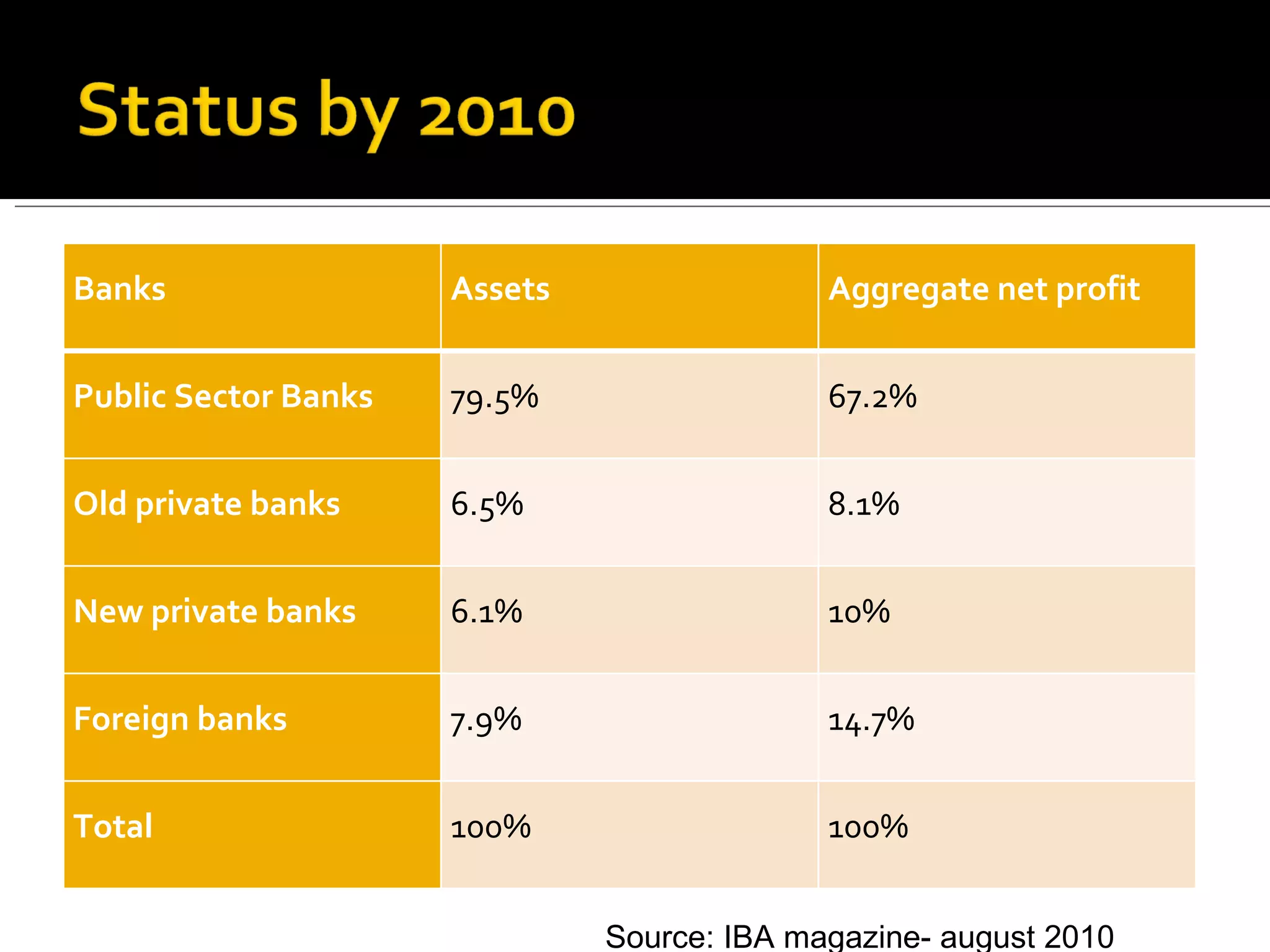
Source: IBA magazine- august 2010 Banks Assets Aggregate net profit Public Sector Banks 79.5% 67.2% Old private banks 6.5% 8.1% New private banks 6.1% 10% Foreign banks 7.9% 14.7% Total 100% 100%
Introduction of Banking Ombudsman,  Banking Codes and Standards Board of India (BCSBI), securitization act, risk rating,  RTI act,  etc. Improved accountability and transparency. Strong security measures( physical and data security) plus disaster recovery are essential.
 
Customers take control Specialized niche competitors A new workforce Regulated transparency Sharply focused technology
 
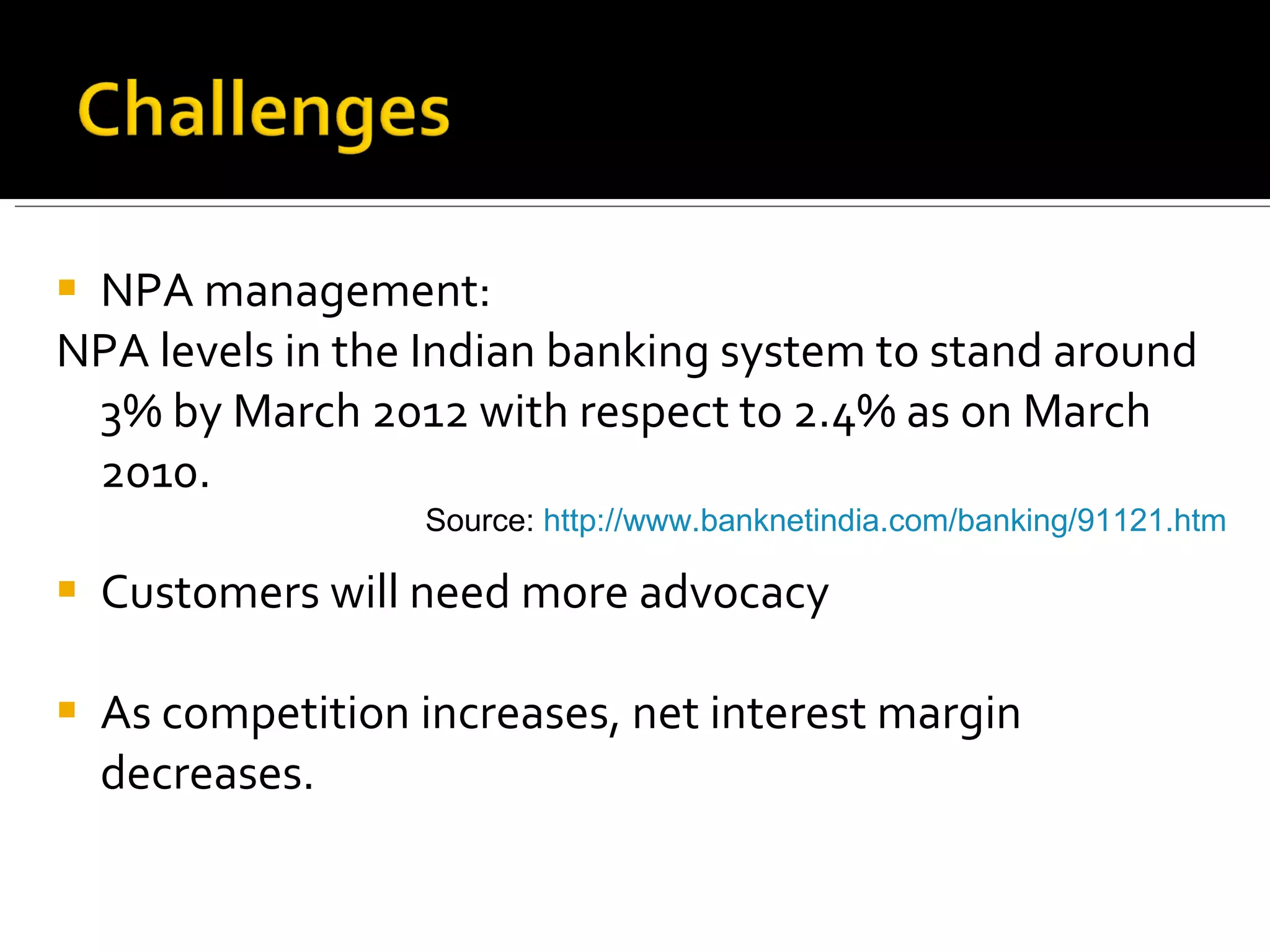
NPA management: NPA levels in the Indian banking system to stand around 3% by March 2012 with respect to 2.4% as on March 2010. Customers will need more advocacy As competition increases, net interest margin decreases. Source:  http://www.banknetindia.com/banking/91121.htm
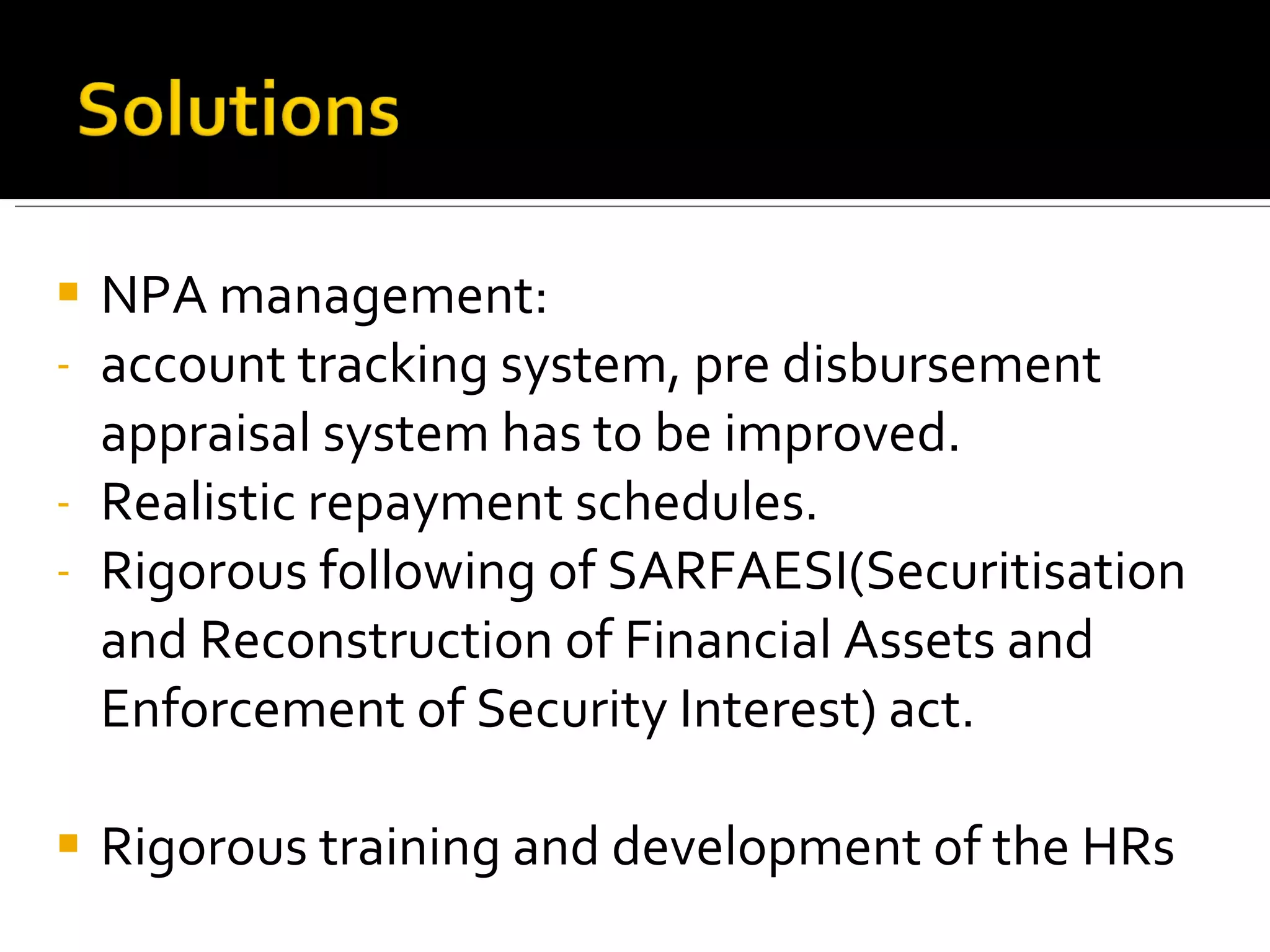
NPA management:  account tracking system, pre disbursement appraisal system has to be improved. Realistic repayment schedules. Rigorous following of SARFAESI( Securitisation and Reconstruction of Financial Assets and Enforcement of Security Interest)  act. Rigorous training and development of the HRs
Outsourcing (eg. IT and HR) RFID (Radio frequency identification) implementation. Managing competition: Marketing , Differentiated products CRM(customized products) Cope with the changing trends incorporating Para-banking activities[banc assurance, pension  fund(CAGR- 122.44%  1999-00 to 2006-07)] Source: http://www.scribd.com/doc/18446435/banking-industry-overview
Banks –  no longer the catalyst for resource mobilization Scope is widening Change is the only thing that cannot be changed.
http://www.allbusiness.com/management/876581-1.html   http://www.allbankingsolutions.com/Indian%20Banking%20Sector%20Industry%20Emerging%20Issues%20Challanges-2.htm http://www.indianmba.com/faculty_column/fc173/fc173.html IBA MAGAZINE- 2010 august issue.
 

Banking analysis

  • 1.
    Balaji Murugan Gowrishankar SARAVANAN.P SARAVANAN.S Sesha raja
  • 2.
    The four pillarsof the Financial System are - Savers. Users. Financial markets. Financial intermediaries. Banks are one of the financial intermediaries operating in the financial system. Banks mobilize deposits from the savers and lend to the users.
  • 3.
    Banks provide varioustypes of financial services to customers in return for payments. The public views the banks as safe and convenient outlet for its savings. The oldest, biggest and the fastest growing financial intermediaries. The main goal is enriching the investors.
  • 4.
    Banks borrow moneyby accepting funds deposited on current accounts, by accepting term deposits, and by issuing debt securities such as banknotes and bonds. Banks lend money by making advances to customers on current accounts, by making installment loans, and by investing in marketable debt securities and other forms of money lending. Banks target huge investment. Lend huge fund. Long term relationship.
  • 5.
    Maintenance of differenttypes of deposit accounts e.g: savings, fixed and current accounts Collection of checks, bill of exchange and other instruments ( inland and foreign) Providing financial guarantees
  • 6.
    Remittance facilities byissue of drafts, mail transfers, and telegraphic transfers Providing safe deposit and safe custody(locker) facilities Purchase and sale of securities
  • 7.
    Market driven competitivesystem Technological incorporation as a new drive. Out of the 27 PSBs, nearly 15 banks have fully computerised their branches. (2010- IBA magazine) Core banking solution
  • 8.
    Local service throughglobal standards. Schemes for deposit mobilization a. Certificate of Deposit(CD) b. Savings Scheme c. Minor Savings Scheme d. Monthly Interest Income Schemes e. Annuity or Retirement Schemes f. Farmers Deposit Schemes g. Insurance linked savings bank accounts h. Innovative Deposit Schemes
  • 9.
    Wide range ofnew services like credit cards, international debit cards, etc. Automatic Extension Deposit Scheme Para-banking activities like insurance, mutual funds, sale of gold coins, etc. Mobile Banking Online banking
  • 10.
  • 11.
    Safety Personal relationshipwas there between the banker and the customer Knowledgeable employees who can handle all the banking operations
  • 12.
    Liquidity problems attimes. In traditional banking the customer has to visit the branch of the bank in person to perform the basic operations. Pace of operations was time consuming Fixed timing operations- eg. 9am -2pm Document management was a challenging process.
  • 13.
    Rural population welcomestraditional banking than modern banking due to personal relationship Growing nature of our economy. Small traders opt for traditional banking. Fear of acceptance of online banking due to spammers, hackers etc.
  • 14.
    Emergence of newtechnologies Robbery Increased traffic and pollution in urban areas making the customers to go for E-banking NBFC as competitors
  • 15.
  • 16.
    Providing consultancy inmatters like taxes and choosing the right investment. Minimal transaction costs through adoption of technology. Anywhere and anytime banking Fast response times Improved management and accountability
  • 17.
    Banker charging highrates of interest at the time of granting loans Not enough balance in the customer’s accounts leading to insufficient funds Customer relationship management is poor, since there is less physical presence of bankers. Prone to technological breakdowns – eg. Debit cards getting stuck in ATM.
  • 18.
    Scope of expansionin rural areas. Opportunities in credit cards, consumer finance and wealth management on the retail banking. Consumers will increasingly demand enhanced institutional capabilities and service levels from banks Trading opportunities in commodity and commodity derivatives. Hybrid capital- perpetual bonds, FII and NRI investments
  • 19.
    Online banking proneto hackers. Loans becoming Non performing assets. Defaults in retail banking- eg. Credit Card fraud Majority of Rural populace are not fully ready to embrace technology.
  • 20.
  • 21.
    Both systems hastheir own pros and cons. Traditional banking is preferred over modern banking. Already it’s a proven success. 78% of customers in India prefer traditional banking. Source: study by accenture, http://www.business-standard.com/india/news/traditional-banking-stillpreferred-way-accenture/409657/
  • 22.
    RBI Acknowledges RisksOf Modern E-Banking In India No effective Internet banking laws in India or online banking laws in India In the absence of proper encryption norms in India, e-banking in India is really insecure. Recommendations to appoint CIOs arenot implemented Source: http://cjnewsind.blogspot.com/2011/04/rbi-acknowledges-risks-of-e-banking-in.html
  • 23.
  • 24.
  • 25.
    Majority of bankingsegment is under state control Balance comprises of private sectors & foreign banks Public sector commercial banks are divided into 3 categories: State bank group(eight banks) Nationalized banks(19 banks) Regional rural banks(RRBs)
  • 26.
    It consist ofSBI and associate Banks of SBI Reserve Bank of India (RBI) owns the majority share of SBI and some Associate Banks of SBI 13 head offices Governed by Board of Directors under the supervision of a central board
  • 27.
    Introduced in 1969To expand branch network Owned by the Government Nationalized banks are centrally governed State bank group and Nationalized banks are together referred to as the public sector banks (PSBs)
  • 28.
    Regional Rural Banks(RRBs). Cooperative banks. Private sector banks. Foreign banks.
  • 29.
    Source: IBA magazine-august 2010 Banks Assets Aggregate net profit Public Sector Banks 79.5% 67.2% Old private banks 6.5% 8.1% New private banks 6.1% 10% Foreign banks 7.9% 14.7% Total 100% 100%
  • 30.
    Introduction of BankingOmbudsman, Banking Codes and Standards Board of India (BCSBI), securitization act, risk rating, RTI act, etc. Improved accountability and transparency. Strong security measures( physical and data security) plus disaster recovery are essential.
  • 31.
  • 32.
    Customers take controlSpecialized niche competitors A new workforce Regulated transparency Sharply focused technology
  • 33.
  • 34.
    NPA management: NPAlevels in the Indian banking system to stand around 3% by March 2012 with respect to 2.4% as on March 2010. Customers will need more advocacy As competition increases, net interest margin decreases. Source: http://www.banknetindia.com/banking/91121.htm
  • 35.
    NPA management: account tracking system, pre disbursement appraisal system has to be improved. Realistic repayment schedules. Rigorous following of SARFAESI( Securitisation and Reconstruction of Financial Assets and Enforcement of Security Interest) act. Rigorous training and development of the HRs
  • 36.
    Outsourcing (eg. ITand HR) RFID (Radio frequency identification) implementation. Managing competition: Marketing , Differentiated products CRM(customized products) Cope with the changing trends incorporating Para-banking activities[banc assurance, pension fund(CAGR- 122.44% 1999-00 to 2006-07)] Source: http://www.scribd.com/doc/18446435/banking-industry-overview
  • 37.
    Banks – no longer the catalyst for resource mobilization Scope is widening Change is the only thing that cannot be changed.
  • 38.
    http://www.allbusiness.com/management/876581-1.html http://www.allbankingsolutions.com/Indian%20Banking%20Sector%20Industry%20Emerging%20Issues%20Challanges-2.htm http://www.indianmba.com/faculty_column/fc173/fc173.html IBA MAGAZINE- 2010 august issue.
  • 39.