LOGO
Bank Loan & Advances
Contents
Classification of Loans and Advances
Credit Investigation
Loan Pricing
Supervision and Follow up of Loans
Security of a Loan
Stock Statement
Loan Supervision at Branch Level
Cardinal Principles of Sound Lending
Loan, Lending & Advances :
 A loan is when you receive money from a friend,
bank or financial institution in exchange for future
repayment of the principal, plus interest.
 Lending is one the primary function of a bank. The
banks accept deposits from people and then lend
that money to needy people in the form of loans,
advances, cash credit and overdraft.
 A bank should examine the security offered against
loan, credit worthiness of the borrower and the
purpose of the loan as advances.
Principles Of Sound Lending :
• Liquidity
• Safety
• Diversity
• Profitability
• Margin Money
• Principle of Purpose
Cardinal Principles of Sound Lending
 Liquidity: Liquidity is a measure of the ability and ease with
which assets can be converted to cash.
 Safety: Safety means that the borrower should be able to repay the
loan and interest in time at regular intervals without default.
 Diversity: Diversification aims at minimizing risks of the investment
portfolio of a bank.
 Profitability: The bank has to earn profit to pay salaries to the staff,
interest to the depositors, dividend to the shareholders and to meet
the day-to-day expenditure. Loans and advances, though the least
liquid asset, constitute the most profitable asset to the bank.
 Margin Money: Margin means a sufficient gap between loan value
and security value. For example, if security market value is Rs 1000
then bank may offer Rs 800 as loan.
 Principle of Purpose: At the time of granting an advance the
banker must inquire about the purpose of the loan.
Cardinal Principles of Sound Lending
Classification of Loans and Advances
Categories of Loans and Advances :
All loans and advances will be grouped into four categories
for the purpose of classification, namely-
• Continuous Loan
• Demand Loan
• Fixed Term Loan and
• Short-term Agricultural & Micro- Credit.
Objective Criteria of Loans classification
 Past Due/Over Due:
i. Any Continuous Loan if not repaid/renewed within the fixed expiry
date for repayment will be treated as past due/overdue from the
following day of the expiry date.
ii. Any Demand Loan if not repaid within the fixed expiry date for
repayment will be treated as past due/overdue from the following
day of the expiry date.
iii. In case of any installments or part of installments of a Fixed Term
Loan is not repaid within the fixed expiry date, the amount of
unpaid installments will be treated as past due/overdue from the
following day of the expiry date.
iv. The Short-term Agricultural and Micro-Credit if not repaid within the
fixed expiry date for repayment will be considered past
due/overdue after six months of the expiry date.
Classification of Loans and Advances
 All unclassified loans other than Special Mention Account
(SMA) will be treated as Standard.
 A Continuous loan, Demand loan or a Term Loan which will
remain overdue for a period of 02 (two) months or more, will
be put into the “Special Mention Account(SMA)” and interest
accrued on such loan will be credited to Interest Suspense
Account, instead of crediting the same to Income Account.
 Any continuous loan will be classified as:
I. ‘Sub-standard’ if it is past due/over due for 03 (three) months
or beyond but less than 06 (six) months.
II. ‘Doubtful’ if it is past due/over due for 06 (six) months or
beyond but less than 09 (nine) months
III.‘Bad/Loss’ if it is past due/over due for 09 (nine) months or
beyond.
Classification of Loans and Advances
 Any Demand Loan will be classified as:
I. ‘Sub-standard’ if it remains past due/overdue for 03 (three) months or
beyond but not over 06 (six) months from the date of claim by the bank or
from the date of creation of forced loan.
II. Doubtful’ if it remains past due/overdue for 06 (six) months or beyond but
not over 09 (nine) months from the date of claim by the bank or from the
date of creation of forced loan.
III.‘Bad/Loss’ if it remains past due/overdue for 09 (nine) months or beyond
from the date of claim by the bank or from the date of creation of forced
loan.
 The Short-term Agricultural and Micro-Credit will be considered
irregular if not repaid within the due date as stipulated in the loan
agreement.
Classification of Loans and Advances
Credit Investigation
Credit Investigation of Loan
 Collection of information of the entrepreneur.
 Preparation and analysis of this information in order to
determine creditworthiness of the borrower/entrepreneur.
 Making decisions and recommendations about the
borrower.
 Furnishing credit information to other bankers.
 Retention of the information for future use.
Sources of information for credit investigation
 Personal Interview:
 Refreezing
 Assessing achievement need
 Assessing management skill
 Assessing overall knowledge about the
project
 Assessing attitudes of the entrepreneur
Credit Investigation
 Borrower's loan application
 Bank’s own record
 Reports obtained through friends or rivals
 Confidential Report/ Status Report from fellow
bank
 Spot verification
 Market reports
 Financial statement of the applicant
 Income Tax statement
 Report from CIB
 Trade checking
 Reports from Chamber of Commerce and Industry
Credit Investigation
Borrower Selection Criteria:
 The borrower must be a real entrepreneur.
 He must be resident of the project area.
 He should have at least 20% of the total project value as
his equity.
 He should have the ability to offer collateral security
acceptable to the lending bank.
 A borrower that qualifies the 5(five) essentials, which
may be termed as five C’s:
• Character
• Capacity
• Capital
• Condition
• Collateral
Credit Investigation
Loan Pricing
Loan Pricing
Risk-based pricing or loan pricing is a system
that evaluates the risk factors of your mortgage
application and credit profile and adjusts the
interest rate and discount points up or down
based on this risk evaluation. The interest rate
on a loan is determined not only by the time
value of money, but also by the lender's
estimate of the probability that the borrower will
default on the loan.
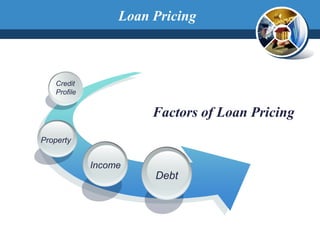
Factors of Loan Pricing
Property
Credit
Profile
Income
Debt
Loan Pricing
Supervision and Follow up of Loans
Meaning of Loan Supervision and Follow up
 Loan supervision means the procedures to have a proper
control over the borrowers’ operation to ensure the end use of
funds. Supervision keeps track of the end-use of fund lent.
 Follow-up is the systematic process to ensure that the terms
and conditions of the advance at pre-disbursement,
disbursement, post-disbursements and recovery stages are
complied with and money lent is repaid as per schedule of
repayment.
 Supervision and follow-up are closely related. Supervision gives
more emphasis on proper end-use and follow-up gives more
emphasis on timely recovery of advances.
Objectives of Loan Supervision and Follow up
 To ensure compliance with the terms and conditions of
sanction.
 To ensure that assumptions for credit sanction was
correct.
 To ensure end use of funds.
 To ensure adequacy of credit on an ongoing basis
depending on the needs of the borrowers.
 To monitor the health of the unit and detect signs of
weakness in the financial position of the borrower.
Supervision and Follow up of Loans
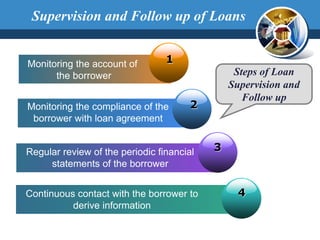
1
2Monitoring the compliance of the
borrower with loan agreement
3
Monitoring the account of
the borrower
Regular review of the periodic financial
statements of the borrower
Continuous contact with the borrower to
derive information
4
Steps of Loan
Supervision and
Follow up
Supervision and Follow up of Loans
Loan Supervision at Branch Level
Supervision and follow-up of advances are the direct
responsibilities of the branch. Branch is the unit
wherefrom the proposal is made for any advance. The
borrowers maintain their accounts with the branch.
Operations are conducted through the account. Reports
and returns are submitted by the borrower to the branch.
So success depends on how effectively the branch
ensures supervision and follow-up of the advances.
Loan Supervision at Branch Level
Responsibilities of Branch for Supervision:
1. Ensure that operations of accounts are regular, bad indications
warrant greater supervision.
2. Keep watch over the inflow and outflow of fund.
3. Maintain production and sales record.
4. Verify proper end-use of funds for the purpose loan was given.
5. Progress made in construction and operations.
6. Inventory position and turn over rate observation
7. Ensure that security/collaterals have been obtained as per terms
of sanction.
8. Ensure that the valuation of security has been assessed
correctly.
9. Check position regarding insurance of goods.
10.Ensure that the documents have been obtained as per terms of
sanctions.
Loan Supervision at Branch Level
11. Conduct regular inspection of the security and verification
of documents.
12. Enquire reasons for default or delayed payment of loan installments.
13. Take appropriate actions in time to regularize the irregularities and
recover as per schedule.
14. Keep regular contract with the borrower.
15. Keep a watch on safety of funds.
16. Ascertain financial positions of the borrowing concern from time to
time through the study of audited financial statement.
17. Obtain periodical balance confirmation.
18. Obtain stock statement as per terms of sanction against hypothecation
and pledge of goods.
19. Maintain limit registers.
20. Check for non-compliance of any terms and conditions of the loan.
Loan Supervision at Branch Level
Security of a Loan
Security of a Loan
 In lending agreements, security is a borrower's pledge of specific
property to a lender, to secure repayment of a loan.
 The security serves as protection for a lender against a borrower's
default—that is, it can be used to offset the loan to any borrower
failing to pay the principal and interest under the terms of a loan
obligation.
 If a borrower does default on a loan (due to insolvency or other
event), that borrower forfeits the property pledged as security, with
the lender then becoming the owner of the property.
 For instance, in a typical mortgage loan transaction the real estate
being acquired with the help of the loan serves as security. Should
the buyer fail to pay the loan under the mortgage loan agreement,
the ownership of the real estate is transferred to the bank.
Various forms of Loan Security
 Mortgages
 Pledged deposits
 Guarantees
 Lien on machinery and other equipment
 Pledge or lien on inventory
 Letter of comfort
Security of a Loan
Definition
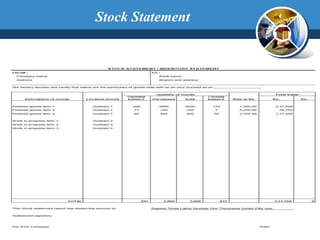
Inventory or Stock statement is a system that finds the value
of goods or products in stock, recorded in accounts by
physical verification and count.
Stock Statement
Purpose
 Most of the banks ask this statement to their customer who has
used Business loan either Cash credit (CC) or Over draft (OD).
 Some banks asks stock report to be submitted every month, some
may ask quarterly or half yearly or even annually.
 Stock statement report shall depend on the nature of the business,
loan type, and of-course varies bank to bank.
Stock Statement
Uses
 This statement describes how much stock was purchased at what
value and when.
 It is a matter of accounts and finance supplied by the cash credit
account holder (e.g. a private limited company) to banks providing
loans at a regular interval.
 It details opening and closing balances for transacted items as well.
Stock Statement
Stock Statement
LOGO

Bank loan

  • 1.
  • 2.
    Contents Classification of Loansand Advances Credit Investigation Loan Pricing Supervision and Follow up of Loans Security of a Loan Stock Statement Loan Supervision at Branch Level Cardinal Principles of Sound Lending
  • 3.
    Cardinal Principles ofSound Lending Loan, Lending & Advances :  A loan is when you receive money from a friend, bank or financial institution in exchange for future repayment of the principal, plus interest.  Lending is one the primary function of a bank. The banks accept deposits from people and then lend that money to needy people in the form of loans, advances, cash credit and overdraft.  A bank should examine the security offered against loan, credit worthiness of the borrower and the purpose of the loan as advances.
  • 4.
    Principles Of SoundLending : • Liquidity • Safety • Diversity • Profitability • Margin Money • Principle of Purpose Cardinal Principles of Sound Lending
  • 5.
     Liquidity: Liquidityis a measure of the ability and ease with which assets can be converted to cash.  Safety: Safety means that the borrower should be able to repay the loan and interest in time at regular intervals without default.  Diversity: Diversification aims at minimizing risks of the investment portfolio of a bank.  Profitability: The bank has to earn profit to pay salaries to the staff, interest to the depositors, dividend to the shareholders and to meet the day-to-day expenditure. Loans and advances, though the least liquid asset, constitute the most profitable asset to the bank.  Margin Money: Margin means a sufficient gap between loan value and security value. For example, if security market value is Rs 1000 then bank may offer Rs 800 as loan.  Principle of Purpose: At the time of granting an advance the banker must inquire about the purpose of the loan. Cardinal Principles of Sound Lending
  • 6.
    Classification of Loansand Advances Categories of Loans and Advances : All loans and advances will be grouped into four categories for the purpose of classification, namely- • Continuous Loan • Demand Loan • Fixed Term Loan and • Short-term Agricultural & Micro- Credit.
  • 7.
    Objective Criteria ofLoans classification  Past Due/Over Due: i. Any Continuous Loan if not repaid/renewed within the fixed expiry date for repayment will be treated as past due/overdue from the following day of the expiry date. ii. Any Demand Loan if not repaid within the fixed expiry date for repayment will be treated as past due/overdue from the following day of the expiry date. iii. In case of any installments or part of installments of a Fixed Term Loan is not repaid within the fixed expiry date, the amount of unpaid installments will be treated as past due/overdue from the following day of the expiry date. iv. The Short-term Agricultural and Micro-Credit if not repaid within the fixed expiry date for repayment will be considered past due/overdue after six months of the expiry date. Classification of Loans and Advances
  • 8.
     All unclassifiedloans other than Special Mention Account (SMA) will be treated as Standard.  A Continuous loan, Demand loan or a Term Loan which will remain overdue for a period of 02 (two) months or more, will be put into the “Special Mention Account(SMA)” and interest accrued on such loan will be credited to Interest Suspense Account, instead of crediting the same to Income Account.  Any continuous loan will be classified as: I. ‘Sub-standard’ if it is past due/over due for 03 (three) months or beyond but less than 06 (six) months. II. ‘Doubtful’ if it is past due/over due for 06 (six) months or beyond but less than 09 (nine) months III.‘Bad/Loss’ if it is past due/over due for 09 (nine) months or beyond. Classification of Loans and Advances
  • 9.
     Any DemandLoan will be classified as: I. ‘Sub-standard’ if it remains past due/overdue for 03 (three) months or beyond but not over 06 (six) months from the date of claim by the bank or from the date of creation of forced loan. II. Doubtful’ if it remains past due/overdue for 06 (six) months or beyond but not over 09 (nine) months from the date of claim by the bank or from the date of creation of forced loan. III.‘Bad/Loss’ if it remains past due/overdue for 09 (nine) months or beyond from the date of claim by the bank or from the date of creation of forced loan.  The Short-term Agricultural and Micro-Credit will be considered irregular if not repaid within the due date as stipulated in the loan agreement. Classification of Loans and Advances
  • 10.
    Credit Investigation Credit Investigationof Loan  Collection of information of the entrepreneur.  Preparation and analysis of this information in order to determine creditworthiness of the borrower/entrepreneur.  Making decisions and recommendations about the borrower.  Furnishing credit information to other bankers.  Retention of the information for future use.
  • 11.
    Sources of informationfor credit investigation  Personal Interview:  Refreezing  Assessing achievement need  Assessing management skill  Assessing overall knowledge about the project  Assessing attitudes of the entrepreneur Credit Investigation
  • 12.
     Borrower's loanapplication  Bank’s own record  Reports obtained through friends or rivals  Confidential Report/ Status Report from fellow bank  Spot verification  Market reports  Financial statement of the applicant  Income Tax statement  Report from CIB  Trade checking  Reports from Chamber of Commerce and Industry Credit Investigation
  • 13.
    Borrower Selection Criteria: The borrower must be a real entrepreneur.  He must be resident of the project area.  He should have at least 20% of the total project value as his equity.  He should have the ability to offer collateral security acceptable to the lending bank.  A borrower that qualifies the 5(five) essentials, which may be termed as five C’s: • Character • Capacity • Capital • Condition • Collateral Credit Investigation
  • 14.
    Loan Pricing Loan Pricing Risk-basedpricing or loan pricing is a system that evaluates the risk factors of your mortgage application and credit profile and adjusts the interest rate and discount points up or down based on this risk evaluation. The interest rate on a loan is determined not only by the time value of money, but also by the lender's estimate of the probability that the borrower will default on the loan.
  • 15.
    Factors of LoanPricing Property Credit Profile Income Debt Loan Pricing
  • 16.
    Supervision and Followup of Loans Meaning of Loan Supervision and Follow up  Loan supervision means the procedures to have a proper control over the borrowers’ operation to ensure the end use of funds. Supervision keeps track of the end-use of fund lent.  Follow-up is the systematic process to ensure that the terms and conditions of the advance at pre-disbursement, disbursement, post-disbursements and recovery stages are complied with and money lent is repaid as per schedule of repayment.  Supervision and follow-up are closely related. Supervision gives more emphasis on proper end-use and follow-up gives more emphasis on timely recovery of advances.
  • 17.
    Objectives of LoanSupervision and Follow up  To ensure compliance with the terms and conditions of sanction.  To ensure that assumptions for credit sanction was correct.  To ensure end use of funds.  To ensure adequacy of credit on an ongoing basis depending on the needs of the borrowers.  To monitor the health of the unit and detect signs of weakness in the financial position of the borrower. Supervision and Follow up of Loans
  • 18.
    1 2Monitoring the complianceof the borrower with loan agreement 3 Monitoring the account of the borrower Regular review of the periodic financial statements of the borrower Continuous contact with the borrower to derive information 4 Steps of Loan Supervision and Follow up Supervision and Follow up of Loans
  • 19.
    Loan Supervision atBranch Level Supervision and follow-up of advances are the direct responsibilities of the branch. Branch is the unit wherefrom the proposal is made for any advance. The borrowers maintain their accounts with the branch. Operations are conducted through the account. Reports and returns are submitted by the borrower to the branch. So success depends on how effectively the branch ensures supervision and follow-up of the advances. Loan Supervision at Branch Level
  • 20.
    Responsibilities of Branchfor Supervision: 1. Ensure that operations of accounts are regular, bad indications warrant greater supervision. 2. Keep watch over the inflow and outflow of fund. 3. Maintain production and sales record. 4. Verify proper end-use of funds for the purpose loan was given. 5. Progress made in construction and operations. 6. Inventory position and turn over rate observation 7. Ensure that security/collaterals have been obtained as per terms of sanction. 8. Ensure that the valuation of security has been assessed correctly. 9. Check position regarding insurance of goods. 10.Ensure that the documents have been obtained as per terms of sanctions. Loan Supervision at Branch Level
  • 21.
    11. Conduct regularinspection of the security and verification of documents. 12. Enquire reasons for default or delayed payment of loan installments. 13. Take appropriate actions in time to regularize the irregularities and recover as per schedule. 14. Keep regular contract with the borrower. 15. Keep a watch on safety of funds. 16. Ascertain financial positions of the borrowing concern from time to time through the study of audited financial statement. 17. Obtain periodical balance confirmation. 18. Obtain stock statement as per terms of sanction against hypothecation and pledge of goods. 19. Maintain limit registers. 20. Check for non-compliance of any terms and conditions of the loan. Loan Supervision at Branch Level
  • 22.
    Security of aLoan Security of a Loan  In lending agreements, security is a borrower's pledge of specific property to a lender, to secure repayment of a loan.  The security serves as protection for a lender against a borrower's default—that is, it can be used to offset the loan to any borrower failing to pay the principal and interest under the terms of a loan obligation.  If a borrower does default on a loan (due to insolvency or other event), that borrower forfeits the property pledged as security, with the lender then becoming the owner of the property.  For instance, in a typical mortgage loan transaction the real estate being acquired with the help of the loan serves as security. Should the buyer fail to pay the loan under the mortgage loan agreement, the ownership of the real estate is transferred to the bank.
  • 23.
    Various forms ofLoan Security  Mortgages  Pledged deposits  Guarantees  Lien on machinery and other equipment  Pledge or lien on inventory  Letter of comfort Security of a Loan
  • 24.
    Definition Inventory or Stockstatement is a system that finds the value of goods or products in stock, recorded in accounts by physical verification and count. Stock Statement
  • 25.
    Purpose  Most ofthe banks ask this statement to their customer who has used Business loan either Cash credit (CC) or Over draft (OD).  Some banks asks stock report to be submitted every month, some may ask quarterly or half yearly or even annually.  Stock statement report shall depend on the nature of the business, loan type, and of-course varies bank to bank. Stock Statement
  • 26.
    Uses  This statementdescribes how much stock was purchased at what value and when.  It is a matter of accounts and finance supplied by the cash credit account holder (e.g. a private limited company) to banks providing loans at a regular interval.  It details opening and closing balances for transacted items as well. Stock Statement
  • 27.
  • 28.