Bengaluru Metropolitan Region
Development Authority
CONSTITUTION OF BMRDA
• Statutory Authority constituted on 01-02-1986
under the provisions of the Bengaluru
Metropolitan Region Development Authority Act
1985, for planning, coordinating and
supervising the proper and orderly development
of the areas within BMR.
• Planning and Regulatory Authority for
Bengaluru Metropolitain Region. BMR
comprises Bengaluru Urban District, Bengaluru
Rural District & Ramanagaram District.
Bengaluru Metropolitan Region
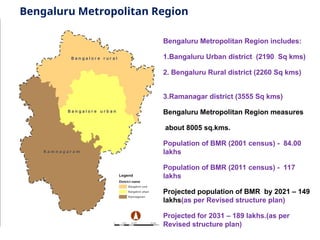
Bengaluru Metropolitan Region includes:
1.Bangaluru Urban district (2190 Sq kms)
2. Bengaluru Rural district (2260 Sq kms)
3.Ramanagar district (3555 Sq kms)
Bengaluru Metropolitan Region measures
about 8005 sq.kms.
Population of BMR (2001 census) - 84.00
lakhs
Population of BMR (2011 census) - 117
lakhs
Projected population of BMR by 2021 – 149
lakhs(as per Revised structure plan)
Projected for 2031 – 189 lakhs.(as per
Revised structure plan)
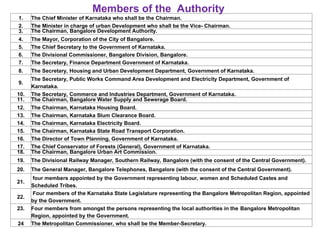
1. The Chief Minister of Karnataka who shall be the Chairman.
2. The Minister in charge of urban Development who shall be the Vice- Chairman.
3. The Chairman, Bangalore Development Authority.
4. The Mayor, Corporation of the City of Bangalore.
5. The Chief Secretary to the Government of Karnataka.
6. The Divisional Commissioner, Bangalore Division, Bangalore.
7. The Secretary, Finance Department Government of Karnataka.
8. The Secretary, Housing and Urban Development Department, Government of Karnataka.
9.
The Secretary, Public Works Command Area Development and Electricity Department, Government of
Karnataka.
10. The Secretary, Commerce and Industries Department, Government of Karnataka.
11. The Chairman, Bangalore Water Supply and Sewerage Board.
12. The Chairman, Karnataka Housing Board.
13. The Chairman, Karnataka Slum Clearance Board.
14. The Chairman, Karnataka Electricity Board.
15. The Chairman, Karnataka State Road Transport Corporation.
16. The Director of Town Planning, Government of Karnataka.
17. The Chief Conservator of Forests (General), Government of Karnataka.
18. The Chairman, Bangalore Urban Art Commission.
19. The Divisional Railway Manager, Southern Railway, Bangalore (with the consent of the Central Government).
20. The General Manager, Bangalore Telephones, Bangalore (with the consent of the Central Government).
21.
four members appointed by the Government representing labour, women and Scheduled Castes and
Scheduled Tribes.
22.
Four members of the Karnataka State Legislature representing the Bangalore Metropolitan Region, appointed
by the Government.
23. Four members from amongst the persons representing the local authorities in the Bangalore Metropolitan
Region, appointed by the Government.
24 The Metropolitan Commissioner, who shall be the Member-Secretary.
Members of the Authority
ULBs, UDAs and PAs in BMR
 NUMBER OF ULBs: 17
I. Corporation – B.B.M.P.
II. CMCs 6 Nos : Ramanagara,
Kanakapura,
Channapattana,
D.Ballapur,
Hoskote,
Hebbagodi.
III. TMCs 10 Nos : Magadi, Vijayapur, Devanahalli,
Anekal, Nelamanagala, Attibele,
Jigan, Bommasandra, Chandapura,
Bidadi.
 Gram Panchayats- 284
Nos. covering 2551
villages
 Urban Development
Authorities - 2 Nos
– BDA
– RUDA
 Planning Authorities
– 9 Nos
BMRDA
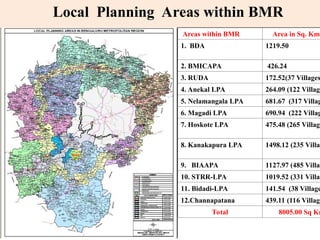
Local Planning Areas within BMR
Areas within BMR Area in Sq. Kms
1. BDA 1219.50
2. BMICAPA 426.24
3. RUDA 172.52(37 Villages
4. Anekal LPA 264.09 (122 Village
5. Nelamangala LPA 681.67 (317 Villag
6. Magadi LPA 690.94 (222 Villag
7. Hoskote LPA 475.48 (265 Village
8. Kanakapura LPA 1498.12 (235 Villag
9. BIAAPA 1127.97 (485 Villag
10. STRR-LPA 1019.52 (331 Villag
11. Bidadi-LPA 141.54 (38 Village
12.Channapatana 439.11 (116 Village
Total 8005.00 Sq Km
BMRDA
Functions of the Authority:
To carry out a survey of the Bengaluru Metropolitan
Region and prepare reports on the surveys so carried
out.
To prepare a Structure Plan for the development of
the Bengaluru Metropolitan Region.
To cause to be carried out such works as are
contemplated in the Structure Plan.
To formulate suitable schemes for implementing the
Structure Plan.
BMRDA
To secure and coordinate execution of the town
planning schemes for the development of the Bengaluru
Metropolitan Region.
To raise finance for any project or scheme for the
development of the Bengaluru Metropolitan Region and
to extend assistance to the Local Authorities in the
Region for the execution of such projects or schemes.
To do such other acts or things as may be entrusted by
the Government or as may be necessary for, or incidental
to, any matters that are necessary for furtherance of the
objects for which the Authority is constituted.
BMRDA
To entrust to any Local Authority the work of
execution of any development plan or town planning
scheme.
To coordinate the activities of the Bengaluru
Development Authority (BDA), the Bruhat Bengaluru
Mahanagar Palike (BBMP), the Bengaluru Water
Supply and Sewerage Board (BWSSB), the Karnataka
Slum Clearance Board (KSCB), the Karnataka Power
Transmission Corporation Limited (KPTCL), the
Karnataka Industrial Areas Development Board
(KIADB), the Karnataka State Road Transport
Corporation (KSRTC) and such other bodies as are
connected with developmental activities in the
Bengaluru Metropolitan Region.
PREPARATION OF REVISED STRUCTURE PLAN
 Section 9 (ii) of BMRDA Act,1985 provides for preparation of
Structure plan.
 The Structure Plan is a regional level Perspective plan supporting
a long term Vision for Development and related spatial
perspective for Integrated Development in the area without
Compromising on its ecology and natural environment.
Concept of Structure Plan
 Structure plan is a framework that guides development
of a
particular area.
 The plan provides the overall strategy for development .
 The plan does not assign use to each land parcel, it gives broad
zoning of urbanisable areas.
 The plan has to be further detailed into area level plans for
execution / enforcement.
Structure Plan
BMR STRUCTURE PLAN - 2011
 Structure plan provides Policy measures to encourage the concentrated
decentralization from the BMA to strategic satellite towns, Growth centers
and nodes in the periphery of the Bangalore Metropolitan Region.
Thereby, alleviating the excessive burden of demand on urban services
and resources of the BMR.
 Initiated preparation in 1998.
 Draft approval on 02-06-2004.
 Final approval on 21-09-2005.
Recommendations
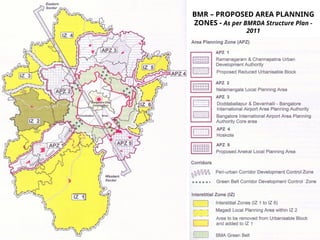
 Area suitable for Urbanization have been classified as Area Planning Zone
(APZs).
 Areas where agriculture is a predominant, forestry is abundant,
conservation has been stressed more and such areas have been classified
as Interstitial Zones.
 Improving Regional accessibility - STRR, IRR, ITRR &RR.
 Satellite Towns and New growth centers.
BMR – PROPOSED AREA PLANNING
ZONES - As per BMRDA Structure Plan -
2011
REVISED STRUCTURE PLAN – 2031
Purpose of revision- Plan period ends in 2011,New plans and Policies, Changing
global trends & Liberalized economic environment, Make it relevant to the present day
needs.
Initiated in 2008.
Draft Approved on 24-02-2011.
Objections/suggesions invited on 09-03-2011.
Objections/suggesions received – 28.
Stake holders meeting – 17-04-2012.
Finalization of comments/ suggesions on 15-03-2013.
The Revised Structure Plan-2031 has been placed before the Meeting of BMRDA under
the chairmanship of Hon’ble Chief Minister held on 11-06-2014 for submission to the
Government for final approval. It was resolved to submit to the Government for final
approval after giving presentation to Chief Secretary and other senior officers of
Government and, incorporating the suggestions given by them.
Presentation to Chief Secretary and other senior officers of Government has been done
on 21-11-2015.
Approved in the 15th
meeting of BMRDA held on 29.12.2015.
Submitted to state government for approval on 8.1.2016.
 LAND CAPABILITY ANALYSIS
 POPULATION PROJECTIONS
 GUIDING PRINCIPLES & VISION
 CLUSTER AND NODAL DEVELOPMENT
 ZONAL REGULATIONS
 GOVERNANCE & LAND MANAGEMENT
 PRIORITY PROJECTS & INVESTMENT OUTLAY
Contents of Revised Structure Plan-2031
Transportation
Parameters
Demographic
Parameters
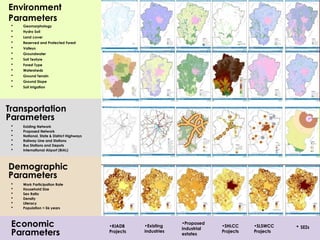
 Geomorphology
 Hydro Soil
 Land cover
 Reserved and Protected Forest
 Valleys
 Groundwater
 Soil Texture
 Forest Type
 Watersheds
 Ground Terrain
 Ground Slope
 Soil Irrigation
 Work Participation Rate
 Household Size
 Sex Ratio
 Density
 Literacy
 Population < 06 years
 Existing Network
 Proposed Network
 National, State & District Highways
 Railway Line and Stations
 Bus Stations and Depots
 International Airport (BIAL)
Economic
Parameters
 SEZs
•KIADB
Projects
•Existing
industries
•Proposed
industrial
estates
•SHLCC
Projects
•SLSWCC
Projects
Environment
Parameters
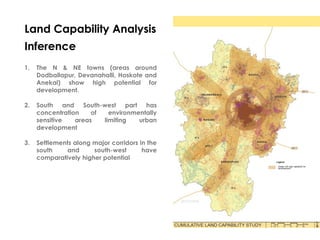
Land Capability Analysis
Inference
1. The N & NE towns (areas around
Dodballapur, Devanahalli, Hoskote and
Anekal) show high potential for
development.
2. South and South-west part has
concentration of environmentally
sensitive areas limiting urban
development
3. Settlements along major corridors in the
south and south-west have
comparatively higher potential
Population Trend : BMR & BMA
3.37
4.95
6.51
8.42
1.66
2.91
4.30
6.17
0
2
4
6
8
10
1971 1981 1991 2001
Census Year
Population
in
Million
BMR BMA
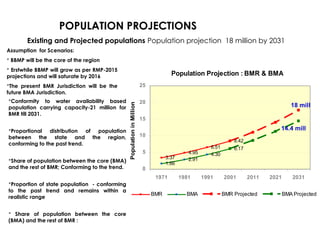
Assumption for Scenarios:
 BBMP will be the core of the region
 Erstwhile BBMP will grow as per RMP-2015
projections and will saturate by 2016
The present BMR Jurisdiction will be the
future BMA Jurisdiction.
Conformity to water availability based
population carrying capacity-21 million for
BMR till 2031.
Proportional distribution of population
between the state and the region,
conforming to the past trend.
Share of population between the core (BMA)
and the rest of BMR; Conforming to the trend.
Proportion of state population - conforming
to the past trend and remains within a
realistic range
 Share of population between the core
(BMA) and the rest of BMR :
Population Projection : BMR & BMA
3.37
4.95
6.51
8.42
1.66
2.91
4.30
6.17
0
5
10
15
20
25
1971 1981 1991 2001 2011 2021 2031
Census Year
Population
in
Million
BMR BMA BMR Projected-1
BMR Projected-2 BMR Projected-3 BMA Projected
12.6
14.4
17.7
22
Population Projection : BMR & BMA
3.37
4.95
6.51
8.42
1.66
2.91
4.30
6.17
0
5
10
15
20
25
1971 1981 1991 2001 2011 2021 2031
Census Year
Population
in
Million
BMR BMA BMR Projected BMA Projected
18 mill
14.4 mill
POPULATION PROJECTIONS
Existing and Projected populations Population projection 18 million by 2031
GUIDING PRINCIPLES & VISION
Vision of the BMR RSP 2031
 Inducing agglomeration economies and clustered
development through a decentralized planning and
governance system
 Maintain the primacy of Bangalore as a center.
 Establishing a streamlined planning and governance
system that addresses the decentralization agenda
 Ensure land utilization suited to its capability for
sustained economic production
“ BMR as a Competitive, Inclusive and Sustainable
Region”
3.
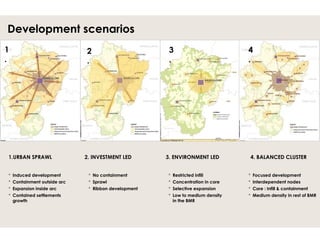
Development scenarios
 No containment
 Sprawl
 Ribbon development
 Induced development
 Containment outside arc
 Expansion inside arc
 Contained settlements
growth
1.URBAN SPRAWL 2. INVESTMENT LED 3. ENVIRONMENT LED 4. BALANCED CLUSTER
1
.
2
.
3
.
4
.
 Restricted infill
 Concentration in core
 Selective expansion
 Low to medium density
in the BMR
 Focused development
 Interdependent nodes
 Core : Infill & containment
 Medium density in rest of BMR
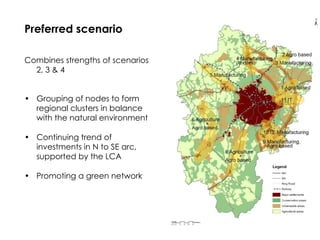
Preferred scenario
Combines strengths of scenarios
2, 3 & 4
• Grouping of nodes to form
regional clusters in balance
with the natural environment
• Continuing trend of
investments in N to SE arc,
supported by the LCA
• Promoting a green network
Policy Paradigm Shifts
Cluster node development
Inclusive economic growth by encouraging local economic development of smaller towns, exploring benefits of
agglomeration economies
Transit oriented development
Promotion of employment nodes integrated with public transport systems
Water and Urbanizable areas
Irrigated lands and areas with high water table delineated as agricultural zones
Preservation of major and minor watersheds to enable regional level ground water recharge
Housing
Potential to introduce private sector in building affordable housing and building and managing infrastructure for
affordable housing
Solid Waste management
Introduction of decentralized waste management systems at local levels and recycling of waste.
Introduce technologies for converting waste to energy through specialized expertise and techniques
Heritage and Tourism
Formation of a heritage cell along with comprehensive identification and mapping of heritage areas to conserve
important natural and built heritage. Explore potential of tourism to enhance accessibility of heritage destinations
along with provision of amenities.
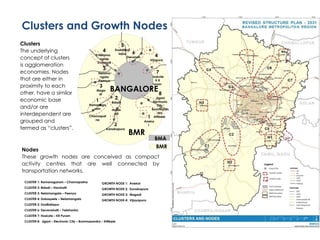
Clusters and Growth Nodes
CLUSTER 1: Ramanagaram – Channapatna
CLUSTER 2: Bidadi – Harohalli
CLUSTER 3: Nelamangala – Peenya
CLUSTER 4: Dobaspete – Nelamangala
CLUSTER 5: DodBallapur
CLUSTER 6: Devanahalli – Yelahanka
CLUSTER 7: Hoskote – KR Puram
CLUSTER 8: Jigani – Electronic City – Bommasandra – Attibele
BMR
1
Ramanaga
ram
Channapat
na
2
Kanakapura
2
Bidadi
Haroh
alli
3
Maga
di
1
Aneka
l
4
Nelama
ngala
Dobaspe
te
5
Doddabal
lapur 6
Devanah
alli
Yelahan
ka
4
Vijapura
7
Hoskote
K R
Puram
8
Jigani
Electronic
City
Bommasan
dra
Attibele
BANGALORE
3
Nelama
ngala
Peenya
BMA
BMR
Clusters
The underlying
concept of clusters
is agglomeration
economies. Nodes
that are either in
proximity to each
other, have a similar
economic base
and/or are
interdependent are
grouped and
termed as “clusters”.
Nodes
These growth nodes are conceived as compact
activity centres that are well connected by
transportation networks.
GROWTH NODE 1: Anekal
GROWTH NODE 2: Kanakapura
GROWTH NODE 3: Magadi
GROWTH NODE 4: Vijayapura
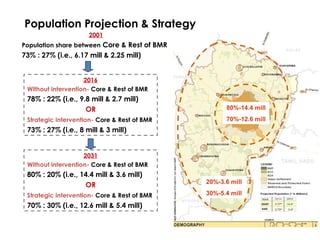
Population Projection & Strategy
2001
Population share between Core & Rest of BMR
73% : 27% (i.e., 6.17 mill & 2.25 mill)
2031
Without intervention- Core & Rest of BMR
80% : 20% (i.e., 14.4 mill & 3.6 mill)
OR
Strategic intervention- Core & Rest of BMR
70% : 30% (i.e., 12.6 mill & 5.4 mill)
Population Trend : BMR & BMA
3.37
4.95
6.51
8.42
1.66
2.91
4.30
6.17
0
2
4
6
8
10
1971 1981 1991 2001
Census Year
Population
in
Million
BMR BMA
Population Projection : BMR & BMA
3.37
4.95
6.51
8.42
1.66
2.91
4.30
6.17
0
5
10
15
20
25
1971 1981 1991 2001 2011 2021 2031
Census Year
Population
in
Million
BMR BMA BMR Projected BMA Projected
18
mill
14.4
mill
80%-14.4 mill
70%-12.6 mill
20%-3.6 mill
30%-5.4 mill
2016
Without intervention- Core & Rest of BMR
78% : 22% (i.e., 9.8 mill & 2.7 mill)
OR
Strategic intervention- Core & Rest of BMR
73% : 27% (i.e., 8 mill & 3 mill)
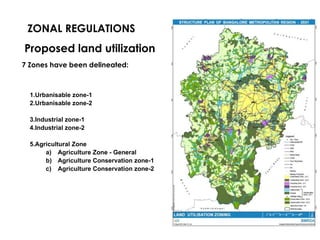
ZONAL REGULATIONS
Proposed land utilization
1.Urbanisable zone-1
2.Urbanisable zone-2
3.Industrial zone-1
4.Industrial zone-2
5.Agricultural Zone
a) Agriculture Zone - General
b) Agriculture Conservation zone-1
c) Agriculture Conservation zone-2
7 Zones have been delineated:
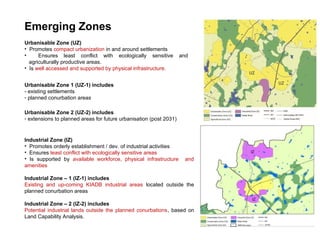
Urbanisable Zone (UZ)
• Promotes compact urbanization in and around settlements
• Ensures least conflict with ecologically sensitive and
agriculturally productive areas.
• Is well accessed and supported by physical infrastructure.
Urbanisable Zone 1 (UZ-1) includes
- existing settlements
- planned conurbation areas
Urbanisable Zone 2 (UZ-2) includes
- extensions to planned areas for future urbanisation (post 2031)
Industrial Zone (IZ)
• Promotes orderly establishment / dev. of industrial activities
• Ensures least conflict with ecologically sensitive areas
• Is supported by available workforce, physical infrastructure and
amenities
Industrial Zone – 1 (IZ-1) includes
Existing and up-coming KIADB industrial areas located outside the
planned conurbation areas
Industrial Zone – 2 (IZ-2) includes
Potential industrial lands outside the planned conurbations, based on
Land Capability Analysis.
Emerging Zones
Emerging Zones
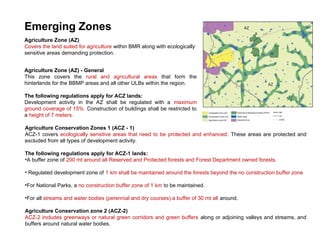
Agriculture Zone (AZ)
Covers the land suited for agriculture within BMR along with ecologically
sensitive areas demanding protection.
Agriculture Zone (AZ) - General
This zone covers the rural and agricultural areas that form the
hinterlands for the BBMP areas and all other ULBs within the region.
The following regulations apply for ACZ lands:
Development activity in the AZ shall be regulated with a maximum
ground coverage of 15%. Construction of buildings shall be restricted to
a height of 7 meters.
Agriculture Conservation Zones 1 (ACZ - 1)
ACZ-1 covers ecologically sensitive areas that need to be protected and enhanced. These areas are protected and
excluded from all types of development activity.
The following regulations apply for ACZ-1 lands:
•A buffer zone of 200 mt around all Reserved and Protected forests and Forest Department owned forests.
• Regulated development zone of 1 km shall be maintained around the forests beyond the no construction buffer zone
•For National Parks, a no construction buffer zone of 1 km to be maintained.
•For all streams and water bodies (perennial and dry courses) a buffer of 30 mt all around.
Agriculture Conservation zone 2 (ACZ-2)
ACZ-2 includes greenways or natural green corridors and green buffers along or adjoining valleys and streams, and
buffers around natural water bodies.
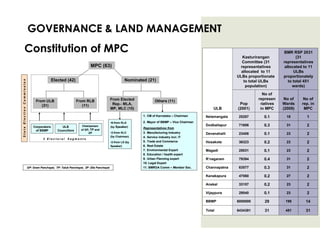
MPC (63)
Nominated (21)
Elected (42)
From ULB
(31)
From RLB
(11)
S
t
a
t
e
E
l
e
c
t
I
o
n
C
o
m
m
I
s
s
I
o
n
Corporators
of BBMP
ULB
Councillors
Chairperson
of GP, TP and
ZP
3 E l e c t o r a l S e g m e n t s
GP- Gram Panchayat, TP- Taluk Panchayat, ZP -Zila Panchayat
From Elected
Rep.- MLA,
MP, MLC (10)
Others (11)
•6-from KLA
(by Speaker)
•2-from KLC
(by Chairman)
•2-from LS (by
Speaker)
1. CM of Karnataka – Chairman
2. Mayor of BBMP – Vice Chairman
Representatives from
3. Manufacturing Industry
4. Service industry incl. IT
5. Trade and Commerce
6. Real Estate
7. Environmental Expert
8. Education / health expert
9. Urban Planning expert
10. Legal Expert
11. BMRDA Comm – Member Sec.
MPC (63)
Nominated (21)
Elected (42)
From ULB
(31)
From RLB
(11)
S
t
a
t
e
E
l
e
c
t
I
o
n
C
o
m
m
I
s
s
I
o
n
Corporators
of BBMP
ULB
Councillors
Chairperson
of GP, TP and
ZP
3 E l e c t o r a l S e g m e n t s
GP- Gram Panchayat, TP- Taluk Panchayat, ZP -Zila Panchayat
From Elected
Rep.- MLA,
MP, MLC (10)
Others (11)
•6-from KLA
(by Speaker)
•2-from KLC
(by Chairman)
•2-from LS (by
Speaker)
1. CM of Karnataka – Chairman
2. Mayor of BBMP – Vice Chairman
Representatives from
3. Manufacturing Industry
4. Service industry incl. IT
5. Trade and Commerce
6. Real Estate
7. Environmental Expert
8. Education / health expert
9. Urban Planning expert
10. Legal Expert
11. BMRDA Comm – Member Sec.
ULB
Kasturirangan
Committee (31
representatives
allocated to 11
ULBs proportionate
to total ULBs
population)
BMR RSP 2031
(31
representatives
allocated to 11
ULBs
proportionately
to total 451
wards)
Pop
(2001)
No of
represen
-tatives
in MPC
No of
Wards
(2009)
No of
rep. in
MPC
Nelamangala 25287 0.1 18 1
Dodballapur 71606 0.3 31 2
Devanahalli 23406 0.1 23 2
Hosakote 36323 0.2 23 2
Magadi 25031 0.1 23 2
R’nagaram 79394 0.4 31 2
Channapatna 63577 0.3 31 2
Kanakapura 47060 0.2 27 2
Anekal 33157 0.2 23 2
Vijaypura 29540 0.1 23 2
BBMP 6000000 29 198 14
Total 6434381 31 451 31
GOVERNANCE & LAND MANAGEMENT
Constitution of MPC
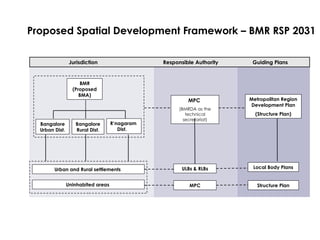
Proposed Spatial Development Framework – BMR RSP 2031
Jurisdiction Responsible Authority Guiding Plans
BMR
(Proposed
BMA)
Bangalore
Urban Dist.
Bangalore
Rural Dist.
R’nagaram
Dist.
Metropolitan Region
Development Plan
(Structure Plan)
Local Body Plans
Urban and Rural settlements
Uninhabited areas
MPC
(BMRDA as the
technical
secretariat)
ULBs & RLBs
MPC Structure Plan
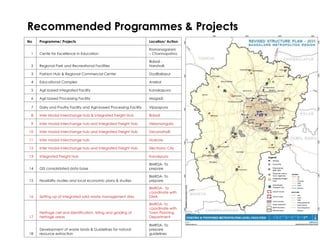
Recommended Programmes & Projects
No Programme/ Projects Location/ Action
1 Cente for Excellence in Education
Ramanagaram
– Channapatna
2 Regional Park and Recreational Facilities
Bidadi -
Harohalli
3 Fashion Hub & Regional Commercial Center DodBallapur
4 Educational Complex Anekal
5 Agri based Integrated Facility Kanakapura
6 Agri based Processing Facility Magadi
7 Dairy and Poultry Facility and Agri-based Processing Facility Vijayapura
8 Inter Modal Interchange Hub & Integrated Freight Hub Bidadi
9 Inter modal interchange hub and Integrated Freight Hub Nelamangala
10 Inter modal interchange hub and Integrated Freight Hub Devanahalli
11 Inter modal interchange hub Hoskote
12 Inter modal interchange hub and Integrated Freight Hub Electronic City
13 Integrated Freight Hub Kanakpura
14 GIS consolidated data base
BMRDA- To
prepare
15 Feasibility studies and local economic plans & studies
BMRDA- To
prepare
16 Setting up of integrated solid waste management sites
BMRDA- to
coordinate with
DMA
17
Heritage cell and Identification, listing and grading of
heritage areas
BMRDA- to
coordinate with
Town Planning
Department
18
Development of waste lands & Guidelines for natural
resource extraction
BMRDA- To
prepare
guidelines
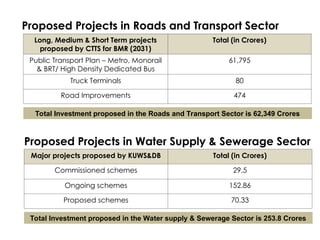
Proposed Projects in Roads and Transport Sector
Long, Medium & Short Term projects
proposed by CTTS for BMR (2031)
Total (in Crores)
Public Transport Plan – Metro, Monorail
& BRT/ High Density Dedicated Bus
61,795
Truck Terminals 80
Road Improvements 474
Total Investment proposed in the Roads and Transport Sector is 62,349 Crores
Proposed Projects in Water Supply & Sewerage Sector
management Sector
Major projects proposed by KUWS&DB Total (in Crores)
Commissioned schemes 29.5
Ongoing schemes 152.86
Proposed schemes 70.33
Total Investment proposed in the Water supply & Sewerage Sector is 253.8 Crores
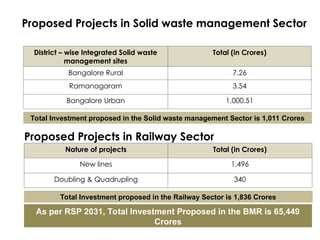
Proposed Projects in Solid waste management Sector
District – wise Integrated Solid waste
management sites
Total (in Crores)
Bangalore Rural 7.26
Ramanagaram 3.54
Bangalore Urban 1,000.51
Total Investment proposed in the Solid waste management Sector is 1,011 Crores
Proposed Projects in Railway Sector
Nature of projects Total (in Crores)
New lines 1,496
Doubling & Quadrupling 340
Total Investment proposed in the Railway Sector is 1,836 Crores
As per RSP 2031, Total Investment Proposed in the BMR is 65,449
Crores
BMRDA
Comprehensive Traffic and
Transportation Study (CTTS)
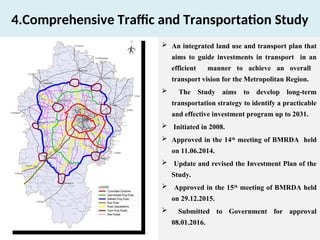
4.Comprehensive Traffic and Transportation Study
 An integrated land use and transport plan that
aims to guide investments in transport in an
efficient manner to achieve an overall
transport vision for the Metropolitan Region.
 The Study aims to develop long-term
transportation strategy to identify a practicable
and effective investment program up to 2031.
 Initiated in 2008.
 Approved in the 14th
meeting of BMRDA held
on 11.06.2014.
 Update and revised the Investment Plan of the
Study.
 Approved in the 15th
meeting of BMRDA held
on 29.12.2015.
 Submitted to Government for approval
08.01.2016.
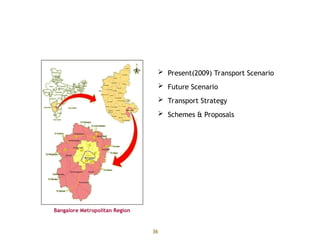
36
Contents
 Present(2009) Transport Scenario
 Future Scenario
 Transport Strategy
 Schemes & Proposals
Bangalore Metropolitan Region
37
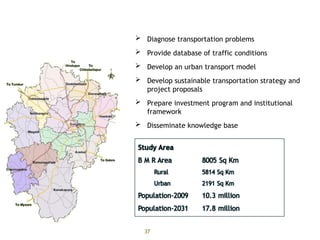
 Diagnose transportation problems
 Provide database of traffic conditions
 Develop an urban transport model
 Develop sustainable transportation strategy and
project proposals
 Prepare investment program and institutional
framework
 Disseminate knowledge base
Project Scope
38
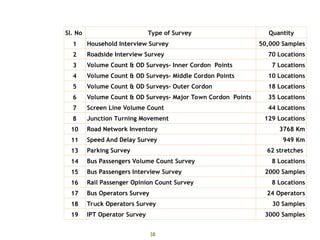
Data Base
Sl. No Type of Survey Quantity
1 Household Interview Survey 50,000 Samples
2 Roadside Interview Survey 70 Locations
3 Volume Count & OD Surveys- Inner Cordon Points 7 Locations
4 Volume Count & OD Surveys- Middle Cordon Points 10 Locations
5 Volume Count & OD Surveys- Outer Cordon 18 Locations
6 Volume Count & OD Surveys- Major Town Cordon Points 35 Locations
7 Screen Line Volume Count 44 Locations
8 Junction Turning Movement 129 Locations
10 Road Network Inventory 3768 Km
11 Speed And Delay Survey 949 Km
13 Parking Survey 62 stretches
14 Bus Passengers Volume Count Survey 8 Locations
15 Bus Passengers Interview Survey 2000 Samples
16 Rail Passenger Opinion Count Survey 8 Locations
17 Bus Operators Survey 24 Operators
18 Truck Operators Survey 30 Samples
19 IPT Operator Survey 3000 Samples
Present Scenario
39
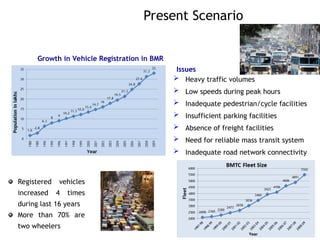
Registered vehicles
increased 4 times
during last 16 years
More than 70% are
two wheelers
Growth in Vehicle Registration in BMR
 Heavy traffic volumes
 Low speeds during peak hours
 Inadequate pedestrian/cycle facilities
 Insufficient parking facilities
 Absence of freight facilities
 Need for reliable mass transit system
 Inadequate road network connectivity
Issues
Socio Economic & Travel Characteristics
40
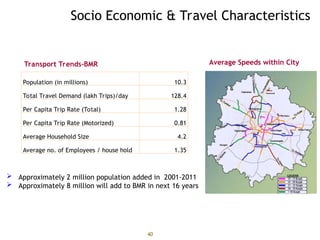
Population (in millions) 10.3
Total Travel Demand (lakh Trips)/day 128.4
Per Capita Trip Rate (Total) 1.28
Per Capita Trip Rate (Motorized) 0.81
Average Household Size 4.2
Average no. of Employees / house hold 1.35
Transport Trends-BMR Average Speeds within City
 Approximately 2 million population added in 2001-2011
 Approximately 8 million will add to BMR in next 16 years
BMR Strategic Transport Model
41
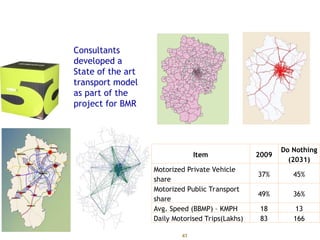
Item 2009
Do Nothing
(2031)
Motorized Private Vehicle
share
37% 45%
Motorized Public Transport
share
49% 36%
Avg. Speed (BBMP) – KMPH 18 13
Daily Motorised Trips(Lakhs) 83 166
Consultants
developed a
State of the art
transport model
as part of the
project for BMR
Transport Strategy for BMR
42
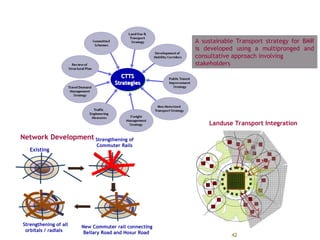
Existing
Strengthening of
Commuter Rails
Strengthening of all
orbitals / radials
New Commuter rail connecting
Bellary Road and Hosur Road
Network Development
Landuse Transport Integration
A sustainable Transport strategy for BMR
is developed using a multipronged and
consultative approach involving
stakeholders
Road Improvement Proposals
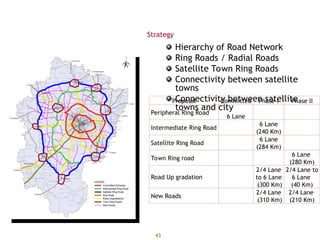
Strategy
Hierarchy of Road Network
Ring Roads / Radial Roads
Satellite Town Ring Roads
Connectivity between satellite
towns
Connectivity between satellite
towns and city
43
Proposal Committed Phase-I Phase II
Peripheral Ring Road
6 Lane
Intermediate Ring Road
6 Lane
(240 Km)
Satellite Ring Road
6 Lane
(284 Km)
Town Ring road
6 Lane
(280 Km)
Road Up gradation
2/4 Lane
to 6 Lane
(300 Km)
2/4 Lane to
6 Lane
(40 Km)
New Roads
2/4 Lane
(310 Km)
2/4 Lane
(210 Km)
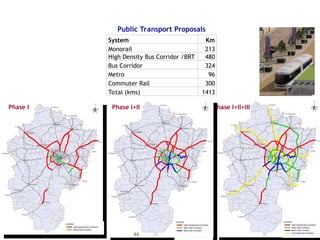
Phase I+II+III
Phase I+II
Public Transport Improvement Proposals
44
Phase I
System Km
Monorail 213
High Density Bus Corridor /BRT 480
Bus Corridor 324
Metro 96
Commuter Rail 300
Total (kms) 1413
Public Transport Proposals
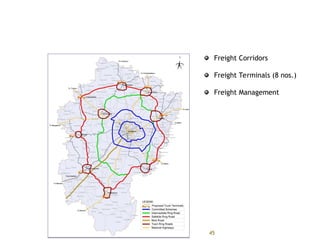
Freight Management Proposals
Freight Corridors
Freight Terminals (8 nos.)
Freight Management
45
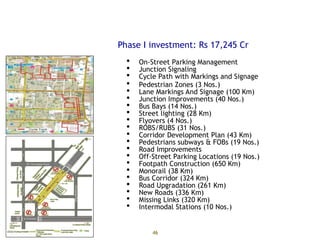
Phase I Proposals (2010-2015)
46
 On-Street Parking Management
 Junction Signaling
 Cycle Path with Markings and Signage
 Pedestrian Zones (3 Nos.)
 Lane Markings And Signage (100 Km)
 Junction Improvements (40 Nos.)
 Bus Bays (14 Nos.)
 Street lighting (28 Km)
 Flyovers (4 Nos.)
 ROBS/RUBS (31 Nos.)
 Corridor Development Plan (43 Km)
 Pedestrians subways & FOBs (19 Nos.)
 Road Improvements
 Off-Street Parking Locations (19 Nos.)
 Footpath Construction (650 Km)
 Monorail (38 Km)
 Bus Corridor (324 Km)
 Road Upgradation (261 Km)
 New Roads (336 Km)
 Missing Links (320 Km)
 Intermodal Stations (10 Nos.)
Phase I investment: Rs 17,245 Cr
Phase II Proposals (2016-2021)
Grade Separators
47
RUB/ROB Locations
Pedestrian
Subways
Parking Facilities
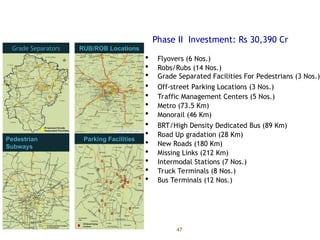
 Flyovers (6 Nos.)
 Robs/Rubs (14 Nos.)
 Grade Separated Facilities For Pedestrians (3 Nos.)
 Off-street Parking Locations (3 Nos.)
 Traffic Management Centers (5 Nos.)
 Metro (73.5 Km)
 Monorail (46 Km)
 BRT/High Density Dedicated Bus (89 Km)
 Road Up gradation (28 Km)
 New Roads (180 Km)
 Missing Links (212 Km)
 Intermodal Stations (7 Nos.)
 Truck Terminals (8 Nos.)
 Bus Terminals (12 Nos.)
Phase II Investment: Rs 30,390 Cr
48
Phase III Proposals (2022-2031)
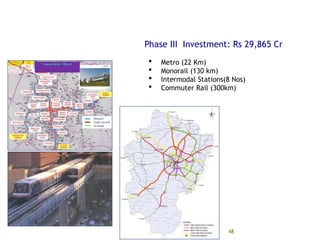
Phase III Investment: Rs 29,865 Cr
 Metro (22 Km)
 Monorail (130 km)
 Intermodal Stations(8 Nos)
 Commuter Rail (300km)
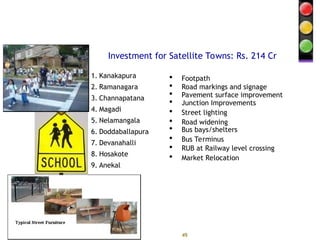
1. Kanakapura
2. Ramanagara
3. Channapatana
4. Magadi
5. Nelamangala
6. Doddaballapura
7. Devanahalli
8. Hosakote
9. Anekal
Satellite Town Proposals
49
 Footpath
 Road markings and signage
 Pavement surface improvement
 Junction Improvements
 Street lighting
 Road widening
 Bus bays/shelters
 Bus Terminus
 RUB at Railway level crossing
 Market Relocation
Investment for Satellite Towns: Rs. 214 Cr
50
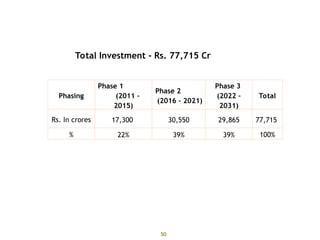
Investment Program
Phasing
Phase 1
(2011 –
2015)
Phase 2
(2016 – 2021)
Phase 3
(2022 –
2031)
Total
Rs. In crores 17,300 30,550 29,865 77,715
% 22% 39% 39% 100%
Total Investment - Rs. 77,715 Cr
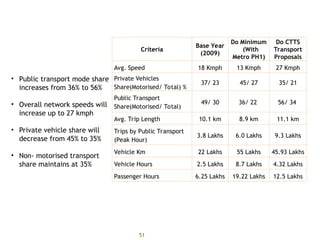
Impact of Transport Proposals-2031
Criteria
Base Year
(2009)
Do Minimum
(With
Metro PH1)
Do CTTS
Transport
Proposals
Avg. Speed 18 Kmph 13 Kmph 27 Kmph
Private Vehicles
Share(Motorised/ Total) %
37/ 23 45/ 27 35/ 21
Public Transport
Share(Motorised/ Total)
49/ 30 36/ 22 56/ 34
Avg. Trip Length 10.1 km 8.9 km 11.1 km
Trips by Public Transport
(Peak Hour)
3.8 Lakhs 6.0 Lakhs 9.3 Lakhs
Vehicle Km 22 Lakhs 55 Lakhs 45.93 Lakhs
Vehicle Hours 2.5 Lakhs 8.7 Lakhs 4.32 Lakhs
Passenger Hours 6.25 Lakhs 19.22 Lakhs 12.5 Lakhs
51
• Public transport mode share
increases from 36% to 56%
• Overall network speeds will
increase up to 27 kmph
• Private vehicle share will
decrease from 45% to 35%
• Non- motorised transport
share maintains at 35%
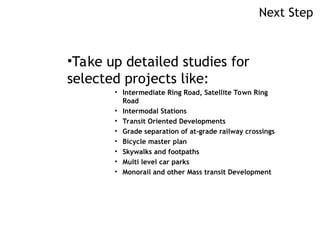
Next Step
•Take up detailed studies for
selected projects like:
• Intermediate Ring Road, Satellite Town Ring
Road
• Intermodal Stations
• Transit Oriented Developments
• Grade separation of at-grade railway crossings
• Bicycle master plan
• Skywalks and footpaths
• Multi level car parks
• Monorail and other Mass transit Development
SATELLITE TOWN RING ROAD
BMRDA
STRR – NECESSITY OF THE PROJECT
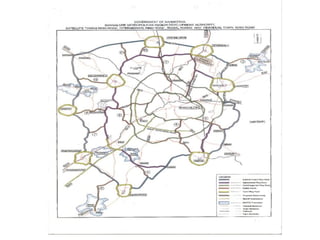
• BMRDA in its structure plan has proposed for the
development of STRR and ITRR.
• BMRDA Planned to connect 8 Towns viz. Hoskote,
Doddaballapura, Devanahalli, Dobaspet, Anekal,
Kanakapura, Ramanagara and Magadi located around
Bengaluru.
• STRR provides smooth, efficient and high speed corridor
caters to the future growth and traffic demands around
Bengaluru.
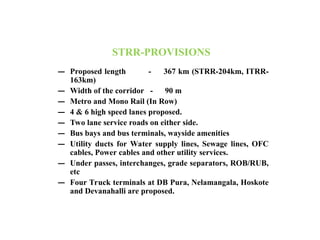
STRR-PROVISIONS
– Proposed length - 367 km (STRR-204km, ITRR-
163km)
– Width of the corridor - 90 m
– Metro and Mono Rail (In Row)
– 4 & 6 high speed lanes proposed.
– Two lane service roads on either side.
– Bus bays and bus terminals, wayside amenities
– Utility ducts for Water supply lines, Sewage lines, OFC
cables, Power cables and other utility services.
– Under passes, interchanges, grade separators, ROB/RUB,
etc
– Four Truck terminals at DB Pura, Nelamangala, Hoskote
and Devanahalli are proposed.
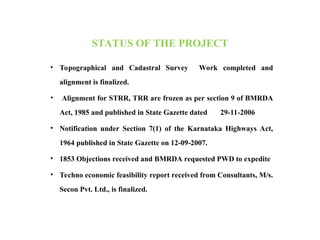
STATUS OF THE PROJECT
• Topographical and Cadastral Survey Work completed and
alignment is finalized.
• Alignment for STRR, TRR are frozen as per section 9 of BMRDA
Act, 1985 and published in State Gazette dated 29-11-2006
• Notification under Section 7(1) of the Karnataka Highways Act,
1964 published in State Gazette on 12-09-2007.
• 1853 Objections received and BMRDA requested PWD to expedite
• Techno economic feasibility report received from Consultants, M/s.
Secon Pvt. Ltd., is finalized.
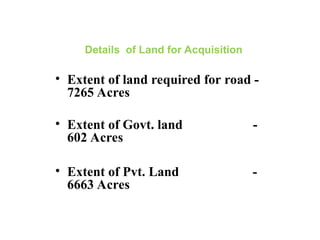
Details of Land for Acquisition
• Extent of land required for road -
7265 Acres
• Extent of Govt. land -
602 Acres
• Extent of Pvt. Land -
6663 Acres
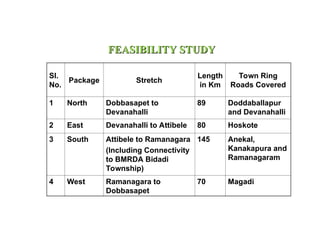
FEASIBILITY STUDY
FEASIBILITY STUDY
Sl.
No.
Package Stretch
Length
in Km
Town Ring
Roads Covered
1 North Dobbasapet to
Devanahalli
89 Doddaballapur
and Devanahalli
2 East Devanahalli to Attibele 80 Hoskote
3 South Attibele to Ramanagara
(Including Connectivity
to BMRDA Bidadi
Township)
145 Anekal,
Kanakapura and
Ramanagaram
4 West Ramanagara to
Dobbasapet
70 Magadi
DESCRIPTION OF PACKAGES
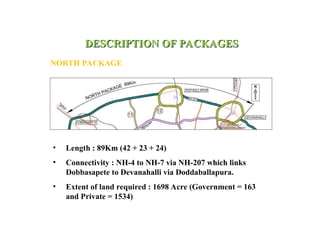
NORTH PACKAGE
• Length : 89Km (42 + 23 + 24)
• Connectivity : NH-4 to NH-7 via NH-207 which links
Dobbasapete to Devanahalli via Doddaballapura.
• Extent of land required : 1698 Acre (Government = 163
and Private = 1534)
DESCRIPTION OF PACKAGES
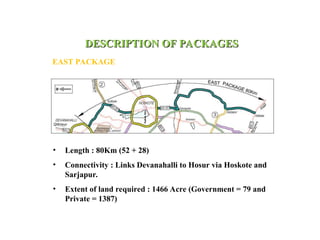
EAST PACKAGE
• Length : 80Km (52 + 28)
• Connectivity : Links Devanahalli to Hosur via Hoskote and
Sarjapur.
• Extent of land required : 1466 Acre (Government = 79 and
Private = 1387)
DESCRIPTION OF PACKAGES
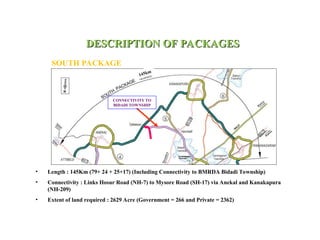
SOUTH PACKAGE
• Length : 145Km (79+ 24 + 25+17) (Including Connectivity to BMRDA Bidadi Township)
• Connectivity : Links Hosur Road (NH-7) to Mysore Road (SH-17) via Anekal and Kanakapura
(NH-209)
• Extent of land required : 2629 Acre (Government = 266 and Private = 2362)
CONNECTIVITY TO
BIDADI TOWNSHIP
145km
DESCRIPTION OF PACKAGES
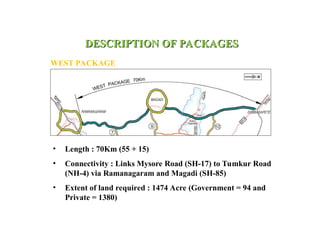
WEST PACKAGE
• Length : 70Km (55 + 15)
• Connectivity : Links Mysore Road (SH-17) to Tumkur Road
(NH-4) via Ramanagaram and Magadi (SH-85)
• Extent of land required : 1474 Acre (Government = 94 and
Private = 1380)
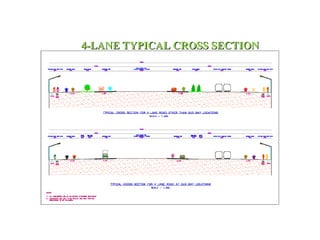
4-LANE TYPICAL CROSS SECTION
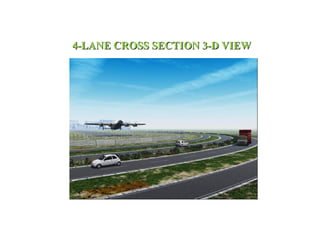
4-LANE CROSS SECTION 3-D VIEW
PROJECT DETAILS
PROJECT DETAILS
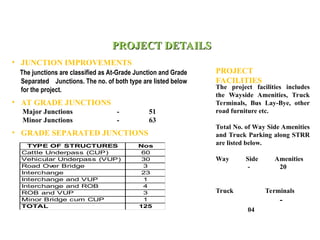
• JUNCTION IMPROVEMENTS
The junctions are classified as At-Grade Junction and Grade
Separated Junctions. The no. of both type are listed below
for the project.
• AT GRADE JUNCTIONS
Major Junctions - 51
Minor Junctions - 63
• GRADE SEPARATED JUNCTIONS
TYPE OF STRUCTURES Nos
Cattle Underpass (CUP) 60
Vehicular Underpass (VUP) 30
Road Over Bridge 3
Interchange 23
Interchange and VUP 1
Interchange and ROB 4
ROB and VUP 3
Minor Bridge cum CUP 1
TOTAL 125
PROJECT
FACILITIES
The project facilities includes
the Wayside Amenities, Truck
Terminals, Bus Lay-Bye, other
road furniture etc.
Total No. of Way Side Amenities
and Truck Parking along STRR
are listed below.
Way Side Amenities
- 20
Truck Terminals
-
04
BMRDA
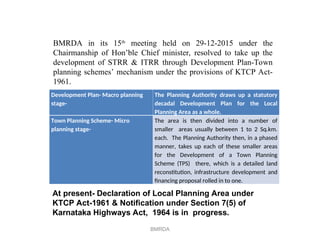
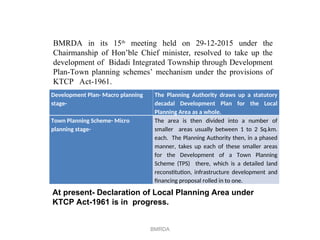
BMRDA in its 15th
meeting held on 29-12-2015 under the
Chairmanship of Hon’ble Chief minister, resolved to take up the
development of STRR & ITRR through Development Plan-Town
planning schemes’ mechanism under the provisions of KTCP Act-
1961.
Development Plan- Macro planning
stage-
The Planning Authority draws up a statutory
decadal Development Plan for the Local
Planning Area as a whole.
Town Planning Scheme- Micro
planning stage-
The area is then divided into a number of
smaller areas usually between 1 to 2 Sq.km.
each. The Planning Authority then, in a phased
manner, takes up each of these smaller areas
for the Development of a Town Planning
Scheme (TPS) there, which is a detailed land
reconstitution, infrastructure development and
financing proposal rolled in to one.
At present- Declaration of Local Planning Area under
KTCP Act-1961 & Notification under Section 7(5) of
Karnataka Highways Act, 1964 is in progress.
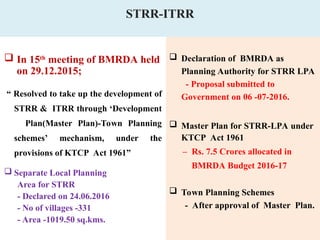
STRR-ITRR
 Declaration of BMRDA as
Planning Authority for STRR LPA
- Proposal submitted to
Government on 06 -07-2016.
 Master Plan for STRR-LPA under
KTCP Act 1961
– Rs. 7.5 Crores allocated in
BMRDA Budget 2016-17
 Town Planning Schemes
- After approval of Master Plan.
 In 15th
meeting of BMRDA held
on 29.12.2015;
“ Resolved to take up the development of
STRR & ITRR through ‘Development
Plan(Master Plan)-Town Planning
schemes’ mechanism, under the
provisions of KTCP Act 1961”
 Separate Local Planning
Area for STRR
- Declared on 24.06.2016
- No of villages -331
- Area -1019.50 sq.kms.
BMRDA
New Integrated Townships
in Bengaluru Metropolitan Region
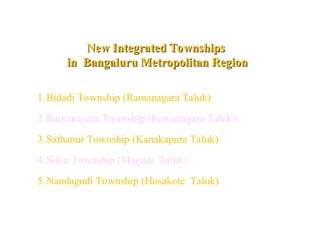
New Integrated Townships
in Bangaluru Metropolitan Region
1.Bidadi Township (Ramanagara Taluk)
2.Ramanagara Township (Ramanagara Taluk)
3.Sathanur Township (Kanakapura Taluk)
4.Solur Township (Magadi Taluk)
5.Nandagudi Township (Hosakote Taluk)
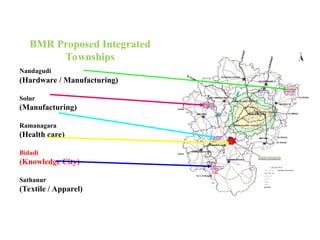
Nandagudi
(Hardware / Manufacturing)
Solur
(Manufacturing)
Ramanagara
(Health care)
Bidadi
(Knowledge City)
Sathanur
(Textile / Apparel)
BMR Proposed Integrated
Townships
Bidadi Integrated Township Location
From Bangalore
From Bangalore
City
City
35 Kms
35 Kms
From State
From State
Highway [B’lore-
Highway [B’lore-
Mysore Road]
Mysore Road]
3 Kms
3 Kms
From National
From National
Highway [NH-209]
Highway [NH-209]
15 Kms
15 Kms
Railway Station –
Railway Station –
[Bidadi Station on
[Bidadi Station on
the B’lore-Mysore
the B’lore-Mysore
Railway line]
Railway line]
9 Kms
9 Kms
New International
New International
Airport at
Airport at
Devanahalli
Devanahalli
45 Kms
45 Kms
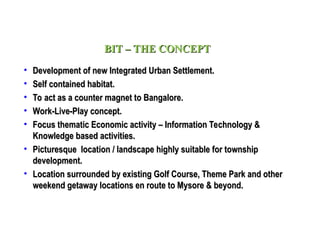
• Development of new Integrated Urban Settlement.
Development of new Integrated Urban Settlement.
• Self contained habitat.
Self contained habitat.
• To act as a counter magnet to Bangalore.
To act as a counter magnet to Bangalore.
• Work-Live-Play concept.
Work-Live-Play concept.
• Focus thematic Economic activity – Information Technology &
Focus thematic Economic activity – Information Technology &
Knowledge based activities.
• Picturesque location / landscape highly suitable for township
Picturesque location / landscape highly suitable for township
development.
development.
• Location surrounded by existing Golf Course, Theme Park and other
Location surrounded by existing Golf Course, Theme Park and other
weekend getaway locations en route to Mysore & beyond.
BIT – THE CONCEPT
BIT – THE CONCEPT
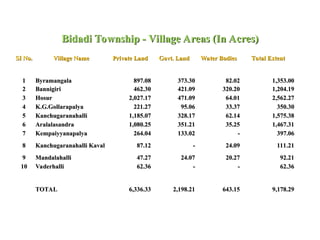
Bidadi Township - Village Areas (In Acres)
SI No.
SI No. Village Name
Village Name Private Land
Private Land Govt. Land
Govt. Land Water Bodies
Water Bodies Total Extent
Total Extent
1
1 Byramangala
Byramangala 897.08
897.08 373.30
373.30 82.02
82.02 1,353.00
1,353.00
2
2 Bannigiri
Bannigiri 462.30
462.30 421.09
421.09 320.20
320.20 1,204.19
1,204.19
3
3 Hosur
Hosur 2,027.17
2,027.17 471.09
471.09 64.01
64.01 2,562.27
2,562.27
4
4 K.G.Gollarapalya
K.G.Gollarapalya 221.27
221.27 95.06
95.06 33.37
33.37 350.30
350.30
5
5 Kanchugaranahalli
Kanchugaranahalli 1,185.07
1,185.07 328.17
328.17 62.14
62.14 1,575.38
1,575.38
6
6 Aralalasandra
Aralalasandra 1,080.25
1,080.25 351.21
351.21 35.25
35.25 1,467.31
1,467.31
7
7 Kempaiyyanapalya
Kempaiyyanapalya 264.04
264.04 133.02
133.02 -
- 397.06
397.06
8
8 Kanchugaranahalli Kaval
Kanchugaranahalli Kaval 87.12
87.12 -
- 24.09
24.09 111.21
111.21
9
9 Mandalahalli
Mandalahalli 47.27
47.27 24.07
24.07 20.27
20.27 92.21
92.21
10
10 Vaderhalli
Vaderhalli 62.36
62.36 -
- -
- 62.36
62.36
TOTAL
TOTAL 6,336.33
6,336.33 2,198.21
2,198.21 643.15
643.15 9,178.29
9,178.29
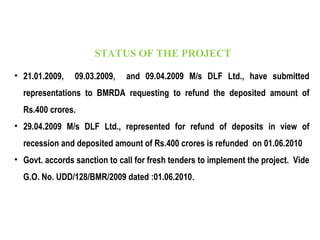
• 21.01.2009, 09.03.2009, and 09.04.2009 M/s DLF Ltd., have submitted
representations to BMRDA requesting to refund the deposited amount of
Rs.400 crores.
• 29.04.2009 M/s DLF Ltd., represented for refund of deposits in view of
recession and deposited amount of Rs.400 crores is refunded on 01.06.2010
• Govt. accords sanction to call for fresh tenders to implement the project. Vide
G.O. No. UDD/128/BMR/2009 dated :01.06.2010.
STATUS OF THE PROJECT
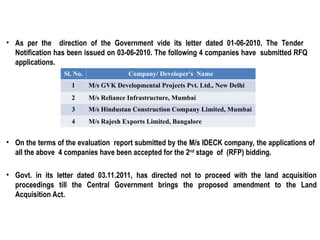
• As per the direction of the Government vide its letter dated 01-06-2010. The Tender
Notification has been issued on 03-06-2010. The following 4 companies have submitted RFQ
applications.
Sl. No. Company/ Developer's Name
1 M/s GVK Developmental Projects Pvt. Ltd., New Delhi
2 M/s Reliance Infrastructure, Mumbai
3 M/s Hindustan Construction Company Limited, Mumbai
4 M/s Rajesh Exports Limited, Bangalore
• On the terms of the evaluation report submitted by the M/s IDECK company, the applications of
all the above 4 companies have been accepted for the 2nd
stage of (RFP) bidding.
• Govt. in its letter dated 03.11.2011, has directed not to proceed with the land acquisition
proceedings till the Central Government brings the proposed amendment to the Land
Acquisition Act.
BMRDA
BMRDA in its 15th
meeting held on 29-12-2015 under the
Chairmanship of Hon’ble Chief minister, resolved to take up the
development of Bidadi Integrated Township through Development
Plan-Town planning schemes’ mechanism under the provisions of
KTCP Act-1961.
Development Plan- Macro planning
stage-
The Planning Authority draws up a statutory
decadal Development Plan for the Local
Planning Area as a whole.
Town Planning Scheme- Micro
planning stage-
The area is then divided into a number of
smaller areas usually between 1 to 2 Sq.km.
each. The Planning Authority then, in a phased
manner, takes up each of these smaller areas
for the Development of a Town Planning
Scheme (TPS) there, which is a detailed land
reconstitution, infrastructure development and
financing proposal rolled in to one.
At present- Declaration of Local Planning Area under
KTCP Act-1961 is in progress.
3.Grater Bengaluru – Bidadi Smart City
• From Bangalore City -35 Kms
• From State Highway [B’lore-Mysore Road] -3 Kms
• From National Highway [NH-209] -15 Kms
• Railway Station – [Bidadi Station on the B’lore-Mysore
Railway line] -9 Kms
• New International Airport at Devanahalli – 65 kms
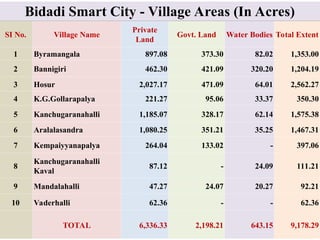
Bidadi Smart City - Village Areas (In Acres)
SI No. Village Name
Private
Land
Govt. Land Water Bodies Total Extent
1 Byramangala 897.08 373.30 82.02 1,353.00
2 Bannigiri 462.30 421.09 320.20 1,204.19
3 Hosur 2,027.17 471.09 64.01 2,562.27
4 K.G.Gollarapalya 221.27 95.06 33.37 350.30
5 Kanchugaranahalli 1,185.07 328.17 62.14 1,575.38
6 Aralalasandra 1,080.25 351.21 35.25 1,467.31
7 Kempaiyyanapalya 264.04 133.02 - 397.06
8
Kanchugaranahalli
Kaval
87.12 - 24.09 111.21
9 Mandalahalli 47.27 24.07 20.27 92.21
10 Vaderhalli 62.36 - - 62.36
TOTAL 6,336.33 2,198.21 643.15 9,178.29
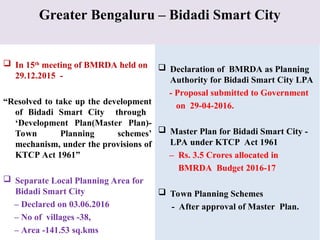
Greater Bengaluru – Bidadi Smart City
 In 15th
meeting of BMRDA held on
29.12.2015 -
“Resolved to take up the development
of Bidadi Smart City through
‘Development Plan(Master Plan)-
Town Planning schemes’
mechanism, under the provisions of
KTCP Act 1961”
 Separate Local Planning Area for
Bidadi Smart City
– Declared on 03.06.2016
– No of villages -38,
– Area -141.53 sq.kms
 Declaration of BMRDA as Planning
Authority for Bidadi Smart City LPA
- Proposal submitted to Government
on 29-04-2016.
 Master Plan for Bidadi Smart City -
LPA under KTCP Act 1961
– Rs. 3.5 Crores allocated in
BMRDA Budget 2016-17
 Town Planning Schemes
- After approval of Master Plan.
PREPARATION OF VILLAGE DEVELOPMENT PLANS
Village Development Plans
 A written document and a detailed
spatial drawing which indicates the
issues concerned to that village such as
linkages, physical infrastructures,
conservation areas etc. and proposes
practical actions which will result in
planned development.
 To provide planned development in and
around 500mts from the edge of the
gramathana boundary of the existing
village.
 Includes mapping of all physical
infrastructures, natural features and
structures in the area and form the
foundation for orderly development of
the gramathana and surrounding area.
In 15th
meeting of BMRDA held on
29.12.2015- resolved to take up
preparation of village Development
Plans
Approximately 1608 - villages in
Agriculture Zone.
Concurrence for TOR from RDPR -
on 21.03.2016.
Present at Tender process stage – for
selection of consultants.
PREPARATION OF MASTER PLANS FOR
LOCAL PLANNING AREAS
Sl. No. Local Planning Area Approved Date Remarks.
1 Anekal 3.9.2014
2 Magadi 1.6.2015 Adjoining IZ areas are added to these
LPA’s Now Preparation of Master Plans for
Additional areas and Township areas (Solur
& Sathanur) is taken up
3 Nelamangala 1.6.2015
4 Kanakapura 7.8.2015
5 Hosakote Draft approval
on 16.9.2013
Objection received -1775
There was Interim stay in W.P. No.
4188/2016 in Hon’ble High Court.
Recently the Stay order has been lifted by
the Hon’ble High Court. Hence the
Preparation of Master Plan is in Progress.
6 BIAAPA 29.2.2009 Revision of Master Plan is taken up
Declaration of intention to prepare Master
Plan -2031 on 16.03.2016.
7 RCUDA IMP on
24.10.2013
Part of APZ-1 and IZ adjoining the LPA to
be added.
8 Grater Bengaluru –
Bidadi Smart City
LPA declared on
03.06.2016 Proposal to constitute BMRDA as Planning
Authority under KTCP Act 1961 is
6. Preparation /Revision of Master Plan for LPA’S within BMR
BMRDA
Bangalore Metropolitan Planning
Committee
Constitution – 74th
Amendment Act, 1992 – Part IX A, Municipalities.
Article 243 ZE –
 Committee for Metropolitan Planning in every Metropolitan Area
 Committee to prepare a draft Development Plan for the area as a whole.
 State Government by law to make provision –
o Karnataka Municipal Corporations Act, 1976 Section 503-B.
o Metropolitan Planning Committee for Bangalore Metropolitan Area.
o Metropolitan Planning Committee shall consist 30 persons – 2/3 from elected
representatives from amongst City Municipal Corporation, Corporation, Adhyakshas
& Upadhyakshas of Taluk Panchayath, Zila Panchayath, Gram a Panchayath;
o 1/3rd
representatives of State Government & Central Government.
o All MP, MLA, MLCs., Permanent invitees.
Bangalore Metropolitan Planning Committee
Draft Development Plan shall have regard to
i. the plans prepared by the local authorities in the Metropolitan area;
ii. Matters of common interest between the local authorities including
co-ordinated spatial planning of the area, sharing of water and other physical and natural
resources, the integrated development of infrastructure and environmental conservation;
i. The overall objectives and priorities set by the Government of India and the State
Government;
ii. the extent and nature of investments likely to be made in the Metropolitan area by agencies
of the Government of India and of the State Government and other available resources
whether financial or otherwise;
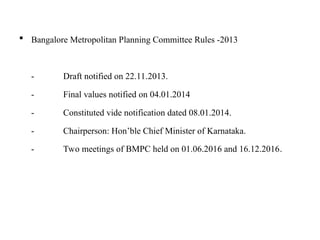
 Bangalore Metropolitan Planning Committee Rules -2013
- Draft notified on 22.11.2013.
- Final values notified on 04.01.2014
- Constituted vide notification dated 08.01.2014.
- Chairperson: Hon’ble Chief Minister of Karnataka.
- Two meetings of BMPC held on 01.06.2016 and 16.12.2016.
bangalore metropolitan development authority

bangalore metropolitan development authority

  • 1.
  • 2.
    CONSTITUTION OF BMRDA •Statutory Authority constituted on 01-02-1986 under the provisions of the Bengaluru Metropolitan Region Development Authority Act 1985, for planning, coordinating and supervising the proper and orderly development of the areas within BMR. • Planning and Regulatory Authority for Bengaluru Metropolitain Region. BMR comprises Bengaluru Urban District, Bengaluru Rural District & Ramanagaram District.
  • 3.
    Bengaluru Metropolitan Region BengaluruMetropolitan Region includes: 1.Bangaluru Urban district (2190 Sq kms) 2. Bengaluru Rural district (2260 Sq kms) 3.Ramanagar district (3555 Sq kms) Bengaluru Metropolitan Region measures about 8005 sq.kms. Population of BMR (2001 census) - 84.00 lakhs Population of BMR (2011 census) - 117 lakhs Projected population of BMR by 2021 – 149 lakhs(as per Revised structure plan) Projected for 2031 – 189 lakhs.(as per Revised structure plan)
  • 4.
    1. The ChiefMinister of Karnataka who shall be the Chairman. 2. The Minister in charge of urban Development who shall be the Vice- Chairman. 3. The Chairman, Bangalore Development Authority. 4. The Mayor, Corporation of the City of Bangalore. 5. The Chief Secretary to the Government of Karnataka. 6. The Divisional Commissioner, Bangalore Division, Bangalore. 7. The Secretary, Finance Department Government of Karnataka. 8. The Secretary, Housing and Urban Development Department, Government of Karnataka. 9. The Secretary, Public Works Command Area Development and Electricity Department, Government of Karnataka. 10. The Secretary, Commerce and Industries Department, Government of Karnataka. 11. The Chairman, Bangalore Water Supply and Sewerage Board. 12. The Chairman, Karnataka Housing Board. 13. The Chairman, Karnataka Slum Clearance Board. 14. The Chairman, Karnataka Electricity Board. 15. The Chairman, Karnataka State Road Transport Corporation. 16. The Director of Town Planning, Government of Karnataka. 17. The Chief Conservator of Forests (General), Government of Karnataka. 18. The Chairman, Bangalore Urban Art Commission. 19. The Divisional Railway Manager, Southern Railway, Bangalore (with the consent of the Central Government). 20. The General Manager, Bangalore Telephones, Bangalore (with the consent of the Central Government). 21. four members appointed by the Government representing labour, women and Scheduled Castes and Scheduled Tribes. 22. Four members of the Karnataka State Legislature representing the Bangalore Metropolitan Region, appointed by the Government. 23. Four members from amongst the persons representing the local authorities in the Bangalore Metropolitan Region, appointed by the Government. 24 The Metropolitan Commissioner, who shall be the Member-Secretary. Members of the Authority
  • 5.
    ULBs, UDAs andPAs in BMR  NUMBER OF ULBs: 17 I. Corporation – B.B.M.P. II. CMCs 6 Nos : Ramanagara, Kanakapura, Channapattana, D.Ballapur, Hoskote, Hebbagodi. III. TMCs 10 Nos : Magadi, Vijayapur, Devanahalli, Anekal, Nelamanagala, Attibele, Jigan, Bommasandra, Chandapura, Bidadi.  Gram Panchayats- 284 Nos. covering 2551 villages  Urban Development Authorities - 2 Nos – BDA – RUDA  Planning Authorities – 9 Nos BMRDA
  • 6.
    Local Planning Areaswithin BMR Areas within BMR Area in Sq. Kms 1. BDA 1219.50 2. BMICAPA 426.24 3. RUDA 172.52(37 Villages 4. Anekal LPA 264.09 (122 Village 5. Nelamangala LPA 681.67 (317 Villag 6. Magadi LPA 690.94 (222 Villag 7. Hoskote LPA 475.48 (265 Village 8. Kanakapura LPA 1498.12 (235 Villag 9. BIAAPA 1127.97 (485 Villag 10. STRR-LPA 1019.52 (331 Villag 11. Bidadi-LPA 141.54 (38 Village 12.Channapatana 439.11 (116 Village Total 8005.00 Sq Km
  • 7.
    BMRDA Functions of theAuthority: To carry out a survey of the Bengaluru Metropolitan Region and prepare reports on the surveys so carried out. To prepare a Structure Plan for the development of the Bengaluru Metropolitan Region. To cause to be carried out such works as are contemplated in the Structure Plan. To formulate suitable schemes for implementing the Structure Plan.
  • 8.
    BMRDA To secure andcoordinate execution of the town planning schemes for the development of the Bengaluru Metropolitan Region. To raise finance for any project or scheme for the development of the Bengaluru Metropolitan Region and to extend assistance to the Local Authorities in the Region for the execution of such projects or schemes. To do such other acts or things as may be entrusted by the Government or as may be necessary for, or incidental to, any matters that are necessary for furtherance of the objects for which the Authority is constituted.
  • 9.
    BMRDA To entrust toany Local Authority the work of execution of any development plan or town planning scheme. To coordinate the activities of the Bengaluru Development Authority (BDA), the Bruhat Bengaluru Mahanagar Palike (BBMP), the Bengaluru Water Supply and Sewerage Board (BWSSB), the Karnataka Slum Clearance Board (KSCB), the Karnataka Power Transmission Corporation Limited (KPTCL), the Karnataka Industrial Areas Development Board (KIADB), the Karnataka State Road Transport Corporation (KSRTC) and such other bodies as are connected with developmental activities in the Bengaluru Metropolitan Region.
  • 11.
    PREPARATION OF REVISEDSTRUCTURE PLAN
  • 12.
     Section 9(ii) of BMRDA Act,1985 provides for preparation of Structure plan.  The Structure Plan is a regional level Perspective plan supporting a long term Vision for Development and related spatial perspective for Integrated Development in the area without Compromising on its ecology and natural environment. Concept of Structure Plan  Structure plan is a framework that guides development of a particular area.  The plan provides the overall strategy for development .  The plan does not assign use to each land parcel, it gives broad zoning of urbanisable areas.  The plan has to be further detailed into area level plans for execution / enforcement. Structure Plan
  • 13.
    BMR STRUCTURE PLAN- 2011  Structure plan provides Policy measures to encourage the concentrated decentralization from the BMA to strategic satellite towns, Growth centers and nodes in the periphery of the Bangalore Metropolitan Region. Thereby, alleviating the excessive burden of demand on urban services and resources of the BMR.  Initiated preparation in 1998.  Draft approval on 02-06-2004.  Final approval on 21-09-2005. Recommendations  Area suitable for Urbanization have been classified as Area Planning Zone (APZs).  Areas where agriculture is a predominant, forestry is abundant, conservation has been stressed more and such areas have been classified as Interstitial Zones.  Improving Regional accessibility - STRR, IRR, ITRR &RR.  Satellite Towns and New growth centers.
  • 14.
    BMR – PROPOSEDAREA PLANNING ZONES - As per BMRDA Structure Plan - 2011
  • 15.
    REVISED STRUCTURE PLAN– 2031 Purpose of revision- Plan period ends in 2011,New plans and Policies, Changing global trends & Liberalized economic environment, Make it relevant to the present day needs. Initiated in 2008. Draft Approved on 24-02-2011. Objections/suggesions invited on 09-03-2011. Objections/suggesions received – 28. Stake holders meeting – 17-04-2012. Finalization of comments/ suggesions on 15-03-2013. The Revised Structure Plan-2031 has been placed before the Meeting of BMRDA under the chairmanship of Hon’ble Chief Minister held on 11-06-2014 for submission to the Government for final approval. It was resolved to submit to the Government for final approval after giving presentation to Chief Secretary and other senior officers of Government and, incorporating the suggestions given by them. Presentation to Chief Secretary and other senior officers of Government has been done on 21-11-2015. Approved in the 15th meeting of BMRDA held on 29.12.2015. Submitted to state government for approval on 8.1.2016.
  • 16.
     LAND CAPABILITYANALYSIS  POPULATION PROJECTIONS  GUIDING PRINCIPLES & VISION  CLUSTER AND NODAL DEVELOPMENT  ZONAL REGULATIONS  GOVERNANCE & LAND MANAGEMENT  PRIORITY PROJECTS & INVESTMENT OUTLAY Contents of Revised Structure Plan-2031
  • 17.
    Transportation Parameters Demographic Parameters  Geomorphology  HydroSoil  Land cover  Reserved and Protected Forest  Valleys  Groundwater  Soil Texture  Forest Type  Watersheds  Ground Terrain  Ground Slope  Soil Irrigation  Work Participation Rate  Household Size  Sex Ratio  Density  Literacy  Population < 06 years  Existing Network  Proposed Network  National, State & District Highways  Railway Line and Stations  Bus Stations and Depots  International Airport (BIAL) Economic Parameters  SEZs •KIADB Projects •Existing industries •Proposed industrial estates •SHLCC Projects •SLSWCC Projects Environment Parameters
  • 18.
    Land Capability Analysis Inference 1.The N & NE towns (areas around Dodballapur, Devanahalli, Hoskote and Anekal) show high potential for development. 2. South and South-west part has concentration of environmentally sensitive areas limiting urban development 3. Settlements along major corridors in the south and south-west have comparatively higher potential
  • 19.
    Population Trend :BMR & BMA 3.37 4.95 6.51 8.42 1.66 2.91 4.30 6.17 0 2 4 6 8 10 1971 1981 1991 2001 Census Year Population in Million BMR BMA Assumption for Scenarios:  BBMP will be the core of the region  Erstwhile BBMP will grow as per RMP-2015 projections and will saturate by 2016 The present BMR Jurisdiction will be the future BMA Jurisdiction. Conformity to water availability based population carrying capacity-21 million for BMR till 2031. Proportional distribution of population between the state and the region, conforming to the past trend. Share of population between the core (BMA) and the rest of BMR; Conforming to the trend. Proportion of state population - conforming to the past trend and remains within a realistic range  Share of population between the core (BMA) and the rest of BMR : Population Projection : BMR & BMA 3.37 4.95 6.51 8.42 1.66 2.91 4.30 6.17 0 5 10 15 20 25 1971 1981 1991 2001 2011 2021 2031 Census Year Population in Million BMR BMA BMR Projected-1 BMR Projected-2 BMR Projected-3 BMA Projected 12.6 14.4 17.7 22 Population Projection : BMR & BMA 3.37 4.95 6.51 8.42 1.66 2.91 4.30 6.17 0 5 10 15 20 25 1971 1981 1991 2001 2011 2021 2031 Census Year Population in Million BMR BMA BMR Projected BMA Projected 18 mill 14.4 mill POPULATION PROJECTIONS Existing and Projected populations Population projection 18 million by 2031
  • 20.
    GUIDING PRINCIPLES &VISION Vision of the BMR RSP 2031  Inducing agglomeration economies and clustered development through a decentralized planning and governance system  Maintain the primacy of Bangalore as a center.  Establishing a streamlined planning and governance system that addresses the decentralization agenda  Ensure land utilization suited to its capability for sustained economic production “ BMR as a Competitive, Inclusive and Sustainable Region”
  • 21.
    3. Development scenarios  Nocontainment  Sprawl  Ribbon development  Induced development  Containment outside arc  Expansion inside arc  Contained settlements growth 1.URBAN SPRAWL 2. INVESTMENT LED 3. ENVIRONMENT LED 4. BALANCED CLUSTER 1 . 2 . 3 . 4 .  Restricted infill  Concentration in core  Selective expansion  Low to medium density in the BMR  Focused development  Interdependent nodes  Core : Infill & containment  Medium density in rest of BMR
  • 22.
    Preferred scenario Combines strengthsof scenarios 2, 3 & 4 • Grouping of nodes to form regional clusters in balance with the natural environment • Continuing trend of investments in N to SE arc, supported by the LCA • Promoting a green network
  • 23.
    Policy Paradigm Shifts Clusternode development Inclusive economic growth by encouraging local economic development of smaller towns, exploring benefits of agglomeration economies Transit oriented development Promotion of employment nodes integrated with public transport systems Water and Urbanizable areas Irrigated lands and areas with high water table delineated as agricultural zones Preservation of major and minor watersheds to enable regional level ground water recharge Housing Potential to introduce private sector in building affordable housing and building and managing infrastructure for affordable housing Solid Waste management Introduction of decentralized waste management systems at local levels and recycling of waste. Introduce technologies for converting waste to energy through specialized expertise and techniques Heritage and Tourism Formation of a heritage cell along with comprehensive identification and mapping of heritage areas to conserve important natural and built heritage. Explore potential of tourism to enhance accessibility of heritage destinations along with provision of amenities.
  • 24.
    Clusters and GrowthNodes CLUSTER 1: Ramanagaram – Channapatna CLUSTER 2: Bidadi – Harohalli CLUSTER 3: Nelamangala – Peenya CLUSTER 4: Dobaspete – Nelamangala CLUSTER 5: DodBallapur CLUSTER 6: Devanahalli – Yelahanka CLUSTER 7: Hoskote – KR Puram CLUSTER 8: Jigani – Electronic City – Bommasandra – Attibele BMR 1 Ramanaga ram Channapat na 2 Kanakapura 2 Bidadi Haroh alli 3 Maga di 1 Aneka l 4 Nelama ngala Dobaspe te 5 Doddabal lapur 6 Devanah alli Yelahan ka 4 Vijapura 7 Hoskote K R Puram 8 Jigani Electronic City Bommasan dra Attibele BANGALORE 3 Nelama ngala Peenya BMA BMR Clusters The underlying concept of clusters is agglomeration economies. Nodes that are either in proximity to each other, have a similar economic base and/or are interdependent are grouped and termed as “clusters”. Nodes These growth nodes are conceived as compact activity centres that are well connected by transportation networks. GROWTH NODE 1: Anekal GROWTH NODE 2: Kanakapura GROWTH NODE 3: Magadi GROWTH NODE 4: Vijayapura
  • 25.
    Population Projection &Strategy 2001 Population share between Core & Rest of BMR 73% : 27% (i.e., 6.17 mill & 2.25 mill) 2031 Without intervention- Core & Rest of BMR 80% : 20% (i.e., 14.4 mill & 3.6 mill) OR Strategic intervention- Core & Rest of BMR 70% : 30% (i.e., 12.6 mill & 5.4 mill) Population Trend : BMR & BMA 3.37 4.95 6.51 8.42 1.66 2.91 4.30 6.17 0 2 4 6 8 10 1971 1981 1991 2001 Census Year Population in Million BMR BMA Population Projection : BMR & BMA 3.37 4.95 6.51 8.42 1.66 2.91 4.30 6.17 0 5 10 15 20 25 1971 1981 1991 2001 2011 2021 2031 Census Year Population in Million BMR BMA BMR Projected BMA Projected 18 mill 14.4 mill 80%-14.4 mill 70%-12.6 mill 20%-3.6 mill 30%-5.4 mill 2016 Without intervention- Core & Rest of BMR 78% : 22% (i.e., 9.8 mill & 2.7 mill) OR Strategic intervention- Core & Rest of BMR 73% : 27% (i.e., 8 mill & 3 mill)
  • 26.
    ZONAL REGULATIONS Proposed landutilization 1.Urbanisable zone-1 2.Urbanisable zone-2 3.Industrial zone-1 4.Industrial zone-2 5.Agricultural Zone a) Agriculture Zone - General b) Agriculture Conservation zone-1 c) Agriculture Conservation zone-2 7 Zones have been delineated:
  • 27.
    Urbanisable Zone (UZ) •Promotes compact urbanization in and around settlements • Ensures least conflict with ecologically sensitive and agriculturally productive areas. • Is well accessed and supported by physical infrastructure. Urbanisable Zone 1 (UZ-1) includes - existing settlements - planned conurbation areas Urbanisable Zone 2 (UZ-2) includes - extensions to planned areas for future urbanisation (post 2031) Industrial Zone (IZ) • Promotes orderly establishment / dev. of industrial activities • Ensures least conflict with ecologically sensitive areas • Is supported by available workforce, physical infrastructure and amenities Industrial Zone – 1 (IZ-1) includes Existing and up-coming KIADB industrial areas located outside the planned conurbation areas Industrial Zone – 2 (IZ-2) includes Potential industrial lands outside the planned conurbations, based on Land Capability Analysis. Emerging Zones
  • 28.
    Emerging Zones Agriculture Zone(AZ) Covers the land suited for agriculture within BMR along with ecologically sensitive areas demanding protection. Agriculture Zone (AZ) - General This zone covers the rural and agricultural areas that form the hinterlands for the BBMP areas and all other ULBs within the region. The following regulations apply for ACZ lands: Development activity in the AZ shall be regulated with a maximum ground coverage of 15%. Construction of buildings shall be restricted to a height of 7 meters. Agriculture Conservation Zones 1 (ACZ - 1) ACZ-1 covers ecologically sensitive areas that need to be protected and enhanced. These areas are protected and excluded from all types of development activity. The following regulations apply for ACZ-1 lands: •A buffer zone of 200 mt around all Reserved and Protected forests and Forest Department owned forests. • Regulated development zone of 1 km shall be maintained around the forests beyond the no construction buffer zone •For National Parks, a no construction buffer zone of 1 km to be maintained. •For all streams and water bodies (perennial and dry courses) a buffer of 30 mt all around. Agriculture Conservation zone 2 (ACZ-2) ACZ-2 includes greenways or natural green corridors and green buffers along or adjoining valleys and streams, and buffers around natural water bodies.
  • 29.
    MPC (63) Nominated (21) Elected(42) From ULB (31) From RLB (11) S t a t e E l e c t I o n C o m m I s s I o n Corporators of BBMP ULB Councillors Chairperson of GP, TP and ZP 3 E l e c t o r a l S e g m e n t s GP- Gram Panchayat, TP- Taluk Panchayat, ZP -Zila Panchayat From Elected Rep.- MLA, MP, MLC (10) Others (11) •6-from KLA (by Speaker) •2-from KLC (by Chairman) •2-from LS (by Speaker) 1. CM of Karnataka – Chairman 2. Mayor of BBMP – Vice Chairman Representatives from 3. Manufacturing Industry 4. Service industry incl. IT 5. Trade and Commerce 6. Real Estate 7. Environmental Expert 8. Education / health expert 9. Urban Planning expert 10. Legal Expert 11. BMRDA Comm – Member Sec. MPC (63) Nominated (21) Elected (42) From ULB (31) From RLB (11) S t a t e E l e c t I o n C o m m I s s I o n Corporators of BBMP ULB Councillors Chairperson of GP, TP and ZP 3 E l e c t o r a l S e g m e n t s GP- Gram Panchayat, TP- Taluk Panchayat, ZP -Zila Panchayat From Elected Rep.- MLA, MP, MLC (10) Others (11) •6-from KLA (by Speaker) •2-from KLC (by Chairman) •2-from LS (by Speaker) 1. CM of Karnataka – Chairman 2. Mayor of BBMP – Vice Chairman Representatives from 3. Manufacturing Industry 4. Service industry incl. IT 5. Trade and Commerce 6. Real Estate 7. Environmental Expert 8. Education / health expert 9. Urban Planning expert 10. Legal Expert 11. BMRDA Comm – Member Sec. ULB Kasturirangan Committee (31 representatives allocated to 11 ULBs proportionate to total ULBs population) BMR RSP 2031 (31 representatives allocated to 11 ULBs proportionately to total 451 wards) Pop (2001) No of represen -tatives in MPC No of Wards (2009) No of rep. in MPC Nelamangala 25287 0.1 18 1 Dodballapur 71606 0.3 31 2 Devanahalli 23406 0.1 23 2 Hosakote 36323 0.2 23 2 Magadi 25031 0.1 23 2 R’nagaram 79394 0.4 31 2 Channapatna 63577 0.3 31 2 Kanakapura 47060 0.2 27 2 Anekal 33157 0.2 23 2 Vijaypura 29540 0.1 23 2 BBMP 6000000 29 198 14 Total 6434381 31 451 31 GOVERNANCE & LAND MANAGEMENT Constitution of MPC
  • 30.
    Proposed Spatial DevelopmentFramework – BMR RSP 2031 Jurisdiction Responsible Authority Guiding Plans BMR (Proposed BMA) Bangalore Urban Dist. Bangalore Rural Dist. R’nagaram Dist. Metropolitan Region Development Plan (Structure Plan) Local Body Plans Urban and Rural settlements Uninhabited areas MPC (BMRDA as the technical secretariat) ULBs & RLBs MPC Structure Plan
  • 31.
    Recommended Programmes &Projects No Programme/ Projects Location/ Action 1 Cente for Excellence in Education Ramanagaram – Channapatna 2 Regional Park and Recreational Facilities Bidadi - Harohalli 3 Fashion Hub & Regional Commercial Center DodBallapur 4 Educational Complex Anekal 5 Agri based Integrated Facility Kanakapura 6 Agri based Processing Facility Magadi 7 Dairy and Poultry Facility and Agri-based Processing Facility Vijayapura 8 Inter Modal Interchange Hub & Integrated Freight Hub Bidadi 9 Inter modal interchange hub and Integrated Freight Hub Nelamangala 10 Inter modal interchange hub and Integrated Freight Hub Devanahalli 11 Inter modal interchange hub Hoskote 12 Inter modal interchange hub and Integrated Freight Hub Electronic City 13 Integrated Freight Hub Kanakpura 14 GIS consolidated data base BMRDA- To prepare 15 Feasibility studies and local economic plans & studies BMRDA- To prepare 16 Setting up of integrated solid waste management sites BMRDA- to coordinate with DMA 17 Heritage cell and Identification, listing and grading of heritage areas BMRDA- to coordinate with Town Planning Department 18 Development of waste lands & Guidelines for natural resource extraction BMRDA- To prepare guidelines
  • 32.
    Proposed Projects inRoads and Transport Sector Long, Medium & Short Term projects proposed by CTTS for BMR (2031) Total (in Crores) Public Transport Plan – Metro, Monorail & BRT/ High Density Dedicated Bus 61,795 Truck Terminals 80 Road Improvements 474 Total Investment proposed in the Roads and Transport Sector is 62,349 Crores Proposed Projects in Water Supply & Sewerage Sector management Sector Major projects proposed by KUWS&DB Total (in Crores) Commissioned schemes 29.5 Ongoing schemes 152.86 Proposed schemes 70.33 Total Investment proposed in the Water supply & Sewerage Sector is 253.8 Crores
  • 33.
    Proposed Projects inSolid waste management Sector District – wise Integrated Solid waste management sites Total (in Crores) Bangalore Rural 7.26 Ramanagaram 3.54 Bangalore Urban 1,000.51 Total Investment proposed in the Solid waste management Sector is 1,011 Crores Proposed Projects in Railway Sector Nature of projects Total (in Crores) New lines 1,496 Doubling & Quadrupling 340 Total Investment proposed in the Railway Sector is 1,836 Crores As per RSP 2031, Total Investment Proposed in the BMR is 65,449 Crores
  • 34.
    BMRDA Comprehensive Traffic and ComprehensiveTraffic and Transportation Study (CTTS) Transportation Study (CTTS)
  • 35.
    4.Comprehensive Traffic andTransportation Study  An integrated land use and transport plan that aims to guide investments in transport in an efficient manner to achieve an overall transport vision for the Metropolitan Region.  The Study aims to develop long-term transportation strategy to identify a practicable and effective investment program up to 2031.  Initiated in 2008.  Approved in the 14th meeting of BMRDA held on 11.06.2014.  Update and revised the Investment Plan of the Study.  Approved in the 15th meeting of BMRDA held on 29.12.2015.  Submitted to Government for approval 08.01.2016.
  • 36.
    36 Contents  Present(2009) TransportScenario  Future Scenario  Transport Strategy  Schemes & Proposals Bangalore Metropolitan Region
  • 37.
    37  Diagnose transportationproblems  Provide database of traffic conditions  Develop an urban transport model  Develop sustainable transportation strategy and project proposals  Prepare investment program and institutional framework  Disseminate knowledge base Project Scope
  • 38.
    38 Data Base Sl. NoType of Survey Quantity 1 Household Interview Survey 50,000 Samples 2 Roadside Interview Survey 70 Locations 3 Volume Count & OD Surveys- Inner Cordon Points 7 Locations 4 Volume Count & OD Surveys- Middle Cordon Points 10 Locations 5 Volume Count & OD Surveys- Outer Cordon 18 Locations 6 Volume Count & OD Surveys- Major Town Cordon Points 35 Locations 7 Screen Line Volume Count 44 Locations 8 Junction Turning Movement 129 Locations 10 Road Network Inventory 3768 Km 11 Speed And Delay Survey 949 Km 13 Parking Survey 62 stretches 14 Bus Passengers Volume Count Survey 8 Locations 15 Bus Passengers Interview Survey 2000 Samples 16 Rail Passenger Opinion Count Survey 8 Locations 17 Bus Operators Survey 24 Operators 18 Truck Operators Survey 30 Samples 19 IPT Operator Survey 3000 Samples
  • 39.
    Present Scenario 39 Registered vehicles increased4 times during last 16 years More than 70% are two wheelers Growth in Vehicle Registration in BMR  Heavy traffic volumes  Low speeds during peak hours  Inadequate pedestrian/cycle facilities  Insufficient parking facilities  Absence of freight facilities  Need for reliable mass transit system  Inadequate road network connectivity Issues
  • 40.
    Socio Economic &Travel Characteristics 40 Population (in millions) 10.3 Total Travel Demand (lakh Trips)/day 128.4 Per Capita Trip Rate (Total) 1.28 Per Capita Trip Rate (Motorized) 0.81 Average Household Size 4.2 Average no. of Employees / house hold 1.35 Transport Trends-BMR Average Speeds within City  Approximately 2 million population added in 2001-2011  Approximately 8 million will add to BMR in next 16 years
  • 41.
    BMR Strategic TransportModel 41 Item 2009 Do Nothing (2031) Motorized Private Vehicle share 37% 45% Motorized Public Transport share 49% 36% Avg. Speed (BBMP) – KMPH 18 13 Daily Motorised Trips(Lakhs) 83 166 Consultants developed a State of the art transport model as part of the project for BMR
  • 42.
    Transport Strategy forBMR 42 Existing Strengthening of Commuter Rails Strengthening of all orbitals / radials New Commuter rail connecting Bellary Road and Hosur Road Network Development Landuse Transport Integration A sustainable Transport strategy for BMR is developed using a multipronged and consultative approach involving stakeholders
  • 43.
    Road Improvement Proposals Strategy Hierarchyof Road Network Ring Roads / Radial Roads Satellite Town Ring Roads Connectivity between satellite towns Connectivity between satellite towns and city 43 Proposal Committed Phase-I Phase II Peripheral Ring Road 6 Lane Intermediate Ring Road 6 Lane (240 Km) Satellite Ring Road 6 Lane (284 Km) Town Ring road 6 Lane (280 Km) Road Up gradation 2/4 Lane to 6 Lane (300 Km) 2/4 Lane to 6 Lane (40 Km) New Roads 2/4 Lane (310 Km) 2/4 Lane (210 Km)
  • 44.
    Phase I+II+III Phase I+II PublicTransport Improvement Proposals 44 Phase I System Km Monorail 213 High Density Bus Corridor /BRT 480 Bus Corridor 324 Metro 96 Commuter Rail 300 Total (kms) 1413 Public Transport Proposals
  • 45.
    Freight Management Proposals FreightCorridors Freight Terminals (8 nos.) Freight Management 45
  • 46.
    Phase I Proposals(2010-2015) 46  On-Street Parking Management  Junction Signaling  Cycle Path with Markings and Signage  Pedestrian Zones (3 Nos.)  Lane Markings And Signage (100 Km)  Junction Improvements (40 Nos.)  Bus Bays (14 Nos.)  Street lighting (28 Km)  Flyovers (4 Nos.)  ROBS/RUBS (31 Nos.)  Corridor Development Plan (43 Km)  Pedestrians subways & FOBs (19 Nos.)  Road Improvements  Off-Street Parking Locations (19 Nos.)  Footpath Construction (650 Km)  Monorail (38 Km)  Bus Corridor (324 Km)  Road Upgradation (261 Km)  New Roads (336 Km)  Missing Links (320 Km)  Intermodal Stations (10 Nos.) Phase I investment: Rs 17,245 Cr
  • 47.
    Phase II Proposals(2016-2021) Grade Separators 47 RUB/ROB Locations Pedestrian Subways Parking Facilities  Flyovers (6 Nos.)  Robs/Rubs (14 Nos.)  Grade Separated Facilities For Pedestrians (3 Nos.)  Off-street Parking Locations (3 Nos.)  Traffic Management Centers (5 Nos.)  Metro (73.5 Km)  Monorail (46 Km)  BRT/High Density Dedicated Bus (89 Km)  Road Up gradation (28 Km)  New Roads (180 Km)  Missing Links (212 Km)  Intermodal Stations (7 Nos.)  Truck Terminals (8 Nos.)  Bus Terminals (12 Nos.) Phase II Investment: Rs 30,390 Cr
  • 48.
    48 Phase III Proposals(2022-2031) Phase III Investment: Rs 29,865 Cr  Metro (22 Km)  Monorail (130 km)  Intermodal Stations(8 Nos)  Commuter Rail (300km)
  • 49.
    1. Kanakapura 2. Ramanagara 3.Channapatana 4. Magadi 5. Nelamangala 6. Doddaballapura 7. Devanahalli 8. Hosakote 9. Anekal Satellite Town Proposals 49  Footpath  Road markings and signage  Pavement surface improvement  Junction Improvements  Street lighting  Road widening  Bus bays/shelters  Bus Terminus  RUB at Railway level crossing  Market Relocation Investment for Satellite Towns: Rs. 214 Cr
  • 50.
    50 Investment Program Phasing Phase 1 (2011– 2015) Phase 2 (2016 – 2021) Phase 3 (2022 – 2031) Total Rs. In crores 17,300 30,550 29,865 77,715 % 22% 39% 39% 100% Total Investment - Rs. 77,715 Cr
  • 51.
    Impact of TransportProposals-2031 Criteria Base Year (2009) Do Minimum (With Metro PH1) Do CTTS Transport Proposals Avg. Speed 18 Kmph 13 Kmph 27 Kmph Private Vehicles Share(Motorised/ Total) % 37/ 23 45/ 27 35/ 21 Public Transport Share(Motorised/ Total) 49/ 30 36/ 22 56/ 34 Avg. Trip Length 10.1 km 8.9 km 11.1 km Trips by Public Transport (Peak Hour) 3.8 Lakhs 6.0 Lakhs 9.3 Lakhs Vehicle Km 22 Lakhs 55 Lakhs 45.93 Lakhs Vehicle Hours 2.5 Lakhs 8.7 Lakhs 4.32 Lakhs Passenger Hours 6.25 Lakhs 19.22 Lakhs 12.5 Lakhs 51 • Public transport mode share increases from 36% to 56% • Overall network speeds will increase up to 27 kmph • Private vehicle share will decrease from 45% to 35% • Non- motorised transport share maintains at 35%
  • 52.
    Next Step •Take updetailed studies for selected projects like: • Intermediate Ring Road, Satellite Town Ring Road • Intermodal Stations • Transit Oriented Developments • Grade separation of at-grade railway crossings • Bicycle master plan • Skywalks and footpaths • Multi level car parks • Monorail and other Mass transit Development
  • 53.
  • 54.
  • 55.
    STRR – NECESSITYOF THE PROJECT • BMRDA in its structure plan has proposed for the development of STRR and ITRR. • BMRDA Planned to connect 8 Towns viz. Hoskote, Doddaballapura, Devanahalli, Dobaspet, Anekal, Kanakapura, Ramanagara and Magadi located around Bengaluru. • STRR provides smooth, efficient and high speed corridor caters to the future growth and traffic demands around Bengaluru.
  • 56.
    STRR-PROVISIONS – Proposed length- 367 km (STRR-204km, ITRR- 163km) – Width of the corridor - 90 m – Metro and Mono Rail (In Row) – 4 & 6 high speed lanes proposed. – Two lane service roads on either side. – Bus bays and bus terminals, wayside amenities – Utility ducts for Water supply lines, Sewage lines, OFC cables, Power cables and other utility services. – Under passes, interchanges, grade separators, ROB/RUB, etc – Four Truck terminals at DB Pura, Nelamangala, Hoskote and Devanahalli are proposed.
  • 57.
    STATUS OF THEPROJECT • Topographical and Cadastral Survey Work completed and alignment is finalized. • Alignment for STRR, TRR are frozen as per section 9 of BMRDA Act, 1985 and published in State Gazette dated 29-11-2006 • Notification under Section 7(1) of the Karnataka Highways Act, 1964 published in State Gazette on 12-09-2007. • 1853 Objections received and BMRDA requested PWD to expedite • Techno economic feasibility report received from Consultants, M/s. Secon Pvt. Ltd., is finalized.
  • 58.
    Details of Landfor Acquisition • Extent of land required for road - 7265 Acres • Extent of Govt. land - 602 Acres • Extent of Pvt. Land - 6663 Acres
  • 59.
    FEASIBILITY STUDY FEASIBILITY STUDY Sl. No. PackageStretch Length in Km Town Ring Roads Covered 1 North Dobbasapet to Devanahalli 89 Doddaballapur and Devanahalli 2 East Devanahalli to Attibele 80 Hoskote 3 South Attibele to Ramanagara (Including Connectivity to BMRDA Bidadi Township) 145 Anekal, Kanakapura and Ramanagaram 4 West Ramanagara to Dobbasapet 70 Magadi
  • 60.
    DESCRIPTION OF PACKAGES DESCRIPTIONOF PACKAGES NORTH PACKAGE • Length : 89Km (42 + 23 + 24) • Connectivity : NH-4 to NH-7 via NH-207 which links Dobbasapete to Devanahalli via Doddaballapura. • Extent of land required : 1698 Acre (Government = 163 and Private = 1534)
  • 61.
    DESCRIPTION OF PACKAGES DESCRIPTIONOF PACKAGES EAST PACKAGE • Length : 80Km (52 + 28) • Connectivity : Links Devanahalli to Hosur via Hoskote and Sarjapur. • Extent of land required : 1466 Acre (Government = 79 and Private = 1387)
  • 62.
    DESCRIPTION OF PACKAGES DESCRIPTIONOF PACKAGES SOUTH PACKAGE • Length : 145Km (79+ 24 + 25+17) (Including Connectivity to BMRDA Bidadi Township) • Connectivity : Links Hosur Road (NH-7) to Mysore Road (SH-17) via Anekal and Kanakapura (NH-209) • Extent of land required : 2629 Acre (Government = 266 and Private = 2362) CONNECTIVITY TO BIDADI TOWNSHIP 145km
  • 63.
    DESCRIPTION OF PACKAGES DESCRIPTIONOF PACKAGES WEST PACKAGE • Length : 70Km (55 + 15) • Connectivity : Links Mysore Road (SH-17) to Tumkur Road (NH-4) via Ramanagaram and Magadi (SH-85) • Extent of land required : 1474 Acre (Government = 94 and Private = 1380)
  • 64.
    4-LANE TYPICAL CROSSSECTION 4-LANE TYPICAL CROSS SECTION
  • 65.
    4-LANE CROSS SECTION3-D VIEW 4-LANE CROSS SECTION 3-D VIEW
  • 66.
    PROJECT DETAILS PROJECT DETAILS •JUNCTION IMPROVEMENTS The junctions are classified as At-Grade Junction and Grade Separated Junctions. The no. of both type are listed below for the project. • AT GRADE JUNCTIONS Major Junctions - 51 Minor Junctions - 63 • GRADE SEPARATED JUNCTIONS TYPE OF STRUCTURES Nos Cattle Underpass (CUP) 60 Vehicular Underpass (VUP) 30 Road Over Bridge 3 Interchange 23 Interchange and VUP 1 Interchange and ROB 4 ROB and VUP 3 Minor Bridge cum CUP 1 TOTAL 125 PROJECT FACILITIES The project facilities includes the Wayside Amenities, Truck Terminals, Bus Lay-Bye, other road furniture etc. Total No. of Way Side Amenities and Truck Parking along STRR are listed below. Way Side Amenities - 20 Truck Terminals - 04
  • 67.
    BMRDA BMRDA in its15th meeting held on 29-12-2015 under the Chairmanship of Hon’ble Chief minister, resolved to take up the development of STRR & ITRR through Development Plan-Town planning schemes’ mechanism under the provisions of KTCP Act- 1961. Development Plan- Macro planning stage- The Planning Authority draws up a statutory decadal Development Plan for the Local Planning Area as a whole. Town Planning Scheme- Micro planning stage- The area is then divided into a number of smaller areas usually between 1 to 2 Sq.km. each. The Planning Authority then, in a phased manner, takes up each of these smaller areas for the Development of a Town Planning Scheme (TPS) there, which is a detailed land reconstitution, infrastructure development and financing proposal rolled in to one. At present- Declaration of Local Planning Area under KTCP Act-1961 & Notification under Section 7(5) of Karnataka Highways Act, 1964 is in progress.
  • 68.
    STRR-ITRR  Declaration ofBMRDA as Planning Authority for STRR LPA - Proposal submitted to Government on 06 -07-2016.  Master Plan for STRR-LPA under KTCP Act 1961 – Rs. 7.5 Crores allocated in BMRDA Budget 2016-17  Town Planning Schemes - After approval of Master Plan.  In 15th meeting of BMRDA held on 29.12.2015; “ Resolved to take up the development of STRR & ITRR through ‘Development Plan(Master Plan)-Town Planning schemes’ mechanism, under the provisions of KTCP Act 1961”  Separate Local Planning Area for STRR - Declared on 24.06.2016 - No of villages -331 - Area -1019.50 sq.kms.
  • 69.
    BMRDA New Integrated Townships NewIntegrated Townships in Bengaluru Metropolitan Region in Bengaluru Metropolitan Region
  • 70.
    New Integrated Townships NewIntegrated Townships in Bangaluru Metropolitan Region in Bangaluru Metropolitan Region 1.Bidadi Township (Ramanagara Taluk) 2.Ramanagara Township (Ramanagara Taluk) 3.Sathanur Township (Kanakapura Taluk) 4.Solur Township (Magadi Taluk) 5.Nandagudi Township (Hosakote Taluk)
  • 71.
    Nandagudi (Hardware / Manufacturing) Solur (Manufacturing) Ramanagara (Healthcare) Bidadi (Knowledge City) Sathanur (Textile / Apparel) BMR Proposed Integrated Townships
  • 72.
    Bidadi Integrated TownshipLocation From Bangalore From Bangalore City City 35 Kms 35 Kms From State From State Highway [B’lore- Highway [B’lore- Mysore Road] Mysore Road] 3 Kms 3 Kms From National From National Highway [NH-209] Highway [NH-209] 15 Kms 15 Kms Railway Station – Railway Station – [Bidadi Station on [Bidadi Station on the B’lore-Mysore the B’lore-Mysore Railway line] Railway line] 9 Kms 9 Kms New International New International Airport at Airport at Devanahalli Devanahalli 45 Kms 45 Kms
  • 73.
    • Development ofnew Integrated Urban Settlement. Development of new Integrated Urban Settlement. • Self contained habitat. Self contained habitat. • To act as a counter magnet to Bangalore. To act as a counter magnet to Bangalore. • Work-Live-Play concept. Work-Live-Play concept. • Focus thematic Economic activity – Information Technology & Focus thematic Economic activity – Information Technology & Knowledge based activities. Knowledge based activities. • Picturesque location / landscape highly suitable for township Picturesque location / landscape highly suitable for township development. development. • Location surrounded by existing Golf Course, Theme Park and other Location surrounded by existing Golf Course, Theme Park and other weekend getaway locations en route to Mysore & beyond. weekend getaway locations en route to Mysore & beyond. BIT – THE CONCEPT BIT – THE CONCEPT
  • 74.
    Bidadi Township -Village Areas (In Acres) SI No. SI No. Village Name Village Name Private Land Private Land Govt. Land Govt. Land Water Bodies Water Bodies Total Extent Total Extent 1 1 Byramangala Byramangala 897.08 897.08 373.30 373.30 82.02 82.02 1,353.00 1,353.00 2 2 Bannigiri Bannigiri 462.30 462.30 421.09 421.09 320.20 320.20 1,204.19 1,204.19 3 3 Hosur Hosur 2,027.17 2,027.17 471.09 471.09 64.01 64.01 2,562.27 2,562.27 4 4 K.G.Gollarapalya K.G.Gollarapalya 221.27 221.27 95.06 95.06 33.37 33.37 350.30 350.30 5 5 Kanchugaranahalli Kanchugaranahalli 1,185.07 1,185.07 328.17 328.17 62.14 62.14 1,575.38 1,575.38 6 6 Aralalasandra Aralalasandra 1,080.25 1,080.25 351.21 351.21 35.25 35.25 1,467.31 1,467.31 7 7 Kempaiyyanapalya Kempaiyyanapalya 264.04 264.04 133.02 133.02 - - 397.06 397.06 8 8 Kanchugaranahalli Kaval Kanchugaranahalli Kaval 87.12 87.12 - - 24.09 24.09 111.21 111.21 9 9 Mandalahalli Mandalahalli 47.27 47.27 24.07 24.07 20.27 20.27 92.21 92.21 10 10 Vaderhalli Vaderhalli 62.36 62.36 - - - - 62.36 62.36 TOTAL TOTAL 6,336.33 6,336.33 2,198.21 2,198.21 643.15 643.15 9,178.29 9,178.29
  • 75.
    • 21.01.2009, 09.03.2009,and 09.04.2009 M/s DLF Ltd., have submitted representations to BMRDA requesting to refund the deposited amount of Rs.400 crores. • 29.04.2009 M/s DLF Ltd., represented for refund of deposits in view of recession and deposited amount of Rs.400 crores is refunded on 01.06.2010 • Govt. accords sanction to call for fresh tenders to implement the project. Vide G.O. No. UDD/128/BMR/2009 dated :01.06.2010. STATUS OF THE PROJECT
  • 76.
    • As perthe direction of the Government vide its letter dated 01-06-2010. The Tender Notification has been issued on 03-06-2010. The following 4 companies have submitted RFQ applications. Sl. No. Company/ Developer's Name 1 M/s GVK Developmental Projects Pvt. Ltd., New Delhi 2 M/s Reliance Infrastructure, Mumbai 3 M/s Hindustan Construction Company Limited, Mumbai 4 M/s Rajesh Exports Limited, Bangalore • On the terms of the evaluation report submitted by the M/s IDECK company, the applications of all the above 4 companies have been accepted for the 2nd stage of (RFP) bidding. • Govt. in its letter dated 03.11.2011, has directed not to proceed with the land acquisition proceedings till the Central Government brings the proposed amendment to the Land Acquisition Act.
  • 77.
    BMRDA BMRDA in its15th meeting held on 29-12-2015 under the Chairmanship of Hon’ble Chief minister, resolved to take up the development of Bidadi Integrated Township through Development Plan-Town planning schemes’ mechanism under the provisions of KTCP Act-1961. Development Plan- Macro planning stage- The Planning Authority draws up a statutory decadal Development Plan for the Local Planning Area as a whole. Town Planning Scheme- Micro planning stage- The area is then divided into a number of smaller areas usually between 1 to 2 Sq.km. each. The Planning Authority then, in a phased manner, takes up each of these smaller areas for the Development of a Town Planning Scheme (TPS) there, which is a detailed land reconstitution, infrastructure development and financing proposal rolled in to one. At present- Declaration of Local Planning Area under KTCP Act-1961 is in progress.
  • 78.
    3.Grater Bengaluru –Bidadi Smart City • From Bangalore City -35 Kms • From State Highway [B’lore-Mysore Road] -3 Kms • From National Highway [NH-209] -15 Kms • Railway Station – [Bidadi Station on the B’lore-Mysore Railway line] -9 Kms • New International Airport at Devanahalli – 65 kms
  • 79.
    Bidadi Smart City- Village Areas (In Acres) SI No. Village Name Private Land Govt. Land Water Bodies Total Extent 1 Byramangala 897.08 373.30 82.02 1,353.00 2 Bannigiri 462.30 421.09 320.20 1,204.19 3 Hosur 2,027.17 471.09 64.01 2,562.27 4 K.G.Gollarapalya 221.27 95.06 33.37 350.30 5 Kanchugaranahalli 1,185.07 328.17 62.14 1,575.38 6 Aralalasandra 1,080.25 351.21 35.25 1,467.31 7 Kempaiyyanapalya 264.04 133.02 - 397.06 8 Kanchugaranahalli Kaval 87.12 - 24.09 111.21 9 Mandalahalli 47.27 24.07 20.27 92.21 10 Vaderhalli 62.36 - - 62.36 TOTAL 6,336.33 2,198.21 643.15 9,178.29
  • 80.
    Greater Bengaluru –Bidadi Smart City  In 15th meeting of BMRDA held on 29.12.2015 - “Resolved to take up the development of Bidadi Smart City through ‘Development Plan(Master Plan)- Town Planning schemes’ mechanism, under the provisions of KTCP Act 1961”  Separate Local Planning Area for Bidadi Smart City – Declared on 03.06.2016 – No of villages -38, – Area -141.53 sq.kms  Declaration of BMRDA as Planning Authority for Bidadi Smart City LPA - Proposal submitted to Government on 29-04-2016.  Master Plan for Bidadi Smart City - LPA under KTCP Act 1961 – Rs. 3.5 Crores allocated in BMRDA Budget 2016-17  Town Planning Schemes - After approval of Master Plan.
  • 81.
    PREPARATION OF VILLAGEDEVELOPMENT PLANS
  • 82.
    Village Development Plans A written document and a detailed spatial drawing which indicates the issues concerned to that village such as linkages, physical infrastructures, conservation areas etc. and proposes practical actions which will result in planned development.  To provide planned development in and around 500mts from the edge of the gramathana boundary of the existing village.  Includes mapping of all physical infrastructures, natural features and structures in the area and form the foundation for orderly development of the gramathana and surrounding area. In 15th meeting of BMRDA held on 29.12.2015- resolved to take up preparation of village Development Plans Approximately 1608 - villages in Agriculture Zone. Concurrence for TOR from RDPR - on 21.03.2016. Present at Tender process stage – for selection of consultants.
  • 83.
    PREPARATION OF MASTERPLANS FOR LOCAL PLANNING AREAS
  • 84.
    Sl. No. LocalPlanning Area Approved Date Remarks. 1 Anekal 3.9.2014 2 Magadi 1.6.2015 Adjoining IZ areas are added to these LPA’s Now Preparation of Master Plans for Additional areas and Township areas (Solur & Sathanur) is taken up 3 Nelamangala 1.6.2015 4 Kanakapura 7.8.2015 5 Hosakote Draft approval on 16.9.2013 Objection received -1775 There was Interim stay in W.P. No. 4188/2016 in Hon’ble High Court. Recently the Stay order has been lifted by the Hon’ble High Court. Hence the Preparation of Master Plan is in Progress. 6 BIAAPA 29.2.2009 Revision of Master Plan is taken up Declaration of intention to prepare Master Plan -2031 on 16.03.2016. 7 RCUDA IMP on 24.10.2013 Part of APZ-1 and IZ adjoining the LPA to be added. 8 Grater Bengaluru – Bidadi Smart City LPA declared on 03.06.2016 Proposal to constitute BMRDA as Planning Authority under KTCP Act 1961 is 6. Preparation /Revision of Master Plan for LPA’S within BMR
  • 85.
  • 86.
    Constitution – 74th AmendmentAct, 1992 – Part IX A, Municipalities. Article 243 ZE –  Committee for Metropolitan Planning in every Metropolitan Area  Committee to prepare a draft Development Plan for the area as a whole.  State Government by law to make provision – o Karnataka Municipal Corporations Act, 1976 Section 503-B. o Metropolitan Planning Committee for Bangalore Metropolitan Area. o Metropolitan Planning Committee shall consist 30 persons – 2/3 from elected representatives from amongst City Municipal Corporation, Corporation, Adhyakshas & Upadhyakshas of Taluk Panchayath, Zila Panchayath, Gram a Panchayath; o 1/3rd representatives of State Government & Central Government. o All MP, MLA, MLCs., Permanent invitees. Bangalore Metropolitan Planning Committee
  • 87.
    Draft Development Planshall have regard to i. the plans prepared by the local authorities in the Metropolitan area; ii. Matters of common interest between the local authorities including co-ordinated spatial planning of the area, sharing of water and other physical and natural resources, the integrated development of infrastructure and environmental conservation; i. The overall objectives and priorities set by the Government of India and the State Government; ii. the extent and nature of investments likely to be made in the Metropolitan area by agencies of the Government of India and of the State Government and other available resources whether financial or otherwise;
  • 88.
     Bangalore MetropolitanPlanning Committee Rules -2013 - Draft notified on 22.11.2013. - Final values notified on 04.01.2014 - Constituted vide notification dated 08.01.2014. - Chairperson: Hon’ble Chief Minister of Karnataka. - Two meetings of BMPC held on 01.06.2016 and 16.12.2016.

Editor's Notes

  • #74 update with latest plan
  • #79 update with latest plan