page1
Information, Equipment and Funding:
Seated Throws
Seated Throws
Seated, or secured, throwing takes place in a throws circle. The events cover shot, javelin,
discus and club and are available to those athletes that are unable to stand and/or have
balance and stability problems that make throwing from an ambulant position difficult.
Athletes in the seated throwing events throw from either their day chairs, or from custom
made throwing frames, which are secured to the ground by straps.
Classification & Eligibility
The impairments and classifications associated with seated throwing events are:
u Athletes with cerebral palsy (or similar) - F31, F32, F33, F34
u Athletes with spinal injury - F51, F52, F53, F54, F55, F56
u Athletes with lower limb loss (or similar) - F57
Classification is coordinated nationally by British Athletics. A classification is required to enter
all Parallel Success competitions and for results to be recognised on the UK Rankings
(www.thepowerof10.info).
u For ‘An Introduction to Classification’ video and downloadable factsheet visit:
http://ucoach.com/video/an-introduction-to-classification-in-athletics
u For more information and changes to eligibility rules see IPC Athletics:
www.paralympic.org/Athletics/RulesandRegulations/Classification
Throwing Frames
Throwing frames are individually designed
assistive devices which are scaffold-like chairs
made of metal bars and plates welded
together. The main purpose of the throwing
frame is to assist in weight bearing.
Consequently, it contributes to the
performance of an athlete by enabling the
optimum throwing action (range of
movement, velocity of body segments, final
body position at release etc).* A variety of
different classes are eligible to compete in
seated throws, consequently, there is a range
of frames within and between the different
classes of athletes.
Information,EquipmentandFunding:SeatedThrowspage2
Seat (with strap)
Back/side rests
Anchor straps
Pole/holding bar
Hooks for straps
Footplate
or Foothook
*Frossard L, O’Riordan A, Goodman S. ‘Throwing frame and performance of elite male seated shot-putters’. Sports Technology. 2010. 3 (2), p
88-101. DOI: 10.1080/19346182.2010.542005.
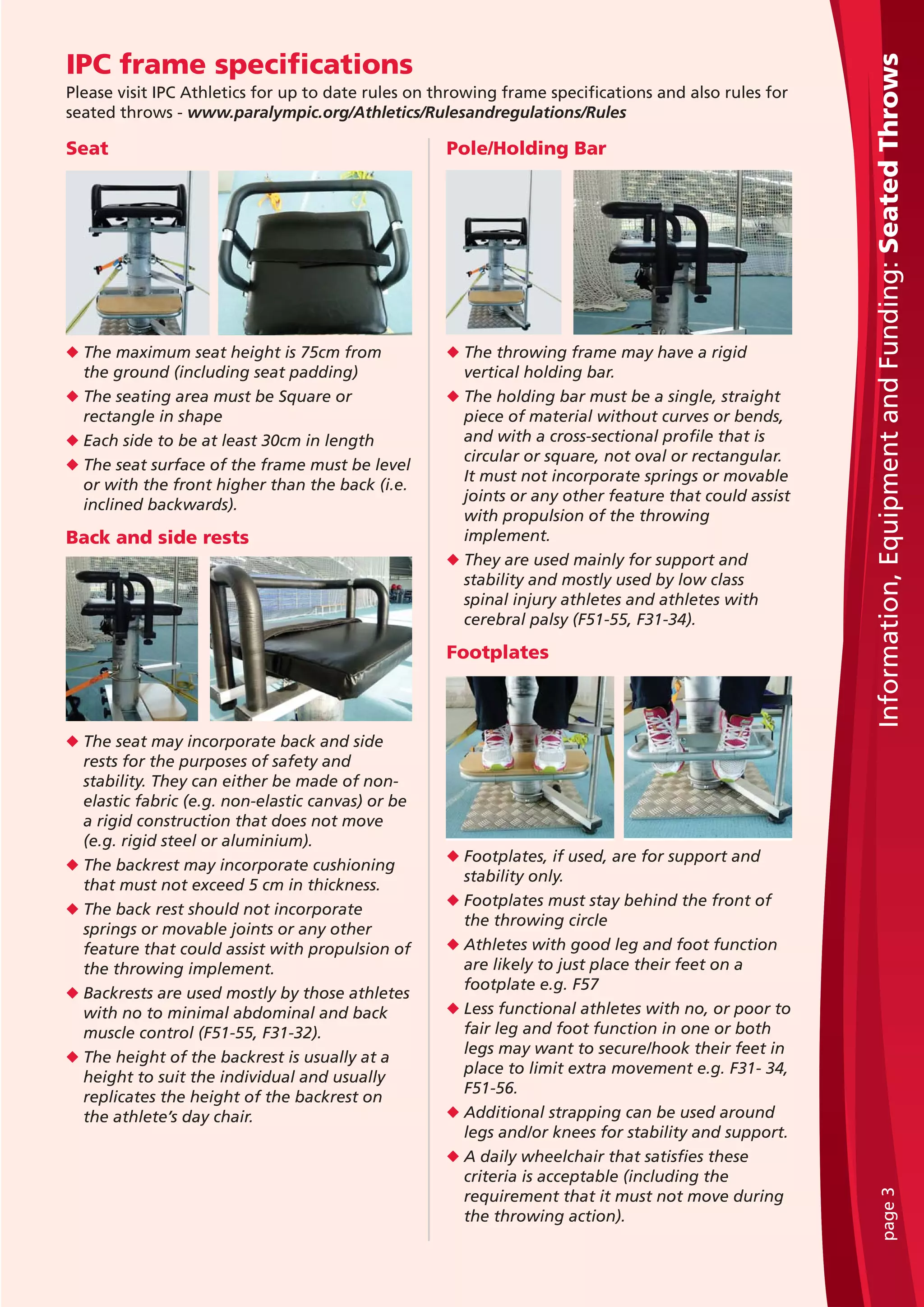
Seat
u The maximum seat height is 75cm from
the ground (including seat padding)
u The seating area must be Square or
rectangle in shape
u Each side to be at least 30cm in length
u The seat surface of the frame must be level
or with the front higher than the back (i.e.
inclined backwards).
Back and side rests
u The seat may incorporate back and side
rests for the purposes of safety and
stability. They can either be made of non-
elastic fabric (e.g. non-elastic canvas) or be
a rigid construction that does not move
(e.g. rigid steel or aluminium).
u The backrest may incorporate cushioning
that must not exceed 5 cm in thickness.
u The back rest should not incorporate
springs or movable joints or any other
feature that could assist with propulsion of
the throwing implement.
u Backrests are used mostly by those athletes
with no to minimal abdominal and back
muscle control (F51-55, F31-32).
u The height of the backrest is usually at a
height to suit the individual and usually
replicates the height of the backrest on
the athlete’s day chair.
Pole/Holding Bar
u The throwing frame may have a rigid
vertical holding bar.
u The holding bar must be a single, straight
piece of material without curves or bends,
and with a cross-sectional profile that is
circular or square, not oval or rectangular.
It must not incorporate springs or movable
joints or any other feature that could assist
with propulsion of the throwing
implement.
u They are used mainly for support and
stability and mostly used by low class
spinal injury athletes and athletes with
cerebral palsy (F51-55, F31-34).
Footplates
u Footplates, if used, are for support and
stability only.
u Footplates must stay behind the front of
the throwing circle
u Athletes with good leg and foot function
are likely to just place their feet on a
footplate e.g. F57
u Less functional athletes with no, or poor to
fair leg and foot function in one or both
legs may want to secure/hook their feet in
place to limit extra movement e.g. F31- 34,
F51-56.
u Additional strapping can be used around
legs and/or knees for stability and support.
u A daily wheelchair that satisfies these
criteria is acceptable (including the
requirement that it must not move during
the throwing action).
Information,EquipmentandFunding:SeatedThrowspage3
IPC frame specifications
Please visit IPC Athletics for up to date rules on throwing frame specifications and also rules for
seated throws - www.paralympic.org/Athletics/Rulesandregulations/Rules
Accessing Throwing
Frames
A fully adjustable throwing frame, the
‘Protean STF’ is now available for purchase
through England Athletics, full information
at www.englandathletics.org/protean. It
enables athletics clubs to provide training
opportunities for new and beginner athletes
who want to try seated throwing.
The throwing frame meets the IPC Athletics
rule specifications and has anchor points for
securing it to the ground when throwing. It
is easily adjustable so multiple athletes are
able to use it, and will also assist the coach
with developing the functional template for
those athletes that commit to the sport and
may need a more bespoke throwing frame.
Bespoke frames are designed and
engineered around an individual athlete that
has committed to training and competing.
Currently, the construction of each individual
throwing frame is mainly driven by an
empirical approach, relying on the feedback
from coaches and athletes as well as
apparent functionality and sensations of
comfort.*
The fully adjustable throwing frame
described above now makes this process
simpler, by assisting with the development of
an individual athlete’s functional template.
This functional template can then be taken
to local welders/fabricators for design and
manufacture.
Further information and contact details can
be accessed by visiting
www.englandathletics.org/protean
JGB Engineering also manufacture the
Throwster throwing frame. More
information can be found by visiting
www.throwster.weebly.com
The following national organisations are also
able to design, develop and manufacture
bespoke items of equipment for disabled
people.
Remap: www.remap.org.uk
Demand: www.demand.org.uk
* Frossard L, O’Riordan A, Goodman S. ‘Applied biomechanics for
evidence-based training of Australian elite seated throwers’, in
Sport for persons with a disability, ICSSPE, Editor. 2006,
International Council of Sport Science and Physical Education
“Perspectives” series. 175-198. 2
Securing Throwing
Frames & Wheelchairs
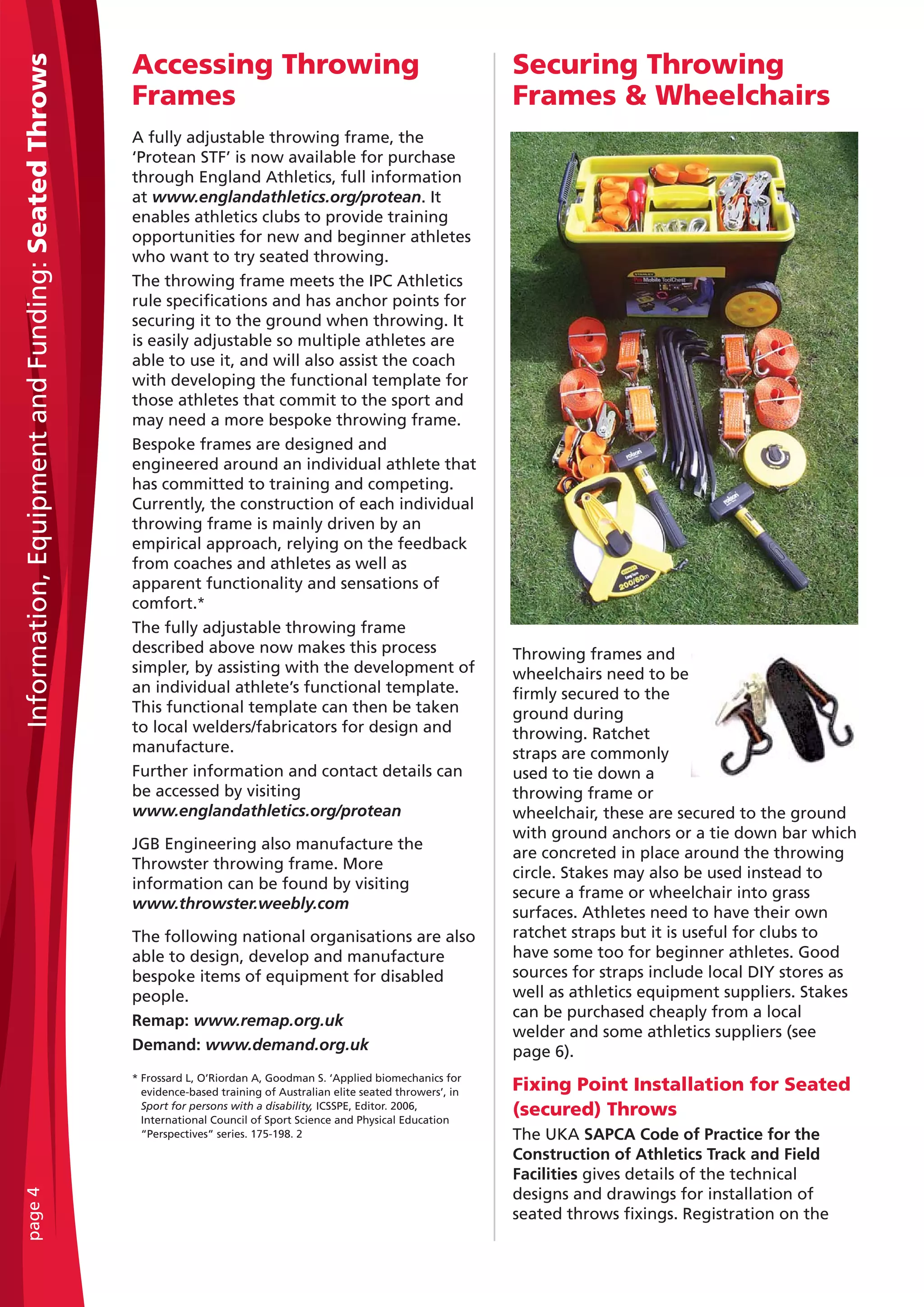
Throwing frames and
wheelchairs need to be
firmly secured to the
ground during
throwing. Ratchet
straps are commonly
used to tie down a
throwing frame or
wheelchair, these are secured to the ground
with ground anchors or a tie down bar which
are concreted in place around the throwing
circle. Stakes may also be used instead to
secure a frame or wheelchair into grass
surfaces. Athletes need to have their own
ratchet straps but it is useful for clubs to
have some too for beginner athletes. Good
sources for straps include local DIY stores as
well as athletics equipment suppliers. Stakes
can be purchased cheaply from a local
welder and some athletics suppliers (see
page 6).
Fixing Point Installation for Seated
(secured) Throws
The UKA SAPCA Code of Practice for the
Construction of Athletics Track and Field
Facilities gives details of the technical
designs and drawings for installation of
seated throws fixings. Registration on the
Information,EquipmentandFunding:SeatedThrowspage4
following website is free, and will allow any
changes or revisions to the Code of Practice
to be emailed directly.
www.sapca.org.uk/quick-links/athletics-tracks
For all new build/refurbishment projects
provision should be made to accommodate
athletes using throwing frames or
wheelchairs by installing throws circle fixing
points.
Fixings for Performance Facilities
and Higher Level Domestic and
International Competition
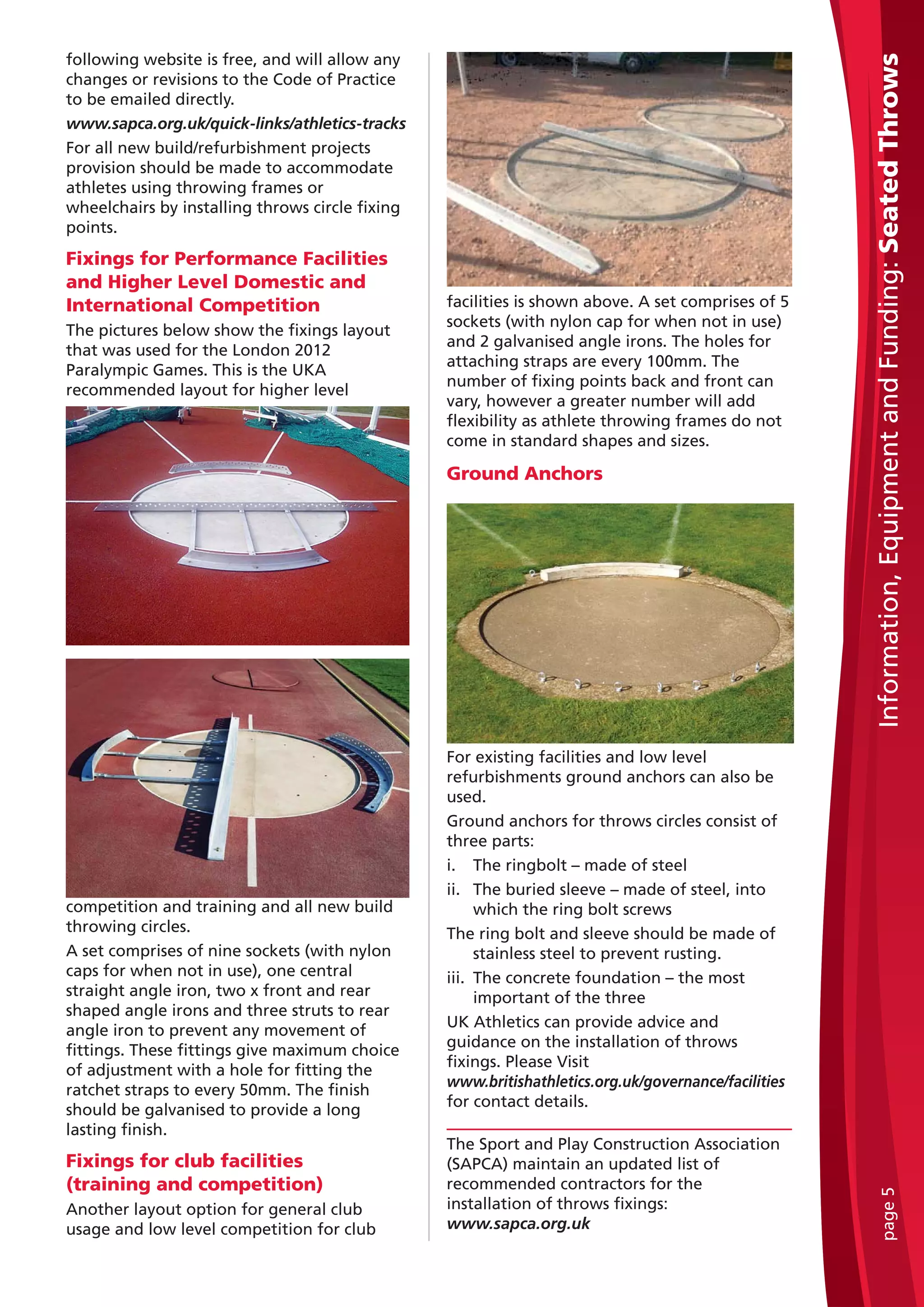
The pictures below show the fixings layout
that was used for the London 2012
Paralympic Games. This is the UKA
recommended layout for higher level
competition and training and all new build
throwing circles.
A set comprises of nine sockets (with nylon
caps for when not in use), one central
straight angle iron, two x front and rear
shaped angle irons and three struts to rear
angle iron to prevent any movement of
fittings. These fittings give maximum choice
of adjustment with a hole for fitting the
ratchet straps to every 50mm. The finish
should be galvanised to provide a long
lasting finish.
Fixings for club facilities
(training and competition)
Another layout option for general club
usage and low level competition for club
facilities is shown above. A set comprises of 5
sockets (with nylon cap for when not in use)
and 2 galvanised angle irons. The holes for
attaching straps are every 100mm. The
number of fixing points back and front can
vary, however a greater number will add
flexibility as athlete throwing frames do not
come in standard shapes and sizes.
Ground Anchors
For existing facilities and low level
refurbishments ground anchors can also be
used.
Ground anchors for throws circles consist of
three parts:
i. The ringbolt – made of steel
ii. The buried sleeve – made of steel, into
which the ring bolt screws
The ring bolt and sleeve should be made of
stainless steel to prevent rusting.
iii. The concrete foundation – the most
important of the three
UK Athletics can provide advice and
guidance on the installation of throws
fixings. Please Visit
www.britishathletics.org.uk/governance/facilities
for contact details.
The Sport and Play Construction Association
(SAPCA) maintain an updated list of
recommended contractors for the
installation of throws fixings:
www.sapca.org.uk
Information,EquipmentandFunding:SeatedThrowspage5
Throwing Platforms or Stakes
When throwing circles with fixings are not
available it is also possible for athletes to
throw from throwing platforms or for
throwing frames and wheelchairs to be
secured using stakes in the ground. These
fixing methods are best done only in training
situations and full throwing circles should be
used wherever possible for competition.
Particular attention should be paid to the
safety and distance of other athletes and any
other persons when throwing without a
cage, especially during club or javelin
training or competition. It is advisable NOT
to participate in discus without a cage under
any circumstance.
Throwing Implements
Disabled athletes throw different weight
implements and details of the recommended
weights and age groups are available from
the IPC (International Paralympic Committee)
Rules:
www.paralympic.org/Athletics/
Rulesandregulations/Rules
In general, standard size implements can be
used by disabled athletes with a couple of
exceptions:
u Club – A throwing club has 2 main head
types, round or square, and a competition
club weighs 397g.
u Shot – Smaller sized, same weight shots
are available for dwarf /short stature
athletes who have smaller hands and
therefore more difficulty holding the
larger implements.
Suppliers
This is not an exhaustive list but throwing
implements can be purchased from:
Eveque
www.eveque.co.uk
Neuff
www.neuff.co.uk
Stadia Sports
www.stadia.sports.co.uk
Track and Field Sports
www.trackandfieldsports.co.uk
Safari Sports
www.safarisports.com
Information,EquipmentandFunding:SeatedThrowspage6
Funding Advice
Below are some tips for applying for funding
from local charities and private
organisations:
u Read the criteria carefully before
applying.
u Charities have limited funding themselves
and are often run by volunteers, so
decisions may not be immediate.
u Local support is often faster, through
smaller contributions, fundraising and
personal savings:
u Fundraising: ebay, car boot sales,
sponsored events, parties
u Local businesses
u Local groups: Lions Club, Rotary
International, Round Table etc.
u School PTA etc.
u Local Councils, Districts etc. often have
details of trusts, charities and grants
In all cases providing your own contribution
will help an application, and remember the
sport will cost money through training,
travel, race entries, and accommodation.
Showing that you are already committed,
using borrowed or second-hand equipment,
being a member of a club and have UKA
classification will also boost an application.
There are details of funding opportunities
listed below, this is some general advice and
not an exhaustive list. As funding
opportunities change regularly we
recommend doing your own research too.
Your local County Sports Partnership will
have details of any local funding
opportunities.
Funding Opportunities
Funding Central
For funding advice and to search for funding
opportunities visit Funding Central:
www.fundingcentral.org.uk
Adam Millichip Foundation
Individuals looking to improve their quality
of life by taking up a new venture. Athletes
new to the sport, not for competition
purposes.
www.adammillichipfoundation.org
Aspire
Supporting people with a spinal injury. Part-
funding for new equipment only.
www.aspire.org.uk/1aspire-grants.aspx
Barchester Charitable Foundation
Adults with a physical disability.
£1,500 to £5,000.
www.bhcfoundation.org.uk
Boparan Charitable Trust
(Children under 18 years)
www.theboparancharitabletrust.com
Cash4Kids
Regional
www.cashforkids.uk.com
Caudwell Children
Children under 18 years. Means-tested.
www.caudwellchildren.com
Cerebra
Children up to 16 years with neurological
disability (i.e. CP, Brain Damage). Up to 80%.
www.cerebra.org.uk/English/gethelp/grants/
Pages/default.aspx
Challenged Athlete Foundation
IPC eligible - i.e. must have a UKA
classification, max $2,500.
www.challengedathletes.org
Children’s Hope Foundation
Individuals and clubs, look under the
downloads section for an application form.
www.childrenshopefoundation.org.uk
Children Today
Up to 25 years.
www.childrentoday.org.uk
Dickie Bird Foundation
Children under 18 years.
www.thedickiebirdfoundation.co.uk
Dream It Believe It Achieve It
www.dreamitbelieveitachieveit.com
Elifar Foundation
Children and Adults
www.elifarfoundation.org.uk
Information,EquipmentandFunding:SeatedThrowspage7
Family Fund
Children under 18 years. Means-tested.
www.familyfund.org.uk
Get Kids Going
Children up to 26 years.
www.getkidsgoing.com
Richard Overall Trust
Young people and students
www.richardoveralltrust.co.uk
Roald Dahl Charity
Up to 25 years with specific conditions of
blood or brain, up to £500.
www.roalddahl.com/charity
SF Charity
Disabled people - all ages. Up to £1,000
suggested limit, Midlands only.
www.sfcharity.co.uk/
Sport England Small Grants
Clubs only
www.sportengland.org/funding/
small_grants.aspx
Variety
Children up to 18 years, individuals and clubs.
www.variety.org.uk/
WheelPower Wheel Appeal
Individuals and clubs)
www.wheelpower.org.uk/WPower/index.cfm
/what-we-do/wheel-appeal/
WhizzKidz
Children under 18 years.
www.whizz-kidz.org.uk/get-our-help/
equipment
Women’s Sport Trust
Individuals and clubs, grants of £500-£5,000,
females only.
www.womenssporttrust.com
Other sources
Also try local Lions Clubs, Rotary
International, Round Table etc.
Information,EquipmentandFunding:SeatedThrowspage8
Acknowledgements
England Athletics would like to thank WheelPower, British Wheelchair Athletics Association, CP
Sport and Alison O’Riordan Sports Consultancy for their input on this resource.

Bancos de Lançamento

  • 1.
    page1 Information, Equipment andFunding: Seated Throws Seated Throws Seated, or secured, throwing takes place in a throws circle. The events cover shot, javelin, discus and club and are available to those athletes that are unable to stand and/or have balance and stability problems that make throwing from an ambulant position difficult. Athletes in the seated throwing events throw from either their day chairs, or from custom made throwing frames, which are secured to the ground by straps. Classification & Eligibility The impairments and classifications associated with seated throwing events are: u Athletes with cerebral palsy (or similar) - F31, F32, F33, F34 u Athletes with spinal injury - F51, F52, F53, F54, F55, F56 u Athletes with lower limb loss (or similar) - F57 Classification is coordinated nationally by British Athletics. A classification is required to enter all Parallel Success competitions and for results to be recognised on the UK Rankings (www.thepowerof10.info). u For ‘An Introduction to Classification’ video and downloadable factsheet visit: http://ucoach.com/video/an-introduction-to-classification-in-athletics u For more information and changes to eligibility rules see IPC Athletics: www.paralympic.org/Athletics/RulesandRegulations/Classification
  • 2.
    Throwing Frames Throwing framesare individually designed assistive devices which are scaffold-like chairs made of metal bars and plates welded together. The main purpose of the throwing frame is to assist in weight bearing. Consequently, it contributes to the performance of an athlete by enabling the optimum throwing action (range of movement, velocity of body segments, final body position at release etc).* A variety of different classes are eligible to compete in seated throws, consequently, there is a range of frames within and between the different classes of athletes. Information,EquipmentandFunding:SeatedThrowspage2 Seat (with strap) Back/side rests Anchor straps Pole/holding bar Hooks for straps Footplate or Foothook *Frossard L, O’Riordan A, Goodman S. ‘Throwing frame and performance of elite male seated shot-putters’. Sports Technology. 2010. 3 (2), p 88-101. DOI: 10.1080/19346182.2010.542005.
  • 3.
    Seat u The maximumseat height is 75cm from the ground (including seat padding) u The seating area must be Square or rectangle in shape u Each side to be at least 30cm in length u The seat surface of the frame must be level or with the front higher than the back (i.e. inclined backwards). Back and side rests u The seat may incorporate back and side rests for the purposes of safety and stability. They can either be made of non- elastic fabric (e.g. non-elastic canvas) or be a rigid construction that does not move (e.g. rigid steel or aluminium). u The backrest may incorporate cushioning that must not exceed 5 cm in thickness. u The back rest should not incorporate springs or movable joints or any other feature that could assist with propulsion of the throwing implement. u Backrests are used mostly by those athletes with no to minimal abdominal and back muscle control (F51-55, F31-32). u The height of the backrest is usually at a height to suit the individual and usually replicates the height of the backrest on the athlete’s day chair. Pole/Holding Bar u The throwing frame may have a rigid vertical holding bar. u The holding bar must be a single, straight piece of material without curves or bends, and with a cross-sectional profile that is circular or square, not oval or rectangular. It must not incorporate springs or movable joints or any other feature that could assist with propulsion of the throwing implement. u They are used mainly for support and stability and mostly used by low class spinal injury athletes and athletes with cerebral palsy (F51-55, F31-34). Footplates u Footplates, if used, are for support and stability only. u Footplates must stay behind the front of the throwing circle u Athletes with good leg and foot function are likely to just place their feet on a footplate e.g. F57 u Less functional athletes with no, or poor to fair leg and foot function in one or both legs may want to secure/hook their feet in place to limit extra movement e.g. F31- 34, F51-56. u Additional strapping can be used around legs and/or knees for stability and support. u A daily wheelchair that satisfies these criteria is acceptable (including the requirement that it must not move during the throwing action). Information,EquipmentandFunding:SeatedThrowspage3 IPC frame specifications Please visit IPC Athletics for up to date rules on throwing frame specifications and also rules for seated throws - www.paralympic.org/Athletics/Rulesandregulations/Rules
  • 4.
    Accessing Throwing Frames A fullyadjustable throwing frame, the ‘Protean STF’ is now available for purchase through England Athletics, full information at www.englandathletics.org/protean. It enables athletics clubs to provide training opportunities for new and beginner athletes who want to try seated throwing. The throwing frame meets the IPC Athletics rule specifications and has anchor points for securing it to the ground when throwing. It is easily adjustable so multiple athletes are able to use it, and will also assist the coach with developing the functional template for those athletes that commit to the sport and may need a more bespoke throwing frame. Bespoke frames are designed and engineered around an individual athlete that has committed to training and competing. Currently, the construction of each individual throwing frame is mainly driven by an empirical approach, relying on the feedback from coaches and athletes as well as apparent functionality and sensations of comfort.* The fully adjustable throwing frame described above now makes this process simpler, by assisting with the development of an individual athlete’s functional template. This functional template can then be taken to local welders/fabricators for design and manufacture. Further information and contact details can be accessed by visiting www.englandathletics.org/protean JGB Engineering also manufacture the Throwster throwing frame. More information can be found by visiting www.throwster.weebly.com The following national organisations are also able to design, develop and manufacture bespoke items of equipment for disabled people. Remap: www.remap.org.uk Demand: www.demand.org.uk * Frossard L, O’Riordan A, Goodman S. ‘Applied biomechanics for evidence-based training of Australian elite seated throwers’, in Sport for persons with a disability, ICSSPE, Editor. 2006, International Council of Sport Science and Physical Education “Perspectives” series. 175-198. 2 Securing Throwing Frames & Wheelchairs Throwing frames and wheelchairs need to be firmly secured to the ground during throwing. Ratchet straps are commonly used to tie down a throwing frame or wheelchair, these are secured to the ground with ground anchors or a tie down bar which are concreted in place around the throwing circle. Stakes may also be used instead to secure a frame or wheelchair into grass surfaces. Athletes need to have their own ratchet straps but it is useful for clubs to have some too for beginner athletes. Good sources for straps include local DIY stores as well as athletics equipment suppliers. Stakes can be purchased cheaply from a local welder and some athletics suppliers (see page 6). Fixing Point Installation for Seated (secured) Throws The UKA SAPCA Code of Practice for the Construction of Athletics Track and Field Facilities gives details of the technical designs and drawings for installation of seated throws fixings. Registration on the Information,EquipmentandFunding:SeatedThrowspage4
  • 5.
    following website isfree, and will allow any changes or revisions to the Code of Practice to be emailed directly. www.sapca.org.uk/quick-links/athletics-tracks For all new build/refurbishment projects provision should be made to accommodate athletes using throwing frames or wheelchairs by installing throws circle fixing points. Fixings for Performance Facilities and Higher Level Domestic and International Competition The pictures below show the fixings layout that was used for the London 2012 Paralympic Games. This is the UKA recommended layout for higher level competition and training and all new build throwing circles. A set comprises of nine sockets (with nylon caps for when not in use), one central straight angle iron, two x front and rear shaped angle irons and three struts to rear angle iron to prevent any movement of fittings. These fittings give maximum choice of adjustment with a hole for fitting the ratchet straps to every 50mm. The finish should be galvanised to provide a long lasting finish. Fixings for club facilities (training and competition) Another layout option for general club usage and low level competition for club facilities is shown above. A set comprises of 5 sockets (with nylon cap for when not in use) and 2 galvanised angle irons. The holes for attaching straps are every 100mm. The number of fixing points back and front can vary, however a greater number will add flexibility as athlete throwing frames do not come in standard shapes and sizes. Ground Anchors For existing facilities and low level refurbishments ground anchors can also be used. Ground anchors for throws circles consist of three parts: i. The ringbolt – made of steel ii. The buried sleeve – made of steel, into which the ring bolt screws The ring bolt and sleeve should be made of stainless steel to prevent rusting. iii. The concrete foundation – the most important of the three UK Athletics can provide advice and guidance on the installation of throws fixings. Please Visit www.britishathletics.org.uk/governance/facilities for contact details. The Sport and Play Construction Association (SAPCA) maintain an updated list of recommended contractors for the installation of throws fixings: www.sapca.org.uk Information,EquipmentandFunding:SeatedThrowspage5
  • 6.
    Throwing Platforms orStakes When throwing circles with fixings are not available it is also possible for athletes to throw from throwing platforms or for throwing frames and wheelchairs to be secured using stakes in the ground. These fixing methods are best done only in training situations and full throwing circles should be used wherever possible for competition. Particular attention should be paid to the safety and distance of other athletes and any other persons when throwing without a cage, especially during club or javelin training or competition. It is advisable NOT to participate in discus without a cage under any circumstance. Throwing Implements Disabled athletes throw different weight implements and details of the recommended weights and age groups are available from the IPC (International Paralympic Committee) Rules: www.paralympic.org/Athletics/ Rulesandregulations/Rules In general, standard size implements can be used by disabled athletes with a couple of exceptions: u Club – A throwing club has 2 main head types, round or square, and a competition club weighs 397g. u Shot – Smaller sized, same weight shots are available for dwarf /short stature athletes who have smaller hands and therefore more difficulty holding the larger implements. Suppliers This is not an exhaustive list but throwing implements can be purchased from: Eveque www.eveque.co.uk Neuff www.neuff.co.uk Stadia Sports www.stadia.sports.co.uk Track and Field Sports www.trackandfieldsports.co.uk Safari Sports www.safarisports.com Information,EquipmentandFunding:SeatedThrowspage6
  • 7.
    Funding Advice Below aresome tips for applying for funding from local charities and private organisations: u Read the criteria carefully before applying. u Charities have limited funding themselves and are often run by volunteers, so decisions may not be immediate. u Local support is often faster, through smaller contributions, fundraising and personal savings: u Fundraising: ebay, car boot sales, sponsored events, parties u Local businesses u Local groups: Lions Club, Rotary International, Round Table etc. u School PTA etc. u Local Councils, Districts etc. often have details of trusts, charities and grants In all cases providing your own contribution will help an application, and remember the sport will cost money through training, travel, race entries, and accommodation. Showing that you are already committed, using borrowed or second-hand equipment, being a member of a club and have UKA classification will also boost an application. There are details of funding opportunities listed below, this is some general advice and not an exhaustive list. As funding opportunities change regularly we recommend doing your own research too. Your local County Sports Partnership will have details of any local funding opportunities. Funding Opportunities Funding Central For funding advice and to search for funding opportunities visit Funding Central: www.fundingcentral.org.uk Adam Millichip Foundation Individuals looking to improve their quality of life by taking up a new venture. Athletes new to the sport, not for competition purposes. www.adammillichipfoundation.org Aspire Supporting people with a spinal injury. Part- funding for new equipment only. www.aspire.org.uk/1aspire-grants.aspx Barchester Charitable Foundation Adults with a physical disability. £1,500 to £5,000. www.bhcfoundation.org.uk Boparan Charitable Trust (Children under 18 years) www.theboparancharitabletrust.com Cash4Kids Regional www.cashforkids.uk.com Caudwell Children Children under 18 years. Means-tested. www.caudwellchildren.com Cerebra Children up to 16 years with neurological disability (i.e. CP, Brain Damage). Up to 80%. www.cerebra.org.uk/English/gethelp/grants/ Pages/default.aspx Challenged Athlete Foundation IPC eligible - i.e. must have a UKA classification, max $2,500. www.challengedathletes.org Children’s Hope Foundation Individuals and clubs, look under the downloads section for an application form. www.childrenshopefoundation.org.uk Children Today Up to 25 years. www.childrentoday.org.uk Dickie Bird Foundation Children under 18 years. www.thedickiebirdfoundation.co.uk Dream It Believe It Achieve It www.dreamitbelieveitachieveit.com Elifar Foundation Children and Adults www.elifarfoundation.org.uk Information,EquipmentandFunding:SeatedThrowspage7
  • 8.
    Family Fund Children under18 years. Means-tested. www.familyfund.org.uk Get Kids Going Children up to 26 years. www.getkidsgoing.com Richard Overall Trust Young people and students www.richardoveralltrust.co.uk Roald Dahl Charity Up to 25 years with specific conditions of blood or brain, up to £500. www.roalddahl.com/charity SF Charity Disabled people - all ages. Up to £1,000 suggested limit, Midlands only. www.sfcharity.co.uk/ Sport England Small Grants Clubs only www.sportengland.org/funding/ small_grants.aspx Variety Children up to 18 years, individuals and clubs. www.variety.org.uk/ WheelPower Wheel Appeal Individuals and clubs) www.wheelpower.org.uk/WPower/index.cfm /what-we-do/wheel-appeal/ WhizzKidz Children under 18 years. www.whizz-kidz.org.uk/get-our-help/ equipment Women’s Sport Trust Individuals and clubs, grants of £500-£5,000, females only. www.womenssporttrust.com Other sources Also try local Lions Clubs, Rotary International, Round Table etc. Information,EquipmentandFunding:SeatedThrowspage8 Acknowledgements England Athletics would like to thank WheelPower, British Wheelchair Athletics Association, CP Sport and Alison O’Riordan Sports Consultancy for their input on this resource.