






Balancing Centrality and
Distinctiveness for Mapping
Brand Strategy
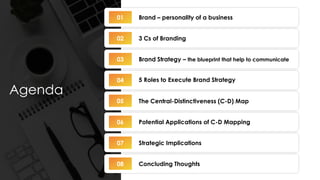
Brand – personality of a business01
3 Cs of Branding02
Brand Strategy – the blueprint that help to communicate03
5 Roles to Execute Brand Strategy04
The Central-Distinctiveness (C-D) Map05
Potential Applications of C-D Mapping06
Strategic Implications07
Concluding Thoughts08
Agenda
Brand – personality
of a business
A brand is a feeling
people have about you.
Brand = Mind Set
The sum of all communications and experiences
received by the consumer and customer resulting
in a distinctive image in their “mind set” based on
perceived emotional and functional benefits.
A brand is the personality of a business. The modern
concepts views a brand as consisting of four levels
• generic
• expected
• augmented
• potential
“
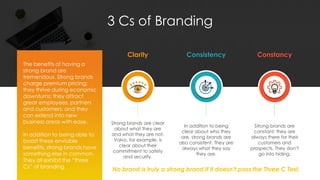
3 Cs of Branding
The benefits of having a
strong brand are
tremendous. Strong brands
charge premium pricing;
they thrive during economic
downturns; they attract
great employees, partners
and customers; and they
can extend into new
business areas with ease.
In addition to being able to
boast these enviable
benefits, strong brands have
something else in common.
They all exhibit the “three
Cs” of branding.
Strong brands are clear
about what they are
and what they are not.
Volvo, for example, is
clear about their
commitment to safety
and security.
In addition to being
clear about who they
are, strong brands are
also consistent. They are
always what they say
they are.
Strong brands are
constant; they are
always there for their
customers and
prospects. They don’t
go into hiding.
Clarity Consistency Constancy
No brand is truly a strong brand if it doesn’t pass the Three C Test.
Brand Strategy –
the blueprint that
help to
communicate
A brand strategy is “a plan for the
systematic development of brand in
alignment with a business strategy.
– branding guru Marty Neumeier
The brand strategy process can be
broken into three distinct parts.
• Brand Heart - the core of the brand
• Brand Messaging - how brand talk
about the brand
• Visual Identity - the visual expression
of the brand.
Align brand and
business goals by
bridging the gap
between brand and
business.
Preserved brand
identity, oversee
and enforce brand
guidelines
Align marketing to
brand strategy,
oversee content
creating and
coordination of
teams/resources
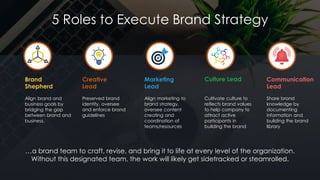
Brand
Shepherd
5 Roles to Execute Brand Strategy
…a brand team to craft, revise, and bring it to life at every level of the organization.
Without this designated team, the work will likely get sidetracked or steamrolled.
Creative
Lead
Marketing
Lead
Culture Lead Communication
Lead
Cultivate culture to
reflects brand values
to help company to
attract active
participants in
building the brand
Share brand
knowledge by
documenting
information and
building the brand
library
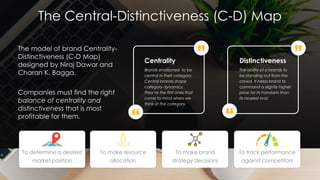
Centrality
Brands envisioned to be
central in their category.
Central brands shape
category dynamics.
They’re the first ones that
come to mind when we
think of the category.
Distinctiveness
The ability of a brands to
be standing out from the
crowd. It helps brand to
command a slightly higher
price for its handsets than
its nearest rival
The Central-Distinctiveness (C-D) Map
Companies must find the right
balance of centrality and
distinctiveness that is most
profitable for them.
The model of brand Centrality-
Distinctiveness (C-D Map)
designed by Niraj Dawar and
Charan K. Bagga.
To determine a desired
market position
To make resource
allocation
To make brand
strategy decisions
To track performance
against competitors
Producing a
C-D Map 01
Niche players, meaning that
they are decidedly distinctive,
and not particularly central.
Unconventional
02
Both central and distinctive –
meaning that they have high
sales volume, but can still
command high prices
Aspirational
03 Neither central nor distinctive,
yet they can still generate high
profits due to low marketing
and innovation costs
Peripheral
04
Central but not distinctive and
are often carefully aligned to
appeal to popular tastes.
Generally regarded as reliable,
recognizable brands.
Mainstream
Centrality
how representative the brand is in category
Distinctiveness
degreetowhichbrandstandoutof
crowd
Unconventional Aspirational
Peripheral Mainstream
The C-D map is split on a 2x2 basis, with 4
distinct quadrants. Where the brand falls
on the map – based on its unique
coordinates – has implications for key
decisions such as pricing, sales volumes,
risk, and profitability.
* Circles are sized according to brands’ performance on
financial matrix.
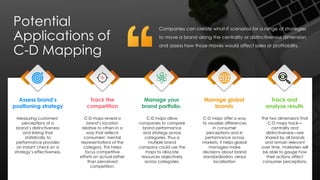
Companies can create what-if scenarios for a range of strategies
to move a brand along the centrality or distinctiveness dimension
and assess how those moves would affect sales or profitability.
Potential
Applications of
C-D Mapping
Measuring customers’
perceptions of a
brand’s distinctiveness
and linking that
statistically to
performance provides
an instant check on a
strategy’s effectiveness.
Assess brand’s
positioning strategy
Track the
competition
Manage your
brand portfolio.
Manage global
brands
Track and
analyze results
C-D maps reveal a
brand’s location
relative to others in a
way that reflects
consumers’ mental
representations of the
category. This helps
focus competitive
efforts on actual rather
than perceived
competition.
C-D maps allow
companies to compare
brand performance
and strategy across
categories. Thus a
multiple brand
company could use the
maps to allocate
resources objectively
across categories.
C-D maps offer a way
to visualize differences
in consumer
perceptions and in
performance across
markets. it helps global
managers make
decisions about brand
standardization versus
localization
The two dimensions that
C-D maps track—
centrality and
distinctiveness—are
shared by all brands
and remain relevant
over time. marketers will
be able to gauge how
their actions affect
consumer perceptions.
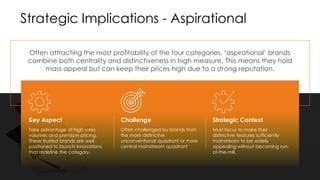
Strategic Implications - Aspirational
Often attracting the most profitability of the four categories, ‘aspirational’ brands
combine both centrality and distinctiveness in high measure. This means they hold
mass appeal but can keep their prices high due to a strong reputation.
Take advantage of high sales
volumes and premium pricing.
These trusted brands are well
positioned to launch innovations
that redefine the category.
Key Aspect
Often challenged by brands from
the more distinctive
unconventional quadrant or more
central mainstream quadrant
Challenge
Must focus to make their
distinctive features sufficiently
mainstream to be widely
appealing without becoming run-
of-the-mill.
Strategic Context
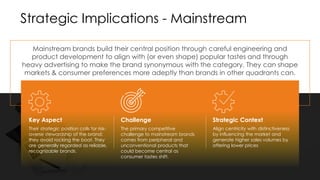
Strategic Implications - Mainstream
Mainstream brands build their central position through careful engineering and
product development to align with (or even shape) popular tastes and through
heavy advertising to make the brand synonymous with the category. They can shape
markets & consumer preferences more adeptly than brands in other quadrants can.
Their strategic position calls for risk-
averse stewardship of the brand;
they avoid rocking the boat. They
are generally regarded as reliable,
recognizable brands.
Key Aspect
The primary competitive
challenge to mainstream brands
comes from peripheral and
unconventional products that
could become central as
consumer tastes shift.
Challenge
Align centricity with distinctiveness
by influencing the market and
generate higher sales volumes by
offering lower prices
Strategic Context
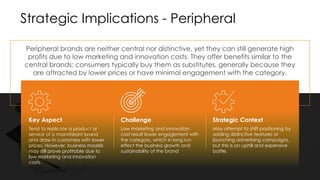
Strategic Implications - Peripheral
Peripheral brands are neither central nor distinctive, yet they can still generate high
profits due to low marketing and innovation costs. They offer benefits similar to the
central brands; consumers typically buy them as substitutes, generally because they
are attracted by lower prices or have minimal engagement with the category.
Tend to replicate a product or
service of a mainstream brand
and draw in customers with lower
prices. However, business models
may still prove profitable due to
low marketing and innovation
costs.
Key Aspect
Low marketing and innovation
cost result lower engagement with
the category, which in long run
effect the business growth and
sustainability of the brand
Challenge
May attempt to shift positioning by
adding distinctive features or
launching advertising campaigns,
but this is an uphill and expensive
battle.
Strategic Context
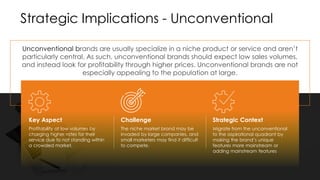
Strategic Implications - Unconventional
Unconventional brands are usually specialize in a niche product or service and aren’t
particularly central. As such, unconventional brands should expect low sales volumes,
and instead look for profitability through higher prices. Unconventional brands are not
especially appealing to the population at large.
Profitability at low volumes by
charging higher rates for their
service due to not standing within
a crowded market.
Key Aspect
The niche market brand may be
invaded by large companies, and
small marketers may find it difficult
to compete.
Challenge
Migrate from the unconventional
to the aspirational quadrant by
making the brand’s unique
features more mainstream or
adding mainstream features
Strategic Context
Concluding Thought
In a nutshell, the central-distinctive map helps companies
assess the strengths and weaknesses of the brand by
repeatedly chart position following campaigns, incentives
and otherwise and track how these changes have
affected this. It can help to decide whether to stay in
place or find the strategies that will help them move to a
more advantageous quadrant.
i a m m o u l u d e . w o r d p r e s s . c o m
Things that Describe ME!
A person with intense personal magnetism and a great love of home and
family. One of the most important traits of my personality is I am detail-
oriented and have a hard time letting something rest until I am satisfied it’s
complete and accurate.
In my personal time and on my own world I am very sensitive and often
think about my childhood and how it affects me in the present. Learning
to let go of things is something that will contribute greatly to my happiness
and success in life.
Besides my professional commitments and responsibilities I am very much
fond of bonding with people. In my personal world I used to write poems
and short stories.
ME
about
Modhyo Badda, Dhaka, Bangladesh.
+8801914538413
iammoulude.wordpress.com
mdmoulude@gmail.com
FinTech | Digital Payment | Product and Strategy|
QR Payment | Entrepreneur | Business Development
Md. Moulude Hossain
THANK
YOU

Balancing Centrality and Distinctiveness for Mapping Brand Strategy

  • 1.
    Balancing Centrality and Distinctivenessfor Mapping Brand Strategy
  • 2.
    Brand – personalityof a business01 3 Cs of Branding02 Brand Strategy – the blueprint that help to communicate03 5 Roles to Execute Brand Strategy04 The Central-Distinctiveness (C-D) Map05 Potential Applications of C-D Mapping06 Strategic Implications07 Concluding Thoughts08 Agenda
  • 3.
    Brand – personality ofa business A brand is a feeling people have about you. Brand = Mind Set The sum of all communications and experiences received by the consumer and customer resulting in a distinctive image in their “mind set” based on perceived emotional and functional benefits. A brand is the personality of a business. The modern concepts views a brand as consisting of four levels • generic • expected • augmented • potential “
  • 4.
    3 Cs ofBranding The benefits of having a strong brand are tremendous. Strong brands charge premium pricing; they thrive during economic downturns; they attract great employees, partners and customers; and they can extend into new business areas with ease. In addition to being able to boast these enviable benefits, strong brands have something else in common. They all exhibit the “three Cs” of branding. Strong brands are clear about what they are and what they are not. Volvo, for example, is clear about their commitment to safety and security. In addition to being clear about who they are, strong brands are also consistent. They are always what they say they are. Strong brands are constant; they are always there for their customers and prospects. They don’t go into hiding. Clarity Consistency Constancy No brand is truly a strong brand if it doesn’t pass the Three C Test.
  • 5.
    Brand Strategy – theblueprint that help to communicate A brand strategy is “a plan for the systematic development of brand in alignment with a business strategy. – branding guru Marty Neumeier The brand strategy process can be broken into three distinct parts. • Brand Heart - the core of the brand • Brand Messaging - how brand talk about the brand • Visual Identity - the visual expression of the brand.
  • 6.
    Align brand and businessgoals by bridging the gap between brand and business. Preserved brand identity, oversee and enforce brand guidelines Align marketing to brand strategy, oversee content creating and coordination of teams/resources Brand Shepherd 5 Roles to Execute Brand Strategy …a brand team to craft, revise, and bring it to life at every level of the organization. Without this designated team, the work will likely get sidetracked or steamrolled. Creative Lead Marketing Lead Culture Lead Communication Lead Cultivate culture to reflects brand values to help company to attract active participants in building the brand Share brand knowledge by documenting information and building the brand library
  • 7.
    Centrality Brands envisioned tobe central in their category. Central brands shape category dynamics. They’re the first ones that come to mind when we think of the category. Distinctiveness The ability of a brands to be standing out from the crowd. It helps brand to command a slightly higher price for its handsets than its nearest rival The Central-Distinctiveness (C-D) Map Companies must find the right balance of centrality and distinctiveness that is most profitable for them. The model of brand Centrality- Distinctiveness (C-D Map) designed by Niraj Dawar and Charan K. Bagga. To determine a desired market position To make resource allocation To make brand strategy decisions To track performance against competitors
  • 8.
    Producing a C-D Map01 Niche players, meaning that they are decidedly distinctive, and not particularly central. Unconventional 02 Both central and distinctive – meaning that they have high sales volume, but can still command high prices Aspirational 03 Neither central nor distinctive, yet they can still generate high profits due to low marketing and innovation costs Peripheral 04 Central but not distinctive and are often carefully aligned to appeal to popular tastes. Generally regarded as reliable, recognizable brands. Mainstream Centrality how representative the brand is in category Distinctiveness degreetowhichbrandstandoutof crowd Unconventional Aspirational Peripheral Mainstream The C-D map is split on a 2x2 basis, with 4 distinct quadrants. Where the brand falls on the map – based on its unique coordinates – has implications for key decisions such as pricing, sales volumes, risk, and profitability. * Circles are sized according to brands’ performance on financial matrix.
  • 9.
    Companies can createwhat-if scenarios for a range of strategies to move a brand along the centrality or distinctiveness dimension and assess how those moves would affect sales or profitability. Potential Applications of C-D Mapping Measuring customers’ perceptions of a brand’s distinctiveness and linking that statistically to performance provides an instant check on a strategy’s effectiveness. Assess brand’s positioning strategy Track the competition Manage your brand portfolio. Manage global brands Track and analyze results C-D maps reveal a brand’s location relative to others in a way that reflects consumers’ mental representations of the category. This helps focus competitive efforts on actual rather than perceived competition. C-D maps allow companies to compare brand performance and strategy across categories. Thus a multiple brand company could use the maps to allocate resources objectively across categories. C-D maps offer a way to visualize differences in consumer perceptions and in performance across markets. it helps global managers make decisions about brand standardization versus localization The two dimensions that C-D maps track— centrality and distinctiveness—are shared by all brands and remain relevant over time. marketers will be able to gauge how their actions affect consumer perceptions.
  • 10.
    Strategic Implications -Aspirational Often attracting the most profitability of the four categories, ‘aspirational’ brands combine both centrality and distinctiveness in high measure. This means they hold mass appeal but can keep their prices high due to a strong reputation. Take advantage of high sales volumes and premium pricing. These trusted brands are well positioned to launch innovations that redefine the category. Key Aspect Often challenged by brands from the more distinctive unconventional quadrant or more central mainstream quadrant Challenge Must focus to make their distinctive features sufficiently mainstream to be widely appealing without becoming run- of-the-mill. Strategic Context
  • 11.
    Strategic Implications -Mainstream Mainstream brands build their central position through careful engineering and product development to align with (or even shape) popular tastes and through heavy advertising to make the brand synonymous with the category. They can shape markets & consumer preferences more adeptly than brands in other quadrants can. Their strategic position calls for risk- averse stewardship of the brand; they avoid rocking the boat. They are generally regarded as reliable, recognizable brands. Key Aspect The primary competitive challenge to mainstream brands comes from peripheral and unconventional products that could become central as consumer tastes shift. Challenge Align centricity with distinctiveness by influencing the market and generate higher sales volumes by offering lower prices Strategic Context
  • 12.
    Strategic Implications -Peripheral Peripheral brands are neither central nor distinctive, yet they can still generate high profits due to low marketing and innovation costs. They offer benefits similar to the central brands; consumers typically buy them as substitutes, generally because they are attracted by lower prices or have minimal engagement with the category. Tend to replicate a product or service of a mainstream brand and draw in customers with lower prices. However, business models may still prove profitable due to low marketing and innovation costs. Key Aspect Low marketing and innovation cost result lower engagement with the category, which in long run effect the business growth and sustainability of the brand Challenge May attempt to shift positioning by adding distinctive features or launching advertising campaigns, but this is an uphill and expensive battle. Strategic Context
  • 13.
    Strategic Implications -Unconventional Unconventional brands are usually specialize in a niche product or service and aren’t particularly central. As such, unconventional brands should expect low sales volumes, and instead look for profitability through higher prices. Unconventional brands are not especially appealing to the population at large. Profitability at low volumes by charging higher rates for their service due to not standing within a crowded market. Key Aspect The niche market brand may be invaded by large companies, and small marketers may find it difficult to compete. Challenge Migrate from the unconventional to the aspirational quadrant by making the brand’s unique features more mainstream or adding mainstream features Strategic Context
  • 14.
    Concluding Thought In anutshell, the central-distinctive map helps companies assess the strengths and weaknesses of the brand by repeatedly chart position following campaigns, incentives and otherwise and track how these changes have affected this. It can help to decide whether to stay in place or find the strategies that will help them move to a more advantageous quadrant.
  • 15.
    i a mm o u l u d e . w o r d p r e s s . c o m Things that Describe ME! A person with intense personal magnetism and a great love of home and family. One of the most important traits of my personality is I am detail- oriented and have a hard time letting something rest until I am satisfied it’s complete and accurate. In my personal time and on my own world I am very sensitive and often think about my childhood and how it affects me in the present. Learning to let go of things is something that will contribute greatly to my happiness and success in life. Besides my professional commitments and responsibilities I am very much fond of bonding with people. In my personal world I used to write poems and short stories. ME about Modhyo Badda, Dhaka, Bangladesh. +8801914538413 iammoulude.wordpress.com mdmoulude@gmail.com FinTech | Digital Payment | Product and Strategy| QR Payment | Entrepreneur | Business Development Md. Moulude Hossain
  • 16.