




Presentation
of Entrepreneurship
On the Topic of
Marketing Plan
Group Members









Rana Absar Ahmed (Leader)
Samina Yaqoob
Salman Tareen
Hafiz Muhammad Ameen
Rana Moazam Ali (CR)
Noor-ul-Ain (GR)
Zia Rajwana
Muhammad Saqib (Assistant Leader)
Index
Marketing Plan
 Marketing Mix
 4 P‟s & C‟s
 Target Marketing
 Market Segmentation
 Marketing Strategies
 Implementation Of Marketing Plan

Marketing Plan Defined
Before we move to M.P Let’s
Discuss the Following first
 Marketing

mix
 4 C‟s & P‟s
 Market Segmentation
 Target Market
 Marketing Strategies
Marketing Mix Defined
Marketing mix is the set
of marketing tool that the
firm uses to pursue its
marketing objectives in the
target market.
Now what these tools are….
Let‟s just say that ….
When marketing those products a firms
need to create a successful mix of:
 the right product
 sold at the right price
 in the right place
 using the most suitable promotion
To create the right marketing mix, businesses
have to meet the following conditions:
 The product has to have the right features - for
example, it must look good and work well.
 The price must be right. Consumer will need to
buy in large numbers to produce a healthy
profit.
 The goods must be in the right place at the
right time. Making sure that the goods arrive
when and where they are wanted is an
important operation.
 The target group needs to be made aware of
the existence and availability of the product
through promotion. Successful promotion
helps a firm to spread costs over a larger
output
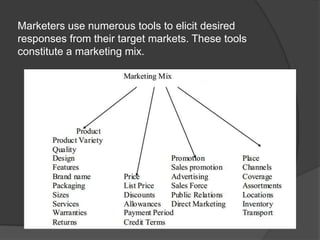
Marketers use numerous tools to elicit desired
responses from their target markets. These tools
constitute a marketing mix.
Well what you know we have
actually discussed the 4 P‟s of
Marketing mix. Now what were 4
C‟s my mate was talking
about….
I‟d say to achieve 4 P‟s we need to
convert 4 P‟s into 4 C‟s without
that We can‟t Complete
marketing mix. And its also
important for the purpose to
market the product.
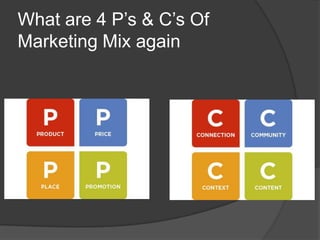
What are 4 P‟s & C‟s Of
Marketing Mix again
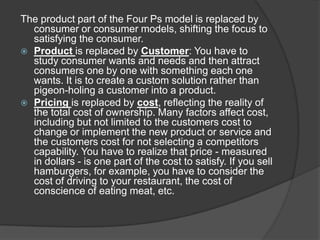
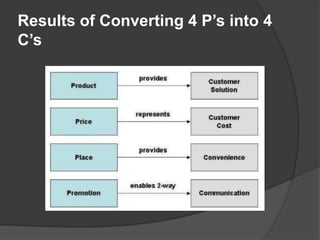
The product part of the Four Ps model is replaced by
consumer or consumer models, shifting the focus to
satisfying the consumer.
 Product is replaced by Customer: You have to
study consumer wants and needs and then attract
consumers one by one with something each one
wants. It is to create a custom solution rather than
pigeon-holing a customer into a product.
 Pricing is replaced by cost, reflecting the reality of
the total cost of ownership. Many factors affect cost,
including but not limited to the customers cost to
change or implement the new product or service and
the customers cost for not selecting a competitors
capability. You have to realize that price - measured
in dollars - is one part of the cost to satisfy. If you sell
hamburgers, for example, you have to consider the
cost of driving to your restaurant, the cost of
conscience of eating meat, etc.
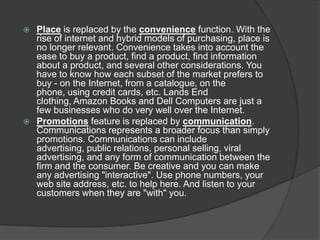
Place is replaced by the convenience function. With the
rise of internet and hybrid models of purchasing, place is
no longer relevant. Convenience takes into account the
ease to buy a product, find a product, find information
about a product, and several other considerations. You
have to know how each subset of the market prefers to
buy - on the Internet, from a catalogue, on the
phone, using credit cards, etc. Lands End
clothing, Amazon Books and Dell Computers are just a
few businesses who do very well over the Internet.
 Promotions feature is replaced by communication.
Communications represents a broader focus than simply
promotions. Communications can include
advertising, public relations, personal selling, viral
advertising, and any form of communication between the
firm and the consumer. Be creative and you can make
any advertising "interactive". Use phone numbers, your
web site address, etc. to help here. And listen to your
customers when they are "with" you.

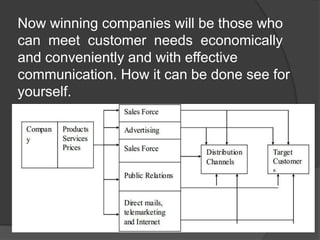
Now winning companies will be those who
can meet customer needs economically
and conveniently and with effective
communication. How it can be done see for
yourself.
Results of Converting 4 P’s into 4
C’s
Target Marketing Defined
A target market is a group of customers that
the business has decided to aim its
marketing efforts and ultimately its
merchandise towards. A well-defined target
market is the first element to a marketing
strategy The marketing mix variables of
product, place (distribution), promotion and
price are the four elements of a marketing
mix strategy that determine the success of
a product in the marketplace.
Target marketing means identifying specific
market segments within a larger audience
and targeting them with ad campaigns.
This process is commonplace in marketing
and helps companies get more value for
their advertising investment. It goes against
historical approaches to marketing
whereby companies would simply pay to
deliver messages to mass markets without
considering the waste in paying to reach
consumers who would never buy. By
targeting select markets, businesses with
tight budgets can get more return from their
advertising dollars.
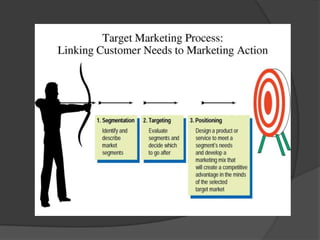
Segmentation
Segmenting means breaking up the market into
smaller, homogeneous segments. Within S-T-P, it is
a virtual brainstorming step where by the business
considers all possible market segments. Segmenting
strategies
include
demographics, lifestyle, geographic and behavioral
approaches. Demographics segmentation means
you break up markets based on personal traits like
age, race, marital status, gender and income.
Lifestyle segmenting means you divide customers by
hobbies and interests. Geographic segmentation
makes local, state, regional, national or international
markets key. Behavioral segmenting is based on
such things as usage patterns and benefits sought
from the product.
Targeting
Following the brainstorming of possible
segments in step one, the next step is to
pick a select market to target or focus on.
Companies often focus on one market
segment at a time with marketing and ad
campaigns. Whichever market is the most
attractive from a profit standpoint or longterm potential is usually selected first.
Factors including size of the
market, growth potential and competitive
intensity impact the perceived opportunity
in targeting a given market.
Positioning
Positioning is how the company wants the
targeted market to perceive its brand or
product. Some companies make quality a key
positioning message and try to market their
product as top quality for the target market
segment. Other qualities commonly used to
differentiate include service, unique
features, environmental friendliness, family
friendliness, safety, reliability, durability and
low cost. The key is to stand out from
competitors with a unique message that
appeals to the interests of the targeted market
Market Segmentation Defined
Philip Kotler's Says Market Segmentation
Is Subdividing Of Market Into
Homogeneous Sub Set Of Customers
Where Any Subset May Conceivably Be
Selected As Marketing Target With To
Be Reached With Essays and Term
Papers .









Marketers can rarely satisfy everyone in
the market. So they start with ‗ market
segmentation„.
Identify and profile different groups of
buyers.
Target segments that present the
greatest opportunity – those whose
needs the firm can meet in a superior
fashion.
For each chosen target market, the firm
develops a market offering, which is
positioned as offering some central benefit
Marketers view the sellers as
constituting the industry and the buyers
as constituting the market.
Markets May Be Segmented
On Following Grounds.
Need markets (the diet seeking market)
 Product markets (the shoe market)
 Demographic markets (the youth
market)
 Geographic market (the French market)
 Other markets like voter markets, donor
markets and labor markets.
 Marketplace v/s market space – physical
v/s digital

Marketing Strategies
Defined
Marketing strategy is defined by David Aaker as
a process that can allow an organization to
concentrate its resources on the optimal
opportunities with the goals of increasing sales
and achieving a sustainable competitive
advantage. Marketing strategy includes all
basic and long-term activities in the field of
marketing that deal with the analysis of the
strategic initial situation of a company and the
formulation, evaluation and selection of
market-oriented strategies and therefore
contribute to the goals of the company and its
marketing objectives
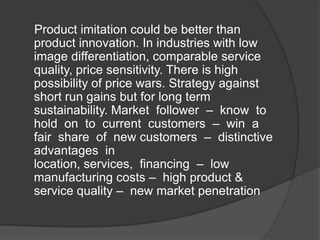
Product imitation could be better than
product innovation. In industries with low
image differentiation, comparable service
quality, price sensitivity. There is high
possibility of price wars. Strategy against
short run gains but for long term
sustainability. Market follower – know to
hold on to current customers – win a
fair share of new customers – distinctive
advantages in
location, services, financing – low
manufacturing costs – high product &
service quality – new market penetration
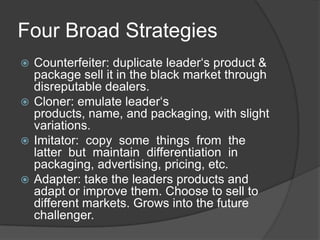
Four Broad Strategies
Counterfeiter: duplicate leader„s product &
package sell it in the black market through
disreputable dealers.
 Cloner: emulate leader„s
products, name, and packaging, with slight
variations.
 Imitator: copy some things from the
latter but maintain differentiation in
packaging, advertising, pricing, etc.
 Adapter: take the leaders products and
adapt or improve them. Choose to sell to
different markets. Grows into the future
challenger.

Developing Market Plan for new
product (Implementation of Marketing plan)


Company History:
 Founded 1937 by Paul and Marie Lamfrom in Portland, Oregon. Began as
a small hat distributor but quickly expanded into
outerwear, sportswear, footwear, accessories, and equipment.



Mission Statement:
 “Columbia Sportswear outfits outdoor enthusiasts with unmatched
performance and advanced technology from head to toe with
outerwear, sportswear, footwear, and accessories”
 Key competitors: The North Face, Patagonia, Timberland



Industry Background
 Apparel Manufacturing Industry, (subsector Outerwear Manufacturing)
 $7.2 Billion, 6% growth - 2006
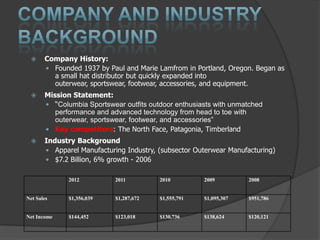
2012

2011

2010

2009

2008

Net Sales

$1,356,039

$1,287,672

$1,555,791

$1,095,307

$951,786

Net Income

$144,452

$123,018

$130,736

$138,624

$120,121



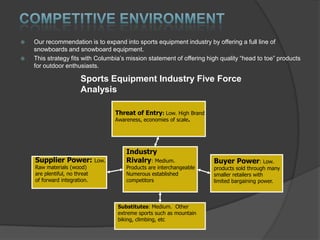
Our recommendation is to expand into sports equipment industry by offering a full line of
snowboards and snowboard equipment.
This strategy fits with Columbia‟s mission statement of offering high quality “head to toe” products
for outdoor enthusiasts.

Sports Equipment Industry Five Force
Analysis
Threat of Entry: Low. High Brand
Awareness, economies of scale.

Supplier Power:
Raw materials (wood)
are plentiful, no threat
of forward integration.

Low.

Industry
Rivalry: Medium.

Products are interchangeable
Numerous established
competitors

Substitutes: Medium. Other
extreme sports such as mountain
biking, climbing, etc

Buyer Power: Low.

products sold through many
smaller retailers with
limited bargaining power.
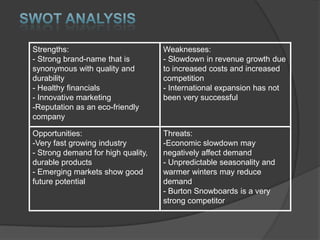
Strengths:
- Strong brand-name that is
synonymous with quality and
durability
- Healthy financials
- Innovative marketing
-Reputation as an eco-friendly
company

Weaknesses:
- Slowdown in revenue growth due
to increased costs and increased
competition
- International expansion has not
been very successful

Opportunities:
-Very fast growing industry
- Strong demand for high quality,
durable products
- Emerging markets show good
future potential

Threats:
-Economic slowdown may
negatively affect demand
- Unpredictable seasonality and
warmer winters may reduce
demand
- Burton Snowboards is a very
strong competitor
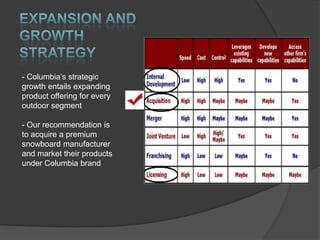
- Columbia‟s strategic
growth entails expanding
product offering for every
outdoor segment

- Our recommendation is
to acquire a premium
snowboard manufacturer
and market their products
under Columbia brand











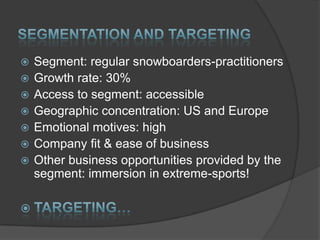
Segment: regular snowboarders-practitioners
Growth rate: 30%
Access to segment: accessible
Geographic concentration: US and Europe
Emotional motives: high
Company fit & ease of business
Other business opportunities provided by the
segment: immersion in extreme-sports!
Demographics



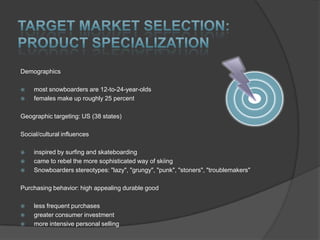
most snowboarders are 12-to-24-year-olds
females make up roughly 25 percent

Geographic targeting: US (38 states)
Social/cultural influences




inspired by surfing and skateboarding
came to rebel the more sophisticated way of skiing
Snowboarders stereotypes: "lazy", "grungy", "punk", "stoners", "troublemakers"

Purchasing behavior: high appealing durable good




less frequent purchases
greater consumer investment
more intensive personal selling
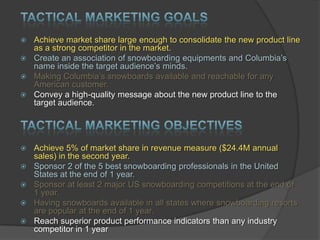
Achieve market share large enough to consolidate the new product line
as a strong competitor in the market.
 Create an association of snowboarding equipments and Columbia‟s
name inside the target audience‟s minds.
 Making Columbia‟s snowboards available and reachable for any
American customer.
 Convey a high-quality message about the new product line to the
target audience.








Achieve 5% of market share in revenue measure ($24.4M annual
sales) in the second year.
Sponsor 2 of the 5 best snowboarding professionals in the United
States at the end of 1 year.
Sponsor at least 2 major US snowboarding competitions at the end of
1 year.
Having snowboards available in all states where snowboarding resorts
are popular at the end of 1 year.
Reach superior product performance indicators than any industry
competitor in 1 year
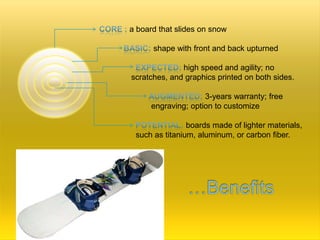
a board that slides on snow
shape with front and back upturned
high speed and agility; no
scratches, and graphics printed on both sides.
3-years warranty; free
engraving; option to customize
boards made of lighter materials,
such as titanium, aluminum, or carbon fiber.
Performance



high performance levels
constantly assessed: indoor, in a science lab; and
outdoor, a team of pros and amateurs will take the boards
to the slopes and subject them to different riding styles and
terrains
Price-value-quality relationship

• both amateurs and professionals  it
is imperative to deliver a high valueadded product
• practice of higher prices than the
average of competition
Market plan

Market plan

  • 2.
  • 3.
    Group Members         Rana AbsarAhmed (Leader) Samina Yaqoob Salman Tareen Hafiz Muhammad Ameen Rana Moazam Ali (CR) Noor-ul-Ain (GR) Zia Rajwana Muhammad Saqib (Assistant Leader)
  • 4.
    Index Marketing Plan  MarketingMix  4 P‟s & C‟s  Target Marketing  Market Segmentation  Marketing Strategies  Implementation Of Marketing Plan 
  • 5.
  • 6.
    Before we moveto M.P Let’s Discuss the Following first  Marketing mix  4 C‟s & P‟s  Market Segmentation  Target Market  Marketing Strategies
  • 7.
    Marketing Mix Defined Marketingmix is the set of marketing tool that the firm uses to pursue its marketing objectives in the target market. Now what these tools are….
  • 8.
    Let‟s just saythat …. When marketing those products a firms need to create a successful mix of:  the right product  sold at the right price  in the right place  using the most suitable promotion
  • 9.
    To create theright marketing mix, businesses have to meet the following conditions:  The product has to have the right features - for example, it must look good and work well.  The price must be right. Consumer will need to buy in large numbers to produce a healthy profit.  The goods must be in the right place at the right time. Making sure that the goods arrive when and where they are wanted is an important operation.  The target group needs to be made aware of the existence and availability of the product through promotion. Successful promotion helps a firm to spread costs over a larger output
  • 10.
    Marketers use numeroustools to elicit desired responses from their target markets. These tools constitute a marketing mix.
  • 11.
    Well what youknow we have actually discussed the 4 P‟s of Marketing mix. Now what were 4 C‟s my mate was talking about…. I‟d say to achieve 4 P‟s we need to convert 4 P‟s into 4 C‟s without that We can‟t Complete marketing mix. And its also important for the purpose to market the product.
  • 12.
    What are 4P‟s & C‟s Of Marketing Mix again
  • 13.
    The product partof the Four Ps model is replaced by consumer or consumer models, shifting the focus to satisfying the consumer.  Product is replaced by Customer: You have to study consumer wants and needs and then attract consumers one by one with something each one wants. It is to create a custom solution rather than pigeon-holing a customer into a product.  Pricing is replaced by cost, reflecting the reality of the total cost of ownership. Many factors affect cost, including but not limited to the customers cost to change or implement the new product or service and the customers cost for not selecting a competitors capability. You have to realize that price - measured in dollars - is one part of the cost to satisfy. If you sell hamburgers, for example, you have to consider the cost of driving to your restaurant, the cost of conscience of eating meat, etc.
  • 14.
    Place is replacedby the convenience function. With the rise of internet and hybrid models of purchasing, place is no longer relevant. Convenience takes into account the ease to buy a product, find a product, find information about a product, and several other considerations. You have to know how each subset of the market prefers to buy - on the Internet, from a catalogue, on the phone, using credit cards, etc. Lands End clothing, Amazon Books and Dell Computers are just a few businesses who do very well over the Internet.  Promotions feature is replaced by communication. Communications represents a broader focus than simply promotions. Communications can include advertising, public relations, personal selling, viral advertising, and any form of communication between the firm and the consumer. Be creative and you can make any advertising "interactive". Use phone numbers, your web site address, etc. to help here. And listen to your customers when they are "with" you. 
  • 15.
    Now winning companieswill be those who can meet customer needs economically and conveniently and with effective communication. How it can be done see for yourself.
  • 16.
    Results of Converting4 P’s into 4 C’s
  • 17.
    Target Marketing Defined Atarget market is a group of customers that the business has decided to aim its marketing efforts and ultimately its merchandise towards. A well-defined target market is the first element to a marketing strategy The marketing mix variables of product, place (distribution), promotion and price are the four elements of a marketing mix strategy that determine the success of a product in the marketplace.
  • 18.
    Target marketing meansidentifying specific market segments within a larger audience and targeting them with ad campaigns. This process is commonplace in marketing and helps companies get more value for their advertising investment. It goes against historical approaches to marketing whereby companies would simply pay to deliver messages to mass markets without considering the waste in paying to reach consumers who would never buy. By targeting select markets, businesses with tight budgets can get more return from their advertising dollars.
  • 20.
    Segmentation Segmenting means breakingup the market into smaller, homogeneous segments. Within S-T-P, it is a virtual brainstorming step where by the business considers all possible market segments. Segmenting strategies include demographics, lifestyle, geographic and behavioral approaches. Demographics segmentation means you break up markets based on personal traits like age, race, marital status, gender and income. Lifestyle segmenting means you divide customers by hobbies and interests. Geographic segmentation makes local, state, regional, national or international markets key. Behavioral segmenting is based on such things as usage patterns and benefits sought from the product.
  • 21.
    Targeting Following the brainstormingof possible segments in step one, the next step is to pick a select market to target or focus on. Companies often focus on one market segment at a time with marketing and ad campaigns. Whichever market is the most attractive from a profit standpoint or longterm potential is usually selected first. Factors including size of the market, growth potential and competitive intensity impact the perceived opportunity in targeting a given market.
  • 22.
    Positioning Positioning is howthe company wants the targeted market to perceive its brand or product. Some companies make quality a key positioning message and try to market their product as top quality for the target market segment. Other qualities commonly used to differentiate include service, unique features, environmental friendliness, family friendliness, safety, reliability, durability and low cost. The key is to stand out from competitors with a unique message that appeals to the interests of the targeted market
  • 23.
    Market Segmentation Defined PhilipKotler's Says Market Segmentation Is Subdividing Of Market Into Homogeneous Sub Set Of Customers Where Any Subset May Conceivably Be Selected As Marketing Target With To Be Reached With Essays and Term Papers .
  • 24.
         Marketers can rarelysatisfy everyone in the market. So they start with ‗ market segmentation„. Identify and profile different groups of buyers. Target segments that present the greatest opportunity – those whose needs the firm can meet in a superior fashion. For each chosen target market, the firm develops a market offering, which is positioned as offering some central benefit Marketers view the sellers as constituting the industry and the buyers as constituting the market.
  • 25.
    Markets May BeSegmented On Following Grounds. Need markets (the diet seeking market)  Product markets (the shoe market)  Demographic markets (the youth market)  Geographic market (the French market)  Other markets like voter markets, donor markets and labor markets.  Marketplace v/s market space – physical v/s digital 
  • 26.
    Marketing Strategies Defined Marketing strategyis defined by David Aaker as a process that can allow an organization to concentrate its resources on the optimal opportunities with the goals of increasing sales and achieving a sustainable competitive advantage. Marketing strategy includes all basic and long-term activities in the field of marketing that deal with the analysis of the strategic initial situation of a company and the formulation, evaluation and selection of market-oriented strategies and therefore contribute to the goals of the company and its marketing objectives
  • 27.
    Product imitation couldbe better than product innovation. In industries with low image differentiation, comparable service quality, price sensitivity. There is high possibility of price wars. Strategy against short run gains but for long term sustainability. Market follower – know to hold on to current customers – win a fair share of new customers – distinctive advantages in location, services, financing – low manufacturing costs – high product & service quality – new market penetration
  • 28.
    Four Broad Strategies Counterfeiter:duplicate leader„s product & package sell it in the black market through disreputable dealers.  Cloner: emulate leader„s products, name, and packaging, with slight variations.  Imitator: copy some things from the latter but maintain differentiation in packaging, advertising, pricing, etc.  Adapter: take the leaders products and adapt or improve them. Choose to sell to different markets. Grows into the future challenger. 
  • 29.
    Developing Market Planfor new product (Implementation of Marketing plan)
  • 30.
     Company History:  Founded1937 by Paul and Marie Lamfrom in Portland, Oregon. Began as a small hat distributor but quickly expanded into outerwear, sportswear, footwear, accessories, and equipment.  Mission Statement:  “Columbia Sportswear outfits outdoor enthusiasts with unmatched performance and advanced technology from head to toe with outerwear, sportswear, footwear, and accessories”  Key competitors: The North Face, Patagonia, Timberland  Industry Background  Apparel Manufacturing Industry, (subsector Outerwear Manufacturing)  $7.2 Billion, 6% growth - 2006 2012 2011 2010 2009 2008 Net Sales $1,356,039 $1,287,672 $1,555,791 $1,095,307 $951,786 Net Income $144,452 $123,018 $130,736 $138,624 $120,121
  • 31.
      Our recommendation isto expand into sports equipment industry by offering a full line of snowboards and snowboard equipment. This strategy fits with Columbia‟s mission statement of offering high quality “head to toe” products for outdoor enthusiasts. Sports Equipment Industry Five Force Analysis Threat of Entry: Low. High Brand Awareness, economies of scale. Supplier Power: Raw materials (wood) are plentiful, no threat of forward integration. Low. Industry Rivalry: Medium. Products are interchangeable Numerous established competitors Substitutes: Medium. Other extreme sports such as mountain biking, climbing, etc Buyer Power: Low. products sold through many smaller retailers with limited bargaining power.
  • 32.
    Strengths: - Strong brand-namethat is synonymous with quality and durability - Healthy financials - Innovative marketing -Reputation as an eco-friendly company Weaknesses: - Slowdown in revenue growth due to increased costs and increased competition - International expansion has not been very successful Opportunities: -Very fast growing industry - Strong demand for high quality, durable products - Emerging markets show good future potential Threats: -Economic slowdown may negatively affect demand - Unpredictable seasonality and warmer winters may reduce demand - Burton Snowboards is a very strong competitor
  • 33.
    - Columbia‟s strategic growthentails expanding product offering for every outdoor segment - Our recommendation is to acquire a premium snowboard manufacturer and market their products under Columbia brand
  • 35.
            Segment: regular snowboarders-practitioners Growthrate: 30% Access to segment: accessible Geographic concentration: US and Europe Emotional motives: high Company fit & ease of business Other business opportunities provided by the segment: immersion in extreme-sports!
  • 36.
    Demographics   most snowboarders are12-to-24-year-olds females make up roughly 25 percent Geographic targeting: US (38 states) Social/cultural influences    inspired by surfing and skateboarding came to rebel the more sophisticated way of skiing Snowboarders stereotypes: "lazy", "grungy", "punk", "stoners", "troublemakers" Purchasing behavior: high appealing durable good    less frequent purchases greater consumer investment more intensive personal selling
  • 38.
    Achieve market sharelarge enough to consolidate the new product line as a strong competitor in the market.  Create an association of snowboarding equipments and Columbia‟s name inside the target audience‟s minds.  Making Columbia‟s snowboards available and reachable for any American customer.  Convey a high-quality message about the new product line to the target audience.       Achieve 5% of market share in revenue measure ($24.4M annual sales) in the second year. Sponsor 2 of the 5 best snowboarding professionals in the United States at the end of 1 year. Sponsor at least 2 major US snowboarding competitions at the end of 1 year. Having snowboards available in all states where snowboarding resorts are popular at the end of 1 year. Reach superior product performance indicators than any industry competitor in 1 year
  • 40.
    a board thatslides on snow shape with front and back upturned high speed and agility; no scratches, and graphics printed on both sides. 3-years warranty; free engraving; option to customize boards made of lighter materials, such as titanium, aluminum, or carbon fiber.
  • 41.
    Performance   high performance levels constantlyassessed: indoor, in a science lab; and outdoor, a team of pros and amateurs will take the boards to the slopes and subject them to different riding styles and terrains Price-value-quality relationship • both amateurs and professionals  it is imperative to deliver a high valueadded product • practice of higher prices than the average of competition