ļ‚— Bailment (derived from French word ā€˜bailer’)
ļ‚— A Bailment is the delivery of goods by one person to
another for some purpose , upon a contract that they
shall, when the purpose is accomplished , be returned
or otherwise disposed of according to the directions of
the person delivering them .
 The person delivering the goods is called the ā€˜bailor’ and
the person to whom they are delivered is called the ā€˜bailee’.
E.g.:
ļ‚— A delivers a piece of cloth to B ,a tailor ,to be stitched in to a
suit. there is a contract of bailment between A and B.
ļ‚— Hiring a bicycle
ļ‚— Delivering watch for repair
1. Delivery of possession
2. Delivery of goods should be upon a contract
3. Delivery of goods must be for a specific purpose
4. Return of specific goods in specie(same)
1.Delivery of the Goods:
The first unique feature of bailment is that the bailor
must transfer his possession of goods to the bailee.
The goods should be put in the legal possession of the
bailee.
Delivery may be of two types:
a. Actual delivery: Handing over physical possession of the
goods.
b. Constructive delivery: Only effect of putting the goods
into the bailee’s possession.
2.Delivery of goods should be upon a Contract :
When a persons ā€˜s goods go into the possession of
another without any contract there is no bailment.
However a finder of lost goods of another is considered
to be a bailee even though there is no real contract
.The contract may be express or implied
3.Delivery of Goods must be for a specific
purpose :
U/S 148 provides , the delivery of goods from bailor to
bailee must be for some purpose .
If goods delivered by mistake to a person , there is
really no bailment .
4.Return of Specific Goods in Specie(same):
Goods should be returned to the bailor or disposed of
according to his direction ,either in their original or in
an altered form , when the purpose of bailment is over.
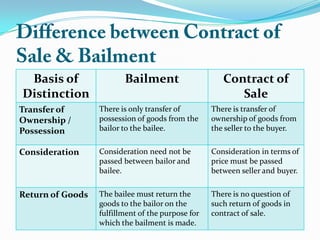
Basis of
Distinction
Bailment Contract of
Sale
Transfer of
Ownership /
Possession
There is only transfer of
possession of goods from the
bailor to the bailee.
There is transfer of
ownership of goods from
the seller to the buyer.
Consideration Consideration need not be
passed between bailor and
bailee.
Consideration in terms of
price must be passed
between seller and buyer.
Return of Goods The bailee must return the
goods to the bailor on the
fulfillment of the purpose for
which the bailment is made.
There is no question of
such return of goods in
contract of sale.
Kinds of bailment Based on benefit:
Bailment for the exclusive benefit of :
1] bailor: leaving goods in safe custody without paying
2] bailee :a loan of some article like a pen
3] mutual benefit: contracts for hiring, repair ,etc
Based on reward:
1] Gratuitous bailment: Goods given to a friend or any
one else, to be used by him without any (unnecessary)
reward or remuneration or consideration.
example: lending a book to a friend
2] Non-gratuitous bailment: bailment of reward:
either bailee or bailor is entitled to a remuneration /
Consideration.
example: hire, tailor, etc
Duties of Bailor = Rights of Bailee
ļ‚— To Disclose faults in goods bailed [ ]
ļ‚— To bear expenses [ ]
ļ‚— To indemnify the bailee [ ]
ļ‚— Liability on premature breach of bailment[ ]
In case of non-gratuitous bailment
ļ‚— Duty to bear the risk of loss [ ]
ļ‚— Duty to receive back the goods[ ]
a) Duty of Disclosure
 In the case of gratuitous bailment , the bailor must
disclose all the known faults to the bailee and if he
doesn’t make such disclosure , he is responsible for
the damage arising to the bailee directly from such
faults .
 In case of bailment for reward the bailor is
responsible irrespective of the knowledge of the
faults in the goods bailed .
b) Duty to Bear Expenses :
If the bailment is gratuitous and the bailee is in no
way benefited , the bailor has to bear the expenses .
In the case of bailment for reward , even though the
bailee is to bear the ordinary and reasonable expenses
of bailment (e.g., feeding of horse lent),
c) Duty to Indemnify the Bailee :
The bailor should indemnify the bailee for any cost or
costs which the bailee may incur because of the
defective title of the bailor to the goods bailed .
Bailor title may be defective:
At the time of bailment.
At the time of receiving back the goods from the
bailee.
At the time of giving directions in respect of the goods
bailed.
Premature termination of gratuitous bailment
Duties of Bailee = Rights of Bailor
ļ‚— Take reasonable care of goods[ ]
ļ‚— Not to make unauthorized use of goods[ ]
ļ‚— Not to mix goods with his own goods[ ]
ļ‚— Duty to return goods[ ]
ļ‚— Returning any profit / accretions[ ]
ļ‚— Not to set up any adverse title
1)To take care of the Goods
ļ‚§ The bailee is bound by the contract of bailment to return the
goods when the purpose of bailment is fulfilled .He has to
take care of the goods while they are in his possession .
ļ‚§ Measure of care depends on nature, quality, quantity, and
value of the goods.
ļ‚§ Bailee is not liable, if events are beyond the control of bailee.
ļ‚§ If stolen, reasonable steps otherwise liable.
ļ‚§ Loss due to the negligence of the servant.
2)Duty not to mix with his own goods :
 : deal with the provisions governing the
rights of the bailor and bailee when there is an inter-
mixing of their goods .
 The bailee has an obligation to keep the goods of the bailor
separate from his own .
a. Mixing the goods with bailor’s consent.
b. Mixing the goods without the bailor’s consent and the
goods are separable.
c. Mixing the goods without the bailor’s consent and the
goods are not separable.
3)Duty to Return the Goods
Duty of the bailee to return the goods without
demand, on the expiration of the time specified or
when the purpose is accomplished .
4)Duty not to use bailed goods in an
Unauthorized Manner [ :
Bailee is under an obligation not to use the goods in an
unauthorized manner or for an unauthorized purpose.
If bailee does so , the bailor can terminate the
bailment , and claim damages for any loss or damage
caused by the unauthorized use .
5)Duty to return any accretion of the
goods [ :
The bailee must return to the bailor any increase or
profits which have accrued from the goods bailed .
 states that the bailor is entitled to the profits
accruing from the goods , unless there is a contract to
the contrary .
6)Duty of Finder of Lost Goods:
A finder of lost goods is a bailee and such he is bound
to take reasonable care of those goods.
He has to return the goods to the real owner if the real
owner pays his lawful charges
ā€œLien is the right of one person to retain
that which is in his possession, belonging to
another, until some debt or claim is paidā€.
1) Particular Lien [Sec.170]:
A particular lien is a right to retain only those goods in
respect of which some charges are due. (Skill & Labor).
Generally, bailee has this lien only.
Conditions:
a) Bailee must have rendered some service in relation to the thing
bailed, must be entitled to some remuneration- and must be
unpaid
b) Service rendered by the bailee must be one involving the exercise
of labor or skill in respect of the goods bailed.
c) Services must have been performed in full –directions of bailor
d) There must not be an agreement to perform the services on credit.
e) The goods must be in possession of the bailee. Bailee loses the
lien, if possession is lost.
f) Must not be any contract to contrary.
2) General Lien [
A general lien is a right to retain all the goods as a security for
the general balance of account until the satisfaction of the
claims due whether in respect of those goods.
Bankers: Has general lien on all goods, cash, cheques and
securities deposited with him as banker by a customer, for any
money due to him as a banker.
Factors: An agent entrusted with the possession of goods for the
purpose of selling on behalf of his principal. If goods are
delivered for some other purpose, no GL
Wharfingers: A person who owns or keeps a wharf.
Wharf: Place, adjoining to water, used for loading and unloading
goods from ships – not to store.
Finder of goods is the person who find some goods which
do not belong to him.
ļ‚— Right to Lien-[ ]
ļ‚— Right to Sue for Reward- [ ]
ļ‚— Right to Sell- [ ]
(i) If owner can not be found.
(ii) If charges are 2/3 rd of value of goods and owner
refuses to pay.
(iii) If goods are perishable in nature.
A finder of goods is subject to the same responsibility
as a bailee. The Duties are
ļ‚— To take reasonable care of the goods bailed
ļ‚— Not to make any unauthorized use of goods
ļ‚— Not to mix the goods bailed with his own goods
ļ‚— To find & return the goods to Owner
ļ‚— On expiry of fixed period[ ]
ļ‚— On accomplishment of object[ ]
ļ‚— Inconsistent use of Goods[ ]
ļ‚— Destruction of subject matter of bailment.
Termination of Gratuitous Bailment:
ļ‚— At desire of the bailor even before the expiry of fixed
period[ ]
ļ‚— Death of the bailor or bailee [ ]
PLEDGE OR PAWN
PLEDGE [ ]:
Bailment of goods as security for payment of debt or
performance of a promise is called Pledge / Pawn.
 In other words, Pledge is a special type of bailment where
transfer of goods is for security of something.
Pledges are a form of security to assure that a person will
repay a debt or perform an act under contract. In a pledge
one person temporarily gives possession of property to
another party.
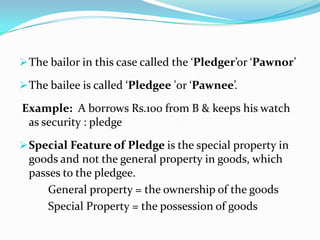
The bailor in this case called the ā€˜Pledger’or ā€˜Pawnor’
The bailee is called ā€˜Pledgee 'or ā€˜Pawnee’.
Example: A borrows Rs.100 from B & keeps his watch
as security : pledge
Special Feature of Pledge is the special property in
goods and not the general property in goods, which
passes to the pledgee.
General property = the ownership of the goods
Special Property = the possession of goods
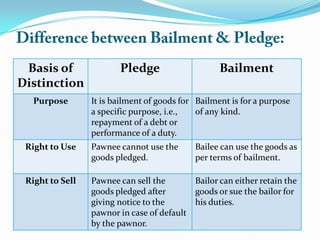
Basis of
Distinction
Pledge Bailment
Purpose It is bailment of goods for
a specific purpose, i.e.,
repayment of a debt or
performance of a duty.
Bailment is for a purpose
of any kind.
Right to Use Pawnee cannot use the
goods pledged.
Bailee can use the goods as
per terms of bailment.
Right to Sell Pawnee can sell the
goods pledged after
giving notice to the
pawnor in case of default
by the pawnor.
Bailor can either retain the
goods or sue the bailor for
his duties.
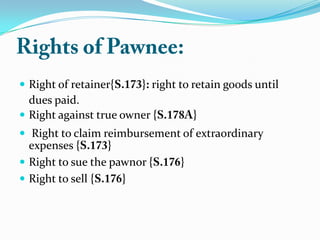
ļ‚— Right of retainer{ }: right to retain goods until
dues paid.
ļ‚— Right against true owner { }
ļ‚— Right to claim reimbursement of extraordinary
expenses { }
ļ‚— Right to sue the pawnor { }
ļ‚— Right to sell { }
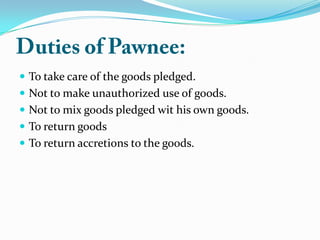
ļ‚— To take care of the goods pledged.
ļ‚— Not to make unauthorized use of goods.
ļ‚— Not to mix goods pledged wit his own goods.
ļ‚— To return goods
ļ‚— To return accretions to the goods.
Enforcement of pawnee’s duties (to receive goods,
accretions etc.).
Right to redeem { }.
To comply with the terms of pledge.
To compensate the Pawnee for extraordinary expenses.
According to the general rule, only the true owner can
pledge the goods but under the following cases , even a
non-owner can make a valid pledge.
1. Pledge by mercantile agent
2. Pledge by seller or buyer in possession after sale [
]
3. Pledge where pawnor has a limited interest
4. Pledge by co-owner in possession.
5. Pledge by person to possession under voidable contract
Bailment with sections final

Bailment with sections final

  • 2.
    ļ‚— Bailment (derivedfrom French word ā€˜bailer’) ļ‚— A Bailment is the delivery of goods by one person to another for some purpose , upon a contract that they shall, when the purpose is accomplished , be returned or otherwise disposed of according to the directions of the person delivering them .
  • 3.
     The persondelivering the goods is called the ā€˜bailor’ and the person to whom they are delivered is called the ā€˜bailee’. E.g.: ļ‚— A delivers a piece of cloth to B ,a tailor ,to be stitched in to a suit. there is a contract of bailment between A and B. ļ‚— Hiring a bicycle ļ‚— Delivering watch for repair
  • 4.
    1. Delivery ofpossession 2. Delivery of goods should be upon a contract 3. Delivery of goods must be for a specific purpose 4. Return of specific goods in specie(same)
  • 5.
    1.Delivery of theGoods: The first unique feature of bailment is that the bailor must transfer his possession of goods to the bailee. The goods should be put in the legal possession of the bailee. Delivery may be of two types: a. Actual delivery: Handing over physical possession of the goods. b. Constructive delivery: Only effect of putting the goods into the bailee’s possession.
  • 6.
    2.Delivery of goodsshould be upon a Contract : When a persons ā€˜s goods go into the possession of another without any contract there is no bailment. However a finder of lost goods of another is considered to be a bailee even though there is no real contract .The contract may be express or implied
  • 7.
    3.Delivery of Goodsmust be for a specific purpose : U/S 148 provides , the delivery of goods from bailor to bailee must be for some purpose . If goods delivered by mistake to a person , there is really no bailment .
  • 8.
    4.Return of SpecificGoods in Specie(same): Goods should be returned to the bailor or disposed of according to his direction ,either in their original or in an altered form , when the purpose of bailment is over.
  • 9.
    Basis of Distinction Bailment Contractof Sale Transfer of Ownership / Possession There is only transfer of possession of goods from the bailor to the bailee. There is transfer of ownership of goods from the seller to the buyer. Consideration Consideration need not be passed between bailor and bailee. Consideration in terms of price must be passed between seller and buyer. Return of Goods The bailee must return the goods to the bailor on the fulfillment of the purpose for which the bailment is made. There is no question of such return of goods in contract of sale.
  • 10.
    Kinds of bailmentBased on benefit: Bailment for the exclusive benefit of : 1] bailor: leaving goods in safe custody without paying 2] bailee :a loan of some article like a pen 3] mutual benefit: contracts for hiring, repair ,etc
  • 11.
    Based on reward: 1]Gratuitous bailment: Goods given to a friend or any one else, to be used by him without any (unnecessary) reward or remuneration or consideration. example: lending a book to a friend 2] Non-gratuitous bailment: bailment of reward: either bailee or bailor is entitled to a remuneration / Consideration. example: hire, tailor, etc
  • 12.
    Duties of Bailor= Rights of Bailee ļ‚— To Disclose faults in goods bailed [ ] ļ‚— To bear expenses [ ] ļ‚— To indemnify the bailee [ ] ļ‚— Liability on premature breach of bailment[ ] In case of non-gratuitous bailment ļ‚— Duty to bear the risk of loss [ ] ļ‚— Duty to receive back the goods[ ]
  • 13.
    a) Duty ofDisclosure  In the case of gratuitous bailment , the bailor must disclose all the known faults to the bailee and if he doesn’t make such disclosure , he is responsible for the damage arising to the bailee directly from such faults .  In case of bailment for reward the bailor is responsible irrespective of the knowledge of the faults in the goods bailed .
  • 14.
    b) Duty toBear Expenses : If the bailment is gratuitous and the bailee is in no way benefited , the bailor has to bear the expenses . In the case of bailment for reward , even though the bailee is to bear the ordinary and reasonable expenses of bailment (e.g., feeding of horse lent),
  • 15.
    c) Duty toIndemnify the Bailee : The bailor should indemnify the bailee for any cost or costs which the bailee may incur because of the defective title of the bailor to the goods bailed . Bailor title may be defective: At the time of bailment. At the time of receiving back the goods from the bailee. At the time of giving directions in respect of the goods bailed. Premature termination of gratuitous bailment
  • 16.
    Duties of Bailee= Rights of Bailor ļ‚— Take reasonable care of goods[ ] ļ‚— Not to make unauthorized use of goods[ ] ļ‚— Not to mix goods with his own goods[ ] ļ‚— Duty to return goods[ ] ļ‚— Returning any profit / accretions[ ] ļ‚— Not to set up any adverse title
  • 17.
    1)To take careof the Goods ļ‚§ The bailee is bound by the contract of bailment to return the goods when the purpose of bailment is fulfilled .He has to take care of the goods while they are in his possession . ļ‚§ Measure of care depends on nature, quality, quantity, and value of the goods. ļ‚§ Bailee is not liable, if events are beyond the control of bailee. ļ‚§ If stolen, reasonable steps otherwise liable. ļ‚§ Loss due to the negligence of the servant.
  • 18.
    2)Duty not tomix with his own goods :  : deal with the provisions governing the rights of the bailor and bailee when there is an inter- mixing of their goods .  The bailee has an obligation to keep the goods of the bailor separate from his own . a. Mixing the goods with bailor’s consent. b. Mixing the goods without the bailor’s consent and the goods are separable. c. Mixing the goods without the bailor’s consent and the goods are not separable.
  • 19.
    3)Duty to Returnthe Goods Duty of the bailee to return the goods without demand, on the expiration of the time specified or when the purpose is accomplished .
  • 20.
    4)Duty not touse bailed goods in an Unauthorized Manner [ : Bailee is under an obligation not to use the goods in an unauthorized manner or for an unauthorized purpose. If bailee does so , the bailor can terminate the bailment , and claim damages for any loss or damage caused by the unauthorized use .
  • 21.
    5)Duty to returnany accretion of the goods [ : The bailee must return to the bailor any increase or profits which have accrued from the goods bailed .  states that the bailor is entitled to the profits accruing from the goods , unless there is a contract to the contrary .
  • 22.
    6)Duty of Finderof Lost Goods: A finder of lost goods is a bailee and such he is bound to take reasonable care of those goods. He has to return the goods to the real owner if the real owner pays his lawful charges
  • 23.
    ā€œLien is theright of one person to retain that which is in his possession, belonging to another, until some debt or claim is paidā€.
  • 24.
    1) Particular Lien[Sec.170]: A particular lien is a right to retain only those goods in respect of which some charges are due. (Skill & Labor). Generally, bailee has this lien only. Conditions: a) Bailee must have rendered some service in relation to the thing bailed, must be entitled to some remuneration- and must be unpaid b) Service rendered by the bailee must be one involving the exercise of labor or skill in respect of the goods bailed. c) Services must have been performed in full –directions of bailor d) There must not be an agreement to perform the services on credit. e) The goods must be in possession of the bailee. Bailee loses the lien, if possession is lost. f) Must not be any contract to contrary.
  • 25.
    2) General Lien[ A general lien is a right to retain all the goods as a security for the general balance of account until the satisfaction of the claims due whether in respect of those goods. Bankers: Has general lien on all goods, cash, cheques and securities deposited with him as banker by a customer, for any money due to him as a banker. Factors: An agent entrusted with the possession of goods for the purpose of selling on behalf of his principal. If goods are delivered for some other purpose, no GL Wharfingers: A person who owns or keeps a wharf. Wharf: Place, adjoining to water, used for loading and unloading goods from ships – not to store.
  • 26.
    Finder of goodsis the person who find some goods which do not belong to him. ļ‚— Right to Lien-[ ] ļ‚— Right to Sue for Reward- [ ] ļ‚— Right to Sell- [ ] (i) If owner can not be found. (ii) If charges are 2/3 rd of value of goods and owner refuses to pay. (iii) If goods are perishable in nature.
  • 27.
    A finder ofgoods is subject to the same responsibility as a bailee. The Duties are ļ‚— To take reasonable care of the goods bailed ļ‚— Not to make any unauthorized use of goods ļ‚— Not to mix the goods bailed with his own goods ļ‚— To find & return the goods to Owner
  • 28.
    ļ‚— On expiryof fixed period[ ] ļ‚— On accomplishment of object[ ] ļ‚— Inconsistent use of Goods[ ] ļ‚— Destruction of subject matter of bailment. Termination of Gratuitous Bailment: ļ‚— At desire of the bailor even before the expiry of fixed period[ ] ļ‚— Death of the bailor or bailee [ ]
  • 29.
    PLEDGE OR PAWN PLEDGE[ ]: Bailment of goods as security for payment of debt or performance of a promise is called Pledge / Pawn.  In other words, Pledge is a special type of bailment where transfer of goods is for security of something. Pledges are a form of security to assure that a person will repay a debt or perform an act under contract. In a pledge one person temporarily gives possession of property to another party.
  • 30.
    The bailor inthis case called the ā€˜Pledger’or ā€˜Pawnor’ The bailee is called ā€˜Pledgee 'or ā€˜Pawnee’. Example: A borrows Rs.100 from B & keeps his watch as security : pledge Special Feature of Pledge is the special property in goods and not the general property in goods, which passes to the pledgee. General property = the ownership of the goods Special Property = the possession of goods
  • 31.
    Basis of Distinction Pledge Bailment PurposeIt is bailment of goods for a specific purpose, i.e., repayment of a debt or performance of a duty. Bailment is for a purpose of any kind. Right to Use Pawnee cannot use the goods pledged. Bailee can use the goods as per terms of bailment. Right to Sell Pawnee can sell the goods pledged after giving notice to the pawnor in case of default by the pawnor. Bailor can either retain the goods or sue the bailor for his duties.
  • 32.
    ļ‚— Right ofretainer{ }: right to retain goods until dues paid. ļ‚— Right against true owner { } ļ‚— Right to claim reimbursement of extraordinary expenses { } ļ‚— Right to sue the pawnor { } ļ‚— Right to sell { }
  • 33.
    ļ‚— To takecare of the goods pledged. ļ‚— Not to make unauthorized use of goods. ļ‚— Not to mix goods pledged wit his own goods. ļ‚— To return goods ļ‚— To return accretions to the goods.
  • 34.
    Enforcement of pawnee’sduties (to receive goods, accretions etc.). Right to redeem { }. To comply with the terms of pledge. To compensate the Pawnee for extraordinary expenses.
  • 35.
    According to thegeneral rule, only the true owner can pledge the goods but under the following cases , even a non-owner can make a valid pledge. 1. Pledge by mercantile agent 2. Pledge by seller or buyer in possession after sale [ ] 3. Pledge where pawnor has a limited interest 4. Pledge by co-owner in possession. 5. Pledge by person to possession under voidable contract