PLEDGE
Meaning:
 The bailment of goods as security for payment of
debt or performance of a promise is called pledge.
 Here the bailor is called the ‘pledger’ or ‘pawnor’
and the bailee is called the ‘pledgee’ or ‘pawnee’
(sec. 172).
 Any kind of movable property may be pledged.
 Even saving passbook may be pledged.
Essentials of pledge:
 The goods must be delivered by borrower to the
lender as a security for repayment of debt or for
performance of a promise.
 The possession of the goods passes from one person
to the other person and not the ownership.
 Pledge can be of only movable goods- documents of
title, shares, valuables etc.
 Immovable properties can not be pledged.
RIGHTS OF PAWNEE
Rights of retainer:
The pawnee may retain the goods pledged
until his dues are paid. He may retain them not
only for the payment of the debt or the
performance of the promise, but also for (a) the
interest due on the debt, and (b) all necessary
expenses incurred by him in respect of the
possession or for the preservation of the goods
pledged (sec. 173). He can however only exercise
a particular over the goods.
Right of retainer for subsequent
advances:
When the pawnee lends
money to the same pawnor after
the date of the pledge, it is
presumed the right of retainer
over the pledged goods extends
to subsequent advances also.
This presumption can be rebutted
only by a contract to the contrary
(sec. 174)
Right to extraordinary expenses:
The pawnee is entitled to receive from the
pawnor extraordinary expenses incurred by him for the
preservation of the goods pledged (sec. 175). For such
expenses he has no right to retain the goods: he can
only sue to recover them.
Right against true owner, when the pawnor’s
title is defective:
When the pawnor has obtained possession of the
goods pledged by him under a voidable contract but
the contract has not been rescinded at the time of the
pledge, the pawnee acquires a good title to the goods,
provided he acts in good faith and without notice of
the pawnor’s defect of title (sec. 178A).
RIGHTS OF PAWNOR
Right to get back goods:
On the performance of promise or repayment of loan
and interest, if any, the pawnor is entitled to get back the
goods pledged.
Right to redeem debt:
Quite often a time is stipulated for the payment of the
debt , or performance of the promise, for which the pledge
is made. In such a case if the pawnor makes default in
payment of the debt or performance of the promise at the
stipulated time, he may still redeem the goods pledged at
any subsequent time before the actual sale of them, but he
must, in that case, pay, in addition, any expenses which
have arises from his default (sec. 177).
Preservation and maintenance of the goods:
The pawnee, like bailee, is bound to
preserve the goods pledged and properly
maintains them.
Rights of an ordinary debtor:
The pawnor has in addition to the above
rights of an ordinary debtor which are
conferred on him by various statutes meant
for the production of debtors, e.g., the
money-lenders Acts.
DUTIES OF PAWNOR
It is the duty of the pawnor to repay the loan
taken from the pawnee within the time and in
the manner specified in the contract.
He has to compensate the pawnee for any
extraordinary expenses incurred by him.
Default or risk, if any, in goods pledged, should
be known to pawnee.
DUTIES OF PAWNEE
He has to take reasonable care of the goods
pledged.
He is not permitted any unauthorized use of the
goods pledged.
He has to return the pledged goods on the
payment of debt.
He should not do any act in violation of the terms
of the contract.
He should not mix the goods pledged with his
own goods.
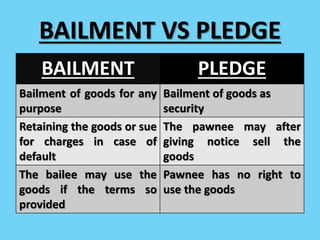
BAILMENT VS PLEDGE
BAILMENT PLEDGE
Bailment of goods for any
purpose
Bailment of goods as
security
Retaining the goods or sue
for charges in case of
default
The pawnee may after
giving notice sell the
goods
The bailee may use the
goods if the terms so
provided
Pawnee has no right to
use the goods
PLEDGE BY NON-OWNER
The general rule is that it is the owner who can
ordinarily create a valid pledge. But in the following cases
even non-owner can create a valid pledge.
 Pledge by mercantile agent:
Where a mercantile agent is with the consent of the
pawnor, in possession of goods or the documents of title
of goods, any pledge made by him, when acting in the
ordinary course of business of a mercantile agent, is as
valid as if he were expressly authorised by the owner of
the goods to make the same. But the pledge is valid only if
the Pawnee acts in good faith and has not as the time of
the pledge notice that the pawnor has not the authority
to pledge (sec. 178).The term ‘mercantile agent’ is defined
in sec. 2(9) of the sale of goods act. 1930.
 Pledge by seller or buyer in possession after
sale:
A seller left in possession of goods after sale
and a buyer who obtains possession of goods with the
consent of the seller, before sale, can create a valid
pledge provided the pawnee acts in good faith and
has no notice of the previous sale of the goods to the
buyer or of the lien of the seller over the goods.
(sec.30 of the sale of goods take steps. 1930).
 Pledger having limited interest:
One of the several joint owners of goods in
possession there of with the consent of the other co-
owners may create a valid pledge of the goods.
Pledger having limited interest:
Where a person pledges goods in which he has
only a limited interest, the pledge is valid to the extent
of that interest (sec. 179). A person having a lien over
the goods or a finder of goods may pledge them to the
extent of his interest.
 Pledge by person in possession under
voidable contract:
Where a person obtains possession of goods
under a voidable contract, the pledge created by him is
valid provided (1) the contract has not been rescinded
before the contract of pledge, and (2) the pawnee acts
in good faith and without notice of the pawnor’s defect
of title (sec. 178-A).
Pledge

Pledge

  • 2.
    PLEDGE Meaning:  The bailmentof goods as security for payment of debt or performance of a promise is called pledge.  Here the bailor is called the ‘pledger’ or ‘pawnor’ and the bailee is called the ‘pledgee’ or ‘pawnee’ (sec. 172).  Any kind of movable property may be pledged.  Even saving passbook may be pledged.
  • 3.
    Essentials of pledge: The goods must be delivered by borrower to the lender as a security for repayment of debt or for performance of a promise.  The possession of the goods passes from one person to the other person and not the ownership.  Pledge can be of only movable goods- documents of title, shares, valuables etc.  Immovable properties can not be pledged.
  • 4.
    RIGHTS OF PAWNEE Rightsof retainer: The pawnee may retain the goods pledged until his dues are paid. He may retain them not only for the payment of the debt or the performance of the promise, but also for (a) the interest due on the debt, and (b) all necessary expenses incurred by him in respect of the possession or for the preservation of the goods pledged (sec. 173). He can however only exercise a particular over the goods.
  • 5.
    Right of retainerfor subsequent advances: When the pawnee lends money to the same pawnor after the date of the pledge, it is presumed the right of retainer over the pledged goods extends to subsequent advances also. This presumption can be rebutted only by a contract to the contrary (sec. 174)
  • 6.
    Right to extraordinaryexpenses: The pawnee is entitled to receive from the pawnor extraordinary expenses incurred by him for the preservation of the goods pledged (sec. 175). For such expenses he has no right to retain the goods: he can only sue to recover them. Right against true owner, when the pawnor’s title is defective: When the pawnor has obtained possession of the goods pledged by him under a voidable contract but the contract has not been rescinded at the time of the pledge, the pawnee acquires a good title to the goods, provided he acts in good faith and without notice of the pawnor’s defect of title (sec. 178A).
  • 7.
    RIGHTS OF PAWNOR Rightto get back goods: On the performance of promise or repayment of loan and interest, if any, the pawnor is entitled to get back the goods pledged. Right to redeem debt: Quite often a time is stipulated for the payment of the debt , or performance of the promise, for which the pledge is made. In such a case if the pawnor makes default in payment of the debt or performance of the promise at the stipulated time, he may still redeem the goods pledged at any subsequent time before the actual sale of them, but he must, in that case, pay, in addition, any expenses which have arises from his default (sec. 177).
  • 8.
    Preservation and maintenanceof the goods: The pawnee, like bailee, is bound to preserve the goods pledged and properly maintains them. Rights of an ordinary debtor: The pawnor has in addition to the above rights of an ordinary debtor which are conferred on him by various statutes meant for the production of debtors, e.g., the money-lenders Acts.
  • 9.
    DUTIES OF PAWNOR Itis the duty of the pawnor to repay the loan taken from the pawnee within the time and in the manner specified in the contract. He has to compensate the pawnee for any extraordinary expenses incurred by him. Default or risk, if any, in goods pledged, should be known to pawnee.
  • 10.
    DUTIES OF PAWNEE Hehas to take reasonable care of the goods pledged. He is not permitted any unauthorized use of the goods pledged. He has to return the pledged goods on the payment of debt. He should not do any act in violation of the terms of the contract. He should not mix the goods pledged with his own goods.
  • 11.
    BAILMENT VS PLEDGE BAILMENTPLEDGE Bailment of goods for any purpose Bailment of goods as security Retaining the goods or sue for charges in case of default The pawnee may after giving notice sell the goods The bailee may use the goods if the terms so provided Pawnee has no right to use the goods
  • 12.
    PLEDGE BY NON-OWNER Thegeneral rule is that it is the owner who can ordinarily create a valid pledge. But in the following cases even non-owner can create a valid pledge.  Pledge by mercantile agent: Where a mercantile agent is with the consent of the pawnor, in possession of goods or the documents of title of goods, any pledge made by him, when acting in the ordinary course of business of a mercantile agent, is as valid as if he were expressly authorised by the owner of the goods to make the same. But the pledge is valid only if the Pawnee acts in good faith and has not as the time of the pledge notice that the pawnor has not the authority to pledge (sec. 178).The term ‘mercantile agent’ is defined in sec. 2(9) of the sale of goods act. 1930.
  • 13.
     Pledge byseller or buyer in possession after sale: A seller left in possession of goods after sale and a buyer who obtains possession of goods with the consent of the seller, before sale, can create a valid pledge provided the pawnee acts in good faith and has no notice of the previous sale of the goods to the buyer or of the lien of the seller over the goods. (sec.30 of the sale of goods take steps. 1930).  Pledger having limited interest: One of the several joint owners of goods in possession there of with the consent of the other co- owners may create a valid pledge of the goods.
  • 14.
    Pledger having limitedinterest: Where a person pledges goods in which he has only a limited interest, the pledge is valid to the extent of that interest (sec. 179). A person having a lien over the goods or a finder of goods may pledge them to the extent of his interest.  Pledge by person in possession under voidable contract: Where a person obtains possession of goods under a voidable contract, the pledge created by him is valid provided (1) the contract has not been rescinded before the contract of pledge, and (2) the pawnee acts in good faith and without notice of the pawnor’s defect of title (sec. 178-A).