The importance of PDHPE for
Primary School Education:

PARENT’s GUIDE

Miss Bahar Sevgi, 4S


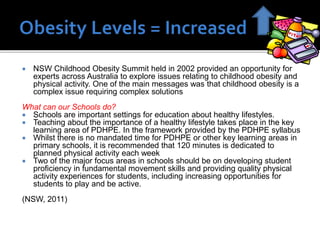
NSW Childhood Obesity Summit held in 2002 provided an opportunity for
experts across Australia to explore issues relating to childhood obesity and
physical activity. One of the main messages was that childhood obesity is a
complex issue requiring complex solutions

What can our Schools do?
 Schools are important settings for education about healthy lifestyles.
 Teaching about the importance of a healthy lifestyle takes place in the key
learning area of PDHPE. In the framework provided by the PDHPE syllabus
 Whilst there is no mandated time for PDHPE or other key learning areas in
primary schools, it is recommended that 120 minutes is dedicated to
planned physical activity each week
 Two of the major focus areas in schools should be on developing student
proficiency in fundamental movement skills and providing quality physical
activity experiences for students, including increasing opportunities for
students to play and be active.
(NSW, 2011)


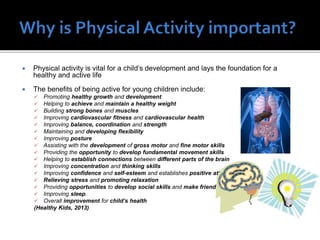
Physical activity is vital for a child’s development and lays the foundation for a
healthy and active life



The benefits of being active for young children include:

















Promoting healthy growth and development
Helping to achieve and maintain a healthy weight
Building strong bones and muscles
Improving cardiovascular fitness and cardiovascular health
Improving balance, coordination and strength
Maintaining and developing flexibility
Improving posture
Assisting with the development of gross motor and fine motor skills
Providing the opportunity to develop fundamental movement skills
Helping to establish connections between different parts of the brain
Improving concentration and thinking skills
Improving confidence and self-esteem and establishes positive attitudes
Relieving stress and promoting relaxation
Providing opportunities to develop social skills and make friends
Improving sleep.
Overall improvement for child’s health
(Healthy Kids, 2013)
Only six out of 10 children aged between five and 14
years participate in sport outside of school, according
to the Australian Bureau of Statistics.
 The Australian Health Survey conducted in April 2012
found that 25 per cent of Australian children and
teenagers, aged five to 17 years, are overweight or
obese, indicating that we need to foster a more
sports-minded culture that encourages children to be
physically active.
 Around 40 per cent of Australian children don’t
participate in sport at all. Common sedentary activities
that compete with physical activity include: homework,
computer games ,internet use, and/or television.
(Better Health Channel, 2013)

The Australian Government recommends that:
‘Children and young people should participate in
at least 60 minutes (and up to several hours) of
moderate to vigorous-intensity physical activity
every day’.
 ‘Children and young people should not spend
more than two hours a day using electronic media
for entertainment (such as computer games,
internet, TV), particularly during daylight hours’.
 These recommendations are a guide to the
minimum level of physical activity required for
good health.
(Better Health Channel, 2013)





We need YOUR SUPPORT in order to provide the children with
adequate resources in order to increase these levels of physical
activity to improve overall health of all children!
What you can do:
 Parents can help their children to be physically active in a number of

ways, including: Lead by example – be physically active yourself.
 Make sure that some family outings offer opportunities for physical
activity, such as playing sport together.
 Encourage your child to walk or ride their bicycle for short trips, rather
than rely on you to drive them.
 Support your child’s efforts in sport. Make sure you’re there at each
match, cheering them on from the sidelines.
 Set time limits on sedentary activities like computer games and
television.
 Consult with your child’s school on ways to encourage greater
participation in sports and physical activity.
(Better Channel Health, 2013)


Better Health Channel. (2013). Sport and Children: Benefits of sport for
children. Retrieved from
http://www.betterhealth.vic.gov.au/bhcv2/bhcarticles.nsf/pages/Sport_a
nd_children . - See more at:
http://reffor.us/index.php#sthash.1QKSM99y.dpuf



Healthy Kids. (2013). Why is physical activity important in early childhood
services for infants and young children?. Retrieved from
http://www.healthykids.nsw.gov.au/teachers-childcare/physicalactivity.aspx.
- See more at: http://reffor.us/index.php#sthash.fpnsoFbT.dpuf



NSW Department of Education and Communities. (2011). Childhood
Obesity: The Problem is getting bigger. (Original work published 1999).
Retrieved from
http://www.curriculumsupport.education.nsw.gov.au/primary/pdhpe/ass
ets/pdf/csarticles/chobesity.pdf.
- See more at: http://reffor.us/index.php#sthash.o99Zo4yW.dpuf

Bahar's powerpoint presentation pdhpe

  • 1.
    The importance ofPDHPE for Primary School Education: PARENT’s GUIDE Miss Bahar Sevgi, 4S
  • 2.
     NSW Childhood ObesitySummit held in 2002 provided an opportunity for experts across Australia to explore issues relating to childhood obesity and physical activity. One of the main messages was that childhood obesity is a complex issue requiring complex solutions What can our Schools do?  Schools are important settings for education about healthy lifestyles.  Teaching about the importance of a healthy lifestyle takes place in the key learning area of PDHPE. In the framework provided by the PDHPE syllabus  Whilst there is no mandated time for PDHPE or other key learning areas in primary schools, it is recommended that 120 minutes is dedicated to planned physical activity each week  Two of the major focus areas in schools should be on developing student proficiency in fundamental movement skills and providing quality physical activity experiences for students, including increasing opportunities for students to play and be active. (NSW, 2011)
  • 3.
     Physical activity isvital for a child’s development and lays the foundation for a healthy and active life  The benefits of being active for young children include:                 Promoting healthy growth and development Helping to achieve and maintain a healthy weight Building strong bones and muscles Improving cardiovascular fitness and cardiovascular health Improving balance, coordination and strength Maintaining and developing flexibility Improving posture Assisting with the development of gross motor and fine motor skills Providing the opportunity to develop fundamental movement skills Helping to establish connections between different parts of the brain Improving concentration and thinking skills Improving confidence and self-esteem and establishes positive attitudes Relieving stress and promoting relaxation Providing opportunities to develop social skills and make friends Improving sleep. Overall improvement for child’s health (Healthy Kids, 2013)
  • 4.
    Only six outof 10 children aged between five and 14 years participate in sport outside of school, according to the Australian Bureau of Statistics.  The Australian Health Survey conducted in April 2012 found that 25 per cent of Australian children and teenagers, aged five to 17 years, are overweight or obese, indicating that we need to foster a more sports-minded culture that encourages children to be physically active.  Around 40 per cent of Australian children don’t participate in sport at all. Common sedentary activities that compete with physical activity include: homework, computer games ,internet use, and/or television. (Better Health Channel, 2013) 
  • 5.
    The Australian Governmentrecommends that: ‘Children and young people should participate in at least 60 minutes (and up to several hours) of moderate to vigorous-intensity physical activity every day’.  ‘Children and young people should not spend more than two hours a day using electronic media for entertainment (such as computer games, internet, TV), particularly during daylight hours’.  These recommendations are a guide to the minimum level of physical activity required for good health. (Better Health Channel, 2013) 
  • 6.
      We need YOURSUPPORT in order to provide the children with adequate resources in order to increase these levels of physical activity to improve overall health of all children! What you can do:  Parents can help their children to be physically active in a number of ways, including: Lead by example – be physically active yourself.  Make sure that some family outings offer opportunities for physical activity, such as playing sport together.  Encourage your child to walk or ride their bicycle for short trips, rather than rely on you to drive them.  Support your child’s efforts in sport. Make sure you’re there at each match, cheering them on from the sidelines.  Set time limits on sedentary activities like computer games and television.  Consult with your child’s school on ways to encourage greater participation in sports and physical activity. (Better Channel Health, 2013)
  • 7.
     Better Health Channel.(2013). Sport and Children: Benefits of sport for children. Retrieved from http://www.betterhealth.vic.gov.au/bhcv2/bhcarticles.nsf/pages/Sport_a nd_children . - See more at: http://reffor.us/index.php#sthash.1QKSM99y.dpuf  Healthy Kids. (2013). Why is physical activity important in early childhood services for infants and young children?. Retrieved from http://www.healthykids.nsw.gov.au/teachers-childcare/physicalactivity.aspx. - See more at: http://reffor.us/index.php#sthash.fpnsoFbT.dpuf  NSW Department of Education and Communities. (2011). Childhood Obesity: The Problem is getting bigger. (Original work published 1999). Retrieved from http://www.curriculumsupport.education.nsw.gov.au/primary/pdhpe/ass ets/pdf/csarticles/chobesity.pdf. - See more at: http://reffor.us/index.php#sthash.o99Zo4yW.dpuf