Road Safety Engineering Challenges
Indonesia & Beyond
August 2011
Education Encouragement Research
HUMAN FACTOR
Make road transportation save for everyone
DIFINISI KESELAMATAN LLAJ
Suatu keadaan terhindarnya setiap
orang dari resiko kecelakaan selama
berlalu lalu lintas yang disebabkan
oleh manusia, kendaraan, jalan,
dan/atau lingkungan
Kecelakaan adalah suatu peristiwa yang
tidak diduga dan tidak disengaja melibat kan
kendaraan dengan atau tanpa peng guna
jalan lain yang mengakibatkan kor ban
manusia dan / atau kerugian harta benda
Accident is defined as “that occurrence in
a sequence of events which ussualy produced
intended injury, death or property damaged”
Kita harus bekerja berangkat dari pemikiran
bahwa 99% kecelakaan yg terjadi adalah
karena faktor sistem, dan hanya 1 % yang
merupakan takdir
Kecelakaan adalah sesuatu yang seharus nya
bisa dicegah atau dihilangkan
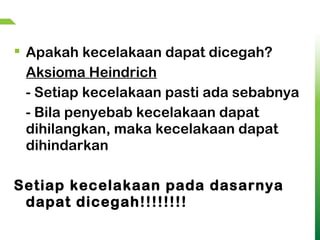
 Apakah kecelakaan dapat dicegah?
Aksioma Heindrich
- Setiap kecelakaan pasti ada sebabnya
- Bila penyebab kecelakaan dapat
dihilangkan, maka kecelakaan dapat
dihindarkan
Setiap kecelakaan pada dasarnya
dapat dicegah!!!!!!!!
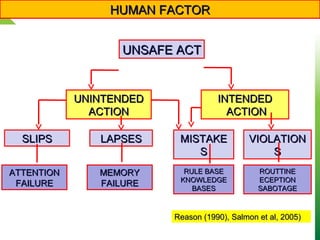
HUMAN FACTORHUMAN FACTOR
UNSAFE ACTUNSAFE ACT
UNINTENDEDUNINTENDED
ACTIONACTION
ROUTTINEROUTTINE
ECEPTIONECEPTION
SABOTAGESABOTAGE
RULE BASERULE BASE
KNOWLEDGEKNOWLEDGE
BASESBASES
MEMORYMEMORY
FAILUREFAILURE
ATTENTIONATTENTION
FAILUREFAILURE
VIOLATIONVIOLATION
SS
MISTAKEMISTAKE
SS
LAPSESLAPSESSLIPSSLIPS
INTENDEDINTENDED
ACTIONACTION
Reason (1990), Salmon et al, 2005)Reason (1990), Salmon et al, 2005)
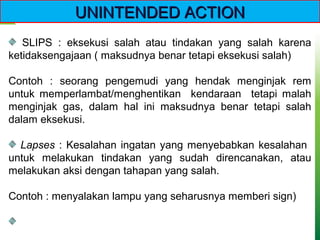
SLIPS : eksekusi salah atau tindakan yang salah karena
ketidaksengajaan ( maksudnya benar tetapi eksekusi salah)
Contoh : seorang pengemudi yang hendak menginjak rem
untuk memperlambat/menghentikan kendaraan tetapi malah
menginjak gas, dalam hal ini maksudnya benar tetapi salah
dalam eksekusi.
Lapses : Kesalahan ingatan yang menyebabkan kesalahan
untuk melakukan tindakan yang sudah direncanakan, atau
melakukan aksi dengan tahapan yang salah.
Contoh : menyalakan lampu yang seharusnya memberi sign)
UNINTENDED ACTIONUNINTENDED ACTION
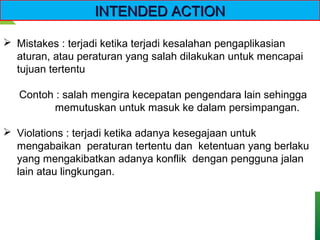
 Mistakes : terjadi ketika terjadi kesalahan pengaplikasian
aturan, atau peraturan yang salah dilakukan untuk mencapai
tujuan tertentu
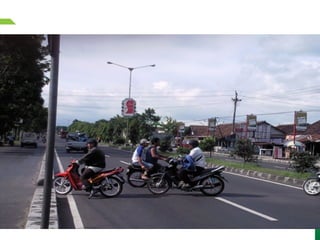
Contoh : salah mengira kecepatan pengendara lain sehingga
memutuskan untuk masuk ke dalam persimpangan.
 Violations : terjadi ketika adanya kesegajaan untuk
mengabaikan peraturan tertentu dan ketentuan yang berlaku
yang mengakibatkan adanya konflik dengan pengguna jalan
lain atau lingkungan.
INTENDED ACTIONINTENDED ACTION
What is Human Factors?
This section shall:
• Define human factors as it relates to
maintenance
• Show specific examples of maintenance
human factors
• Show why the topic is important to you
Why is human factor important..?
- Make Mistakes ( cenderung berbuat salah )
- Could be Distracted ( seringkali bingung )
- Forget what has been learned ( lupa yg sdh dipelajari )
- Get tired ( cape )
- Use naturally subjective preferences
- Have phsychological limitation
- Etc
Untuk apa belajar human factor..?
 Designing workplaces, tools, procedures, and
policies so people can use them easily and
safely
 Primary concern is for people in the
organization
 Combines elements from many disciplines
 Critical to the overall road safety and personal
safety
Ensure continuing safety and
efficiency by paying
attention to issues that affect human
performance.
Human Factors Goal
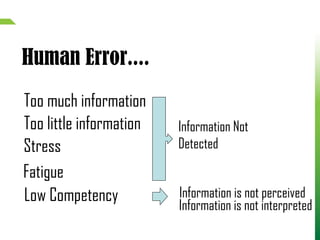
Too much information
Human Error....
Too little information
Stress
Low Competency
Fatigue
Information Not
Detected
Information is not perceived
Information is not interpreted
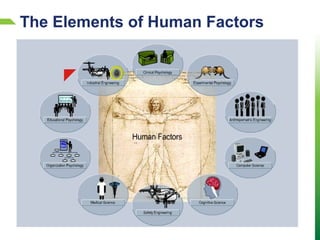
The Elements of Human Factors
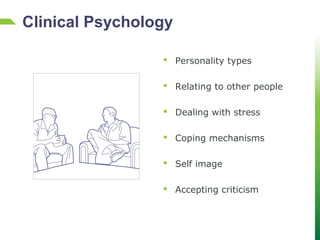
 Personality types
 Relating to other people
 Dealing with stress
 Coping mechanisms
 Self image
 Accepting criticism
Clinical Psychology
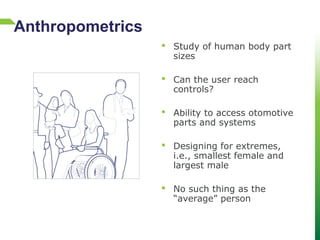
 Study of human body part
sizes
 Can the user reach
controls?
 Ability to access otomotive
parts and systems
 Designing for extremes,
i.e., smallest female and
largest male
 No such thing as the
“average” person
Anthropometrics
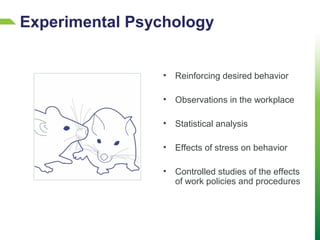
• Reinforcing desired behavior
• Observations in the workplace
• Statistical analysis
• Effects of stress on behavior
• Controlled studies of the effects
of work policies and procedures
Experimental Psychology
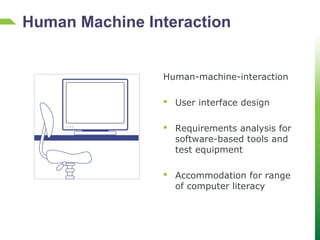
Human-machine-interaction
 User interface design
 Requirements analysis for
software-based tools and
test equipment
 Accommodation for range
of computer literacy
Human Machine Interaction
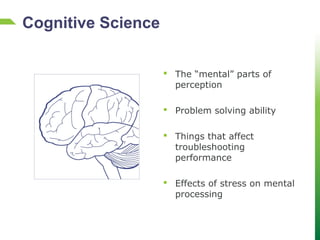
 The “mental” parts of
perception
 Problem solving ability
 Things that affect
troubleshooting
performance
 Effects of stress on mental
processing
Cognitive Science
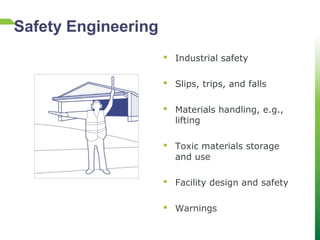
 Industrial safety
 Slips, trips, and falls
 Materials handling, e.g.,
lifting
 Toxic materials storage
and use
 Facility design and safety
 Warnings
Safety Engineering
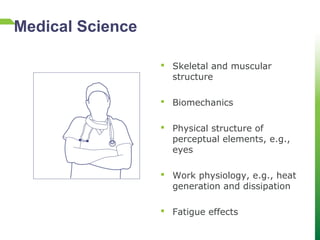
 Skeletal and muscular
structure
 Biomechanics
 Physical structure of
perceptual elements, e.g.,
eyes
 Work physiology, e.g., heat
generation and dissipation
 Fatigue effects
Medical Science
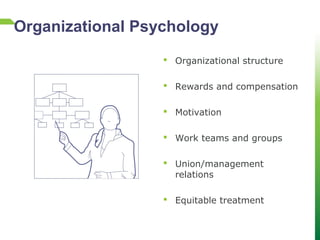
 Organizational structure
 Rewards and compensation
 Motivation
 Work teams and groups
 Union/management
relations
 Equitable treatment
Organizational Psychology
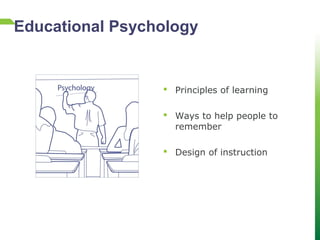
 Principles of learning
 Ways to help people to
remember
 Design of instruction
Educational Psychology
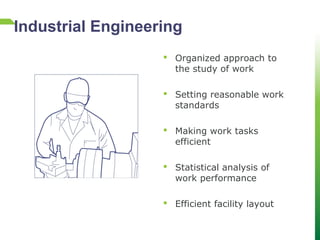
 Organized approach to
the study of work
 Setting reasonable work
standards
 Making work tasks
efficient
 Statistical analysis of
work performance
 Efficient facility layout
Industrial Engineering
TUGAS
Buat makalah dengan mencari sumber / referensi
dari internet atau buku-buku.
Siapkan bahan presentasi untuk menjelaskan
isi dari makalah tersebut
Dibagi kelompok dimana 1 kelompok terdiri atas
5 orang
Pencarian data bisa on the desk survey ataupun
on the field survey
Waktu : 1 bulan
TOPIK
1. Sifat / Karakteristik Dasar Manusia
2. Anthropometrics
3. Eksperimental Psikhologi ( anak TK )
4. Human Machine Interaction ( mobil terbaru )
5. Cognitive Science
6. Safety Engineering ( K3 untuk transportasi )
7. Skeletal and muscular structure
8. Biomechanical
9. Phisycal Structure ( mata )
10. Organizational Psichology
11. Educational Psichology
12. Industrial Engineering ( contoh di udara )

Bahan ajar human factor

  • 1.
    Road Safety EngineeringChallenges Indonesia & Beyond August 2011 Education Encouragement Research HUMAN FACTOR Make road transportation save for everyone
  • 2.
    DIFINISI KESELAMATAN LLAJ Suatukeadaan terhindarnya setiap orang dari resiko kecelakaan selama berlalu lalu lintas yang disebabkan oleh manusia, kendaraan, jalan, dan/atau lingkungan
  • 3.
    Kecelakaan adalah suatuperistiwa yang tidak diduga dan tidak disengaja melibat kan kendaraan dengan atau tanpa peng guna jalan lain yang mengakibatkan kor ban manusia dan / atau kerugian harta benda Accident is defined as “that occurrence in a sequence of events which ussualy produced intended injury, death or property damaged”
  • 4.
    Kita harus bekerjaberangkat dari pemikiran bahwa 99% kecelakaan yg terjadi adalah karena faktor sistem, dan hanya 1 % yang merupakan takdir Kecelakaan adalah sesuatu yang seharus nya bisa dicegah atau dihilangkan
  • 10.
     Apakah kecelakaandapat dicegah? Aksioma Heindrich - Setiap kecelakaan pasti ada sebabnya - Bila penyebab kecelakaan dapat dihilangkan, maka kecelakaan dapat dihindarkan Setiap kecelakaan pada dasarnya dapat dicegah!!!!!!!!
  • 11.
    HUMAN FACTORHUMAN FACTOR UNSAFEACTUNSAFE ACT UNINTENDEDUNINTENDED ACTIONACTION ROUTTINEROUTTINE ECEPTIONECEPTION SABOTAGESABOTAGE RULE BASERULE BASE KNOWLEDGEKNOWLEDGE BASESBASES MEMORYMEMORY FAILUREFAILURE ATTENTIONATTENTION FAILUREFAILURE VIOLATIONVIOLATION SS MISTAKEMISTAKE SS LAPSESLAPSESSLIPSSLIPS INTENDEDINTENDED ACTIONACTION Reason (1990), Salmon et al, 2005)Reason (1990), Salmon et al, 2005)
  • 12.
    SLIPS : eksekusisalah atau tindakan yang salah karena ketidaksengajaan ( maksudnya benar tetapi eksekusi salah) Contoh : seorang pengemudi yang hendak menginjak rem untuk memperlambat/menghentikan kendaraan tetapi malah menginjak gas, dalam hal ini maksudnya benar tetapi salah dalam eksekusi. Lapses : Kesalahan ingatan yang menyebabkan kesalahan untuk melakukan tindakan yang sudah direncanakan, atau melakukan aksi dengan tahapan yang salah. Contoh : menyalakan lampu yang seharusnya memberi sign) UNINTENDED ACTIONUNINTENDED ACTION
  • 13.
     Mistakes :terjadi ketika terjadi kesalahan pengaplikasian aturan, atau peraturan yang salah dilakukan untuk mencapai tujuan tertentu Contoh : salah mengira kecepatan pengendara lain sehingga memutuskan untuk masuk ke dalam persimpangan.  Violations : terjadi ketika adanya kesegajaan untuk mengabaikan peraturan tertentu dan ketentuan yang berlaku yang mengakibatkan adanya konflik dengan pengguna jalan lain atau lingkungan. INTENDED ACTIONINTENDED ACTION
  • 14.
    What is HumanFactors? This section shall: • Define human factors as it relates to maintenance • Show specific examples of maintenance human factors • Show why the topic is important to you
  • 15.
    Why is humanfactor important..? - Make Mistakes ( cenderung berbuat salah ) - Could be Distracted ( seringkali bingung ) - Forget what has been learned ( lupa yg sdh dipelajari ) - Get tired ( cape ) - Use naturally subjective preferences - Have phsychological limitation - Etc
  • 16.
    Untuk apa belajarhuman factor..?  Designing workplaces, tools, procedures, and policies so people can use them easily and safely  Primary concern is for people in the organization  Combines elements from many disciplines  Critical to the overall road safety and personal safety
  • 17.
    Ensure continuing safetyand efficiency by paying attention to issues that affect human performance. Human Factors Goal
  • 18.
    Too much information HumanError.... Too little information Stress Low Competency Fatigue Information Not Detected Information is not perceived Information is not interpreted
  • 19.
    The Elements ofHuman Factors
  • 20.
     Personality types Relating to other people  Dealing with stress  Coping mechanisms  Self image  Accepting criticism Clinical Psychology
  • 21.
     Study ofhuman body part sizes  Can the user reach controls?  Ability to access otomotive parts and systems  Designing for extremes, i.e., smallest female and largest male  No such thing as the “average” person Anthropometrics
  • 22.
    • Reinforcing desiredbehavior • Observations in the workplace • Statistical analysis • Effects of stress on behavior • Controlled studies of the effects of work policies and procedures Experimental Psychology
  • 23.
    Human-machine-interaction  User interfacedesign  Requirements analysis for software-based tools and test equipment  Accommodation for range of computer literacy Human Machine Interaction
  • 24.
     The “mental”parts of perception  Problem solving ability  Things that affect troubleshooting performance  Effects of stress on mental processing Cognitive Science
  • 25.
     Industrial safety Slips, trips, and falls  Materials handling, e.g., lifting  Toxic materials storage and use  Facility design and safety  Warnings Safety Engineering
  • 26.
     Skeletal andmuscular structure  Biomechanics  Physical structure of perceptual elements, e.g., eyes  Work physiology, e.g., heat generation and dissipation  Fatigue effects Medical Science
  • 27.
     Organizational structure Rewards and compensation  Motivation  Work teams and groups  Union/management relations  Equitable treatment Organizational Psychology
  • 28.
     Principles oflearning  Ways to help people to remember  Design of instruction Educational Psychology
  • 29.
     Organized approachto the study of work  Setting reasonable work standards  Making work tasks efficient  Statistical analysis of work performance  Efficient facility layout Industrial Engineering
  • 30.
    TUGAS Buat makalah denganmencari sumber / referensi dari internet atau buku-buku. Siapkan bahan presentasi untuk menjelaskan isi dari makalah tersebut Dibagi kelompok dimana 1 kelompok terdiri atas 5 orang Pencarian data bisa on the desk survey ataupun on the field survey Waktu : 1 bulan
  • 31.
    TOPIK 1. Sifat /Karakteristik Dasar Manusia 2. Anthropometrics 3. Eksperimental Psikhologi ( anak TK ) 4. Human Machine Interaction ( mobil terbaru ) 5. Cognitive Science 6. Safety Engineering ( K3 untuk transportasi ) 7. Skeletal and muscular structure 8. Biomechanical 9. Phisycal Structure ( mata ) 10. Organizational Psichology 11. Educational Psichology 12. Industrial Engineering ( contoh di udara )

Editor's Notes

  • #20 Just select one or two and run the animation or talk about yourself. Human factors is comprised of many disciplines, which is the reason human factors has no single definition. We can review 10 of the human factors disciplines with the chart.
  • #21 Clinical psychology deals with your psychological composure. It can address topics like emotions, motivation, fears, and such things.
  • #22 Anthropometrics is the study of factors such as size, strength, reach and other dimensions that can be quantified to match the machine to the human. An original Coca-Cola bottle, for example, was designed to fit the average human hand, thus making it easy to hold the bottle and drink a lot of the product.
  • #24 Computer scientists study the graphical user interface to be sure that humans can easily operate software. Therefore, computer science remains an excellent example of human factors.
  • #25 Cognitive science studies how humans think, how they solve problems and the ways in which they process information. This knowledge can be critical to design of equipment, software, and documentation.
  • #26 Safety engineering applies to worker safety, with respect to topics like safety equipment, labeling, rules, and such things.
  • #27 Medical science applies to topics such as vision, hearing, balance, and overall health issues.
  • #28 Organizational psychology looks at how people work within various size groups. Organizational psychologists have made excellent contributions to the field of Crew Resource Management, which is mandatory training for flight crews, and important to maintenance crews.
  • #29 Educational psychologists study how people learn. Excellent training programs are often the result of using applied educational psychology.
  • #30 Industrial engineering is the study of humans at work, using a systematic approach to understand how people work, and then to design the job and the equipment accordingly. You may be able to suggest additional human factors disciplines.