I.F.D.C. LENGUAS VIVAS
TALLER DE PRÁCTICA DOCENTE
Alumno Residente: Báez María José
Periodo de práctica: Nivel secundario
Institución Educativa: Panguitruz Nger
Dirección: Rio de la Plata 875
Sala/Grado/Año-sección: 2°II
Cantidad de alumnos: 18
Nivel lingüístico del curso del curso: Básico
Tipo de Planificación: clase
Unidad Temática: Routines and frequency adverbs
Clase N°: 8
Fecha: 26/10/2017
Hora: 9:20-10:40
Duración de la clase: 80´
Fecha de primera entrega: 21/10/2017
 Teaching points: Routines with frequency adverbs using third person
singular (she always makes her homework)
 Aims: During this lesson, learners will be able to…
- Identify and name routines using adverbs of frequency
- Be able to greet their mates and teacher in English.
- Develop their listening skills by working collaboratively.
- Identify and use the structures: simple present affirmative for
example: he always goes to school, they go to bed at 9 o’clock.
- To deepen their understanding of commands/instructions while
developing their skills.
- Write short sentences about routines
- Develop their speaking and listening abilities by taking part in short
oral exchanges.
-Be able to read and understand a short text.
 Language focus:
Lexis Function Structure Pronunciation
Revision Hello, goodbye-
look at the
pictures- How are
you today?- what
day is today?-
commands: sit
down!, repeat
please, silence.
The time. Get up,
have breakfast,
do my
homework, go to
bed, get home,
have a shower,
get dressed, have
dinner, make my
bed.. Frequency
adverbs:Always,
sometimes, never
Usually, hardly
Greeting, giving
commands and
instructions
She always gets
up earlier.
He listens to
music. They
watch TV.
ever, Play
games/sports,
watch TV,read,
listentomusic
New
 Teaching approach: Natural approach- Presentation, practice, production. Communicative
approach where students should use the new vocabulary.
 Materials and resources: a white board, notebook and text
 Pedagogical use of ICT in class: There is no instance of ICT in the lesson.
 Seating arrangement: Students work in their seats to have visual contact and interaction.
 Cooperative work: Students work as a class, then in groups and finally individually.
 Possible problems/difficulties and their possible solutions during the class: students may not like I
speak the whole class in English so I will speak slowly and I will give them my help and support.
 Potential problems students may have with the language: students may not understand
instructions or vocabulary so the teacher will repeat the language, use body language, miming,
intonation and use visual support. Also a volunteer can translate the task into their mother tongue.
 Assessment what will be assessed and how: I will note how they do the activities. I will repeat the
correct intonation, instructions and the structure with the aim they repeat and pay special
attention to these.
 Skills integration: listening, speaking and writing will be integrated in this lesson.
Routine 5’:
Aim: To greet students and create the right environment.
I will get into the classroom and greet students: “Hello! Good morning!
EA: Hello!
T: how are you?
EA: Fine!
T: Excellent! Now we are going to start with the class. Today you will do a test so sit down
and be quiet because I will explain each activity. You have all the time to do the test so think,
concentrate and do the exam. Can you tell me what day is today?
EA: Today is Thursday 26th th October
I will write this on the board.
T: Now look outside and tell me: how is the weather today? . Look outside, look through the
window! Is today windy? (I will show students images of clouds, sun, rain and they only answers
yes or no)
EA: No or Yes
EA: It is…..
I will give thematest.
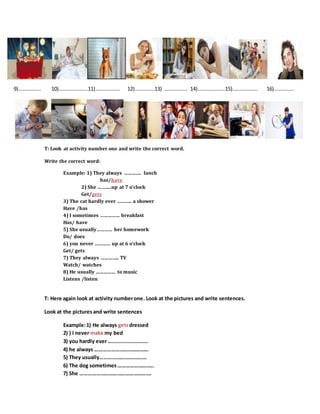
Write the word with the correct picture.
1)…………….. 2) …………… 3)…………….. 4)……………. 5)……………… 6)……………….. 7)…………………..8) ………………
Get up- have lunch- have breakfast- make my bed- clean their teeth- watch TV -
have dinner- have a shower- get dressed- get home- do my homework- go to bed-
play tennis- read books - listen to music - cook pizza
9)…………….. 10)………………….11)………………. 12)……………13) ……………… 14)…………………15)………………. 16)……………
T: Look at activity number one and write the correct word.
Write the correct word:
Example: 1) They always …………. lunch
has/have
2) She ………..up at 7 o’clock
Get/gets
3) The cat hardly ever ……….. a shower
Have /has
4) I sometimes …………… breakfast
Has/ have
5) She usually………… her homework
Do/ does
6) you never ………… up at 6 o’clock
Get/ gets
7) They always ………….. TV
Watch/ watches
8) He usually …………… to music
Listens /listen
T: Here again look at activity numberone. Look at the pictures and write sentences.
Look at the pictures and write sentences
Example:1) He always getsdressed
2) ) I never make my bed
3) you hardly ever ….......................
4) he always …………………………………
5) They usually…………………………….
6) The dog sometimes……………………..
7) She …………………………………………….
8) Lucas ...........................................
Activity 4- 10’:
Aim: To practise and assess students what they learned in class.
(This activity I could not do in the previous class that's why I'm using it now)
Match the sentences
1)Marcos gets books and newspapers
2) The dog goes up at 7 o’clock
3) We always play to bed at 8 o’clock
4) I sometimesread tenniswith friends
5) They nevermake TV with her brother
6) Lucia usuallywatches theirbeds
7) Nicolas neverlistens to pop music.
Put the words in order.
Example:1) Sometimes-Lauraand Friends- tennis-play
Laura and friends sometimes playtennis
2) watch-I-TV- hardlyever
3) never- They - to-go-bed-at-9-0’clock
4) Laura- has-usually-lunch
5) always-Nicolas-her-does-homework
6) shower- the cat-has-a-never-sometimes
7) you- read-always-books.
Read the textabout Lucas and friends and write the word in the correct place.
go get watch have play read cook do clean have
My name is Lucas. I always …….. up at 7 o’clock. I ………… breakfast, …….. my teeth and I go to school
with my friends. There, we sometimes ………. tennis and ……….books. We never ………..pizzas. When the
school ends, I get home with my family. I usually …………….TV with my sister. We like horror films. After
that, I ……….. my homework. Then, we ………..dinner and we ………… to bed at 10 o’clock.
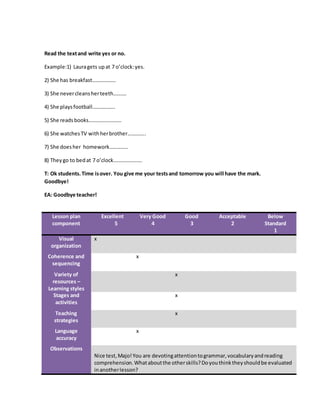
Read the textand write yes or no.
Example:1) Lauragets upat 7 o’clock:yes.
2) She has breakfast………………
3) She nevercleansherteeth……….
4) She playsfootball……………..
5) She readsbooks…………………….
6) She watchesTV withherbrother…………..
7) She doesher homework…………..
8) Theygo to bedat 7 o’clock………………….
T: Ok students.Time isover. You give me your testsand tomorrow you will have the mark.
Goodbye!
EA: Goodbye teacher!
Lesson plan
component
Excellent
5
Very Good
4
Good
3
Acceptable
2
Below
Standard
1
Visual
organization
x
Coherence and
sequencing
x
Variety of
resources –
Learning styles
x
Stages and
activities
x
Teaching
strategies
x
Language
accuracy
x
Observations
Nice test,Majo!You are devotingattentiontogrammar,vocabularyandreading
comprehension.Whataboutthe otherskills?Doyouthinktheyshouldbe evaluated
inanotherlesson?
Go overthe comments,pls.
Have a greattime!
Aure

Baez lesson 8- secundaria - pass-pdf

  • 1.
    I.F.D.C. LENGUAS VIVAS TALLERDE PRÁCTICA DOCENTE Alumno Residente: Báez María José Periodo de práctica: Nivel secundario Institución Educativa: Panguitruz Nger Dirección: Rio de la Plata 875 Sala/Grado/Año-sección: 2°II Cantidad de alumnos: 18 Nivel lingüístico del curso del curso: Básico Tipo de Planificación: clase Unidad Temática: Routines and frequency adverbs Clase N°: 8 Fecha: 26/10/2017 Hora: 9:20-10:40 Duración de la clase: 80´ Fecha de primera entrega: 21/10/2017  Teaching points: Routines with frequency adverbs using third person singular (she always makes her homework)  Aims: During this lesson, learners will be able to… - Identify and name routines using adverbs of frequency - Be able to greet their mates and teacher in English. - Develop their listening skills by working collaboratively. - Identify and use the structures: simple present affirmative for example: he always goes to school, they go to bed at 9 o’clock. - To deepen their understanding of commands/instructions while developing their skills. - Write short sentences about routines - Develop their speaking and listening abilities by taking part in short oral exchanges. -Be able to read and understand a short text.  Language focus: Lexis Function Structure Pronunciation Revision Hello, goodbye- look at the pictures- How are you today?- what day is today?- commands: sit down!, repeat please, silence. The time. Get up, have breakfast, do my homework, go to bed, get home, have a shower, get dressed, have dinner, make my bed.. Frequency adverbs:Always, sometimes, never Usually, hardly Greeting, giving commands and instructions She always gets up earlier. He listens to music. They watch TV.
  • 2.
    ever, Play games/sports, watch TV,read, listentomusic New Teaching approach: Natural approach- Presentation, practice, production. Communicative approach where students should use the new vocabulary.  Materials and resources: a white board, notebook and text  Pedagogical use of ICT in class: There is no instance of ICT in the lesson.  Seating arrangement: Students work in their seats to have visual contact and interaction.  Cooperative work: Students work as a class, then in groups and finally individually.  Possible problems/difficulties and their possible solutions during the class: students may not like I speak the whole class in English so I will speak slowly and I will give them my help and support.  Potential problems students may have with the language: students may not understand instructions or vocabulary so the teacher will repeat the language, use body language, miming, intonation and use visual support. Also a volunteer can translate the task into their mother tongue.  Assessment what will be assessed and how: I will note how they do the activities. I will repeat the correct intonation, instructions and the structure with the aim they repeat and pay special attention to these.  Skills integration: listening, speaking and writing will be integrated in this lesson. Routine 5’: Aim: To greet students and create the right environment. I will get into the classroom and greet students: “Hello! Good morning! EA: Hello! T: how are you? EA: Fine! T: Excellent! Now we are going to start with the class. Today you will do a test so sit down and be quiet because I will explain each activity. You have all the time to do the test so think, concentrate and do the exam. Can you tell me what day is today? EA: Today is Thursday 26th th October I will write this on the board. T: Now look outside and tell me: how is the weather today? . Look outside, look through the window! Is today windy? (I will show students images of clouds, sun, rain and they only answers yes or no) EA: No or Yes EA: It is….. I will give thematest. Write the word with the correct picture. 1)…………….. 2) …………… 3)…………….. 4)……………. 5)……………… 6)……………….. 7)…………………..8) ……………… Get up- have lunch- have breakfast- make my bed- clean their teeth- watch TV - have dinner- have a shower- get dressed- get home- do my homework- go to bed- play tennis- read books - listen to music - cook pizza
  • 3.
    9)…………….. 10)………………….11)………………. 12)……………13)……………… 14)…………………15)………………. 16)…………… T: Look at activity number one and write the correct word. Write the correct word: Example: 1) They always …………. lunch has/have 2) She ………..up at 7 o’clock Get/gets 3) The cat hardly ever ……….. a shower Have /has 4) I sometimes …………… breakfast Has/ have 5) She usually………… her homework Do/ does 6) you never ………… up at 6 o’clock Get/ gets 7) They always ………….. TV Watch/ watches 8) He usually …………… to music Listens /listen T: Here again look at activity numberone. Look at the pictures and write sentences. Look at the pictures and write sentences Example:1) He always getsdressed 2) ) I never make my bed 3) you hardly ever …....................... 4) he always ………………………………… 5) They usually……………………………. 6) The dog sometimes…………………….. 7) She …………………………………………….
  • 4.
    8) Lucas ........................................... Activity4- 10’: Aim: To practise and assess students what they learned in class. (This activity I could not do in the previous class that's why I'm using it now) Match the sentences 1)Marcos gets books and newspapers 2) The dog goes up at 7 o’clock 3) We always play to bed at 8 o’clock 4) I sometimesread tenniswith friends 5) They nevermake TV with her brother 6) Lucia usuallywatches theirbeds 7) Nicolas neverlistens to pop music. Put the words in order. Example:1) Sometimes-Lauraand Friends- tennis-play Laura and friends sometimes playtennis 2) watch-I-TV- hardlyever 3) never- They - to-go-bed-at-9-0’clock 4) Laura- has-usually-lunch 5) always-Nicolas-her-does-homework 6) shower- the cat-has-a-never-sometimes 7) you- read-always-books. Read the textabout Lucas and friends and write the word in the correct place. go get watch have play read cook do clean have My name is Lucas. I always …….. up at 7 o’clock. I ………… breakfast, …….. my teeth and I go to school with my friends. There, we sometimes ………. tennis and ……….books. We never ………..pizzas. When the school ends, I get home with my family. I usually …………….TV with my sister. We like horror films. After that, I ……….. my homework. Then, we ………..dinner and we ………… to bed at 10 o’clock.
  • 5.
    Read the textandwrite yes or no. Example:1) Lauragets upat 7 o’clock:yes. 2) She has breakfast……………… 3) She nevercleansherteeth………. 4) She playsfootball…………….. 5) She readsbooks……………………. 6) She watchesTV withherbrother………….. 7) She doesher homework………….. 8) Theygo to bedat 7 o’clock…………………. T: Ok students.Time isover. You give me your testsand tomorrow you will have the mark. Goodbye! EA: Goodbye teacher! Lesson plan component Excellent 5 Very Good 4 Good 3 Acceptable 2 Below Standard 1 Visual organization x Coherence and sequencing x Variety of resources – Learning styles x Stages and activities x Teaching strategies x Language accuracy x Observations Nice test,Majo!You are devotingattentiontogrammar,vocabularyandreading comprehension.Whataboutthe otherskills?Doyouthinktheyshouldbe evaluated inanotherlesson?
  • 6.