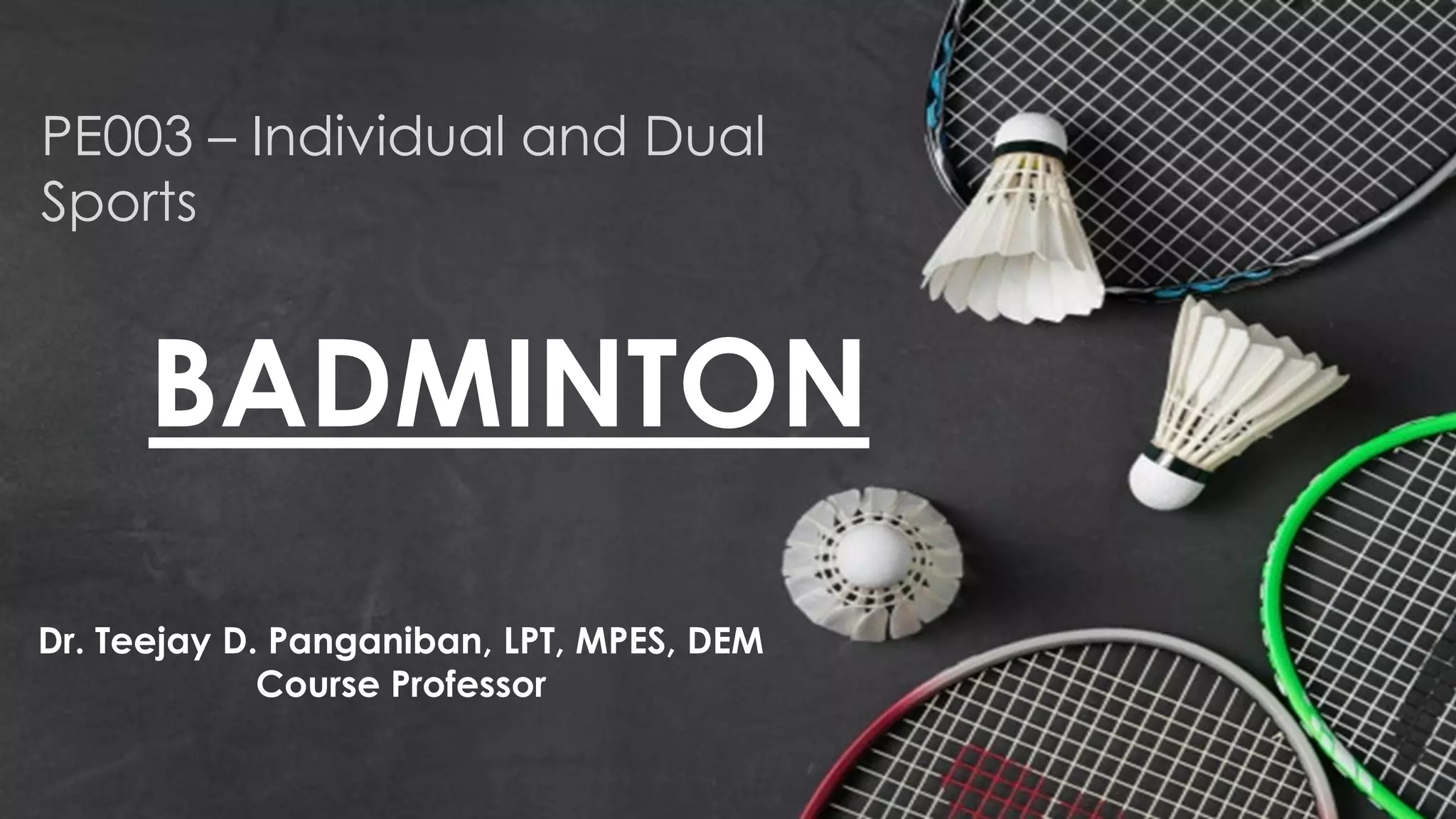
PE003 – Individual and Dual
Sports
BADMINTON
Dr. Teejay D. Panganiban, LPT, MPES, DEM
Course Professor
✔BADMINTON is a racket sport played by either two
opposing players (singles) or two opposing pairs
(doubles).
✔Competitive badminton is best played indoors
because shuttlecock flight is affected by wind. But
badminton, as a casual recreational activity, can
also be played outdoors.
✔Badminton has been an Olympic sport since 1992
(Barcelona).
Nature of the Game
✔The origins of the game, badminton, date back at
least 2,000 years to the game of battledore and
shuttlecock played in ancient Greece, China and
India, where a form of the game called “poona”
was played.
✔In 1860s, British army officers posted to India
became interested in “Poona” and took the game
home to England, where the rules of badminton
were set out.
History of Badminton
✔This new sport was definitively launched in 1873 at
the Badminton House in Gloucestershire, the
ancestral home of the Duke of Beaufort, where
he introduced the sport to his guests.
✔It was then known as “The Game of Badminton”
for a number of years, until the name was
shortened to BADMINTON.
✔Gloucestershire is now the base for the
International Badminton Federation.
Henry Charles Fitzroy
Somerset
Badminton House, Gloucestershire,
England
✔The IBF was formed in 1934
The first big IBF tournament was the Thomas Cup (men’s
world team championships) in 1948
✔The Uber Cup (ladies’ team)
The World Cup invitational event started in 1981 and
was organized by the International Management
Group (IMG)
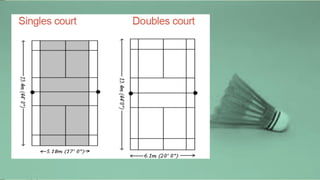
Court – The area of play, as defined by the outer
boundary lines, 44 x 17 ft (singles) and 44 x 20 ft (doubles).
Net – It is made of fine cord, dark in color and of an even
thickness, with a mesh. 760 mm in depth and at least 6.1
m in width, 1.524 m high at the center of the court; 1.55 m
over the side lines for doubles
Post – These are used to hold the net in place, 1.55 m in
height
Facilities and
Equipment
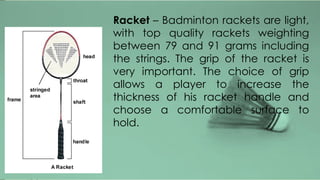
Racket – Badminton rackets are light,
with top quality rackets weighting
between 79 and 91 grams including
the strings. The grip of the racket is
very important. The choice of grip
allows a player to increase the
thickness of his racket handle and
choose a comfortable surface to
hold.
Shuttlecock – A shuttlecock (shuttle, birdie) is a high-drag
projectile, with an open conical shape: the cone is
formed from sixteen overlapping feathers embedded
into a rounded cork base. The cork is covered with thin
leather or synthetic material.
✔Synthetic shuttles (nylon) are often used by
recreational players to reduce their costs as feathered
shuttles break easily.
BADMINTON
Skills
A. TYPES OF GRIP
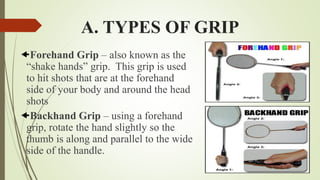
Forehand Grip – also known as the
“shake hands” grip. This grip is used
to hit shots that are at the forehand
side of your body and around the head
shots
Backhand Grip – using a forehand
grip, rotate the hand slightly so the
thumb is along and parallel to the wide
side of the handle.
B. FOOTWORK
1. Move toward the shot with short steps and end with a long
stride.
2. Most shots are played with the body at right angles to the
net.
3. In the ready position the racket is held high, the knees are
slightly bent, and the body weight is on the balls of the feet.
C. STROKES
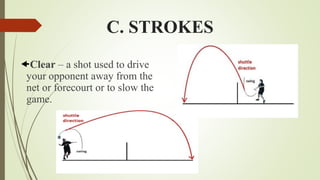
Clear – a shot used to drive
your opponent away from the
net or forecourt or to slow the
game.
https://youtu.be/tAnZMbMH2gc
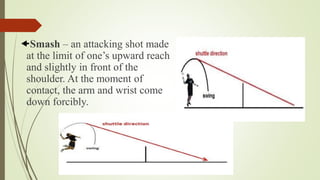
Smash – an attacking shot made
at the limit of one’s upward reach
and slightly in front of the
shoulder. At the moment of
contact, the arm and wrist come
down forcibly.
https://youtu.be/vfi4HlxgpQU
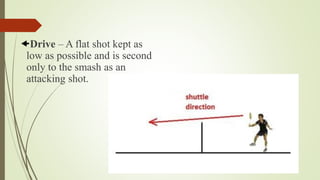
Drive – A flat shot kept as
low as possible and is second
only to the smash as an
attacking shot.
https://youtu.be/2p-PyA1kes8
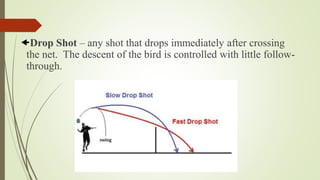
Drop Shot – any shot that drops immediately after crossing
the net. The descent of the bird is controlled with little follow-
through.
https://youtu.be/dotVTfOlpN8
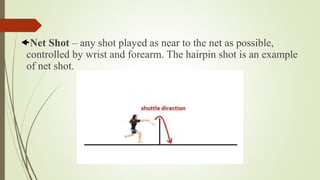
Net Shot – any shot played as near to the net as possible,
controlled by wrist and forearm. The hairpin shot is an example
of net shot.
https://youtu.be/2ByjAixfocA
D. SERVICE
1. High and deep (singles) – take a position near and on the
proper side of the center line and about four feet behind the
short service line. Drop the bird on the racket side and
swing the racket forward.
2. Low and short (doubles) – take a position closer to the
front service line. The racket is swung forward with little
follow-through.
Drive (flick) – a quick snap of the wrist in the backhand grip
with the bird held directly in front of the body. The bird travels
in a direct line at the receiver.
Badminton
Game Rules and Scoring
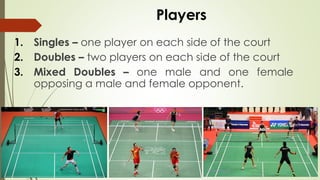
Players
1. Singles – one player on each side of the court
2. Doubles – two players on each side of the court
3. Mixed Doubles – one male and one female
opposing a male and female opponent.
SCORING
oA match consists of the best of 3 games of 21
points.
oEvery time there is a serve – there is a point scored.
oThe side winning a rally adds a point to its score.
oAt 20 all, the side which gains a 2 point lead first,
wins that game.
oAt 29 all, the side scoring the 30th point, wins that
game.
oThe side winning a game serves first in the next
game.
RULES AND REGULATIONS
1. Serving
a. The server must keep both feet in contact
with the floor at the time of the serve.
b. The bird must be contacted below the
waist.
c. The racket head must be below the server’s
wrist.
d. The server should not serve until the
receiver is ready; the opponent is deemed
ready if a turn is attempted
e. Partners of the server and receiver may stand
anywhere on the court provided that they
do not obstruct the opponent’s view.
f. A bird that touches the net on the serve and
goes into the proper service court is legal.
g. If the server misses the bird on the serve
attempt, it still counts. In singles and doubles
the serve would go to the opponent. The
serve is lost to the opponent.
2. Serving Order – Singles
a. The first serve of the game and all
following serves, when the server’s
score is an even number, are made
from the right service court.
b. All serves, when the server’s score is an
odd number, are made from the left
service court.
c. When a rally is lost, the receiving player
becomes the server and scores a point.
3. Serving Order – Doubles
a. There is only one server in doubles.
b. At the beginning of the game and when
the score is EVEN, the server serves from the
RIGHT COURT. When the score is ODD, the
server serves from the LEFT COURT
c. If the serving side wins a rally, the serving
side scores a point and the same person
serves again from the alternate court.
d. If the receiving side wins a rally, the
receiving side scores a point. The
receiving side becomes the new serving
side.
e. The players do not change their
respective service court until they win a
point when their side is serving. You only
change sides of the court, from left to
right, when your team has scored while
serving.
4. The winners of the first game serve first in
the next game.
5. Birds falling on the lines are considered
good.
6. During a rally, a bird that touches the
net and goes over is in play.
7. A fault (violation of rules) occurs if:
a. On the service, any part of the racket
head is higher than the server’s wrist
and contact is made above the waist.
b. The service fails to cross the net or go
into the proper service court.
c. The feet of the server and the receiver
are not in the proper courts at time of
service.
8. Let (a play allowed to be replayed)
a. The bird becomes caught in or on the
net after passing over the net.
b. The bird hits the basketball supports or
net.
c. The following situations occur before
the next serve and if the offending side
wins the rally:
i. The correct server serves from the
wrong court.
ii. The wrong server serves from
either the correct/incorrect
service court.
iii. The correct receiver receives in
the wrong court.
Module 4_ Badminton_History, Basic Skills, Equipment, Rules and Regulations.pdf

Module 4_ Badminton_History, Basic Skills, Equipment, Rules and Regulations.pdf

  • 1.
    PE003 – Individualand Dual Sports BADMINTON Dr. Teejay D. Panganiban, LPT, MPES, DEM Course Professor
  • 2.
    ✔BADMINTON is aracket sport played by either two opposing players (singles) or two opposing pairs (doubles). ✔Competitive badminton is best played indoors because shuttlecock flight is affected by wind. But badminton, as a casual recreational activity, can also be played outdoors. ✔Badminton has been an Olympic sport since 1992 (Barcelona). Nature of the Game
  • 3.
    ✔The origins ofthe game, badminton, date back at least 2,000 years to the game of battledore and shuttlecock played in ancient Greece, China and India, where a form of the game called “poona” was played. ✔In 1860s, British army officers posted to India became interested in “Poona” and took the game home to England, where the rules of badminton were set out. History of Badminton
  • 4.
    ✔This new sportwas definitively launched in 1873 at the Badminton House in Gloucestershire, the ancestral home of the Duke of Beaufort, where he introduced the sport to his guests. ✔It was then known as “The Game of Badminton” for a number of years, until the name was shortened to BADMINTON. ✔Gloucestershire is now the base for the International Badminton Federation.
  • 5.
  • 6.
  • 7.
    ✔The IBF wasformed in 1934 The first big IBF tournament was the Thomas Cup (men’s world team championships) in 1948 ✔The Uber Cup (ladies’ team) The World Cup invitational event started in 1981 and was organized by the International Management Group (IMG)
  • 8.
    Court – Thearea of play, as defined by the outer boundary lines, 44 x 17 ft (singles) and 44 x 20 ft (doubles). Net – It is made of fine cord, dark in color and of an even thickness, with a mesh. 760 mm in depth and at least 6.1 m in width, 1.524 m high at the center of the court; 1.55 m over the side lines for doubles Post – These are used to hold the net in place, 1.55 m in height Facilities and Equipment
  • 10.
    Racket – Badmintonrackets are light, with top quality rackets weighting between 79 and 91 grams including the strings. The grip of the racket is very important. The choice of grip allows a player to increase the thickness of his racket handle and choose a comfortable surface to hold.
  • 11.
    Shuttlecock – Ashuttlecock (shuttle, birdie) is a high-drag projectile, with an open conical shape: the cone is formed from sixteen overlapping feathers embedded into a rounded cork base. The cork is covered with thin leather or synthetic material. ✔Synthetic shuttles (nylon) are often used by recreational players to reduce their costs as feathered shuttles break easily.
  • 12.
  • 13.
    A. TYPES OFGRIP Forehand Grip – also known as the “shake hands” grip. This grip is used to hit shots that are at the forehand side of your body and around the head shots Backhand Grip – using a forehand grip, rotate the hand slightly so the thumb is along and parallel to the wide side of the handle.
  • 14.
    B. FOOTWORK 1. Movetoward the shot with short steps and end with a long stride. 2. Most shots are played with the body at right angles to the net. 3. In the ready position the racket is held high, the knees are slightly bent, and the body weight is on the balls of the feet.
  • 15.
    C. STROKES Clear –a shot used to drive your opponent away from the net or forecourt or to slow the game.
  • 16.
  • 17.
    Smash – anattacking shot made at the limit of one’s upward reach and slightly in front of the shoulder. At the moment of contact, the arm and wrist come down forcibly.
  • 18.
  • 19.
    Drive – Aflat shot kept as low as possible and is second only to the smash as an attacking shot.
  • 20.
  • 21.
    Drop Shot –any shot that drops immediately after crossing the net. The descent of the bird is controlled with little follow- through.
  • 22.
  • 23.
    Net Shot –any shot played as near to the net as possible, controlled by wrist and forearm. The hairpin shot is an example of net shot.
  • 24.
  • 25.
    D. SERVICE 1. Highand deep (singles) – take a position near and on the proper side of the center line and about four feet behind the short service line. Drop the bird on the racket side and swing the racket forward. 2. Low and short (doubles) – take a position closer to the front service line. The racket is swung forward with little follow-through.
  • 26.
    Drive (flick) –a quick snap of the wrist in the backhand grip with the bird held directly in front of the body. The bird travels in a direct line at the receiver.
  • 27.
  • 28.
    Players 1. Singles –one player on each side of the court 2. Doubles – two players on each side of the court 3. Mixed Doubles – one male and one female opposing a male and female opponent.
  • 29.
    SCORING oA match consistsof the best of 3 games of 21 points. oEvery time there is a serve – there is a point scored. oThe side winning a rally adds a point to its score. oAt 20 all, the side which gains a 2 point lead first, wins that game. oAt 29 all, the side scoring the 30th point, wins that game. oThe side winning a game serves first in the next game.
  • 30.
    RULES AND REGULATIONS 1.Serving a. The server must keep both feet in contact with the floor at the time of the serve. b. The bird must be contacted below the waist. c. The racket head must be below the server’s wrist. d. The server should not serve until the receiver is ready; the opponent is deemed ready if a turn is attempted
  • 31.
    e. Partners ofthe server and receiver may stand anywhere on the court provided that they do not obstruct the opponent’s view. f. A bird that touches the net on the serve and goes into the proper service court is legal. g. If the server misses the bird on the serve attempt, it still counts. In singles and doubles the serve would go to the opponent. The serve is lost to the opponent.
  • 32.
    2. Serving Order– Singles a. The first serve of the game and all following serves, when the server’s score is an even number, are made from the right service court. b. All serves, when the server’s score is an odd number, are made from the left service court. c. When a rally is lost, the receiving player becomes the server and scores a point.
  • 33.
    3. Serving Order– Doubles a. There is only one server in doubles. b. At the beginning of the game and when the score is EVEN, the server serves from the RIGHT COURT. When the score is ODD, the server serves from the LEFT COURT c. If the serving side wins a rally, the serving side scores a point and the same person serves again from the alternate court.
  • 34.
    d. If thereceiving side wins a rally, the receiving side scores a point. The receiving side becomes the new serving side. e. The players do not change their respective service court until they win a point when their side is serving. You only change sides of the court, from left to right, when your team has scored while serving.
  • 35.
    4. The winnersof the first game serve first in the next game. 5. Birds falling on the lines are considered good. 6. During a rally, a bird that touches the net and goes over is in play.
  • 36.
    7. A fault(violation of rules) occurs if: a. On the service, any part of the racket head is higher than the server’s wrist and contact is made above the waist. b. The service fails to cross the net or go into the proper service court. c. The feet of the server and the receiver are not in the proper courts at time of service.
  • 37.
    8. Let (aplay allowed to be replayed) a. The bird becomes caught in or on the net after passing over the net. b. The bird hits the basketball supports or net. c. The following situations occur before the next serve and if the offending side wins the rally: i. The correct server serves from the wrong court.
  • 38.
    ii. The wrongserver serves from either the correct/incorrect service court. iii. The correct receiver receives in the wrong court.