Badminton
What is “badminton”
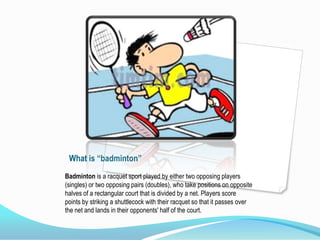
Badminton is a racquet sport played by either two opposing players
(singles) or two opposing pairs (doubles), who take positions on opposite
halves of a rectangular court that is divided by a net. Players score
points by striking a shuttlecock with their racquet so that it passes over
the net and lands in their opponents' half of the court.
Equipment
 Racquets
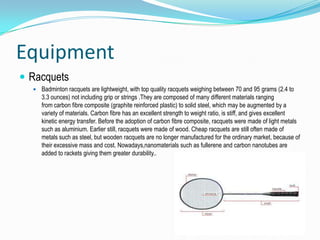
   Badminton racquets are lightweight, with top quality racquets weighing between 70 and 95 grams (2.4 to
     3.3 ounces) not including grip or strings .They are composed of many different materials ranging
     from carbon fibre composite (graphite reinforced plastic) to solid steel, which may be augmented by a
     variety of materials. Carbon fibre has an excellent strength to weight ratio, is stiff, and gives excellent
     kinetic energy transfer. Before the adoption of carbon fibre composite, racquets were made of light metals
     such as aluminium. Earlier still, racquets were made of wood. Cheap racquets are still often made of
     metals such as steel, but wooden racquets are no longer manufactured for the ordinary market, because of
     their excessive mass and cost. Nowadays,nanomaterials such as fullerene and carbon nanotubes are
     added to rackets giving them greater durability..
 Shuttlecock
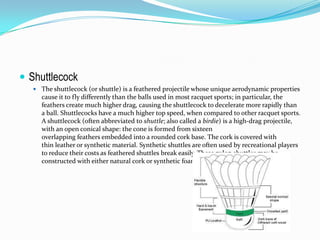
    The shuttlecock (or shuttle) is a feathered projectile whose unique aerodynamic properties
     cause it to fly differently than the balls used in most racquet sports; in particular, the
     feathers create much higher drag, causing the shuttlecock to decelerate more rapidly than
     a ball. Shuttlecocks have a much higher top speed, when compared to other racquet sports.
     A shuttlecock (often abbreviated to shuttle; also called a birdie) is a high-drag projectile,
     with an open conical shape: the cone is formed from sixteen
     overlapping feathers embedded into a rounded cork base. The cork is covered with
     thin leather or synthetic material. Synthetic shuttles are often used by recreational players
     to reduce their costs as feathered shuttles break easily. These nylon shuttles may be
     constructed with either natural cork or synthetic foam base, and a plastic skirt.
 Shoes
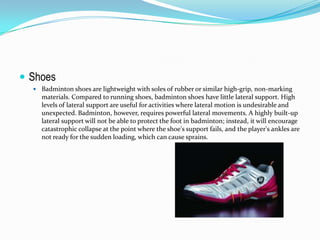
   Badminton shoes are lightweight with soles of rubber or similar high-grip, non-marking
    materials. Compared to running shoes, badminton shoes have little lateral support. High
    levels of lateral support are useful for activities where lateral motion is undesirable and
    unexpected. Badminton, however, requires powerful lateral movements. A highly built-up
    lateral support will not be able to protect the foot in badminton; instead, it will encourage
    catastrophic collapse at the point where the shoe's support fails, and the player's ankles are
    not ready for the sudden loading, which can cause sprains.
Where it was created?
 The beginnings of badminton can be traced to mid-18th century British India, where it was created
  by British military officers stationed there.Early photographs show Englishmen adding a net to the
  traditional English game of battledore and shuttlecock. Being particularly popular in the British garrison town
  Poona (now Pune ), the game also came to be known as Poona.Initially, balls of wool referred as ball
  badminton were preferred by the upper classes in windy or wet conditions, but ultimately the shuttlecock stuck.
  This game was taken by retired officers back to England where it developed and rules were set out. Although it
  appears clear that Badminton House, Gloucestershire, owned by the Duke of Beaufort, has given its name to
  the sports, it is unclear when and why the name was adopted. As early as 1860, Isaac Spratt, a London toy
  dealer, published a booklet, Badminton Battledore – a new game, but unfortunately no copy has survived.An
  1863 article in The Cornhill Magazine describes badminton as "battledore and shuttlecock played with sides,
  across a string suspended some five feet from the ground“.This early use has cast doubt on the origin through
  expatriates in India, though it is known that it was popular there in the 1870s and that the first rules were drawn
  up in Poonah in 1873.
 As early as 1875, veterans returning from India started a club in Folkestone. Until 1887, the sport was played in
  England under the rules that prevailed in British India. The Bath Badminton Club standardized the rules and
  made the game applicable to English ideas. J.H.E. Hart drew up revised basic regulations in 1887 and, with
  Bagnel Wild, again in 1890.In 1893, the Badminton Association of England published the first set of rules
  according to these regulations, similar to today's rules, and officially launched badminton in a house called
  "Dunbar" at 6 Waverley Grove, Portsmouth, England on September 13 of that year.They also started the All
  England Open Badminton Championships, the first badminton competition in the world, in 1899.
Rules
 Playing court dimensions
   The court is rectangular and divided into halves by a net. Courts are usually marked for
     both singles and doubles play, although badminton rules permit a court to be marked for
     singles only.The doubles court is wider than the singles court, but both are of same length.
     The exception, which often causes confusion to newer players, is that the doubles court has
     a shorter serve-length dimension. The full width of the court is 6.1 metres (20 ft), and
     in singles this width is reduced to 5.18 metres (17 ft). The full length of the court is
     13.4 metres (44 ft). The service courts are marked by a centre line dividing the width
     of the court, by a short service line at a distance of 1.98 metres (6 ft 6 inch) from the
     net, and by the outer side and back boundaries. In doubles, the service court is also
     marked by a long service line, which is 0.76 metres (2 ft 6 inch) from the back
     boundary. The net is 1.55 metres (5 ft 1 inch) high at the edges and 1.524 metres (5 ft)
     high in the centre. The net posts are placed over the doubles sidelines, even when
     singles is played.
 Scoring system and services
    Basic
       Each game is played to 21 points, with players scoring a point whenever they win a rally
        regardless of whether they served(this differs from the old system where players could only win a
        point on their serve and each game was played to 15 points). A match is the best of three games.
        At the start of the rally, the server and receiver stand in diagonally opposite service
        courts (see court dimensions). The server hits the shuttlecock so that it would land in the
        receiver's service court. This is similar to tennis, except that a badminton serve must be hit below
        waist height and with the racquet shaft pointing downwards, the shuttlecock is not allowed to
        bounce and in badminton, the players stand inside their service courts unlike tennis. When the
        serving side loses a rally, the serve immediately passes to their opponent(s) (this differs from the
        old system where sometimes the serve passes to the doubles partner for what is known as a
        "second serve").
 Details
 When the server serves, the shuttlecock must pass over the short service line on the opponents' court or it will
   count as a fault. If the score reaches 20-all, then the game continues until one side gains a two point lead (such
   as 24–22), up to a maximum of 30 points (30–29 is a winning score). At the start of a match, the shuttlecock is
   cast and the side towards which the shuttlecock is pointing serves first. Alternatively, a coin may be tossed, with
   the winners choosing whether to serve or receive first, or choosing which end of the court to occupy, and their
   opponents making the leftover the remaining choice. In subsequent games, the winners of the previous game
   serve first. Matches are best out of three: a player or pair must win two games (of 21 points each) to win the
   match. For the first rally of any doubles game, the serving pair may decide who serves and the receiving pair
   may decide who receives. The players change ends at the start of the second game; if the match reaches a third
   game, they change ends both at the start of the game and when the leading player's or pair's score reaches 11
   points.
 Lets
     If a let is called, the rally is stopped and replayed with no change to the score. Lets may occur because
      of some unexpected disturbance such as a shuttlecock landing on court (having been hit there by
      players on an adjacent court) or in small halls the shuttle may touch an overhead rail which can be
      classed as a let. If the receiver is not ready when the service is delivered, a let shall be called; yet, if
      the receiver attempts to return the shuttlecock, he shall be judged to have been ready.
Badminton

Badminton

  • 1.
  • 2.
    What is “badminton” Badmintonis a racquet sport played by either two opposing players (singles) or two opposing pairs (doubles), who take positions on opposite halves of a rectangular court that is divided by a net. Players score points by striking a shuttlecock with their racquet so that it passes over the net and lands in their opponents' half of the court.
  • 3.
    Equipment  Racquets  Badminton racquets are lightweight, with top quality racquets weighing between 70 and 95 grams (2.4 to 3.3 ounces) not including grip or strings .They are composed of many different materials ranging from carbon fibre composite (graphite reinforced plastic) to solid steel, which may be augmented by a variety of materials. Carbon fibre has an excellent strength to weight ratio, is stiff, and gives excellent kinetic energy transfer. Before the adoption of carbon fibre composite, racquets were made of light metals such as aluminium. Earlier still, racquets were made of wood. Cheap racquets are still often made of metals such as steel, but wooden racquets are no longer manufactured for the ordinary market, because of their excessive mass and cost. Nowadays,nanomaterials such as fullerene and carbon nanotubes are added to rackets giving them greater durability..
  • 4.
     Shuttlecock  The shuttlecock (or shuttle) is a feathered projectile whose unique aerodynamic properties cause it to fly differently than the balls used in most racquet sports; in particular, the feathers create much higher drag, causing the shuttlecock to decelerate more rapidly than a ball. Shuttlecocks have a much higher top speed, when compared to other racquet sports. A shuttlecock (often abbreviated to shuttle; also called a birdie) is a high-drag projectile, with an open conical shape: the cone is formed from sixteen overlapping feathers embedded into a rounded cork base. The cork is covered with thin leather or synthetic material. Synthetic shuttles are often used by recreational players to reduce their costs as feathered shuttles break easily. These nylon shuttles may be constructed with either natural cork or synthetic foam base, and a plastic skirt.
  • 5.
     Shoes  Badminton shoes are lightweight with soles of rubber or similar high-grip, non-marking materials. Compared to running shoes, badminton shoes have little lateral support. High levels of lateral support are useful for activities where lateral motion is undesirable and unexpected. Badminton, however, requires powerful lateral movements. A highly built-up lateral support will not be able to protect the foot in badminton; instead, it will encourage catastrophic collapse at the point where the shoe's support fails, and the player's ankles are not ready for the sudden loading, which can cause sprains.
  • 6.
    Where it wascreated?  The beginnings of badminton can be traced to mid-18th century British India, where it was created by British military officers stationed there.Early photographs show Englishmen adding a net to the traditional English game of battledore and shuttlecock. Being particularly popular in the British garrison town Poona (now Pune ), the game also came to be known as Poona.Initially, balls of wool referred as ball badminton were preferred by the upper classes in windy or wet conditions, but ultimately the shuttlecock stuck. This game was taken by retired officers back to England where it developed and rules were set out. Although it appears clear that Badminton House, Gloucestershire, owned by the Duke of Beaufort, has given its name to the sports, it is unclear when and why the name was adopted. As early as 1860, Isaac Spratt, a London toy dealer, published a booklet, Badminton Battledore – a new game, but unfortunately no copy has survived.An 1863 article in The Cornhill Magazine describes badminton as "battledore and shuttlecock played with sides, across a string suspended some five feet from the ground“.This early use has cast doubt on the origin through expatriates in India, though it is known that it was popular there in the 1870s and that the first rules were drawn up in Poonah in 1873.  As early as 1875, veterans returning from India started a club in Folkestone. Until 1887, the sport was played in England under the rules that prevailed in British India. The Bath Badminton Club standardized the rules and made the game applicable to English ideas. J.H.E. Hart drew up revised basic regulations in 1887 and, with Bagnel Wild, again in 1890.In 1893, the Badminton Association of England published the first set of rules according to these regulations, similar to today's rules, and officially launched badminton in a house called "Dunbar" at 6 Waverley Grove, Portsmouth, England on September 13 of that year.They also started the All England Open Badminton Championships, the first badminton competition in the world, in 1899.
  • 7.
    Rules  Playing courtdimensions  The court is rectangular and divided into halves by a net. Courts are usually marked for both singles and doubles play, although badminton rules permit a court to be marked for singles only.The doubles court is wider than the singles court, but both are of same length. The exception, which often causes confusion to newer players, is that the doubles court has a shorter serve-length dimension. The full width of the court is 6.1 metres (20 ft), and in singles this width is reduced to 5.18 metres (17 ft). The full length of the court is 13.4 metres (44 ft). The service courts are marked by a centre line dividing the width of the court, by a short service line at a distance of 1.98 metres (6 ft 6 inch) from the net, and by the outer side and back boundaries. In doubles, the service court is also marked by a long service line, which is 0.76 metres (2 ft 6 inch) from the back boundary. The net is 1.55 metres (5 ft 1 inch) high at the edges and 1.524 metres (5 ft) high in the centre. The net posts are placed over the doubles sidelines, even when singles is played.
  • 8.
     Scoring systemand services  Basic  Each game is played to 21 points, with players scoring a point whenever they win a rally regardless of whether they served(this differs from the old system where players could only win a point on their serve and each game was played to 15 points). A match is the best of three games. At the start of the rally, the server and receiver stand in diagonally opposite service courts (see court dimensions). The server hits the shuttlecock so that it would land in the receiver's service court. This is similar to tennis, except that a badminton serve must be hit below waist height and with the racquet shaft pointing downwards, the shuttlecock is not allowed to bounce and in badminton, the players stand inside their service courts unlike tennis. When the serving side loses a rally, the serve immediately passes to their opponent(s) (this differs from the old system where sometimes the serve passes to the doubles partner for what is known as a "second serve").
  • 9.
     Details  Whenthe server serves, the shuttlecock must pass over the short service line on the opponents' court or it will count as a fault. If the score reaches 20-all, then the game continues until one side gains a two point lead (such as 24–22), up to a maximum of 30 points (30–29 is a winning score). At the start of a match, the shuttlecock is cast and the side towards which the shuttlecock is pointing serves first. Alternatively, a coin may be tossed, with the winners choosing whether to serve or receive first, or choosing which end of the court to occupy, and their opponents making the leftover the remaining choice. In subsequent games, the winners of the previous game serve first. Matches are best out of three: a player or pair must win two games (of 21 points each) to win the match. For the first rally of any doubles game, the serving pair may decide who serves and the receiving pair may decide who receives. The players change ends at the start of the second game; if the match reaches a third game, they change ends both at the start of the game and when the leading player's or pair's score reaches 11 points.
  • 10.
     Lets  If a let is called, the rally is stopped and replayed with no change to the score. Lets may occur because of some unexpected disturbance such as a shuttlecock landing on court (having been hit there by players on an adjacent court) or in small halls the shuttle may touch an overhead rail which can be classed as a let. If the receiver is not ready when the service is delivered, a let shall be called; yet, if the receiver attempts to return the shuttlecock, he shall be judged to have been ready.