Badminton
By: Sir Mike
Object of the Game Badminton
•The game of badminton consists of
two to four players (singles or
doubles). The aim of badminton is to
hit the shuttle with your racket so
that it passes over the net and lands
inside your opponent’s half of the
court.
Object of the Game Badminton
•Play begins from the right half
court. Players must hit the
shuttlecock into the diagonal
opposite court.
Badminton court
History of Badminton
• Badminton was first called as Poona. It
was developed from a children’s game
called battledore and shuttlecock. The
object of this game was to see how long a
group could volley the shuttlecock by
hitting it with the battledore, or paddle.
This cooperative, non-competitive game
was originally played without a net.
History of Badminton
•It was in the 1860s, when some
british officers in india who were
stationed at 'kirkee' near the city of
'poona' (now known as pune city)
used to play a game which was very
similar to badminton and the game
was known as the 'poona' game at
that time.
History of Badminton
• These soldiers played with battledores
(paddles) which was used to hit the
shuttlecock and had also added a net in
between the players. When these british
soldiers returned back home at
gloustershire county in the 1870s, they
continued to play this 'poona' badminton
game.
History of Badminton
• In 1873, the duke of beaufort held a lawn
party in his country place, called
badminton. A game of poona was played
on that day and it became popular among
the elite people of british society. The
new party sport became known as "the
badminton game" and started to grow
popular.
History of Badminton
• The year 1877, is of historic significance
for badminton, as the 'bath badminton
club', the first badminton club ever, was
formed and also the first official set of
rules were developed.
• The first badminton association
tournament know as “ the England
championship” was played and held
1899.
History of Badminton
• The International Badminton Federation (IBF) was formed in
1934 with 9 founding members.
• - England
• - Ireland
• - Scotland
• - Wales
• - Denmark
• - Holland
• - Canada
• - New Zealand
• - France
History of Badminton
• Badminton was officially granted Olympic
status in the 1992 Barcelona games. From
9 founding members, IBF now have over
150 member countries.
Facilities and Equipment of
Badminton
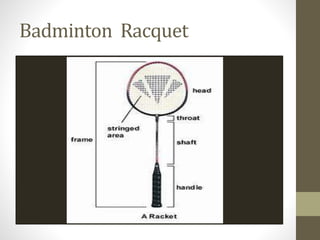
• Racquet – used to hit the bird, the racquet is
shaped like a tennis racquet and has strings, but
weighs much less. The frame of the racket,
including the handle, is not to exceed 680 mm
(26.75 inches) in overall length, and 230 mm (9
inches) in overall width. The overall length of
the head is not to exceed 290 mm. Most
racquets are made from light man-made
materials such as aluminum or graphite, and
are strung with synthetic material such as
nylon.
Badminton Racquet
Facilities and Equipment of
Badminton
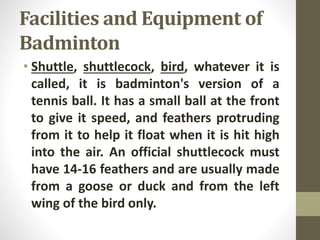
• Shuttle, shuttlecock, bird, whatever it is
called, it is badminton's version of a
tennis ball. It has a small ball at the front
to give it speed, and feathers protruding
from it to help it float when it is hit high
into the air. An official shuttlecock must
have 14-16 feathers and are usually made
from a goose or duck and from the left
wing of the bird only.
Shuttlecock
Facilities and Equipment of
Badminton
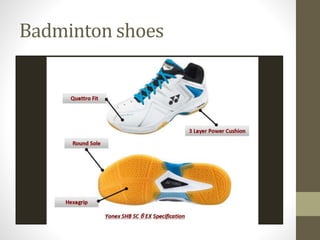
• Shoes – special court shoes are worn to
allow players to move quickly across the
court, and to give them traction for quick
movements around.
Badminton shoes
Facilities and Equipment of
Badminton
• Net -plays an important role in badminton matches. The
badminton world federation’s laws of badminton
provide specific standards for net height, width, and
construction. An official badminton net must measure 5
feet high in the center, and 5 feet, 1 inch at the sides.
The net attaches to vertical posts on either side of the
court. The net should measure 30 inches from bottom
to top, and must consist of a uniform, dark colored
mesh. The net should have a white tape running along
the top to make the net’s full height visible to players
and officials.
Badminton Net
Facilities and Equipment of
Badminton
• Badminton court - shall be a rectangle
laid out with lines of 40mm wide,
preferably in white or yellow color. The
badminton court dimensions are of 13.4m
in length and 6.1m in width.
Badminton court
Rules of the Game
• scoring system • every time you win a
rally, you get a point. • the winner of a
badminton match is the player(s) who
win two games out of three.
Rules of the Game
• A game is won by being the first to reach
11, 15 or 21 points. • Each game must be
won by at least two points and a number
of systems are available for extending a
game where a score of 10-10, 14-14 or 20-
20 has been reached.
Rules of the Game
• The server is not allowed to serve until
his opponent is ready. If the opponent
attempts to return service, he is deemed
to have been ready. • Both the server and
the opponent receiving the serve are
required to stand so that some part of
both feet remains in contact with the
surface of the court while in a stationary
position until the service has been
delivered.
Rules of the Game
• Every time there is a serve – there is a
point scored. • The side winning a rally
adds a point to its score. • At 20 all, the
side which gains a 2 point lead first, wins
that game. • At 29 all, the side scoring the
30th point, wins that game. • When
you’re saying the score, always say the
server’s score first.
Rules of the Game
• The side winning a game serves first in
the next game • if players commit an
error in the service court, the error is
corrected when the mistake is discovered.
Rules of the Game
• Serving Serving is how you start the rally
receiver is the person who hits the
second shot in the rally. In doubles, the
receiver’s partner is not allowed to hit
this shot.
Rules of the Game
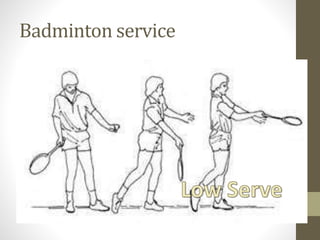
• How to serve in badminton, the serve must be
hit in an upwards direction, with an underarm
hitting action. You are not allowed to play a
"tennis style" serve. The main rule here is that
when you hit the shuttle, it must be below your
waist. To be exact, the rules define this to be a
height level with the lowest part of your
ribcage. In other words, you can serve from a
bit higher than the top of your shorts, but not
much.
Rules of the Game
• Two service courts your right service
court, and your left service court. Doubles
service courts. They are wider, because
they use the outside side line (remember:
the doubles court is wider); and they are
shorter, because they use the inside back
line.
Rules of the Game
• How service courts are used the server must stand
inside a service court. The receiver must stand inside
the diagonally opposite service court. The serve must
travel into the diagonally opposite service court. If the
serve is going to land outside the service court, then the
receiver should let it fall to the floor. If the receiver hits
the serve, then the rally continues even if the serve had
been going out. The server and receiver must stay
inside their service boxes until the server contacts the
shuttle with his racket. After that, they can leave the
boxes immediately and move anywhere on court.
Rules of the Game
• Deciding who gets to serve first in a major
tournament, a coin toss is used to decide
which side will serve first. In more casual
club or league games, you usually just
throw the shuttle up in the air, let it land,
and see which side it points towards: that
side serves first.
Rules of the Game
• In a doubles match between A & B
against C & D. A & B won the toss and
decided to serve. A to serve to C. A shall
be the initial server while C shall be the
initial receiver.
Doubles
Rules of the Game
• The order of server depends on the score
odd or even same as in singles. • The
service courts are changed by the
servicing side only when a point is scored.
In all other cases, the players continue to
stay in their respective service court from
where they played previous rally. This
shall guarantee alternate server.
Rules of the Game
•Singles, doubles, and mixed doubles
you can have either two or four
players on a badminton court: one
player on each side, or a team of two
players on each side. Singles- one-
against-one doubles- two-against-
two
Rules of the Game
•Five types of badminton men’s
singles women’s singles men’s
doubles women’s doubles mixed
doubles (each team is a man and a
woman) men’s doubles and women’s
doubles are also called level doubles.
Rules of the Game
• Interval and change of ends • when the
leading score reaches 11 points, players
have a 60 second interval. • A 2 minute
interval between each game is allowed. •
In the third game, players change ends
when the leading score reaches 11 points.
Badminton service
Badminton service
Badminton serve
Badminton serve
Badminton serve
Badminton

Badminton

  • 1.
  • 2.
    Object of theGame Badminton •The game of badminton consists of two to four players (singles or doubles). The aim of badminton is to hit the shuttle with your racket so that it passes over the net and lands inside your opponent’s half of the court.
  • 3.
    Object of theGame Badminton •Play begins from the right half court. Players must hit the shuttlecock into the diagonal opposite court.
  • 4.
  • 5.
    History of Badminton •Badminton was first called as Poona. It was developed from a children’s game called battledore and shuttlecock. The object of this game was to see how long a group could volley the shuttlecock by hitting it with the battledore, or paddle. This cooperative, non-competitive game was originally played without a net.
  • 6.
    History of Badminton •Itwas in the 1860s, when some british officers in india who were stationed at 'kirkee' near the city of 'poona' (now known as pune city) used to play a game which was very similar to badminton and the game was known as the 'poona' game at that time.
  • 7.
    History of Badminton •These soldiers played with battledores (paddles) which was used to hit the shuttlecock and had also added a net in between the players. When these british soldiers returned back home at gloustershire county in the 1870s, they continued to play this 'poona' badminton game.
  • 8.
    History of Badminton •In 1873, the duke of beaufort held a lawn party in his country place, called badminton. A game of poona was played on that day and it became popular among the elite people of british society. The new party sport became known as "the badminton game" and started to grow popular.
  • 9.
    History of Badminton •The year 1877, is of historic significance for badminton, as the 'bath badminton club', the first badminton club ever, was formed and also the first official set of rules were developed. • The first badminton association tournament know as “ the England championship” was played and held 1899.
  • 10.
    History of Badminton •The International Badminton Federation (IBF) was formed in 1934 with 9 founding members. • - England • - Ireland • - Scotland • - Wales • - Denmark • - Holland • - Canada • - New Zealand • - France
  • 11.
    History of Badminton •Badminton was officially granted Olympic status in the 1992 Barcelona games. From 9 founding members, IBF now have over 150 member countries.
  • 12.
    Facilities and Equipmentof Badminton • Racquet – used to hit the bird, the racquet is shaped like a tennis racquet and has strings, but weighs much less. The frame of the racket, including the handle, is not to exceed 680 mm (26.75 inches) in overall length, and 230 mm (9 inches) in overall width. The overall length of the head is not to exceed 290 mm. Most racquets are made from light man-made materials such as aluminum or graphite, and are strung with synthetic material such as nylon.
  • 13.
  • 14.
    Facilities and Equipmentof Badminton • Shuttle, shuttlecock, bird, whatever it is called, it is badminton's version of a tennis ball. It has a small ball at the front to give it speed, and feathers protruding from it to help it float when it is hit high into the air. An official shuttlecock must have 14-16 feathers and are usually made from a goose or duck and from the left wing of the bird only.
  • 15.
  • 16.
    Facilities and Equipmentof Badminton • Shoes – special court shoes are worn to allow players to move quickly across the court, and to give them traction for quick movements around.
  • 17.
  • 18.
    Facilities and Equipmentof Badminton • Net -plays an important role in badminton matches. The badminton world federation’s laws of badminton provide specific standards for net height, width, and construction. An official badminton net must measure 5 feet high in the center, and 5 feet, 1 inch at the sides. The net attaches to vertical posts on either side of the court. The net should measure 30 inches from bottom to top, and must consist of a uniform, dark colored mesh. The net should have a white tape running along the top to make the net’s full height visible to players and officials.
  • 19.
  • 20.
    Facilities and Equipmentof Badminton • Badminton court - shall be a rectangle laid out with lines of 40mm wide, preferably in white or yellow color. The badminton court dimensions are of 13.4m in length and 6.1m in width.
  • 21.
  • 22.
    Rules of theGame • scoring system • every time you win a rally, you get a point. • the winner of a badminton match is the player(s) who win two games out of three.
  • 23.
    Rules of theGame • A game is won by being the first to reach 11, 15 or 21 points. • Each game must be won by at least two points and a number of systems are available for extending a game where a score of 10-10, 14-14 or 20- 20 has been reached.
  • 24.
    Rules of theGame • The server is not allowed to serve until his opponent is ready. If the opponent attempts to return service, he is deemed to have been ready. • Both the server and the opponent receiving the serve are required to stand so that some part of both feet remains in contact with the surface of the court while in a stationary position until the service has been delivered.
  • 25.
    Rules of theGame • Every time there is a serve – there is a point scored. • The side winning a rally adds a point to its score. • At 20 all, the side which gains a 2 point lead first, wins that game. • At 29 all, the side scoring the 30th point, wins that game. • When you’re saying the score, always say the server’s score first.
  • 26.
    Rules of theGame • The side winning a game serves first in the next game • if players commit an error in the service court, the error is corrected when the mistake is discovered.
  • 27.
    Rules of theGame • Serving Serving is how you start the rally receiver is the person who hits the second shot in the rally. In doubles, the receiver’s partner is not allowed to hit this shot.
  • 28.
    Rules of theGame • How to serve in badminton, the serve must be hit in an upwards direction, with an underarm hitting action. You are not allowed to play a "tennis style" serve. The main rule here is that when you hit the shuttle, it must be below your waist. To be exact, the rules define this to be a height level with the lowest part of your ribcage. In other words, you can serve from a bit higher than the top of your shorts, but not much.
  • 29.
    Rules of theGame • Two service courts your right service court, and your left service court. Doubles service courts. They are wider, because they use the outside side line (remember: the doubles court is wider); and they are shorter, because they use the inside back line.
  • 30.
    Rules of theGame • How service courts are used the server must stand inside a service court. The receiver must stand inside the diagonally opposite service court. The serve must travel into the diagonally opposite service court. If the serve is going to land outside the service court, then the receiver should let it fall to the floor. If the receiver hits the serve, then the rally continues even if the serve had been going out. The server and receiver must stay inside their service boxes until the server contacts the shuttle with his racket. After that, they can leave the boxes immediately and move anywhere on court.
  • 31.
    Rules of theGame • Deciding who gets to serve first in a major tournament, a coin toss is used to decide which side will serve first. In more casual club or league games, you usually just throw the shuttle up in the air, let it land, and see which side it points towards: that side serves first.
  • 32.
    Rules of theGame • In a doubles match between A & B against C & D. A & B won the toss and decided to serve. A to serve to C. A shall be the initial server while C shall be the initial receiver.
  • 33.
  • 34.
    Rules of theGame • The order of server depends on the score odd or even same as in singles. • The service courts are changed by the servicing side only when a point is scored. In all other cases, the players continue to stay in their respective service court from where they played previous rally. This shall guarantee alternate server.
  • 35.
    Rules of theGame •Singles, doubles, and mixed doubles you can have either two or four players on a badminton court: one player on each side, or a team of two players on each side. Singles- one- against-one doubles- two-against- two
  • 36.
    Rules of theGame •Five types of badminton men’s singles women’s singles men’s doubles women’s doubles mixed doubles (each team is a man and a woman) men’s doubles and women’s doubles are also called level doubles.
  • 37.
    Rules of theGame • Interval and change of ends • when the leading score reaches 11 points, players have a 60 second interval. • A 2 minute interval between each game is allowed. • In the third game, players change ends when the leading score reaches 11 points.
  • 38.
  • 39.
  • 40.
  • 41.
  • 42.