Badminton traces its
originsto ancient games
such as “battledore and
shuttlecock” that were
played in Greece, Egypt,
China and India more than
2,000 years ago.
3.
In India duringthe mid-
19th century a version
called “Poona” (or
“Poonah”) was played, especially by
British
military officers stationed
there.
4.
Around 1873 thegame was
introduced in England at the
country estate of the Duke of
Beaufort in Gloucestershire,
called “Badminton”, from which
the sport derives its name.
5.
In 1893 theBadminton
Association of England was
formed, standardizing rules
and helping shape the
competitive sport we know
today.
6.
In 1893 theBadminton
Association of England was
formed, standardizing rules and
helping shape the competitive
sport we know today.
7.
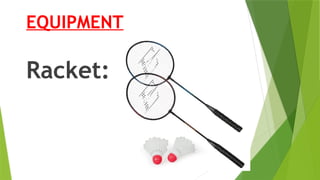
EQUIPMENT
Racket:
Modern rackets areusually
made from materials like
aluminum, steel or carbon fiber
and are designed to
be light, fast and maneuverable.
EQUIPMENT
Shuttlecock:
The shuttlecock istypically
made from 16 feathers attached
to a cork base, or from
synthetic materials for durability;
it must have a specific flight trajectory
and weight.
COURT
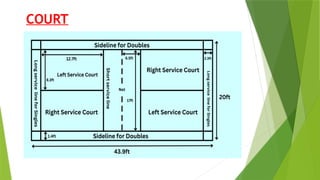
The standard badmintoncourt is a
rectangular area divided by a net.
For doubles, the width is greater,
and the back‐boundary is slightly
different than for singles. A typical
court dimension for doubles is about
13.40 m × 6.10 m.
12.
COURT
Proper court linesindicate
service areas, side boundaries,
and back boundaries. Accurate
markings are crucial since many
rules depend on where the
shuttle lands or is served.
RULES
A match istypically played as the best of
three games. Each game is played to 21 points
under the rally‐scoring system, meaning a point is
awarded in every rally, regardless of who served.
If the score reaches 20-20, play continues until a
player (or pair) leads by two points. Players
change sides after each game, and in the third
game when one side reaches 11 points.
17.
TYPES OF STROKE
•Clear: A high, deep shot to the back of the opponent’s
court to gain time or push opponent back.
• Drop shot: A soft shot that barely clears the net and
lands close to the opponent’s front court.
• Smash: A fast, downward stroke meant to win the point
directly.
• Drive: A flat, fast shot across the net, used to pressure
the opponent.
Good players combine tactical placement, speed, foot‐
work and anticipation to gain advantage.
18.
Doubles vs Singles:
KeyDifferences
While the basic rules remain the
same, there are strategic and
positional differences between singles
and doubles. In doubles, the court is
wider and players often specialize in
front/back or side/side formations.
19.
Doubles vs Singles:
KeyDifferences
Communication, quick reflexes and team
positioning become crucial. In singles, players
must cover the entire court alone, so stamina,
movement and positioning are more
emphazised. Understanding these differences
helps adapt your play style depending on
format.
20.
SERVING RULES
• Servemust be underhand and hit below the
waist.
• The shuttle must land diagonally in the
opponent’s service court.
• In doubles, the right-hand court serves
when the score is even; left-hand court
serves when odd.
21.
FAULTS
A fault occurswhen:
• The shuttle lands outside the
boundaries.
• The shuttle does not pass over the net.
• A player touches the net with the
racket or body.
• A player hits the shuttle twice in one
stroke.
22.
SCORING SYSTEM
• Everyrally results in one point.
• At 20-all, the game continues until
one player leads by two points.
• The first to reach 21 points wins the
game.
• The winner of the previous game
serves first in the next game.
BENEFITS
It is alsoa fantastic lifetime physical
activity: it improves agility,
coordination, cardiovascular fitness,
and social interaction. Encourage
students to view badminton not just
as a class activity but as a skill and
habit they can carry into adult life.
25.
SUMMARY
• Badminton’s rootslie in ancient
shuttlecock games, evolved through
India and England into the modern
sport.
• Key equipment includes the racket,
shuttlecock, net and court with
specific dimensions.
26.
SUMMARY
• The rulesinclude rally‐scoring to 21,
serves underhand, diagonal service,
and faults when shuttle/players
violate boundaries or contact.
• Different strategies apply for singles
vs doubles.
27.
SUMMARY
• Most importantly,badminton can be
enjoyed competitively or casually,
promoting physical and social well‐
being.
Editor's Notes
#14 Get a picture of tract (oval)
Get a video of examples of relay and hurdles
#15 Get a picture of tract (oval)
Get a video of examples of relay and hurdles
#16 Picture of pit of sand
Insert examples of long jump