BACKGROUND OF
        PARTITION OF BENGAL
Partitioning Bengal was first considered in 1903.
There were also additional proposals to separate
Chittagong and the districts of Dhaka and
Mymensingh from Bengal and attaching them to
the province of Assam. In a similar way,
Chhota Nagpur was to be incorporated with the
central provinces.
The government officially published the idea in
January 1904, and in February, Lord Curzon
made an official tour to eastern districts of Bengal
to assess public opinion on the partition. He
consulted with leading personalities and delivered
speeches at Dhaka, Chittagong and Mymensingh
explaining the government's stand on partition.
The idea was opposed by
Henry John Stedman Cotton, Chief
Commissioner of Assam 1896-1902.
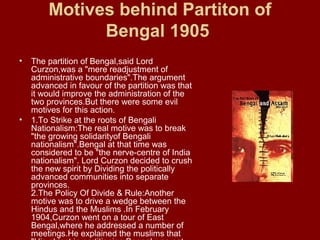
Motives behind Partiton of
              Bengal 1905
•   The partition of Bengal,said Lord
    Curzon,was a "mere readjustment of
    administrative boundaries".The argument
    advanced in favour of the partition was that
    it would improve the administration of the
    two provinces.But there were some evil
    motives for this action.
•   1.To Strike at the roots of Bengali
    Nationalism:The real motive was to break
    "the growing solidarityof Bengali
    nationalism".Bengal at that time was
    considered to be "the nerve-centre of India
    nationalism". Lord Curzon decided to crush
    the new spirit by Dividing the politically
    advanced communities into separate
    provinces.
    2.The Policy Of Divide & Rule:Another
    motive was to drive a wedge between the
    Hindus and the Muslims .In February
    1904,Curzon went on a tour of East
    Bengal,where he addressed a number of
    meetings.He explained the muslims that
BACKGROUND OF SIMLA
           DEPUTATION
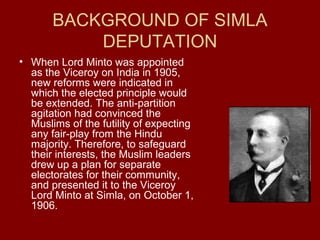
• When Lord Minto was appointed
  as the Viceroy on India in 1905,
  new reforms were indicated in
  which the elected principle would
  be extended. The anti-partition
  agitation had convinced the
  Muslims of the futility of expecting
  any fair-play from the Hindu
  majority. Therefore, to safeguard
  their interests, the Muslim leaders
  drew up a plan for separate
  electorates for their community,
  and presented it to the Viceroy
  Lord Minto at Simla, on October 1,
  1906.
IMPORTANCE OF SIMLA
               DEPUTATION
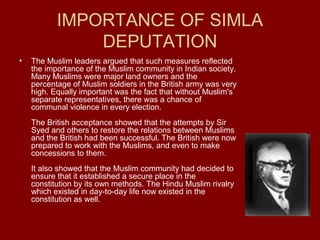
•   The Muslim leaders argued that such measures reflected
    the importance of the Muslim community in Indian society.
    Many Muslims were major land owners and the
    percentage of Muslim soldiers in the British army was very
    high. Equally important was the fact that without Muslim's
    separate representatives, there was a chance of
    communal violence in every election.
    The British acceptance showed that the attempts by Sir
    Syed and others to restore the relations between Muslims
    and the British had been successful. The British were now
    prepared to work with the Muslims, and even to make
    concessions to them.
    It also showed that the Muslim community had decided to
    ensure that it established a secure place in the
    constitution by its own methods. The Hindu Muslim rivalry
    which existed in day-to-day life now existed in the
    constitution as well.
BACKGROUND OF MUSLIM
            LEAGUE
• Muslim rule was established across India between the 8th and the
  14th centuries. The Muslim Turkic Mughal Empire ruled most of
  India from the early 16th century, but suffered a major decline in the
  18th century. The decline of the Mughal empire and its successor
  states like Avadh led to a feeling of discontentment among Muslim
  elites . Muslims represented about 25-30% of the population of
  British India, and constituted the majority of the population in
  Baluchistan, East Bengal, Kashmir valley,
  North-West Frontier Province, West Punjab, and the Sindh region of
  the Karachi Presidency.
• In the late 19th century an Indian nationalist movement developed
  with the Indian National Congress being founded in 1885 as a
  forum, that became a political party subsequently. The Congress
  made no conscious efforts to enlist the Muslim community in its
  struggle for Indian independence. Although some Muslims were
  active in the Congress, majority of Muslim leaders did not trust the
  Hindu predominance and most of the Muslims remained reluctant to
  join the Congress Party.
FOUNDATION OF MUSLIM
            LEAGUE
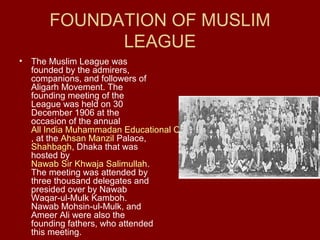
• The Muslim League was
  founded by the admirers,
  companions, and followers of
  Aligarh Movement. The
  founding meeting of the
  League was held on 30
  December 1906 at the
  occasion of the annual
  All India Muhammadan Educational Conference
  , at the Ahsan Manzil Palace,
  Shahbagh, Dhaka that was
  hosted by
  Nawab Sir Khwaja Salimullah.
  The meeting was attended by
  three thousand delegates and
  presided over by Nawab
  Waqar-ul-Mulk Kamboh.
  Nawab Mohsin-ul-Mulk, and
  Ameer Ali were also the
  founding fathers, who attended
  this meeting.
BACKGROUND OF MORLEY
         MINTO REFORMS
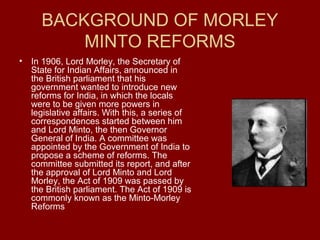
• In 1906, Lord Morley, the Secretary of
  State for Indian Affairs, announced in
  the British parliament that his
  government wanted to introduce new
  reforms for India, in which the locals
  were to be given more powers in
  legislative affairs. With this, a series of
  correspondences started between him
  and Lord Minto, the then Governor
  General of India. A committee was
  appointed by the Government of India to
  propose a scheme of reforms. The
  committee submitted its report, and after
  the approval of Lord Minto and Lord
  Morley, the Act of 1909 was passed by
  the British parliament. The Act of 1909 is
  commonly known as the Minto-Morley
  Reforms
ABOUT MORLEY MINTO
               REFORMS
• The following were the main features of the Act of 1909:
• 1. The number of the members of the Legislative Council at the Center
  was increased from 16 to 60.
• 2. The number of the members of the Provincial Legislatives was also
  increased. It was fixed as 50 in the provinces of Bengal, Madras and
  Bombay, and for the rest of the provinces it was 30.
• 3. The member of the Legislative Councils, both at the Center and in
  the provinces, were to be of four categories i.e. ex-officio members
  (Governor General and the members of their Executive Councils),
  nominated official members (those nominated by the Governor
  General and were government officials), nominated non-official
  members (nominated by the Governor General but were not
  government officials) and elected members (elected by different
  categories of Indian people).
• 4. Right of separate electorate was given to the Muslims.
• 5. At the Center, official members were to form the majority but in
  provinces non-official members would be in majority.
• 6. Two Indians were nominated to the Council of the Secretary of
  State for Indian Affairs.
BACKGROUND OF LUCKNOW
            PACT
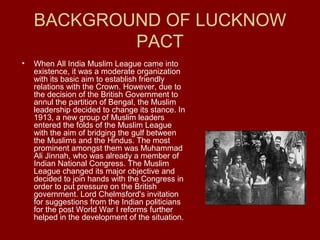
•   When All India Muslim League came into
    existence, it was a moderate organization
    with its basic aim to establish friendly
    relations with the Crown. However, due to
    the decision of the British Government to
    annul the partition of Bengal, the Muslim
    leadership decided to change its stance. In
    1913, a new group of Muslim leaders
    entered the folds of the Muslim League
    with the aim of bridging the gulf between
    the Muslims and the Hindus. The most
    prominent amongst them was Muhammad
    Ali Jinnah, who was already a member of
    Indian National Congress. The Muslim
    League changed its major objective and
    decided to join hands with the Congress in
    order to put pressure on the British
    government. Lord Chelmsford's invitation
    for suggestions from the Indian politicians
    for the post World War I reforms further
    helped in the development of the situation.
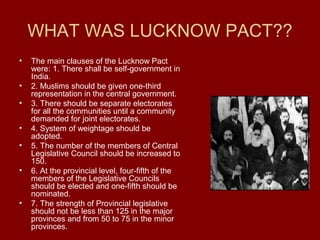
WHAT WAS LUCKNOW PACT??
•   The main clauses of the Lucknow Pact
    were: 1. There shall be self-government in
    India.
•   2. Muslims should be given one-third
    representation in the central government.
•   3. There should be separate electorates
    for all the communities until a community
    demanded for joint electorates.
•   4. System of weightage should be
    adopted.
•   5. The number of the members of Central
    Legislative Council should be increased to
    150.
•   6. At the provincial level, four-fifth of the
    members of the Legislative Councils
    should be elected and one-fifth should be
    nominated.
•   7. The strength of Provincial legislative
    should not be less than 125 in the major
    provinces and from 50 to 75 in the minor
    provinces.
BACKGROUND OF MONTAGUE-
      CHELMSFORD REFORMS
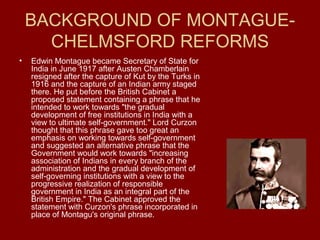
•   Edwin Montague became Secretary of State for
    India in June 1917 after Austen Chamberlain
    resigned after the capture of Kut by the Turks in
    1916 and the capture of an Indian army staged
    there. He put before the British Cabinet a
    proposed statement containing a phrase that he
    intended to work towards "the gradual
    development of free institutions in India with a
    view to ultimate self-government." Lord Curzon
    thought that this phrase gave too great an
    emphasis on working towards self-government
    and suggested an alternative phrase that the
    Government would work towards "increasing
    association of Indians in every branch of the
    administration and the gradual development of
    self-governing institutions with a view to the
    progressive realization of responsible
    government in India as an integral part of the
    British Empire." The Cabinet approved the
    statement with Curzon's phrase incorporated in
    place of Montagu's original phrase.
IMPORTANCE OF MONTAGUE-
       CHELMSFORD REFORMS
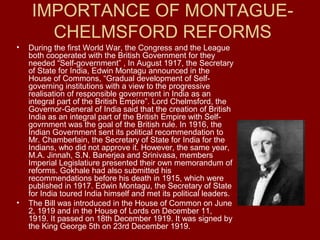
•   During the first World War, the Congress and the League
    both cooperated with the British Government for they
    needed “Self-government” , In August 1917, the Secretary
    of State for India, Edwin Montagu announced in the
    House of Commons, “Gradual development of Self-
    governing institutions with a view to the progressive
    realisation of responsible government in India as an
    integral part of the British Empire”. Lord Chelmsford, the
    Governor-General of India said that the creation of British
    India as an integral part of the British Empire with Self-
    govrnment was the goal of the British rule. In 1916, the
    Indian Government sent its political recommendation to
    Mr. Chamberlain, the Secretary of State for India for the
    Indians, who did not approve it. However, the same year,
    M.A. Jinnah, S.N. Banerjea and Srinivasa, members
    Imperial Legislatiure presented their own memorandum of
    reforms. Gokhale had also submitted his
    recommendations before his death in 1915, which were
    published in 1917. Edwin Montagu, the Secretary of State
    for India toured India himself and met its political leaders.
•   The Bill was introduced in the House of Common on June
    2, 1919 and in the House of Lords on December 11,
    1919. It passed on 18th December 1919. It was signed by
    the King George 5th on 23rd December 1919.
BACKGROUND OF KHILAFAT
          MOVEMENT
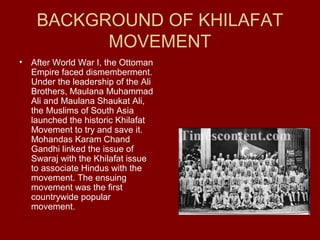
• After World War I, the Ottoman
  Empire faced dismemberment.
  Under the leadership of the Ali
  Brothers, Maulana Muhammad
  Ali and Maulana Shaukat Ali,
  the Muslims of South Asia
  launched the historic Khilafat
  Movement to try and save it.
  Mohandas Karam Chand
  Gandhi linked the issue of
  Swaraj with the Khilafat issue
  to associate Hindus with the
  movement. The ensuing
  movement was the first
  countrywide popular
  movement.
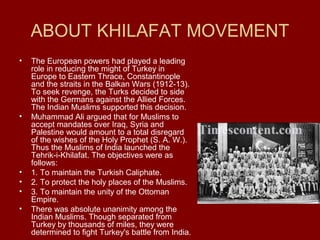
ABOUT KHILAFAT MOVEMENT
•   The European powers had played a leading
    role in reducing the might of Turkey in
    Europe to Eastern Thrace, Constantinople
    and the straits in the Balkan Wars (1912-13).
    To seek revenge, the Turks decided to side
    with the Germans against the Allied Forces.
    The Indian Muslims supported this decision.
•   Muhammad Ali argued that for Muslims to
    accept mandates over Iraq, Syria and
    Palestine would amount to a total disregard
    of the wishes of the Holy Prophet (S. A. W.).
    Thus the Muslims of India launched the
    Tehrik-i-Khilafat. The objectives were as
    follows:
•   1. To maintain the Turkish Caliphate.
•   2. To protect the holy places of the Muslims.
•   3. To maintain the unity of the Ottoman
    Empire.
•   There was absolute unanimity among the
    Indian Muslims. Though separated from
    Turkey by thousands of miles, they were
    determined to fight Turkey's battle from India.