You’ve opened the door to a world of
possibilities….
Bachelor of Science
Enrolment 2016
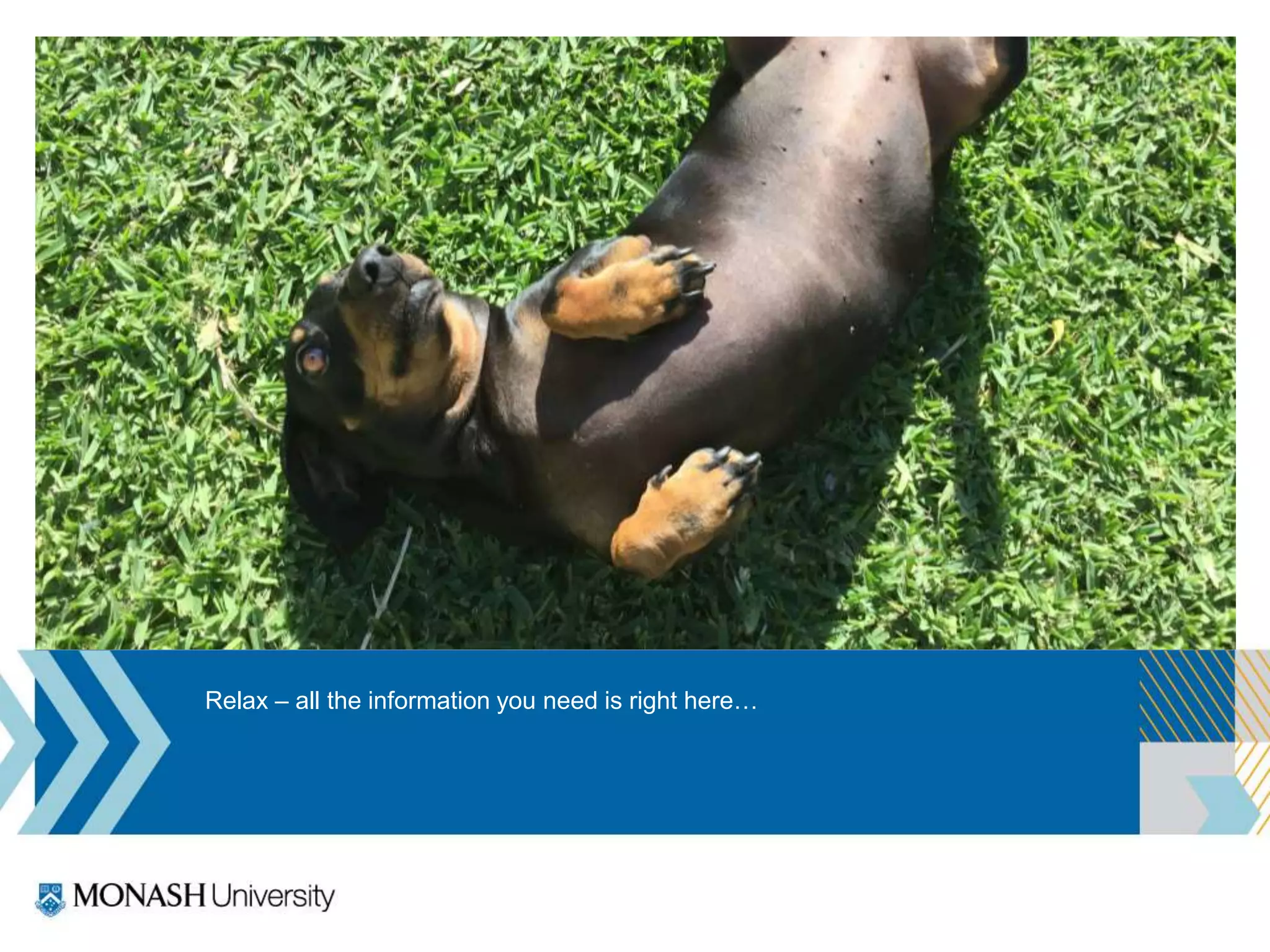
Relax – all the information you need is right here…
So… what do you need to
know?
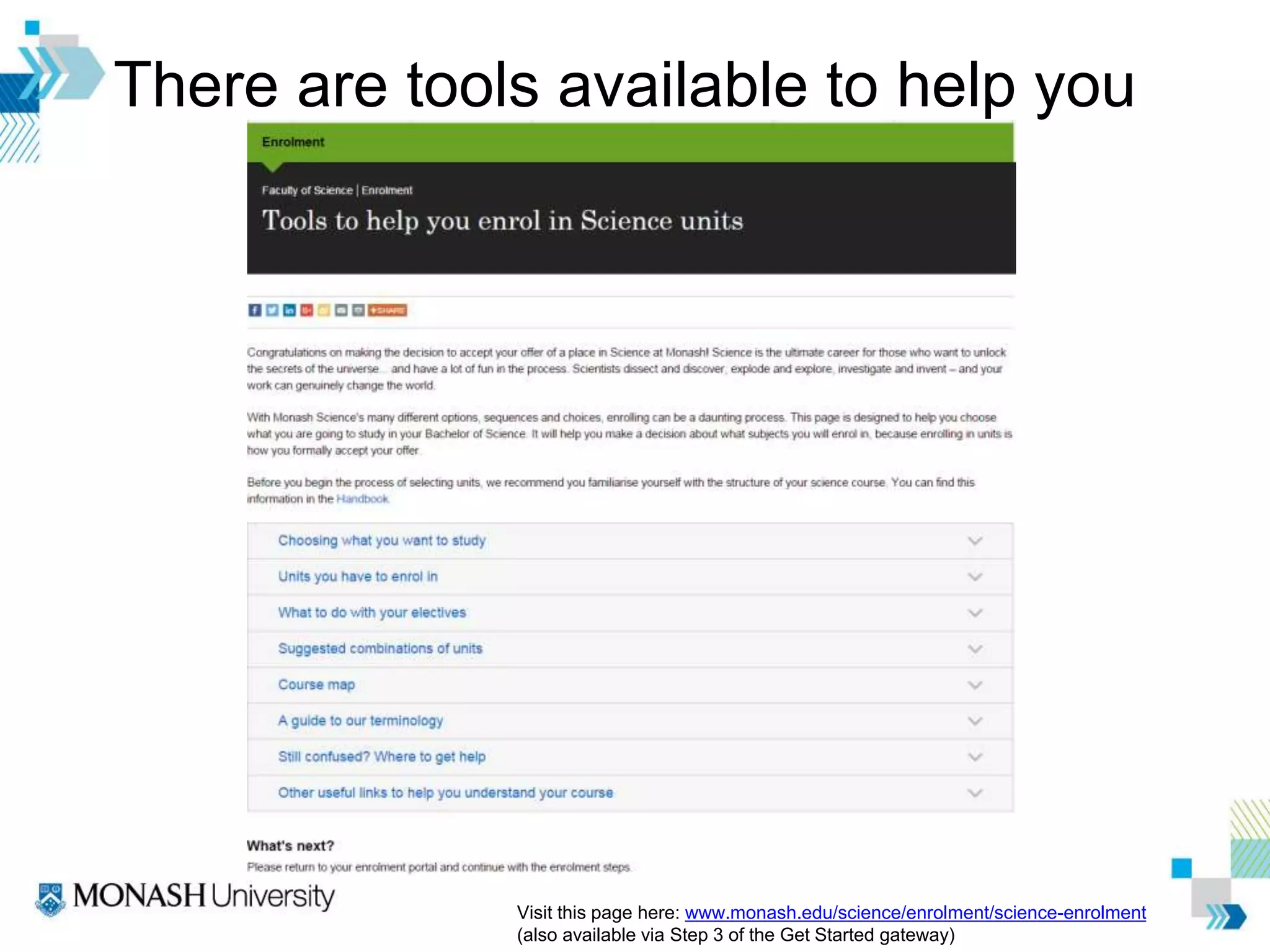
There are tools available to help you
Visit this page here: www.monash.edu/science/enrolment/science-enrolment
(also available via Step 3 of the Get Started gateway)
The fountain of all truth
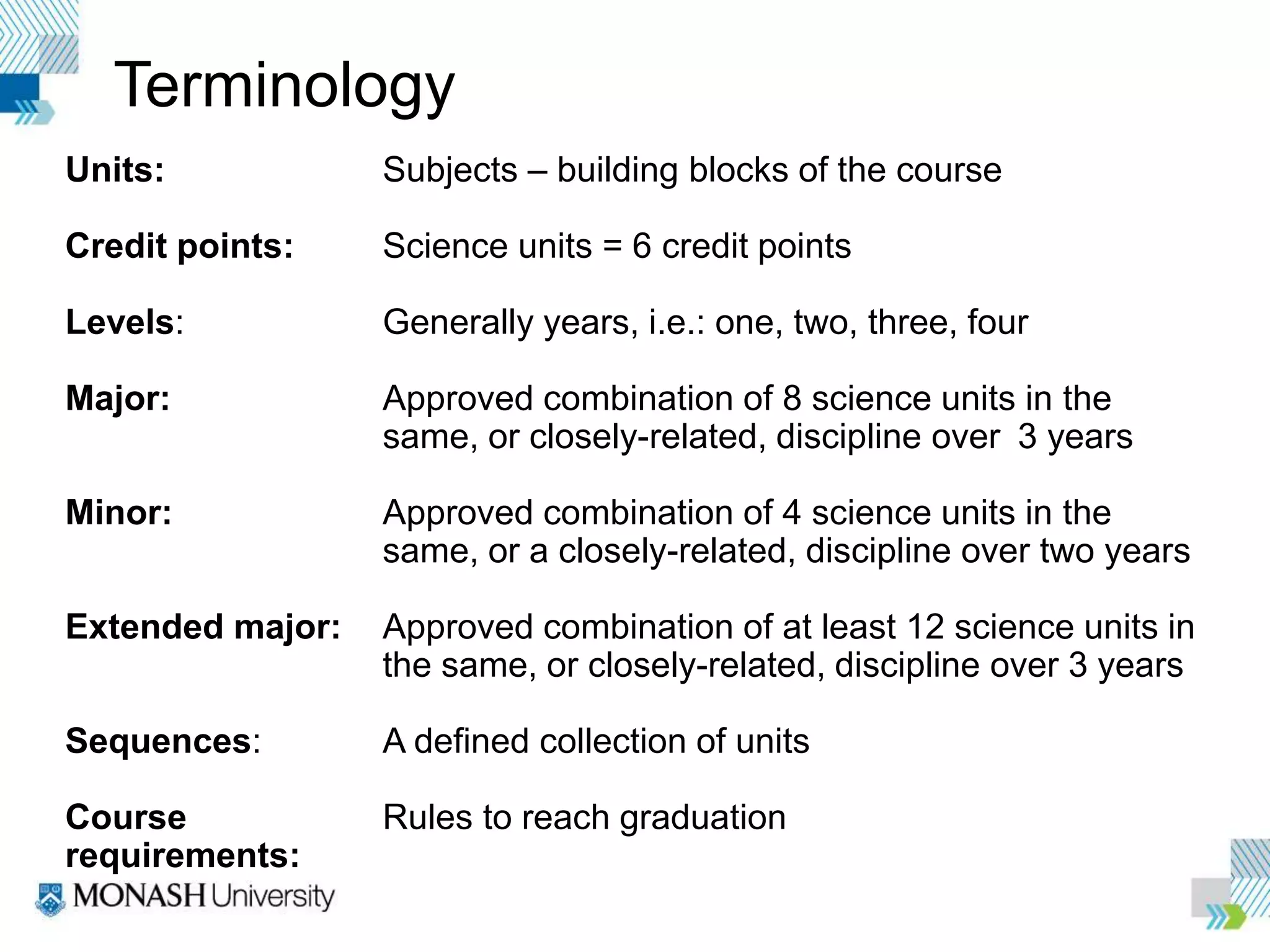
Terminology
Units: Subjects – building blocks of the course
Credit points: Science units = 6 credit points
Levels: Generally years, i.e.: one, two, three, four
Major: Approved combination of 8 science units in the
same, or closely-related, discipline over 3 years
Minor: Approved combination of 4 science units in the
same, or a closely-related, discipline over two years
Extended major: Approved combination of at least 12 science units in
the same, or closely-related, discipline over 3 years
Sequences: A defined collection of units
Course Rules to reach graduation
requirements:
The Bachelor of Science structure
SCIENCE
ELECTIVES
Year 1
Year 2
Year 3
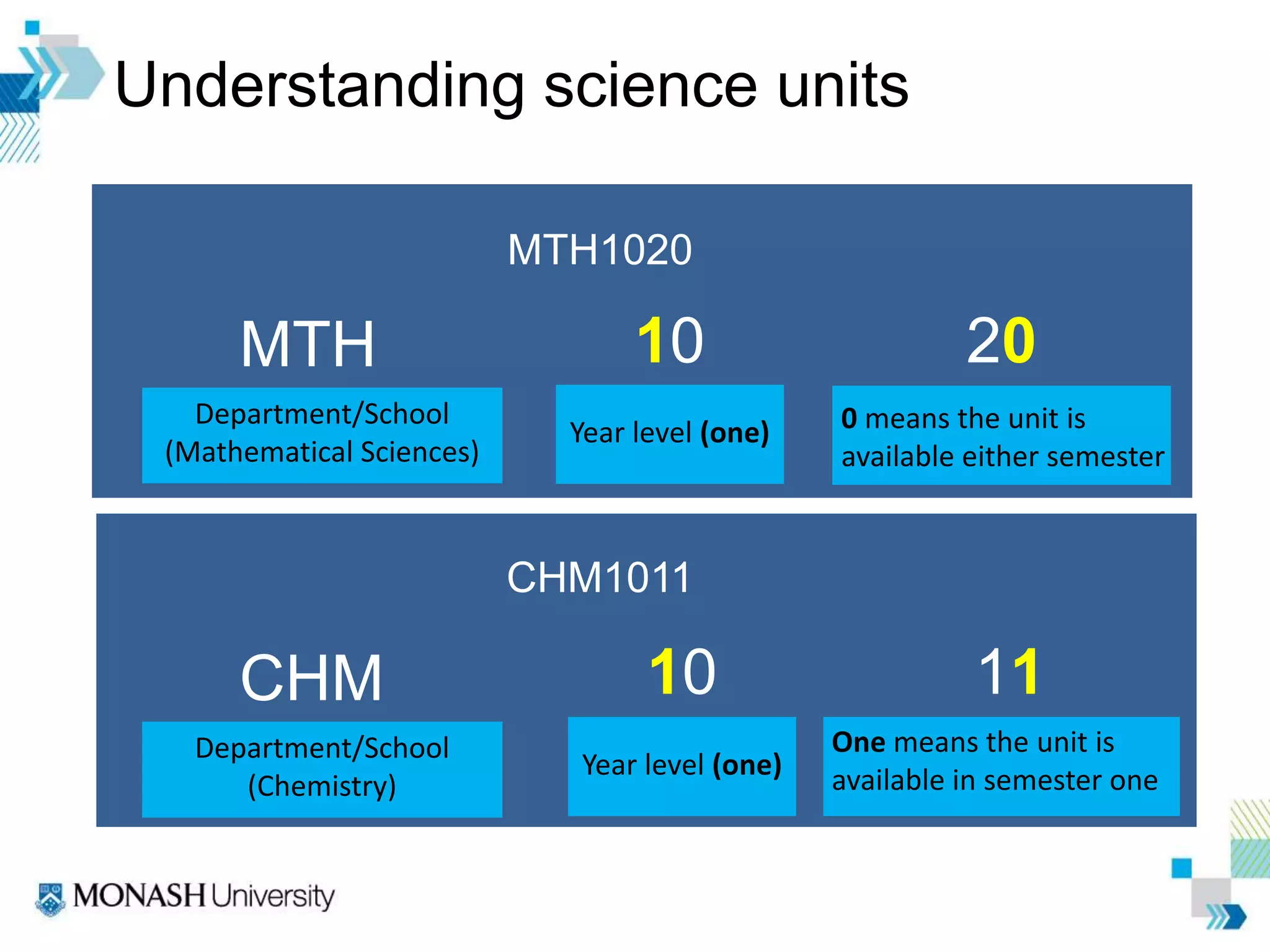
Understanding science units
MTH1020
Department/School
(Mathematical Sciences)
Year level (one) 0 means the unit is
available either semester
Department/School
(Chemistry)
Year level (one)
One means the unit is
available in semester one
MTH 10
11CHM 10
20
CHM1011
Applied
mathematics
Atmospheric
science
Biochemistry Chemistry
Computational
science
Immunology
Developmental
biology
Physiology
Pure
Mathematics
Mathematics
Ecology and
conservation
biology
Plant sciences
Physics
Materials
science
Financial and
insurance
mathematics
(extended)
Environmental
science
(extended)
Human
pathology
Geosciences
Mathematical
statistics
Psychology
Microbiology Pharmacology
Genetics
Geographical
science
What majors you can choose
Astrophysics
Zoology
Choosing your units
Year 1
Year 2
Year 3
Level 1 unit
Level 1 unit
Level 1 unit
Level 1 unit
Maths/ stats
unit
Level 1
science unit
Core unit
Science unit
Science
sequence/
unit or
Elective
Level 1 unit
Level 1 unit
Level 1 unit
Level 1 unit
Maths / stats unit
Level 1 unit
(science)
Science
sequence/unit or
elective
Science
sequence/unit or
elective
How your first year could look
Year 1
BIO1011
BIO1022
CHM1011/
CHM1051
CHM1022/
CHM1052
SCI1020/STA1010
SCI1300
EAE1011/ elective
EAE1022/ elective
Level 1 unit
Level 1 unit
Level 1 unit
Level 1 unit
Maths / stats unit
Level 1 unit
(science)
Science
sequence/unit or
elective
Science
sequence/unit or
elective
How your first year could look
Year 1
PHS1011/ PHS1080
PHS1022
MTH1020
MTH1030
FIT1045
FIT1008
ASP1010/ elective
ASP1022/ elective
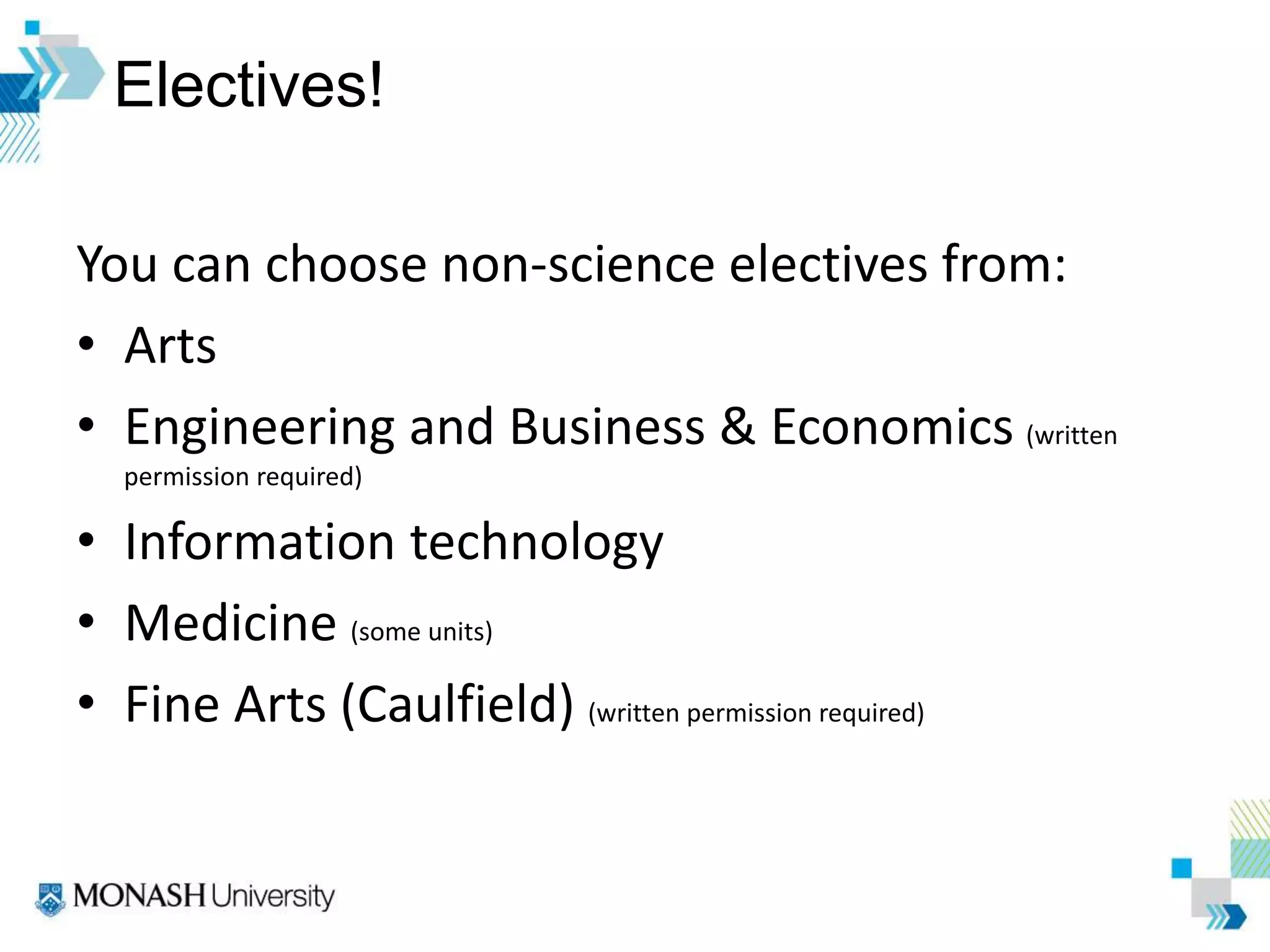
Electives!
You can choose non-science electives from:
• Arts
• Engineering and Business & Economics (written
permission required)
• Information technology
• Medicine (some units)
• Fine Arts (Caulfield) (written permission required)
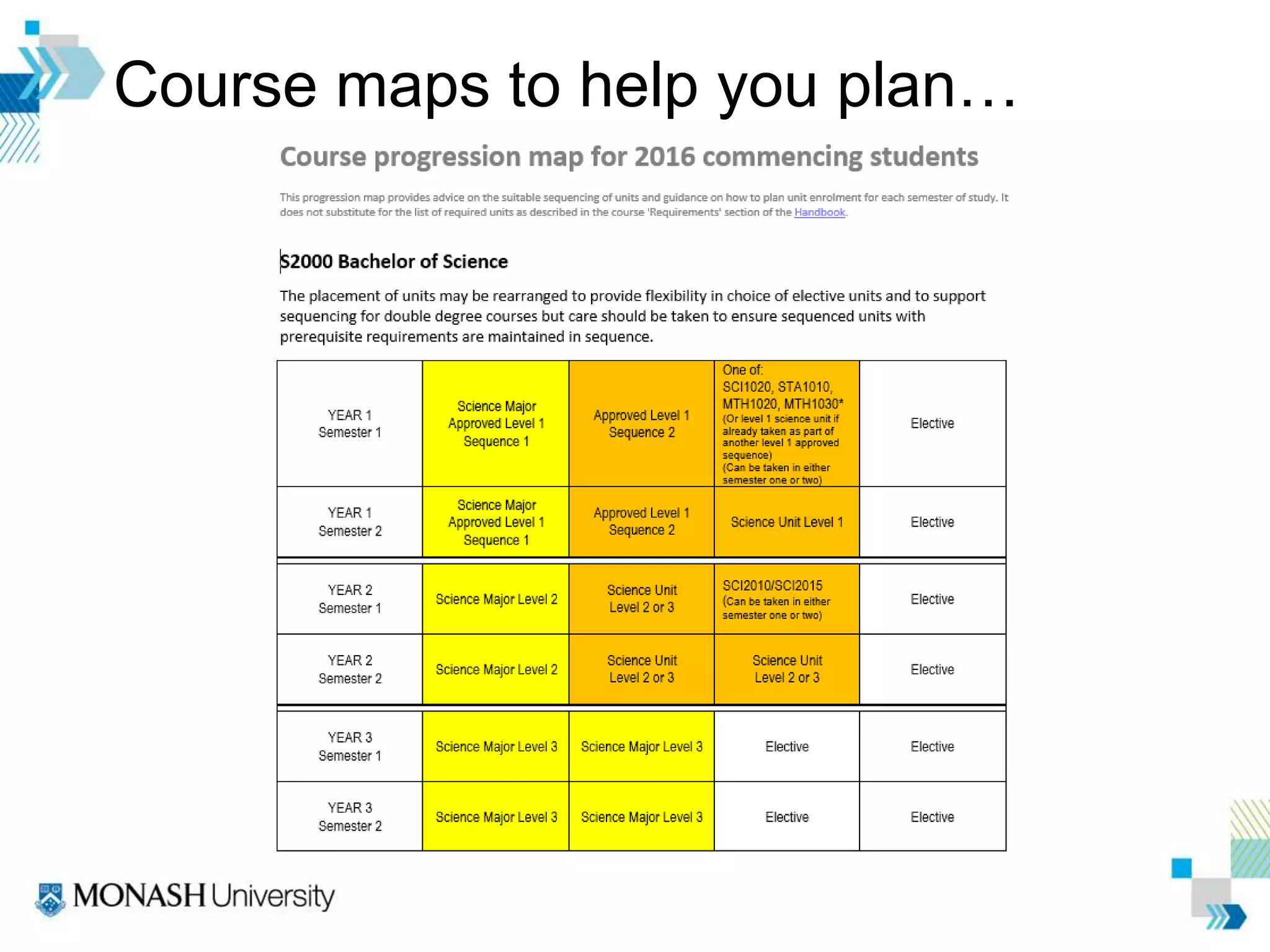
Course maps to help you plan…
Extra info: do you have credit?
Credit recognises previous study at tertiary level that can
be counted towards your course. It can reduce the number
of units required to complete a course.
To submit your credit application:
• Email to sci-enquiries@monash.edu, or
• Hand in at the end of this session, or
• Visit Science Student Services from 25 January
Complete the credit application form - https://www.monash.edu/science/future-students/undergraduate-study-
options/credit
What next?
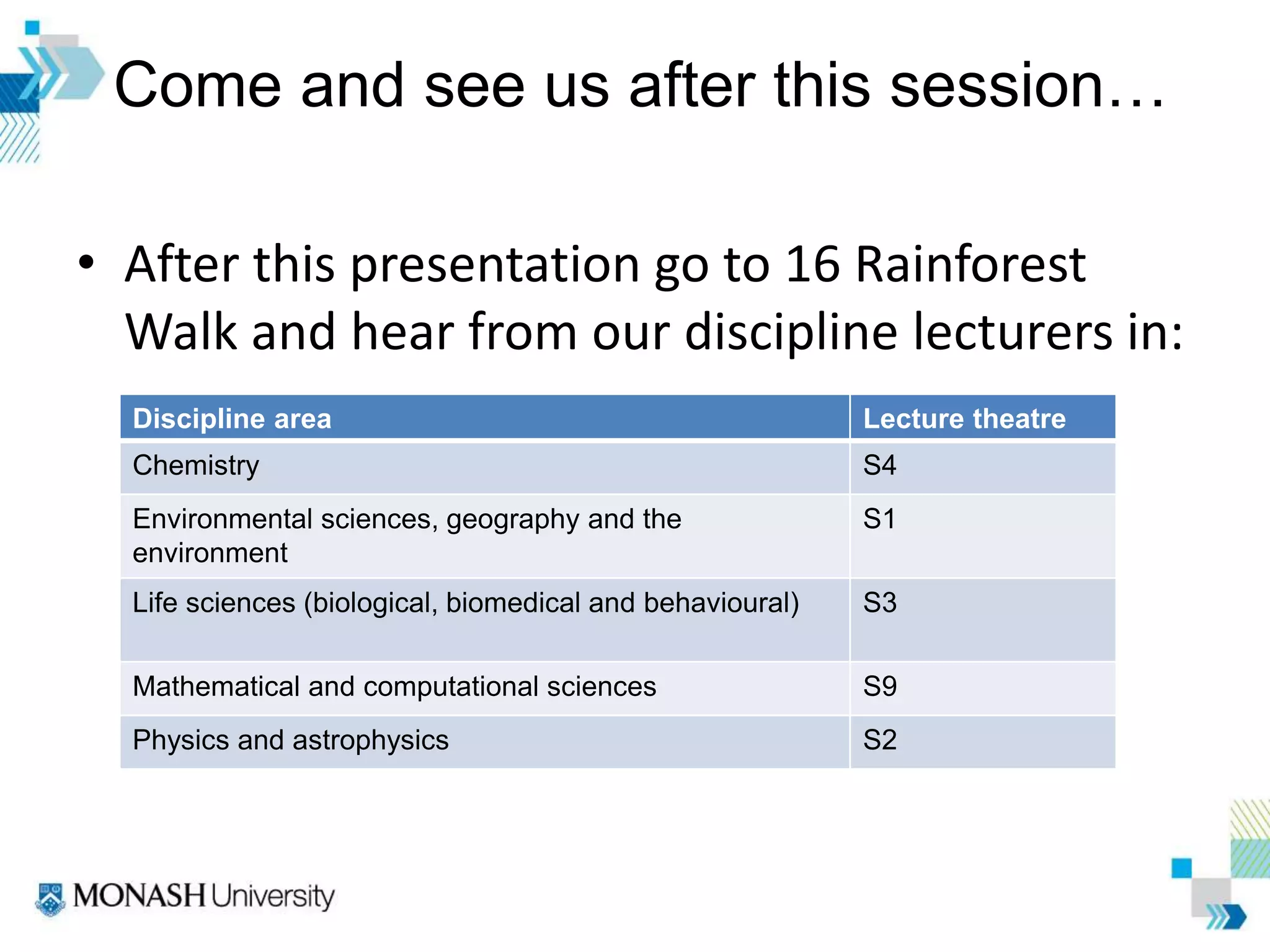
Come and see us after this session…
• After this presentation go to 16 Rainforest
Walk and hear from our discipline lecturers in:
Discipline area Lecture theatre
Chemistry S4
Environmental sciences, geography and the
environment
S1
Life sciences (biological, biomedical and behavioural) S3
Mathematical and computational sciences S9
Physics and astrophysics S2
After today…
Go back to the Get Started gateway and continue with the
steps to enrol. You need to enrol in units by 29 January.
Don’t forget the science tools available to you in Step 3
of the gateway (these will help you with choosing your
units!).
Remember, once you’ve enrolled in units, collect your ID
card any time before Semester starts (See step 5 of the
Get Started gateway).
Once you’ve enrolled
• Use Allocate+ to enter your timetable
preferences by 5pm Thursday 18
February
• You can change your enrolment in units
via WES up to the second week of
Semester 1
• Don’t forget O-Week (week commencing
22 February)
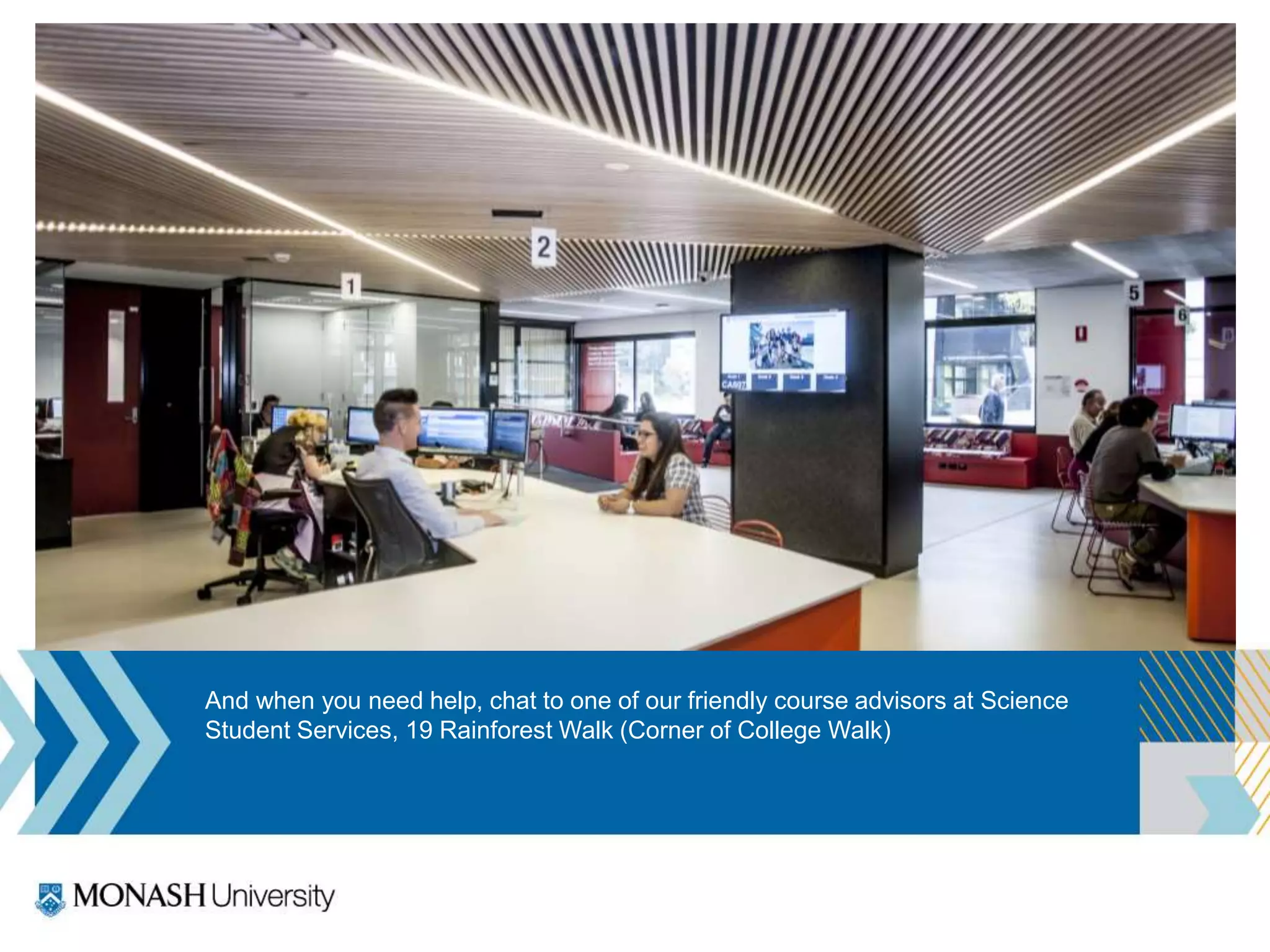
And when you need help, chat to one of our friendly course advisors at Science
Student Services, 19 Rainforest Walk (Corner of College Walk)
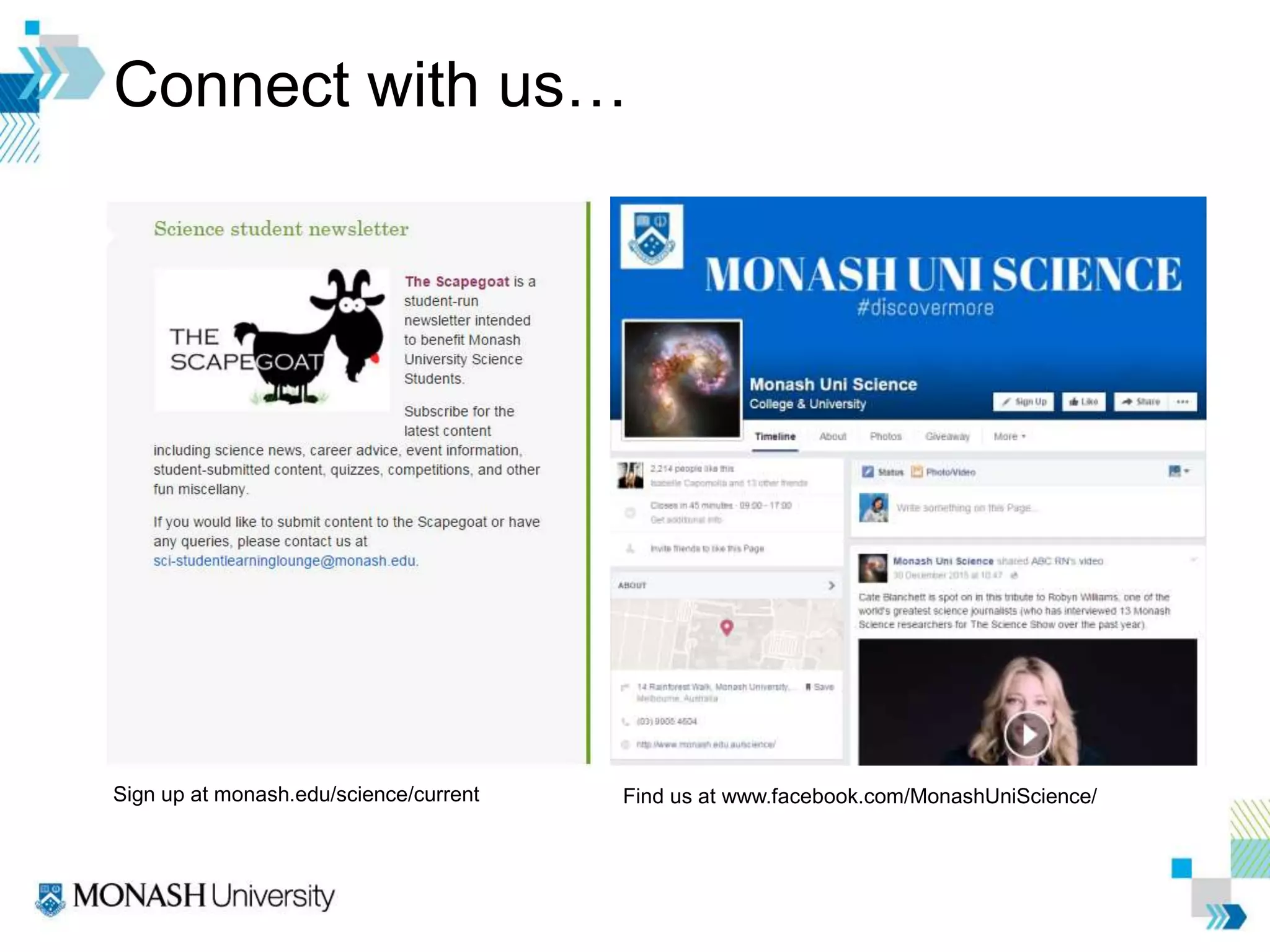
Connect with us…
Sign up at monash.edu/science/current Find us at www.facebook.com/MonashUniScience/
And finally…once you’re enrolled, enjoy the rest of your holiday and see you at
O-week!
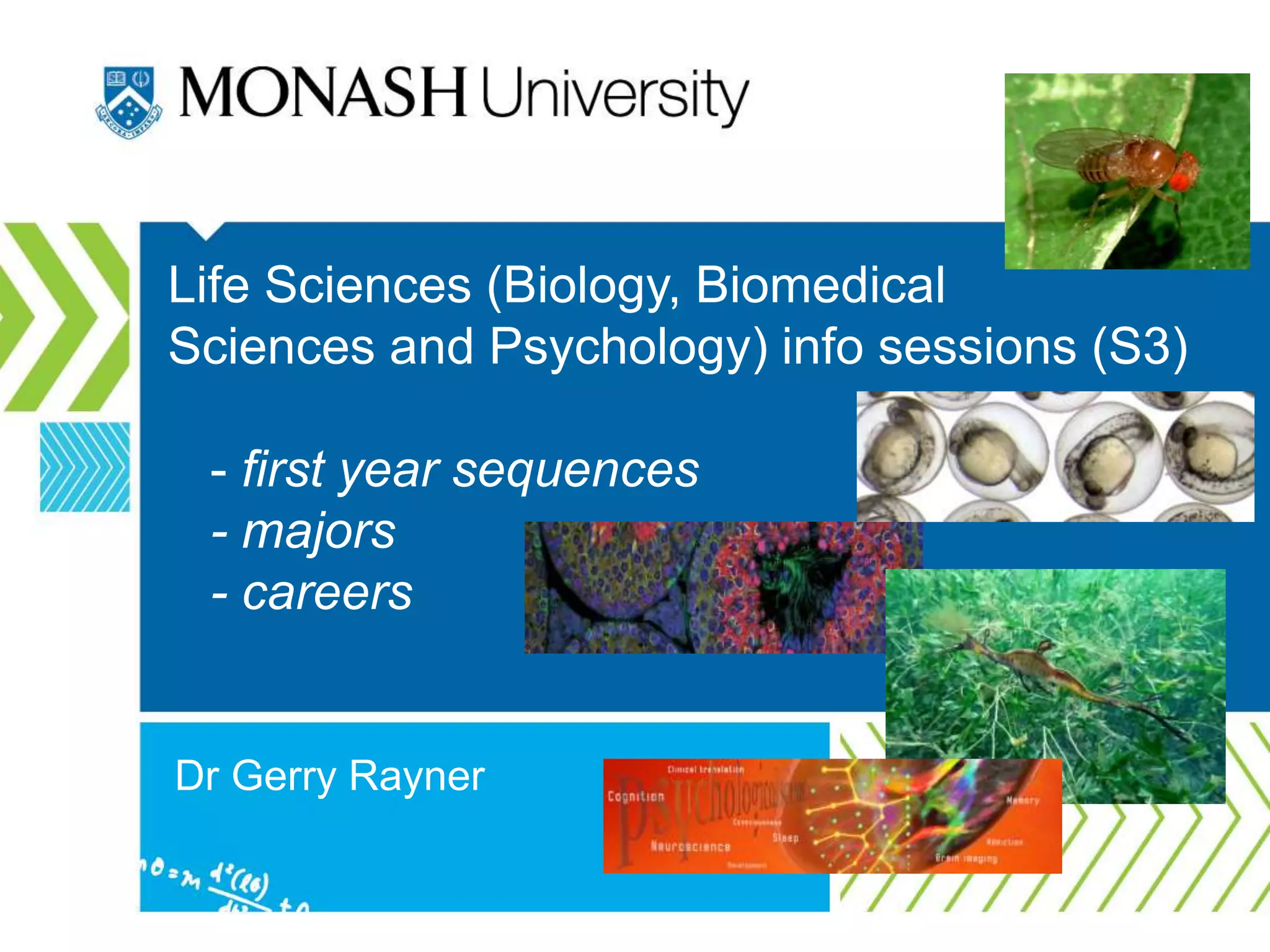
Life Sciences (Biology, Biomedical
Sciences and Psychology) info sessions (S3)
- first year sequences
- majors
- careers
Dr Gerry Rayner
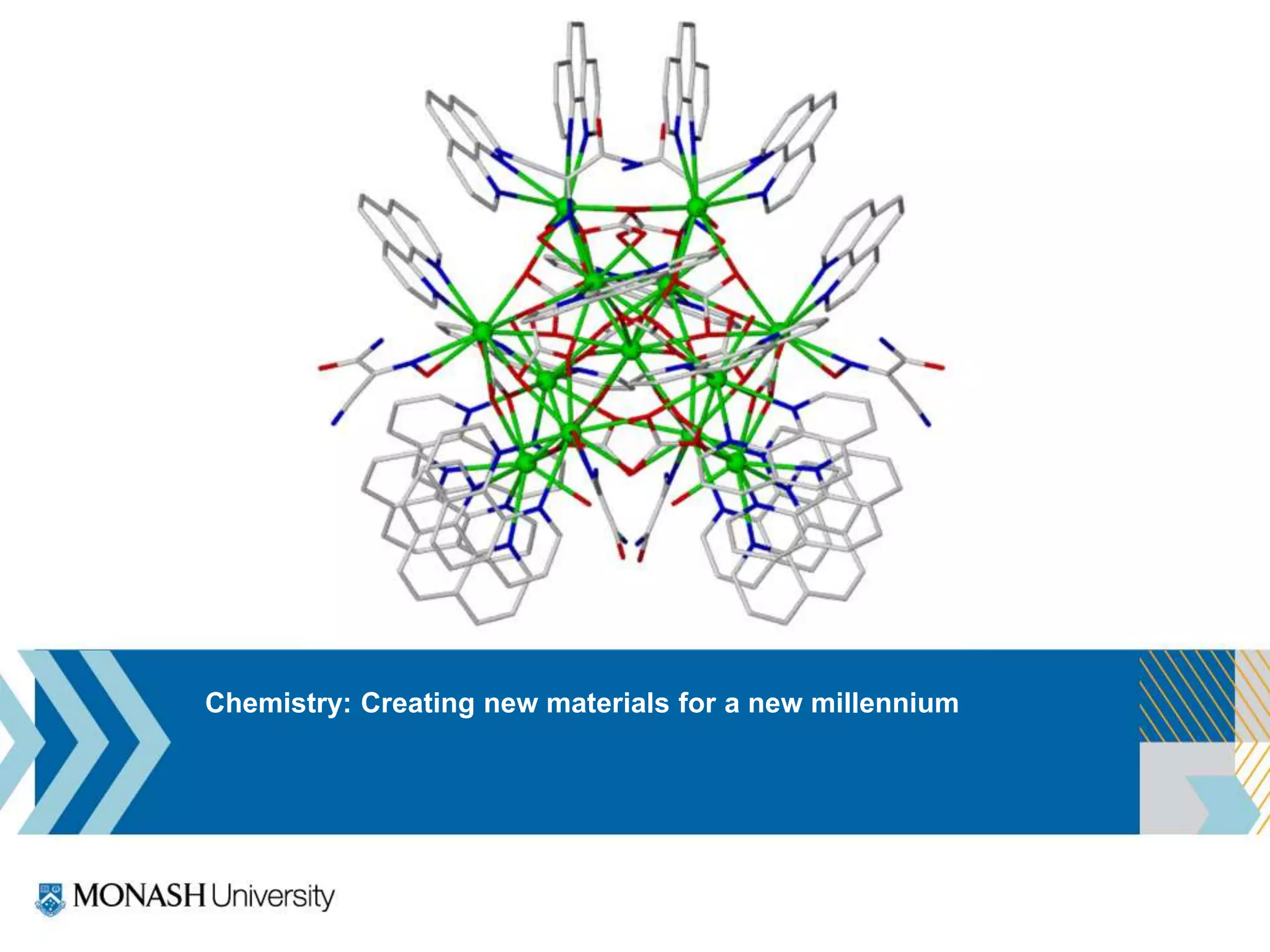
Chemistry: Creating new materials for a new millennium
All of your lives and careers
will be affected by climate change
Learn and understand
where, when and how
this is happening.
Natural hazards
affect millions of people worldwide
You can help to estimate
risks and identify safe
areas to live.
Your smartphone
contains over 80 different elements
You can help secure
sustainable future supplies
without costing the Earth.
Australia is
the driest inhabited continent
You can help to secure
our water supply
for the future.
To shape the Earth
means knowing how it works
@MonashEAEEarth, Atmosphere & Environment
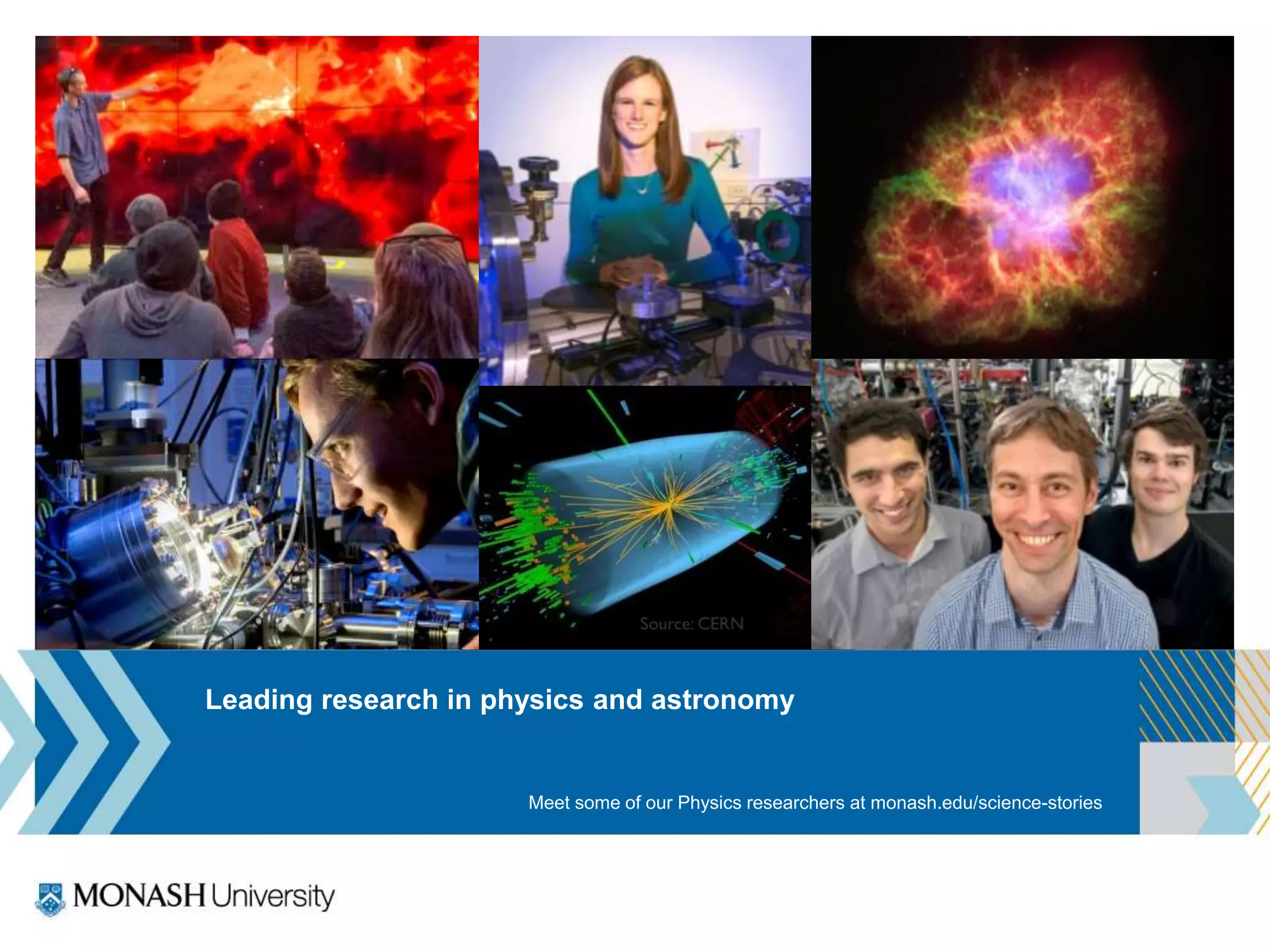
Leading research in physics and astronomy
Meet some of our Physics researchers at monash.edu/science-stories

Bachelor of Science

  • 1.
    You’ve opened thedoor to a world of possibilities…. Bachelor of Science Enrolment 2016
  • 3.
    Relax – allthe information you need is right here…
  • 4.
    So… what doyou need to know?
  • 5.
    There are toolsavailable to help you Visit this page here: www.monash.edu/science/enrolment/science-enrolment (also available via Step 3 of the Get Started gateway)
  • 6.
    The fountain ofall truth
  • 7.
    Terminology Units: Subjects –building blocks of the course Credit points: Science units = 6 credit points Levels: Generally years, i.e.: one, two, three, four Major: Approved combination of 8 science units in the same, or closely-related, discipline over 3 years Minor: Approved combination of 4 science units in the same, or a closely-related, discipline over two years Extended major: Approved combination of at least 12 science units in the same, or closely-related, discipline over 3 years Sequences: A defined collection of units Course Rules to reach graduation requirements:
  • 8.
    The Bachelor ofScience structure SCIENCE ELECTIVES Year 1 Year 2 Year 3
  • 9.
    Understanding science units MTH1020 Department/School (MathematicalSciences) Year level (one) 0 means the unit is available either semester Department/School (Chemistry) Year level (one) One means the unit is available in semester one MTH 10 11CHM 10 20 CHM1011
  • 10.
    Applied mathematics Atmospheric science Biochemistry Chemistry Computational science Immunology Developmental biology Physiology Pure Mathematics Mathematics Ecology and conservation biology Plantsciences Physics Materials science Financial and insurance mathematics (extended) Environmental science (extended) Human pathology Geosciences Mathematical statistics Psychology Microbiology Pharmacology Genetics Geographical science What majors you can choose Astrophysics Zoology
  • 11.
    Choosing your units Year1 Year 2 Year 3 Level 1 unit Level 1 unit Level 1 unit Level 1 unit Maths/ stats unit Level 1 science unit Core unit Science unit Science sequence/ unit or Elective
  • 12.
    Level 1 unit Level1 unit Level 1 unit Level 1 unit Maths / stats unit Level 1 unit (science) Science sequence/unit or elective Science sequence/unit or elective How your first year could look Year 1 BIO1011 BIO1022 CHM1011/ CHM1051 CHM1022/ CHM1052 SCI1020/STA1010 SCI1300 EAE1011/ elective EAE1022/ elective
  • 13.
    Level 1 unit Level1 unit Level 1 unit Level 1 unit Maths / stats unit Level 1 unit (science) Science sequence/unit or elective Science sequence/unit or elective How your first year could look Year 1 PHS1011/ PHS1080 PHS1022 MTH1020 MTH1030 FIT1045 FIT1008 ASP1010/ elective ASP1022/ elective
  • 14.
    Electives! You can choosenon-science electives from: • Arts • Engineering and Business & Economics (written permission required) • Information technology • Medicine (some units) • Fine Arts (Caulfield) (written permission required)
  • 15.
    Course maps tohelp you plan…
  • 16.
    Extra info: doyou have credit? Credit recognises previous study at tertiary level that can be counted towards your course. It can reduce the number of units required to complete a course. To submit your credit application: • Email to sci-enquiries@monash.edu, or • Hand in at the end of this session, or • Visit Science Student Services from 25 January Complete the credit application form - https://www.monash.edu/science/future-students/undergraduate-study- options/credit
  • 17.
  • 18.
    Come and seeus after this session… • After this presentation go to 16 Rainforest Walk and hear from our discipline lecturers in: Discipline area Lecture theatre Chemistry S4 Environmental sciences, geography and the environment S1 Life sciences (biological, biomedical and behavioural) S3 Mathematical and computational sciences S9 Physics and astrophysics S2
  • 19.
    After today… Go backto the Get Started gateway and continue with the steps to enrol. You need to enrol in units by 29 January. Don’t forget the science tools available to you in Step 3 of the gateway (these will help you with choosing your units!). Remember, once you’ve enrolled in units, collect your ID card any time before Semester starts (See step 5 of the Get Started gateway).
  • 20.
    Once you’ve enrolled •Use Allocate+ to enter your timetable preferences by 5pm Thursday 18 February • You can change your enrolment in units via WES up to the second week of Semester 1 • Don’t forget O-Week (week commencing 22 February)
  • 21.
    And when youneed help, chat to one of our friendly course advisors at Science Student Services, 19 Rainforest Walk (Corner of College Walk)
  • 22.
    Connect with us… Signup at monash.edu/science/current Find us at www.facebook.com/MonashUniScience/
  • 23.
    And finally…once you’reenrolled, enjoy the rest of your holiday and see you at O-week!
  • 24.
    Life Sciences (Biology,Biomedical Sciences and Psychology) info sessions (S3) - first year sequences - majors - careers Dr Gerry Rayner
  • 25.
    Chemistry: Creating newmaterials for a new millennium
  • 26.
    All of yourlives and careers will be affected by climate change Learn and understand where, when and how this is happening. Natural hazards affect millions of people worldwide You can help to estimate risks and identify safe areas to live. Your smartphone contains over 80 different elements You can help secure sustainable future supplies without costing the Earth. Australia is the driest inhabited continent You can help to secure our water supply for the future. To shape the Earth means knowing how it works @MonashEAEEarth, Atmosphere & Environment
  • 28.
    Leading research inphysics and astronomy Meet some of our Physics researchers at monash.edu/science-stories

Editor's Notes

  • #2 Welcome! We’re so glad you’re here. And…congratulations, I know you’ve worked hard to get to this point, and now is the time to be excited. You deserve it. Science at Monash has undergone a transformation. It’s an exciting time to be here. Lots of new spaces…our teaching is focused on getting the best out of you. Today is about giving you an introduction to the Bachelor of Science, and an overview of some of the main things you need to be familiar with in order to enrol.
  • #3 Right now….some of you might be feeling a little like this….
  • #4 …but I hope by the end of this presentation, you’ll be feeling more like this… And if you miss anything, we’ll have it available on our Facebook page – Monash Uni Science - after this presentation and on our website. So brace yourself for a quick guide to make sure you’re enroled and ready to go!
  • #6 So you’ve probably started your journey through the ‘Get Started’ gateway – the link you received from us. Some of you may have already completed the first few of the five steps. Some of you may have gone all the way through. The idea of this gateway is to help you enrol correctly into your course, thereby accepting your offer at Monash Uni. Its important to remember, you haven’t accepted your offer, until you are enrolled in units. At Step 3, there is a link out to science online course information. We’ve created this content to give you tools to help you enrol.
  • #7 So this is your source of all knowledge – The Handbook. It sets out the requirements for your course, terminology and units offered. Look at course requirements and need to complete all of these in order to graduate – make sure you tick them all off at the end of your course The handbook, together with the science online course information (which is accessible via Step 3 of your gateway), will ensure you understand your course and help choose your units.
  • #8 You’ve probably already started to hear some pretty unfamiliar language. Broadly, these are some of the things you should understand now as you go through the process of enrolling. The main terms you are likely to keep hearing are units, major and sequence. (Chris to talk a little more about what they mean).
  • #9 So what does a three year, full time, Science course look like. One third – science major (more detail to follow) One third – core science requirements (includes compulsory level one maths/stats unit and level two Scientific practice and communication unit) One third – electives – can be science or non-science – Opportunity to broaden your knowledge in science. Can use for second major in science or extended major in science or to complete non-science major or electives
  • #10 So, I’ve just talked broadly about the structure of the course, and you probably heard me talking about units. The units are the things you study – and consist of a mix of compulsory and free choice units. Each unit has a code and name. Explain diagram: The first digit usually indicates the year level. The last digit usually indicates the semester of offering (1 – semester one, 2 semester two, zero – either both semesters or in either semester). Unlike other disciplines, in science we like to be logical – so this rule applies to science units only. If you’re choosing units from any other area, refer to the unit description in the handbook to check when the unit is offered.
  • #11 As a Bachelor of science students you have many majors to choose from. Some of you, I’m sure, know exactly what you want to study and major in, but I’m sure most of you are still working that out. One of the great things about this degree is that we give you some time to explore what you want to major in. Now that you are at Uni, it’s your chance to decide what you want to do, and expand your opportunities. This science course is perfect for that. I suggest looking at the many disciplines we offer and consider areas you may not have explored yet at school. For example, we offer majors in Earth Sciences. We often heard of students who have tried units in fields they would not have considered, and loving it so much they’ve made a career of it. After this session today, you have the chance to hear from lecturers who teach the many different disciplines and what it means to study them. After these sessions you’ll have a chance to ask questions to help you make your unit choices. Structure of a major and what units to take, including any additional units to complement and strengthen knowledge are all listed in the Handbook. NOTE: When you start enrolling in units, you’ll be promoted to nominate the major that you would like to complete. Do not fear, you can select what you think you want major in now…BUT, you can change your mind prior to re-enrolling in your second year.
  • #12 As I said, each course is made of units – compulsory ones, and ones you choose. While the Bachelor of Science is largely flexible, there are some units you must complete to graduate. CLICK (first boxes appear) As a minimum you must complete 6 level one science units, including two level one approved sequences and a level one maths/stats unit (if not already completed as part of a level one approved sequence). CLICK (electives appear) – plus two electives – science or non-science MULTIPLE CLICKS (coloured boxes appear to indicate how choice influences major decision) The choice of level-one sequences influences the choice of units at stages two and three and lay the foundation for further study in a science discipline. To ensure that the maximum choice of science majors are available at level two, it is recommended that three level-one sequences in science are completed. Level-one approved sequences – listed in BSc handbook entry Level one Maths/stats requirement if not already completed as a level one sequence (in the BSc course entry in the handbook) The level one mathematics/statistics unit taken will depend on a student's mathematics background and interests – detailed in handbook. Minimum of one from a defined list of units SCI1020, STA1010, MTH1020 or MTH1030 (or MTH1035) ; may choose to complete second unit in mathematics or statistics How to structure your course Full-time – choose 8 units per year – 4 each semester. YOU MUST ENROL IN BOTH SEMESTERS to successfully complete your online enrolment. Build a foundation at level one by selecting at least three level one science sequences (can select four) which build on at levels two and three When selecting units keep in mind course requirements and structure of science major/s Some disciplines and majors have different entry points depending on year 12 subject/s completed ie choose PHS1011 (if completed VCE Physics units 3,4) or PHS1080 (if no year 12 Physics completed) Sample of unit selection at level one for BSc – lots of flexibility within structure to tailor course to suit your interests
  • #13 This sample first year course plan covers you down the track for – all biology majors; chemistry; all biomedical science majors and geosciences. SCI1300 is just an example of a science elective you could choose. There are many others you can choose.
  • #14 This sample first year course plan covers you down the track for – physics, astrophysics, mathematics and statistics and computational science majors.
  • #15 [Emphasise this] Can complete science or non-science units; can use electives to complete a second major in science or extended major in science - can use for a third sequence in Science (good foundation) Non-science electives - are restrictions on units from other Faculties – can enrol provided have met the pre-requisites Arts – can enrol via WES if met pre-requisites; Language units may require a test. Need written permission from Engineering if space in units - will need to go to Engineering at start of O-Week (22 Feb) Need written permission from Business and Economics if space in their units – will need to go to Business and Economics from 1 Feb. Need to bring copy of VCE subject scores to determine if met Maths pre-reqs (VCE Methods or Specialist Maths) for Accounting, Banking and Finance, Economics and Econometrics units. Information technology – can take non computational science electives from the Faculty of Information Technology – can enrol via WES Medicine – depends on unit – not for a BMS units – others require written permission Law - no Fine Arts in Caulfield – written permission if space
  • #16 Use a course map to plan your course and check that your units fit within your course structure
  • #17 As outlined on the Get Started gateway if you are applying for credit for previous study please complete the credit application form, attach your certified academic transcript/s and outlines of completed subjects. You can then either: •email to sci-enquiries@monash.edu; or •hand your completed application in at the end of this session to a  science course adviser who will be in the foyer; or •visit Science Student Services from 25 January for personal advice and to work out a course plan. Please note that you must enrol in 2 units in both semester one and two via WES until your application has been approved and then you can change your enrolment in your units. 
  • #19 These are repeated, giving you the chance to attend two different sessions. FOR 10AM COURSE INFORMATION SESSION Sessions start at 10.40am, and will run for 20min. The repeated sessions will start at 11.05am. FOR 1PM COURSE INFORMATION SESSION Sessions start at 1.40pm, and will run for 20min. The repeated sessions will start at 2.05pm. After your discipline sessions, you can meet and ask questions of the teaching staff for each of the disciplines in the ground floor of 14 Rainforest Walk – Also known as the Science Student Learning Lounge. It’s right next door.
  • #20 If you have already completed all of your enrolment steps today, including enrolling in units, then you can go to Monash Connect to collect your ID card, after the discipline talks and visiting the teaching staff in the Learning Lounge.
  • #21 In Step 5 of the Get Started gateway you’ll notice a heading called ‘What next?’ This is important. Once you’ve enrolled, you need to select your preferred class times in a system known as ALLOCATE+. Not a first in basis. Once you have initially enrolled in units you can change your enrolment – not locked in but must follow course requirements. O-week is a great chance to get to know the campus before starting your studies…it’s also a lot of fun, and a great way to meet new people. Science has a compulsory session on the first day (22 February), so make sure you lock it in your diary.
  • #22 Reassurance – if you need assistance with your unit selection, course planning and for study related matters come chat to a science course advisor. No appointment is needed. They are there to help and are experts at helping pick your science units and working out if you have met your course requirements.
  • #23 Remind students that the presentation will be available from the Facebook page
  • #24 If you’ve missed anything, we’ll have it available on our Facebook page - Monash FYSCI - after this presentation and on our website. Up next, please be guided by current students who will show you the way to 16 Rainforest Walk. In the science precinct, you can also meet our Science Society, pick up a free ice cream and watch the tennis.
  • #29 Show some pictures of active research areas and topics within the School