You’ve opened the door to a world of
possibilities….
Bachelor of Science Advanced – Global Challenges (Honours)
Enrolment 2016
Relax – all the information you need is right here…
So… what do you need to
know?
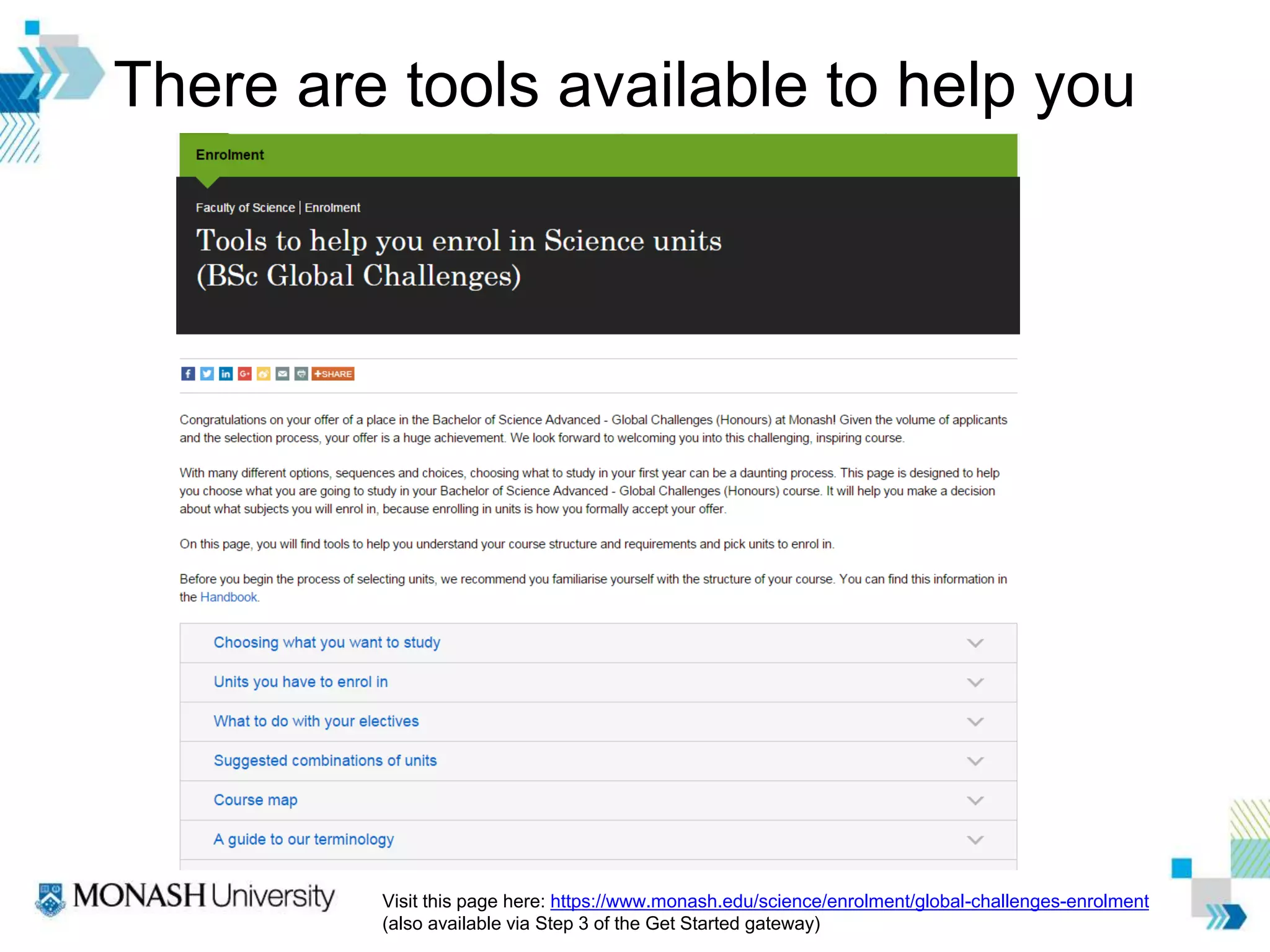
There are tools available to help you
Visit this page here: https://www.monash.edu/science/enrolment/global-challenges-enrolment
(also available via Step 3 of the Get Started gateway)
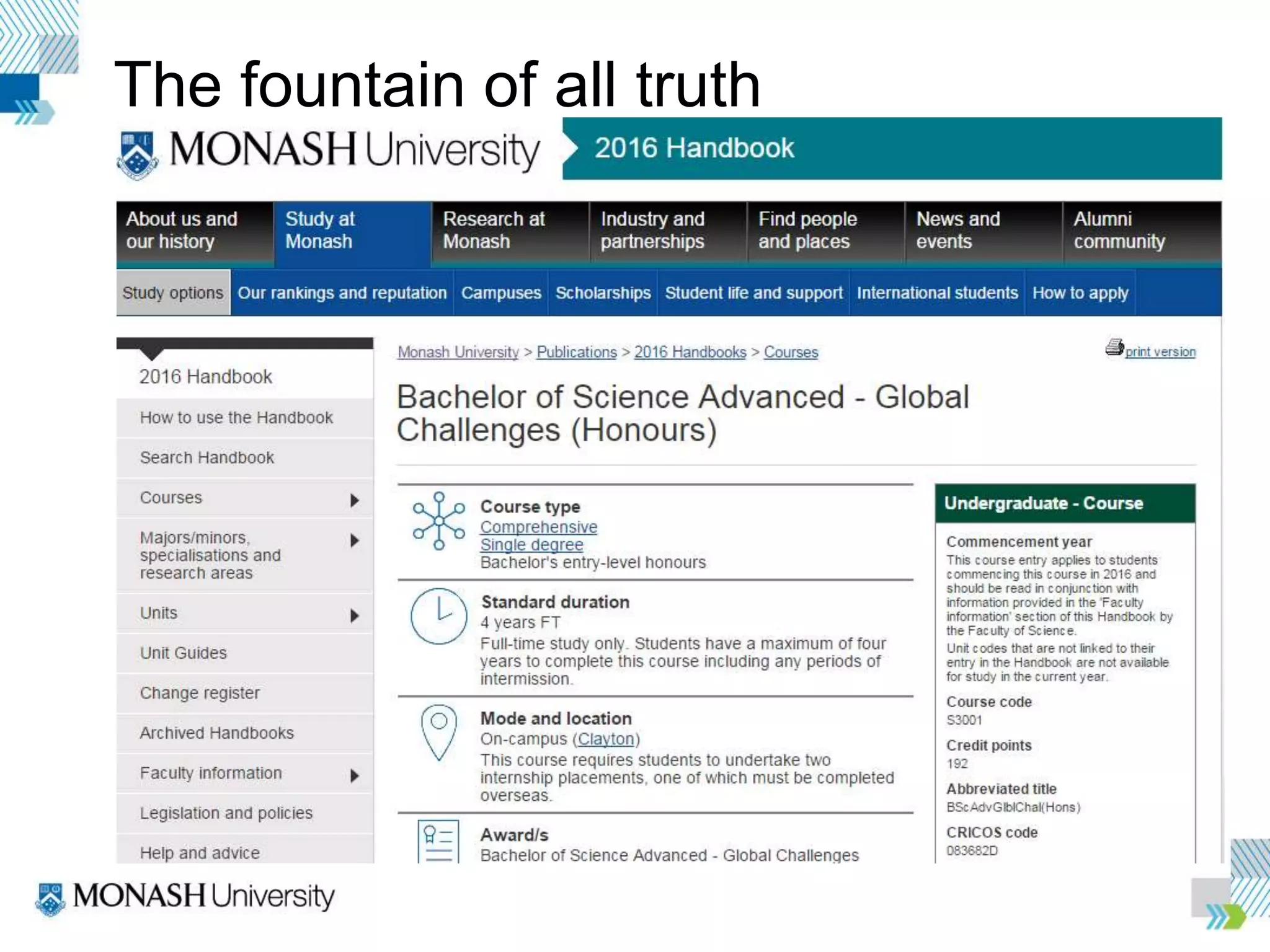
The fountain of all truth
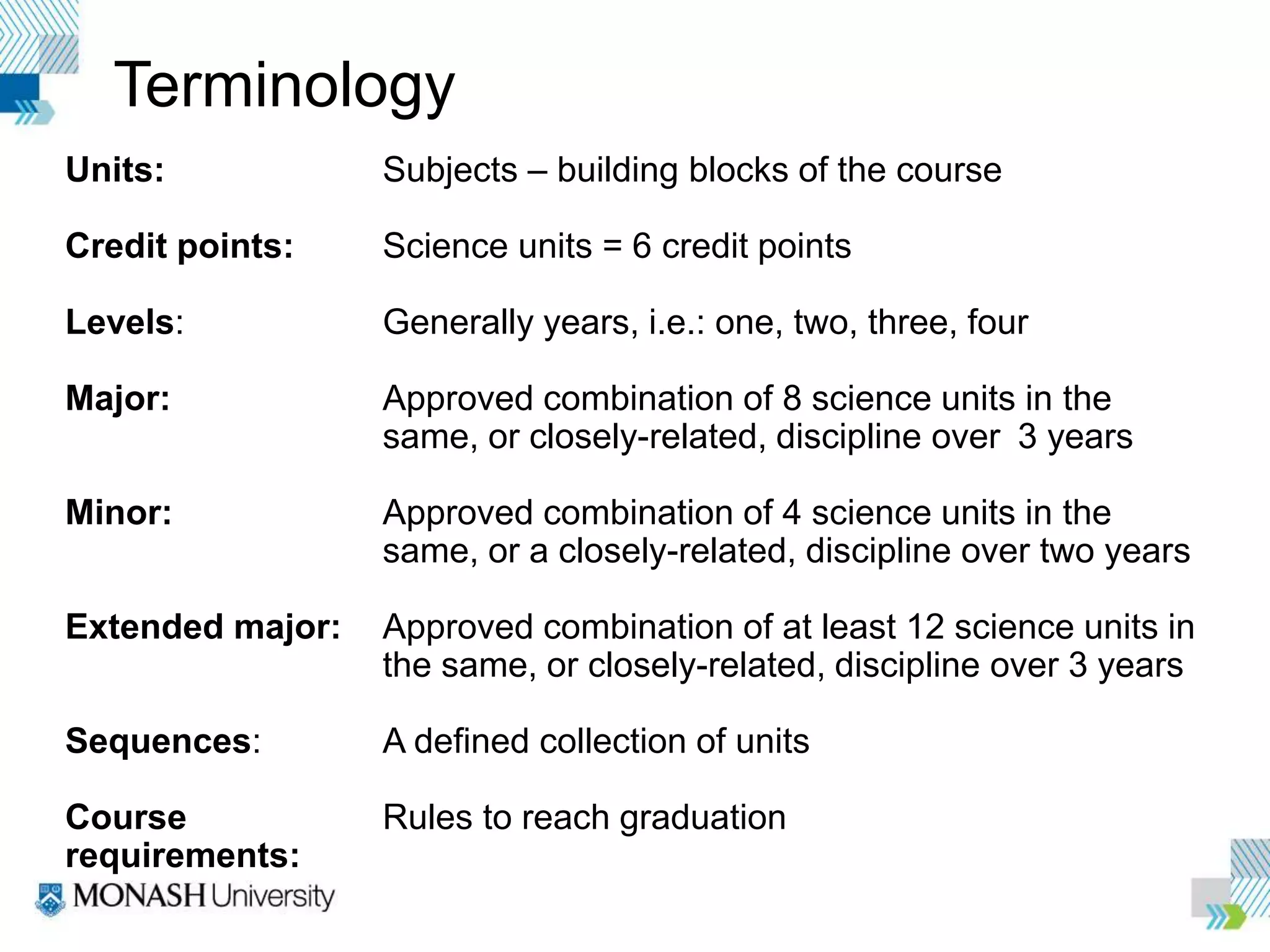
Terminology
Units: Subjects – building blocks of the course
Credit points: Science units = 6 credit points
Levels: Generally years, i.e.: one, two, three, four
Major: Approved combination of 8 science units in the
same, or closely-related, discipline over 3 years
Minor: Approved combination of 4 science units in the
same, or a closely-related, discipline over two years
Extended major: Approved combination of at least 12 science units in
the same, or closely-related, discipline over 3 years
Sequences: A defined collection of units
Course Rules to reach graduation
requirements:
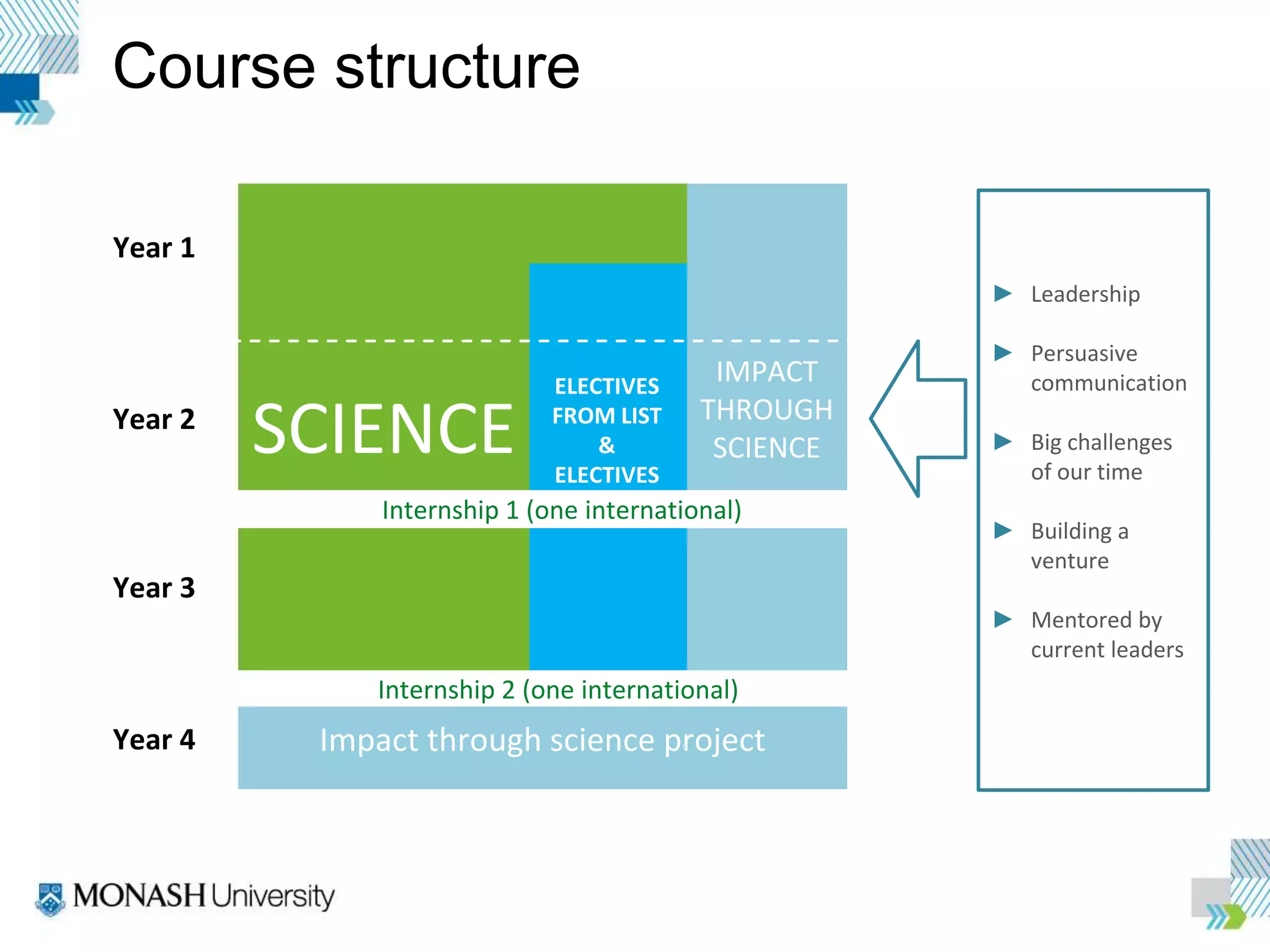
Course structure
SCIENCE
Internship 1 (one international)
Impact through science project
Internship 2 (one international)
► Leadership
► Persuasive
communication
► Big challenges
of our time
► Building a
venture
► Mentored by
current leaders
IMPACT
THROUGH
SCIENCE
Year 1
Year 2
Year 3
Year 4
ELECTIVES
FROM LIST
&
ELECTIVES
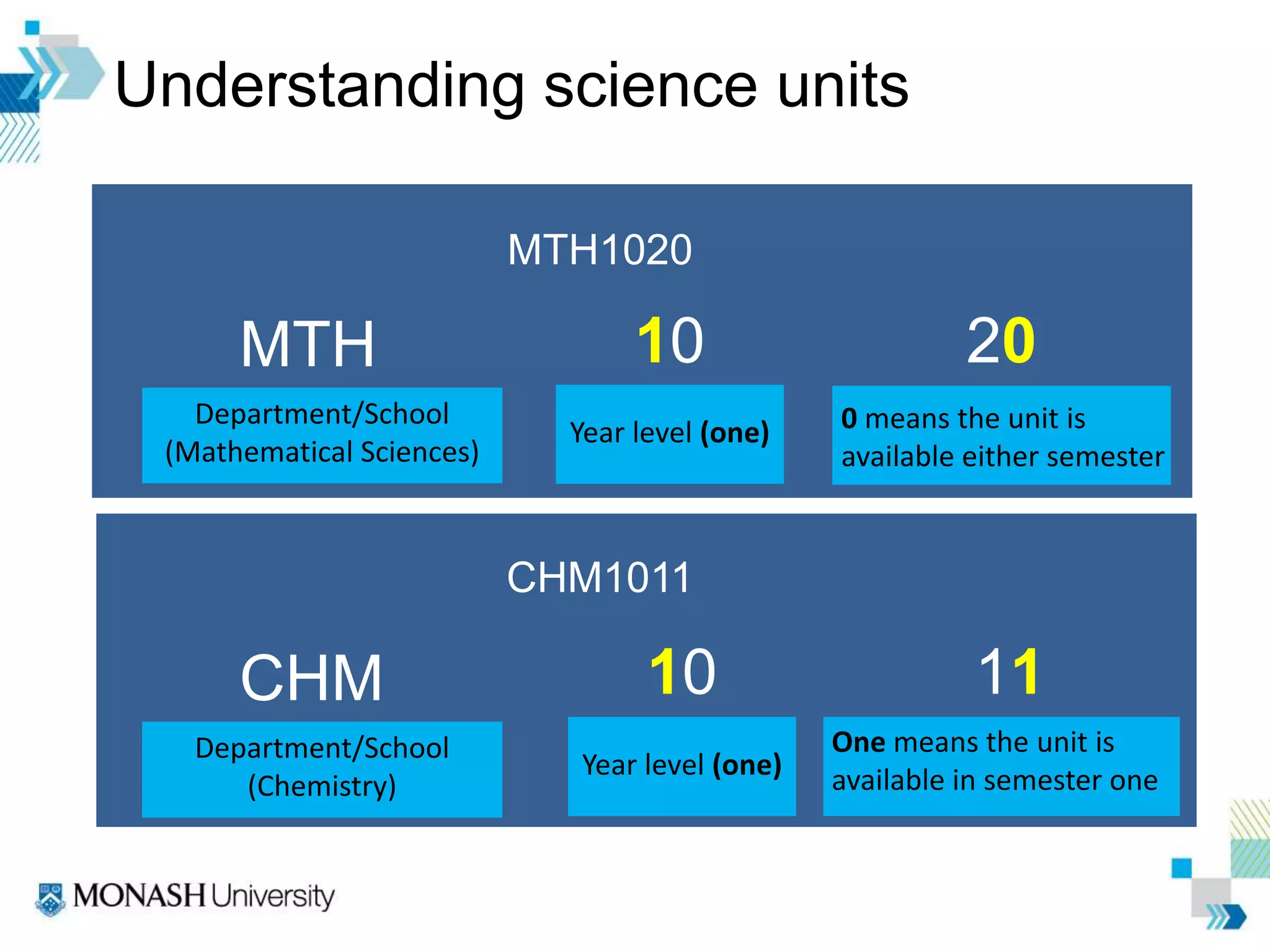
Understanding science units
MTH1020
Department/School
(Mathematical Sciences)
Year level (one) 0 means the unit is
available either semester
Department/School
(Chemistry)
Year level (one)
One means the unit is
available in semester one
MTH 10
11CHM 10
20
CHM1011
Applied
mathematics
Atmospheric
science
Biochemistry Chemistry
Computational
science
Immunology
Developmental
biology
Physiology
Pure
Mathematics
Mathematics
Ecology and
conservation
biology
Plant sciences
Physics
Materials
science
Financial and
insurance
mathematics
(extended)
Environmental
science
(extended)
Human
pathology
Geosciences
Mathematical
statistics
Psychology
Microbiology Pharmacology
Genetics
Geographical
science
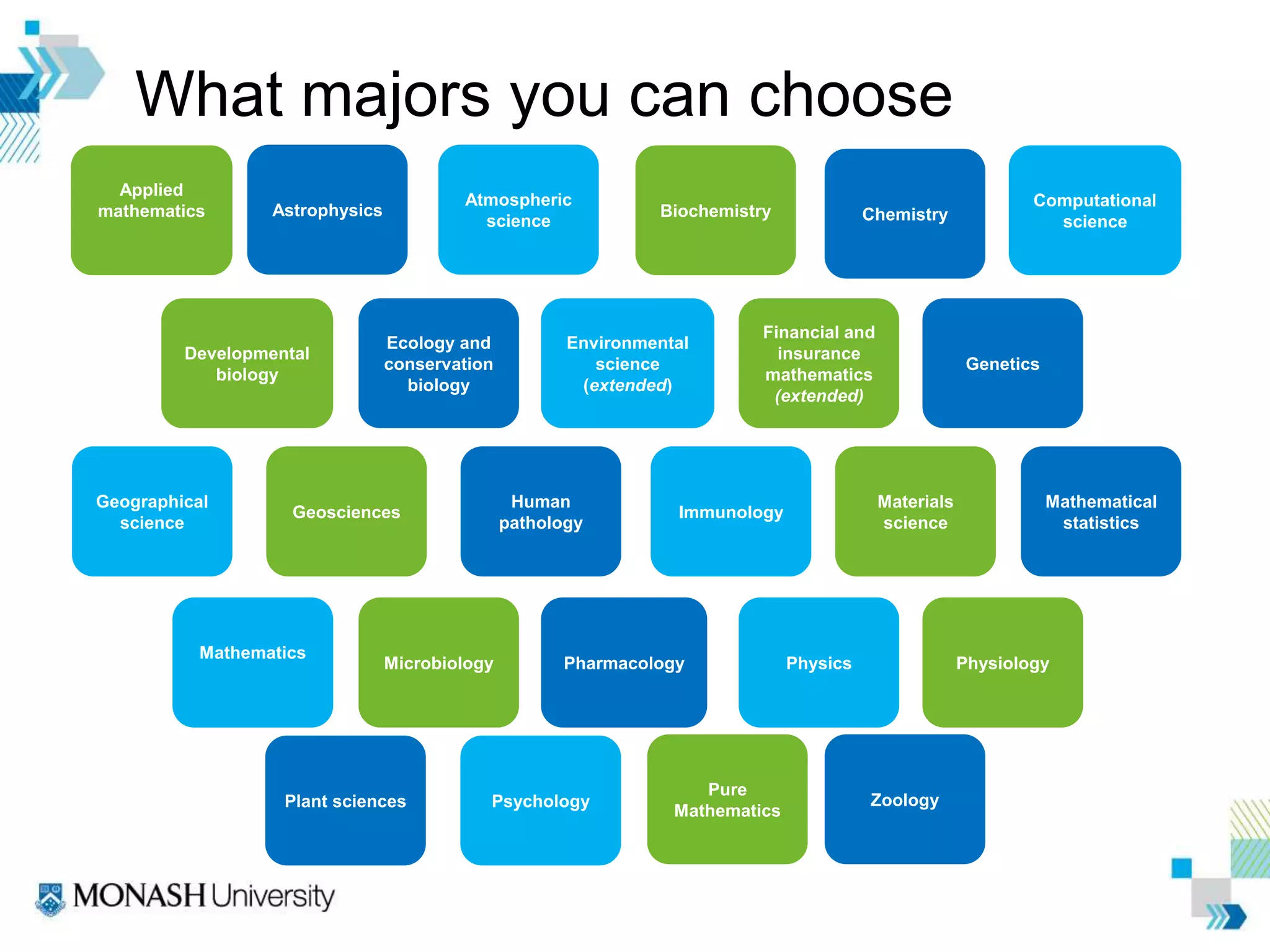
What majors you can choose
Astrophysics
Zoology
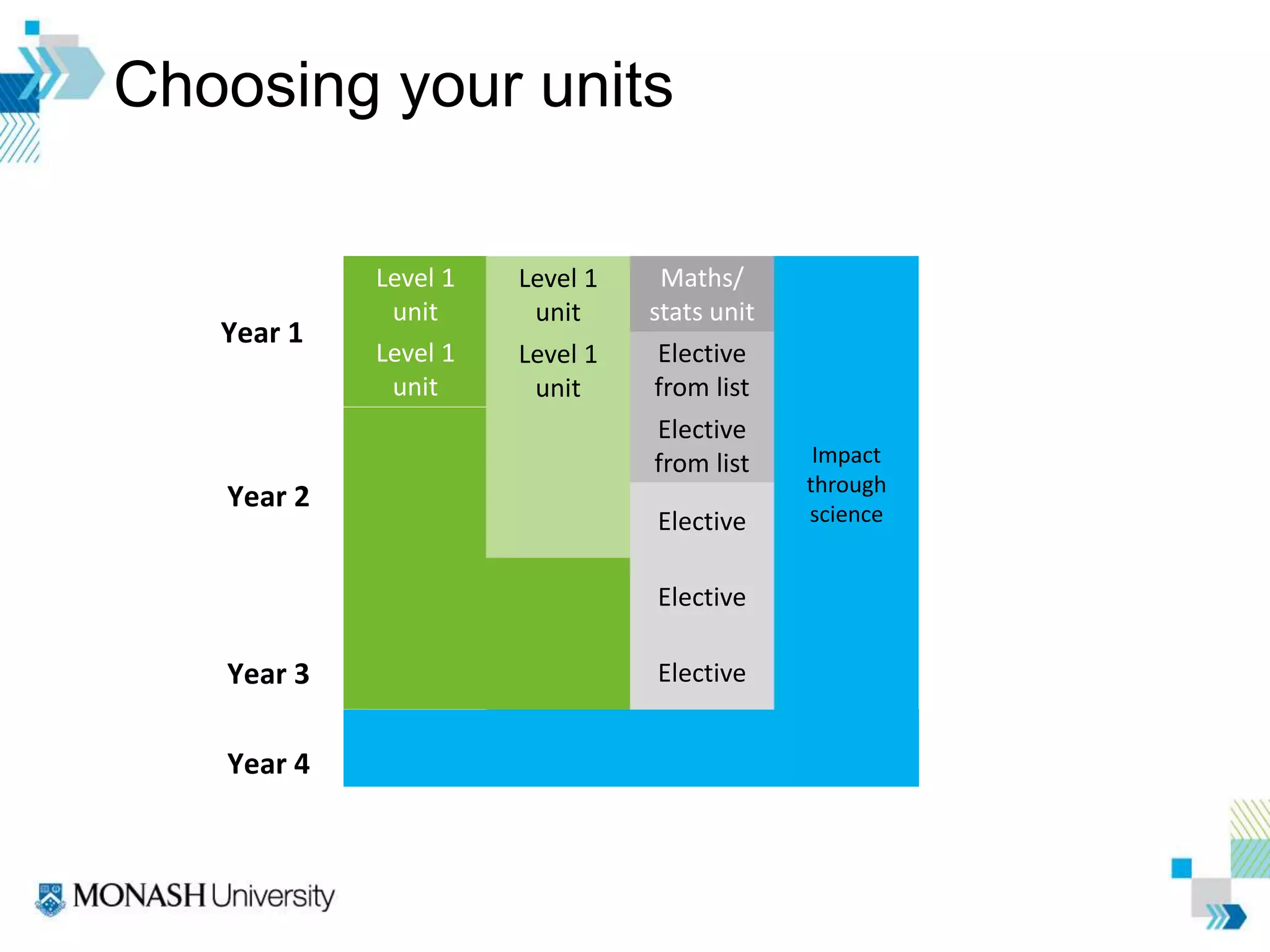
Choosing your units
Year 1
Year 2
Year 3
Level 1
unit
Level 1
unit
Level 1
unit
Level 1
unit
Maths/
stats unit
Elective
from list
Elective
from list
Elective
Impact
through
science
Year 4
Elective
Elective
You will need to undertake two level 1 science
sequences from the following areas:
• Biological sciences
• Chemistry
• Computational science
• Earth, atmosphere and environment
• Geographical science
• Mathematics and statistics
• Physics
• Psychology
What you can choose
• Complete at least one of SCI1020, STA1010,
MTH1020 or MTH1030 (or advanced version
MTH1035)
• Which unit depend on your mathematics
background and interests
• All explained in the handbook
Level 1 maths/stats unit
You will need to undertake 2 ‘selective’ units during your studies
Enrol via WES – no pre-requisites
• ATS1325 Contemporary worlds 1
• ATS1326 Contemporary worlds 2
Enrol manually at Science Student Services – email or in person
Requires 25+ in Maths Methods
• ACC1200 Accounting for managers
• ECC1000 Principles of microeconomics
• ECC1100 Principles of macroeconomics
• MGX3100 Management, ethics and corporate governance (requires 72
credit points)
• MON2005 Law in professional contexts (requires 48 credit points, has
quota and selection process)
Elective units from list
Level 1 unit
Level 1 unit
Level 1 unit
Level 1 unit
Maths / stats unit
Level 1 unit
(science)
Science
sequence/unit or
elective
Science
sequence/unit or
elective
How your first year could look
Year 1
BIO1011
BIO1022
CHM1011/
CHM1051
CHM1022/
CHM1052
Mathematics or
statistics
Elective from list or
free elective or
science unit
Impact Through
Science unit
Impact Through
Science unit
Level 1 unit
Level 1 unit
Level 1 unit
Level 1 unit
Maths / stats unit
Level 1 unit
(science)
Science
sequence/unit or
elective
Science
sequence/unit or
elective
How your first year could look
Year 1
PHS1011/ PHS1080
PHS1022
MTH1020
MTH1030
FIT1045
FIT1008
Impact Through
Science unit
Impact Through
Science unit
Electives!
You can choose non-science electives from:
• Arts
• Engineering and Business & Economics (written
permission required)
• Information technology
• Medicine (some units)
• Fine Arts (Caulfield) (written permission required)
Course maps to help you plan…
Extra info: do you have credit?
Credit recognises previous study at tertiary level that can
be counted towards your course. It can reduce the number
of units required to complete a course.
To submit your credit application:
• Email to sci-enquiries@monash.edu, or
• Hand in at the end of this session, or
• Visit Science Student Services from 25 January
Complete the credit application form - https://www.monash.edu/science/future-students/undergraduate-study-
options/credit
What next?
Come and see us after this session…
• After this presentation go to 16 Rainforest
Walk and hear from our discipline lecturers in:
Discipline area Lecture theatre
Chemistry S4
Environmental sciences, geography and the
environment
S1
Life sciences (biological, biomedical and behavioural) S3
Mathematical and computational sciences S9
Physics and astrophysics S2
After today…
Go back to the Get Started gateway and continue with the
steps to enrol. You need to enrol in units by 29 January.
Don’t forget the science tools available to you in Step 3
of the gateway (these will help you with choosing your
units!).
Remember, once you’ve enrolled in units, collect your ID
card any time before Semester starts (See step 5 of the
Get Started gateway).
Once you’ve enrolled
• Use Allocate+ to enter your timetable
preferences by 5pm Thursday 18
February
• You can change your enrolment in units
via WES up to the second week of
Semester 1
• Don’t forget O-Week (week commencing
22 February)
Pre-Orientation Retreat
15-17th February
Image credit: Flickr – Monash University
Check your Monash email account for details
Global Challenges Orientation Activities
Intro to Global Challenges and Leadership
Visit to the Asylum Seeker Resource Centre and
Save the Children
Tuesday 23rd February 9am, Clayton Campus
Course Orientation
Wednesday 24th February 10am, Clayton
Campus
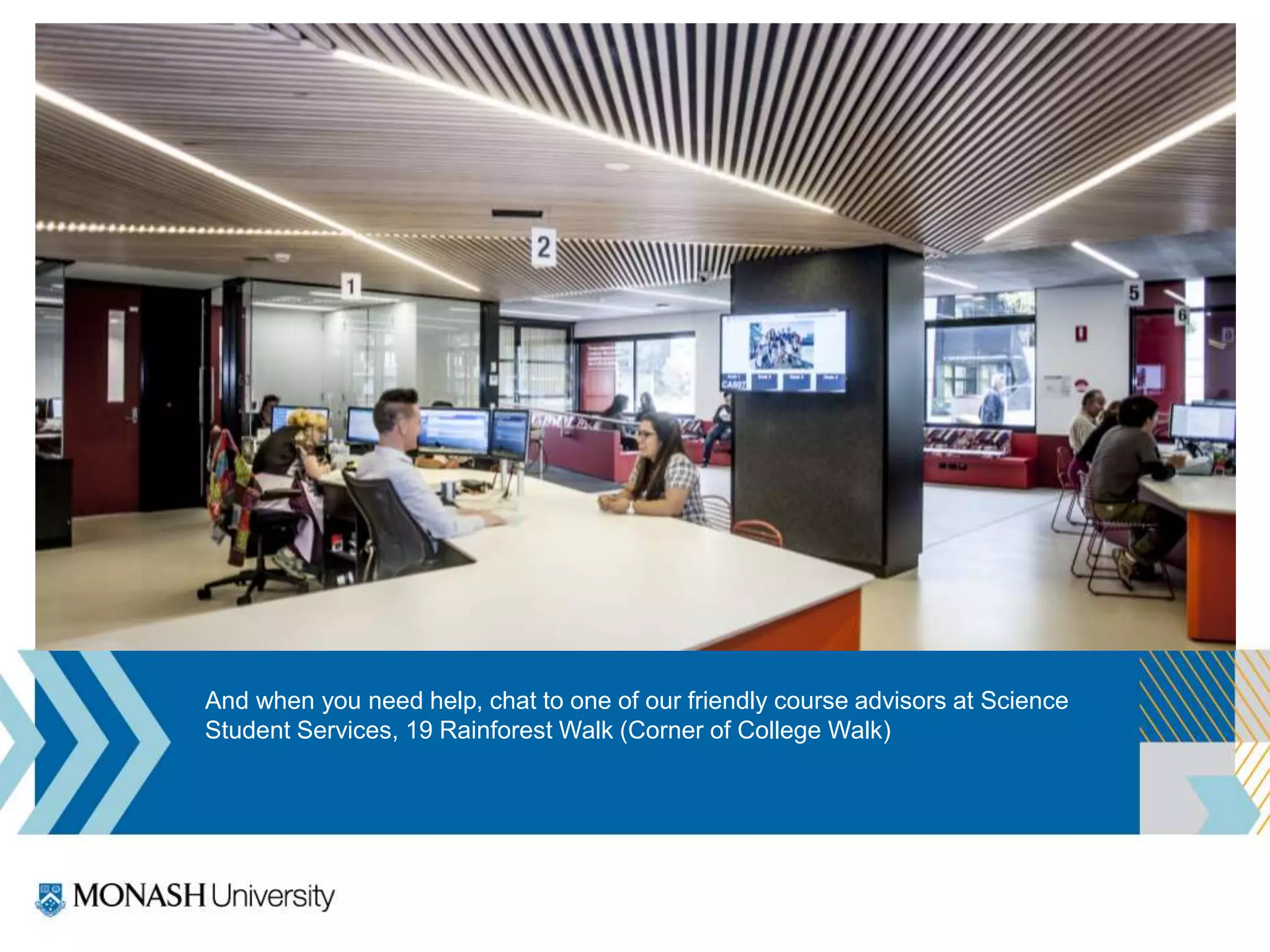
And when you need help, chat to one of our friendly course advisors at Science
Student Services, 19 Rainforest Walk (Corner of College Walk)
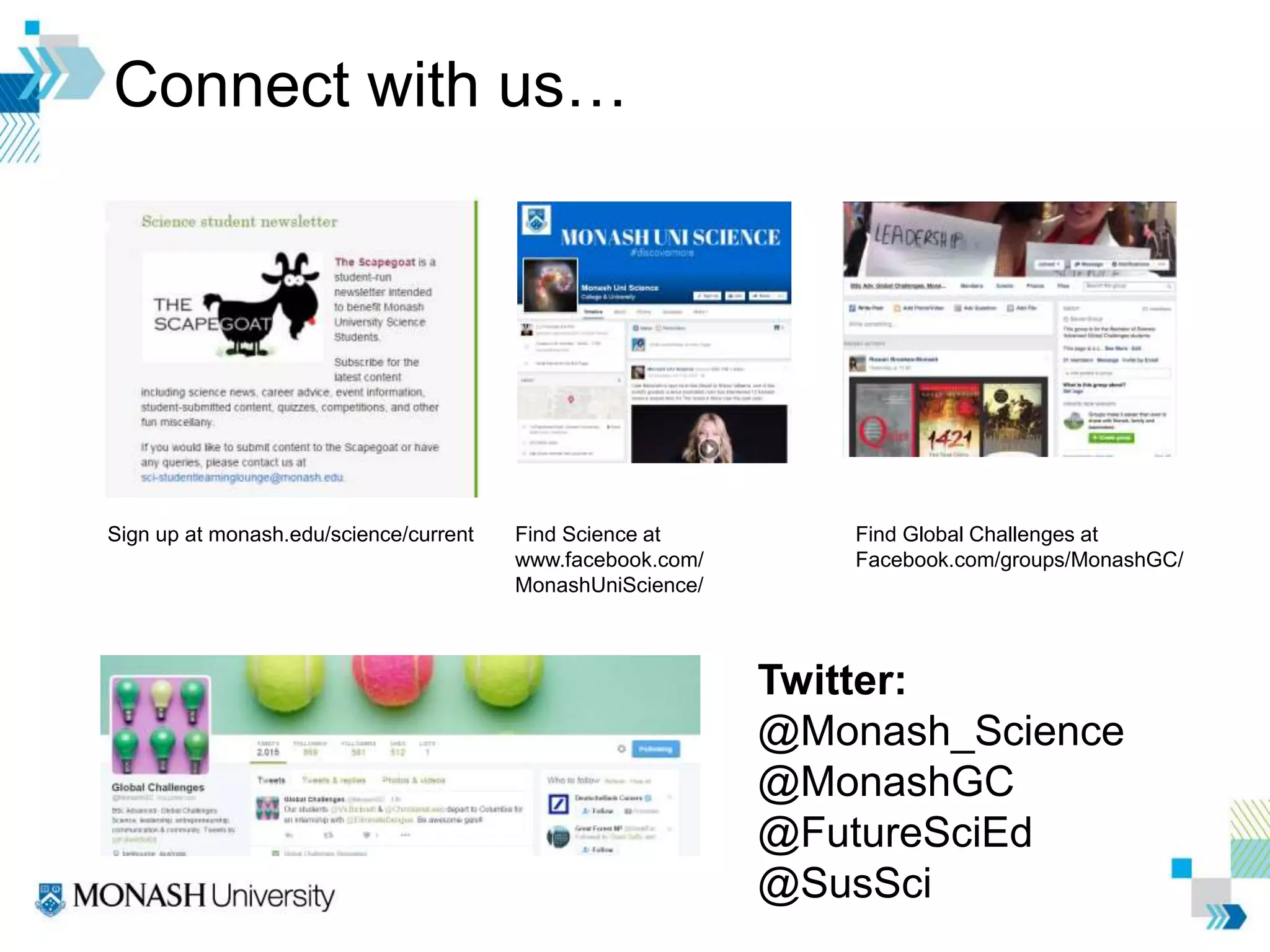
Connect with us…
Sign up at monash.edu/science/current Find Science at
www.facebook.com/
MonashUniScience/
Find Global Challenges at
Facebook.com/groups/MonashGC/
Twitter:
@Monash_Science
@MonashGC
@FutureSciEd
@SusSci
Course co-ordinator: Rowan Brookes
rowan.brookes@monash.edu
Room 116, 25 Rainforest Walk (Biology
building)
9905 5680; 0416970347
Lecturer: Susie Ho
susie.ho@monash.edu
Room 119, as above, 9905 9782
:
Course co-ordinator contact details
And finally…once you’re enrolled, enjoy the rest of your holiday and see you at
O-week!

Bachelor of Science Advanced - Global Challenges (Honours)

  • 1.
    You’ve opened thedoor to a world of possibilities…. Bachelor of Science Advanced – Global Challenges (Honours) Enrolment 2016
  • 3.
    Relax – allthe information you need is right here…
  • 4.
    So… what doyou need to know?
  • 5.
    There are toolsavailable to help you Visit this page here: https://www.monash.edu/science/enrolment/global-challenges-enrolment (also available via Step 3 of the Get Started gateway)
  • 6.
    The fountain ofall truth
  • 7.
    Terminology Units: Subjects –building blocks of the course Credit points: Science units = 6 credit points Levels: Generally years, i.e.: one, two, three, four Major: Approved combination of 8 science units in the same, or closely-related, discipline over 3 years Minor: Approved combination of 4 science units in the same, or a closely-related, discipline over two years Extended major: Approved combination of at least 12 science units in the same, or closely-related, discipline over 3 years Sequences: A defined collection of units Course Rules to reach graduation requirements:
  • 8.
    Course structure SCIENCE Internship 1(one international) Impact through science project Internship 2 (one international) ► Leadership ► Persuasive communication ► Big challenges of our time ► Building a venture ► Mentored by current leaders IMPACT THROUGH SCIENCE Year 1 Year 2 Year 3 Year 4 ELECTIVES FROM LIST & ELECTIVES
  • 9.
    Understanding science units MTH1020 Department/School (MathematicalSciences) Year level (one) 0 means the unit is available either semester Department/School (Chemistry) Year level (one) One means the unit is available in semester one MTH 10 11CHM 10 20 CHM1011
  • 10.
    Applied mathematics Atmospheric science Biochemistry Chemistry Computational science Immunology Developmental biology Physiology Pure Mathematics Mathematics Ecology and conservation biology Plantsciences Physics Materials science Financial and insurance mathematics (extended) Environmental science (extended) Human pathology Geosciences Mathematical statistics Psychology Microbiology Pharmacology Genetics Geographical science What majors you can choose Astrophysics Zoology
  • 11.
    Choosing your units Year1 Year 2 Year 3 Level 1 unit Level 1 unit Level 1 unit Level 1 unit Maths/ stats unit Elective from list Elective from list Elective Impact through science Year 4 Elective Elective
  • 12.
    You will needto undertake two level 1 science sequences from the following areas: • Biological sciences • Chemistry • Computational science • Earth, atmosphere and environment • Geographical science • Mathematics and statistics • Physics • Psychology What you can choose
  • 13.
    • Complete atleast one of SCI1020, STA1010, MTH1020 or MTH1030 (or advanced version MTH1035) • Which unit depend on your mathematics background and interests • All explained in the handbook Level 1 maths/stats unit
  • 14.
    You will needto undertake 2 ‘selective’ units during your studies Enrol via WES – no pre-requisites • ATS1325 Contemporary worlds 1 • ATS1326 Contemporary worlds 2 Enrol manually at Science Student Services – email or in person Requires 25+ in Maths Methods • ACC1200 Accounting for managers • ECC1000 Principles of microeconomics • ECC1100 Principles of macroeconomics • MGX3100 Management, ethics and corporate governance (requires 72 credit points) • MON2005 Law in professional contexts (requires 48 credit points, has quota and selection process) Elective units from list
  • 15.
    Level 1 unit Level1 unit Level 1 unit Level 1 unit Maths / stats unit Level 1 unit (science) Science sequence/unit or elective Science sequence/unit or elective How your first year could look Year 1 BIO1011 BIO1022 CHM1011/ CHM1051 CHM1022/ CHM1052 Mathematics or statistics Elective from list or free elective or science unit Impact Through Science unit Impact Through Science unit
  • 16.
    Level 1 unit Level1 unit Level 1 unit Level 1 unit Maths / stats unit Level 1 unit (science) Science sequence/unit or elective Science sequence/unit or elective How your first year could look Year 1 PHS1011/ PHS1080 PHS1022 MTH1020 MTH1030 FIT1045 FIT1008 Impact Through Science unit Impact Through Science unit
  • 17.
    Electives! You can choosenon-science electives from: • Arts • Engineering and Business & Economics (written permission required) • Information technology • Medicine (some units) • Fine Arts (Caulfield) (written permission required)
  • 18.
    Course maps tohelp you plan…
  • 19.
    Extra info: doyou have credit? Credit recognises previous study at tertiary level that can be counted towards your course. It can reduce the number of units required to complete a course. To submit your credit application: • Email to sci-enquiries@monash.edu, or • Hand in at the end of this session, or • Visit Science Student Services from 25 January Complete the credit application form - https://www.monash.edu/science/future-students/undergraduate-study- options/credit
  • 20.
  • 21.
    Come and seeus after this session… • After this presentation go to 16 Rainforest Walk and hear from our discipline lecturers in: Discipline area Lecture theatre Chemistry S4 Environmental sciences, geography and the environment S1 Life sciences (biological, biomedical and behavioural) S3 Mathematical and computational sciences S9 Physics and astrophysics S2
  • 22.
    After today… Go backto the Get Started gateway and continue with the steps to enrol. You need to enrol in units by 29 January. Don’t forget the science tools available to you in Step 3 of the gateway (these will help you with choosing your units!). Remember, once you’ve enrolled in units, collect your ID card any time before Semester starts (See step 5 of the Get Started gateway).
  • 23.
    Once you’ve enrolled •Use Allocate+ to enter your timetable preferences by 5pm Thursday 18 February • You can change your enrolment in units via WES up to the second week of Semester 1 • Don’t forget O-Week (week commencing 22 February)
  • 24.
    Pre-Orientation Retreat 15-17th February Imagecredit: Flickr – Monash University Check your Monash email account for details
  • 25.
    Global Challenges OrientationActivities Intro to Global Challenges and Leadership Visit to the Asylum Seeker Resource Centre and Save the Children Tuesday 23rd February 9am, Clayton Campus Course Orientation Wednesday 24th February 10am, Clayton Campus
  • 26.
    And when youneed help, chat to one of our friendly course advisors at Science Student Services, 19 Rainforest Walk (Corner of College Walk)
  • 27.
    Connect with us… Signup at monash.edu/science/current Find Science at www.facebook.com/ MonashUniScience/ Find Global Challenges at Facebook.com/groups/MonashGC/ Twitter: @Monash_Science @MonashGC @FutureSciEd @SusSci
  • 28.
    Course co-ordinator: RowanBrookes rowan.brookes@monash.edu Room 116, 25 Rainforest Walk (Biology building) 9905 5680; 0416970347 Lecturer: Susie Ho susie.ho@monash.edu Room 119, as above, 9905 9782 : Course co-ordinator contact details
  • 29.
    And finally…once you’reenrolled, enjoy the rest of your holiday and see you at O-week!