Babylonian, Egyptian and Native
American Periods 3000 BC to 601
BC
Prepared by :
Norfiza bt Musa
Maisarah bt Mistar
Nabilla bt Mohd Nasri
Deevani a/p Chandra sekaram
3PISMP PBM1
BABYLONIAN
• Babylonians mathematics refers to any mathematics
of the people of Mesopotamia (modern Iraq) from
the days of the early Sumerians until the beginning of
the Hellenistic period
• It is named Babylonian mathematics due to the
central role of Babylon as a place of study, which
ceased to exist during the Hellenistic period.
• From this point, Babylonian mathematics merged
with Greek and Egyptian mathematics to give rise to
Hellenistic mathematics. Later under the Arab
Empire, Mesopotamia, especially Baghdad, once
again became an important center of study for Islamic
mathematics.
• The Mathematics of this period was very
practical and it was used in construction,
surveying, record keeping and in the creation
of calendar.
• The culture of the Babylonians reached its
heights about 2500BC and in about 1700BC.
• The main information we have about
civilization and mathematics of the
Babylonian is their numeration system.
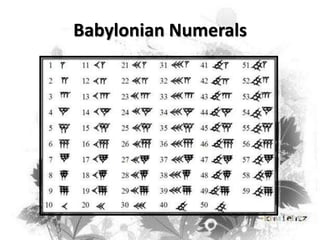
• The Babylonians had an advanced number
system.

• Their numeration system was positional with
base 60 (sexagesimal) .
• They did not have zero symbol.
• But they also cover topics which include
fractions,

algebra,

quadratic

and

cubic

equations.
• Using base 60 system, they usage of 60
seconds in a minute, 60 minutes in an
hour, and 360 (60 x 6) degrees in a circle, as
well as the use of seconds and minutes of arc
to denote fractions of a degree.
• The Greek astronomer Ptolemy used this
system from the Babylonian which is no
doubt why we have minutes, seconds and
degree measurement today.
Babylonian Numerals
EGYPTIAN
• They developed their own pictorical way of
writing, called hieroglyphics and their
numeration system was consequently very
pictorical.
• Its numeration system is an example of
simple grouping system.
• Surveying - using unique method which is
streching rope.
• Basic units – measuring length was cubit (the
distance from the persons elbow to the end
of end of the middle finger.
• The Egyptian have the formulas to find the area of a
circle and volume of the cube, box cylinder and some
other figures.
• They had good reckoning of the calendar and knew
that a solar year was approximately 365 ½ days.
• The Rhind papyrus (c. 1650 BC ) is another major
Egyptian mathematical text, an instruction manual in
arithmetic and geometry. In addition to giving area
formulas and methods for multiplication, division and
working with unit fractions, it also contains evidence
of
other
mathematical
knowledge[including
composite and prime numbers; arithmetic, geometric
and harmonic means ; and simplistic understandings
of both the Sieve of Eratosthenes and perfect
numbers theory (namely, that of the number 6)
Native American
• The native American also known as Mayan’s.
• The mayan civilization had a written a hieroglyphic

language that had been developed by 700BC.
• They have accurate solar calendar.
• The Mayan culture had developed a positional
numeration system.
• Maya numerals were a vigesimal (base-twenty)

numeral system used by the Pre-Columbian Maya
civilization.
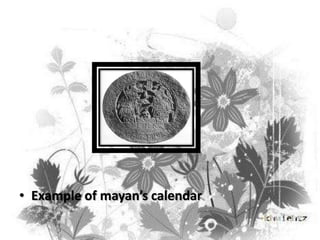
• Example of mayan’s calendar
Thank
You

Babylonian, egyptian and native american

  • 1.
    Babylonian, Egyptian andNative American Periods 3000 BC to 601 BC Prepared by : Norfiza bt Musa Maisarah bt Mistar Nabilla bt Mohd Nasri Deevani a/p Chandra sekaram 3PISMP PBM1
  • 2.
  • 3.
    • Babylonians mathematicsrefers to any mathematics of the people of Mesopotamia (modern Iraq) from the days of the early Sumerians until the beginning of the Hellenistic period • It is named Babylonian mathematics due to the central role of Babylon as a place of study, which ceased to exist during the Hellenistic period. • From this point, Babylonian mathematics merged with Greek and Egyptian mathematics to give rise to Hellenistic mathematics. Later under the Arab Empire, Mesopotamia, especially Baghdad, once again became an important center of study for Islamic mathematics.
  • 4.
    • The Mathematicsof this period was very practical and it was used in construction, surveying, record keeping and in the creation of calendar. • The culture of the Babylonians reached its heights about 2500BC and in about 1700BC.
  • 5.
    • The maininformation we have about civilization and mathematics of the Babylonian is their numeration system. • The Babylonians had an advanced number system. • Their numeration system was positional with base 60 (sexagesimal) . • They did not have zero symbol.
  • 6.
    • But theyalso cover topics which include fractions, algebra, quadratic and cubic equations. • Using base 60 system, they usage of 60 seconds in a minute, 60 minutes in an hour, and 360 (60 x 6) degrees in a circle, as well as the use of seconds and minutes of arc to denote fractions of a degree.
  • 7.
    • The Greekastronomer Ptolemy used this system from the Babylonian which is no doubt why we have minutes, seconds and degree measurement today.
  • 8.
  • 9.
  • 10.
    • They developedtheir own pictorical way of writing, called hieroglyphics and their numeration system was consequently very pictorical. • Its numeration system is an example of simple grouping system. • Surveying - using unique method which is streching rope. • Basic units – measuring length was cubit (the distance from the persons elbow to the end of end of the middle finger.
  • 11.
    • The Egyptianhave the formulas to find the area of a circle and volume of the cube, box cylinder and some other figures. • They had good reckoning of the calendar and knew that a solar year was approximately 365 ½ days. • The Rhind papyrus (c. 1650 BC ) is another major Egyptian mathematical text, an instruction manual in arithmetic and geometry. In addition to giving area formulas and methods for multiplication, division and working with unit fractions, it also contains evidence of other mathematical knowledge[including composite and prime numbers; arithmetic, geometric and harmonic means ; and simplistic understandings of both the Sieve of Eratosthenes and perfect numbers theory (namely, that of the number 6)
  • 12.
  • 13.
    • The nativeAmerican also known as Mayan’s. • The mayan civilization had a written a hieroglyphic language that had been developed by 700BC. • They have accurate solar calendar. • The Mayan culture had developed a positional numeration system. • Maya numerals were a vigesimal (base-twenty) numeral system used by the Pre-Columbian Maya civilization.
  • 14.
    • Example ofmayan’s calendar
  • 15.