• Ancient Period
•Greek Period
• Hindu-Arabic Period
• Period of Transmission
• Early Modern Period
• Modern Period
BRIEF HISTORY of
MATHEMATHICS
3.
Ancient Period (3000B.C. to 260 A.D.)
A. Number Systems and Arithmetic
• Development of numeration systems.
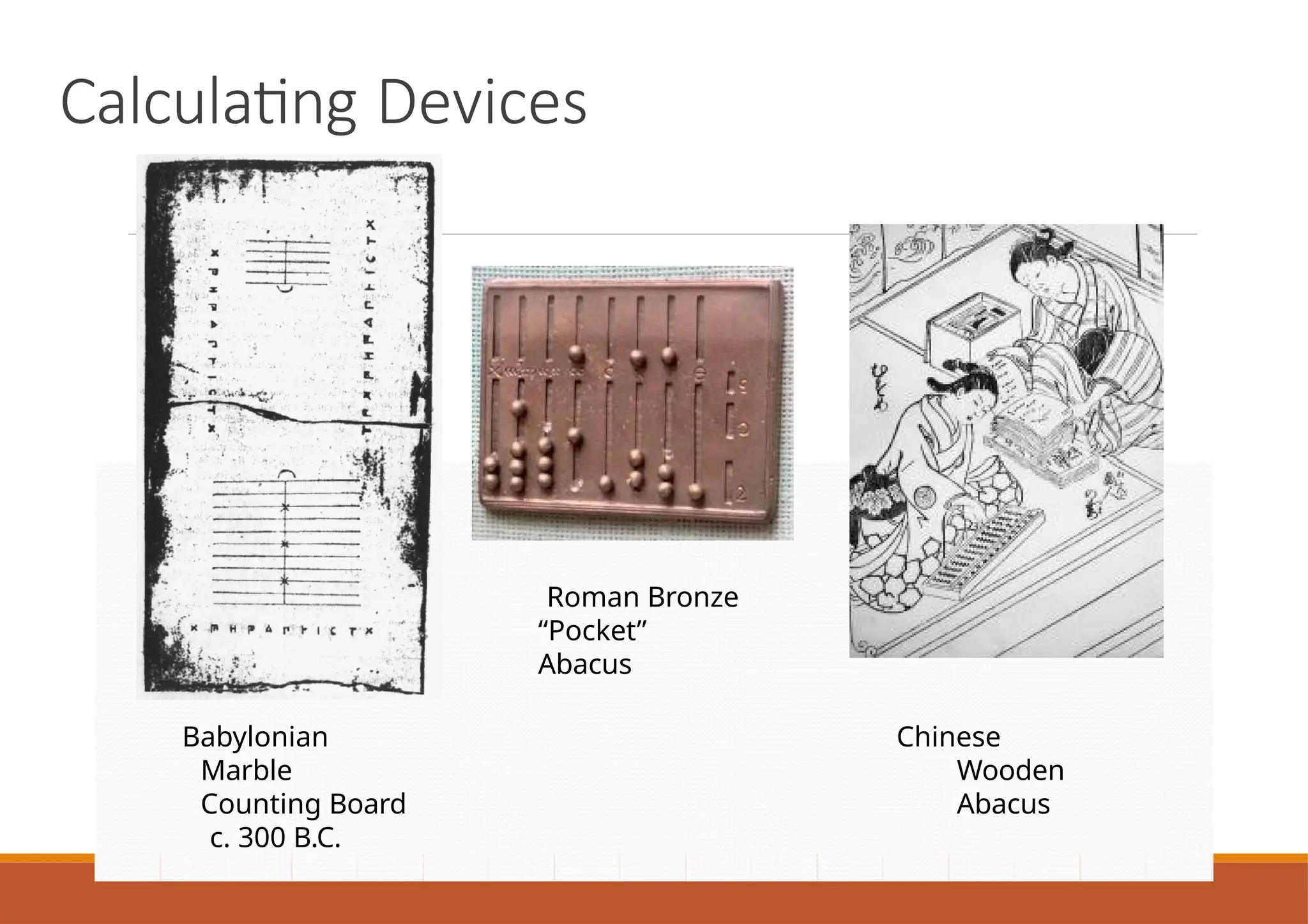
• Creation of arithmetic techniques, lookup tables, the abacus and
other calculation tools.
B. Practical Measurement, Geometry and Astronomy
• Measurement units devised to quantify distance, area, volume,
and time.
• Geometric reasoning used to measure distances indirectly.
• Calendars invented to predict seasons, astronomical events.
• Geometrical forms and patterns appear in art and architecture.
4.
Practical Mathematics
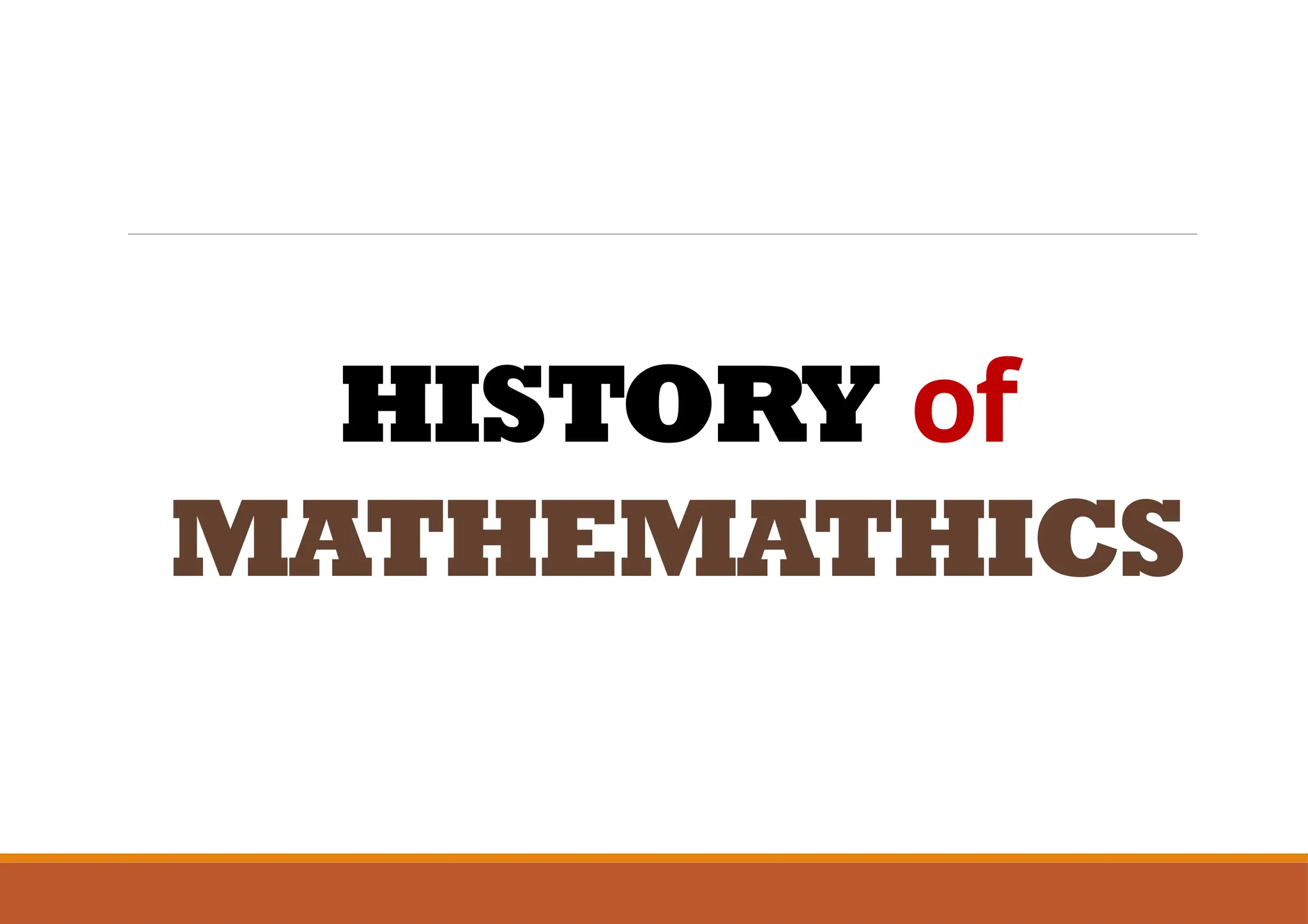
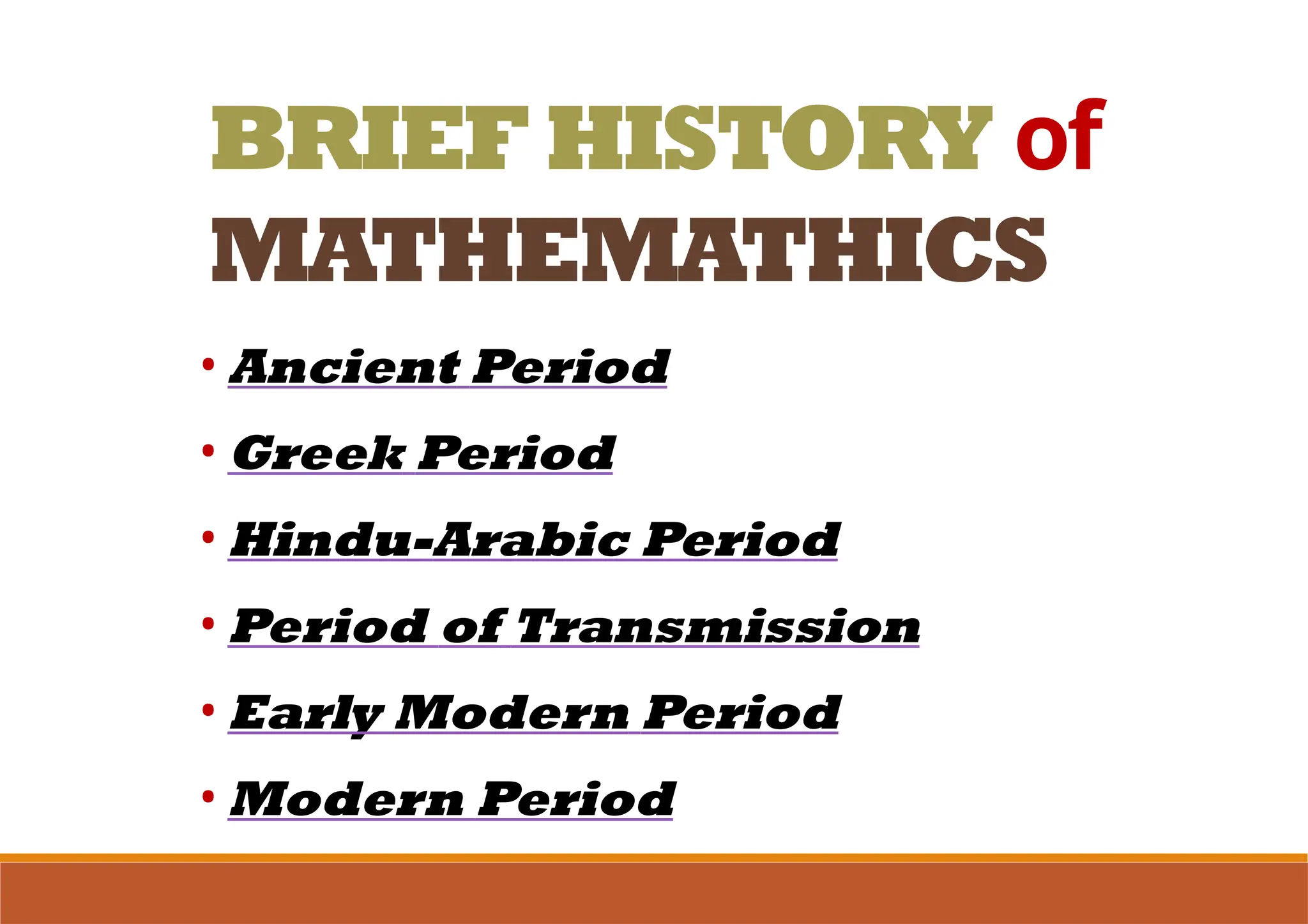
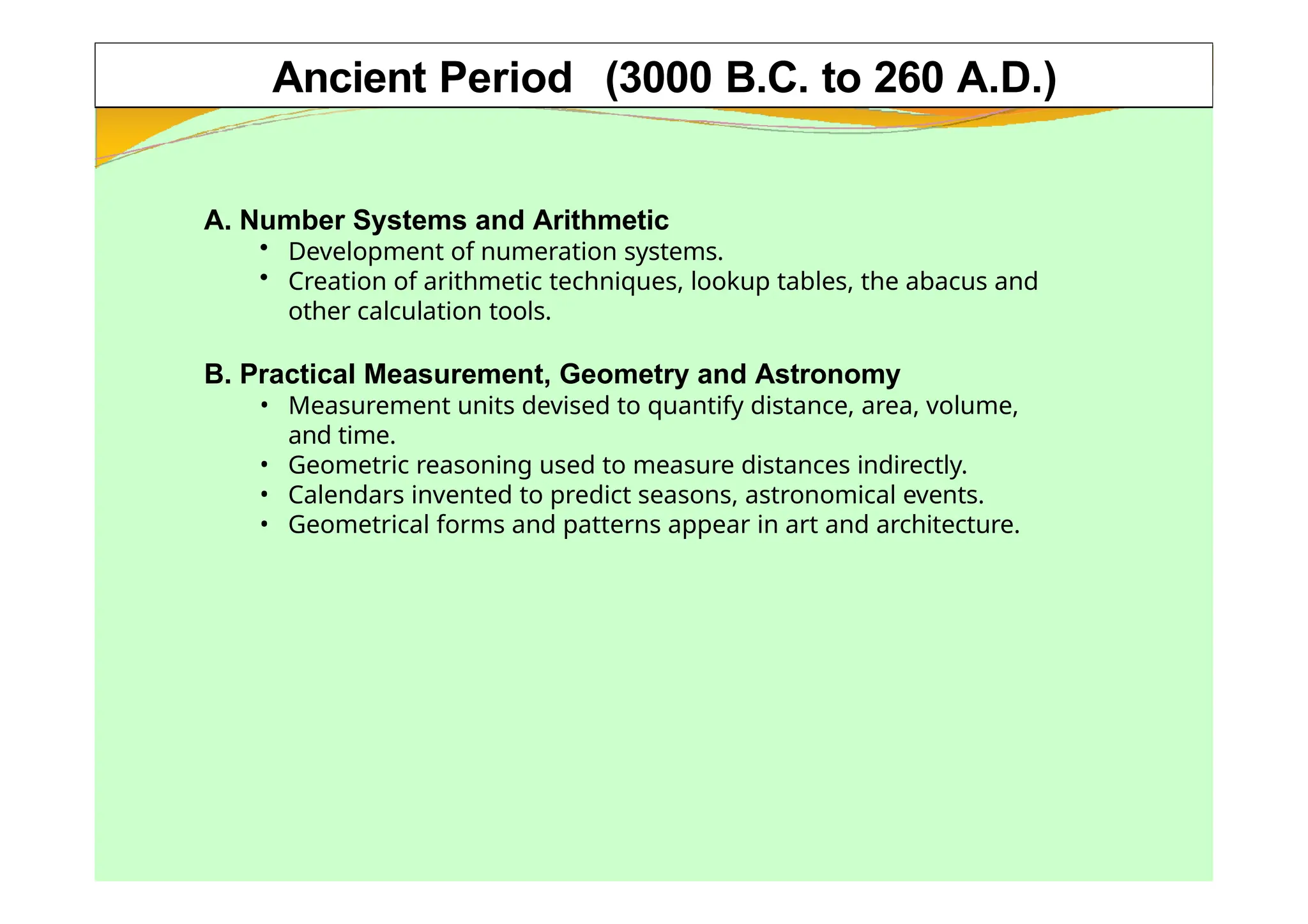
As ancientcivilizations developed,
the need for practical mathematics
increased. They required
numeration systems and arithmetic
techniques for trade, measurement
strategies for construction, and
astronomical calculations to track
the seasons and cosmic cycles.
5.
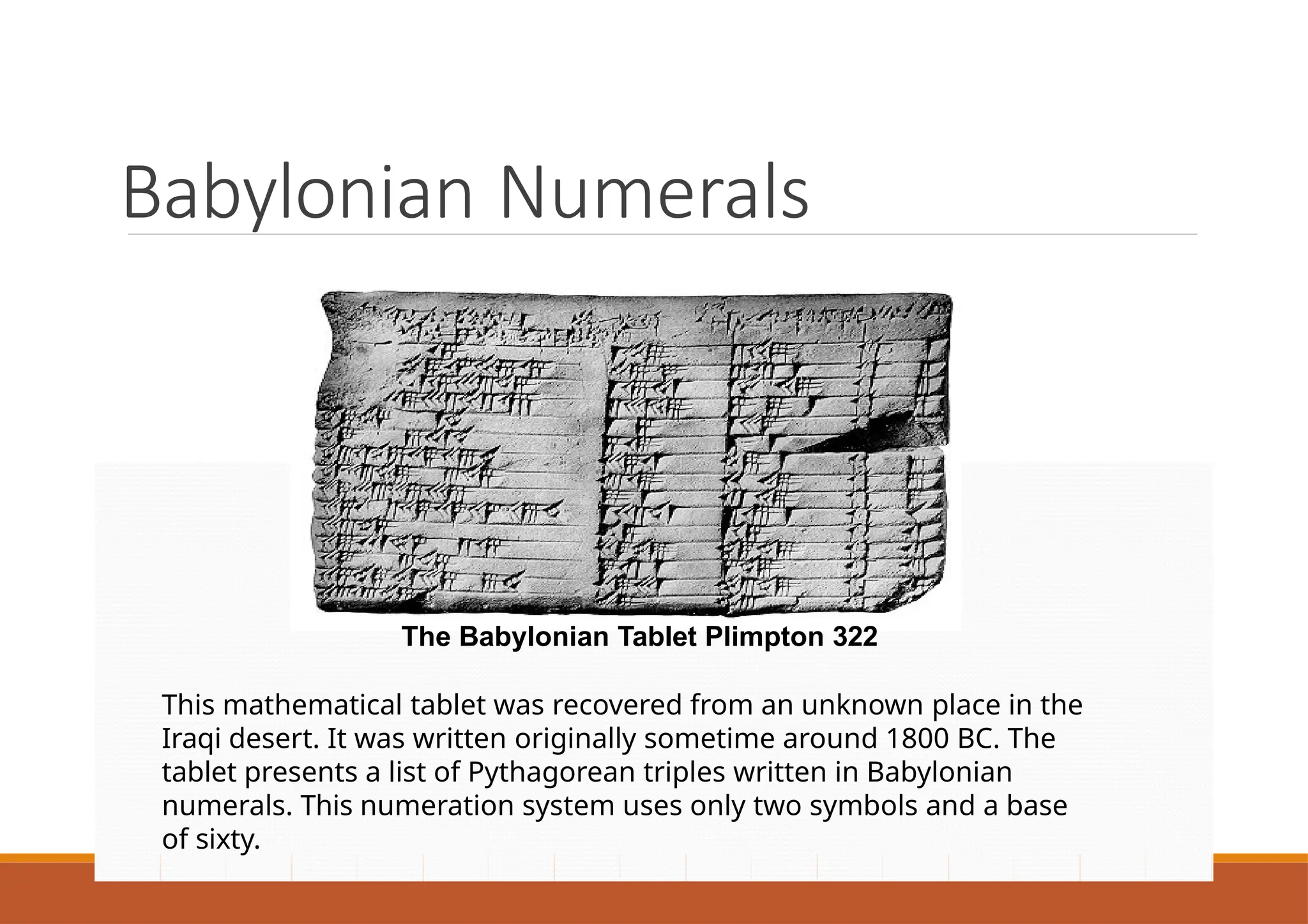
Babylonian Numerals
The BabylonianTablet Plimpton 322
This mathematical tablet was recovered from an unknown place in the
Iraqi desert. It was written originally sometime around 1800 BC. The
tablet presents a list of Pythagorean triples written in Babylonian
numerals. This numeration system uses only two symbols and a base
of sixty.
Greek Period (600B.C. to 450 A.D.)
A. Greek Logic and Philosophy
⚫ Greek philosophers promote logical, rational explanations of
natural phenomena.
⚫ Schools of logic, science and mathematics are established.
⚫ Mathematics is viewed as more than a tool to solve practical
problems; it is seen as a means to understand divine laws.
⚫ Mathematicians achieve fame, are valued for their work.
B. Euclidean Geometry
⚫ The first mathematical system based on postulates, theorems and
proofs appears in Euclid's Elements.
8.
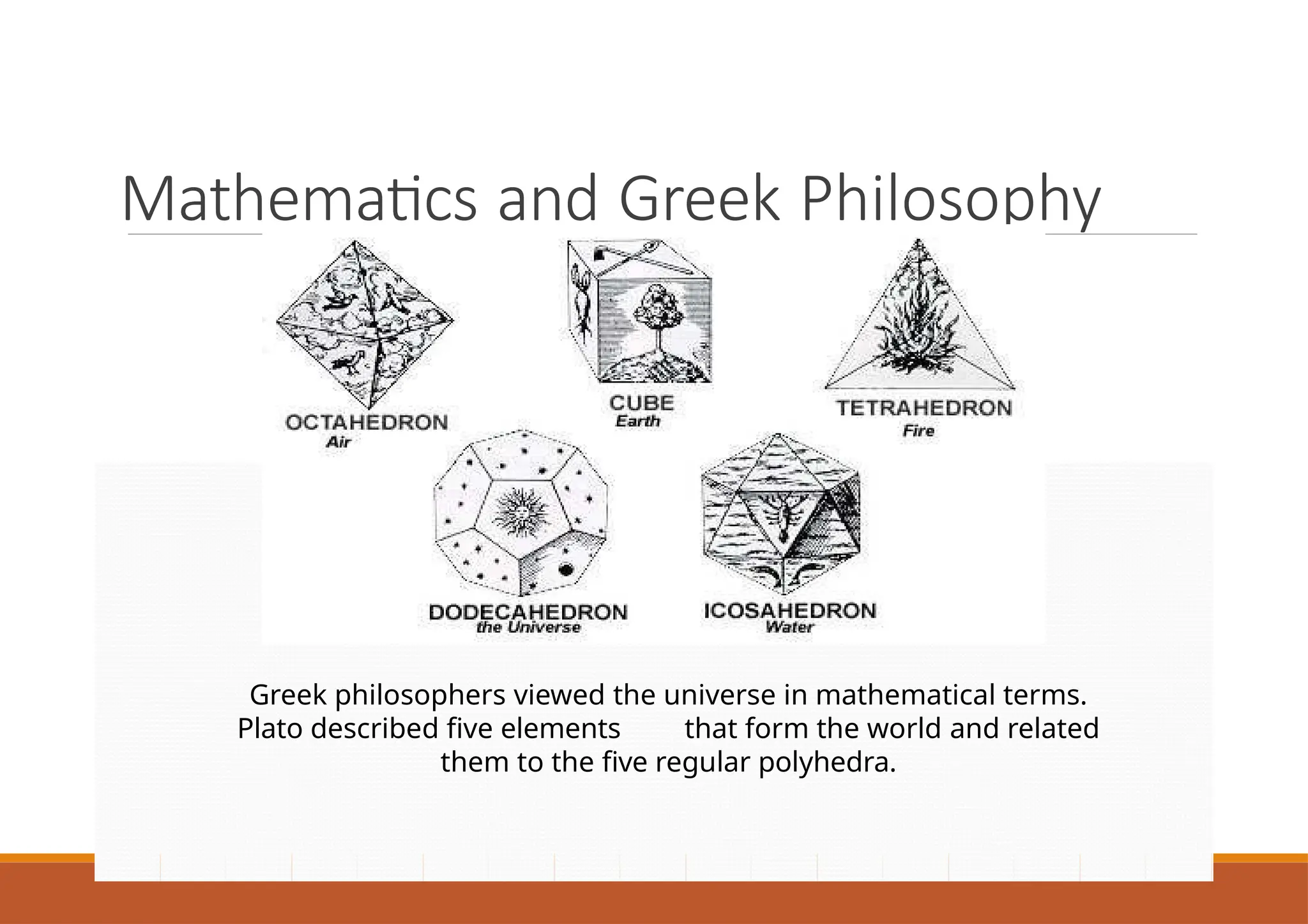
Mathematics and GreekPhilosophy
Greek philosophers viewed the universe in mathematical terms.
Plato described five elements that form the world and related
them to the five regular polyhedra.
9.
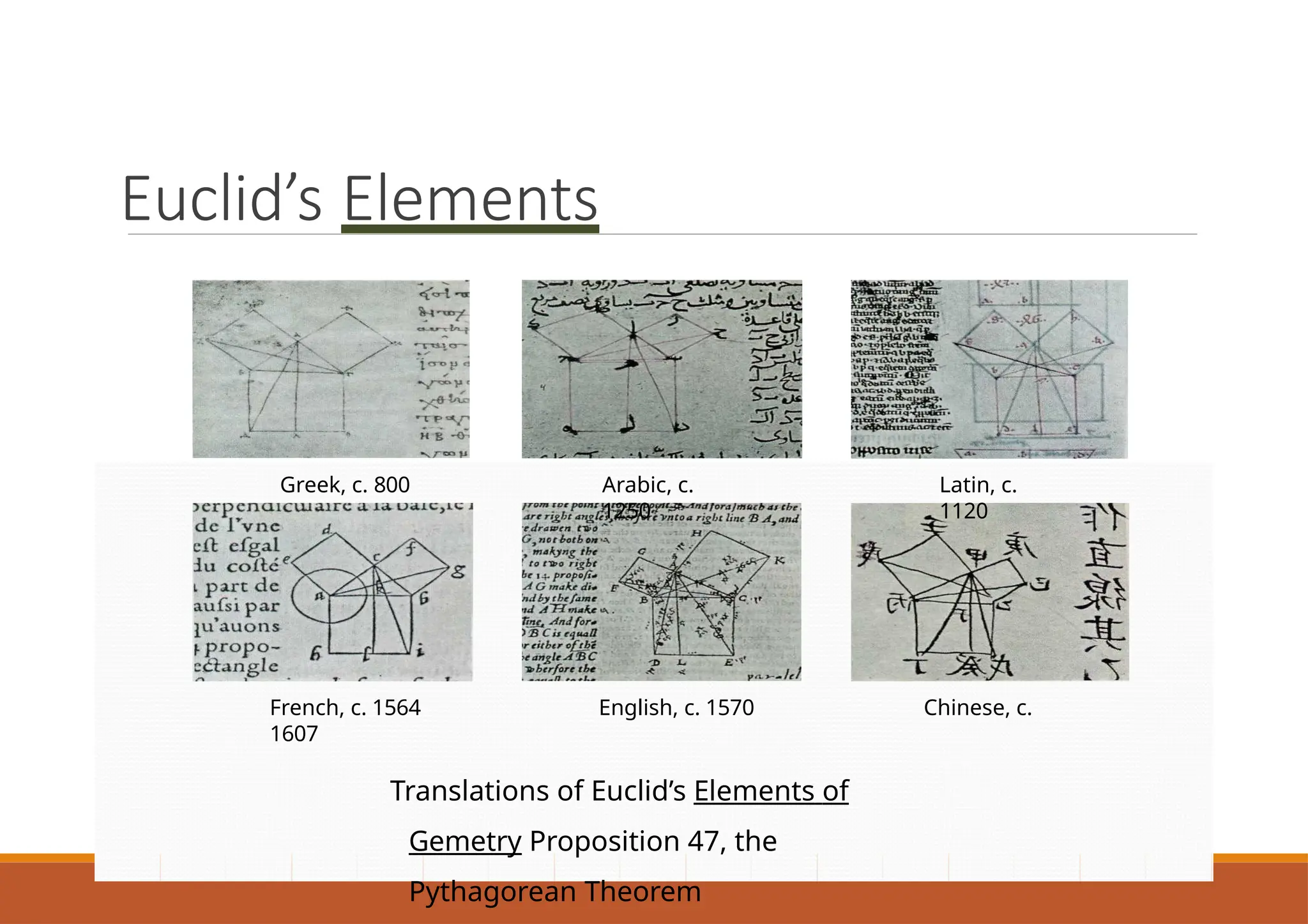
Euclid’s Elements
Greek, c.800 Arabic, c.
1250
Latin, c.
1120
French, c. 1564 English, c. 1570 Chinese, c.
1607
Translations of Euclid’s Elements of
Gemetry Proposition 47, the
Pythagorean Theorem
Hindu-Arabian Period (200B.C. to 1250 A.D. )
A. Development and Spread of Hindu-Arabic Numbers
⚫ A numeration system using base 10, positional notation, the zero
symbol and powerful arithmetic techniques is developed by the
Hindus, approx. 150
B.C. to 800 A.D..
⚫ The Hindu numeration system is adopted by the Arabs and
spread throughout their sphere of influence (approx. 700
A.D. to 1250 A.D.).
B. Preservation of Greek Mathematics
⚫ Arab scholars copied and studied Greek mathematical works,
principally in Baghdad.
C. Development of Algebra and Trigonometry
⚫ Arab mathematicians find methods of solution for quadratic, cubic
and higher degree polynomial equations. The English word
“algebra” is derived from the title of an Arabic book
describing these methods.
⚫ Hindu trigonometry, especially sine tables, is improved and
advanced by Arab mathematicians


![A Reviewer for Math History and Trivia [Not Updated]](https://cdn.slidesharecdn.com/ss_thumbnails/mathhistoryandtriviareviewer-240320201819-f1b01a44-thumbnail.jpg?width=640&height=640&fit=bounds)


