Download to read offline
![Dr. M Chakraborty et al Int. Journal of Engineering Research and Applications
ISSN : 2248-9622, Vol. 4, Issue 1( Version 3), January 2014, pp.06-20
RESEARCH ARTICLE
www.ijera.com
OPEN ACCESS
Effect of Annealing On Thin Film Fabrication of Cadmium Zinc
Telluride by Single-R.F. Magnetron Sputtering Unit
Dr. Monisha Chakraborty A,* and Sugata Bhattacharyya B
A*
B
Assistant Professor, School of Bio-Science & Engineering, Jadavpur University, Kolkata-700032, India
Project Fellow, School of Bio-Science & Engineering, Jadavpur University, Kolkata-700032, India
*Corresponding Author
Abstract
In this work, formation of Cd1-xZnxTe thin films under various annealing-environments, created by layer by
layer deposition of individual CdTe and ZnTe targets from a Single-R.F. Magnetron Sputtering unit is
investigated. Structural and optical characterization results show that Vacuum Annealing is the best suitable for
the formation of better Cd1-xZnxTe XRD peaks of higher intensities in comparison to Argon or NitrogenAnnealing, for a bi-layered deposited CdTe and ZnTe film on glass substrate. The crystallography of the Cd1xZnxTe films formed appeared to be either Cubic or Rhombohedral type. Also, it has been noticed, that the more
inert the annealing-environment is, the lesser is the heat loss by the film-substrate and this results in better
fusing of the deposited particles to move more from the poly-crystalline to the mono-crystalline structure. Also
higher inert environment causes more Cadmium evaporation and this consequently drives the lattice-constant
and the band-gap energy of the formed Cd1-xZnxTe thin film to move from the CdTe side to the ZnTe side. The
method developed here with proper annealing ambiance for Cd1-xZnxTe fabrication can be implemented in
laboratories lacking in Co-Sputtering machine.
Keywords Cd1-xZnxTe, CdTe, ZnTe, Single-R.F. Magnetron Sputtering, Vacuum-Anneal, Argon-Anneal,
Nitrogen-Anneal
I.
Introduction
Cadmium Zinc Telluride (CZT) is a ternary
semiconductor alloy, which has found applications in
x-rays and gamma rays detectors, nuclear radiation
detectors, substrate for epitaxial-growth of IRdetector
material
HgCdTe,
electro-optical
modulators, photo-conductors, light emitting diodes
and solar-cells [1-6]. The band-gap of this ternary
compound CdZnTe lies between 1.45-2.25 eV [7] and
it depends on the variation of Zn content within it.
CdZnTe is considered to be an excellent material for
X-ray and gamma ray detection [8, 9] because of its
low leakage currents and high quantum efficiency.
This facilitates its operation as detectors in large
volume, even at room-temperature [10]. Applications
of CZT have also been studied because of its great
possibility in the field of medical imaging.
Particularly in the field of single photon emission
computed tomography (SPECT), the compound has
shown great potential. CZT has also found its
application in the sphere of positron emission
tomography (PET) [11,12], dedicated emission
mammotomography [11,12] and surgical oncology. So
the importance of CdZnTe as an excellent biomedical device grade material is undeniable.
Sputtering, as a fabrication technology, can be used
for batch-production in medium to large substrate
areas. Also fabrication of Cd1-xZnxTe, with userdefined choice of „x‟, can be fabricated from cowww.ijera.com
sputtering machine using CdTe and ZnTe targets [13]
or ZnTe and Cd [14] targets and vice-versa. But in
laboratories with low infrastructure and lack of better
fabricating-machinery can cause hindrance to such
fabrication. In view of lack of Co-Sputtering
machine, a secondary line of defense can be
implemented to create Cd1-xZnxTe by individual
deposition of layers of CdTe and ZnTe films, one
above the other, respectively. Then by supplementing
the sample with proper choice of annealing
temperature, annealing-environment and time, the
crystals of ZnTe and CdTe can be fused together to
form Cd1-xZnxTe. In this respect, the choice of „x‟ in
the Cd1-xZnxTe thin film can be controlled by
controlling the deposited mass and consequently the
thickness of CdTe and ZnTe layers individually. In
this work our objective is to find the types of
formation of Cd1-xZnxTe planes (hkl values) with
respect to change of annealing environment and to
note the intensities of those planes with change of by
a single R.F. Magnetron Sputtering Unit by using
individual CdTe and ZnTe sputtering-targets
consecutively. Also a study of the lattice-constants,
particle-size and strain and UV-Visible spectrum of
those annealed-samples are made, to make a
comparative study of the impact of annealingenvironment on those above parameters. For our
experiment, the proposed choice of „x‟ was made to
be „0.2‟.
6|P age](https://image.slidesharecdn.com/b41030620-140203060646-phpapp01/85/B41030620-1-320.jpg)
![Dr. M Chakraborty et al Int. Journal of Engineering Research and Applications
ISSN : 2248-9622, Vol. 4, Issue 1( Version 3), January 2014, pp.06-20
II.
Experimental Details
1.1 Sample Preparation
Glass-slide, having dimensions of 75mm
25mm × 1.3 mm, was taken as a substrate for sputter
deposition. The slide was initially weighed and then
it was cleansed by acetone for 15 minutes by using
Ultrasonic Cleaner (Piezo-U-Sonic). The sputtering
unit used here is “Planar Magnetron Sputtering Unit
(Model: 12”MSPT)”, manufactured by Hind High
Vacuum Co. (P) Ltd., Bangalore, India. The glasssubstrate was subjected to shunt-heating at a chamber
pressure of 10-3 mBar and was raised to a temperature
of 200 . At a chamber-pressure of over 10-4 mBar,
sputtering was carried out. The input Argon gas was
injected at a line-pressure of 1.26 Kg/cm2. During
Sputtering, the chamber pressure was maintained at a
fixed value of 0.035 mBar. The Forward Power and
the Reflected Power of the RF Generator was
maintained at 410 W and 50 W respectively.
Sputtering time for the CdTe and ZnTe deposition
was controlled as required to obtain the requisite
stoichiometry of Cd1-xZnxTe. After Sputtering, the
substrate was allowed to cool-off and the Diffusion
Pump was shut-off at a temperature of 50 . Air was
finally admitted into the chamber when the substrate
came down to room-temperature, to prevent any
unwanted oxidation of the film. Consecutive
deposition of single-layer of CdTe and ZnTe were
made, to create a bi-layer film of CdTe and ZnTe
respectively. The glass substrate was now cut into 4
equal parts of dimensions 18mm 25mm × 1.3 mm
for further experiment. Three of those four new
samples were respectively subjected to (a) Vacuum,
(b) Argon and (c) Nitrogen-Annealing. The 4th
sample was left un-annealed.
1.1.1
Vacuum-Annealing
Here the sample was annealed for 30
minutes at a temperature of around 200 in the same
sputter unit at a pressure in between 10-4-10-5 mBar.
The temperature was manually kept constant at
around 200
with a 2 error.
2.1.2 Argon-Annealing
Here the sample was annealed in an Argon
ambience in the same sputter unit. Initially a vacuum
of 10-4 mBar was raised inside the chamber and then
Argon was injected inside the chamber at a line
pressure of 1.26 Kg/cm2 as before and the chamber
pressure was maintained at a value of 0.035 mBar.
The annealing time was 30 minutes, at around 200
with a
2
error.
www.ijera.com
www.ijera.com
2.1.3
Nitrogen-Annealing
The process here is exactly similar to that as
of in the case of Argon-Annealing, except for here
Nitrogen is used as the annealing-environment
instead of Argon. Annealing time remained 30
minutes and temperature was kept in and around
200
with a 2 error as before.
III.
Theory and Calculations
3.1 Analytical Method for Fabrication of Cd1-xZnxTe
by layer by layer deposition of CdTe and ZnTe
The total thickness of the bi-layered CdTe
and ZnTe thin films were proposed to be 250 nm. The
proposed choice of stoichiometry was Cd0.8Zn0.2Te,
as it is very closely related with the available XRD
data of the JCPDS file, where a stoichiometry of
„Cd0.78Zn0.22Te‟ is available. The thickness of CdTe
and ZnTe layers are found by the method as
described in [1, 11, 15, 16] and these values for these
layers are found to be 208.168 nm and 40.351nm
respectively.
IV.
. Results & Discussion
4.1 X-Ray Diffraction (XRD) Results
The XRD spectra of the deposited films
were recorded on Rigaku Miniflex (from Japan)
powder diffractometer. The incident x-rays were
emissions from the Copper-K lines, with a
wavelength of 1.54025 Å. The scanning angle range
i.e. 2θ of the diffractometer was kept between 20º to
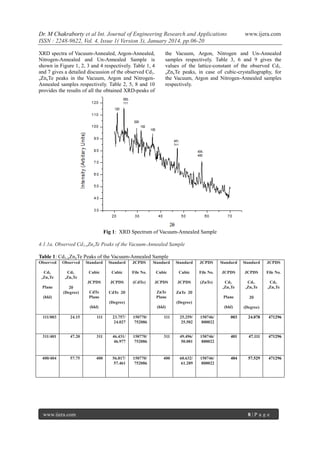
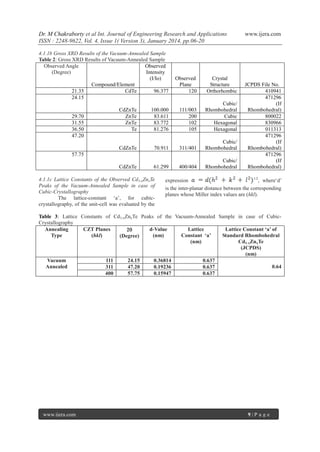
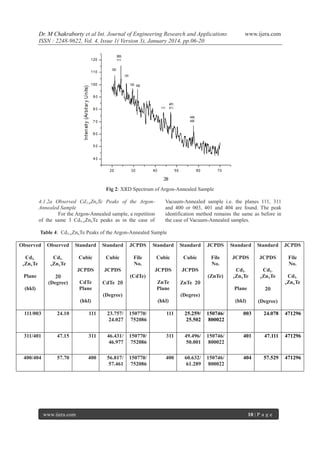
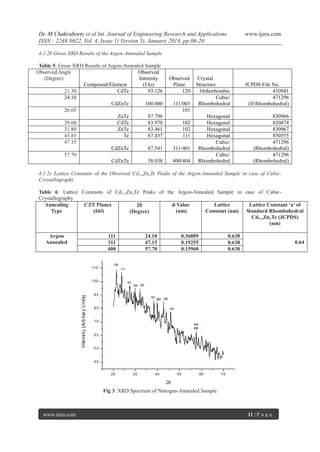
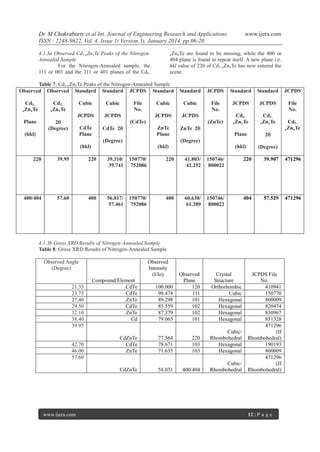
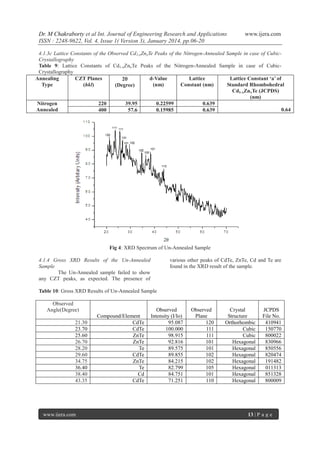
70º. The vacuum-annealed sample, for e.g., revealed
3 Cd1-xZnxTe peaks in XRD, namely planes with hkl
values of 111, 311 and 400 of cubic-crystallography
or 003, 401 and 404 planes of rhombohedralcrystallography, corresponding to standard XRD data
of CZT sample from JCPDS file. The „111‟ Cd1xZnxTe plane of cubic-crystallography lies between
the 111 planes of Cubic-CdTe and Cubic-ZnTe
respectively, with corresponding JCPDS file number
of 150770 or 752086 and 150746 or 800022
respectively. Also the 2 angle of the probable cubicCd1-xZnxTe „111‟ plane, relates with the standard
„Cd0.78Zn0.22Te‟ XRD-data in the JCPDS literature of
file number 471296, where a similar „003‟ plane of
rhombohedral-crystallography is also found near the
same 2 region. In this regard it should be said, that
our obtained CZT peaks can either be of Cubic or of
Rhombohedral crystallography, with either of the
particular corresponding cubic or rhombohedral
planes. A similar identification method of Cd1-xZnxTe
peaks are carried out for all the other observed
CdZnTe peaks in all the other annealed and unannealed sample i.e. the existence of the observed
cubic- Cd1-xZnxTe peak between the standard JCPDS
cubic-CdTe and ZnTe peaks and also the existence of
the observed Cd1-xZnxTe peak in the same 2 region
of the standard Cd1-xZnxTe JCPDS literature. The
7|P age](https://image.slidesharecdn.com/b41030620-140203060646-phpapp01/85/B41030620-2-320.jpg)
![Dr. M Chakraborty et al Int. Journal of Engineering Research and Applications
ISSN : 2248-9622, Vol. 4, Issue 1( Version 3), January 2014, pp.06-20
from the Nitrogen-Annealed samples and less
evaporation of Cd. Table 12 gives a comparative
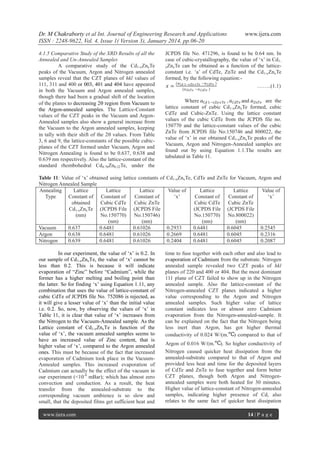
summarized analysis of the number of CZT peaks
www.ijera.com
formed and their intensities, under various annealing
conditions.
Table 12: CZT Peaks and their Intensities under various Annealing-Conditions
Annealing
Type
Intensity
(I/Io)
Vacuum
CZT
Plane
(111)
Present
Intensity
(I/Io)
100
CZT
Plane
(311)
Present
Argon
Nitrogen
Un-Annealed
Present
Absent
Absent
100
Absent
Absent
Present
Absent
Absent
The above table reflects that the formation
of CZT has been most facilitated by the VacuumAnnealing environment, as is understood by
comparing the relative intensities and the number of
CZT peaks under Vacuum, Argon, Nitrogen and UnAnnealed conditions. In this respect it might be reemphasized here that most probably the extreme inert
nature of the Vacuum ambience, with almost zero
heat conduction and convection, gave better time and
more heat for better fusing and formation of CZT
peaks. The impact of better inertness of the annealing
environment thus seem to have a positive effect on
better formation of CZT and the pattern also
continues from the Argon to Nitrogen annealingtypes. Regarding the exact crystallography of the
obtained Cd1-xZnxTe peaks, it is possible either the
cubic or the rhombohedral type is formed. As the
values of „x‟ and lattice-constant for e.g. for the
Nitrogen-Annealed sample for cubic-crystallography
is 0.2404 and 0.2087 (from Table 11) and 0.639 nm
respectively, and this lies very close to the standard
value of “0.22” of “x” and “0.64 nm” value of latticeconstant, in the rhombohedral type Cd0.78Zn0.22Te in
JCPDS file No. 471296, the exact crystallography of
the formed Cd1-xZnxTe peaks could not be said with
certainty in our samples. In this regard it should also
be mentioned, that the standard rhombohedral CZT
was formed by Travelling Heater-Method and had the
angles = β = = 89.94°. So the standard JCPDS
Rhombohedral crystallography of CZT has a very
www.ijera.com
Intensity
(I/Io)
70.91
CZT
Plane
(400)
Present
Intensity
(I/Io)
61.29
CZT
Plane
(220)
Absent
67.54
Absent
Absent
Present
Present
Absent
58.03
58.03
Absent
Absent
Present
Absent
Absent
77.56
Absent
Absent
thin line of demarcation with possible cubiccrystallography. So, the Cd 1-xZnxTe peaks in our
samples can be either of cubic or of rhombohedral
crystallography.
4.2
UV-Visible Results of all the Samples
All the 4 samples were subjected to UVVisible optical test using PerkinElmer Lambda 25
spectrophotometer, with a wavelength ranging from
300-900 nm and the absorption spectra and
correspondingly the transmission spectra were
obtained from them.
From the optical-data, the molar absorption
co-efficient i.e. „‟ is determined by the expression:…….(1.2)
Where„d‟ is the net thickness of the deposited film
and „T‟ is the observed transmittance.
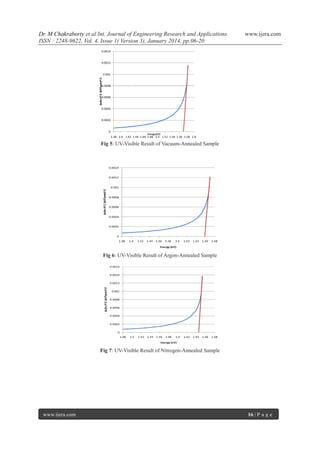
The following graphs were obtained, with
Band-Gap-Energy (h), in eV, as the x-axis and the
(Band-Gap-Energy/nm)2 i.e. (h)2 as the y-axis
from the UV-Visible data. From such graphs, the
band-gap energy of the fabricated thin-films can be
calculated [17, 18]. Figure 5, 6, 7 and 8 provides the
UV-Visible Result of Vacuum, Argon, Nitrogen and
Un-Annealed sample respectively. Table 13 provides
the approximate Band-Gap obtained from all the
samples.
15 | P a g e](https://image.slidesharecdn.com/b41030620-140203060646-phpapp01/85/B41030620-10-320.jpg)
![Dr. M Chakraborty et al Int. Journal of Engineering Research and Applications
ISSN : 2248-9622, Vol. 4, Issue 1( Version 3), January 2014, pp.06-20
www.ijera.com
Fig 8: UV-Visible Result of Un-Annealed Sample
Table 13: Approximate Band-Gap of all Annealed
and Un-Annealed Sample
Annealing Type
Approximate Band-Gap
(eV)
Vacuum
1.570
Argon
1.560
Nitrogen
1.545
Un-Annealed
1.555
The band-gap value of the Un-Annealed sample is
interesting to note, as its band-gap value is almost
similar to that of the Annealed-Samples. This may be
because of the fact, that the proportion of CadmiumTelluride is much higher than that of the ZincTelluride in our sample, and the UV-Visible result of
the Un-Annealed sample is mostly dominated by the
band-gap value of CdTe.
4.2.1
4.3
Strain and Particle Size Results of all the
Samples
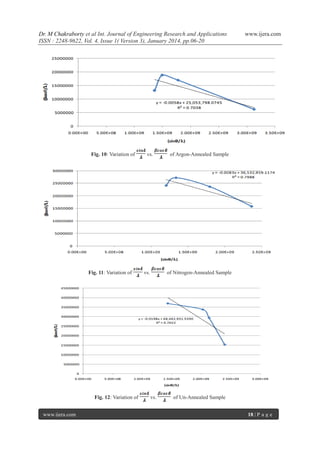
The particle size (L) and strain () for
polycrystalline structures can be expressed in a linear
combination as a function of FWHM (β) of the XRD
peaks and is given by the following equation [9,19]:
Analysis of all the UV-Visible Results
The UV-Visible results of the VacuumAnnealed, Argon-Annealed and Nitrogen-annealed
samples are in tally with their corresponding value of
lattice-constants of the CdZnTe planes. As there is a
general increase in value of the lattice-constants of
the CZT planes of the samples from VacuumAnnealed to Argon-Annealed to Nitrogen-Annealed
samples, there is an increasing Cadmium content
from the Vacuum to the Nitrogen-Annealed samples.
So consequently the band-gap of the samples, from
Vacuum to Nitrogen-annealed ones, has shifted more
towards the direction of the band-gap of CdTe (i.e.
1.45 eV) from the direction of band-gap of ZnTe (i.e.
2.25 eV), in the corresponding UV-Visible spectrum.
Fig. 9: Variation of
www.ijera.com
vs.
…….(1.3)
From the (
) graph, the particle size &
strain are obtained from the intercept and slope of the
above plot in Equation 1.3. Figure 9, 10, 11 and 12
𝑠𝑖𝑛 𝛽𝑐𝑜𝑠
provides the (
,
) graph of the Vacuum, Argon,
Nitrogen
and
Un-Annealed
sample.
of Vacuum-Annealed Sample
17 | P a g e](https://image.slidesharecdn.com/b41030620-140203060646-phpapp01/85/B41030620-12-320.jpg)
![Dr. M Chakraborty et al Int. Journal of Engineering Research and Applications
ISSN : 2248-9622, Vol. 4, Issue 1( Version 3), January 2014, pp.06-20
4.3.1 A comparative study of the obtained Particle
size and Strain under various Annealing and Unannealed conditions
Table 14: Particle Size and Strain Value under
various Annealing and Un-Annealed Conditions
Annealing Type
Particle
Size Strain
(nm)
Vacuum
41.11
-0.0038
Argon
39.91
-0.0058
Nitrogen
27.37
-0.0083
Un-annealed
14.60
-0.0198
Table 14 provides the various particle size
and strain value under various annealing and unannealed condition. It is observed that there is an
increasing value of particle-size along with a
www.ijera.com
decreasing value of compressive-strain (indicated by
negative sign) from the Un-annealed to the VacuumAnnealed sample. It can be proposed here and can be
tallied with XRD peaks and their corresponding
intensities, that under Vacuum-Annealed condition
the CdTe and ZnTe particles received comparatively
higher heat (and lesser heat loss) to produce more
fused and larger particle size. Also the decreasing
value of compressive-strain suggests that under
Vacuum-Annealing condition, the crystalline
structure changed maximum from polycrystalline to
mono-crystalline form and is also strengthened by the
fact of increasing particle-size trend. The following
strain vs. particle-size curve indicates the above
discussion.
Fig. 13: Variation of Strain vs. Particle Size
V.
Conclusion
(1) Vacuum-Annealing is the most suitable
environment for better production of Cd1-xZnxTe
from the layer by layer deposited CdTe and ZnTe
films on glass-substrate, forming a bi-layer, from
a single R.F. Magnetron Sputtering Unit. The
crystals of Cd1-xZnxTe are either of Cubic or of
Rhombohedral-crystallography.
(2) The more inert the annealing environment is, the
less the heat is lost by the substrate and the film
and more the heat it gets to form CZT. Also,
higher inert environment tends to cause more
Cadmium evaporation from the substrate and
consequently shifts the lattice-constant and the
band-gap energy towards the direction of ZnTe,
from the CdTe side.
(3) Bigger particle size is obtained in case of a better
inert environment, thus implying the change of
the crystal structure from the poly-crystalline to
the mono-crystalline form.
www.ijera.com
VI.
Acknowledgement
Authors are very much thankful to
University Grants Commission, Government of India,
for providing financial support for this work.
References
[1]
[2]
[3]
M. Chakaborty, Fabrication of Nanostructured Cadmium Zinc Telluride thin
films, International Journal of Engineering
Research and Applications (IJERA), Vol. 2,
Issue 1( 2012) 1126-1134
D. Zeng, W. Jie, T. Wang, W. Li, J. Zhang,
The relationship between stress and
photoluminescence of Cd0.96Zn0.04Te single
crystal, Materials Science and Engineering
B 142 (2007) 144–147.
J. P. Faurie, J. Reno, M. Boukerche, J.
Crystal Growth, 72 (1985), 111.
19 | P a g e](https://image.slidesharecdn.com/b41030620-140203060646-phpapp01/85/B41030620-14-320.jpg)
![Dr. M Chakraborty et al Int. Journal of Engineering Research and Applications
ISSN : 2248-9622, Vol. 4, Issue 1( Version 3), January 2014, pp.06-20
[4]
[5]
[6]
[7]
[8]
[9]
[10]
[11]
[12]
[13]
[14]
[15]
[16]
T. E. Schlesinger, R. B. James,
Semiconductors and Semimetals, edited 43,
Academic, San Diego (1995).
R. Dornhaus, G. Nimitz, G Höhler, E. A.
Nickisch, Springer (1983), 119.
Z. Q. Shi, C. M. Stahle, P. Shu, Proc. SPIE.
90 (1998) 3553.
K. Prabakar , S. Venkatachalam , Y. L.
Jeyachandran , Sa.K. Narayandass , D.
Mangalaraj, Microstructure, Raman and
optical studies on Cd0.6Zn0.4Te thin films,
Materials Science and Engineering B107
(2004) 99–105.
J. Gaines, R. Drenten, K. Haberbern, P.
Menz, J. Petruzzelo, Appl. Phys. Lett. 62
(1993) 2462.
J. Pal, PhD Thesis, Jadavpur University,
Kolkata, India, 2005.
Q. Li , W. Jie, Li Fu, X. Zhang, X. Wang, X.
Bai, G. Zha, Investigation on the electrical
properties of metal–Cd0.9Zn0.1Te contacts,
Materials Science and Engineering B 135
(2006) 15–19.
M. Chakaborty, A Study Of Dimensional
Effect On Structural Properties Of Cadmium
Zinc Telluride Thin Films, International
Journal of Engineering Research and
Applications (IJERA), Vol. 1, Issue 4, 20962104
M. Chakaborty, Estimation Of „X‟ In Cd1-X
ZnxTe Thin Films Using X-Ray Diffraction
Analysis,
International
Journal
of
Engineering Research and Applications
(IJERA), Vol. 2, Issue 2 (2012) 994-1001
http://etd.fcla.edu/SF/SFE0000341/ThesisC
ZT.pdf ,J. Gadupati, Master of Science
Thesis, University of South Florida, Florida,
USA, 2004.
M. Becerril, H. Silva-Lope, O. ZelayaAngel, Band gap energy in Zn-rich Zn1xCdxTe thin films grown by r.f. sputtering,
Revista Mexicana De Fisica 50 (6) (2004)
588–593.
M. Chakraborty, Optimum Stoichiometry Of
Cadmium Zinc Telluride Thin Films In The
Light Of Optical,Structural And Photon
Generated Gain Studies, International
Journal of Engineering Science and
Technology (IJEST), Vol.3, No. 5 (2011)
3800.
M. Chakraborty, Dimensional Effect on
Optical Properties Of Cadmium Zinc
Telluride Thin Films, International Journal
of Engineering Science and Technology
(IJEST), Vol.3, No. 10 (2011) 7402-7407
www.ijera.com
[17]
[18]
[19]
www.ijera.com
G. P Joshi, N. S. Saxena, R. Mangal, A.
Mishra, T. P. Sharma, Bull. Mater. Sci. 26
(2003) 387.
T. E. Schlesinger, J. E. Toney, H. Yoon, E.
Y. Lee, B. A. Brunett, L. Franks, R.
B.James, Material Science and Engineering
32 (2001) 103.
S. B. Quadri, E. F. Skelton, D. Hsu, A. D.
Dinsmore, J. Yang, H. F. Gray, B. R. Ratna,
Phys. Rev. B 60 (1999) 9191.
20 | P a g e](https://image.slidesharecdn.com/b41030620-140203060646-phpapp01/85/B41030620-15-320.jpg)

This research investigates the formation of cadmium zinc telluride (Cd1-xZnxTe) thin films using single-r.f. magnetron sputtering under various annealing environments, showing that vacuum annealing yields better structural and optical properties compared to argon or nitrogen annealing. It notes that a more inert annealing environment reduces heat loss and enhances crystalline structure, with particular attention to the lattice constant and band-gap energy variation influenced by cadmium evaporation. The study outlines an alternative deposition method feasible for laboratories lacking co-sputtering machines, allowing customization of the stoichiometry of Cd1-xZnxTe.


![Thin_Film_Technology_introduction[1]](https://cdn.slidesharecdn.com/ss_thumbnails/1b4496c8-2102-411b-8465-a3dd3f398327-150205034538-conversion-gate02-thumbnail.jpg?width=640&height=640&fit=bounds)


