2016: B2B Marketing Trends
Produced by: Stryve Digital Marketing
1.  Virtual Technology (VR)
2.  Instant Messaging (IM)
3.  Artificial Intelligence (AI)
4.  Smartphone Apps
CONTENTS
Virtual Reality
(VR)
Trend #1
#1: Virtual Reality
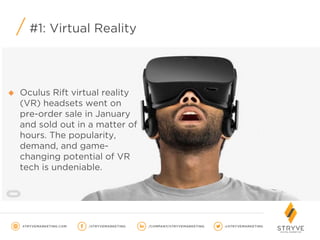
u  Oculus Rift virtual reality
(VR) headsets went on
pre-order sale in January
and sold out in a matter of
hours. The popularity,
demand, and game-
changing potential of VR
tech is undeniable.
B2B Application of Virtual Reality
u  While the virtual reality headsets are primarily for the
consumer market and so far have demonstrated mostly
video game applications, VR tech could be useful to B2B
marketers in a big way in the future.
u  For example, imagine you’re a factory equipment
salesperson: instead of telling a customer about how your
equipment works they can put a VR headset on and you
can show them how your equipment works on a virtual
factory floor. VR headsets could dramatically change the
way B2B companies interact with their customers and
market their products.
Instant Messaging
(IM)
Trend #2
#2: Instant Messaging (IM) 
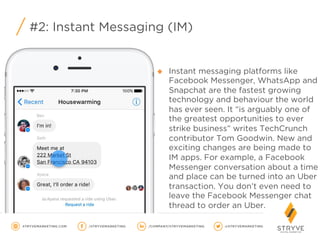
u  Instant messaging platforms like
Facebook Messenger, WhatsApp and
Snapchat are the fastest growing
technology and behaviour the world
has ever seen. It “is arguably one of
the greatest opportunities to ever
strike business” writes TechCrunch
contributor Tom Goodwin. New and
exciting changes are being made to
IM apps. For example, a Facebook
Messenger conversation about a time
and place can be turned into an Uber
transaction. You don’t even need to
leave the Facebook Messenger chat
thread to order an Uber.
u  In the future, B2B conversations could move from
the email exchanges to instant messages. New
functionality could allow decision makers on the
customer-side to press one button to accept
proposals and make buying decisions on behalf of
the company they work for. Read: no more asking
for people “sign the last page of a PDF and send a
scanned copy of the PDF back” in order to
complete a deal.
#2: B2B Applications of Instant Messaging (IM)
Artificial Intelligence
Trend #3
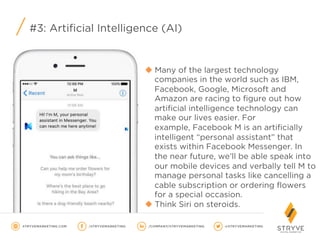
#3: Artificial Intelligence (AI)
u Many of the largest technology
companies in the world such as IBM,
Facebook, Google, Microsoft and
Amazon are racing to figure out how
artificial intelligence technology can
make our lives easier. For
example, Facebook M is an artificially
intelligent “personal assistant” that
exists within Facebook Messenger. In
the near future, we’ll be able speak into
our mobile devices and verbally tell M to
manage personal tasks like cancelling a
cable subscription or ordering flowers
for a special occasion.
u Think Siri on steroids.
B2B Application of Artificial Intelligence
u  Artificial intelligence can have an endless amount
of applications in the B2B world. We all know what
it’s like trying to book meeting or a phone call with
a potential client. It can be a lot of back-and-forth
emails trying to find availability in their calendar
and yours. AI technology in the future will be able
to do this back-and-forth messaging for you by
finding times in your prospect's calendars that are
available, sending messages to them on your
behalf, and booking the meeting for you. It will be
like having your own artificially intelligent personal
assistant.
Smartphone Apps
Trend #4
#4: Smartphone Apps
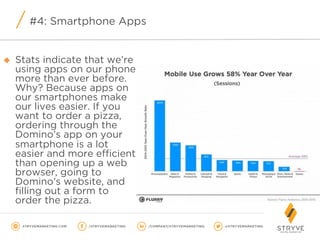
u  Stats indicate that we’re
using apps on our phone
more than ever before.
Why? Because apps on
our smartphones make
our lives easier. If you
want to order a pizza,
ordering through the
Domino’s app on your
smartphone is a lot
easier and more efficient
than opening up a web
browser, going to
Domino’s website, and
filling out a form to
order the pizza.
B2B Application of Smartphone Apps
u  B2B marketers should be thinking about creating apps that
make their customer’s experience with their company
easier. For example, suppose you work in the marketing
department of an industrial parts supply company: wouldn’t it
be great if your customer had the option to open an app and
reorder the parts they need without having to call a sales
person or go to your company website? Take that another
step further and imagine if that app could connect to their
inventory management or ordering system. It could all be
managed through your phone!
u  If you don’t believe this is the way your customers will be
buying your widgets in the future, just look at how using the
Uber app has challenged the act of calling a cab company for
a taxi ride. Similarly, the old way of ordering your company's
widgets will be replaced by ordering through a smartphone
app.
Have Any Questions?
u  Get in touch with Sourov De at Stryve Marketing:
§  sourov@stryvemarketing.com
§  1.855.747.0044
u  stryvemarketing.com

B2B Marketing Trends for 2016

  • 1.
    2016: B2B MarketingTrends Produced by: Stryve Digital Marketing
  • 2.
    1.  Virtual Technology(VR) 2.  Instant Messaging (IM) 3.  Artificial Intelligence (AI) 4.  Smartphone Apps CONTENTS
  • 3.
  • 4.
    #1: Virtual Reality u Oculus Rift virtual reality (VR) headsets went on pre-order sale in January and sold out in a matter of hours. The popularity, demand, and game- changing potential of VR tech is undeniable.
  • 5.
    B2B Application ofVirtual Reality u  While the virtual reality headsets are primarily for the consumer market and so far have demonstrated mostly video game applications, VR tech could be useful to B2B marketers in a big way in the future. u  For example, imagine you’re a factory equipment salesperson: instead of telling a customer about how your equipment works they can put a VR headset on and you can show them how your equipment works on a virtual factory floor. VR headsets could dramatically change the way B2B companies interact with their customers and market their products.
  • 6.
  • 7.
    #2: Instant Messaging(IM)  u  Instant messaging platforms like Facebook Messenger, WhatsApp and Snapchat are the fastest growing technology and behaviour the world has ever seen. It “is arguably one of the greatest opportunities to ever strike business” writes TechCrunch contributor Tom Goodwin. New and exciting changes are being made to IM apps. For example, a Facebook Messenger conversation about a time and place can be turned into an Uber transaction. You don’t even need to leave the Facebook Messenger chat thread to order an Uber.
  • 8.
    u  In thefuture, B2B conversations could move from the email exchanges to instant messages. New functionality could allow decision makers on the customer-side to press one button to accept proposals and make buying decisions on behalf of the company they work for. Read: no more asking for people “sign the last page of a PDF and send a scanned copy of the PDF back” in order to complete a deal. #2: B2B Applications of Instant Messaging (IM)
  • 9.
  • 10.
    #3: Artificial Intelligence(AI) u Many of the largest technology companies in the world such as IBM, Facebook, Google, Microsoft and Amazon are racing to figure out how artificial intelligence technology can make our lives easier. For example, Facebook M is an artificially intelligent “personal assistant” that exists within Facebook Messenger. In the near future, we’ll be able speak into our mobile devices and verbally tell M to manage personal tasks like cancelling a cable subscription or ordering flowers for a special occasion. u Think Siri on steroids.
  • 11.
    B2B Application ofArtificial Intelligence u  Artificial intelligence can have an endless amount of applications in the B2B world. We all know what it’s like trying to book meeting or a phone call with a potential client. It can be a lot of back-and-forth emails trying to find availability in their calendar and yours. AI technology in the future will be able to do this back-and-forth messaging for you by finding times in your prospect's calendars that are available, sending messages to them on your behalf, and booking the meeting for you. It will be like having your own artificially intelligent personal assistant.
  • 12.
  • 13.
    #4: Smartphone Apps u Stats indicate that we’re using apps on our phone more than ever before. Why? Because apps on our smartphones make our lives easier. If you want to order a pizza, ordering through the Domino’s app on your smartphone is a lot easier and more efficient than opening up a web browser, going to Domino’s website, and filling out a form to order the pizza.
  • 14.
    B2B Application ofSmartphone Apps u  B2B marketers should be thinking about creating apps that make their customer’s experience with their company easier. For example, suppose you work in the marketing department of an industrial parts supply company: wouldn’t it be great if your customer had the option to open an app and reorder the parts they need without having to call a sales person or go to your company website? Take that another step further and imagine if that app could connect to their inventory management or ordering system. It could all be managed through your phone! u  If you don’t believe this is the way your customers will be buying your widgets in the future, just look at how using the Uber app has challenged the act of calling a cab company for a taxi ride. Similarly, the old way of ordering your company's widgets will be replaced by ordering through a smartphone app.
  • 15.
    Have Any Questions? u Get in touch with Sourov De at Stryve Marketing: §  sourov@stryvemarketing.com §  1.855.747.0044 u  stryvemarketing.com