Kai Kirkkopelto, Strategic Planner, dynamo&son
What’s Big
in 2015
From weak signals to strong ideas,
we gathered a list of ten trends we
expect to unfold in 2015. What will
make it or break it? Find out!
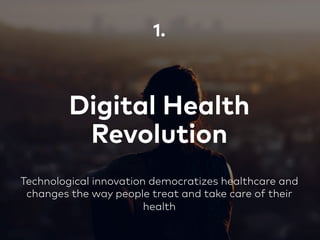
Digital Health
Revolution
1.
Technological innovation democratizes healthcare and
changes the way people treat and take care of their
health
Healthcare industry is in the early stages of major disruption.
Personal medical devices and mobile health applications continue
to enhance and connectivity among patients, medical
professionals and devices increases.
Not only can digital self-care increase individuals’ wellbeing but it
can also bring major savings to the society as a whole. The
healthcare sector and policy makers should therefore rather
embrace than fear the change.
Digital health will become a major industry in the near future –
Gartner expects wearable fitness and personal health devices to
be a $5 billion market by 2016.
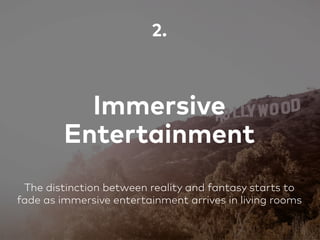
Immersive
Entertainment
2.
The distinction between reality and fantasy starts to
fade as immersive entertainment arrives in living rooms
From technology heavyweights to small start-ups, numerous
developers around the world are harnessing technology to create
new forms of storytelling that puts people in the center of the
action.
Head-mounted displays among other technologies bring
emotional engagement and realism to entertainment like never
before and take the user experience to a whole new level. The
video game industry was quite expectedly among the first ones to
dip its toes in the water, but other industries follow right behind.
There’s a lot of buzz in Hollywood around immersive video and
several major film studios have already announced to be
developing content for virtual reality headsets.
Pay to Play in
Social Media
3.
Facebook is putting an end to companies’ free ride and
other social networks follow the lead
By now, Facebook has made it very clear that to reach your target
audience, brands have to pay for it. Organic distribution keeps on
declining, as the competition to appear in the News Feed is
getting fiercer.
It’s not only about generating more ad revenues, but also about
improving the end user experience by showing people more
relevant and useful content. At the same time, other social media
services are also exploring new ways to monetize their platforms.
To master social media, brands still need to deliver highly engaging
content to the right people at the right time, but by adding
strategic ad spending to the equation brands are able to amplify
the content to even bigger masses.
Mobile
Wallet War
4.
Competition in the payment industry intensifies due to
disruptive innovations arising from outside the banking
sector
Mobile payments are expected to top $720 billion a year by 2017
and that’s attracting a great deal of interest outside the
somewhat conservative banking sector.
Companies such as Square, Apple and Google are becoming major
players in the wallet space, while banks and payment institutions
fear of getting left behind. According to the Millennial Disruption
Index, banking is at the highest risk of disruption especially among
a generation born 1981–2000.
33% of millennials believe they won’t need a bank at all in the
future and 70% percent say that in 5 years the way we pay for
things will be totally different. The money is going mobile, but the
wallet war is just beginning.
Single-Purpose
Apps
5.
Companies streamline their apps for a better and more
focused user experience
What we’re seeing is a shift towards single-purpose apps that
focus solely on one task. Companies are unbundling the user
experience by simplifying their services and addressing different
use cases with different apps. The way Facebook, for example, has
divided messaging and photography into their own entities.
While single-purpose apps are taking the home screens by storm,
they are facing a strong competition for user attention –
smartphone owners between 25-44 use a stunning 29 apps on
average per month.
The social landscape is becoming more fragmented and people
put increasing value on digital products that are simple, easy and
fast to use.
Hyper-Personalization
6.
The heightened use of predictive analysis and marketing
action optimization hyper-personalizes the Internet
The rapid growth of data and processing power has created an
opportunity for highly personalized and targeted products,
services, and content. Hyper-personalization requires a set of
multi-disciplinary technologies that utilize a wide range of
mathematical algorithms to predict what the users will enjoy.
Think Amazon, the king of personalization, which knows their
customers so well that their patented shipping system even
delivers products near the customers before they place the actual
order.
The obvious risk with hyper-personalization is falling into a filter
bubble in which we are selectively shown things based on our past
behavior and become intellectually isolated from contradicting
viewpoints.
Clash
of Clouds
7.
Cloud storage providers continue cutting the prices,
while increasing storage limits and adding new services
The prices for cloud storage are racing to zero and tech titans
such as Google, Amazon and Microsoft are at the center of the
battlefield. Just take a look at Amazon Web Services that slashed
its prices for the 45th consecutive time in only 6 years.
Cloud computing may be well on its way to become free for
everyone, so companies need to differentiate with new criteria.
The last companies standing will be the ones that are able to look
beyond the storage space and provide value beyond the
traditional offering.
Identifying and capturing the right use cases, offering superior
functionality and managing data privacy will rise in importance as
price cuts go on.
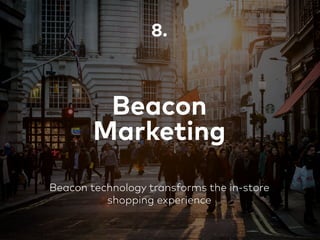
Beacon
Marketing
8.
Beacon technology transforms the in-store
shopping experience
Beacons are radio transmitters that send signals to smartphones,
which enter their close proximity via Bluetooth Low Energy
technology. Beacons provide a viable solution for indoor spaces
that struggle with weak cell signals that make it nearly impossible
to locate devices via GPS.
With beacons marketers can deliver more precise and
personalized messages to consumers in a locale – for example
tailored offers, flash sales or information regarding in-store
purchasability.
While the current utilization of beacons focuses largely on
marketing activities, the possible applications will reach far
beyond that as the technology matures.
The Art of
Authenticity
9.
Consumers demand authentic and transparent
engagement pushing brands to show their true colors
In the digital age the truth will always come out eventually.
Therefore, authenticity resonates now more than ever. To be truly
authentic, however, requires much more than just marketing
communications – it takes commitment of the full organization.
The brand needs to stay consistent with the way it
communicates, because digital backlash can be brutal – miss the
mark and someone will surely spot the flaw.
Big brands such as McDonald’s, Dove, and Under Armour are
embracing the all-real, all-authentic initiatives, but in the end the
brand isn't what you say it is, it's what the people say it is.
Speech-to-Speech
Translation
10.
Machine-mediated speech-to-speech translation tears
down language barriers
Speech-to-speech translation is becoming increasingly important
in various applications. Therefore, it’s no wonder that Google,
Microsoft and Facebook are all looking into enabling real-time
cross-lingual conversations.
Out of the big three, Microsoft was the first to release a working
copy of software that translates voice input into text and
translated audio. The magic is made possible by combining speech
recognition, language translation and speech synthesis.
Simultaneous interpreting remains an extremely complex task
that involves almost all human cognitive and emotional
capabilities, but we might have gotten one step closer to
connecting the world through machine-mediated translation.
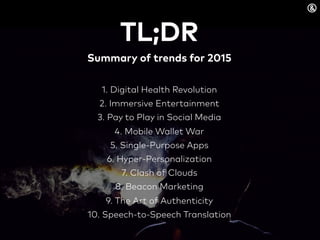
TL;DR
Summary of trends for 2015
1. Digital Health Revolution
2. Immersive Entertainment
3. Pay to Play in Social Media
4. Mobile Wallet War
5. Single-Purpose Apps
6. Hyper-Personalization
7. Clash of Clouds
8. Beacon Marketing
9. The Art of Authenticity
10. Speech-to-Speech Translation
Thank you!
Interested in hearing more? Want to discuss
what the future might hold for your business?
Please, get in touch:
Kai Kirkkopelto
Strategic Planner
kai.kirkkopelto@dynamoson.fi
+358 40 9657 235

What's Big in 2015

  • 1.
    Kai Kirkkopelto, StrategicPlanner, dynamo&son What’s Big in 2015
  • 2.
    From weak signalsto strong ideas, we gathered a list of ten trends we expect to unfold in 2015. What will make it or break it? Find out!
  • 3.
    Digital Health Revolution 1. Technological innovationdemocratizes healthcare and changes the way people treat and take care of their health
  • 4.
    Healthcare industry isin the early stages of major disruption. Personal medical devices and mobile health applications continue to enhance and connectivity among patients, medical professionals and devices increases. Not only can digital self-care increase individuals’ wellbeing but it can also bring major savings to the society as a whole. The healthcare sector and policy makers should therefore rather embrace than fear the change. Digital health will become a major industry in the near future – Gartner expects wearable fitness and personal health devices to be a $5 billion market by 2016.
  • 5.
    Immersive Entertainment 2. The distinction betweenreality and fantasy starts to fade as immersive entertainment arrives in living rooms
  • 6.
    From technology heavyweightsto small start-ups, numerous developers around the world are harnessing technology to create new forms of storytelling that puts people in the center of the action. Head-mounted displays among other technologies bring emotional engagement and realism to entertainment like never before and take the user experience to a whole new level. The video game industry was quite expectedly among the first ones to dip its toes in the water, but other industries follow right behind. There’s a lot of buzz in Hollywood around immersive video and several major film studios have already announced to be developing content for virtual reality headsets.
  • 7.
    Pay to Playin Social Media 3. Facebook is putting an end to companies’ free ride and other social networks follow the lead
  • 8.
    By now, Facebookhas made it very clear that to reach your target audience, brands have to pay for it. Organic distribution keeps on declining, as the competition to appear in the News Feed is getting fiercer. It’s not only about generating more ad revenues, but also about improving the end user experience by showing people more relevant and useful content. At the same time, other social media services are also exploring new ways to monetize their platforms. To master social media, brands still need to deliver highly engaging content to the right people at the right time, but by adding strategic ad spending to the equation brands are able to amplify the content to even bigger masses.
  • 9.
    Mobile Wallet War 4. Competition inthe payment industry intensifies due to disruptive innovations arising from outside the banking sector
  • 10.
    Mobile payments areexpected to top $720 billion a year by 2017 and that’s attracting a great deal of interest outside the somewhat conservative banking sector. Companies such as Square, Apple and Google are becoming major players in the wallet space, while banks and payment institutions fear of getting left behind. According to the Millennial Disruption Index, banking is at the highest risk of disruption especially among a generation born 1981–2000. 33% of millennials believe they won’t need a bank at all in the future and 70% percent say that in 5 years the way we pay for things will be totally different. The money is going mobile, but the wallet war is just beginning.
  • 11.
    Single-Purpose Apps 5. Companies streamline theirapps for a better and more focused user experience
  • 12.
    What we’re seeingis a shift towards single-purpose apps that focus solely on one task. Companies are unbundling the user experience by simplifying their services and addressing different use cases with different apps. The way Facebook, for example, has divided messaging and photography into their own entities. While single-purpose apps are taking the home screens by storm, they are facing a strong competition for user attention – smartphone owners between 25-44 use a stunning 29 apps on average per month. The social landscape is becoming more fragmented and people put increasing value on digital products that are simple, easy and fast to use.
  • 13.
    Hyper-Personalization 6. The heightened useof predictive analysis and marketing action optimization hyper-personalizes the Internet
  • 14.
    The rapid growthof data and processing power has created an opportunity for highly personalized and targeted products, services, and content. Hyper-personalization requires a set of multi-disciplinary technologies that utilize a wide range of mathematical algorithms to predict what the users will enjoy. Think Amazon, the king of personalization, which knows their customers so well that their patented shipping system even delivers products near the customers before they place the actual order. The obvious risk with hyper-personalization is falling into a filter bubble in which we are selectively shown things based on our past behavior and become intellectually isolated from contradicting viewpoints.
  • 15.
    Clash of Clouds 7. Cloud storageproviders continue cutting the prices, while increasing storage limits and adding new services
  • 16.
    The prices forcloud storage are racing to zero and tech titans such as Google, Amazon and Microsoft are at the center of the battlefield. Just take a look at Amazon Web Services that slashed its prices for the 45th consecutive time in only 6 years. Cloud computing may be well on its way to become free for everyone, so companies need to differentiate with new criteria. The last companies standing will be the ones that are able to look beyond the storage space and provide value beyond the traditional offering. Identifying and capturing the right use cases, offering superior functionality and managing data privacy will rise in importance as price cuts go on.
  • 17.
    Beacon Marketing 8. Beacon technology transformsthe in-store shopping experience
  • 18.
    Beacons are radiotransmitters that send signals to smartphones, which enter their close proximity via Bluetooth Low Energy technology. Beacons provide a viable solution for indoor spaces that struggle with weak cell signals that make it nearly impossible to locate devices via GPS. With beacons marketers can deliver more precise and personalized messages to consumers in a locale – for example tailored offers, flash sales or information regarding in-store purchasability. While the current utilization of beacons focuses largely on marketing activities, the possible applications will reach far beyond that as the technology matures.
  • 19.
    The Art of Authenticity 9. Consumersdemand authentic and transparent engagement pushing brands to show their true colors
  • 20.
    In the digitalage the truth will always come out eventually. Therefore, authenticity resonates now more than ever. To be truly authentic, however, requires much more than just marketing communications – it takes commitment of the full organization. The brand needs to stay consistent with the way it communicates, because digital backlash can be brutal – miss the mark and someone will surely spot the flaw. Big brands such as McDonald’s, Dove, and Under Armour are embracing the all-real, all-authentic initiatives, but in the end the brand isn't what you say it is, it's what the people say it is.
  • 21.
  • 22.
    Speech-to-speech translation isbecoming increasingly important in various applications. Therefore, it’s no wonder that Google, Microsoft and Facebook are all looking into enabling real-time cross-lingual conversations. Out of the big three, Microsoft was the first to release a working copy of software that translates voice input into text and translated audio. The magic is made possible by combining speech recognition, language translation and speech synthesis. Simultaneous interpreting remains an extremely complex task that involves almost all human cognitive and emotional capabilities, but we might have gotten one step closer to connecting the world through machine-mediated translation.
  • 23.
    TL;DR Summary of trendsfor 2015 1. Digital Health Revolution 2. Immersive Entertainment 3. Pay to Play in Social Media 4. Mobile Wallet War 5. Single-Purpose Apps 6. Hyper-Personalization 7. Clash of Clouds 8. Beacon Marketing 9. The Art of Authenticity 10. Speech-to-Speech Translation
  • 24.
    Thank you! Interested inhearing more? Want to discuss what the future might hold for your business? Please, get in touch: Kai Kirkkopelto Strategic Planner kai.kirkkopelto@dynamoson.fi +358 40 9657 235