Building Your
Online Community
Structure for Time
• Virtual is Reality
• Opportunity Leads to Service
• Guiding Principles
  – Know Your Goal
  – Work the Land
  – Loosen your Grip
Virtual is Reality
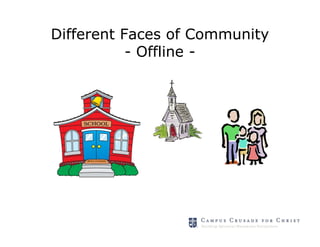
Different Faces of Community
           - Offline -
Different Faces of Community
           - Online -
Opportunity Leads to Service

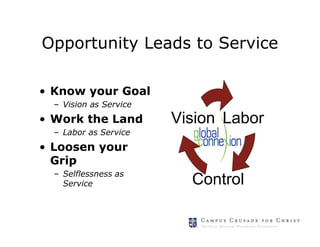
• Know your Goal
  – Vision as Service
• Work the Land         Vision Labor
  – Labor as Service
• Loosen your
  Grip
  – Selflessness as
    Service               Control
Know Your Goal
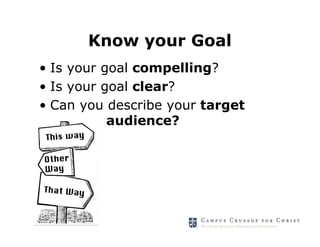
Know your Goal
• Is your goal compelling?
• Is your goal clear?
• Can you describe your target
           audience?
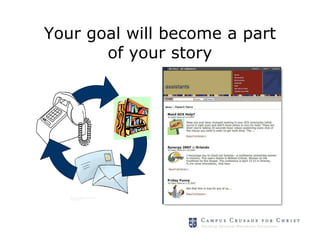
Your goal will become a part
       of your story
Achieve your

• Set aside time each week to
  manage the community
• Do worthwhile activity to generate
  emails.
  – People forget the community is there
  – It’s your job to remind them!
Work the Land
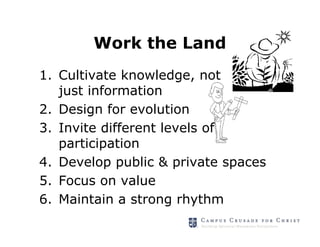
Work the Land
1. Cultivate knowledge, not
   just information
2. Design for evolution
3. Invite different levels of
   participation
4. Develop public & private spaces
5. Focus on value
6. Maintain a strong rhythm
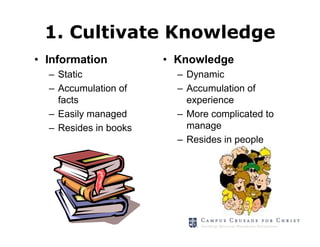
1. Cultivate Knowledge
• Information          • Knowledge
  – Static               – Dynamic
  – Accumulation of      – Accumulation of
    facts                  experience
  – Easily managed       – More complicated to
  – Resides in books       manage
                         – Resides in people
To Cultivate Knowledge
• Share information and experience
  – Uploading documents
  – Protecting security
  – Joining in discussions
• Search the best Crusade materials
  – Google Search
• Connect with the people you need
  – People Locator
  – Email
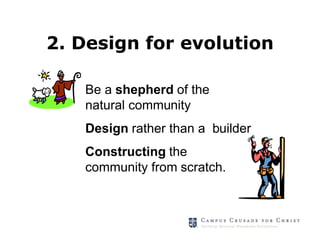
2. Design for evolution

   Be a shepherd of the
   natural community
   Design rather than a builder
   Constructing the
   community from scratch.
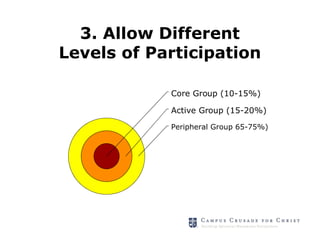
3. Allow Different
Levels of Participation

            Core Group (10-15%)

            Active Group (15-20%)

            Peripheral Group 65-75%)
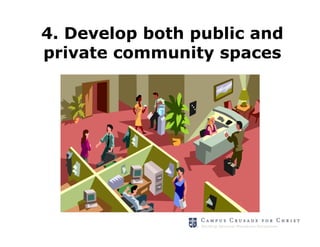
4. Develop both public and
private community spaces
5. Focus on value

  Value is your key
   to community life
        because
    participation in
   most communities
     is voluntary!
6. Maintain a Strong Rhythm

            Rhythm is
     the strongest indicator
     of community aliveness!
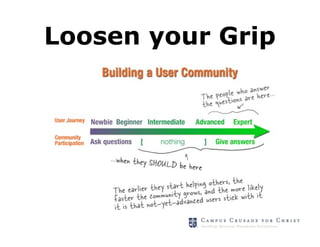
Loosen your Grip
Loosen your Grip
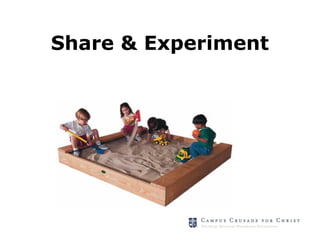
Share & Experiment
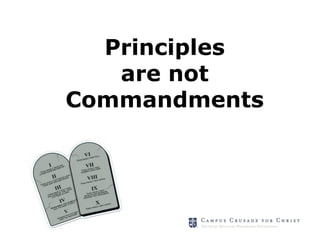
Principles
   are not
Commandments
Summary
• Virtual is Reality: The line between
  the online world and the offline world is
  fuzzy, not distinct
• Opportunity Leads to Service: We
  serve by considering the user first
• Guiding Principles
  – Know Your Goal: Maintain a clear purpose
  – Work the Land: Keep working
  – Loosen your Grip: Trust the user to lead
Sources
1.    Haughey, Matt. Building an Online Community: Just Add Water
      http://www.digital-web.com/articles/building_an_online_community/
2.    Karasic, Shara. Guide to Building an Online Community: An inside
      look at how and why people connect virtually.
      http://www.work.com/building-an-online-community-1299
3.    Shirky, Clay. A Group is its own Worst
      Enemy http://shirky.com/writings/group_enemy.html
4.                   Broadcast Institutions, Community Values
      http://shirky.com/writings/broadcast_and_community.html
5.                   Communities, Audiences, and Scale
      http://shirky.com/writings/community_scale.html
6.                   Social Computing in Student Populations
      http://www.shirky.com/writings/students.html
7.    Sierra, Kathy. Building a Successful Online Community
      http://headrush.typepad.com/creating_passionate_users/2005/06/building_a
      _succ.html
8.                  Can you teach someone to care?
      http://headrush.typepad.com/creating_passionate_users/2005/02/can_you_t
      each_s.html
9.                 How to Build a User Community
      http://headrush.typepad.com/creating_passionate_users/2006/12/how_to_b
      uild_a_.html
10.   Wenger, Etienne and Richard McDermott and William Snyder.
      Cultivating Communities of Practice: A Guide to Managing Knowledge
Cultivating Communities of Practice:
  A Guide to Managing Knowledge

#B2 building online community [keith seabourn]

  • 1.
  • 2.
    Structure for Time •Virtual is Reality • Opportunity Leads to Service • Guiding Principles – Know Your Goal – Work the Land – Loosen your Grip
  • 3.
  • 4.
    Different Faces ofCommunity - Offline -
  • 5.
    Different Faces ofCommunity - Online -
  • 6.
  • 7.
    Opportunity Leads toService • Know your Goal – Vision as Service • Work the Land Vision Labor – Labor as Service • Loosen your Grip – Selflessness as Service Control
  • 8.
  • 9.
    Know your Goal •Is your goal compelling? • Is your goal clear? • Can you describe your target audience?
  • 10.
    Your goal willbecome a part of your story
  • 11.
    Achieve your • Setaside time each week to manage the community • Do worthwhile activity to generate emails. – People forget the community is there – It’s your job to remind them!
  • 12.
  • 13.
    Work the Land 1.Cultivate knowledge, not just information 2. Design for evolution 3. Invite different levels of participation 4. Develop public & private spaces 5. Focus on value 6. Maintain a strong rhythm
  • 14.
    1. Cultivate Knowledge •Information • Knowledge – Static – Dynamic – Accumulation of – Accumulation of facts experience – Easily managed – More complicated to – Resides in books manage – Resides in people
  • 15.
    To Cultivate Knowledge •Share information and experience – Uploading documents – Protecting security – Joining in discussions • Search the best Crusade materials – Google Search • Connect with the people you need – People Locator – Email
  • 16.
    2. Design forevolution Be a shepherd of the natural community Design rather than a builder Constructing the community from scratch.
  • 17.
    3. Allow Different Levelsof Participation Core Group (10-15%) Active Group (15-20%) Peripheral Group 65-75%)
  • 18.
    4. Develop bothpublic and private community spaces
  • 19.
    5. Focus onvalue Value is your key to community life because participation in most communities is voluntary!
  • 20.
    6. Maintain aStrong Rhythm Rhythm is the strongest indicator of community aliveness!
  • 21.
  • 22.
  • 23.
  • 24.
    Principles are not Commandments
  • 25.
    Summary • Virtual isReality: The line between the online world and the offline world is fuzzy, not distinct • Opportunity Leads to Service: We serve by considering the user first • Guiding Principles – Know Your Goal: Maintain a clear purpose – Work the Land: Keep working – Loosen your Grip: Trust the user to lead
  • 26.
    Sources 1. Haughey, Matt. Building an Online Community: Just Add Water http://www.digital-web.com/articles/building_an_online_community/ 2. Karasic, Shara. Guide to Building an Online Community: An inside look at how and why people connect virtually. http://www.work.com/building-an-online-community-1299 3. Shirky, Clay. A Group is its own Worst Enemy http://shirky.com/writings/group_enemy.html 4. Broadcast Institutions, Community Values http://shirky.com/writings/broadcast_and_community.html 5. Communities, Audiences, and Scale http://shirky.com/writings/community_scale.html 6. Social Computing in Student Populations http://www.shirky.com/writings/students.html 7. Sierra, Kathy. Building a Successful Online Community http://headrush.typepad.com/creating_passionate_users/2005/06/building_a _succ.html 8. Can you teach someone to care? http://headrush.typepad.com/creating_passionate_users/2005/02/can_you_t each_s.html 9. How to Build a User Community http://headrush.typepad.com/creating_passionate_users/2006/12/how_to_b uild_a_.html 10. Wenger, Etienne and Richard McDermott and William Snyder. Cultivating Communities of Practice: A Guide to Managing Knowledge
  • 27.
    Cultivating Communities ofPractice: A Guide to Managing Knowledge