Renewable Chemicals and Advanced Biofuels 
Biomass 2013 
July 31 2013 
Brett Lund 
© 2013 Gevo, Inc. | 1
Forward-Looking Statements 
© 2013 Gevo, Inc. | 2 
Certain statements within this presentation may constitute “forward-looking statements” within the meaning of the Private Securities Litigation Reform Act of 1995. Such statements relate to a variety of matters, including but not limited to: the timing and costs associated with and the availability of capital for Gevo’s scheduled retrofits of existing ethanol production facilities, its future isobutanol production capacity, the timing associated with bringing such capacity online, the availability of additional production volumes to seed additional market opportunities, the expected applications of isobutanol, including its use to produce renewable paraxylene, PET, isobutanol-based fuel blends for use in small engines, and ATJ bio-jet, addressable markets, and market demand, Gevo’s ability to produce commercial quantities of isobutanol from cellulosic feedstocks, the suitability of Gevo’s iDGs™ for the animal feed market, the expected cost-competitiveness and relative performance attributes of isobutanol and the products derived from it, the strength of Gevo’s intellectual property position and other statements that are not purely statements of historical fact. These forward-looking statements are made on the basis of the current beliefs, expectations and assumptions of Gevo’s management and are subject to significant risks and uncertainty. All such forward-looking statements speak only as of the date they are made, and Gevo assumes no obligation to update or revise these statements, whether as a result of new information, future events or otherwise. Although Gevo believes that the expectations reflected in these forward-looking statements are reasonable, these statements involve many risks and uncertainties that may cause actual results to differ materially from what may be expressed or implied in these forward-looking statements. For a discussion of the risks and uncertainties that could cause actual results to differ from those expressed in these forward-looking statements, as well as risks relating to the business of the company in general, see the risk disclosures in Gevo’s Annual Report on Form 10-K, as amended, for the year ended December 31, 2012 and in subsequent reports on Forms 10-Q and 8-K and other filings made with the Securities and Exchange Commission by Gevo. 
This presentation is based on information that is generally available to the public and does not contain any material, non-public information. This presentation has been prepared solely for informational purposes and is neither an offer to purchase nor a solicitation of an offer to sell securities.
Company Overview 
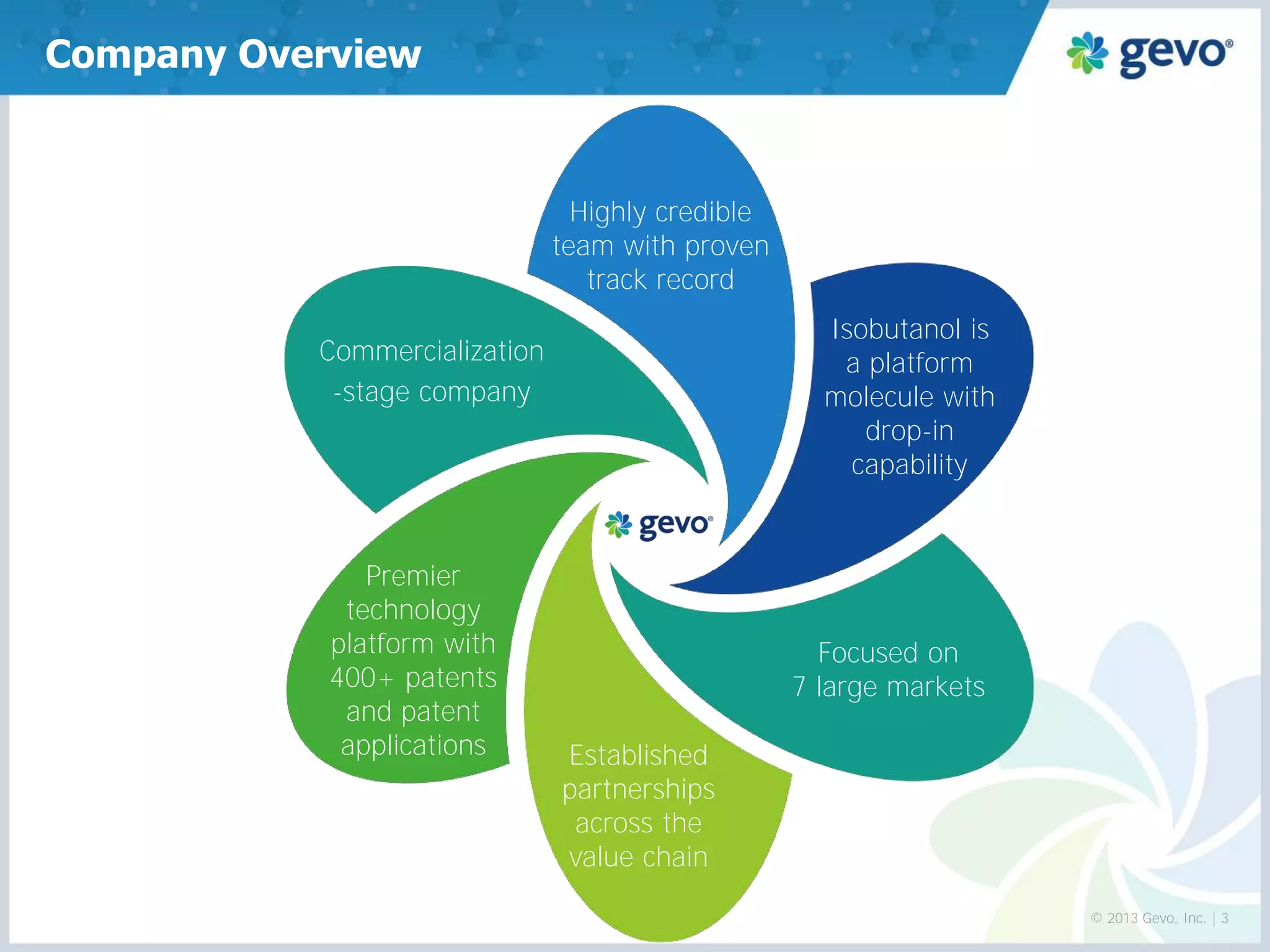
Commercialization 
-stage company 
© 2013 Gevo, Inc. | 3 
Highly credible 
team with proven 
track record 
Isobutanol is a platform molecule with drop-in capability 
Premier technology platform with 
400+ patents 
and patent 
applications 
Established 
partnerships 
across the 
value chain 
Focused on 
7 large markets
$0.00 
$1.00 
$2.00 
$3.00 
$4.00 
$5.00 
Jan-07 
Apr-07 
Jul-07 
Oct-07 
Jan-08 
Apr-08 
Jul-08 
Oct-08 
Jan-09 
Apr-09 
Jul-09 
Oct-09 
Jan-10 
Apr-10 
Jul-10 
Oct-10 
Jan-11 
Apr-11 
Jul-11 
Oct-11 
Jan-12 
Apr-12 
Jul-12 
Oct-12 
Jan-13 
Apr-13 
$/gal Isobutanol 
Cost Competitive Product Drives Market Adoption 
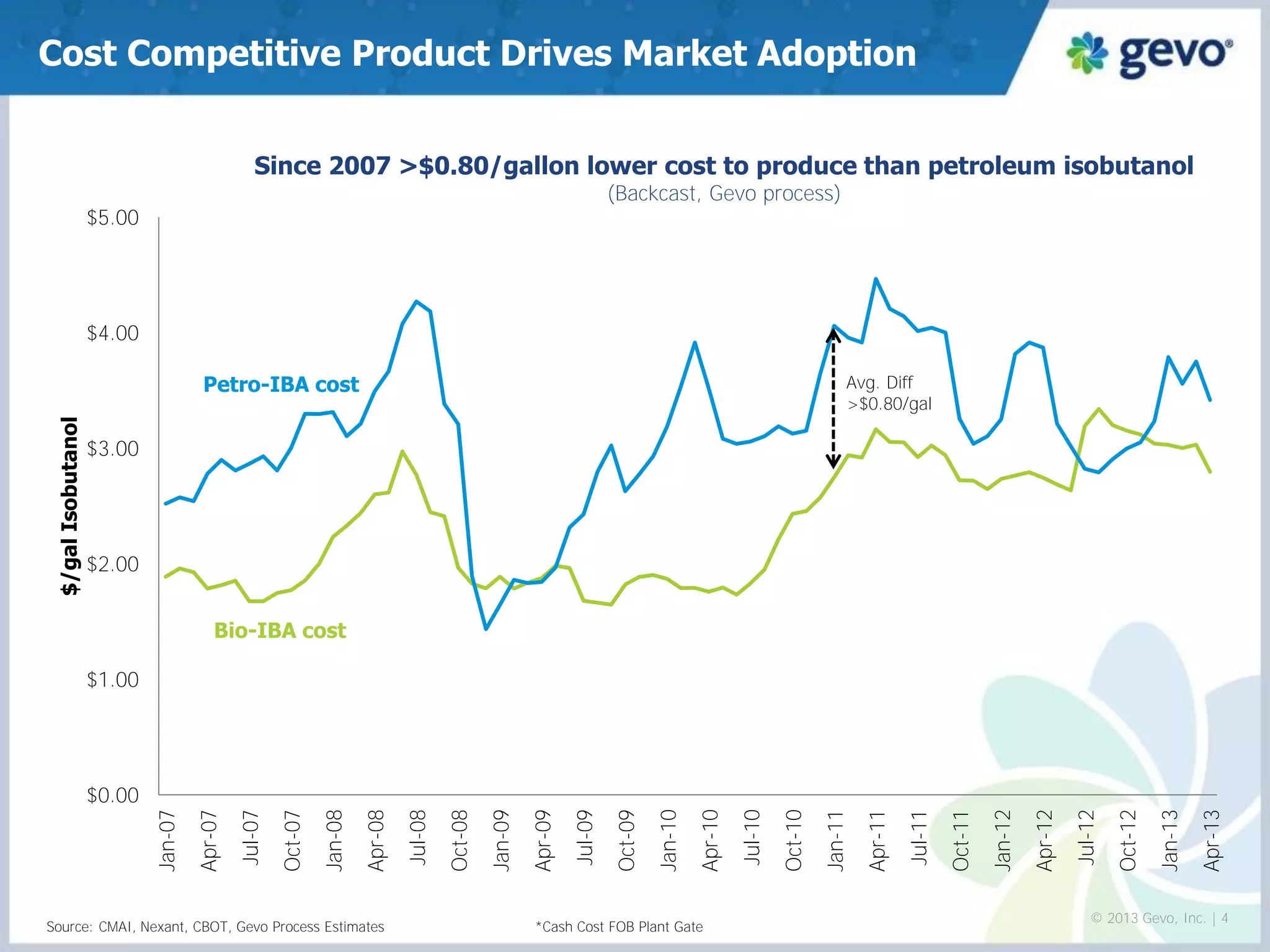
Since 2007 >$0.80/gallon lower cost to produce than petroleum isobutanol 
(Backcast, Gevo process) 
Petro-IBA cost 
Avg. Diff 
>$0.80/gal 
Bio-IBA cost 
© 2013 Gevo, Inc. | 4 
Source: CMAI, Nexant, CBOT, Gevo Process Estimates 
*Cash Cost FOB Plant Gate
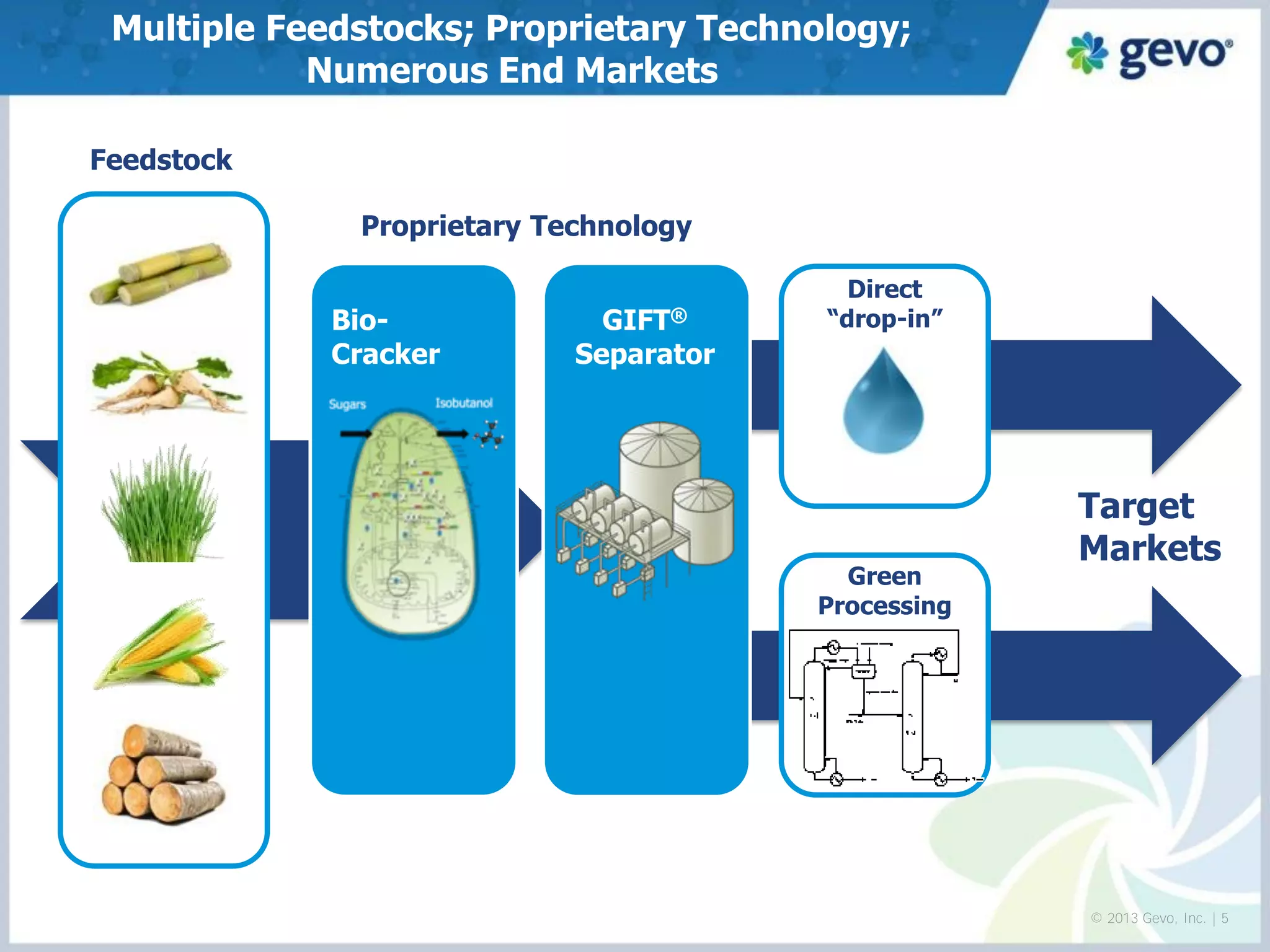
Multiple Feedstocks; Proprietary Technology; Numerous End Markets 
Feedstock 
Bio- Cracker 
GIFT® Separator 
Green Processing 
© 2013 Gevo, Inc. | 5 
Target Markets 
Proprietary Technology 
Direct 
“drop-in”
© 2013 Gevo, Inc| 6 
Source: Company materials, IEA, EIA and Nexant 
Bio-PX/PET 
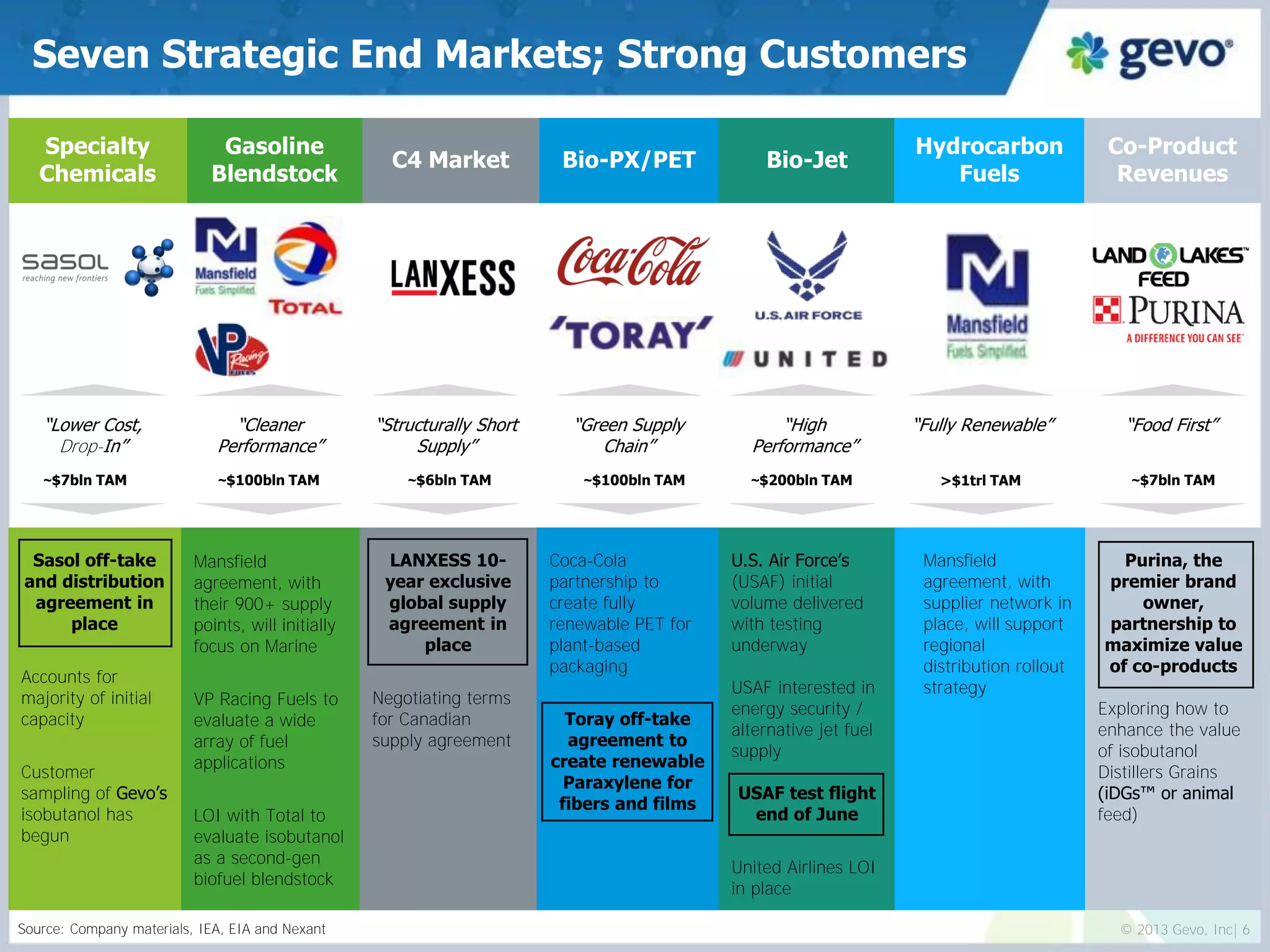
Mansfield agreement, with their 900+ supply points, will initially focus on Marine 
VP Racing Fuels to evaluate a wide array of fuel applications 
LOI with Total to evaluate isobutanol as a second-gen biofuel blendstock 
C4 Market 
Coca-Cola partnership to create fully renewable PET for plant-based packaging Toray off-take agreement to create renewable Paraxylene for fibers and films 
U.S. Air Force’s (USAF) initial volume delivered with testing underway 
USAF interested in energy security / alternative jet fuel supply 
USAF test flight end of June 
United Airlines LOI in place 
Gasoline Blendstock 
Sasol off-take and distribution agreement in place 
Accounts for majority of initial capacity 
Customer sampling of Gevo’s isobutanol has begun 
Specialty Chemicals 
LANXESS 10- year exclusive global supply agreement in place Negotiating terms for Canadian supply agreement 
Bio-Jet 
Seven Strategic End Markets; Strong Customers 
Hydrocarbon Fuels 
Co-Product Revenues 
Mansfield agreement, with supplier network in place, will support regional distribution rollout strategy 
Purina, the premier brand owner, partnership to maximize value of co-products 
Exploring how to enhance the value of isobutanol Distillers Grains (iDGs™ or animal feed) 
“Lower Cost, Drop-In” 
“Cleaner Performance” 
“Structurally Short Supply” 
“Green Supply Chain” 
“High Performance” 
“Fully Renewable” 
“Food First” 
~$7bln TAM 
~$100bln TAM 
~$6bln TAM 
~$100bln TAM 
~$200bln TAM 
>$1trl TAM 
~$7bln TAM
Naphtha & Gas Oil 
NGLs 
Ethylene 
Propylene 
C4s 
Pyrolysis Gasoline 
Other 
Historical 
Expected 
Source: Figured adapted from CMAI, SRI Consulting, American Chemistry Council 
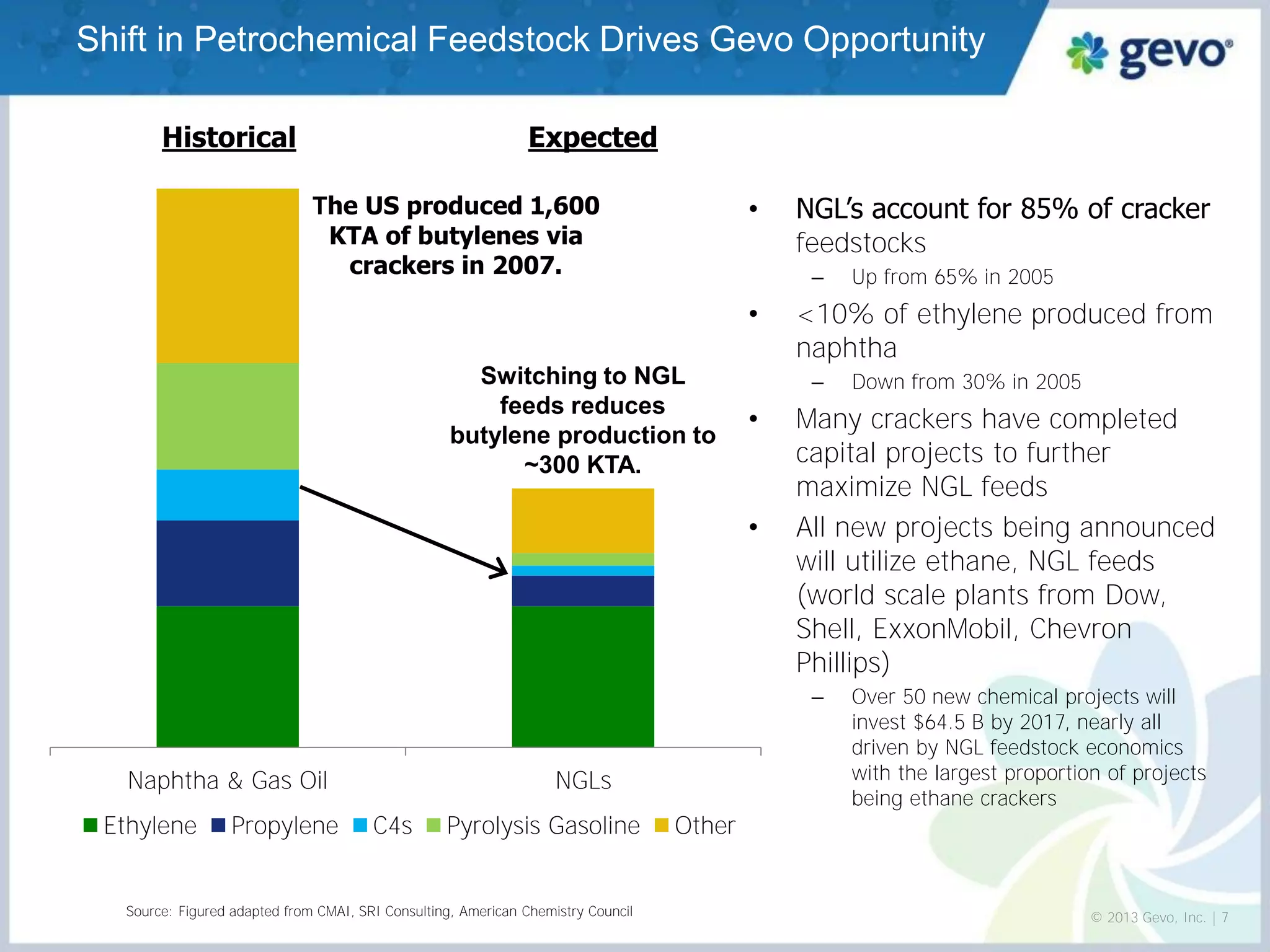
The US produced 1,600 KTA of butylenes via crackers in 2007. 
•NGL’s account for 85% of cracker feedstocks 
–Up from 65% in 2005 
•<10% of ethylene produced from naphtha 
–Down from 30% in 2005 
•Many crackers have completed capital projects to further maximize NGL feeds 
•All new projects being announced will utilize ethane, NGL feeds (world scale plants from Dow, Shell, ExxonMobil, Chevron Phillips) 
–Over 50 new chemical projects will invest $64.5 B by 2017, nearly all driven by NGL feedstock economics with the largest proportion of projects being ethane crackers 
Shift in Petrochemical Feedstock Drives Gevo Opportunity 
Switching to NGL feeds reduces butylene production to ~300 KTA. 
© 2013 Gevo, Inc. | 7
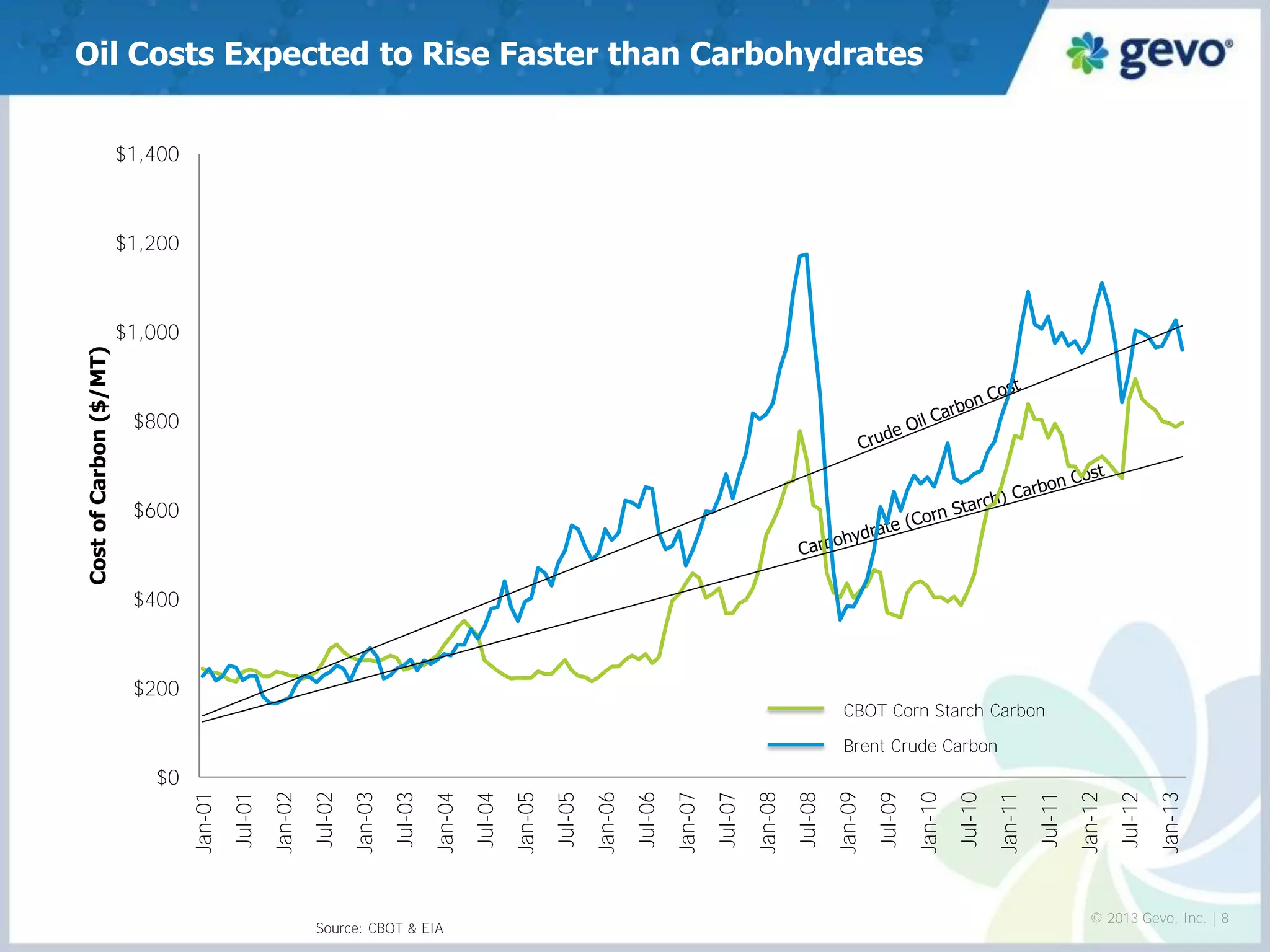
Oil Costs Expected to Rise Faster than Carbohydrates 
© 2013 Gevo, Inc. | 8 
Brent Crude Carbon 
CBOT Corn Starch Carbon 
Source: CBOT & EIA 
$0 
$200 
$400 
$600 
$800 
$1,000 
$1,200 
$1,400 
Jan-01 
Jul-01 
Jan-02 
Jul-02 
Jan-03 
Jul-03 
Jan-04 
Jul-04 
Jan-05 
Jul-05 
Jan-06 
Jul-06 
Jan-07 
Jul-07 
Jan-08 
Jul-08 
Jan-09 
Jul-09 
Jan-10 
Jul-10 
Jan-11 
Jul-11 
Jan-12 
Jul-12 
Jan-13 
Cost of Carbon ($/MT)
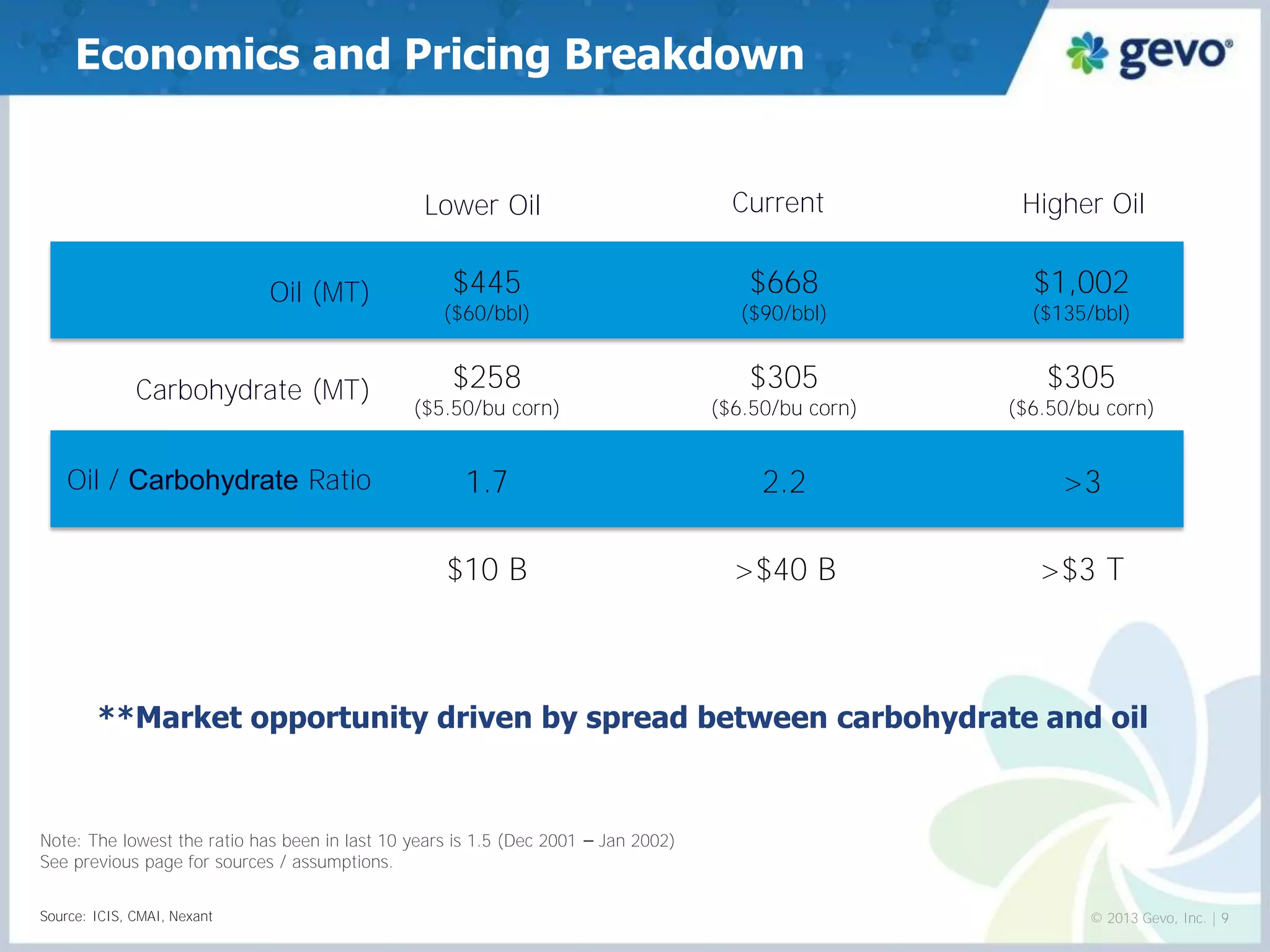
Economics and Pricing Breakdown 
$445 
($60/bbl) 
$668 
($90/bbl) 
$1,002 
($135/bbl) 
$258 
($5.50/bu corn) 
$305 
($6.50/bu corn) 
$305 
($6.50/bu corn) 
1.7 
2.2 
>3 
$10 B 
>$40 B 
>$3 T 
Oil (MT) 
Lower Oil 
Current 
Higher Oil 
Carbohydrate (MT) 
Oil / Carbohydrate Ratio 
**Market opportunity driven by spread between carbohydrate and oil 
Note: The lowest the ratio has been in last 10 years is 1.5 (Dec 2001 – Jan 2002) 
See previous page for sources / assumptions. 
© 2013 Gevo, Inc. | 9 
Source: ICIS, CMAI, Nexant
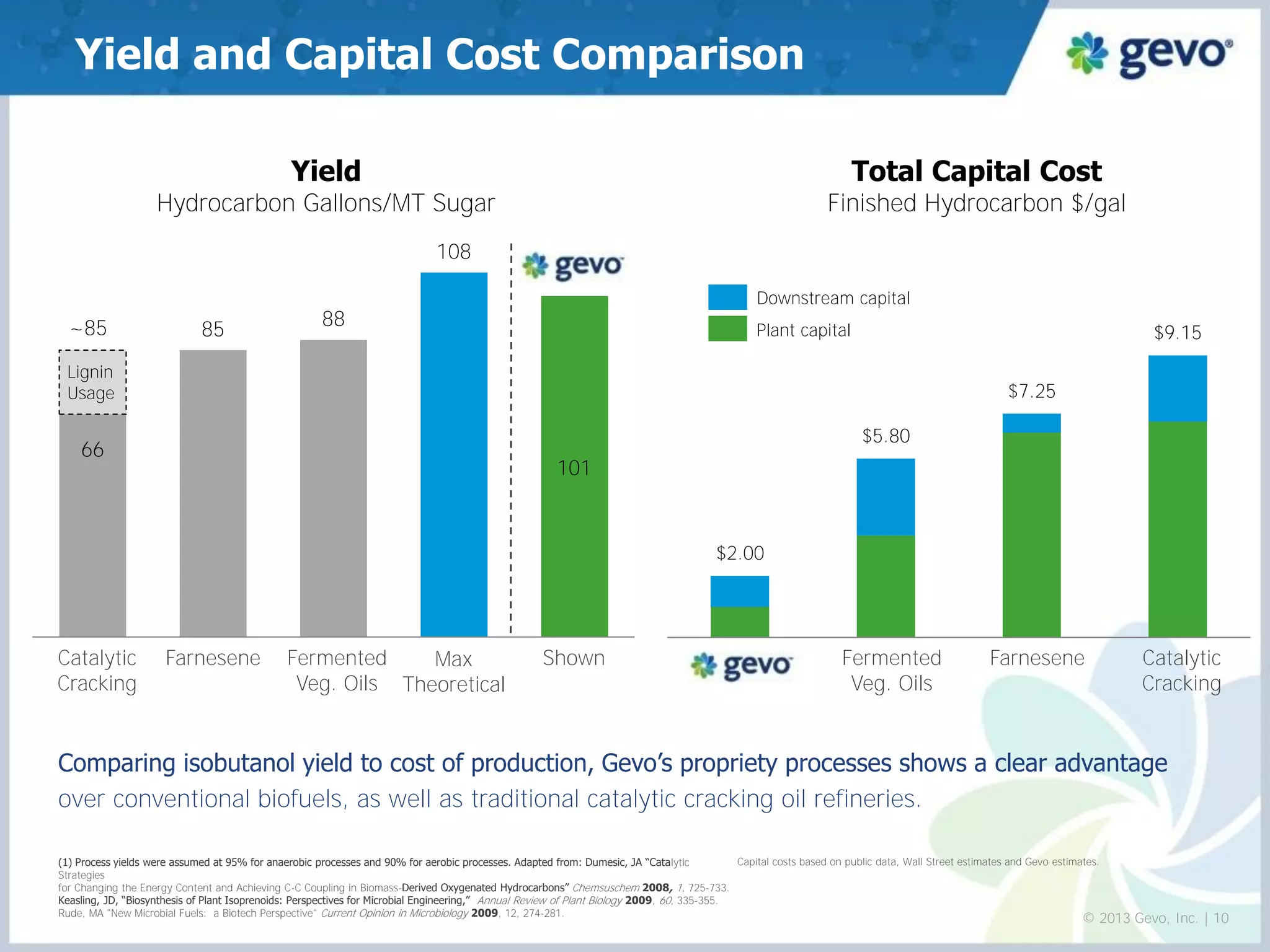
Yield and Capital Cost Comparison 
Comparing isobutanol yield to cost of production, Gevo’s propriety processes shows a clear advantage 
over conventional biofuels, as well as traditional catalytic cracking oil refineries. 
© 2013 Gevo, Inc. | 10 
$2.00 
$5.80 
$7.25 
$9.15 
66 
85 
88 
108 
101 
Farnesene 
Fermented 
Veg. Oils 
Max Theoretical 
Shown 
Yield 
Hydrocarbon Gallons/MT Sugar 
Total Capital Cost Finished Hydrocarbon $/gal 
Farnesene 
Fermented 
Veg. Oils 
Catalytic Cracking 
Plant capital 
Downstream capital 
Catalytic Cracking 
Lignin 
Usage 
~85 
(1) Process yields were assumed at 95% for anaerobic processes and 90% for aerobic processes. Adapted from: Dumesic, JA “Catalytic Strategies for Changing the Energy Content and Achieving C-C Coupling in Biomass-Derived Oxygenated Hydrocarbons” Chemsuschem 2008, 1, 725-733. 
Keasling, JD, “Biosynthesis of Plant Isoprenoids: Perspectives for Microbial Engineering,” Annual Review of Plant Biology 2009, 60, 335-355. 
Rude, MA "New Microbial Fuels: a Biotech Perspective" Current Opinion in Microbiology 2009, 12, 274-281. 
Capital costs based on public data, Wall Street estimates and Gevo estimates.
Isobutanol: How Gevo Displaces Oil 
© 2013 Gevo, Inc. | 11
Benzene 
Toluene 
Xylenes 
Aromatics 
Unsaturated Polyesters 
Polypropylene 
Jet Fuel 
Gasoline 
Diesel 
Source: Adapted from Nexant 
Natural Gas 
Steam Cracking 
Olefins 
Pyrolysis 
Gasoline 
meta-Xylene 
para-Xylene 
ortho-Xylene 
Methyl Methacrylate 
Toluene Diamine 
Cyclohexane 
Ethyl Benzene 
Cumene 
Acrylonitrile 
Propylene Oxide 
Isobutene 
Ethanol 
alpha-Olefin 
Polyols 
Phenol 
Acetone 
Styrene 
Adipic Acid 
Caprolactam 
Toluene Diisocyanate 
Phthalic Anhydride 
Isophthalic Acid 
Terephthalic Acid 
Ethylene Glycol 
MTBE 
Polyesters (PET) 
Plasticizers 
Polyurethane 
Nylon 6 
Nylon 66 
SB Latex 
ABS 
Polystyrene 
Butadiene-Styrene 
Polybutadiene 
Polyacrylonitrile 
Polyisobutylene 
Polyester 
Poly(vinyl cloride) 
Polyethylene 
Ethylene 
Propylene 
Butylenes 
Butadiene 
Vinyl Chloride 
Crude Oil 
Basic Petrochemical Industry Map 
Ethylene Oxide 
EDC 
Hydrocarbon Fuels 
Naphtha 
Chemicals and Materials 
© 2013 Gevo, Inc. | 12
CO2 + 
Jet Fuel 
Gasoline 
Diesel 
Isobutene 
Ethanol 
MTBE 
Vinyl Chloride 
Ethylene Oxide 
EDC 
Hydrocarbon Fuels 
Aromatics 
Olefins 
Pyrolysis Gasoline 
Naphtha 
Benzene 
Xylenes 
Ethylene 
Butylenes 
Butadiene 
C 3 
C 4 
C 7 
Toluene 
C 2 
C 4 
C 8 
Propylene 
3 
Polypropylene 
Propylene Oxide 
Polyols 
Polyisobutylene 
Acrylonitrile 
ABS 
Polystyrene 
Butadiene-Styrene 
Polybutadiene 
Polyacrylonitrile 
Ethyl Benzene 
Cumene 
Phenol 
Acetone 
Styrene 
meta-Xylene 
Para-Xylene 
Roth-Xylene 
Toluene Diamine 
Cyclohexane 
Adipic Acid 
Caprolactam 
Toluene Diisocyanate 
Phthalic Anhydride 
Isophthalic Acid 
Terephthalic Acid 
Source: Adapted from Nexant 
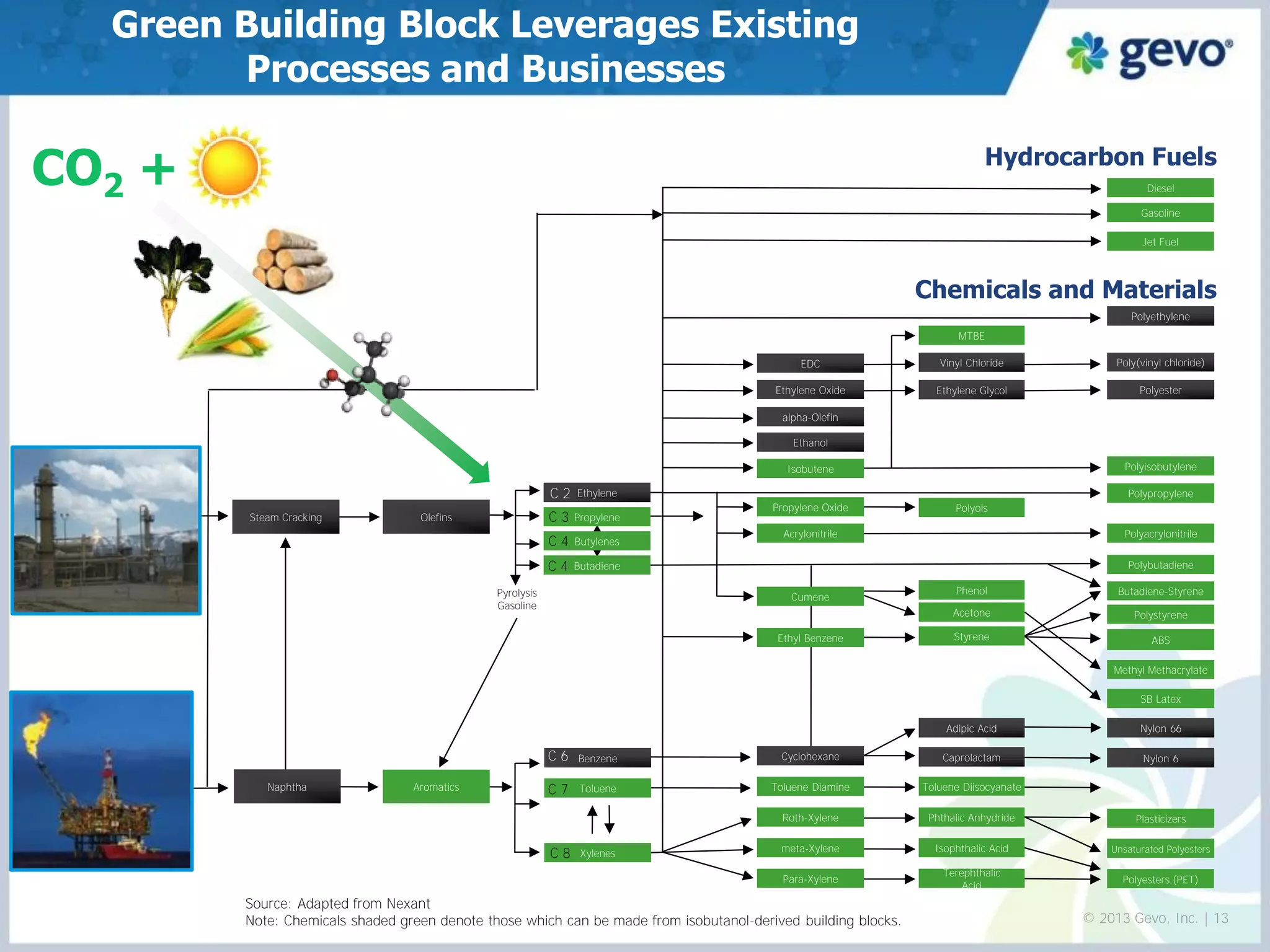
Note: Chemicals shaded green denote those which can be made from isobutanol-derived building blocks. 
Unsaturated Polyesters 
Methyl Methacrylate 
Polyesters (PET) 
Plasticizers 
Nylon 6 
Nylon 66 
SB Latex 
© 2013 Gevo, Inc. | 13 
C 7 
Green Building Block Leverages Existing Processes and Businesses 
alpha-Olefin 
Ethylene Glycol 
Polyester 
Poly(vinyl chloride) 
Chemicals and Materials 
Steam Cracking 
Polyethylene 
C 6
Our Technology is Based on Metabolic Engineering 
© 2013 Gevo, Inc. | 14
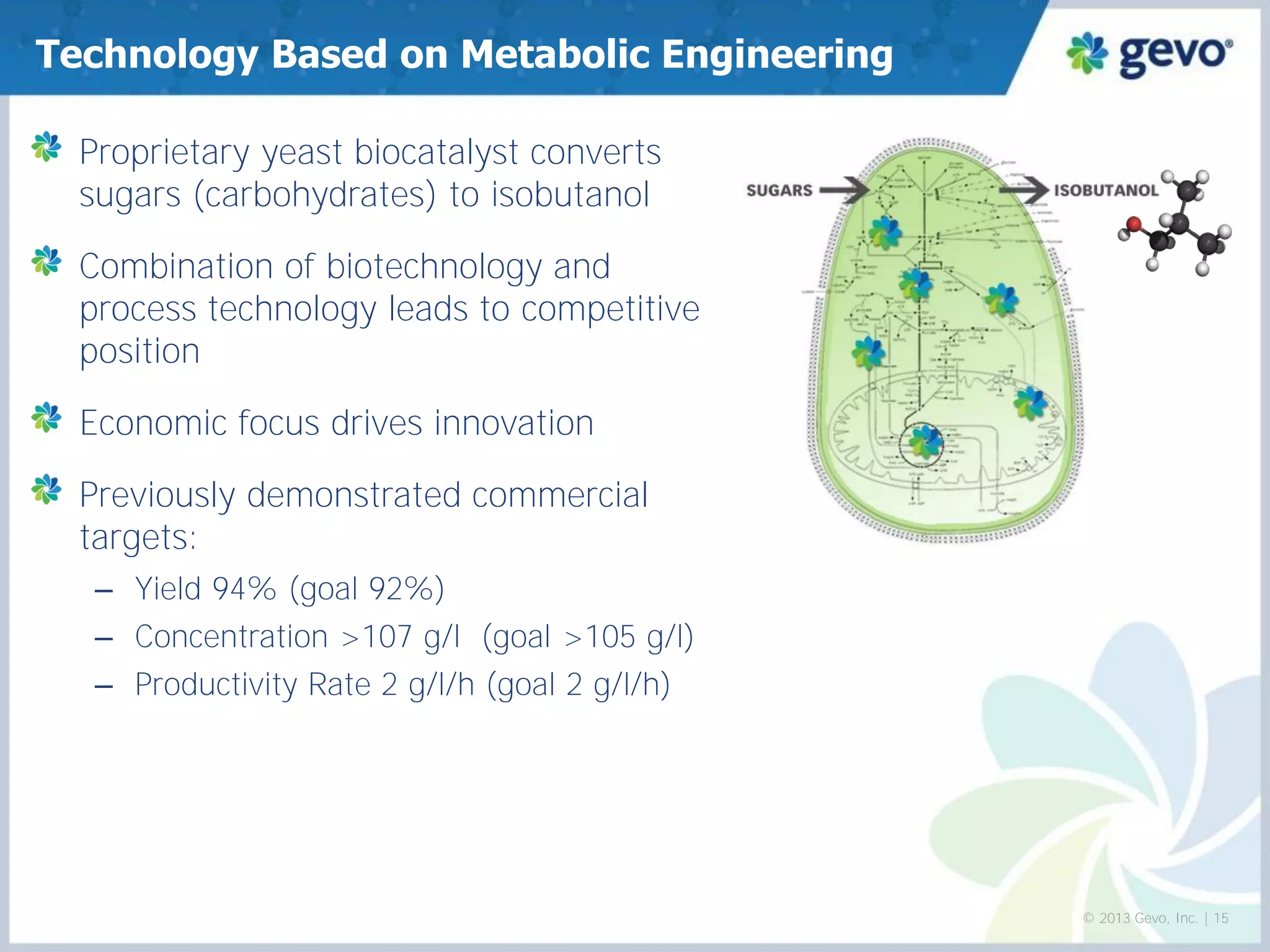
Technology Based on Metabolic Engineering Proprietary yeast biocatalyst converts sugars (carbohydrates) to isobutanol Combination of biotechnology and process technology leads to competitive position Economic focus drives innovation Previously demonstrated commercial targets: 
–Yield 94% (goal 92%) 
–Concentration >107 g/l (goal >105 g/l) 
–Productivity Rate 2 g/l/h (goal 2 g/l/h) 
© 2013 Gevo, Inc. | 15
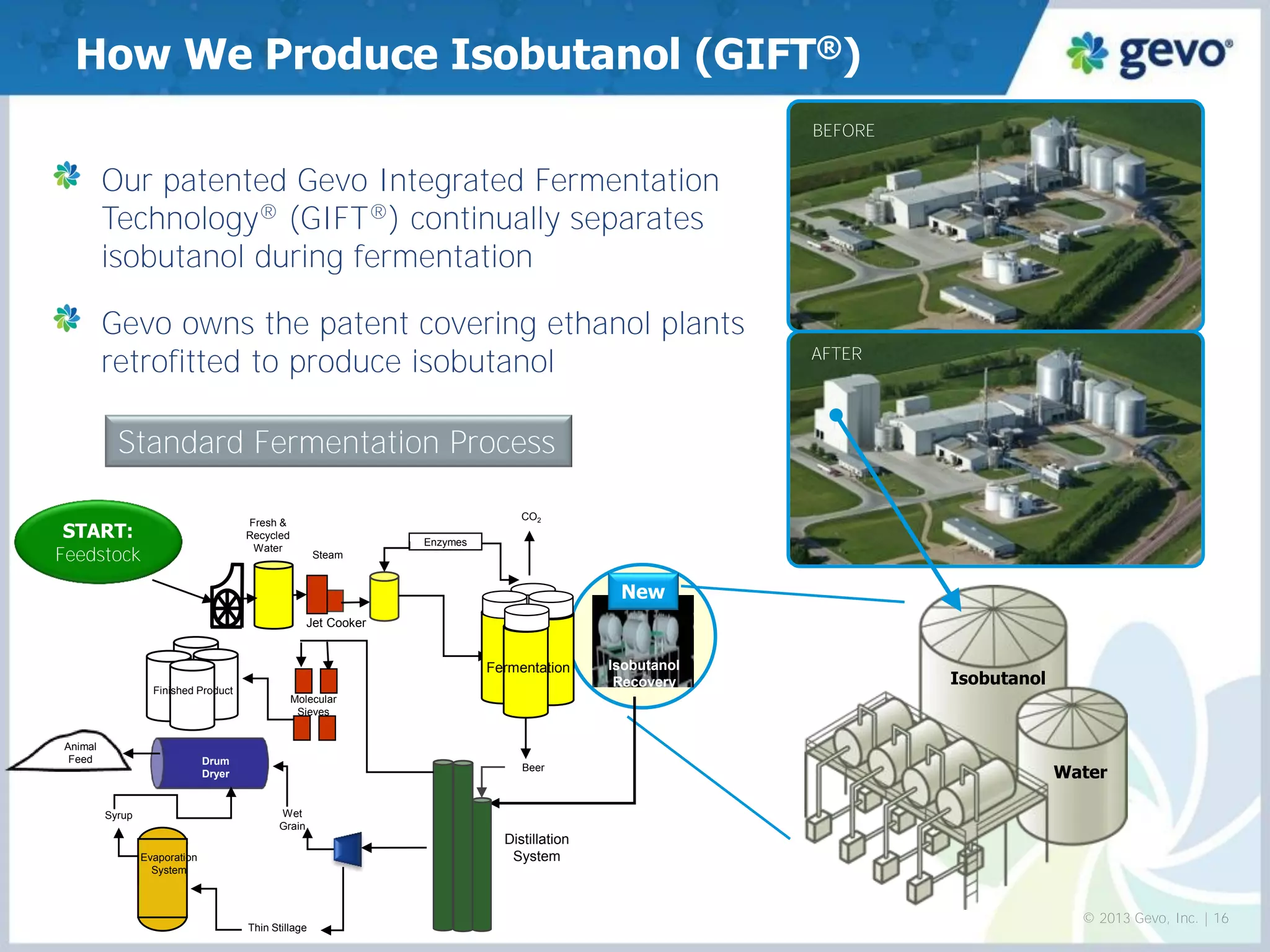
How We Produce Isobutanol (GIFT®) Our patented Gevo Integrated Fermentation Technology® (GIFT®) continually separates isobutanol during fermentation Gevo owns the patent covering ethanol plants retrofitted to produce isobutanol 
Standard Fermentation Process 
START: 
Feedstock 
Fresh & Recycled Water 
Jet Cooker 
Steam 
Enzymes 
Fermentation 
CO2 
Beer 
Distillation System 
Wet Grain 
Drum Dryer 
Thin Stillage 
Evaporation System 
Syrup 
Animal Feed 
Molecular Sieves 
Finished Product 
BEFORE 
AFTER 
© 2013 Gevo, Inc. | 16 
Isobutanol 
Water 
Isobutanol Recovery 
New
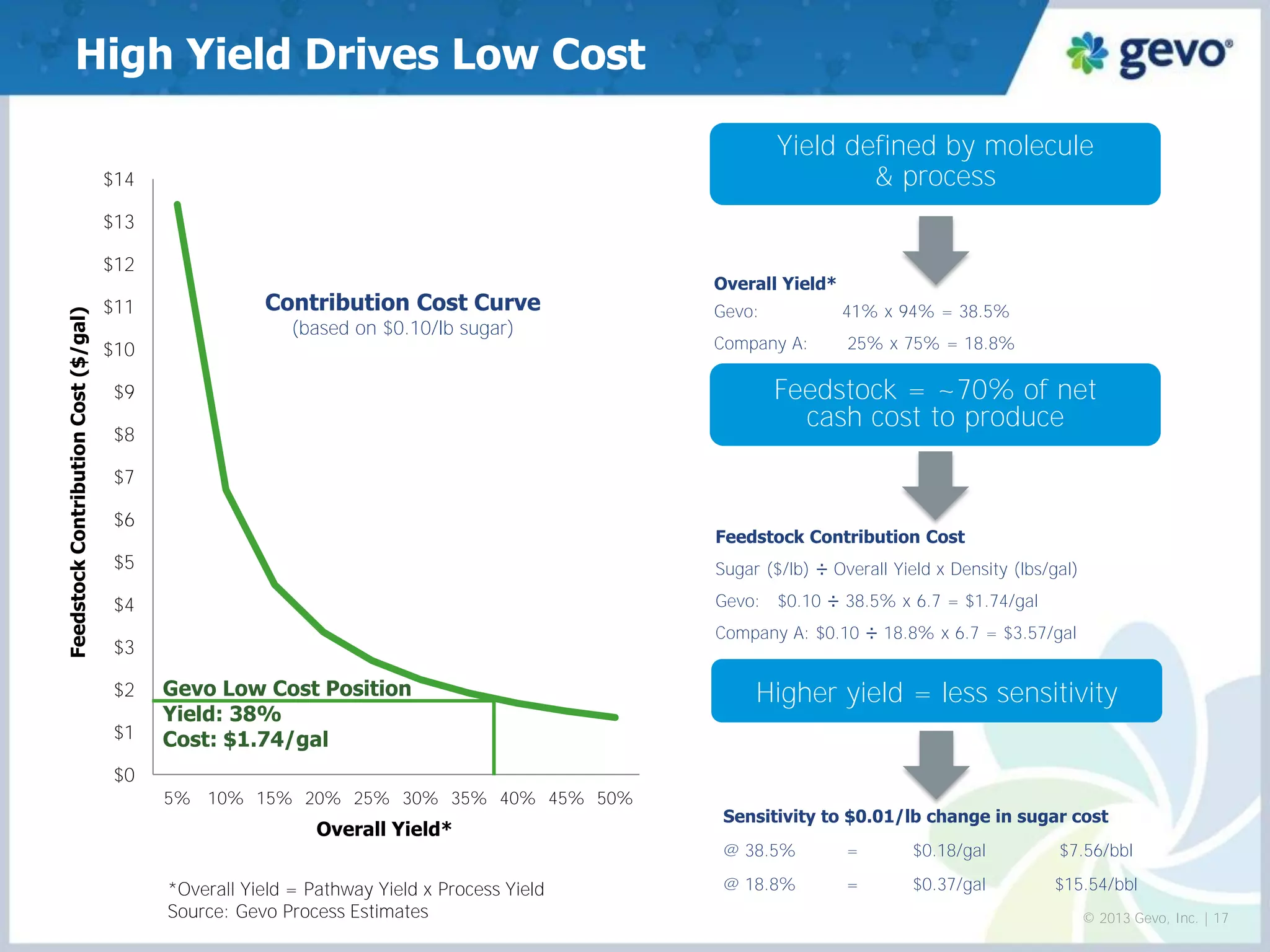
Yield defined by molecule 
& process 
High Yield Drives Low Cost 
$0 
$1 
$2 
$3 
$4 
$5 
$6 
$7 
$8 
$9 
$10 
$11 
$12 
$13 
$14 
5% 
10% 
15% 
20% 
25% 
30% 
35% 
40% 
45% 
50% 
Feedstock Contribution Cost ($/gal) 
Contribution Cost Curve 
(based on $0.10/lb sugar) 
Gevo Low Cost Position 
Yield: 38% 
Cost: $1.74/gal 
Overall Yield* 
Gevo: 41% x 94% = 38.5% 
Company A: 25% x 75% = 18.8% 
Feedstock Contribution Cost 
Sugar ($/lb) ÷ Overall Yield x Density (lbs/gal) 
Gevo: $0.10 ÷ 38.5% x 6.7 = $1.74/gal 
Company A: $0.10 ÷ 18.8% x 6.7 = $3.57/gal 
*Overall Yield = Pathway Yield x Process Yield 
Source: Gevo Process Estimates 
Overall Yield* 
© 2013 Gevo, Inc. | 17 
Sensitivity to $0.01/lb change in sugar cost 
@ 38.5% = 
$0.18/gal 
$7.56/bbl 
@ 18.8% = 
$0.37/gal 
$15.54/bbl 
Feedstock = ~70% of net cash cost to produce 
Higher yield = less sensitivity
Commercial Production 
© 2013 Gevo, Inc. | 18
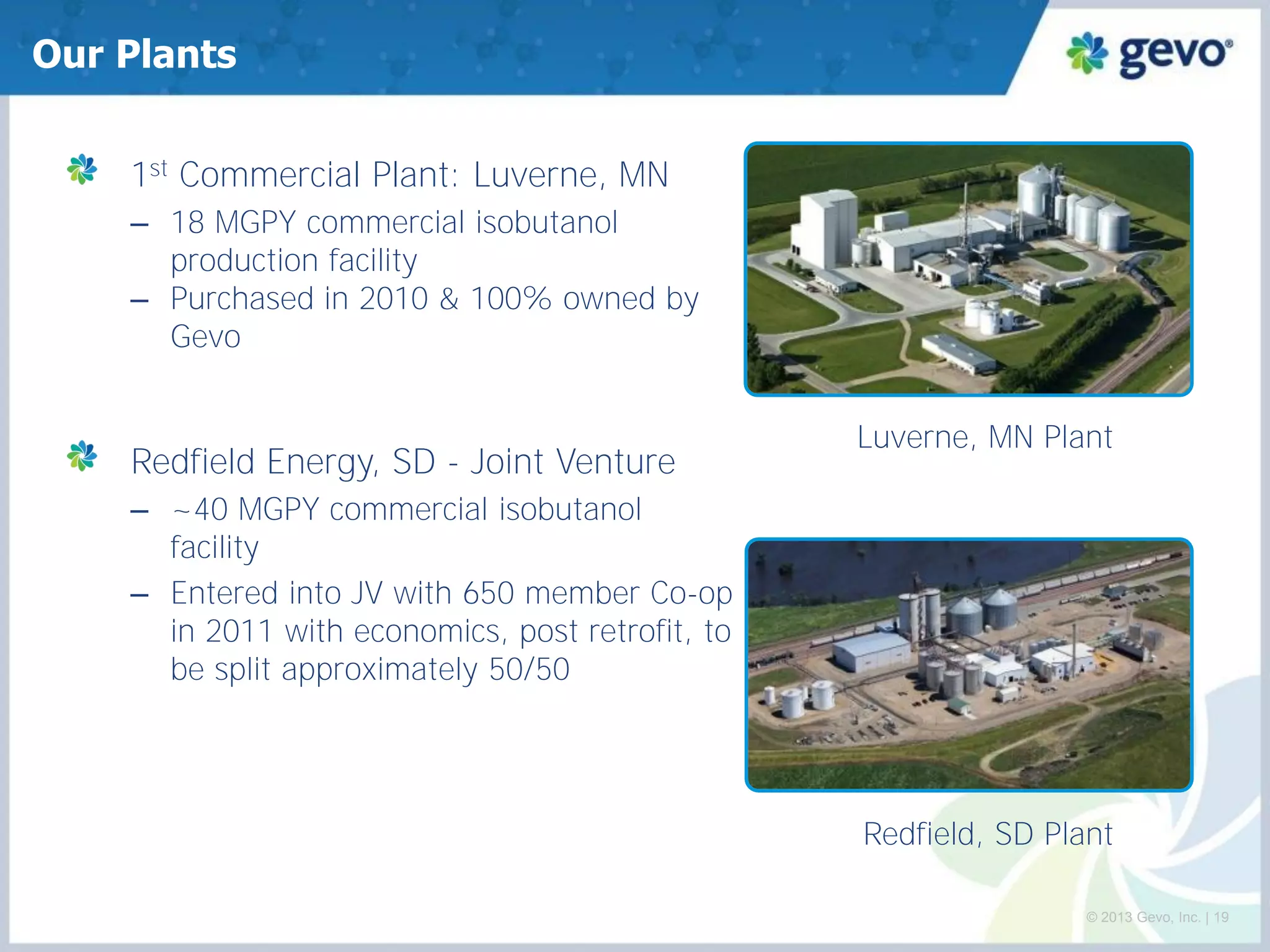
Our Plants 1st Commercial Plant: Luverne, MN 
–18 MGPY commercial isobutanol production facility 
–Purchased in 2010 & 100% owned by Gevo Redfield Energy, SD - Joint Venture 
–~40 MGPY commercial isobutanol facility 
–Entered into JV with 650 member Co-op in 2011 with economics, post retrofit, to be split approximately 50/50 
Redfield, SD Plant 
Luverne, MN Plant 
© 2013 Gevo, Inc. | 19
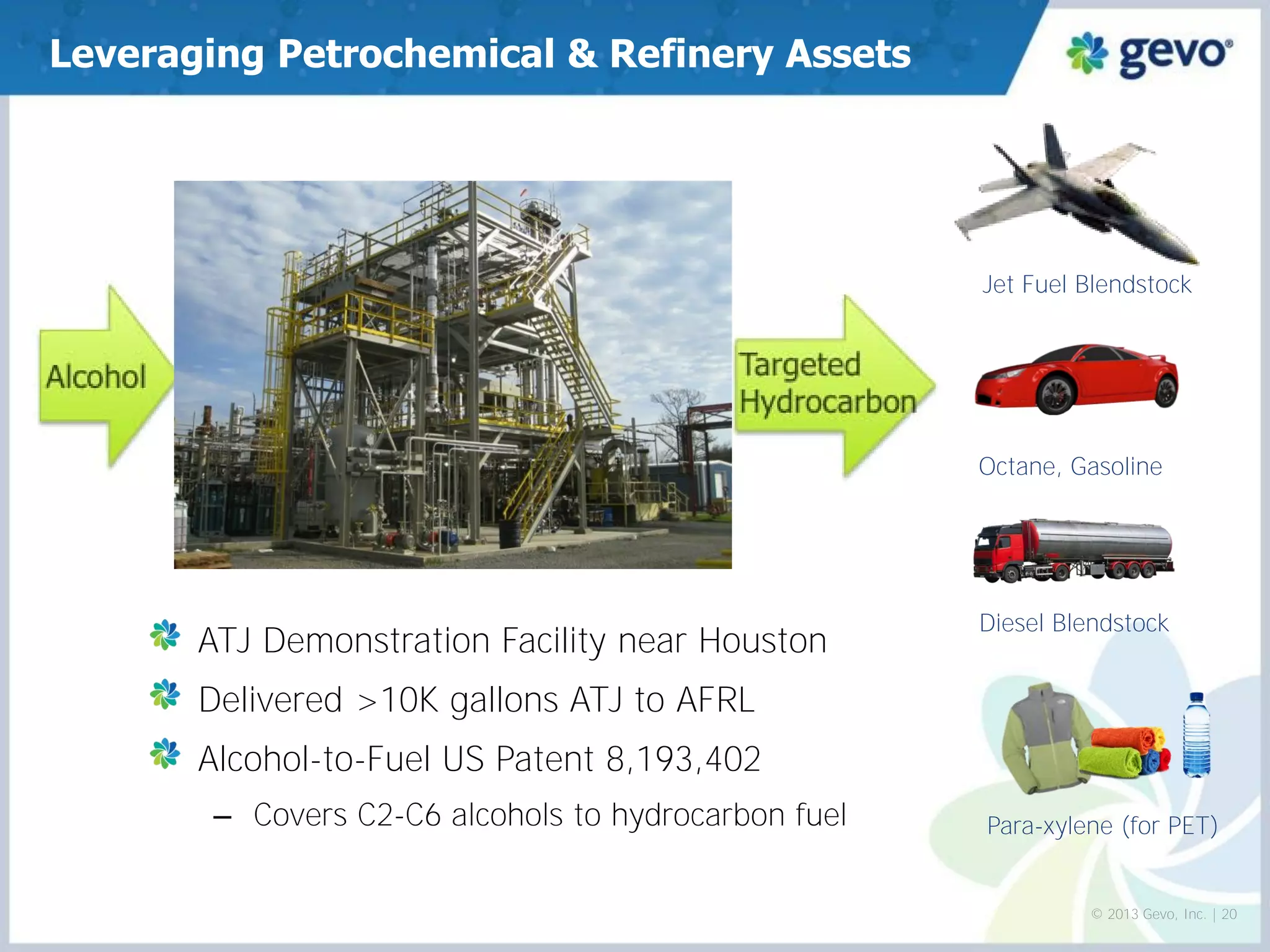
Leveraging Petrochemical & Refinery Assets 
© 2013 Gevo, Inc. | 20 
Jet Fuel Blendstock 
Para-xylene (for PET) 
Octane, Gasoline 
Diesel Blendstock ATJ Demonstration Facility near Houston Delivered >10K gallons ATJ to AFRL Alcohol-to-Fuel US Patent 8,193,402 
–Covers C2-C6 alcohols to hydrocarbon fuel
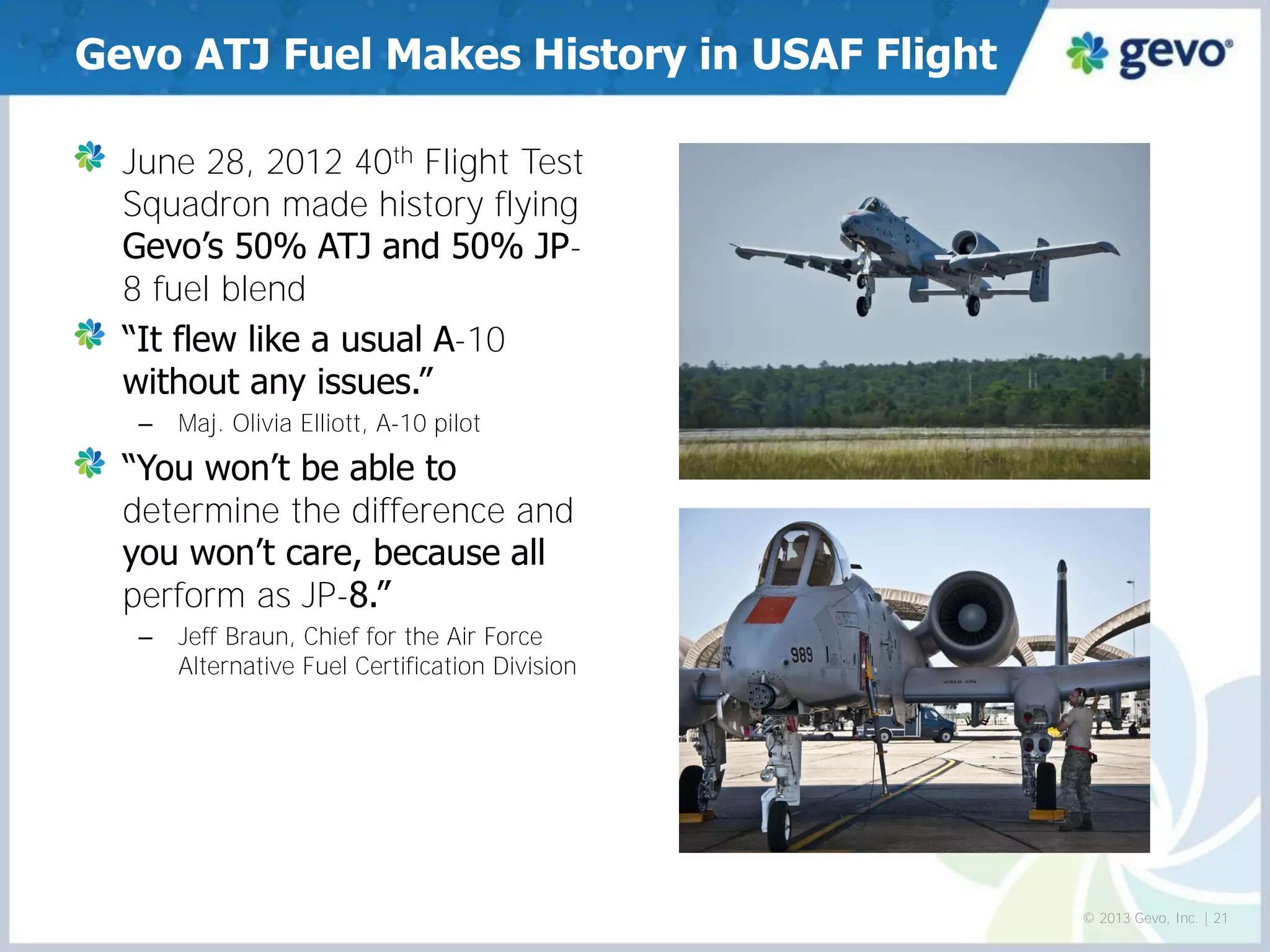
June 28, 2012 40th Flight Test Squadron made history flying Gevo’s 50% ATJ and 50% JP- 8 fuel blend “It flew like a usual A-10 without any issues.” 
–Maj. Olivia Elliott, A-10 pilot “You won’t be able to determine the difference and you won’t care, because all perform as JP-8.” 
–Jeff Braun, Chief for the Air Force Alternative Fuel Certification Division 
Gevo ATJ Fuel Makes History in USAF Flight 
© 2013 Gevo, Inc. | 21
© 2013 Gevo, Inc. | 22 
Feedstocks
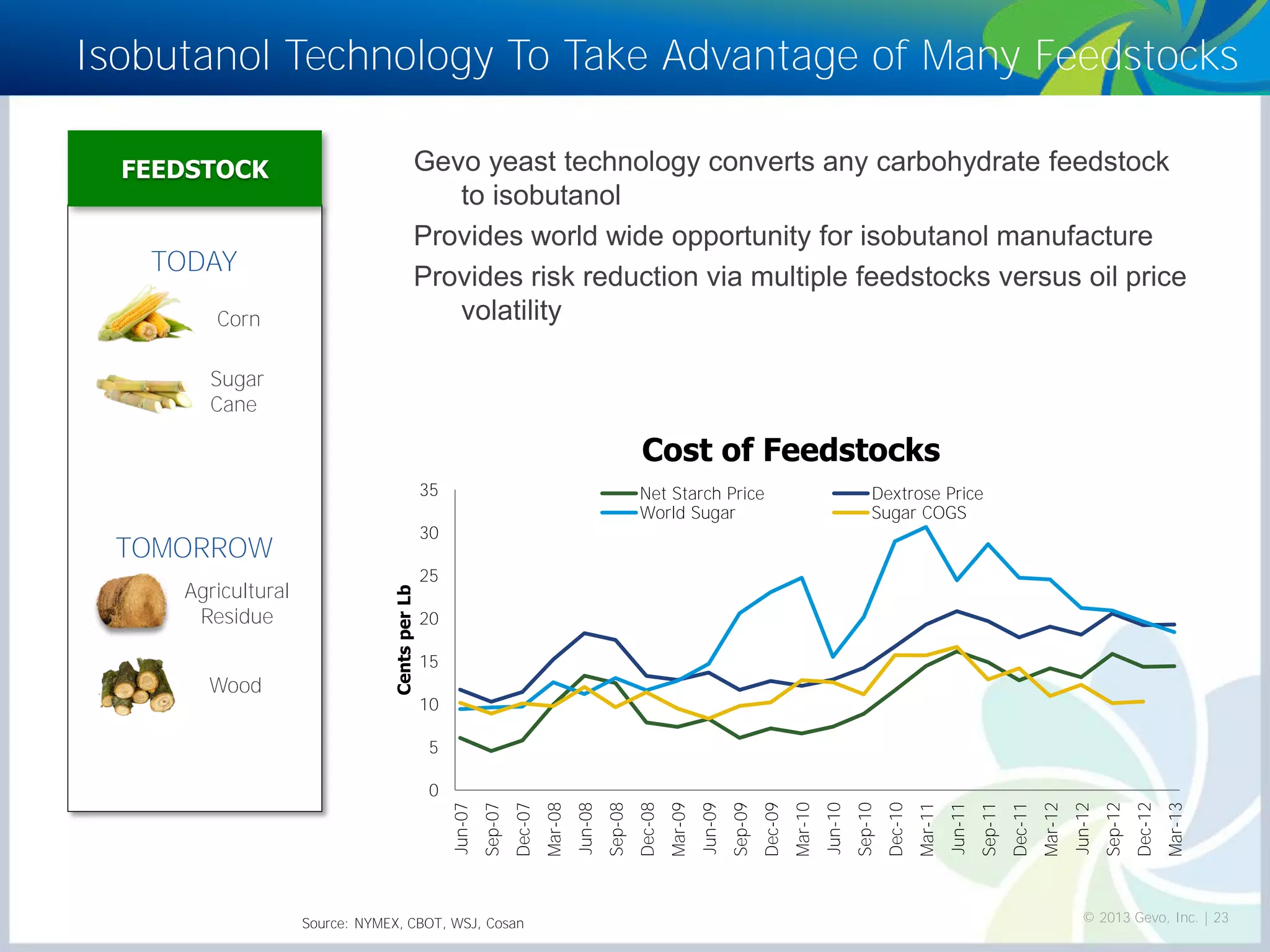
Gevo yeast technology converts any carbohydrate feedstock to isobutanol 
Provides world wide opportunity for isobutanol manufacture 
Provides risk reduction via multiple feedstocks versus oil price volatility 
Isobutanol Technology To Take Advantage of Many Feedstocks 
FEEDSTOCK 
Corn 
Sugar Cane 
Agricultural Residue 
Wood 
TOMORROW 
TODAY 
Source: NYMEX, CBOT, WSJ, Cosan 
0 
5 
10 
15 
20 
25 
30 
35 
Jun-07 
Sep-07 
Dec-07 
Mar-08 
Jun-08 
Sep-08 
Dec-08 
Mar-09 
Jun-09 
Sep-09 
Dec-09 
Mar-10 
Jun-10 
Sep-10 
Dec-10 
Mar-11 
Jun-11 
Sep-11 
Dec-11 
Mar-12 
Jun-12 
Sep-12 
Dec-12 
Mar-13 
Cents per Lb 
Cost of Feedstocks 
Net Starch Price 
Dextrose Price 
World Sugar 
Sugar COGS 
© 2013 Gevo, Inc. | 23
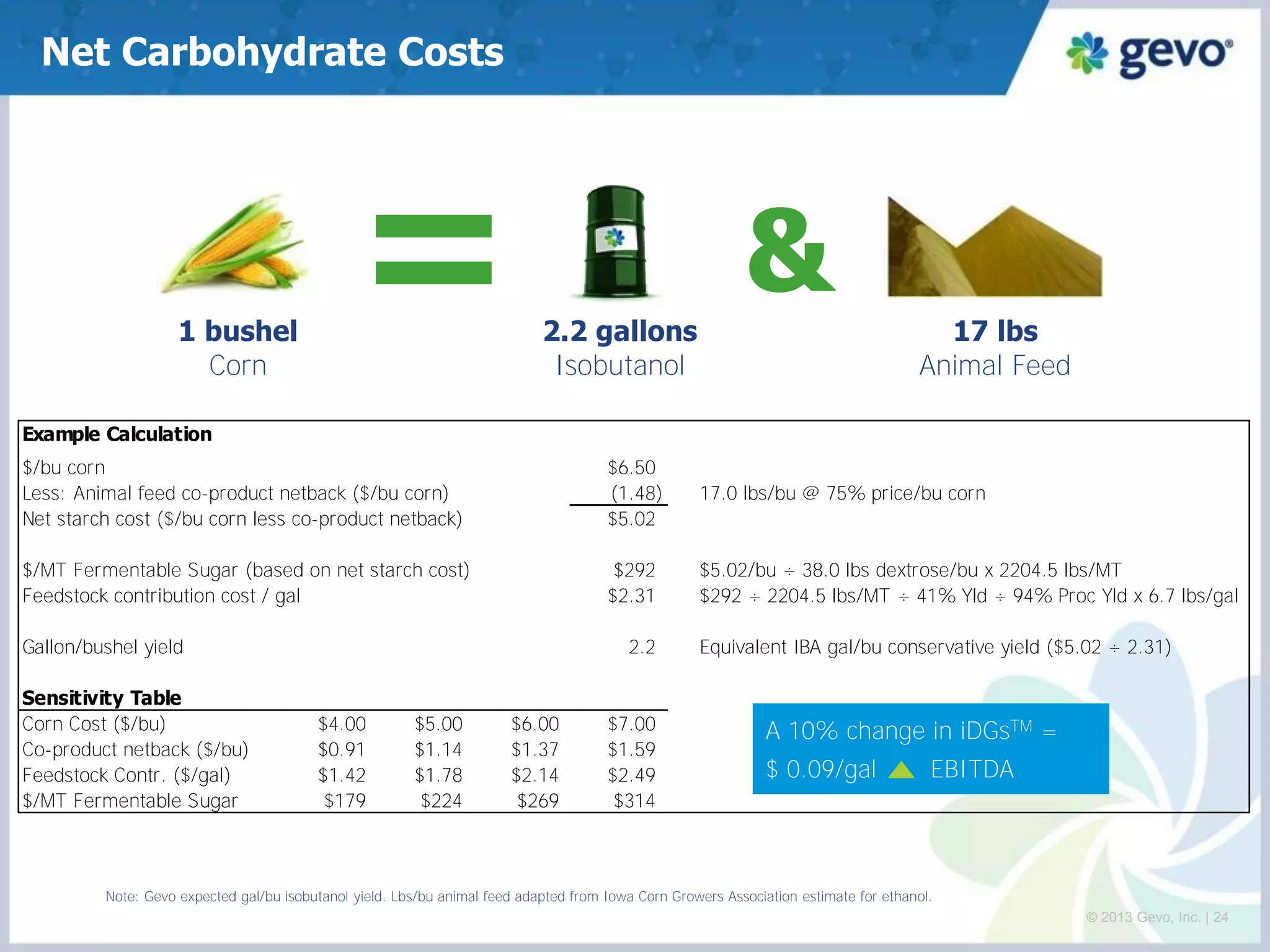
Example Calculation 
$/bu corn $6.50 
Less: Animal feed co-product netback ($/bu corn) (1.48) 17.0 lbs/bu @ 75% price/bu corn 
Net starch cost ($/bu corn less co-product netback) $5.02 
$/MT Fermentable Sugar (based on net starch cost) $292 $5.02/bu ÷ 38.0 lbs dextrose/bu x 2204.5 lbs/MT 
Feedstock contribution cost / gal $2.31 $292 ÷ 2204.5 lbs/MT ÷ 41% Yld ÷ 94% Proc Yld x 6.7 lbs/gal 
Gallon/bushel yield 2.2 Equivalent IBA gal/bu conservative yield ($5.02 ÷ 2.31) 
Sensitivity Table 
Corn Cost ($/bu) $4.00 $5.00 $6.00 $7.00 
Co-product netback ($/bu) $0.91 $1.14 $1.37 $1.59 
Feedstock Contr. ($/gal) $1.42 $1.78 $2.14 $2.49 
$/MT Fermentable Sugar $179 $224 $269 $314 
Net Carbohydrate Costs 
1 bushel 
Corn 
2.2 gallons 
Isobutanol 
17 lbs 
Animal Feed 
& 
Note: Gevo expected gal/bu isobutanol yield. Lbs/bu animal feed adapted from Iowa Corn Growers Association estimate for ethanol. 
A 10% change in iDGsTM = 
$ 0.09/gal EBITDA 
© 2013 Gevo, Inc. | 24
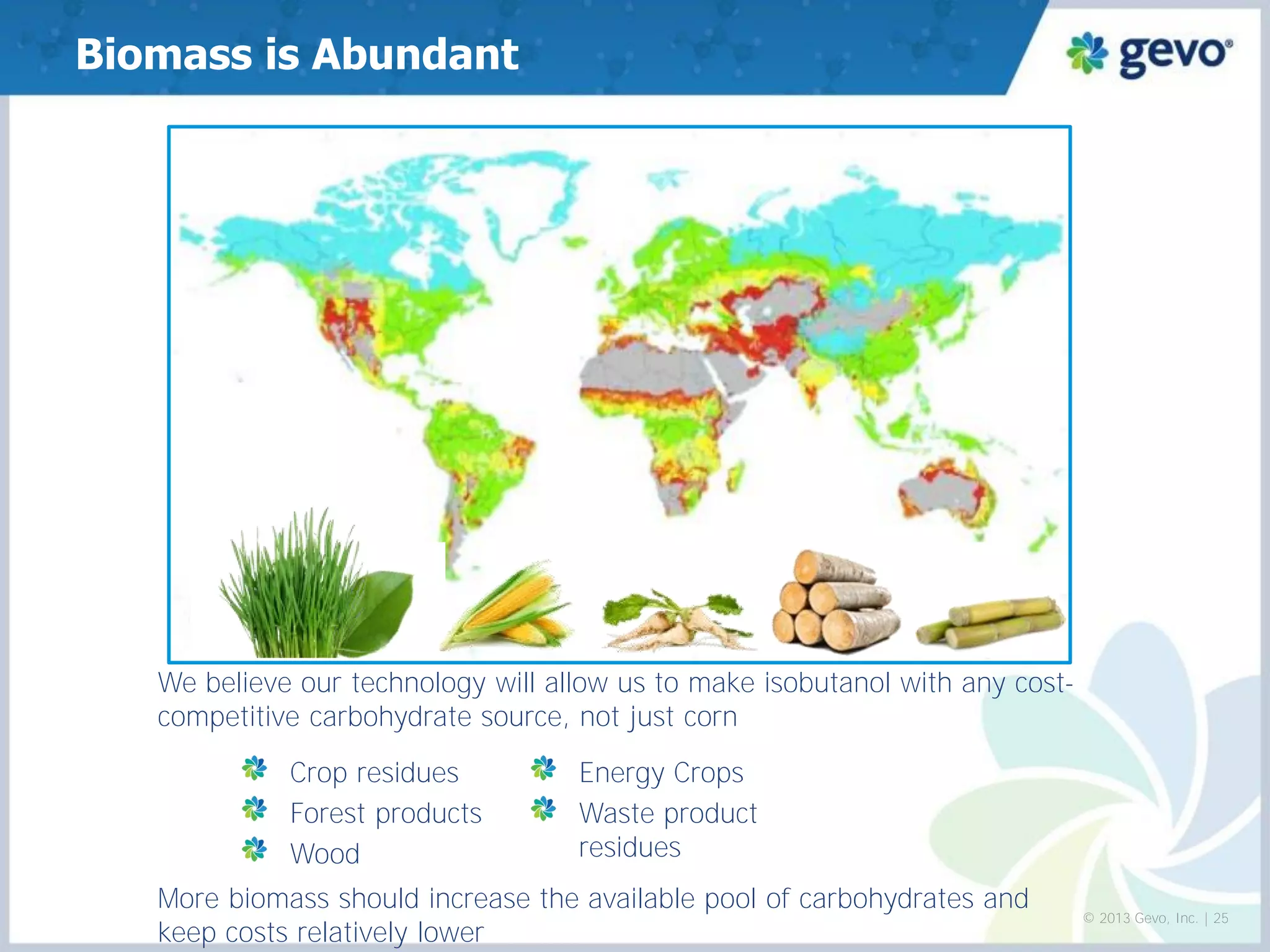
Biomass is Abundant 
© 2013 Gevo, Inc. | 25 
We believe our technology will allow us to make isobutanol with any cost- competitive carbohydrate source, not just corn 
More biomass should increase the available pool of carbohydrates and keep costs relatively lower Crop residues Forest products Wood Energy Crops Waste product residues
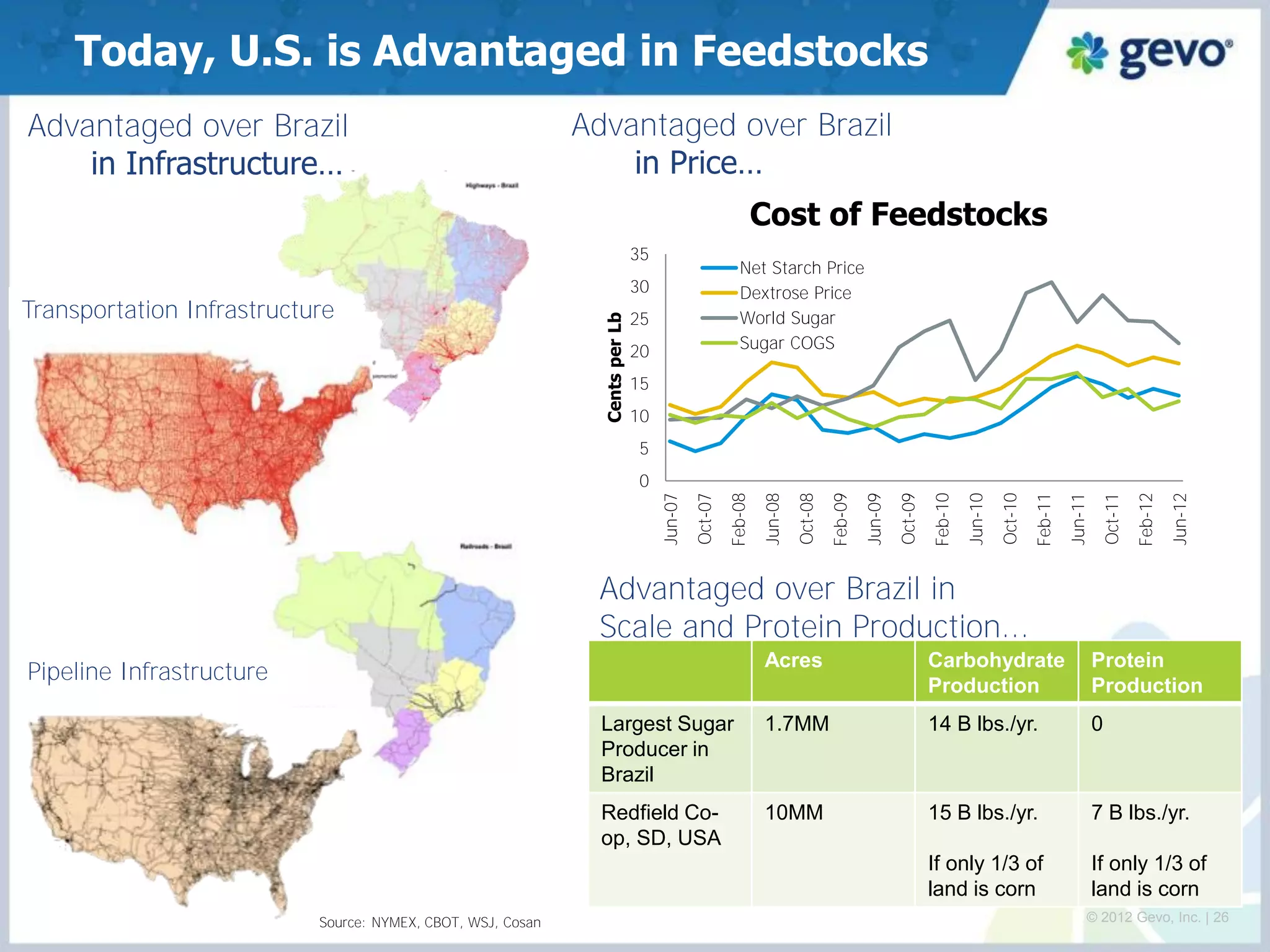
Transportation Infrastructure 
Advantaged over Brazil 
in Price… 
Today, U.S. is Advantaged in Feedstocks 
Advantaged over Brazil in Scale and Protein Production... 
1.7MM 
10MM 
Pipeline Infrastructure 
Source: NYMEX, CBOT, WSJ, Cosan 
Advantaged over Brazil 
in Infrastructure… 
Acres 
Carbohydrate Production 
Protein 
Production 
Largest Sugar Producer in Brazil 
1.7MM 
14 B lbs./yr. 
0 
Redfield Co- op, SD, USA 
10MM 
15 B lbs./yr. 
If only 1/3 of land is corn 
7 B lbs./yr. 
If only 1/3 of land is corn 
© 2012 Gevo, Inc. | 26 
0 
5 
10 
15 
20 
25 
30 
35 
Jun-07 
Oct-07 
Feb-08 
Jun-08 
Oct-08 
Feb-09 
Jun-09 
Oct-09 
Feb-10 
Jun-10 
Oct-10 
Feb-11 
Jun-11 
Oct-11 
Feb-12 
Jun-12 
Cents per Lb 
Cost of Feedstocks 
Net Starch Price 
Dextrose Price 
World Sugar 
Sugar COGS
Next steps – a look forward 
Financial overview 
© 2013 Gevo, Inc. | 27
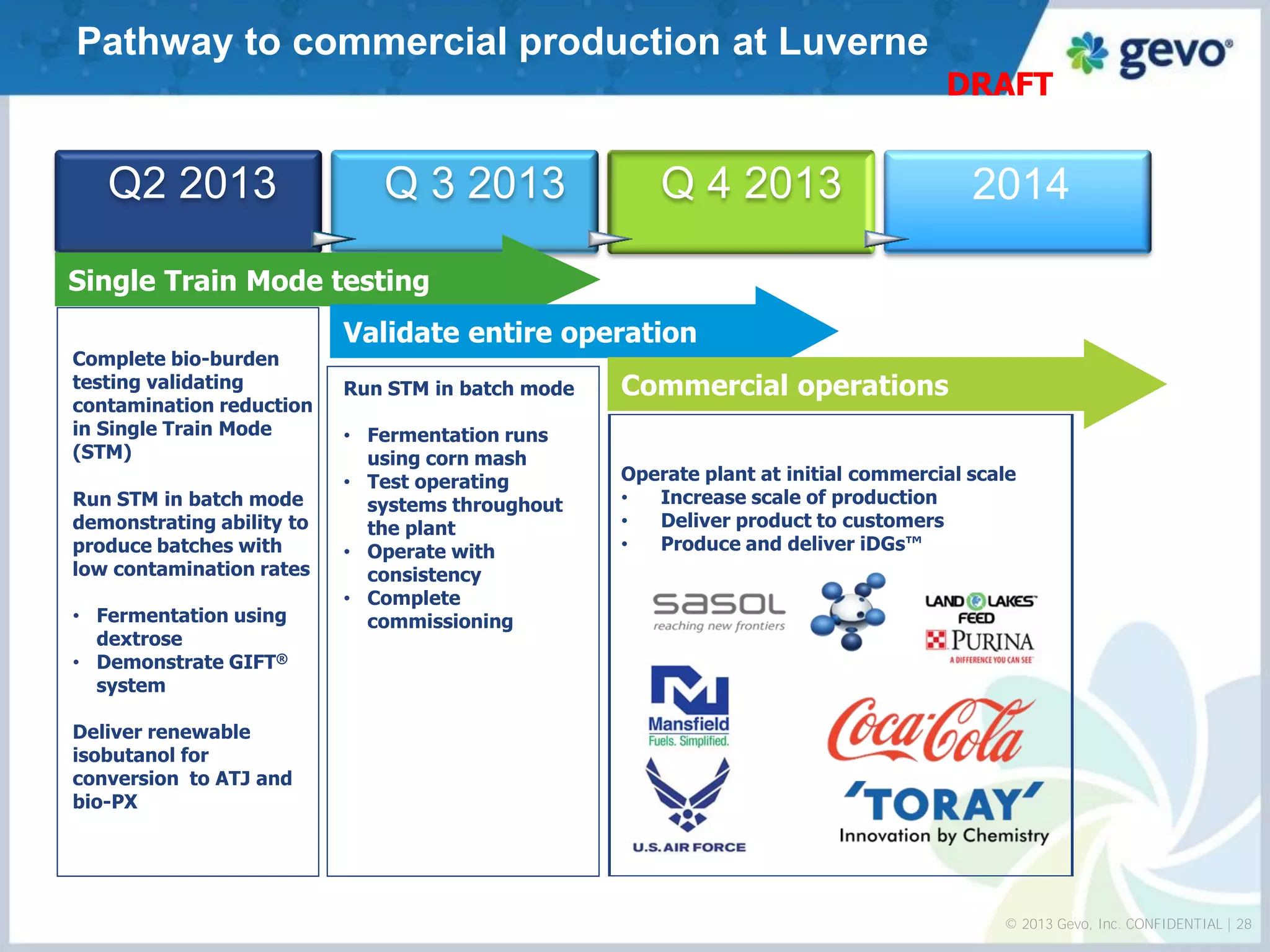
Pathway to commercial production at Luverne 
DRAFT 
Q2 2013 
Q 3 2013 
Q 4 2013 
2014 
Single Train Mode testing 
Validate entire operation 
Commercial operations 
Complete bio-burden testing validating contamination reduction in Single Train Mode (STM) 
Run STM in batch mode demonstrating ability to produce batches with low contamination rates 
•Fermentation using dextrose 
•Demonstrate GIFT® system Deliver renewable isobutanol for conversion to ATJ and bio-PX 
Run STM in batch mode 
•Fermentation runs using corn mash 
•Test operating systems throughout the plant 
•Operate with consistency 
•Complete commissioning 
Operate plant at initial commercial scale 
•Increase scale of production 
•Deliver product to customers 
•Produce and deliver iDGs™ 
© 2013 Gevo, Inc. CONFIDENTIAL | 28
© 2013 Gevo, Inc. CONFIDENTIAL | 29 
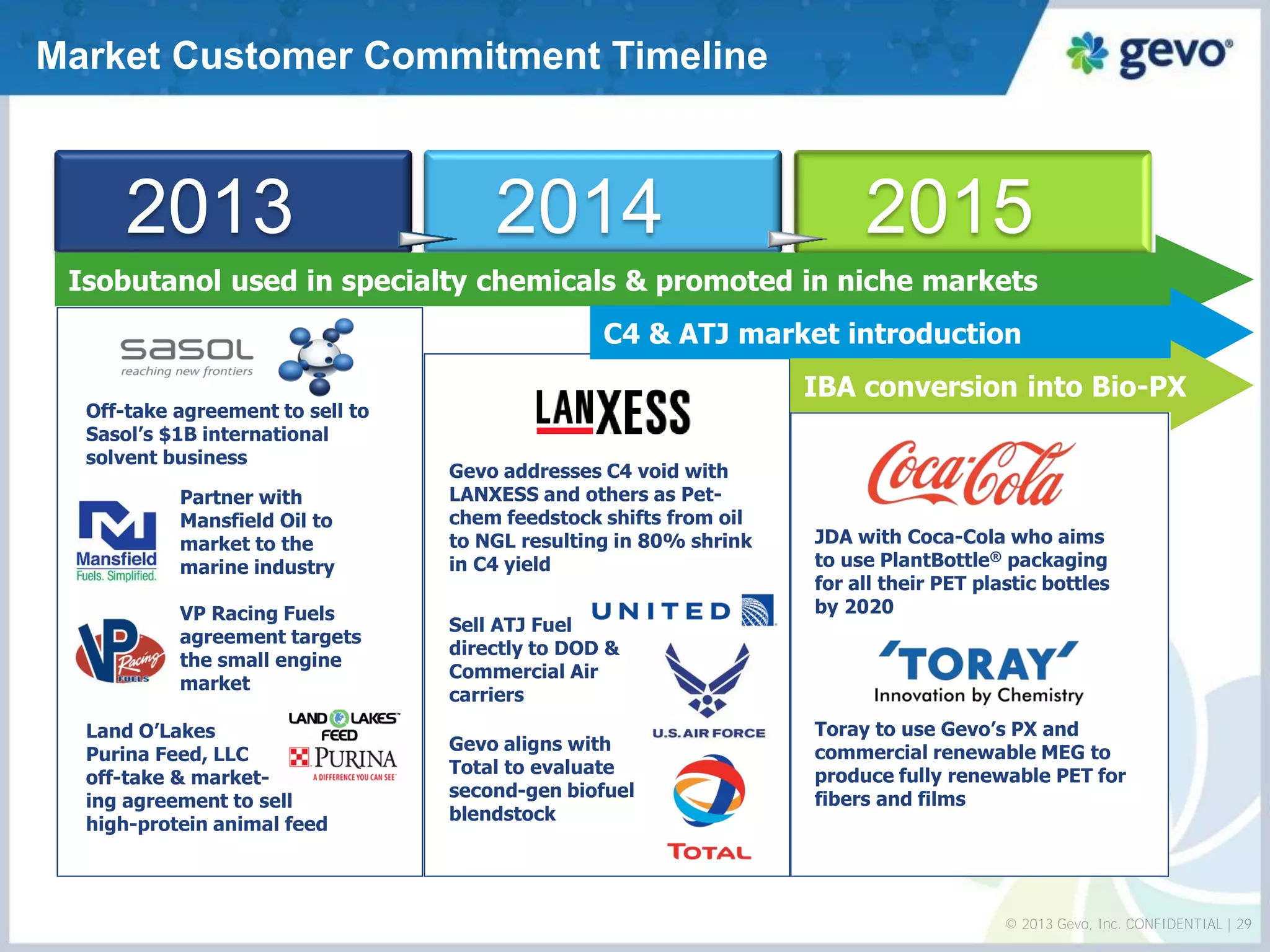
Market Customer Commitment Timeline 
2013 
2014 
2015 
Off-take agreement to sell to Sasol’s $1B international solvent business 
Land O’Lakes Purina Feed, LLC off-take & market- ing agreement to sell high-protein animal feed 
JDA with Coca-Cola who aims to use PlantBottle® packaging for all their PET plastic bottles by 2020 
Sell ATJ Fuel directly to DOD & Commercial Air carriers 
Gevo aligns with Total to evaluate second-gen biofuel blendstock 
Toray to use Gevo’s PX and commercial renewable MEG to produce fully renewable PET for fibers and films 
Gevo addresses C4 void with LANXESS and others as Pet- chem feedstock shifts from oil to NGL resulting in 80% shrink in C4 yield 
VP Racing Fuels agreement targets the small engine market 
Partner with Mansfield Oil to market to the marine industry 
Isobutanol used in specialty chemicals & promoted in niche markets 
C4 & ATJ market introduction 
IBA conversion into Bio-PX
© 2013 Gevo, Inc. | 30

Renewable Chemicals and Advanced Biofuels

  • 1.
    Renewable Chemicals andAdvanced Biofuels Biomass 2013 July 31 2013 Brett Lund © 2013 Gevo, Inc. | 1
  • 2.
    Forward-Looking Statements ©2013 Gevo, Inc. | 2 Certain statements within this presentation may constitute “forward-looking statements” within the meaning of the Private Securities Litigation Reform Act of 1995. Such statements relate to a variety of matters, including but not limited to: the timing and costs associated with and the availability of capital for Gevo’s scheduled retrofits of existing ethanol production facilities, its future isobutanol production capacity, the timing associated with bringing such capacity online, the availability of additional production volumes to seed additional market opportunities, the expected applications of isobutanol, including its use to produce renewable paraxylene, PET, isobutanol-based fuel blends for use in small engines, and ATJ bio-jet, addressable markets, and market demand, Gevo’s ability to produce commercial quantities of isobutanol from cellulosic feedstocks, the suitability of Gevo’s iDGs™ for the animal feed market, the expected cost-competitiveness and relative performance attributes of isobutanol and the products derived from it, the strength of Gevo’s intellectual property position and other statements that are not purely statements of historical fact. These forward-looking statements are made on the basis of the current beliefs, expectations and assumptions of Gevo’s management and are subject to significant risks and uncertainty. All such forward-looking statements speak only as of the date they are made, and Gevo assumes no obligation to update or revise these statements, whether as a result of new information, future events or otherwise. Although Gevo believes that the expectations reflected in these forward-looking statements are reasonable, these statements involve many risks and uncertainties that may cause actual results to differ materially from what may be expressed or implied in these forward-looking statements. For a discussion of the risks and uncertainties that could cause actual results to differ from those expressed in these forward-looking statements, as well as risks relating to the business of the company in general, see the risk disclosures in Gevo’s Annual Report on Form 10-K, as amended, for the year ended December 31, 2012 and in subsequent reports on Forms 10-Q and 8-K and other filings made with the Securities and Exchange Commission by Gevo. This presentation is based on information that is generally available to the public and does not contain any material, non-public information. This presentation has been prepared solely for informational purposes and is neither an offer to purchase nor a solicitation of an offer to sell securities.
  • 3.
    Company Overview Commercialization -stage company © 2013 Gevo, Inc. | 3 Highly credible team with proven track record Isobutanol is a platform molecule with drop-in capability Premier technology platform with 400+ patents and patent applications Established partnerships across the value chain Focused on 7 large markets
  • 4.
    $0.00 $1.00 $2.00 $3.00 $4.00 $5.00 Jan-07 Apr-07 Jul-07 Oct-07 Jan-08 Apr-08 Jul-08 Oct-08 Jan-09 Apr-09 Jul-09 Oct-09 Jan-10 Apr-10 Jul-10 Oct-10 Jan-11 Apr-11 Jul-11 Oct-11 Jan-12 Apr-12 Jul-12 Oct-12 Jan-13 Apr-13 $/gal Isobutanol Cost Competitive Product Drives Market Adoption Since 2007 >$0.80/gallon lower cost to produce than petroleum isobutanol (Backcast, Gevo process) Petro-IBA cost Avg. Diff >$0.80/gal Bio-IBA cost © 2013 Gevo, Inc. | 4 Source: CMAI, Nexant, CBOT, Gevo Process Estimates *Cash Cost FOB Plant Gate
  • 5.
    Multiple Feedstocks; ProprietaryTechnology; Numerous End Markets Feedstock Bio- Cracker GIFT® Separator Green Processing © 2013 Gevo, Inc. | 5 Target Markets Proprietary Technology Direct “drop-in”
  • 6.
    © 2013 Gevo,Inc| 6 Source: Company materials, IEA, EIA and Nexant Bio-PX/PET Mansfield agreement, with their 900+ supply points, will initially focus on Marine VP Racing Fuels to evaluate a wide array of fuel applications LOI with Total to evaluate isobutanol as a second-gen biofuel blendstock C4 Market Coca-Cola partnership to create fully renewable PET for plant-based packaging Toray off-take agreement to create renewable Paraxylene for fibers and films U.S. Air Force’s (USAF) initial volume delivered with testing underway USAF interested in energy security / alternative jet fuel supply USAF test flight end of June United Airlines LOI in place Gasoline Blendstock Sasol off-take and distribution agreement in place Accounts for majority of initial capacity Customer sampling of Gevo’s isobutanol has begun Specialty Chemicals LANXESS 10- year exclusive global supply agreement in place Negotiating terms for Canadian supply agreement Bio-Jet Seven Strategic End Markets; Strong Customers Hydrocarbon Fuels Co-Product Revenues Mansfield agreement, with supplier network in place, will support regional distribution rollout strategy Purina, the premier brand owner, partnership to maximize value of co-products Exploring how to enhance the value of isobutanol Distillers Grains (iDGs™ or animal feed) “Lower Cost, Drop-In” “Cleaner Performance” “Structurally Short Supply” “Green Supply Chain” “High Performance” “Fully Renewable” “Food First” ~$7bln TAM ~$100bln TAM ~$6bln TAM ~$100bln TAM ~$200bln TAM >$1trl TAM ~$7bln TAM
  • 7.
    Naphtha & GasOil NGLs Ethylene Propylene C4s Pyrolysis Gasoline Other Historical Expected Source: Figured adapted from CMAI, SRI Consulting, American Chemistry Council The US produced 1,600 KTA of butylenes via crackers in 2007. •NGL’s account for 85% of cracker feedstocks –Up from 65% in 2005 •<10% of ethylene produced from naphtha –Down from 30% in 2005 •Many crackers have completed capital projects to further maximize NGL feeds •All new projects being announced will utilize ethane, NGL feeds (world scale plants from Dow, Shell, ExxonMobil, Chevron Phillips) –Over 50 new chemical projects will invest $64.5 B by 2017, nearly all driven by NGL feedstock economics with the largest proportion of projects being ethane crackers Shift in Petrochemical Feedstock Drives Gevo Opportunity Switching to NGL feeds reduces butylene production to ~300 KTA. © 2013 Gevo, Inc. | 7
  • 8.
    Oil Costs Expectedto Rise Faster than Carbohydrates © 2013 Gevo, Inc. | 8 Brent Crude Carbon CBOT Corn Starch Carbon Source: CBOT & EIA $0 $200 $400 $600 $800 $1,000 $1,200 $1,400 Jan-01 Jul-01 Jan-02 Jul-02 Jan-03 Jul-03 Jan-04 Jul-04 Jan-05 Jul-05 Jan-06 Jul-06 Jan-07 Jul-07 Jan-08 Jul-08 Jan-09 Jul-09 Jan-10 Jul-10 Jan-11 Jul-11 Jan-12 Jul-12 Jan-13 Cost of Carbon ($/MT)
  • 9.
    Economics and PricingBreakdown $445 ($60/bbl) $668 ($90/bbl) $1,002 ($135/bbl) $258 ($5.50/bu corn) $305 ($6.50/bu corn) $305 ($6.50/bu corn) 1.7 2.2 >3 $10 B >$40 B >$3 T Oil (MT) Lower Oil Current Higher Oil Carbohydrate (MT) Oil / Carbohydrate Ratio **Market opportunity driven by spread between carbohydrate and oil Note: The lowest the ratio has been in last 10 years is 1.5 (Dec 2001 – Jan 2002) See previous page for sources / assumptions. © 2013 Gevo, Inc. | 9 Source: ICIS, CMAI, Nexant
  • 10.
    Yield and CapitalCost Comparison Comparing isobutanol yield to cost of production, Gevo’s propriety processes shows a clear advantage over conventional biofuels, as well as traditional catalytic cracking oil refineries. © 2013 Gevo, Inc. | 10 $2.00 $5.80 $7.25 $9.15 66 85 88 108 101 Farnesene Fermented Veg. Oils Max Theoretical Shown Yield Hydrocarbon Gallons/MT Sugar Total Capital Cost Finished Hydrocarbon $/gal Farnesene Fermented Veg. Oils Catalytic Cracking Plant capital Downstream capital Catalytic Cracking Lignin Usage ~85 (1) Process yields were assumed at 95% for anaerobic processes and 90% for aerobic processes. Adapted from: Dumesic, JA “Catalytic Strategies for Changing the Energy Content and Achieving C-C Coupling in Biomass-Derived Oxygenated Hydrocarbons” Chemsuschem 2008, 1, 725-733. Keasling, JD, “Biosynthesis of Plant Isoprenoids: Perspectives for Microbial Engineering,” Annual Review of Plant Biology 2009, 60, 335-355. Rude, MA "New Microbial Fuels: a Biotech Perspective" Current Opinion in Microbiology 2009, 12, 274-281. Capital costs based on public data, Wall Street estimates and Gevo estimates.
  • 11.
    Isobutanol: How GevoDisplaces Oil © 2013 Gevo, Inc. | 11
  • 12.
    Benzene Toluene Xylenes Aromatics Unsaturated Polyesters Polypropylene Jet Fuel Gasoline Diesel Source: Adapted from Nexant Natural Gas Steam Cracking Olefins Pyrolysis Gasoline meta-Xylene para-Xylene ortho-Xylene Methyl Methacrylate Toluene Diamine Cyclohexane Ethyl Benzene Cumene Acrylonitrile Propylene Oxide Isobutene Ethanol alpha-Olefin Polyols Phenol Acetone Styrene Adipic Acid Caprolactam Toluene Diisocyanate Phthalic Anhydride Isophthalic Acid Terephthalic Acid Ethylene Glycol MTBE Polyesters (PET) Plasticizers Polyurethane Nylon 6 Nylon 66 SB Latex ABS Polystyrene Butadiene-Styrene Polybutadiene Polyacrylonitrile Polyisobutylene Polyester Poly(vinyl cloride) Polyethylene Ethylene Propylene Butylenes Butadiene Vinyl Chloride Crude Oil Basic Petrochemical Industry Map Ethylene Oxide EDC Hydrocarbon Fuels Naphtha Chemicals and Materials © 2013 Gevo, Inc. | 12
  • 13.
    CO2 + JetFuel Gasoline Diesel Isobutene Ethanol MTBE Vinyl Chloride Ethylene Oxide EDC Hydrocarbon Fuels Aromatics Olefins Pyrolysis Gasoline Naphtha Benzene Xylenes Ethylene Butylenes Butadiene C 3 C 4 C 7 Toluene C 2 C 4 C 8 Propylene 3 Polypropylene Propylene Oxide Polyols Polyisobutylene Acrylonitrile ABS Polystyrene Butadiene-Styrene Polybutadiene Polyacrylonitrile Ethyl Benzene Cumene Phenol Acetone Styrene meta-Xylene Para-Xylene Roth-Xylene Toluene Diamine Cyclohexane Adipic Acid Caprolactam Toluene Diisocyanate Phthalic Anhydride Isophthalic Acid Terephthalic Acid Source: Adapted from Nexant Note: Chemicals shaded green denote those which can be made from isobutanol-derived building blocks. Unsaturated Polyesters Methyl Methacrylate Polyesters (PET) Plasticizers Nylon 6 Nylon 66 SB Latex © 2013 Gevo, Inc. | 13 C 7 Green Building Block Leverages Existing Processes and Businesses alpha-Olefin Ethylene Glycol Polyester Poly(vinyl chloride) Chemicals and Materials Steam Cracking Polyethylene C 6
  • 14.
    Our Technology isBased on Metabolic Engineering © 2013 Gevo, Inc. | 14
  • 15.
    Technology Based onMetabolic Engineering Proprietary yeast biocatalyst converts sugars (carbohydrates) to isobutanol Combination of biotechnology and process technology leads to competitive position Economic focus drives innovation Previously demonstrated commercial targets: –Yield 94% (goal 92%) –Concentration >107 g/l (goal >105 g/l) –Productivity Rate 2 g/l/h (goal 2 g/l/h) © 2013 Gevo, Inc. | 15
  • 16.
    How We ProduceIsobutanol (GIFT®) Our patented Gevo Integrated Fermentation Technology® (GIFT®) continually separates isobutanol during fermentation Gevo owns the patent covering ethanol plants retrofitted to produce isobutanol Standard Fermentation Process START: Feedstock Fresh & Recycled Water Jet Cooker Steam Enzymes Fermentation CO2 Beer Distillation System Wet Grain Drum Dryer Thin Stillage Evaporation System Syrup Animal Feed Molecular Sieves Finished Product BEFORE AFTER © 2013 Gevo, Inc. | 16 Isobutanol Water Isobutanol Recovery New
  • 17.
    Yield defined bymolecule & process High Yield Drives Low Cost $0 $1 $2 $3 $4 $5 $6 $7 $8 $9 $10 $11 $12 $13 $14 5% 10% 15% 20% 25% 30% 35% 40% 45% 50% Feedstock Contribution Cost ($/gal) Contribution Cost Curve (based on $0.10/lb sugar) Gevo Low Cost Position Yield: 38% Cost: $1.74/gal Overall Yield* Gevo: 41% x 94% = 38.5% Company A: 25% x 75% = 18.8% Feedstock Contribution Cost Sugar ($/lb) ÷ Overall Yield x Density (lbs/gal) Gevo: $0.10 ÷ 38.5% x 6.7 = $1.74/gal Company A: $0.10 ÷ 18.8% x 6.7 = $3.57/gal *Overall Yield = Pathway Yield x Process Yield Source: Gevo Process Estimates Overall Yield* © 2013 Gevo, Inc. | 17 Sensitivity to $0.01/lb change in sugar cost @ 38.5% = $0.18/gal $7.56/bbl @ 18.8% = $0.37/gal $15.54/bbl Feedstock = ~70% of net cash cost to produce Higher yield = less sensitivity
  • 18.
    Commercial Production ©2013 Gevo, Inc. | 18
  • 19.
    Our Plants 1stCommercial Plant: Luverne, MN –18 MGPY commercial isobutanol production facility –Purchased in 2010 & 100% owned by Gevo Redfield Energy, SD - Joint Venture –~40 MGPY commercial isobutanol facility –Entered into JV with 650 member Co-op in 2011 with economics, post retrofit, to be split approximately 50/50 Redfield, SD Plant Luverne, MN Plant © 2013 Gevo, Inc. | 19
  • 20.
    Leveraging Petrochemical &Refinery Assets © 2013 Gevo, Inc. | 20 Jet Fuel Blendstock Para-xylene (for PET) Octane, Gasoline Diesel Blendstock ATJ Demonstration Facility near Houston Delivered >10K gallons ATJ to AFRL Alcohol-to-Fuel US Patent 8,193,402 –Covers C2-C6 alcohols to hydrocarbon fuel
  • 21.
    June 28, 201240th Flight Test Squadron made history flying Gevo’s 50% ATJ and 50% JP- 8 fuel blend “It flew like a usual A-10 without any issues.” –Maj. Olivia Elliott, A-10 pilot “You won’t be able to determine the difference and you won’t care, because all perform as JP-8.” –Jeff Braun, Chief for the Air Force Alternative Fuel Certification Division Gevo ATJ Fuel Makes History in USAF Flight © 2013 Gevo, Inc. | 21
  • 22.
    © 2013 Gevo,Inc. | 22 Feedstocks
  • 23.
    Gevo yeast technologyconverts any carbohydrate feedstock to isobutanol Provides world wide opportunity for isobutanol manufacture Provides risk reduction via multiple feedstocks versus oil price volatility Isobutanol Technology To Take Advantage of Many Feedstocks FEEDSTOCK Corn Sugar Cane Agricultural Residue Wood TOMORROW TODAY Source: NYMEX, CBOT, WSJ, Cosan 0 5 10 15 20 25 30 35 Jun-07 Sep-07 Dec-07 Mar-08 Jun-08 Sep-08 Dec-08 Mar-09 Jun-09 Sep-09 Dec-09 Mar-10 Jun-10 Sep-10 Dec-10 Mar-11 Jun-11 Sep-11 Dec-11 Mar-12 Jun-12 Sep-12 Dec-12 Mar-13 Cents per Lb Cost of Feedstocks Net Starch Price Dextrose Price World Sugar Sugar COGS © 2013 Gevo, Inc. | 23
  • 24.
    Example Calculation $/bucorn $6.50 Less: Animal feed co-product netback ($/bu corn) (1.48) 17.0 lbs/bu @ 75% price/bu corn Net starch cost ($/bu corn less co-product netback) $5.02 $/MT Fermentable Sugar (based on net starch cost) $292 $5.02/bu ÷ 38.0 lbs dextrose/bu x 2204.5 lbs/MT Feedstock contribution cost / gal $2.31 $292 ÷ 2204.5 lbs/MT ÷ 41% Yld ÷ 94% Proc Yld x 6.7 lbs/gal Gallon/bushel yield 2.2 Equivalent IBA gal/bu conservative yield ($5.02 ÷ 2.31) Sensitivity Table Corn Cost ($/bu) $4.00 $5.00 $6.00 $7.00 Co-product netback ($/bu) $0.91 $1.14 $1.37 $1.59 Feedstock Contr. ($/gal) $1.42 $1.78 $2.14 $2.49 $/MT Fermentable Sugar $179 $224 $269 $314 Net Carbohydrate Costs 1 bushel Corn 2.2 gallons Isobutanol 17 lbs Animal Feed & Note: Gevo expected gal/bu isobutanol yield. Lbs/bu animal feed adapted from Iowa Corn Growers Association estimate for ethanol. A 10% change in iDGsTM = $ 0.09/gal EBITDA © 2013 Gevo, Inc. | 24
  • 25.
    Biomass is Abundant © 2013 Gevo, Inc. | 25 We believe our technology will allow us to make isobutanol with any cost- competitive carbohydrate source, not just corn More biomass should increase the available pool of carbohydrates and keep costs relatively lower Crop residues Forest products Wood Energy Crops Waste product residues
  • 26.
    Transportation Infrastructure Advantagedover Brazil in Price… Today, U.S. is Advantaged in Feedstocks Advantaged over Brazil in Scale and Protein Production... 1.7MM 10MM Pipeline Infrastructure Source: NYMEX, CBOT, WSJ, Cosan Advantaged over Brazil in Infrastructure… Acres Carbohydrate Production Protein Production Largest Sugar Producer in Brazil 1.7MM 14 B lbs./yr. 0 Redfield Co- op, SD, USA 10MM 15 B lbs./yr. If only 1/3 of land is corn 7 B lbs./yr. If only 1/3 of land is corn © 2012 Gevo, Inc. | 26 0 5 10 15 20 25 30 35 Jun-07 Oct-07 Feb-08 Jun-08 Oct-08 Feb-09 Jun-09 Oct-09 Feb-10 Jun-10 Oct-10 Feb-11 Jun-11 Oct-11 Feb-12 Jun-12 Cents per Lb Cost of Feedstocks Net Starch Price Dextrose Price World Sugar Sugar COGS
  • 27.
    Next steps –a look forward Financial overview © 2013 Gevo, Inc. | 27
  • 28.
    Pathway to commercialproduction at Luverne DRAFT Q2 2013 Q 3 2013 Q 4 2013 2014 Single Train Mode testing Validate entire operation Commercial operations Complete bio-burden testing validating contamination reduction in Single Train Mode (STM) Run STM in batch mode demonstrating ability to produce batches with low contamination rates •Fermentation using dextrose •Demonstrate GIFT® system Deliver renewable isobutanol for conversion to ATJ and bio-PX Run STM in batch mode •Fermentation runs using corn mash •Test operating systems throughout the plant •Operate with consistency •Complete commissioning Operate plant at initial commercial scale •Increase scale of production •Deliver product to customers •Produce and deliver iDGs™ © 2013 Gevo, Inc. CONFIDENTIAL | 28
  • 29.
    © 2013 Gevo,Inc. CONFIDENTIAL | 29 Market Customer Commitment Timeline 2013 2014 2015 Off-take agreement to sell to Sasol’s $1B international solvent business Land O’Lakes Purina Feed, LLC off-take & market- ing agreement to sell high-protein animal feed JDA with Coca-Cola who aims to use PlantBottle® packaging for all their PET plastic bottles by 2020 Sell ATJ Fuel directly to DOD & Commercial Air carriers Gevo aligns with Total to evaluate second-gen biofuel blendstock Toray to use Gevo’s PX and commercial renewable MEG to produce fully renewable PET for fibers and films Gevo addresses C4 void with LANXESS and others as Pet- chem feedstock shifts from oil to NGL resulting in 80% shrink in C4 yield VP Racing Fuels agreement targets the small engine market Partner with Mansfield Oil to market to the marine industry Isobutanol used in specialty chemicals & promoted in niche markets C4 & ATJ market introduction IBA conversion into Bio-PX
  • 30.
    © 2013 Gevo,Inc. | 30