......A GOD!
WHY THERE PROBABLY
IS…..
Sheikh Fahim Faysal Sowrav
Email: sffsowrav@teachers.org
What exactly is GOD !?
 “God is nothing—except the imaginings of human beings. It is
however, a belief. A BELIEF that shapes our thinking. ” According
to this way of thinking, as the human race has slowly evolved
from lower life-forms, it has invented “god” as a superstitious
answer to questions about life that it cannot otherwise answer.
 The true God is the Creator of all things. He had no beginning and
will never have an end.
 Since the universe didn’t all start by itself, there was a supreme
being who began all these. So, “God” is just a terminology of “the
creator” in narrower sense.
 Then, what is God? The one Supreme Being, the creator and
policy maker of the universe.
POPULAR BELIEVES
• Monotheism: Monotheism the belief in theology that only one
deity exists.
• Polytheism: It is the belief that there is more than one god.
• Pantheism: The belief that the physical universe is equivalent to
god, and that there is no division between a Creator and the
substance of its creation.
• Panentheism: Like Pantheism, the belief that the physical
universe is joined to a god or gods. However, it also believes that a
god or gods are greater than the material universe.
• Deism: Classical deism is the belief that at least one deity exists
and created the world, but that the creator(s) does/do not alter
the original plan for the universe.
• Autotheism: the viewpoint that, whether divinity is also external or
not, it is inherently within 'oneself' and that one has the ability to
achieve godhood.
GOD & CREATION OF UNIVERSE
• Based on only one of the hundreds of parameters of the physical universe—that
the probability of the emergence of a life-giving cosmos was 1 divided by 10,
raised to the power 10, and again raised to the power of 123. This is a number
as close to zero as anyone has ever imagined.
• Therefore it is clear that we exist in a plan which is governed by rules that were
created, shaped by a universal intelligence and not by chance.
• From within the primeval soup of elementary particles that constituted the
young universe, again as if by a magic hand, all the quarks suddenly bunched
in threes to form protons and neutrons, their electrical charges set precisely to
the exact level needed to attract and capture the electrons, which then began
to circle nuclei made of the protons and neutrons. All of the masses, charges
and forces of interaction in the universe had to be in just the precisely needed
amounts so that early light atoms could form. Larger ones would then be
cooked in nuclear fires inside stars, giving us carbon, iron, nitrogen, oxygen and
all the other elements that are so essential for life to emerge. And eventually,
the highly complicated double-helix molecule, the life-propagating DNA, would
be formed.
Evidence of God in unexpected places
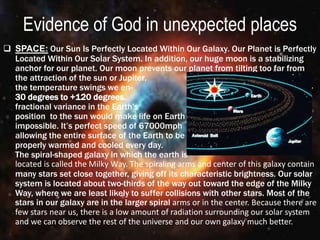
 SPACE: Our Sun Is Perfectly Located Within Our Galaxy. Our Planet is Perfectly
Located Within Our Solar System. In addition, our huge moon is a stabilizing
anchor for our planet. Our moon prevents our planet from tilting too far from
the attraction of the sun or Jupiter. Considering
the temperature swings we en- counter from -
30 degrees to +120 degrees. Even a
fractional variance in the Earth's
position to the sun would make life on Earth
impossible. It’s perfect speed of 67000mph
allowing the entire surface of the Earth to be
properly warmed and cooled every day.
The spiral-shaped galaxy in which the earth is
located is called the Milky Way. The spiraling arms and center of this galaxy contain
many stars set close together, giving off its characteristic brightness. Our solar
system is located about two-thirds of the way out toward the edge of the Milky
Way, where we are least likely to suffer collisions with other stars. Most of the
stars in our galaxy are in the larger spiral arms or in the center. Because there are
few stars near us, there is a low amount of radiation surrounding our solar system
and we can observe the rest of the universe and our own galaxy much better.
 Water: Water's characteristics are uniquely suited to life. It has wide margin
between its boiling point and freezing point. Water allows us to live in an
environment of fluctuating temperature changes, while keeping our bodies a
steady 98.6 degrees. Water is a universal solvent. is also chemically neutral.
Water has a unique surface tension. Water in plants can therefore flow upward
against gravity, bringing life-giving water and nutrients to the top of even the
tallest trees. Water freezes from the top down and floats, so fish can live in the
winter.
 Unusually thin atmosphere: The collision of the small planet with the earth
resulted in the ejection of the majority of the earth's primordial atmosphere. If
this collision had not occurred, we would have had an atmosphere similar to
that of Venus, which is 80 times that of the earth . he earth would have
suffered a similar fate if the majority of its primordial atmosphere had not
been ejected into outer space. In fact, the Earth is 20% more massive than
Venus and further away from the Sun, both factors of which should have lead
to a terrestrial atmosphere much thicker than that of Venus.
 Slowing rotation makes advanced life possible: The earth originally had a
rotational period of eight hours. Such a rapid rotational period would have
resulted in surface wind velocities in excess of 500 miles per hour. The
gravitational tug of the moon over the last 4+ billion years has reduced the
rotation period of the earth to 24 hours . Needless to say, winds of 500 miles
per hour would not be conducive to the existence of higher life forms
(coincidence or design?).
 Van-Allen radiation shield: The large nickel-iron core is responsible for our
large magnetic field. This magnetic field produces the Van-Allen radiation
shield, which protects the Earth from radiation bombardment. If this shield
were not present, life would not be possible on the Earth. The only other rocky
planet to have any magnetic field is Mercury—but its field strength is 100 times
less than the Earth's. Even Venus, our sister planet, has no magnetic field. The
lack of a magnetic field on Venus is thought to have resulted in the planet
losing virtually all of its water through stripping by the solar wind .
 Unique continental crust and tectonic activity: However, the earth's crust
is much thinner (4 km) than that of Venus (30 km). Tectonic processes cannot
happen with such thick plates. If most of the crust of the earth had not been
blown away during the formation of the moon, the earth would have no
continents, but would be completely covered by water.
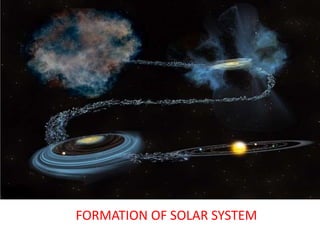
FORMATION OF SOLAR SYSTEM
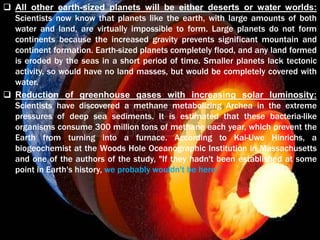
 All other earth-sized planets will be either deserts or water worlds:
Scientists now know that planets like the earth, with large amounts of both
water and land, are virtually impossible to form. Large planets do not form
continents because the increased gravity prevents significant mountain and
continent formation. Earth-sized planets completely flood, and any land formed
is eroded by the seas in a short period of time. Smaller planets lack tectonic
activity, so would have no land masses, but would be completely covered with
water.
 Reduction of greenhouse gases with increasing solar luminosity:
Scientists have discovered a methane metabolizing Archea in the extreme
pressures of deep sea sediments. It is estimated that these bacteria-like
organisms consume 300 million tons of methane each year, which prevent the
Earth from turning into a furnace. According to Kai-Uwe Hinrichs, a
biogeochemist at the Woods Hole Oceanographic Institution in Massachusetts
and one of the authors of the study, "If they hadn't been established at some
point in Earth's history, we probably wouldn't be here.“
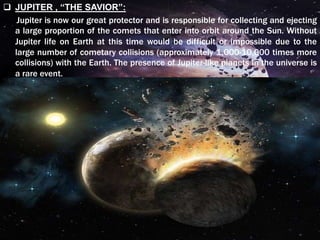
 JUPITER , “THE SAVIOR”:
Jupiter is now our great protector and is responsible for collecting and ejecting
a large proportion of the comets that enter into orbit around the Sun. Without
Jupiter life on Earth at this time would be difficult or impossible due to the
large number of cometary collisions (approximately 1,000-10,000 times more
collisions) with the Earth. The presence of Jupiter-like planets in the universe is
a rare event.
Are all these just
coincidences or does it
seem that someone
designed it so perfectly for
us?
The key word to answer this
question is “contingent.”
• In this context, this means that something owes its existence to something
else; it does not exist by itself. It needs a cause. And everything we know
anything about is contingent. So the universe consists of series and networks
of causes, which are in turn connected into whole systems of causes. That
is, a is caused by b, but only as b is caused by c, and so on. Everything we know
exists and functions only as it is caused by other factors in its causal chain. We
know of nothing that spontaneously initiates its own causal activity. Who
started this contingency? The creator did.
• It means the universe and everything in it had a cause, including you and
including me. Something can’t come from nothing, right? But you say,
“According to your logic, wouldn’t God need a cause too?” Nope. And that’s
because God didn’t begin to exist. He is self-existent. He’s a necessary being,
the uncreated Creator of all things. He’s in a league of His own.
Did you know?
• Our DNA structure seems like a computer program, written by a
very intelligent being. The binary input of computers like:
10110101011 are pretty similar looking to our DNA codes of
every cell which goes like: GTGTGACTCGCTCCTGAT
• What is amazing is that within the tiny space in every cell in your
body, this code is three billion letters long!! the DNA structure is a
complex, three-billion-lettered script, informing and directing the
cell's process.
• It has been determined that 99.9% of your DNA is similar to
everyone's genetic makeup.4 What is uniquely you comes in the
fractional difference in how those three billion letters are
sequenced in your cells.
So, there is evidence of god evidence of God even in the tiny
particle of your body.
Calculating the probability of GOD
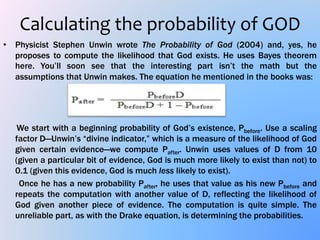
• Physicist Stephen Unwin wrote The Probability of God (2004) and, yes, he
proposes to compute the likelihood that God exists. He uses Bayes theorem
here. You’ll soon see that the interesting part isn’t the math but the
assumptions that Unwin makes. The equation he mentioned in the books was:
We start with a beginning probability of God’s existence, Pbefore. Use a scaling
factor D—Unwin’s “divine indicator,” which is a measure of the likelihood of God
given certain evidence—we compute Pafter. Unwin uses values of D from 10
(given a particular bit of evidence, God is much more likely to exist than not) to
0.1 (given this evidence, God is much less likely to exist).
Once he has a new probability Pafter, he uses that value as his new Pbefore and
repeats the computation with another value of D, reflecting the likelihood of
God given another piece of evidence. The computation is quite simple. The
unreliable part, as with the Drake equation, is determining the probabilities.
And after all that, the
probability of God was
found to be
0.67.Therefore, God is
likelier to exist than not.
It’s math! How are you going to disagree with that?
Why formation of universe is a
miracle, not just a mathematical
probability?
 Littlewood's law of miracle: The total number of events that happen
to us is about 30,000 per day, or about a million per month. With few
exceptions, these events are not miracles because they are insignificant.
The chance of a miracle is about one per million events. Therefore we
should expect about one miracle to happen, on the average, every month.
Mathematically this is dependent on the arbitrary definition of "discrete
events" and the arbitrary assignment of a probability for a miracle - although
"one in a million" is a common sense estimate for something spectacularly
unlikely. So, this is a heuristic, or rule-of-thumb approach. Furthermore, if
one calculates the actual probability, it is approximately 0.632, meaning that
there is 63.2% chance that some miracle(s) occurs, not close to 100%.
In case of the formation of the universe the probability was in trillions, so it
was clearly a miracle. It just didn’t happen, A SUPREME BEING was
responsible for that.
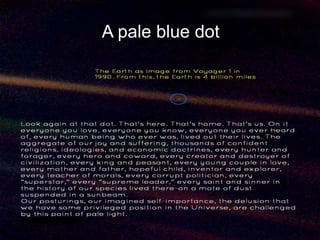
A pale blue dot
Conclusion
• The conclusion of all that , God doesn't have to be real or not,
to make us think and reflect on our lives. God doesn't have to
exist or not, to consider new ideas and concepts. This is a
matter where perception is so much more important than facts.
Because the concept of God fuelled our debates and reflexions
for so long, it's an interesting concept. Because it's an entity
that changed our perception of life and relationship to others, it
goes over the realm of religion and how religions act on earth.
It's an idea that belongs to every single human who can share
his or her point of view on it.
• Trying to prove its existence or non-existence is irrelevant but
debating the idea is important since it's such a wonderful
source of paradoxes, ways to live, understandings of the world.
If you keep your mind open, it doesn't have to come in
opposition with science at all. To many, it can give a larger
picture in which science happens.
Thank you !
• Make sure any misconceptions doesn't
blind you, any idea, faith, concept, can be
harmful and used to be close-minded,
pretend to hold the only truth. But you,
dear audience, you don't have to be like
that ; you can enjoy debating, thinking,
understanding and growing up through
discovering new ideas and concepts.
DOES IT REALLY
MATTER WHETHER
THE GOD EXISTS
OR NOT?

Why there probability is a god

  • 1.
    ......A GOD! WHY THEREPROBABLY IS….. Sheikh Fahim Faysal Sowrav Email: sffsowrav@teachers.org
  • 2.
    What exactly isGOD !?  “God is nothing—except the imaginings of human beings. It is however, a belief. A BELIEF that shapes our thinking. ” According to this way of thinking, as the human race has slowly evolved from lower life-forms, it has invented “god” as a superstitious answer to questions about life that it cannot otherwise answer.  The true God is the Creator of all things. He had no beginning and will never have an end.  Since the universe didn’t all start by itself, there was a supreme being who began all these. So, “God” is just a terminology of “the creator” in narrower sense.  Then, what is God? The one Supreme Being, the creator and policy maker of the universe.
  • 3.
    POPULAR BELIEVES • Monotheism:Monotheism the belief in theology that only one deity exists. • Polytheism: It is the belief that there is more than one god. • Pantheism: The belief that the physical universe is equivalent to god, and that there is no division between a Creator and the substance of its creation. • Panentheism: Like Pantheism, the belief that the physical universe is joined to a god or gods. However, it also believes that a god or gods are greater than the material universe. • Deism: Classical deism is the belief that at least one deity exists and created the world, but that the creator(s) does/do not alter the original plan for the universe. • Autotheism: the viewpoint that, whether divinity is also external or not, it is inherently within 'oneself' and that one has the ability to achieve godhood.
  • 4.
    GOD & CREATIONOF UNIVERSE • Based on only one of the hundreds of parameters of the physical universe—that the probability of the emergence of a life-giving cosmos was 1 divided by 10, raised to the power 10, and again raised to the power of 123. This is a number as close to zero as anyone has ever imagined. • Therefore it is clear that we exist in a plan which is governed by rules that were created, shaped by a universal intelligence and not by chance. • From within the primeval soup of elementary particles that constituted the young universe, again as if by a magic hand, all the quarks suddenly bunched in threes to form protons and neutrons, their electrical charges set precisely to the exact level needed to attract and capture the electrons, which then began to circle nuclei made of the protons and neutrons. All of the masses, charges and forces of interaction in the universe had to be in just the precisely needed amounts so that early light atoms could form. Larger ones would then be cooked in nuclear fires inside stars, giving us carbon, iron, nitrogen, oxygen and all the other elements that are so essential for life to emerge. And eventually, the highly complicated double-helix molecule, the life-propagating DNA, would be formed.
  • 5.
    Evidence of Godin unexpected places  SPACE: Our Sun Is Perfectly Located Within Our Galaxy. Our Planet is Perfectly Located Within Our Solar System. In addition, our huge moon is a stabilizing anchor for our planet. Our moon prevents our planet from tilting too far from the attraction of the sun or Jupiter. Considering the temperature swings we en- counter from - 30 degrees to +120 degrees. Even a fractional variance in the Earth's position to the sun would make life on Earth impossible. It’s perfect speed of 67000mph allowing the entire surface of the Earth to be properly warmed and cooled every day. The spiral-shaped galaxy in which the earth is located is called the Milky Way. The spiraling arms and center of this galaxy contain many stars set close together, giving off its characteristic brightness. Our solar system is located about two-thirds of the way out toward the edge of the Milky Way, where we are least likely to suffer collisions with other stars. Most of the stars in our galaxy are in the larger spiral arms or in the center. Because there are few stars near us, there is a low amount of radiation surrounding our solar system and we can observe the rest of the universe and our own galaxy much better.
  • 6.
     Water: Water'scharacteristics are uniquely suited to life. It has wide margin between its boiling point and freezing point. Water allows us to live in an environment of fluctuating temperature changes, while keeping our bodies a steady 98.6 degrees. Water is a universal solvent. is also chemically neutral. Water has a unique surface tension. Water in plants can therefore flow upward against gravity, bringing life-giving water and nutrients to the top of even the tallest trees. Water freezes from the top down and floats, so fish can live in the winter.  Unusually thin atmosphere: The collision of the small planet with the earth resulted in the ejection of the majority of the earth's primordial atmosphere. If this collision had not occurred, we would have had an atmosphere similar to that of Venus, which is 80 times that of the earth . he earth would have suffered a similar fate if the majority of its primordial atmosphere had not been ejected into outer space. In fact, the Earth is 20% more massive than Venus and further away from the Sun, both factors of which should have lead to a terrestrial atmosphere much thicker than that of Venus.
  • 7.
     Slowing rotationmakes advanced life possible: The earth originally had a rotational period of eight hours. Such a rapid rotational period would have resulted in surface wind velocities in excess of 500 miles per hour. The gravitational tug of the moon over the last 4+ billion years has reduced the rotation period of the earth to 24 hours . Needless to say, winds of 500 miles per hour would not be conducive to the existence of higher life forms (coincidence or design?).  Van-Allen radiation shield: The large nickel-iron core is responsible for our large magnetic field. This magnetic field produces the Van-Allen radiation shield, which protects the Earth from radiation bombardment. If this shield were not present, life would not be possible on the Earth. The only other rocky planet to have any magnetic field is Mercury—but its field strength is 100 times less than the Earth's. Even Venus, our sister planet, has no magnetic field. The lack of a magnetic field on Venus is thought to have resulted in the planet losing virtually all of its water through stripping by the solar wind .  Unique continental crust and tectonic activity: However, the earth's crust is much thinner (4 km) than that of Venus (30 km). Tectonic processes cannot happen with such thick plates. If most of the crust of the earth had not been blown away during the formation of the moon, the earth would have no continents, but would be completely covered by water.
  • 8.
  • 9.
     All otherearth-sized planets will be either deserts or water worlds: Scientists now know that planets like the earth, with large amounts of both water and land, are virtually impossible to form. Large planets do not form continents because the increased gravity prevents significant mountain and continent formation. Earth-sized planets completely flood, and any land formed is eroded by the seas in a short period of time. Smaller planets lack tectonic activity, so would have no land masses, but would be completely covered with water.  Reduction of greenhouse gases with increasing solar luminosity: Scientists have discovered a methane metabolizing Archea in the extreme pressures of deep sea sediments. It is estimated that these bacteria-like organisms consume 300 million tons of methane each year, which prevent the Earth from turning into a furnace. According to Kai-Uwe Hinrichs, a biogeochemist at the Woods Hole Oceanographic Institution in Massachusetts and one of the authors of the study, "If they hadn't been established at some point in Earth's history, we probably wouldn't be here.“
  • 10.
     JUPITER ,“THE SAVIOR”: Jupiter is now our great protector and is responsible for collecting and ejecting a large proportion of the comets that enter into orbit around the Sun. Without Jupiter life on Earth at this time would be difficult or impossible due to the large number of cometary collisions (approximately 1,000-10,000 times more collisions) with the Earth. The presence of Jupiter-like planets in the universe is a rare event.
  • 11.
    Are all thesejust coincidences or does it seem that someone designed it so perfectly for us?
  • 12.
    The key wordto answer this question is “contingent.” • In this context, this means that something owes its existence to something else; it does not exist by itself. It needs a cause. And everything we know anything about is contingent. So the universe consists of series and networks of causes, which are in turn connected into whole systems of causes. That is, a is caused by b, but only as b is caused by c, and so on. Everything we know exists and functions only as it is caused by other factors in its causal chain. We know of nothing that spontaneously initiates its own causal activity. Who started this contingency? The creator did. • It means the universe and everything in it had a cause, including you and including me. Something can’t come from nothing, right? But you say, “According to your logic, wouldn’t God need a cause too?” Nope. And that’s because God didn’t begin to exist. He is self-existent. He’s a necessary being, the uncreated Creator of all things. He’s in a league of His own.
  • 13.
    Did you know? •Our DNA structure seems like a computer program, written by a very intelligent being. The binary input of computers like: 10110101011 are pretty similar looking to our DNA codes of every cell which goes like: GTGTGACTCGCTCCTGAT • What is amazing is that within the tiny space in every cell in your body, this code is three billion letters long!! the DNA structure is a complex, three-billion-lettered script, informing and directing the cell's process. • It has been determined that 99.9% of your DNA is similar to everyone's genetic makeup.4 What is uniquely you comes in the fractional difference in how those three billion letters are sequenced in your cells. So, there is evidence of god evidence of God even in the tiny particle of your body.
  • 14.
    Calculating the probabilityof GOD • Physicist Stephen Unwin wrote The Probability of God (2004) and, yes, he proposes to compute the likelihood that God exists. He uses Bayes theorem here. You’ll soon see that the interesting part isn’t the math but the assumptions that Unwin makes. The equation he mentioned in the books was: We start with a beginning probability of God’s existence, Pbefore. Use a scaling factor D—Unwin’s “divine indicator,” which is a measure of the likelihood of God given certain evidence—we compute Pafter. Unwin uses values of D from 10 (given a particular bit of evidence, God is much more likely to exist than not) to 0.1 (given this evidence, God is much less likely to exist). Once he has a new probability Pafter, he uses that value as his new Pbefore and repeats the computation with another value of D, reflecting the likelihood of God given another piece of evidence. The computation is quite simple. The unreliable part, as with the Drake equation, is determining the probabilities.
  • 15.
    And after allthat, the probability of God was found to be 0.67.Therefore, God is likelier to exist than not. It’s math! How are you going to disagree with that?
  • 16.
    Why formation ofuniverse is a miracle, not just a mathematical probability?  Littlewood's law of miracle: The total number of events that happen to us is about 30,000 per day, or about a million per month. With few exceptions, these events are not miracles because they are insignificant. The chance of a miracle is about one per million events. Therefore we should expect about one miracle to happen, on the average, every month. Mathematically this is dependent on the arbitrary definition of "discrete events" and the arbitrary assignment of a probability for a miracle - although "one in a million" is a common sense estimate for something spectacularly unlikely. So, this is a heuristic, or rule-of-thumb approach. Furthermore, if one calculates the actual probability, it is approximately 0.632, meaning that there is 63.2% chance that some miracle(s) occurs, not close to 100%. In case of the formation of the universe the probability was in trillions, so it was clearly a miracle. It just didn’t happen, A SUPREME BEING was responsible for that.
  • 17.
  • 18.
    Conclusion • The conclusionof all that , God doesn't have to be real or not, to make us think and reflect on our lives. God doesn't have to exist or not, to consider new ideas and concepts. This is a matter where perception is so much more important than facts. Because the concept of God fuelled our debates and reflexions for so long, it's an interesting concept. Because it's an entity that changed our perception of life and relationship to others, it goes over the realm of religion and how religions act on earth. It's an idea that belongs to every single human who can share his or her point of view on it. • Trying to prove its existence or non-existence is irrelevant but debating the idea is important since it's such a wonderful source of paradoxes, ways to live, understandings of the world. If you keep your mind open, it doesn't have to come in opposition with science at all. To many, it can give a larger picture in which science happens.
  • 19.
    Thank you ! •Make sure any misconceptions doesn't blind you, any idea, faith, concept, can be harmful and used to be close-minded, pretend to hold the only truth. But you, dear audience, you don't have to be like that ; you can enjoy debating, thinking, understanding and growing up through discovering new ideas and concepts.
  • 20.
    DOES IT REALLY MATTERWHETHER THE GOD EXISTS OR NOT?