Microsoft Azure
Virtual Networks
Azure Virtual Network (VNet)
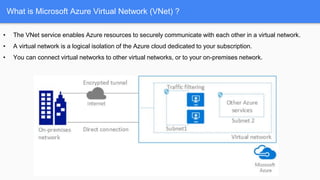
What is Microsoft Azure Virtual Network (VNet) ?
• The VNet service enables Azure resources to securely communicate with each other in a virtual network.
• A virtual network is a logical isolation of the Azure cloud dedicated to your subscription.
• You can connect virtual networks to other virtual networks, or to your on-premises network.
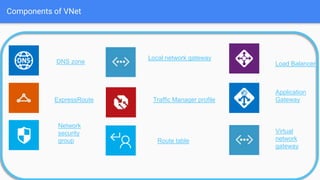
Components of VNet
Network
security
group
ExpressRoute
Route table
DNS zone
Traffic Manager profile
Local network gateway
Virtual
network
gateway
Application
Gateway
Load Balancer
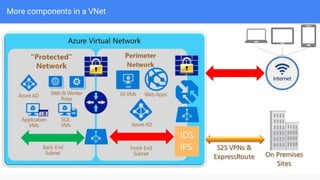
More components in a VNet
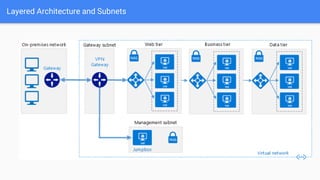
Layered Architecture and Subnets
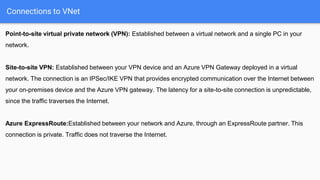
Connections to VNet
Point-to-site virtual private network (VPN): Established between a virtual network and a single PC in your
network.
Site-to-site VPN: Established between your VPN device and an Azure VPN Gateway deployed in a virtual
network. The connection is an IPSec/IKE VPN that provides encrypted communication over the Internet between
your on-premises device and the Azure VPN gateway. The latency for a site-to-site connection is unpredictable,
since the traffic traverses the Internet.
Azure ExpressRoute:Established between your network and Azure, through an ExpressRoute partner. This
connection is private. Traffic does not traverse the Internet.
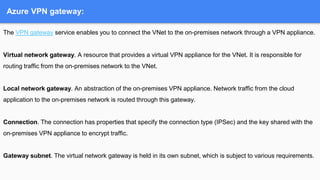
Azure VPN gateway:
The VPN gateway service enables you to connect the VNet to the on-premises network through a VPN appliance.
Virtual network gateway. A resource that provides a virtual VPN appliance for the VNet. It is responsible for
routing traffic from the on-premises network to the VNet.
Local network gateway. An abstraction of the on-premises VPN appliance. Network traffic from the cloud
application to the on-premises network is routed through this gateway.
Connection. The connection has properties that specify the connection type (IPSec) and the key shared with the
on-premises VPN appliance to encrypt traffic.
Gateway subnet. The virtual network gateway is held in its own subnet, which is subject to various requirements.
Network virtual appliances:
• A network virtual appliance is a virtual machine running software that performs a network function, such as a
firewall.
• Network virtual appliances are also available that provide WAN optimization and other network traffic
functions.
• Network virtual appliances are typically used with user-defined or BGP routes.
• You can also use a network virtual appliance to filter traffic between virtual networks.
Network security groups
• A network security group can contain multiple inbound and outbound security rules
• This enables you to filter traffic by source and destination IP address, port, and protocol.
• You can apply a network security group to each network interface in a virtual machine.
• You can also apply a network security group to the subnet a network interface, or other Azure resource, is in.
Components outside VNet
On-premises network. A private local-area network running within an organization.
VPN appliance. A device or service that provides external connectivity to the on-premises network. The VPN
appliance may be a hardware device, or it can be a software solution such as the Routing and Remote Access
Service (RRAS) in Windows Server 2012.
Visit : www.zekeLabs.com for more details
THANK YOU
Let us know how can we help your organization to Upskill the
employees to stay updated in the ever-evolving IT Industry.
Get in touch:
www.zekeLabs.com | +91-8095465880 | info@zekeLabs.com

Azure vnet

  • 1.
  • 2.
  • 3.
    What is MicrosoftAzure Virtual Network (VNet) ? • The VNet service enables Azure resources to securely communicate with each other in a virtual network. • A virtual network is a logical isolation of the Azure cloud dedicated to your subscription. • You can connect virtual networks to other virtual networks, or to your on-premises network.
  • 4.
    Components of VNet Network security group ExpressRoute Routetable DNS zone Traffic Manager profile Local network gateway Virtual network gateway Application Gateway Load Balancer
  • 5.
  • 6.
  • 7.
    Connections to VNet Point-to-sitevirtual private network (VPN): Established between a virtual network and a single PC in your network. Site-to-site VPN: Established between your VPN device and an Azure VPN Gateway deployed in a virtual network. The connection is an IPSec/IKE VPN that provides encrypted communication over the Internet between your on-premises device and the Azure VPN gateway. The latency for a site-to-site connection is unpredictable, since the traffic traverses the Internet. Azure ExpressRoute:Established between your network and Azure, through an ExpressRoute partner. This connection is private. Traffic does not traverse the Internet.
  • 8.
    Azure VPN gateway: TheVPN gateway service enables you to connect the VNet to the on-premises network through a VPN appliance. Virtual network gateway. A resource that provides a virtual VPN appliance for the VNet. It is responsible for routing traffic from the on-premises network to the VNet. Local network gateway. An abstraction of the on-premises VPN appliance. Network traffic from the cloud application to the on-premises network is routed through this gateway. Connection. The connection has properties that specify the connection type (IPSec) and the key shared with the on-premises VPN appliance to encrypt traffic. Gateway subnet. The virtual network gateway is held in its own subnet, which is subject to various requirements.
  • 9.
    Network virtual appliances: •A network virtual appliance is a virtual machine running software that performs a network function, such as a firewall. • Network virtual appliances are also available that provide WAN optimization and other network traffic functions. • Network virtual appliances are typically used with user-defined or BGP routes. • You can also use a network virtual appliance to filter traffic between virtual networks.
  • 10.
    Network security groups •A network security group can contain multiple inbound and outbound security rules • This enables you to filter traffic by source and destination IP address, port, and protocol. • You can apply a network security group to each network interface in a virtual machine. • You can also apply a network security group to the subnet a network interface, or other Azure resource, is in.
  • 11.
    Components outside VNet On-premisesnetwork. A private local-area network running within an organization. VPN appliance. A device or service that provides external connectivity to the on-premises network. The VPN appliance may be a hardware device, or it can be a software solution such as the Routing and Remote Access Service (RRAS) in Windows Server 2012.
  • 12.
    Visit : www.zekeLabs.comfor more details THANK YOU Let us know how can we help your organization to Upskill the employees to stay updated in the ever-evolving IT Industry. Get in touch: www.zekeLabs.com | +91-8095465880 | info@zekeLabs.com