Azure Container Service: not only Docker
Ihor Leontiev, MVP Azure
Azure Architect | Azure MVP
Expert DevOps and ALM – VISEO
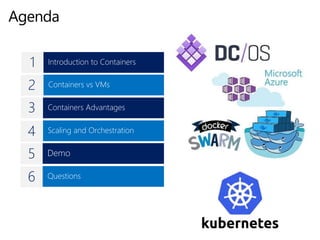
Agenda
Scaling and Orchestration
Containers Advantages
Containers vs VMs
Introduction to Containers
Demo
1
2
3
4
5
Questions6
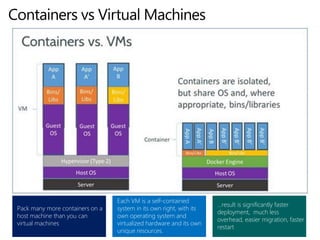
Containers vs Virtual Machines
Pack many more containers on a
host machine than you can
virtual machines
Each VM is a self-contained
system in its own right, with its
own operating system and
virtualized hardware and its own
unique resources.
…result is significantly faster
deployment, much less
overhead, easier migration, faster
restart
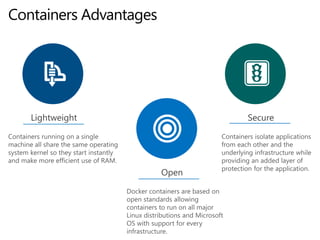
Containers Advantages
Secure
Containers isolate applications
from each other and the
underlying infrastructure while
providing an added layer of
protection for the application.
Open
Docker containers are based on
open standards allowing
containers to run on all major
Linux distributions and Microsoft
OS with support for every
infrastructure.
Lightweight
Containers running on a single
machine all share the same operating
system kernel so they start instantly
and make more efficient use of RAM.
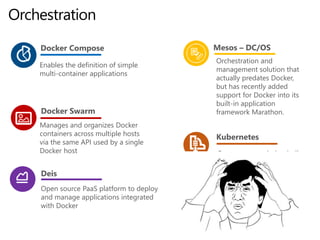
Orchestration
Enables the definition of simple
multi-container applications
Docker Compose
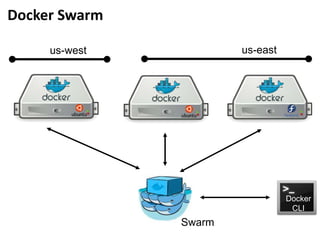
Manages and organizes Docker
containers across multiple hosts
via the same API used by a single
Docker host
Docker Swarm
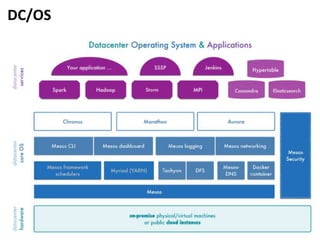
Orchestration and
management solution that
actually predates Docker,
but has recently added
support for Docker into its
built-in application
framework Marathon.
Mesos – DC/OS
Deis
Open source PaaS platform to deploy
and manage applications integrated
with Docker
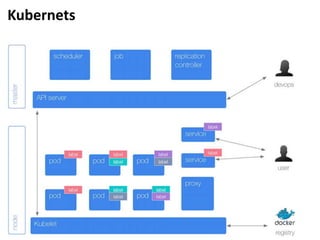
Open-source solution built
by Google offering container
grouping into “Pods” for
management across multiple
hosts, also supported on
Azure
Kubernetes
Orchestration
Docker Swarm
us-west us-east
Docker
CLI
Docker
CLI
Swarm
Kubernets
DC/OS
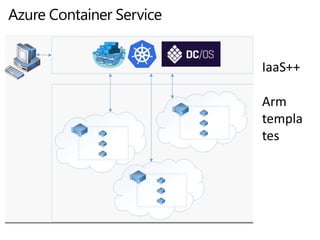
Azure Container Service
IaaS++
Arm
templa
tes
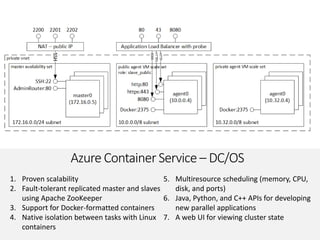
Azure Container Service – DC/OS
1. Proven scalability
2. Fault-tolerant replicated master and slaves
using Apache ZooKeeper
3. Support for Docker-formatted containers
4. Native isolation between tasks with Linux
containers
5. Multiresource scheduling (memory, CPU,
disk, and ports)
6. Java, Python, and C++ APIs for developing
new parallel applications
7. A web UI for viewing cluster state
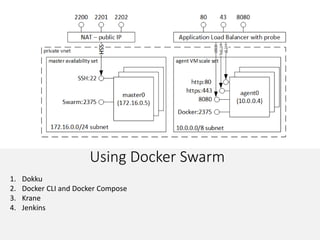
Using Docker Swarm
1. Dokku
2. Docker CLI and Docker Compose
3. Krane
4. Jenkins
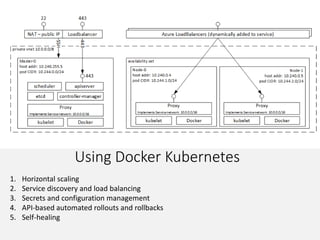
Using Docker Kubernetes
1. Horizontal scaling
2. Service discovery and load balancing
3. Secrets and configuration management
4. API-based automated rollouts and rollbacks
5. Self-healing
Demo

Игорь Леонтьев "Azure Container Service: not only Docker"

  • 1.
    Azure Container Service:not only Docker Ihor Leontiev, MVP Azure Azure Architect | Azure MVP Expert DevOps and ALM – VISEO
  • 2.
    Agenda Scaling and Orchestration ContainersAdvantages Containers vs VMs Introduction to Containers Demo 1 2 3 4 5 Questions6
  • 3.
    Containers vs VirtualMachines Pack many more containers on a host machine than you can virtual machines Each VM is a self-contained system in its own right, with its own operating system and virtualized hardware and its own unique resources. …result is significantly faster deployment, much less overhead, easier migration, faster restart
  • 4.
    Containers Advantages Secure Containers isolateapplications from each other and the underlying infrastructure while providing an added layer of protection for the application. Open Docker containers are based on open standards allowing containers to run on all major Linux distributions and Microsoft OS with support for every infrastructure. Lightweight Containers running on a single machine all share the same operating system kernel so they start instantly and make more efficient use of RAM.
  • 5.
    Orchestration Enables the definitionof simple multi-container applications Docker Compose Manages and organizes Docker containers across multiple hosts via the same API used by a single Docker host Docker Swarm Orchestration and management solution that actually predates Docker, but has recently added support for Docker into its built-in application framework Marathon. Mesos – DC/OS Deis Open source PaaS platform to deploy and manage applications integrated with Docker Open-source solution built by Google offering container grouping into “Pods” for management across multiple hosts, also supported on Azure Kubernetes
  • 6.
  • 7.
  • 8.
  • 9.
  • 10.
  • 11.
    Azure Container Service– DC/OS 1. Proven scalability 2. Fault-tolerant replicated master and slaves using Apache ZooKeeper 3. Support for Docker-formatted containers 4. Native isolation between tasks with Linux containers 5. Multiresource scheduling (memory, CPU, disk, and ports) 6. Java, Python, and C++ APIs for developing new parallel applications 7. A web UI for viewing cluster state
  • 12.
    Using Docker Swarm 1.Dokku 2. Docker CLI and Docker Compose 3. Krane 4. Jenkins
  • 13.
    Using Docker Kubernetes 1.Horizontal scaling 2. Service discovery and load balancing 3. Secrets and configuration management 4. API-based automated rollouts and rollbacks 5. Self-healing
  • 14.

Editor's Notes

  • #10 https://mesosphere.com/blog/2015/09/25/kubernetes-and-the-dcos/