AZEOTROPIC DISTILLATION
The structure and properties of phase equilibrium diagrams for the azeotropic
multi component mixtures are based on the definition of azeotropy. Azeotrope means bubbling
without change in general. This means that the vapor generated in a distillation has the same
composition of the liquid with which it is in equilibrium.
Separation agents used in distillation operations are divided into four categories according to
how the separation is produced:
1. Liquid separating agents that don’t induce liquid phase formation in the ternary mixture.
“Homogeneous azeotropic mixture”
2. Liquid separating agents that induce the formation of two or more liquid phases in the
ternary mixture. “Heterogeneous azeotropic mixture”
3. Separating agents that react with one of the components from the binary azeotropic
mixture (reactive distillation”
4. Separating agents that dissociate ionically in the binary system displacing the Azeotrope.
The residual curve map allows identifying quickly separation alternatives with a process.
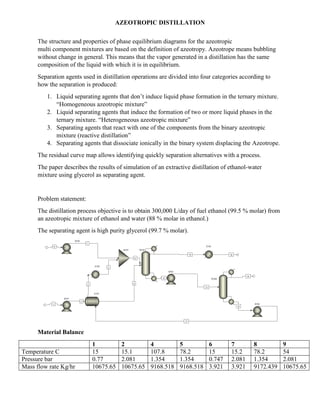
The paper describes the results of simulation of an extractive distillation of ethanol-water
mixture using glycerol as separating agent.
Problem statement:
The distillation process objective is to obtain 300,000 L/day of fuel ethanol (99.5 % molar) from
an azeotropic mixture of ethanol and water (88 % molar in ethanol.)
The separating agent is high purity glycerol (99.7 % molar).
Material Balance
1 2 4 5 6 7 8 9
Temperature C 15 15.1 107.8 78.2 15 15.2 78.2 54
Pressure bar 0.77 2.081 1.354 1.354 0.747 2.081 1.354 2.081
Mass flow rate Kg/hr 10675.65 10675.65 9168.518 9168.518 3.921 3.921 9172.439 10675.65
AZEOTROPIC DISTILLATION
Volume flow cum/hr 13.037 13.04 7.607 7.454 0.003 0.003 7.457 13.811
Mole flow
Ethanol 220 220 0 0 0 0 0 220
Water 30 30 0.5 0.5 0 0 0.5 30
Glycerol 0 0 99.458 99.458 0.043 0.043 99.5 0
10 12 13 14 15 17 18
Temperature C 70.8 146.4 146.4 13.3 159.9 160 15
Pressure bar 0.747 0.763 0.786 0.02 0.02 1.354 0.747
Mass flow rate Kg/hr 10092.57 9755.776 9755.776 587.258 9168.518 9168.518 10092.57
Volume flow cum/hr 13.578 8.385 8.385 0.595 7.902 7.903 12.459
Mole flow
Ethanol 218.9 1.1 1.1 1.1 0 0 218.9
Water 0.447 30.052 30.052 29.552 0.5 0.5 0.447
Glycerol 0 99.503 99.503 0.046 99.458 99.458 0
Energy Balance:
E-101 E-102 E-103 TD-101 TD-102
Condenser reboiler Condenser reboiler
Net duty Gcal/hr 0.278 0.149 0.376 3.33 3.884 0.359 3.88
B-101 B-102 B-103 B-104
Fluid power KW 0.483099878 0.000113423417 0.00528702321 0.292801021
Calculated brake power KW 1.05075186 0.000383630941 0.0134084484 0.760226579
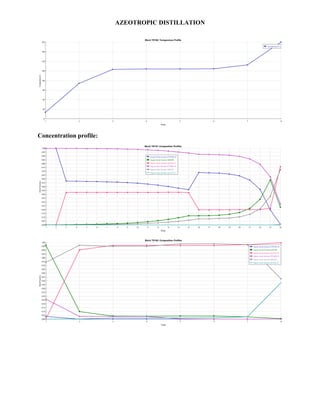
Towers temperature profile:
Block TD101: Temperature Profile
Stage
TemperatureC
1 2 3 4 5 6 7 8 9 10 11 12 13 14 15 16 17 18 19 20 21 22 23 24
70
75
80
85
90
95
100
105
110
115
120
125
130
135
140
145
150
Temperature C
AZEOTROPIC DISTILLATION
Concentration profile:
Block TD102: Temperature Profile
Stage
TemperatureC
1 2 3 4 5 6 7 8
0
20
40
60
80
100
120
140
160
Temperature C
Block TD101: Composition Profiles
Stage
Molefraction
1 2 3 4 5 6 7 8 9 10 11 12 13 14 15 16 17 18 19 20 21 22 23 24
0.00
0.05
0.10
0.15
0.20
0.25
0.30
0.35
0.40
0.45
0.50
0.55
0.60
0.65
0.70
0.75
0.80
0.85
0.90
0.95
1.00
Liquid mole fraction ETHAN-01
Liquid mole fraction WATER
Liquid mole fraction GLYCE-01
Vapor mole fraction ETHAN-01
Vapor mole fraction WATER
Vapor mole fraction GLYCE-01
Block TD102: Composition Profiles
Stage
Molefraction
1 2 3 4 5 6 7 8
0.00
0.05
0.10
0.15
0.20
0.25
0.30
0.35
0.40
0.45
0.50
0.55
0.60
0.65
0.70
0.75
0.80
0.85
0.90
0.95
1.00
Liquid mole fraction ETHAN-01
Liquid mole fraction WATER
Liquid mole fraction GLYCE-01
Vapor mole fraction ETHAN-01
Vapor mole fraction WATER
Vapor mole fraction GLYCE-01
AZEOTROPIC DISTILLATION
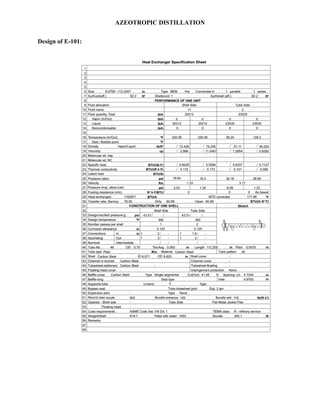
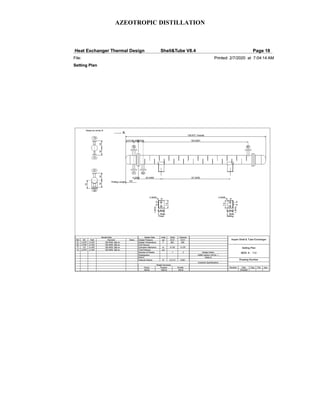
Design of E-101:
AZEOTROPIC DISTILLATION

Azeotropic distillation 1

  • 1.
    AZEOTROPIC DISTILLATION The structureand properties of phase equilibrium diagrams for the azeotropic multi component mixtures are based on the definition of azeotropy. Azeotrope means bubbling without change in general. This means that the vapor generated in a distillation has the same composition of the liquid with which it is in equilibrium. Separation agents used in distillation operations are divided into four categories according to how the separation is produced: 1. Liquid separating agents that don’t induce liquid phase formation in the ternary mixture. “Homogeneous azeotropic mixture” 2. Liquid separating agents that induce the formation of two or more liquid phases in the ternary mixture. “Heterogeneous azeotropic mixture” 3. Separating agents that react with one of the components from the binary azeotropic mixture (reactive distillation” 4. Separating agents that dissociate ionically in the binary system displacing the Azeotrope. The residual curve map allows identifying quickly separation alternatives with a process. The paper describes the results of simulation of an extractive distillation of ethanol-water mixture using glycerol as separating agent. Problem statement: The distillation process objective is to obtain 300,000 L/day of fuel ethanol (99.5 % molar) from an azeotropic mixture of ethanol and water (88 % molar in ethanol.) The separating agent is high purity glycerol (99.7 % molar). Material Balance 1 2 4 5 6 7 8 9 Temperature C 15 15.1 107.8 78.2 15 15.2 78.2 54 Pressure bar 0.77 2.081 1.354 1.354 0.747 2.081 1.354 2.081 Mass flow rate Kg/hr 10675.65 10675.65 9168.518 9168.518 3.921 3.921 9172.439 10675.65
  • 2.
    AZEOTROPIC DISTILLATION Volume flowcum/hr 13.037 13.04 7.607 7.454 0.003 0.003 7.457 13.811 Mole flow Ethanol 220 220 0 0 0 0 0 220 Water 30 30 0.5 0.5 0 0 0.5 30 Glycerol 0 0 99.458 99.458 0.043 0.043 99.5 0 10 12 13 14 15 17 18 Temperature C 70.8 146.4 146.4 13.3 159.9 160 15 Pressure bar 0.747 0.763 0.786 0.02 0.02 1.354 0.747 Mass flow rate Kg/hr 10092.57 9755.776 9755.776 587.258 9168.518 9168.518 10092.57 Volume flow cum/hr 13.578 8.385 8.385 0.595 7.902 7.903 12.459 Mole flow Ethanol 218.9 1.1 1.1 1.1 0 0 218.9 Water 0.447 30.052 30.052 29.552 0.5 0.5 0.447 Glycerol 0 99.503 99.503 0.046 99.458 99.458 0 Energy Balance: E-101 E-102 E-103 TD-101 TD-102 Condenser reboiler Condenser reboiler Net duty Gcal/hr 0.278 0.149 0.376 3.33 3.884 0.359 3.88 B-101 B-102 B-103 B-104 Fluid power KW 0.483099878 0.000113423417 0.00528702321 0.292801021 Calculated brake power KW 1.05075186 0.000383630941 0.0134084484 0.760226579 Towers temperature profile: Block TD101: Temperature Profile Stage TemperatureC 1 2 3 4 5 6 7 8 9 10 11 12 13 14 15 16 17 18 19 20 21 22 23 24 70 75 80 85 90 95 100 105 110 115 120 125 130 135 140 145 150 Temperature C
  • 3.
    AZEOTROPIC DISTILLATION Concentration profile: BlockTD102: Temperature Profile Stage TemperatureC 1 2 3 4 5 6 7 8 0 20 40 60 80 100 120 140 160 Temperature C Block TD101: Composition Profiles Stage Molefraction 1 2 3 4 5 6 7 8 9 10 11 12 13 14 15 16 17 18 19 20 21 22 23 24 0.00 0.05 0.10 0.15 0.20 0.25 0.30 0.35 0.40 0.45 0.50 0.55 0.60 0.65 0.70 0.75 0.80 0.85 0.90 0.95 1.00 Liquid mole fraction ETHAN-01 Liquid mole fraction WATER Liquid mole fraction GLYCE-01 Vapor mole fraction ETHAN-01 Vapor mole fraction WATER Vapor mole fraction GLYCE-01 Block TD102: Composition Profiles Stage Molefraction 1 2 3 4 5 6 7 8 0.00 0.05 0.10 0.15 0.20 0.25 0.30 0.35 0.40 0.45 0.50 0.55 0.60 0.65 0.70 0.75 0.80 0.85 0.90 0.95 1.00 Liquid mole fraction ETHAN-01 Liquid mole fraction WATER Liquid mole fraction GLYCE-01 Vapor mole fraction ETHAN-01 Vapor mole fraction WATER Vapor mole fraction GLYCE-01
  • 4.
  • 5.
  • 6.