AYUSHMAN BHAV
Moderator
Dr. Ginni Agarwal (SR)
Community Medicine Deptt.
PGIMS ROHTAK
Presenter
Dr. Kiran Bhatti(JR 2)
Community Medicine Deptt.
PGIMS ROHTAK
CONTENTS
1. BACKGROUND
2. AYUSHMAN APKE DWAR
3. AYUSHMAN MELAs
4. AYUSHMAN SABHA
5. AYUSHMAN GRAM PANCHAYAT / URBAN WARD
6. SWACHTAABHIYAN AT HEALTH FACILITY
7. PROMOTION OF AYUSHMAN BHAV CAMPAIGN
PROMOTION OF
AYUSHMAN
BHAV CAMPAIGN
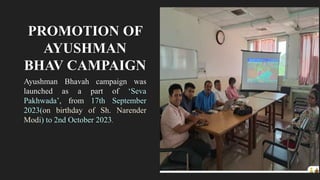
Ayushman Bhavah campaign was
launched as a part of ‘Seva
Pakhwada’, from 17th September
2023(on birthday of Sh. Narender
Modi) to 2nd October 2023.
PROMOTION OF AYUSHMAN BHAV
CAMPAIGN
The District Magistrate, along with the District Health Officer/Chief Medical Officer, to conduct a press
meet on 14th or 15th September to propagate the information & schedule of the various activities to be
conducted during the campaign .
ACTIVITIES:-
1. Gram Sabha to be conducted on 2nd October 2023
2. AB-HWC wise calendar of the themes of weekly Health melas to be organized
3. CHC wise calendar of the Health melas to be organized by Medical Colleges along with specialist
services to be provided
BACKGROUND
 Ayushman Bhavah’ campaign is envisaged to saturate all identified health care services in every
village/ town in line with the commitment of Hon’ble Prime Minister Sh. Narendra Modi ji to
ensure reach to the last mile and enable access to health care services to everyone in the society.
 The soul of India lives in its villages, with more than 65% of the population living in rural areas.
Considering the importance of the village level action, the Government of India initiated
Localizing Sustainable Development Goal (LSDG) as a multi-ministerial initiative .
BACKGROUND
 ‘Healthy Village’ is one of the nine themes in the LSDG initiative.
 The saturation of all services including health initiatives is at the core of ‘leave no one behind’
and ‘leave no village behind’ in line with the principle of ‘Antyodaya’ reaching out to all.
 As cities grow rapidly due to urbanization, urban health has become a critical concern, to deal
with the specific health needs and challenges of urban residents in expanding urban areas.
BACKGROUND
 Ayushman Panchayat in rural and Ayushman Wards in urban areas are envisaged under the umbrella of
Ayushman Bhavah.
 Non- Communicable Diseases (NCDs), Tuberculosis (TB), Routine Immunization coverage and Sickle
Cell Disease (SCD) pose significant challenges in the Indian scenario.
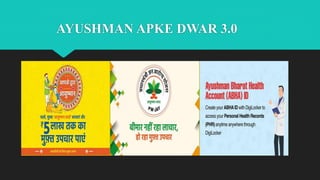
 To build momentum to enhance awareness of Pradhan Mantri Jan Arogya Yojana (PMJAY), ABHA ID
generation and services related to screening and management of non-communicable diseases, TB and
Sickle Cell Disease, Government of India has initiated ‘Ayushman Bhavah’ campaign.
ACTIVITIES UNDER AYUSHMAN BHAV
1. AYUSHMAN APKE DWAR 3.0
2. AYUSHMAN SABHA
3. AYUSHMAN MELA
4. AYUSHMAN GRAM PANCHAYAT/URBAN WARD
AYUSHMAN APKE DWAR 3.0
o ‘Ayushman - Apke Dwar’ initiative 1.0 and 2.0 were successfully undertaken with three key
objectives, namely, improving awareness, increasing Ayushman card penetration, and establishing
continuum of care ultimately leading to increased utilization under the scheme.
o Therefore, it is envisaged to undertake third round of ‘Ayushman - Apke Dwar’ starting from 17th
September for penetrating Ayushman cards provision to all remaining eligible beneficiaries under
PM-JAY scheme to ensure no eligible beneficiary is left out.
AYUSHMAN APKE DWAR 3.0
 Some of the key highlights of the AAD 3.0 drive are as follows:
 Card Creation using Self-registration:
• For AAD 3.0, a revamped IT platform has been created with enhanced feature of self- registration, where eligible
beneficiaries can create and download Ayushman card themselves and their family members.
• Tutorial videos to popularize it through different platforms
 The Self-registration under AAD 3.0 will enable eligible beneficiaries to create Ayushman card for
himself/herself/any of the family member using NHA's IT platform. The user can login into the portal to register
themselves, subsequent to which they can create Ayushman Card. Once the card is approved, the same can be
downloaded from the same portal.
AYUSHMAN APKE DWAR 3.0
 Under AAD 3.0, the Chief Medical Officer under the overall supervision of DG shall be responsible for
devising strategies for Ayushman card saturation in the district and shall prepare village/block wise plan for
Ayushman card saturation. The CMO shall also ensure participation of FLWs like ASHAs during the drive.
 The FLWs shall be targeting to create 100-150 Ayushman cards on a daily basis.
 Massive IEC campaigns including various IEC materials in local/regional languages should be put up to
spread awareness about the card creation.
 If the e-KYC is undertaken by FLWs, NHA shall pay a sum of Rs 5 for every successful e-KYC done.
Further, FLWs shall be paid Rs 3 for every Ayushman card delivered to the beneficiaries.
 Ayushman Bharat - Health and Wellness Centre Level Mela
 Under AB-HWCs, more than 1,60,000 Ayushman Bharat Health and Wellness Centres (AB-
HWCs) have been established by transforming the existing Sub Health Centres and Primary
Health Centres
 They provide an expanded range of primary health care services such as pregnancy related care,
reproductive and child health care, communicable diseases, non- communicable diseases, elderly
care, eye, ear-nose-throat and oral care, emergency care and palliative care, including free
essential drugs and diagnostic services.
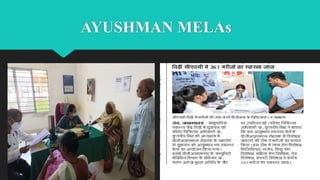
AYUSHMAN MELAs
AYUSHMAN MELAs
 Ayushman Bharat is a flagship program of Government of India, launched in 2018,
translating the policy intent to budgetary commitment, to achieve the Universal Health
Coverage (UHC) underscoring the commitment of “leave no one behind.” Ayushman
Bharat has four pillars, which are:
1. Ayushman Bharat-Health and Wellness Centres (AB-HWC)
2.Ayushman Bharat - Pradhan Mantri Jan Aarogya Yojana (AB-PM-JAY)
3. Pradhan Mantri- Ayushman Bharat Health Infrastructure Mission (PM-ABHIM)
4. Pradhan Mantri- Ayushman Bharat Digital Mission (PM-ABDM) .
AYUSHMAN MELAs
 Organisation of health melas from 17th September 2023 at each of the Ayushman
Bharat - Health and Wellness Centres will optimize the uptake of services.
 The health melas provide platform to people to express their issues and concerns
about the healthcare services and aid people-centric planning and implementation.
 Melas with their wide reach also augment behaviour change among people
through group wellness activities that are integral to such events.
AYUSHMAN MELAs
Objectives of the AB-HWC Health Mela are to:
1. Provide early diagnosis through screening, comprehensive primary health care services with drugs and
diagnostics, teleconsultation with health specialists, and appropriate referrals, with a special focus on
marginalized people, for a continuum of care
2. Build awareness through behavior change communication among the people about health and healthy
lifestyles to maintain well-being and different health schemes and services provided by the Government
3. Bridge the gaps in:
4. Creation of ABHA (Health IDs) and issuance of Ayushman Bharat Cards under PM-JAY for eligible citizens
5. Community-based risk assessment and population-based screening for diseases like hypertension, diabetes,
cancer, cataract, tuberculosis, hepatitis B
6. Routine Immunization
7. Follow-up PM-JAY treated beneficiaries
AYUSHMAN MELAs
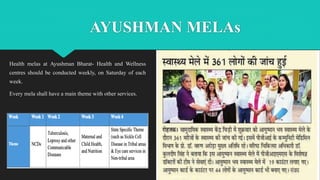
AYUSHMAN MELAs
Health melas at Ayushman Bharat- Health and Wellness
centres should be conducted weekly, on Saturday of each
week.
Every mela shall have a main theme with other services.
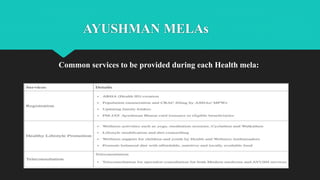
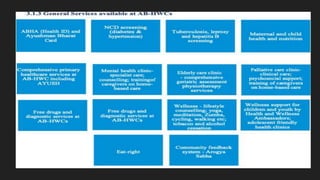
AYUSHMAN MELAs
Common services to be provided during each Health mela:
AYUSHMAN MELAs
Operational Guidelines of Medical Camps to be organized by Medical Colleges at CHC Level
Objective(s)
Engaging Medical Colleges would build a synergism in implementing public health functions and
overall benefitting the community as a whole. The primary objective of the medical camp is to:
1. Provide screening, diagnosis, and basic and advanced health care services through specialized
care, including referrals to tertiary care setup and specialized and diagnostic services.
2. To make available specialist services up to the block level.
3. To enhance the clinical material and training of medical college students/faculty.
AYUSHMAN MELAs
Expected Outcomes:
1. Increased access to specialized care ensure a continuum of Care.
2. Building the trust of the community.
3. Improved health-seeking behaviours and health literacy of the community.
4. Increased ownership of Medical Colleges.
5. Reaching the Unreached: Leaving no one Behind.
AYUSHMAN
MELAs
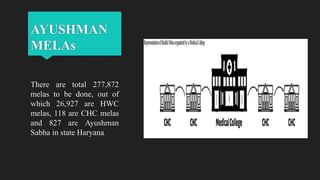
There are total 277,872
melas to be done, out of
which 26,927 are HWC
melas, 118 are CHC melas
and 827 are Ayushman
Sabha in state Haryana.
AYUSHMAN SABHA
Ayushman Sabha is a Gram Panchayat or Urban ward level sabha led by the VHSNC /Ward Committee/ MAS. It shall
ensure saturation coverage of health schemes and optimum healthcare service delivery.
 Objectives of Ayushman Sabha
1. Enhance awareness about the importance of Ayushman cards and their distribution .
2. Generate ABHA IDs.
3. Enhance awareness about the importance of utilizing screening services for NCDs.
4. (Hypertension, Diabetes & three common cancers), TB and sickle cell disease provided through AB-HWCs .
5. Enhance awareness about communicable services and their elimination such as TB, which is treatable and preventable.
6. Social accountability of the Health Systems for the community to express their issues and concerns related to health
services provided at the AB-HWCs.
7. Focus on holistic approach to preventive healthcare, address myths and stigmas.
AYUSHMAN SABHA
ACTIVITES OF AYUSHMAN SABHA:
1. ASHAs wiith support of other stakeholders like AWW, SHG members, youth club members, school
health ambassadors shall mobilize people to participate in the sabha.
2. Health talks for generating awareness regarding the NCDs, TB, Routine Immunization, SCD,
Ayushman Card, ABHA ID, and services related to it available at the AB-HWCs shall be delivered by
the AB-HWC team members.
3. TB Mukt Panchayat: All Panchayats achieve TB free status will be certified as ‘TB Mukt Panchayat’
for 1 Year.
4. A follow up action note will be prepared on issues raised by community which shall include the issue
raised, expected follow up action, expected timeline, person responsible for reporting the follow up
action back to the community.
AYUSHMAN URBAN WARD
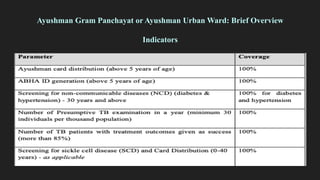
Ayushman Gram Panchayat/ Ayushman Urban Ward is a status awarded to a village /
ward that has been able to achieve the following parameters. A 100% coverage is
envisaged within the given time frame. The indicators will be assessed against the
total population as per the household population enumeration by ASHA.
Ayushman Gram Panchayat or Ayushman Urban Ward: Brief Overview
Indicators
AYUSHMAN URBAN WARD
Key Interventions of Ayushman Gram Panchayat/Ayushman Urban Ward :-
The targets can be achieved by leveraging the services available at the facility level and outreach camps.
Additionally, weekly Health Melas will be utilized to reach the targets. Role of PRIs, VHSNCs/MAS/ Ward
Committee and JAS will be important in social mobilization and community participation to achieve these.
 Ayushman card and ABHA ID generation
 Non-Communicable Disease (Hypertension & Diabetes) screening
 Sickle Cell Disease screening – where applicable
 Screening and treatment of Tuberculosis
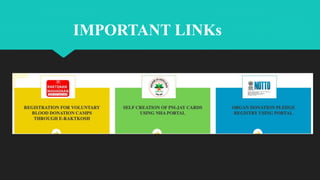
IMPORTANT LINKs
PARTICIPATING PROGRAMS
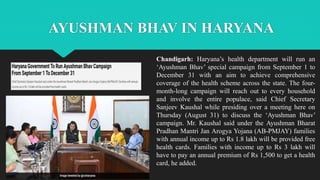
AYUSHMAN BHAV IN HARYANA
Chandigarh: Haryana’s health department will run an
‘Ayushman Bhav’ special campaign from September 1 to
December 31 with an aim to achieve comprehensive
coverage of the health scheme across the state. The four-
month-long campaign will reach out to every household
and involve the entire populace, said Chief Secretary
Sanjeev Kaushal while presiding over a meeting here on
Thursday (August 31) to discuss the ‘Ayushman Bhav’
campaign. Mr. Kaushal said under the Ayushman Bharat
Pradhan Mantri Jan Arogya Yojana (AB-PMJAY) families
with annual income up to Rs 1.8 lakh will be provided free
health cards. Families with income up to Rs 3 lakh will
have to pay an annual premium of Rs 1,500 to get a health
card, he added.
AYUSHMAN BHAV PPT.pptx

AYUSHMAN BHAV PPT.pptx

  • 1.
    AYUSHMAN BHAV Moderator Dr. GinniAgarwal (SR) Community Medicine Deptt. PGIMS ROHTAK Presenter Dr. Kiran Bhatti(JR 2) Community Medicine Deptt. PGIMS ROHTAK
  • 2.
    CONTENTS 1. BACKGROUND 2. AYUSHMANAPKE DWAR 3. AYUSHMAN MELAs 4. AYUSHMAN SABHA 5. AYUSHMAN GRAM PANCHAYAT / URBAN WARD 6. SWACHTAABHIYAN AT HEALTH FACILITY 7. PROMOTION OF AYUSHMAN BHAV CAMPAIGN
  • 3.
    PROMOTION OF AYUSHMAN BHAV CAMPAIGN AyushmanBhavah campaign was launched as a part of ‘Seva Pakhwada’, from 17th September 2023(on birthday of Sh. Narender Modi) to 2nd October 2023.
  • 4.
    PROMOTION OF AYUSHMANBHAV CAMPAIGN The District Magistrate, along with the District Health Officer/Chief Medical Officer, to conduct a press meet on 14th or 15th September to propagate the information & schedule of the various activities to be conducted during the campaign . ACTIVITIES:- 1. Gram Sabha to be conducted on 2nd October 2023 2. AB-HWC wise calendar of the themes of weekly Health melas to be organized 3. CHC wise calendar of the Health melas to be organized by Medical Colleges along with specialist services to be provided
  • 5.
    BACKGROUND  Ayushman Bhavah’campaign is envisaged to saturate all identified health care services in every village/ town in line with the commitment of Hon’ble Prime Minister Sh. Narendra Modi ji to ensure reach to the last mile and enable access to health care services to everyone in the society.  The soul of India lives in its villages, with more than 65% of the population living in rural areas. Considering the importance of the village level action, the Government of India initiated Localizing Sustainable Development Goal (LSDG) as a multi-ministerial initiative .
  • 6.
    BACKGROUND  ‘Healthy Village’is one of the nine themes in the LSDG initiative.  The saturation of all services including health initiatives is at the core of ‘leave no one behind’ and ‘leave no village behind’ in line with the principle of ‘Antyodaya’ reaching out to all.  As cities grow rapidly due to urbanization, urban health has become a critical concern, to deal with the specific health needs and challenges of urban residents in expanding urban areas.
  • 7.
    BACKGROUND  Ayushman Panchayatin rural and Ayushman Wards in urban areas are envisaged under the umbrella of Ayushman Bhavah.  Non- Communicable Diseases (NCDs), Tuberculosis (TB), Routine Immunization coverage and Sickle Cell Disease (SCD) pose significant challenges in the Indian scenario.  To build momentum to enhance awareness of Pradhan Mantri Jan Arogya Yojana (PMJAY), ABHA ID generation and services related to screening and management of non-communicable diseases, TB and Sickle Cell Disease, Government of India has initiated ‘Ayushman Bhavah’ campaign.
  • 8.
    ACTIVITIES UNDER AYUSHMANBHAV 1. AYUSHMAN APKE DWAR 3.0 2. AYUSHMAN SABHA 3. AYUSHMAN MELA 4. AYUSHMAN GRAM PANCHAYAT/URBAN WARD
  • 9.
    AYUSHMAN APKE DWAR3.0 o ‘Ayushman - Apke Dwar’ initiative 1.0 and 2.0 were successfully undertaken with three key objectives, namely, improving awareness, increasing Ayushman card penetration, and establishing continuum of care ultimately leading to increased utilization under the scheme. o Therefore, it is envisaged to undertake third round of ‘Ayushman - Apke Dwar’ starting from 17th September for penetrating Ayushman cards provision to all remaining eligible beneficiaries under PM-JAY scheme to ensure no eligible beneficiary is left out.
  • 10.
    AYUSHMAN APKE DWAR3.0  Some of the key highlights of the AAD 3.0 drive are as follows:  Card Creation using Self-registration: • For AAD 3.0, a revamped IT platform has been created with enhanced feature of self- registration, where eligible beneficiaries can create and download Ayushman card themselves and their family members. • Tutorial videos to popularize it through different platforms  The Self-registration under AAD 3.0 will enable eligible beneficiaries to create Ayushman card for himself/herself/any of the family member using NHA's IT platform. The user can login into the portal to register themselves, subsequent to which they can create Ayushman Card. Once the card is approved, the same can be downloaded from the same portal.
  • 11.
  • 12.
    AYUSHMAN APKE DWAR3.0  Under AAD 3.0, the Chief Medical Officer under the overall supervision of DG shall be responsible for devising strategies for Ayushman card saturation in the district and shall prepare village/block wise plan for Ayushman card saturation. The CMO shall also ensure participation of FLWs like ASHAs during the drive.  The FLWs shall be targeting to create 100-150 Ayushman cards on a daily basis.  Massive IEC campaigns including various IEC materials in local/regional languages should be put up to spread awareness about the card creation.  If the e-KYC is undertaken by FLWs, NHA shall pay a sum of Rs 5 for every successful e-KYC done. Further, FLWs shall be paid Rs 3 for every Ayushman card delivered to the beneficiaries.
  • 13.
     Ayushman Bharat- Health and Wellness Centre Level Mela  Under AB-HWCs, more than 1,60,000 Ayushman Bharat Health and Wellness Centres (AB- HWCs) have been established by transforming the existing Sub Health Centres and Primary Health Centres  They provide an expanded range of primary health care services such as pregnancy related care, reproductive and child health care, communicable diseases, non- communicable diseases, elderly care, eye, ear-nose-throat and oral care, emergency care and palliative care, including free essential drugs and diagnostic services. AYUSHMAN MELAs
  • 14.
    AYUSHMAN MELAs  AyushmanBharat is a flagship program of Government of India, launched in 2018, translating the policy intent to budgetary commitment, to achieve the Universal Health Coverage (UHC) underscoring the commitment of “leave no one behind.” Ayushman Bharat has four pillars, which are: 1. Ayushman Bharat-Health and Wellness Centres (AB-HWC) 2.Ayushman Bharat - Pradhan Mantri Jan Aarogya Yojana (AB-PM-JAY) 3. Pradhan Mantri- Ayushman Bharat Health Infrastructure Mission (PM-ABHIM) 4. Pradhan Mantri- Ayushman Bharat Digital Mission (PM-ABDM) .
  • 15.
    AYUSHMAN MELAs  Organisationof health melas from 17th September 2023 at each of the Ayushman Bharat - Health and Wellness Centres will optimize the uptake of services.  The health melas provide platform to people to express their issues and concerns about the healthcare services and aid people-centric planning and implementation.  Melas with their wide reach also augment behaviour change among people through group wellness activities that are integral to such events.
  • 16.
    AYUSHMAN MELAs Objectives ofthe AB-HWC Health Mela are to: 1. Provide early diagnosis through screening, comprehensive primary health care services with drugs and diagnostics, teleconsultation with health specialists, and appropriate referrals, with a special focus on marginalized people, for a continuum of care 2. Build awareness through behavior change communication among the people about health and healthy lifestyles to maintain well-being and different health schemes and services provided by the Government 3. Bridge the gaps in: 4. Creation of ABHA (Health IDs) and issuance of Ayushman Bharat Cards under PM-JAY for eligible citizens 5. Community-based risk assessment and population-based screening for diseases like hypertension, diabetes, cancer, cataract, tuberculosis, hepatitis B 6. Routine Immunization 7. Follow-up PM-JAY treated beneficiaries
  • 17.
  • 18.
    AYUSHMAN MELAs Health melasat Ayushman Bharat- Health and Wellness centres should be conducted weekly, on Saturday of each week. Every mela shall have a main theme with other services.
  • 19.
    AYUSHMAN MELAs Common servicesto be provided during each Health mela:
  • 21.
    AYUSHMAN MELAs Operational Guidelinesof Medical Camps to be organized by Medical Colleges at CHC Level Objective(s) Engaging Medical Colleges would build a synergism in implementing public health functions and overall benefitting the community as a whole. The primary objective of the medical camp is to: 1. Provide screening, diagnosis, and basic and advanced health care services through specialized care, including referrals to tertiary care setup and specialized and diagnostic services. 2. To make available specialist services up to the block level. 3. To enhance the clinical material and training of medical college students/faculty.
  • 22.
    AYUSHMAN MELAs Expected Outcomes: 1.Increased access to specialized care ensure a continuum of Care. 2. Building the trust of the community. 3. Improved health-seeking behaviours and health literacy of the community. 4. Increased ownership of Medical Colleges. 5. Reaching the Unreached: Leaving no one Behind.
  • 23.
    AYUSHMAN MELAs There are total277,872 melas to be done, out of which 26,927 are HWC melas, 118 are CHC melas and 827 are Ayushman Sabha in state Haryana.
  • 24.
    AYUSHMAN SABHA Ayushman Sabhais a Gram Panchayat or Urban ward level sabha led by the VHSNC /Ward Committee/ MAS. It shall ensure saturation coverage of health schemes and optimum healthcare service delivery.  Objectives of Ayushman Sabha 1. Enhance awareness about the importance of Ayushman cards and their distribution . 2. Generate ABHA IDs. 3. Enhance awareness about the importance of utilizing screening services for NCDs. 4. (Hypertension, Diabetes & three common cancers), TB and sickle cell disease provided through AB-HWCs . 5. Enhance awareness about communicable services and their elimination such as TB, which is treatable and preventable. 6. Social accountability of the Health Systems for the community to express their issues and concerns related to health services provided at the AB-HWCs. 7. Focus on holistic approach to preventive healthcare, address myths and stigmas.
  • 25.
    AYUSHMAN SABHA ACTIVITES OFAYUSHMAN SABHA: 1. ASHAs wiith support of other stakeholders like AWW, SHG members, youth club members, school health ambassadors shall mobilize people to participate in the sabha. 2. Health talks for generating awareness regarding the NCDs, TB, Routine Immunization, SCD, Ayushman Card, ABHA ID, and services related to it available at the AB-HWCs shall be delivered by the AB-HWC team members. 3. TB Mukt Panchayat: All Panchayats achieve TB free status will be certified as ‘TB Mukt Panchayat’ for 1 Year. 4. A follow up action note will be prepared on issues raised by community which shall include the issue raised, expected follow up action, expected timeline, person responsible for reporting the follow up action back to the community.
  • 26.
    AYUSHMAN URBAN WARD AyushmanGram Panchayat/ Ayushman Urban Ward is a status awarded to a village / ward that has been able to achieve the following parameters. A 100% coverage is envisaged within the given time frame. The indicators will be assessed against the total population as per the household population enumeration by ASHA.
  • 27.
    Ayushman Gram Panchayator Ayushman Urban Ward: Brief Overview Indicators
  • 28.
    AYUSHMAN URBAN WARD KeyInterventions of Ayushman Gram Panchayat/Ayushman Urban Ward :- The targets can be achieved by leveraging the services available at the facility level and outreach camps. Additionally, weekly Health Melas will be utilized to reach the targets. Role of PRIs, VHSNCs/MAS/ Ward Committee and JAS will be important in social mobilization and community participation to achieve these.  Ayushman card and ABHA ID generation  Non-Communicable Disease (Hypertension & Diabetes) screening  Sickle Cell Disease screening – where applicable  Screening and treatment of Tuberculosis
  • 29.
  • 30.
  • 31.
    AYUSHMAN BHAV INHARYANA Chandigarh: Haryana’s health department will run an ‘Ayushman Bhav’ special campaign from September 1 to December 31 with an aim to achieve comprehensive coverage of the health scheme across the state. The four- month-long campaign will reach out to every household and involve the entire populace, said Chief Secretary Sanjeev Kaushal while presiding over a meeting here on Thursday (August 31) to discuss the ‘Ayushman Bhav’ campaign. Mr. Kaushal said under the Ayushman Bharat Pradhan Mantri Jan Arogya Yojana (AB-PMJAY) families with annual income up to Rs 1.8 lakh will be provided free health cards. Families with income up to Rs 3 lakh will have to pay an annual premium of Rs 1,500 to get a health card, he added.