Introduction to SEIR Models
Nakul Chitnis
Workshop on Mathematical Models of Climate Variability,
Environmental Change and Infectious Diseases
Trieste, Italy
8 May 2017
Department of Epidemiology and Public Health
Health Systems Research and
Dynamical Modelling Unit
Outline
SI Model
SIS Model
The Basic Reproductive Number (R0)
SIR Model
SEIR Model
2017-05-08 2
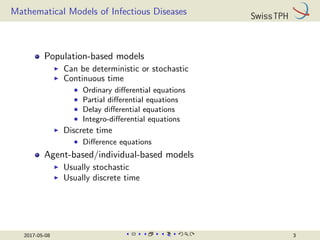
Mathematical Models of Infectious Diseases
Population-based models
I Can be deterministic or stochastic
I Continuous time
• Ordinary differential equations
• Partial differential equations
• Delay differential equations
• Integro-differential equations
I Discrete time
• Difference equations
Agent-based/individual-based models
I Usually stochastic
I Usually discrete time
2017-05-08 3
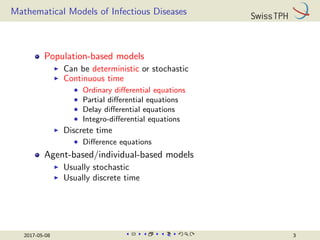
Mathematical Models of Infectious Diseases
Population-based models
I Can be deterministic or stochastic
I Continuous time
• Ordinary differential equations
• Partial differential equations
• Delay differential equations
• Integro-differential equations
I Discrete time
• Difference equations
Agent-based/individual-based models
I Usually stochastic
I Usually discrete time
2017-05-08 3
Outline
SI Model
SIS Model
The Basic Reproductive Number (R0)
SIR Model
SEIR Model
2017-05-08 4
SI Model
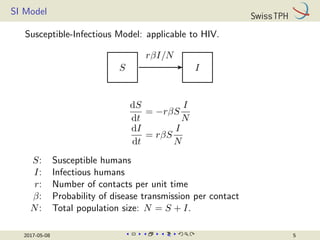
Susceptible-Infectious Model: applicable to HIV.
S I
rβI/N
dS
dt
= −rβS
I
N
dI
dt
= rβS
I
N
S: Susceptible humans
I: Infectious humans
r: Number of contacts per unit time
β: Probability of disease transmission per contact
N: Total population size: N = S + I.
2017-05-08 5
Analyzing the SI Model
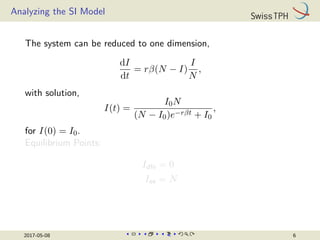
The system can be reduced to one dimension,
dI
dt
= rβ(N − I)
I
N
,
with solution,
I(t) =
I0N
(N − I0)e−rβt + I0
,
for I(0) = I0.
Equilibrium Points:
Idfe = 0
Iee = N
2017-05-08 6
Analyzing the SI Model
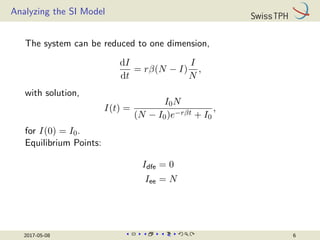
The system can be reduced to one dimension,
dI
dt
= rβ(N − I)
I
N
,
with solution,
I(t) =
I0N
(N − I0)e−rβt + I0
,
for I(0) = I0.
Equilibrium Points:
Idfe = 0
Iee = N
2017-05-08 6
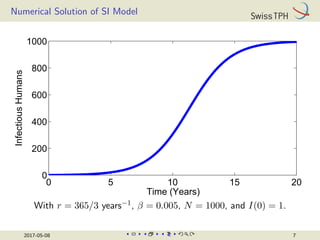
Numerical Solution of SI Model
0 5 10 15 20
0
200
400
600
800
1000
Time (Years)
Infectious
Humans
With r = 365/3 years−1, β = 0.005, N = 1000, and I(0) = 1.
2017-05-08 7
Definition of Transmission Parameters
Note that in some models, usually of diseases where contacts
are not well defined, rβ (the number of contacts per unit time
multiplied by the probability of disease transmission per
contact) are combined into one parameter (often also called β
— the number of adequate contacts per unit time).
For diseases where a contact is well defined (such as sexually
transmitted diseases like HIV or vector-borne diseases like
malaria), it is usually more appropriate to separate the contact
rate, r, and the probability of transmission per contact, β.
For diseases where contacts are not well defined (such as
air-borne diseases like influenza) it is usually more appropriate
to combine the two into one parameter.
2017-05-08 8
Outline
SI Model
SIS Model
The Basic Reproductive Number (R0)
SIR Model
SEIR Model
2017-05-08 9
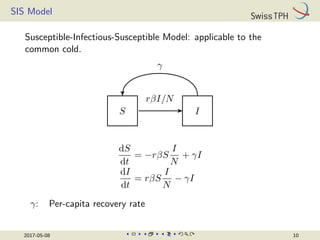
SIS Model
Susceptible-Infectious-Susceptible Model: applicable to the
common cold.
S I
rβI/N
γ
dS
dt
= −rβS
I
N
+ γI
dI
dt
= rβS
I
N
− γI
γ: Per-capita recovery rate
2017-05-08 10
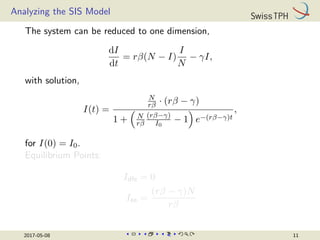
Analyzing the SIS Model
The system can be reduced to one dimension,
dI
dt
= rβ(N − I)
I
N
− γI,
with solution,
I(t) =
N
rβ · (rβ − γ)
1 +

N
rβ
(rβ−γ)
I0
− 1

e−(rβ−γ)t
,
for I(0) = I0.
Equilibrium Points:
Idfe = 0
Iee =
(rβ − γ)N
rβ
2017-05-08 11
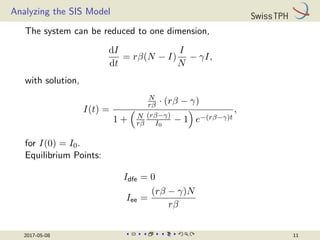
Analyzing the SIS Model
The system can be reduced to one dimension,
dI
dt
= rβ(N − I)
I
N
− γI,
with solution,
I(t) =
N
rβ · (rβ − γ)
1 +

N
rβ
(rβ−γ)
I0
− 1

e−(rβ−γ)t
,
for I(0) = I0.
Equilibrium Points:
Idfe = 0
Iee =
(rβ − γ)N
rβ
2017-05-08 11
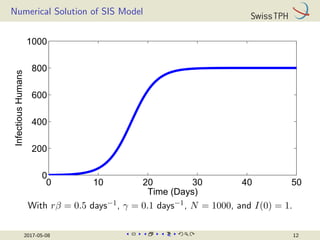
Numerical Solution of SIS Model
0 10 20 30 40 50
0
200
400
600
800
1000
Time (Days)
Infectious
Humans
With rβ = 0.5 days−1, γ = 0.1 days−1, N = 1000, and I(0) = 1.
2017-05-08 12
Outline
SI Model
SIS Model
The Basic Reproductive Number (R0)
SIR Model
SEIR Model
2017-05-08 13
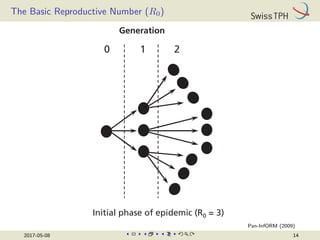
The Basic Reproductive Number (R0)
of uncertainty that may be prioritized for urgent res
Disease is ende
Initial phase of epidemic (R0 = 3)
Generation
0 1 2
Pan-InfORM (2009)
2017-05-08 14
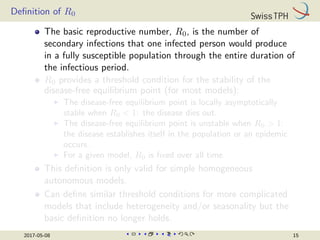
Definition of R0
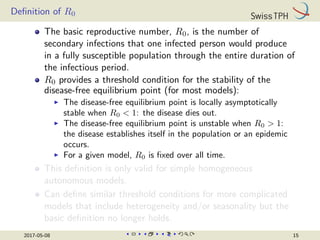
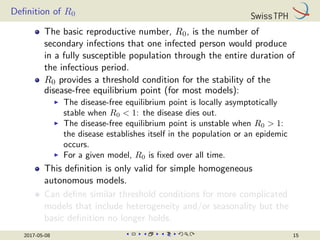
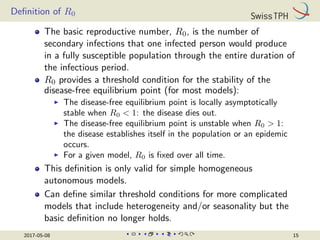
The basic reproductive number, R0, is the number of
secondary infections that one infected person would produce
in a fully susceptible population through the entire duration of
the infectious period.
R0 provides a threshold condition for the stability of the
disease-free equilibrium point (for most models):
I The disease-free equilibrium point is locally asymptotically
stable when R0  1: the disease dies out.
I The disease-free equilibrium point is unstable when R0  1:
the disease establishes itself in the population or an epidemic
occurs.
I For a given model, R0 is fixed over all time.
This definition is only valid for simple homogeneous
autonomous models.
Can define similar threshold conditions for more complicated
models that include heterogeneity and/or seasonality but the
basic definition no longer holds.
2017-05-08 15
Definition of R0
The basic reproductive number, R0, is the number of
secondary infections that one infected person would produce
in a fully susceptible population through the entire duration of
the infectious period.
R0 provides a threshold condition for the stability of the
disease-free equilibrium point (for most models):
I The disease-free equilibrium point is locally asymptotically
stable when R0  1: the disease dies out.
I The disease-free equilibrium point is unstable when R0  1:
the disease establishes itself in the population or an epidemic
occurs.
I For a given model, R0 is fixed over all time.
This definition is only valid for simple homogeneous
autonomous models.
Can define similar threshold conditions for more complicated
models that include heterogeneity and/or seasonality but the
basic definition no longer holds.
2017-05-08 15
Definition of R0
The basic reproductive number, R0, is the number of
secondary infections that one infected person would produce
in a fully susceptible population through the entire duration of
the infectious period.
R0 provides a threshold condition for the stability of the
disease-free equilibrium point (for most models):
I The disease-free equilibrium point is locally asymptotically
stable when R0  1: the disease dies out.
I The disease-free equilibrium point is unstable when R0  1:
the disease establishes itself in the population or an epidemic
occurs.
I For a given model, R0 is fixed over all time.
This definition is only valid for simple homogeneous
autonomous models.
Can define similar threshold conditions for more complicated
models that include heterogeneity and/or seasonality but the
basic definition no longer holds.
2017-05-08 15
Definition of R0
The basic reproductive number, R0, is the number of
secondary infections that one infected person would produce
in a fully susceptible population through the entire duration of
the infectious period.
R0 provides a threshold condition for the stability of the
disease-free equilibrium point (for most models):
I The disease-free equilibrium point is locally asymptotically
stable when R0  1: the disease dies out.
I The disease-free equilibrium point is unstable when R0  1:
the disease establishes itself in the population or an epidemic
occurs.
I For a given model, R0 is fixed over all time.
This definition is only valid for simple homogeneous
autonomous models.
Can define similar threshold conditions for more complicated
models that include heterogeneity and/or seasonality but the
basic definition no longer holds.
2017-05-08 15
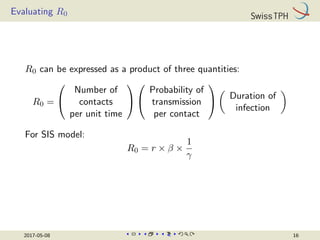
Evaluating R0
R0 can be expressed as a product of three quantities:
R0 =


Number of
contacts
per unit time




Probability of
transmission
per contact



Duration of
infection

For SIS model:
R0 = r × β ×
1
γ
2017-05-08 16
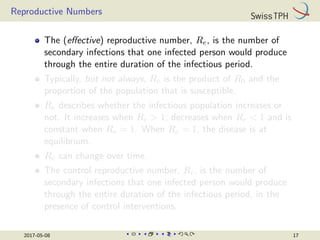
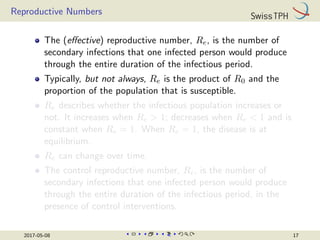
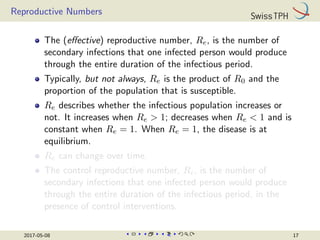
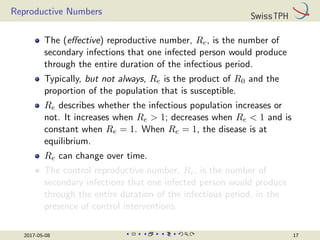
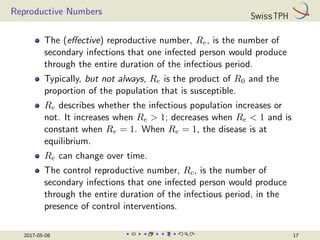
Reproductive Numbers
The (effective) reproductive number, Re, is the number of
secondary infections that one infected person would produce
through the entire duration of the infectious period.
Typically, but not always, Re is the product of R0 and the
proportion of the population that is susceptible.
Re describes whether the infectious population increases or
not. It increases when Re  1; decreases when Re  1 and is
constant when Re = 1. When Re = 1, the disease is at
equilibrium.
Re can change over time.
The control reproductive number, Rc, is the number of
secondary infections that one infected person would produce
through the entire duration of the infectious period, in the
presence of control interventions.
2017-05-08 17
Reproductive Numbers
The (effective) reproductive number, Re, is the number of
secondary infections that one infected person would produce
through the entire duration of the infectious period.
Typically, but not always, Re is the product of R0 and the
proportion of the population that is susceptible.
Re describes whether the infectious population increases or
not. It increases when Re  1; decreases when Re  1 and is
constant when Re = 1. When Re = 1, the disease is at
equilibrium.
Re can change over time.
The control reproductive number, Rc, is the number of
secondary infections that one infected person would produce
through the entire duration of the infectious period, in the
presence of control interventions.
2017-05-08 17
Reproductive Numbers
The (effective) reproductive number, Re, is the number of
secondary infections that one infected person would produce
through the entire duration of the infectious period.
Typically, but not always, Re is the product of R0 and the
proportion of the population that is susceptible.
Re describes whether the infectious population increases or
not. It increases when Re  1; decreases when Re  1 and is
constant when Re = 1. When Re = 1, the disease is at
equilibrium.
Re can change over time.
The control reproductive number, Rc, is the number of
secondary infections that one infected person would produce
through the entire duration of the infectious period, in the
presence of control interventions.
2017-05-08 17
Reproductive Numbers
The (effective) reproductive number, Re, is the number of
secondary infections that one infected person would produce
through the entire duration of the infectious period.
Typically, but not always, Re is the product of R0 and the
proportion of the population that is susceptible.
Re describes whether the infectious population increases or
not. It increases when Re  1; decreases when Re  1 and is
constant when Re = 1. When Re = 1, the disease is at
equilibrium.
Re can change over time.
The control reproductive number, Rc, is the number of
secondary infections that one infected person would produce
through the entire duration of the infectious period, in the
presence of control interventions.
2017-05-08 17
Reproductive Numbers
The (effective) reproductive number, Re, is the number of
secondary infections that one infected person would produce
through the entire duration of the infectious period.
Typically, but not always, Re is the product of R0 and the
proportion of the population that is susceptible.
Re describes whether the infectious population increases or
not. It increases when Re  1; decreases when Re  1 and is
constant when Re = 1. When Re = 1, the disease is at
equilibrium.
Re can change over time.
The control reproductive number, Rc, is the number of
secondary infections that one infected person would produce
through the entire duration of the infectious period, in the
presence of control interventions.
2017-05-08 17
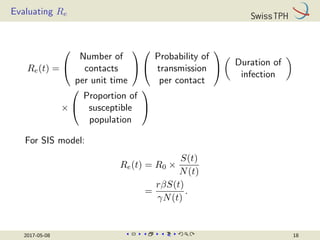
Evaluating Re
Re(t) =


Number of
contacts
per unit time




Probability of
transmission
per contact



Duration of
infection

×


Proportion of
susceptible
population


For SIS model:
Re(t) = R0 ×
S(t)
N(t)
=
rβS(t)
γN(t)
.
2017-05-08 18
The Basic Reproductive Number (R0)
http://www.cameroonweb.com/CameroonHomePage/NewsArchive/Ebola-How-does-it-compare-316932
2017-05-08 19
Outline
SI Model
SIS Model
The Basic Reproductive Number (R0)
SIR Model
SEIR Model
2017-05-08 20
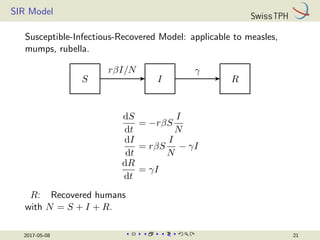
SIR Model
Susceptible-Infectious-Recovered Model: applicable to measles,
mumps, rubella.
S I R
rβI/N γ
dS
dt
= −rβS
I
N
dI
dt
= rβS
I
N
− γI
dR
dt
= γI
R: Recovered humans
with N = S + I + R.
2017-05-08 21
Analyzing the SIR Model
Can reduce to two dimensions by ignoring the equation for R
and using R = N − S − I.
Can no longer analytically solve these equations.
Infinite number of equilibrium points with I∗ = 0.
Perform phase portrait analysis.
Estimate final epidemic size.
2017-05-08 22
R0 for the SIR Model
R0 =


Number of
contacts
per unit time




Probability of
transmission
per contact



Duration of
infection

R0 = r × β ×
1
γ
=
rβ
γ
If R0  1, introduced cases do not lead to an epidemic (the
number of infectious individuals decreases towards 0).
If R0  1, introduced cases can lead to an epidemic
(temporary increase in the number of infectious individuals).
Re(t) =
rβ
γ
S(t)
N
2017-05-08 23
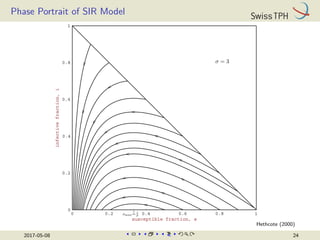
Phase Portrait of SIR Model
THE MATHEMATICS OF INFECTIOUS DISEASES 605
0 0.2 0.4 0.6 0.8 1
susceptible fraction, s
0
0.2
0.4
0.6
0.8
1
infective
fraction,
i
smax
↑
= 1
σ
σ = 3
Fig. 2 Phase plane portrait for the classic SIR epidemic model with contact number σ = 3.
Hethcote (2000)
2017-05-08 24
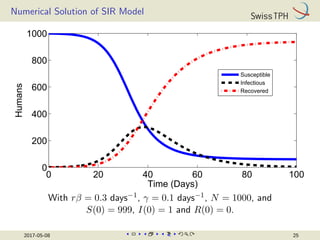
Numerical Solution of SIR Model
0 20 40 60 80 100
0
200
400
600
800
1000
Time (Days)
Humans
Susceptible
Infectious
Recovered
With rβ = 0.3 days−1, γ = 0.1 days−1, N = 1000, and
S(0) = 999, I(0) = 1 and R(0) = 0.
2017-05-08 25
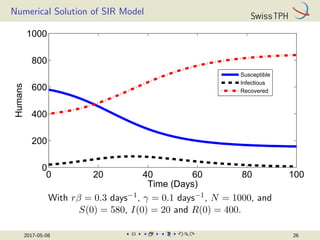
Numerical Solution of SIR Model
0 20 40 60 80 100
0
200
400
600
800
1000
Time (Days)
Humans
Susceptible
Infectious
Recovered
With rβ = 0.3 days−1, γ = 0.1 days−1, N = 1000, and
S(0) = 580, I(0) = 20 and R(0) = 400.
2017-05-08 26
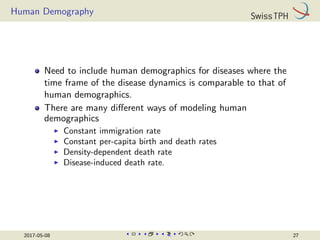
Human Demography
Need to include human demographics for diseases where the
time frame of the disease dynamics is comparable to that of
human demographics.
There are many different ways of modeling human
demographics
I Constant immigration rate
I Constant per-capita birth and death rates
I Density-dependent death rate
I Disease-induced death rate.
2017-05-08 27
Endemic SIR Model
S I R
rβI/N γ
Birth
Death Death Death
Λ
µ µ µ
dS
dt
= Λ − rβS
I
N
− µS
dI
dt
= rβS
I
N
− γI − µI
dR
dt
= γI − µR
N = S + I + R
Λ: Constant recruitment rate
µ: Per-capita removal rate
2017-05-08 28
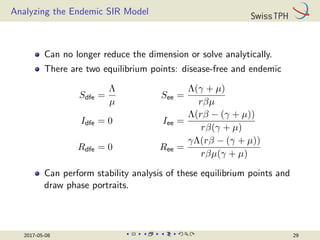
Analyzing the Endemic SIR Model
Can no longer reduce the dimension or solve analytically.
There are two equilibrium points: disease-free and endemic
Sdfe =
Λ
µ
See =
Λ(γ + µ)
rβµ
Idfe = 0 Iee =
Λ(rβ − (γ + µ))
rβ(γ + µ)
Rdfe = 0 Ree =
γΛ(rβ − (γ + µ))
rβµ(γ + µ)
Can perform stability analysis of these equilibrium points and
draw phase portraits.
2017-05-08 29
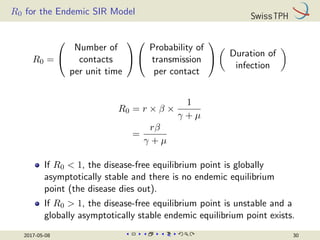
R0 for the Endemic SIR Model
R0 =


Number of
contacts
per unit time




Probability of
transmission
per contact



Duration of
infection

R0 = r × β ×
1
γ + µ
=
rβ
γ + µ
If R0  1, the disease-free equilibrium point is globally
asymptotically stable and there is no endemic equilibrium
point (the disease dies out).
If R0  1, the disease-free equilibrium point is unstable and a
globally asymptotically stable endemic equilibrium point exists.
2017-05-08 30
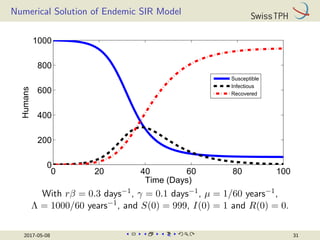
Numerical Solution of Endemic SIR Model
0 20 40 60 80 100
0
200
400
600
800
1000
Time (Days)
Humans
Susceptible
Infectious
Recovered
With rβ = 0.3 days−1, γ = 0.1 days−1, µ = 1/60 years−1,
Λ = 1000/60 years−1, and S(0) = 999, I(0) = 1 and R(0) = 0.
2017-05-08 31
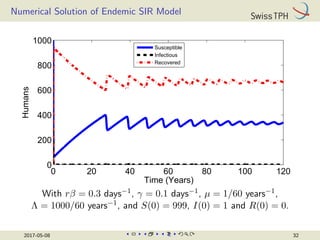
Numerical Solution of Endemic SIR Model
0 20 40 60 80 100 120
0
200
400
600
800
1000
Time (Years)
Humans
Susceptible
Infectious
Recovered
With rβ = 0.3 days−1, γ = 0.1 days−1, µ = 1/60 years−1,
Λ = 1000/60 years−1, and S(0) = 999, I(0) = 1 and R(0) = 0.
2017-05-08 32
Outline
SI Model
SIS Model
The Basic Reproductive Number (R0)
SIR Model
SEIR Model
2017-05-08 33
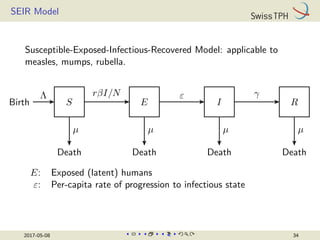
SEIR Model
Susceptible-Exposed-Infectious-Recovered Model: applicable to
measles, mumps, rubella.
S E I R
rβI/N ε γ
Birth
Death Death Death Death
Λ
µ µ µ µ
E: Exposed (latent) humans
ε: Per-capita rate of progression to infectious state
2017-05-08 34
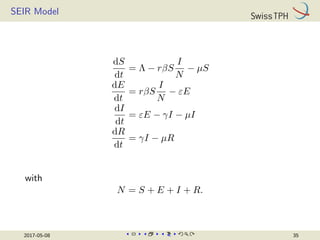
SEIR Model
dS
dt
= Λ − rβS
I
N
− µS
dE
dt
= rβS
I
N
− εE
dI
dt
= εE − γI − µI
dR
dt
= γI − µR
with
N = S + E + I + R.
2017-05-08 35
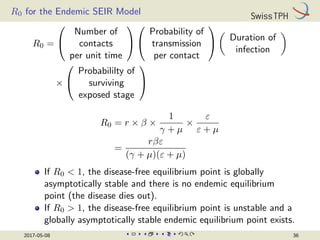
R0 for the Endemic SEIR Model
R0 =


Number of
contacts
per unit time




Probability of
transmission
per contact



Duration of
infection

×


Probabililty of
surviving
exposed stage


R0 = r × β ×
1
γ + µ
×
ε
ε + µ
=
rβε
(γ + µ)(ε + µ)
If R0  1, the disease-free equilibrium point is globally
asymptotically stable and there is no endemic equilibrium
point (the disease dies out).
If R0  1, the disease-free equilibrium point is unstable and a
globally asymptotically stable endemic equilibrium point exists.
2017-05-08 36
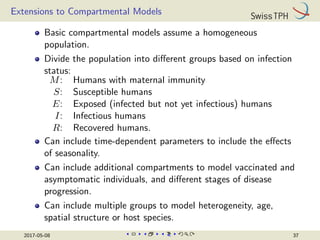
Extensions to Compartmental Models
Basic compartmental models assume a homogeneous
population.
Divide the population into different groups based on infection
status:
M: Humans with maternal immunity
S: Susceptible humans
E: Exposed (infected but not yet infectious) humans
I: Infectious humans
R: Recovered humans.
Can include time-dependent parameters to include the effects
of seasonality.
Can include additional compartments to model vaccinated and
asymptomatic individuals, and different stages of disease
progression.
Can include multiple groups to model heterogeneity, age,
spatial structure or host species.
2017-05-08 37
References
O. Diekmann, H. Heesterbeek, and T. Britton, Mathematical Tools for
Understanding Infectious Disease Dynamics.
Princeton Series in Theoretical and Computational Biology. Princeton University
Press, Princeton, (2013).
H. W. Hethcote, “The mathematics of infectious diseases”, SIAM Review 42,
599–653 (2000).
M. J. Keeling and P. Rohani, Modeling Infectious Diseases in Humans and
Animals.
Princeton University Press, Princeton, (2007).
2017-05-08 38

CHITNIS_017-05-08-MMCVECID-Intro SEIR.pdf

  • 1.
    Introduction to SEIRModels Nakul Chitnis Workshop on Mathematical Models of Climate Variability, Environmental Change and Infectious Diseases Trieste, Italy 8 May 2017 Department of Epidemiology and Public Health Health Systems Research and Dynamical Modelling Unit
  • 2.
    Outline SI Model SIS Model TheBasic Reproductive Number (R0) SIR Model SEIR Model 2017-05-08 2
  • 3.
    Mathematical Models ofInfectious Diseases Population-based models I Can be deterministic or stochastic I Continuous time • Ordinary differential equations • Partial differential equations • Delay differential equations • Integro-differential equations I Discrete time • Difference equations Agent-based/individual-based models I Usually stochastic I Usually discrete time 2017-05-08 3
  • 4.
    Mathematical Models ofInfectious Diseases Population-based models I Can be deterministic or stochastic I Continuous time • Ordinary differential equations • Partial differential equations • Delay differential equations • Integro-differential equations I Discrete time • Difference equations Agent-based/individual-based models I Usually stochastic I Usually discrete time 2017-05-08 3
  • 5.
    Outline SI Model SIS Model TheBasic Reproductive Number (R0) SIR Model SEIR Model 2017-05-08 4
  • 6.
    SI Model Susceptible-Infectious Model:applicable to HIV. S I rβI/N dS dt = −rβS I N dI dt = rβS I N S: Susceptible humans I: Infectious humans r: Number of contacts per unit time β: Probability of disease transmission per contact N: Total population size: N = S + I. 2017-05-08 5
  • 7.
    Analyzing the SIModel The system can be reduced to one dimension, dI dt = rβ(N − I) I N , with solution, I(t) = I0N (N − I0)e−rβt + I0 , for I(0) = I0. Equilibrium Points: Idfe = 0 Iee = N 2017-05-08 6
  • 8.
    Analyzing the SIModel The system can be reduced to one dimension, dI dt = rβ(N − I) I N , with solution, I(t) = I0N (N − I0)e−rβt + I0 , for I(0) = I0. Equilibrium Points: Idfe = 0 Iee = N 2017-05-08 6
  • 9.
    Numerical Solution ofSI Model 0 5 10 15 20 0 200 400 600 800 1000 Time (Years) Infectious Humans With r = 365/3 years−1, β = 0.005, N = 1000, and I(0) = 1. 2017-05-08 7
  • 10.
    Definition of TransmissionParameters Note that in some models, usually of diseases where contacts are not well defined, rβ (the number of contacts per unit time multiplied by the probability of disease transmission per contact) are combined into one parameter (often also called β — the number of adequate contacts per unit time). For diseases where a contact is well defined (such as sexually transmitted diseases like HIV or vector-borne diseases like malaria), it is usually more appropriate to separate the contact rate, r, and the probability of transmission per contact, β. For diseases where contacts are not well defined (such as air-borne diseases like influenza) it is usually more appropriate to combine the two into one parameter. 2017-05-08 8
  • 11.
    Outline SI Model SIS Model TheBasic Reproductive Number (R0) SIR Model SEIR Model 2017-05-08 9
  • 12.
    SIS Model Susceptible-Infectious-Susceptible Model:applicable to the common cold. S I rβI/N γ dS dt = −rβS I N + γI dI dt = rβS I N − γI γ: Per-capita recovery rate 2017-05-08 10
  • 13.
    Analyzing the SISModel The system can be reduced to one dimension, dI dt = rβ(N − I) I N − γI, with solution, I(t) = N rβ · (rβ − γ) 1 + N rβ (rβ−γ) I0 − 1 e−(rβ−γ)t , for I(0) = I0. Equilibrium Points: Idfe = 0 Iee = (rβ − γ)N rβ 2017-05-08 11
  • 14.
    Analyzing the SISModel The system can be reduced to one dimension, dI dt = rβ(N − I) I N − γI, with solution, I(t) = N rβ · (rβ − γ) 1 + N rβ (rβ−γ) I0 − 1 e−(rβ−γ)t , for I(0) = I0. Equilibrium Points: Idfe = 0 Iee = (rβ − γ)N rβ 2017-05-08 11
  • 15.
    Numerical Solution ofSIS Model 0 10 20 30 40 50 0 200 400 600 800 1000 Time (Days) Infectious Humans With rβ = 0.5 days−1, γ = 0.1 days−1, N = 1000, and I(0) = 1. 2017-05-08 12
  • 16.
    Outline SI Model SIS Model TheBasic Reproductive Number (R0) SIR Model SEIR Model 2017-05-08 13
  • 17.
    The Basic ReproductiveNumber (R0) of uncertainty that may be prioritized for urgent res Disease is ende Initial phase of epidemic (R0 = 3) Generation 0 1 2 Pan-InfORM (2009) 2017-05-08 14
  • 18.
    Definition of R0 Thebasic reproductive number, R0, is the number of secondary infections that one infected person would produce in a fully susceptible population through the entire duration of the infectious period. R0 provides a threshold condition for the stability of the disease-free equilibrium point (for most models): I The disease-free equilibrium point is locally asymptotically stable when R0 1: the disease dies out. I The disease-free equilibrium point is unstable when R0 1: the disease establishes itself in the population or an epidemic occurs. I For a given model, R0 is fixed over all time. This definition is only valid for simple homogeneous autonomous models. Can define similar threshold conditions for more complicated models that include heterogeneity and/or seasonality but the basic definition no longer holds. 2017-05-08 15
  • 19.
    Definition of R0 Thebasic reproductive number, R0, is the number of secondary infections that one infected person would produce in a fully susceptible population through the entire duration of the infectious period. R0 provides a threshold condition for the stability of the disease-free equilibrium point (for most models): I The disease-free equilibrium point is locally asymptotically stable when R0 1: the disease dies out. I The disease-free equilibrium point is unstable when R0 1: the disease establishes itself in the population or an epidemic occurs. I For a given model, R0 is fixed over all time. This definition is only valid for simple homogeneous autonomous models. Can define similar threshold conditions for more complicated models that include heterogeneity and/or seasonality but the basic definition no longer holds. 2017-05-08 15
  • 20.
    Definition of R0 Thebasic reproductive number, R0, is the number of secondary infections that one infected person would produce in a fully susceptible population through the entire duration of the infectious period. R0 provides a threshold condition for the stability of the disease-free equilibrium point (for most models): I The disease-free equilibrium point is locally asymptotically stable when R0 1: the disease dies out. I The disease-free equilibrium point is unstable when R0 1: the disease establishes itself in the population or an epidemic occurs. I For a given model, R0 is fixed over all time. This definition is only valid for simple homogeneous autonomous models. Can define similar threshold conditions for more complicated models that include heterogeneity and/or seasonality but the basic definition no longer holds. 2017-05-08 15
  • 21.
    Definition of R0 Thebasic reproductive number, R0, is the number of secondary infections that one infected person would produce in a fully susceptible population through the entire duration of the infectious period. R0 provides a threshold condition for the stability of the disease-free equilibrium point (for most models): I The disease-free equilibrium point is locally asymptotically stable when R0 1: the disease dies out. I The disease-free equilibrium point is unstable when R0 1: the disease establishes itself in the population or an epidemic occurs. I For a given model, R0 is fixed over all time. This definition is only valid for simple homogeneous autonomous models. Can define similar threshold conditions for more complicated models that include heterogeneity and/or seasonality but the basic definition no longer holds. 2017-05-08 15
  • 22.
    Evaluating R0 R0 canbe expressed as a product of three quantities: R0 =   Number of contacts per unit time     Probability of transmission per contact   Duration of infection For SIS model: R0 = r × β × 1 γ 2017-05-08 16
  • 23.
    Reproductive Numbers The (effective)reproductive number, Re, is the number of secondary infections that one infected person would produce through the entire duration of the infectious period. Typically, but not always, Re is the product of R0 and the proportion of the population that is susceptible. Re describes whether the infectious population increases or not. It increases when Re 1; decreases when Re 1 and is constant when Re = 1. When Re = 1, the disease is at equilibrium. Re can change over time. The control reproductive number, Rc, is the number of secondary infections that one infected person would produce through the entire duration of the infectious period, in the presence of control interventions. 2017-05-08 17
  • 24.
    Reproductive Numbers The (effective)reproductive number, Re, is the number of secondary infections that one infected person would produce through the entire duration of the infectious period. Typically, but not always, Re is the product of R0 and the proportion of the population that is susceptible. Re describes whether the infectious population increases or not. It increases when Re 1; decreases when Re 1 and is constant when Re = 1. When Re = 1, the disease is at equilibrium. Re can change over time. The control reproductive number, Rc, is the number of secondary infections that one infected person would produce through the entire duration of the infectious period, in the presence of control interventions. 2017-05-08 17
  • 25.
    Reproductive Numbers The (effective)reproductive number, Re, is the number of secondary infections that one infected person would produce through the entire duration of the infectious period. Typically, but not always, Re is the product of R0 and the proportion of the population that is susceptible. Re describes whether the infectious population increases or not. It increases when Re 1; decreases when Re 1 and is constant when Re = 1. When Re = 1, the disease is at equilibrium. Re can change over time. The control reproductive number, Rc, is the number of secondary infections that one infected person would produce through the entire duration of the infectious period, in the presence of control interventions. 2017-05-08 17
  • 26.
    Reproductive Numbers The (effective)reproductive number, Re, is the number of secondary infections that one infected person would produce through the entire duration of the infectious period. Typically, but not always, Re is the product of R0 and the proportion of the population that is susceptible. Re describes whether the infectious population increases or not. It increases when Re 1; decreases when Re 1 and is constant when Re = 1. When Re = 1, the disease is at equilibrium. Re can change over time. The control reproductive number, Rc, is the number of secondary infections that one infected person would produce through the entire duration of the infectious period, in the presence of control interventions. 2017-05-08 17
  • 27.
    Reproductive Numbers The (effective)reproductive number, Re, is the number of secondary infections that one infected person would produce through the entire duration of the infectious period. Typically, but not always, Re is the product of R0 and the proportion of the population that is susceptible. Re describes whether the infectious population increases or not. It increases when Re 1; decreases when Re 1 and is constant when Re = 1. When Re = 1, the disease is at equilibrium. Re can change over time. The control reproductive number, Rc, is the number of secondary infections that one infected person would produce through the entire duration of the infectious period, in the presence of control interventions. 2017-05-08 17
  • 28.
    Evaluating Re Re(t) =   Numberof contacts per unit time     Probability of transmission per contact   Duration of infection ×   Proportion of susceptible population   For SIS model: Re(t) = R0 × S(t) N(t) = rβS(t) γN(t) . 2017-05-08 18
  • 29.
    The Basic ReproductiveNumber (R0) http://www.cameroonweb.com/CameroonHomePage/NewsArchive/Ebola-How-does-it-compare-316932 2017-05-08 19
  • 30.
    Outline SI Model SIS Model TheBasic Reproductive Number (R0) SIR Model SEIR Model 2017-05-08 20
  • 31.
    SIR Model Susceptible-Infectious-Recovered Model:applicable to measles, mumps, rubella. S I R rβI/N γ dS dt = −rβS I N dI dt = rβS I N − γI dR dt = γI R: Recovered humans with N = S + I + R. 2017-05-08 21
  • 32.
    Analyzing the SIRModel Can reduce to two dimensions by ignoring the equation for R and using R = N − S − I. Can no longer analytically solve these equations. Infinite number of equilibrium points with I∗ = 0. Perform phase portrait analysis. Estimate final epidemic size. 2017-05-08 22
  • 33.
    R0 for theSIR Model R0 =   Number of contacts per unit time     Probability of transmission per contact   Duration of infection R0 = r × β × 1 γ = rβ γ If R0 1, introduced cases do not lead to an epidemic (the number of infectious individuals decreases towards 0). If R0 1, introduced cases can lead to an epidemic (temporary increase in the number of infectious individuals). Re(t) = rβ γ S(t) N 2017-05-08 23
  • 34.
    Phase Portrait ofSIR Model THE MATHEMATICS OF INFECTIOUS DISEASES 605 0 0.2 0.4 0.6 0.8 1 susceptible fraction, s 0 0.2 0.4 0.6 0.8 1 infective fraction, i smax ↑ = 1 σ σ = 3 Fig. 2 Phase plane portrait for the classic SIR epidemic model with contact number σ = 3. Hethcote (2000) 2017-05-08 24
  • 35.
    Numerical Solution ofSIR Model 0 20 40 60 80 100 0 200 400 600 800 1000 Time (Days) Humans Susceptible Infectious Recovered With rβ = 0.3 days−1, γ = 0.1 days−1, N = 1000, and S(0) = 999, I(0) = 1 and R(0) = 0. 2017-05-08 25
  • 36.
    Numerical Solution ofSIR Model 0 20 40 60 80 100 0 200 400 600 800 1000 Time (Days) Humans Susceptible Infectious Recovered With rβ = 0.3 days−1, γ = 0.1 days−1, N = 1000, and S(0) = 580, I(0) = 20 and R(0) = 400. 2017-05-08 26
  • 37.
    Human Demography Need toinclude human demographics for diseases where the time frame of the disease dynamics is comparable to that of human demographics. There are many different ways of modeling human demographics I Constant immigration rate I Constant per-capita birth and death rates I Density-dependent death rate I Disease-induced death rate. 2017-05-08 27
  • 38.
    Endemic SIR Model SI R rβI/N γ Birth Death Death Death Λ µ µ µ dS dt = Λ − rβS I N − µS dI dt = rβS I N − γI − µI dR dt = γI − µR N = S + I + R Λ: Constant recruitment rate µ: Per-capita removal rate 2017-05-08 28
  • 39.
    Analyzing the EndemicSIR Model Can no longer reduce the dimension or solve analytically. There are two equilibrium points: disease-free and endemic Sdfe = Λ µ See = Λ(γ + µ) rβµ Idfe = 0 Iee = Λ(rβ − (γ + µ)) rβ(γ + µ) Rdfe = 0 Ree = γΛ(rβ − (γ + µ)) rβµ(γ + µ) Can perform stability analysis of these equilibrium points and draw phase portraits. 2017-05-08 29
  • 40.
    R0 for theEndemic SIR Model R0 =   Number of contacts per unit time     Probability of transmission per contact   Duration of infection R0 = r × β × 1 γ + µ = rβ γ + µ If R0 1, the disease-free equilibrium point is globally asymptotically stable and there is no endemic equilibrium point (the disease dies out). If R0 1, the disease-free equilibrium point is unstable and a globally asymptotically stable endemic equilibrium point exists. 2017-05-08 30
  • 41.
    Numerical Solution ofEndemic SIR Model 0 20 40 60 80 100 0 200 400 600 800 1000 Time (Days) Humans Susceptible Infectious Recovered With rβ = 0.3 days−1, γ = 0.1 days−1, µ = 1/60 years−1, Λ = 1000/60 years−1, and S(0) = 999, I(0) = 1 and R(0) = 0. 2017-05-08 31
  • 42.
    Numerical Solution ofEndemic SIR Model 0 20 40 60 80 100 120 0 200 400 600 800 1000 Time (Years) Humans Susceptible Infectious Recovered With rβ = 0.3 days−1, γ = 0.1 days−1, µ = 1/60 years−1, Λ = 1000/60 years−1, and S(0) = 999, I(0) = 1 and R(0) = 0. 2017-05-08 32
  • 43.
    Outline SI Model SIS Model TheBasic Reproductive Number (R0) SIR Model SEIR Model 2017-05-08 33
  • 44.
    SEIR Model Susceptible-Exposed-Infectious-Recovered Model:applicable to measles, mumps, rubella. S E I R rβI/N ε γ Birth Death Death Death Death Λ µ µ µ µ E: Exposed (latent) humans ε: Per-capita rate of progression to infectious state 2017-05-08 34
  • 45.
    SEIR Model dS dt = Λ− rβS I N − µS dE dt = rβS I N − εE dI dt = εE − γI − µI dR dt = γI − µR with N = S + E + I + R. 2017-05-08 35
  • 46.
    R0 for theEndemic SEIR Model R0 =   Number of contacts per unit time     Probability of transmission per contact   Duration of infection ×   Probabililty of surviving exposed stage   R0 = r × β × 1 γ + µ × ε ε + µ = rβε (γ + µ)(ε + µ) If R0 1, the disease-free equilibrium point is globally asymptotically stable and there is no endemic equilibrium point (the disease dies out). If R0 1, the disease-free equilibrium point is unstable and a globally asymptotically stable endemic equilibrium point exists. 2017-05-08 36
  • 47.
    Extensions to CompartmentalModels Basic compartmental models assume a homogeneous population. Divide the population into different groups based on infection status: M: Humans with maternal immunity S: Susceptible humans E: Exposed (infected but not yet infectious) humans I: Infectious humans R: Recovered humans. Can include time-dependent parameters to include the effects of seasonality. Can include additional compartments to model vaccinated and asymptomatic individuals, and different stages of disease progression. Can include multiple groups to model heterogeneity, age, spatial structure or host species. 2017-05-08 37
  • 48.
    References O. Diekmann, H.Heesterbeek, and T. Britton, Mathematical Tools for Understanding Infectious Disease Dynamics. Princeton Series in Theoretical and Computational Biology. Princeton University Press, Princeton, (2013). H. W. Hethcote, “The mathematics of infectious diseases”, SIAM Review 42, 599–653 (2000). M. J. Keeling and P. Rohani, Modeling Infectious Diseases in Humans and Animals. Princeton University Press, Princeton, (2007). 2017-05-08 38