Rinku Solanki et al Int. Journal of Engineering Research and Application
ISSN : 2248-9622, Vol. 3, Issue 6, Nov-Dec 2013, pp.304-310

RESEARCH ARTICLE

www.ijera.com

OPEN ACCESS

The Automatic License Plate Recognition(Alpr)
Rinku Solanki*, Rajesh Kumar Rai* Teena Raikwar*
*(M.tech student,digital communication, NRI-IST, Bhopal, Madhya Pradesh, India)
*(Professor, Head of the Department of E.C, NIRT, Bhopal, Madhya Pradesh, India)
* Assis. Prof. Electronics & Communication Dept. (NRI-IST), Bhopal, Madhya Pradesh, India,

ABSTRACT
Every country uses their own way of designing and allocating number plates to their country vehicles. This
license number plate is then used by various government offices for their respective regular administrative task
like- traffic police tracking the people who are violating the traffic rules, to identify the theft cars, in toll
collection and parking allocation management etc. In India all motorized vehicle are assigned unique numbers.
These numbers are assigned to the vehicles by district-level Regional Transport Office (RTO). In India the
license plates must be kept in both front and back of the vehicle. These plates in general are easily readable by
human due to their high level of intelligence on the contrary; it becomes an extremely difficult task for the
computers to do the same. Many attributes like illumination, blur, background color, foreground color etc. will
pose a problem.
Keywords - : Automatic license plate recognition (ALPR) system, proposed methodology, reference.

I.

INTRODUCTION

The purpose of this paper is to provide
researchers a systematic survey of existing ALPR
research by categorizing existing methods according
to the features they used, by analyzing the pros/cons of
these features, and by comparing them in terms of
recognition performance and processing speed, and to
open some issues for the future research.
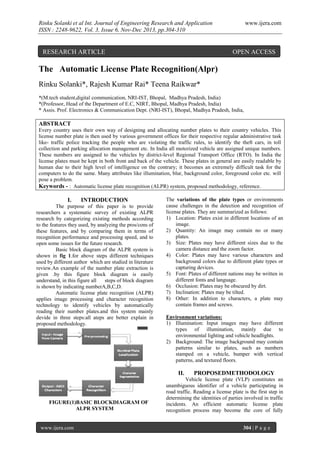
Basic block diagram of the ALPR system is
shown in fig 1.for above steps different techniques
used by different author which are studied in literature
review.An example of the number plate extraction is
given .by this figure block diagram is easily
understand, in this figure all
steps of block diagram
is shown by indicating numberA,B,C,D.
Automatic license plate recognition (ALPR)
applies image processing and character recognition
technology to identify vehicles by automatically
reading their number plates.and this system mainly
devide in three steps:all ateps are better explain in
proposed methodology.

The variations of the plate types or environments
cause challenges in the detection and recognition of
license plates. They are summarized as follows:
1) Location: Plates exist in different locations of an
image.
2) Quantity: An image may contain no or many
plates.
3) Size: Plates may have different sizes due to the
camera distance and the zoom factor.
4) Color: Plates may have various characters and
background colors due to different plate types or
capturing devices.
5) Font: Plates of different nations may be written in
different fonts and language.
6) Occlusion: Plates may be obscured by dirt.
7) Inclination: Plates may be tilted.
8) Other: In addition to characters, a plate may
contain frames and screws.
Environment variations:
1) Illumination: Input images may have different
types of illumination, mainly due to
environmental lighting and vehicle headlights.
2) Background: The image background may contain
patterns similar to plates, such as numbers
stamped on a vehicle, bumper with vertical
patterns, and textured floors.

II.

FIGURE(1)BASIC BLOCKDIAGRAM OF
ALPR SYSTEM

www.ijera.com

PROPOSEDMETHODOLOGY

Vehicle license plate (VLP) constitutes an
unambiguous identifier of a vehicle participating in
road traffic. Reading a license plate is the first step in
determining the identities of parties involved in traffic
incidents. An efficient automatic license plate
recognition process may become the core of fully
304 | P a g e
Rinku Solanki et al Int. Journal of Engineering Research and Application
ISSN : 2248-9622, Vol. 3, Issue 6, Nov-Dec 2013, pp.304-310

www.ijera.com

computerized road traffic monitoring systems,
electronic fee collection solutions, surveillance
devices and safety supervision systems. It is important
that the recognition accuracy of such a process is very
high. Tracking and registering dangerous behavior in
traffic may be used for prosecuting offenders.

(III) Horizontal Segmentation
Once the Preprocessing is over, the next step
is to segment the license plate candidates from the
image. We first do a horizontal segmentation of the
image
using the histogram method.

License-Plate Recognition System consists of three
main modules:
(1) License plate detection,
(2) character segmentation
(3)Character Recognition (CR).

Steps:-

Step(1)image acquisition, in image acquisition
explained that from where images are acquire Image
can be input to the system by different methods by
analog camera,or by digital cameras, but nowadays
digital technology has their advantages so better input
method is by digital cameras or by direct digital
photos.
(1)License plate detection
by whole capturing image we having license
plate covered by background of vehicle body,so by
this step only plate are is extracted from whole body.
our task now is to identify the region containing the
license plate. In this experiment, two features are
defined and extracted in order to decide if a candidate
region contains a license plate or not , these features
are
(I)Preprocessing: Since we have assumed that the
license plate has a yellow background , the first step is
to identify the regions in the image that contain the
intensity of RGB corresponding to the color yellow.
We Filter the yellow colored part from the image
using values obtained by experiments on the 10
sample images. (i) - (a< R< b) && (p< G< q) && (x<
B< y) Where R is the intensity of the color Red , G of
Green and B that of Blue.Based on this condition we
obtain a BinaryImageWe change yellow to white and
non-yellow to black.
(II) Morphological Operations:
These are Non-linear filters, with the function
of restraining noises, extracting features and
segmenting images etc The following morphological
operations have been used
Fill (MATLAB function – imfill): fills holes in the
binary image. A hole is a set of background pixels that
cannot be reached by filling in the background from
the edge of the image.
Open (MATLAB function – imopen): performs
morphological opening on the grayscale or binary
image with the pre-defined structuring element .
Dilate (MATLAB function – imdilate): dilates the
grayscale, binary, or packed binary image returning
the dilated image
(I)On Applying these morphological operations on
„im1.jpg‟ we obtain the Image.

www.ijera.com

For this we calculate the horizontal and
vertical projections of intensity.Then we find the mean
of the local minimas of horizontal projection plot
.Based on the threshold calculated from the above
local minimas, we findx locations of the segmented
regions.In order to locate the right and left edges of
license plate from candidate region, the vertical
projection after mathematicalmorphology deal is
changed into binary image. The arithmetic for doing
this is:

f T ( LT )  1 f T  T
f T ( LT )  0 f T  T
where fT (1,i) is the vertical projection after
mathematical morphology, T is the threshold. Then
scan the function of fT (1,i) and register the portions
where values change from 0 to 1 and from 1 to 0 in
stack1 and stack2 respectively. So the candidate
position of the left and right edge of the license plate
are in stack1 (1,i) and stack2(1,i) respectively, and the
candidate’s width of the license plate is calculated by:
width(1, i) stack2(1, i) - stack1(1, i) respectively. So
the candidate position of the left and right edge of the
license plate are in stack1 (1,i) and stack2(1,i)
respectively, and the candidate’s width of the license
plate is calculated by: width(1, i) stack2(1, i) stack1(1, i) These give the x coordinates of the
potentially candidates regions
(IV) Getting Potential Candidates
After getting the horizontal segments of the
candidate regions, we would now want to get the
vertical coordinates, in order to extract the exact area
from the image For each of the horizontal segments, in
order find the vertical location, we once again use the
vertical projections of intensity. Then converting to a
binary image using the threshold as discussed in the
previous section we get the desired vertical
coordinates. Now we have all our candidate regions.
An candidate regions obtained from our sample image
„im1.jpg‟ are :

figure(2)Candidate regions
(V) Identifying the License Plate:
Out of the many candidate regions that we
have obtained from the so far mentioned procedure,
our task now is to identify the region containing the
license plate. In this experiment, two features are
defined and extracted in order to decide if a candidate
305 | P a g e
Rinku Solanki et al Int. Journal of Engineering Research and Application
ISSN : 2248-9622, Vol. 3, Issue 6, Nov-Dec 2013, pp.304-310
region contains a license plate or not , these features
are
1. Aspect ratio
2. Edge Density
Even though these features are not scaleinvariant, luminance-invariant, rotation-invariant, but
they are insensitive to many environment changes.
Aspect ratio
The aspect ratio is defined as the ratio of the
width to the height of the region.
Aspect Ratio = width/height
Since
the
minimum
enclosing
rectangle(MER) of the object region can be computed
via rotating the region in previous section, the
dimension of the object‟s MER can be taken as the
width and the height of the region.
Edge density
Applying the above feature to filter the
segmented regions, a lot of nonlicense plate regions
can be removed. However, there are still many
candidate regions left which take similar
rectangularity and aspect ratio features as the license
plate regions do, such as often the head lights.
Considering that the license plate regions generally
take higher local variance in its pixels‟ values due to
the presence of characters, an important feature to
describe license plate region is local variance, which is
quantized using the edge density. The edge density is
measured in a region R by averaging the intensities of
all edge pixels within the region as

DR 

1
NR

 E(m, n)

(2)SEGMENTATION
this step characters on license plate are
segmented and identify. This step is the most
important step in license plate recognition because all
further steps rely on it. This is the second major part of
the License Plate detection algorithm. There are many
factors that cause the character segmentation task
difficult, such as image noise, plate frame, rivet, space
mark, plate rotation and illumination variance.We here
propose the algorithm that is quite robust and gives
significantly good results on images having the above
mentioned
problems.for
the
segmentation
preprocessing is required by conversion to gray scale
and binarization. Different algorithms are used for
segmentation which are explained further later in
literature review.
In the segmentation of plate characters,
license plate is segmented into its constituent parts
obtaining the characters individually. Firstly, image is
filtered for enhancing the image and removing the
noises and unwanted spots. Then dilation operation is
applied to the image for separating the characters from
each other if the characters are close to each other.
After this operation, horizontal and vertical smearing
are applied for finding the character regions. The
result of this segmentation is in Figure given below.

figure(4)Locations of plate characters
The next step is to cut the plate characters. It
is done by finding starting and end points of characters
in horizontal direction. The individual characters cut
from the plate are as follows in Figure given below.

m , nR

Where E(i,j) represents the edge magnitude at
location (i,j), and NR is the number of pixels in region
R. License plate Sets used for training to calculate
aspect ratio and edge density: We used 24 license
plates as training data. They are contained in the
directory named “edge_density_and_aspect_ratio_t
raining _images”.
After performing this experiment, we found the
average values of the above mentioned features as
follow:
aspect ratio = 4.4912 edge density = 0.1359
On using the above mentioned features we are able
to drop the incorrect regions and get the final result as
the extracted license plate from the input image.
For the candidate images shown above, above tests
rules out the first candidate and gives the following
output –

figure(3)Number Plate

www.ijera.com

www.ijera.com

figure(5)Number plate characters
(3)CHARACTER RECOGNITISON:
automatically locate license plates by
principal visual word (PVW), discovery and local
feature
matching. Observing that characters in
different license plates are duplicates of each other, we
bring in the idea of using the bag-ofwords (BoW)
model popularly applied in partial-duplicate image
search. Unlike the classic BoW model, for each plate
character, we automatically discover the PVW
characterized with geometric context. Given a new
image, the license plates are extracted by matching
local features with PVW. Besides license plate
detection, our approach can also be extended to the
detection of logos and trademarks. Due to the
invariance virtue of scale-invariant feature transform
feature, our method can adaptively deal with various
changes in the license plates, such as rotation, scaling,
illumination, etc. Promising results of the proposed
approach are demonstrated with an experimental study
in license plate detection. we formulate license plate

306 | P a g e
Rinku Solanki et al Int. Journal of Engineering Research and Application
ISSN : 2248-9622, Vol. 3, Issue 6, Nov-Dec 2013, pp.304-310
detection as a visual matching problem. For each
character, we collect SIFT features falling into the
character region and generate PVW by unsupervised
clustering. The amount of PVW for each plate
character is determined automatically Besides SIFT
descriptors, each visual word contains some geometric
information, such as orientation, ratio of scale to
character height, and relative position in the character
region. Those geometric clues will be used to filter
false feature matches and estimate the character and
plate size. In testing, every valid match votes a support
for plate location, and all supports are unified to
discover potential license plates.Due to the invariance
virtue of SIFT feature, our method can adaptively deal
with various changes of license plate, such as
distortion from observation views, scaling, and
illumination. Multiple license plates in a single image
can also be automatically detected.
In visual word matching and license plate
locating, we compare the extracted SIFT features of
the test image with all discovered PVW, and locate the
license plate based on the matching results. Let us
denote the PVW set as {D, G} ={(di , gi ), i = 1, . . . ,
N}, where di denotes appearance descriptor, and gi
denotes the geometric clues, N denotes the visual word
number. Once the PVW of an object category is
discovered, we can use it for detection in a new image.
Given features F = { fi } for a test image, the
probability
that
the
test
image
corresponds to a sign of interest is

p (0  d i , g i ) 

p ( d i , g i  0)  p ( 0 )
 p ( d i , g i  0)
p(d i , g i )

………………………….(1)
where p(O) is prior of plate. The likelihood p(di ,
gi |O) is deduced as

p(d i , g i  0)   p(d i , g i  f j ,0)  p( f j  0)
j

…………………….(2)
where p(di , gi | f j , O) is modeled by matching
feature f j to the descriptor di of the PVW.

www.ijera.com

generation and local feature matching to extract
license plate in detail.
A. PVW Generation
There are a certain number of sorted
characters in license plates, each with the same format,
but maybe undergoing illumination change or affine
transformation. Since SIFT feature is invariant to
changes in scale and rotation, and robust to
illumination change and affine distortion [2], some
repeatable and distinctive SIFT features to each
character exist, called PVW. As shown in Fig., a PVW
is denoted as V (des, ori, rat, pos), where des is the
128-D SIFT descriptor, ori is the SIFT orientation (−π
≤ ori < π), rat = H/s (s is the SIFT scale), and pos = (
f/W, e/H) is a 2-D vector denoting the relative position
of the key point in the character region. Both des and
ori are originated from the standard SIFT features [2]
des captures the local visual appearance with a
concatenation of 8-D orientation histograms from 4 by
4 subpatches around local interest point. ori denotes
the dominant directions of local gradients around a
key point. Relative to ori and des is represented to
achieve invariance to image rotation changes . Ideally,
for a feature with high repeatability in a certain
character, rat shall be identical. Given this specific
SIFT feature with scale s, we can estimate the
corresponding character height as rat · s. Given an
image patch of the character with height, v, we can
also derive the scale of the SIFT feature as v/rat. We
collect many training images, each containing one or
more license plates. License plates in the training
images are all upright, with little affine distortion.
Each character in the license plate is annotated and all
SIFT features in each character region are extracted.
Usually, many noisy features also exist. To discover
the PVW of each character, we need to cluster the
local features of each character and discover the most
representative cluster centers as the PVW.
which can be found automatically in the
clustering process. In affinity propagation, a similarity
matrix of samples shall be defined. We first give the
distance metric, which will be used to define the
similarity metric. The distance between two feature
samples V j and Vk is defined in (3)

d j ,k    Dd    DO    Dr    DP

Figure(6)Illustration of a PVW (red arrow) in
the character “6.”
Consequently, by searching for the local
maxima of the likelihood function given by (1) for all
PVW, we can find the initial hypotheses for license
plate location. Some other prior heuristics can also be
imposed to remove potential false positives. In the
following subsections, we will discuss PVW

…..……..(3)
where α, β, γ, and δ are constant weighting factors,
Dd ,Do, Dr, and Dp are the distance of descriptor,
orientation, height-scale ratio, and position,
respectively, and are defined as follows:

Dd 

1





128

 (des
i 1

i

j

 desik ) 2
………………(4)

1
DO   min ori j  ori k , 2  ori j  ori k




…………….(5)

www.ijera.com

307 | P a g e
Rinku Solanki et al Int. Journal of Engineering Research and Application
ISSN : 2248-9622, Vol. 3, Issue 6, Nov-Dec 2013, pp.304-310

Dr 

1
rat j  rat k
N
………….(6)

Dp 

1
2

2

 ( pos
i 1

i

j

 posik ) 2

………………...(7)
where σ and N are normalization factors to make
sure that both Dd and Dr range from 0 to 1.
The similarity metric is a decreasing function of
the distance metric. There are many choices for it. In
our implementation, the pair wise similarity between
two feature samples V j and Vk is defined as

S j ,k  (d j ,k ) n , (n  0)
……………(8)
In affinity propagation, the diagonal elements in
the similarity matrix are referred to as exemplar
preference, which will influence the number of
identified clusters. Generally, without any priori, we
set it as the median of the input similarities, After
clustering, we need to discover the most representative
clusters. For each cluster, we count the number of
image patches which contain at least one feature
falling into the cluster. Then an image-number
histogram is built. To select those representative
clusters, a threshold thresh shall be specified on the
histogram. Any cluster with image number above
thresh will be selected. In each selected cluster, the
PVW are defined as the average of all samples falling
into that cluster. In our experiments, we set thresh =
0.6·Num, where Num is the total sample number of
the specific character. Fig. illustrates the feature
clustering results of three characters: “0,” “6,” and
“9.” In each character, the PVW are highlighted in red
color on the patch with its geometric information: ori,
rat, and pos. The PVW of characters from “0” to “9”
are shown in Fig. while those of characters from “A”
to “Z” excluding “I” and“O” are illustrated in Fig. 5.
There are no PVW of character “I” and “O” as these
two characters are not found in any training plate.
Modification in proposed method:
Instead of visual word matching we can
implement by template matching methodology, which
takes less efforts and calculations. Method explain
below,Template matching is used for the character
recognition. Before the matching process, the input
image must be resized in order to be equal-sized with
the template. After that, the isolated character can be
identified by comparing with the ones in the template
and the best similarity is measured. To measure the
similarity and find the best match, a 2-dimension
correlation method is used. Two perfectly matched
characters will have a correlation which is equals to 1.
Finally, the license plate number will be recognized
and saved in database.
Template Matching

www.ijera.com

www.ijera.com

The developed program used template
matching to identify the segmented character.
Template matching method must have character
images as template stored in memory [6].The
segmented character will be identified by calculating
the correlation coefficient. The idea behind the
implementation of a correlation based identification
scheme is when two template pools, one consisting of
all the possible values of letters, and of all values of
the digits, are constructed. Generally, once the license
plate has been segmented into the several characters,
each image that containing a single character is
evaluated. The correlation coefficient between the
image of the character and the appropriate template
pool is computed. The template that yields the highest
coefficient will indicate what character is depicted in
the input images.
For matching characters with the template, input
images must be equal sized with the template’s
characters.In this program, the characters are fit to the
size of 24 x 42.The extracted characters are obtained
from plate and the characters on database are now
equal sized. After that, the character image is
compared with each component in the database and
the best similarity is measured.the template which
consists of 24alphabets and 10 numerals with the size
of 24 x 42. The template formed is based on the real
font of the license plate. To measure the similarity and
find the best match,a 2-dimensional correlation
coefficient is used. This method measures the
correlation coefficient between a number of known
images with the same size unknown images or parts of
an image with the highest coefficient between the
images producing the best match. The equation for
calculate the coefficient is as shown in Equation :

r

 m n( A  A)(B  B)
( m n( A  A) )( m n( B
mn

mn

2

mn

mn

 B) 2 )

,where A is the mean value of A, B is the mean
value of B
One of the segmented characters. The developed
program will calculate the correlation coefficient
between the input image and the images in the
template.The value of correlation coefficient is then
return . Since the template created consists of 9
images, thus there are 34 values of correlation
coefficient were calculated and return under the
position of the images in the template respectively.
The measured values of correlation coefficient allow
the developed program to find the best match for the
input character.
The position of the images in the template
will be arranged sequentially.This means that the
character ‘A’ will be placed at position1, character ‘B’
at position 2 and so on. There are 34 images in the
template and hence the maximum number of the
position is 9.
Program will find the maximum value of the
correlation coefficient as shown in Figure 11. Then the
308 | P a g e
Rinku Solanki et al Int. Journal of Engineering Research and Application
ISSN : 2248-9622, Vol. 3, Issue 6, Nov-Dec 2013, pp.304-310
program will locate the location of the maximum
value of the correlation coefficient. The location of the
correlation coefficient will feed as the recognition
result and store in the database.
ALGORITHM:
Training:
The program is first trained with a set of
sample images for each of the characters to extract the
important features based on which the recognition
operation would be performed.
Our program is trained on a set of 10
characters with 10 samples of each. The training
algorithm involves the following steps
1. Preprocessing :
Before preparing the template for each of the
characters for further use, we need to do some
processing on the images. The following are the
operations that are performed:
- Binarization.
- Inversion of intensity of the characters.
- Finding the connected component that represents
the character
- Finding the smallest rectangle enclosing this
connected component
- Normalization of the image to size 15 X 15.
- Storing the intensity values using the below
mentioned algorithm for each of the characters.

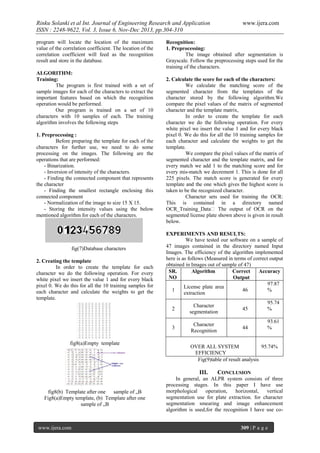
fig(7)Database characters
2. Creating the template
In order to create the template for each
character we do the following operation. For every
white pixel we insert the value 1 and for every black
pixel 0. We do this for all the 10 training samples for
each character and calculate the weights to get the
template.

www.ijera.com

Recognition:
1. Preprocessing:
The image obtained after segmentation is
Grayscale. Follow the preprocessing steps used for the
training of the characters.
2. Calculate the score for each of the characters:
We calculate the matching score of the
segmented character from the templates of the
character stored by the following algorithm.We
compare the pixel values of the matrix of segmented
character and the template matrix,
In order to create the template for each
character we do the following operation. For every
white pixel we insert the value 1 and for every black
pixel 0. We do this for all the 10 training samples for
each character and calculate the weights to get the
template.
We compare the pixel values of the matrix of
segmented character and the template matrix, and for
every match we add 1 to the matching score and for
every mis-match we decrement 1. This is done for all
225 pixels. The match score is generated for every
template and the one which gives the highest score is
taken to be the recognized character.
Character sets used for training the OCR:
This is contained in a directory named
OCR_Training_Data‟ The output of OCR on the
segmented license plate shown above is given in result
below.
EXPERIMENTS AND RESULTS:
We have tested our software on a sample of
47 images contained in the directory named Input
Images. The efficiency of the algorithm implemented
here is as follows (Measured in terms of correct output
obtained in Images out of sample of 47)
SR.
Algorithm
Correct
Accuracy
NO
Output
97.87
License plate area
1
46
%
extraction
2

45

95.74
%

3
fig8(a)Empty template

Character
segmentation
Character
Recognition

44

93.61
%

OVER ALL SYSTEM
95.74%
EFFICIENCY
Fig(9)table of result analysis

III.
fig8(b) Template after one sample of „B
Fig8(a)Empty template, (b) Template after one
sample of „B

www.ijera.com

CONCLUSION

In general, an ALPR system consists of three
processing stages. In this paper I have use
morphological
operation,
horizontal,
vertical
segmentation use for plate extraction. for character
segmentation smearing and image enhancement
algorithm is used,for the recognition I have use co309 | P a g e
Rinku Solanki et al Int. Journal of Engineering Research and Application
ISSN : 2248-9622, Vol. 3, Issue 6, Nov-Dec 2013, pp.304-310
rrelation technique and getting 95.74% of system
efficiency.

IV.

Acknowledgements

I would like to thank professor rajesh kumar
rai who is lecturer in our college they give me proper
and perfect guidance in this literature paper .another
person who give me a direction is Mr. Rajesh nema sir
,He is H.O.D. of our collge.by the strict way they take
work regularly from me and that’s why I lots of
thankful to them.i can say that because of strict nature
of nema sir I can complete my work properly.

[9]

[10]

REFERENCES
[1]

[2]

[3]

[5]

[6]

[7]

[8]

Muhammad Sarfraz, Mohammed Jameel
Ahmed, and Syed A. Ghazi ,“Saudi arebian
licence
plate
recognition
system”,
International Conference on Geometric
Modeling and Graphics
(GMAG’03),
2003.
Serkan Ozbay, and Ergun Ercelebi,”
Automatic Vehicle Identification by Plate
Recognition”, Processing of world academy
of science engineering and technology vol9,
ISSN 1307-6884, november 2005.
Humayun Karim Sulehria, Ye Zhang, Danish
Irfan, Atif Karim Sulehria,” Vehicle Number
Plate Recognition Using Mathematical
Morphology and Neural Networks”, WSEAS
TRANSACTIONS
on
COMPUTERS,
Volume 7,ISSN: 1109-2750, Issue 6, June
2008.
[4] Zhen-Xue Chen, Cheng-Yun Liu, FaLiang Chang, and Guo-You Wang,”
Automatic License-Plate Location and
Recognition Based on Feature Salience”,
IEEE Transaction on vehicle technology,
VOL. 58, NO. 7, september 2009.
Dr. P.K.Suri, Dr. Ekta Walia, Er. Amit
Verma,” Vehicle Number Plate Detection
using Sobel Edge Detection Technique”,
International Journal of Computer Science
and Technology, ISSN : 2229 – 4333, IJCST
Vol. 1, Issue 2, December 2010.
Kumar Parasuraman, Member, IEEE and
P.Vasantha Kumar, “ An Efficient Method
for Indian Vehicle License Plate Extraction
and
Character
Segmentation”,
IEEE
International Conference on Computational
Intelligence and Computing Research,2010.
Muhammad H Dashtban, Zahra Dashtban,
Hassan Bevrani, “ A Novel Approach for
Vehicle License Plate Localization and
Recognition”, International Journal of
Computer Applications (0975 – 8887),
Volume 26– No.11, July 2011.
Stuti Asthana, Niresh Sharma, Rajdeep
Singh, “Vehicle number plate recognition
using multiple layer back propagation neural
networks”, International Journal of Computer

www.ijera.com

[11]

[12]

[13]

[14]

www.ijera.com

Technology and Electronics Engineering
(IJCTEE), Volume 1, Issue 1, July 10, 2011.
Chetan Sharma1 and Amandeep Kaur2, “
INDIAN VEHICLE LICENSE PLATE
EXTRACTION AND SEGMENTATION”,
International Journal of Computer Science
and Communication, Vol. 2, No. 2, pp. 593599, July-December 2011.
R. T. Lee, K. C. Hung, and H. S. Wang,“Real
Time Vehicle License Plate Recognition
Based on 2D Haar Discrete Wavelet
Transform”,
International
Journal
of
Scientific & Engineering Research, Volume
3, Issue 4, ISSN 2229-5518, April-2012.
Lekhana G.C, M.Tech; R.Srikantaswamy,
Professor,“Real time license plate recognition
system”, International Journal of Advanced
Technology & Engineering Research
(IJATER) National Conference on Emerging
Trends in Technology (NCET-Tech) ISSN,
Volume 2, Issue 4, ISSN No: 2250-3536,
July 2012.
Wengang Zhou, Houqiang Li, Yijuan Lu,
Member, IEEE, and Qi Tian, Senior Member,
IEEE, “Principal Visual Word Discovery for
Automatic License Plate Detection”, IEEE
transaction on image processing ,vol21, NO.
9, September 2012.
P.Sandhya Rani1, Vara Prasad,“License plate
character segmentation based on pixel
distribution density”, [IJESAT] International
journal of engineering science and advanced
technology, Volume-2, Issue-5, 1539 – 1542,
Sep-Oct 2012.
R.Radha1 and C.P.Sumathi2, “A Novel
approach to extract text from license plate of
vehicle”, Signal & Image Processing: An
International Journal (SIPIJ) Vol.3, No.4,
August 2012.

Books:
[1]
Digital Image Processing
Gonzalez, Pearson (2008).

(Rafael

310 | P a g e

C.

Ay36304310

  • 1.
    Rinku Solanki etal Int. Journal of Engineering Research and Application ISSN : 2248-9622, Vol. 3, Issue 6, Nov-Dec 2013, pp.304-310 RESEARCH ARTICLE www.ijera.com OPEN ACCESS The Automatic License Plate Recognition(Alpr) Rinku Solanki*, Rajesh Kumar Rai* Teena Raikwar* *(M.tech student,digital communication, NRI-IST, Bhopal, Madhya Pradesh, India) *(Professor, Head of the Department of E.C, NIRT, Bhopal, Madhya Pradesh, India) * Assis. Prof. Electronics & Communication Dept. (NRI-IST), Bhopal, Madhya Pradesh, India, ABSTRACT Every country uses their own way of designing and allocating number plates to their country vehicles. This license number plate is then used by various government offices for their respective regular administrative task like- traffic police tracking the people who are violating the traffic rules, to identify the theft cars, in toll collection and parking allocation management etc. In India all motorized vehicle are assigned unique numbers. These numbers are assigned to the vehicles by district-level Regional Transport Office (RTO). In India the license plates must be kept in both front and back of the vehicle. These plates in general are easily readable by human due to their high level of intelligence on the contrary; it becomes an extremely difficult task for the computers to do the same. Many attributes like illumination, blur, background color, foreground color etc. will pose a problem. Keywords - : Automatic license plate recognition (ALPR) system, proposed methodology, reference. I. INTRODUCTION The purpose of this paper is to provide researchers a systematic survey of existing ALPR research by categorizing existing methods according to the features they used, by analyzing the pros/cons of these features, and by comparing them in terms of recognition performance and processing speed, and to open some issues for the future research. Basic block diagram of the ALPR system is shown in fig 1.for above steps different techniques used by different author which are studied in literature review.An example of the number plate extraction is given .by this figure block diagram is easily understand, in this figure all steps of block diagram is shown by indicating numberA,B,C,D. Automatic license plate recognition (ALPR) applies image processing and character recognition technology to identify vehicles by automatically reading their number plates.and this system mainly devide in three steps:all ateps are better explain in proposed methodology. The variations of the plate types or environments cause challenges in the detection and recognition of license plates. They are summarized as follows: 1) Location: Plates exist in different locations of an image. 2) Quantity: An image may contain no or many plates. 3) Size: Plates may have different sizes due to the camera distance and the zoom factor. 4) Color: Plates may have various characters and background colors due to different plate types or capturing devices. 5) Font: Plates of different nations may be written in different fonts and language. 6) Occlusion: Plates may be obscured by dirt. 7) Inclination: Plates may be tilted. 8) Other: In addition to characters, a plate may contain frames and screws. Environment variations: 1) Illumination: Input images may have different types of illumination, mainly due to environmental lighting and vehicle headlights. 2) Background: The image background may contain patterns similar to plates, such as numbers stamped on a vehicle, bumper with vertical patterns, and textured floors. II. FIGURE(1)BASIC BLOCKDIAGRAM OF ALPR SYSTEM www.ijera.com PROPOSEDMETHODOLOGY Vehicle license plate (VLP) constitutes an unambiguous identifier of a vehicle participating in road traffic. Reading a license plate is the first step in determining the identities of parties involved in traffic incidents. An efficient automatic license plate recognition process may become the core of fully 304 | P a g e
  • 2.
    Rinku Solanki etal Int. Journal of Engineering Research and Application ISSN : 2248-9622, Vol. 3, Issue 6, Nov-Dec 2013, pp.304-310 www.ijera.com computerized road traffic monitoring systems, electronic fee collection solutions, surveillance devices and safety supervision systems. It is important that the recognition accuracy of such a process is very high. Tracking and registering dangerous behavior in traffic may be used for prosecuting offenders. (III) Horizontal Segmentation Once the Preprocessing is over, the next step is to segment the license plate candidates from the image. We first do a horizontal segmentation of the image using the histogram method. License-Plate Recognition System consists of three main modules: (1) License plate detection, (2) character segmentation (3)Character Recognition (CR). Steps:- Step(1)image acquisition, in image acquisition explained that from where images are acquire Image can be input to the system by different methods by analog camera,or by digital cameras, but nowadays digital technology has their advantages so better input method is by digital cameras or by direct digital photos. (1)License plate detection by whole capturing image we having license plate covered by background of vehicle body,so by this step only plate are is extracted from whole body. our task now is to identify the region containing the license plate. In this experiment, two features are defined and extracted in order to decide if a candidate region contains a license plate or not , these features are (I)Preprocessing: Since we have assumed that the license plate has a yellow background , the first step is to identify the regions in the image that contain the intensity of RGB corresponding to the color yellow. We Filter the yellow colored part from the image using values obtained by experiments on the 10 sample images. (i) - (a< R< b) && (p< G< q) && (x< B< y) Where R is the intensity of the color Red , G of Green and B that of Blue.Based on this condition we obtain a BinaryImageWe change yellow to white and non-yellow to black. (II) Morphological Operations: These are Non-linear filters, with the function of restraining noises, extracting features and segmenting images etc The following morphological operations have been used Fill (MATLAB function – imfill): fills holes in the binary image. A hole is a set of background pixels that cannot be reached by filling in the background from the edge of the image. Open (MATLAB function – imopen): performs morphological opening on the grayscale or binary image with the pre-defined structuring element . Dilate (MATLAB function – imdilate): dilates the grayscale, binary, or packed binary image returning the dilated image (I)On Applying these morphological operations on „im1.jpg‟ we obtain the Image. www.ijera.com For this we calculate the horizontal and vertical projections of intensity.Then we find the mean of the local minimas of horizontal projection plot .Based on the threshold calculated from the above local minimas, we findx locations of the segmented regions.In order to locate the right and left edges of license plate from candidate region, the vertical projection after mathematicalmorphology deal is changed into binary image. The arithmetic for doing this is: f T ( LT )  1 f T  T f T ( LT )  0 f T  T where fT (1,i) is the vertical projection after mathematical morphology, T is the threshold. Then scan the function of fT (1,i) and register the portions where values change from 0 to 1 and from 1 to 0 in stack1 and stack2 respectively. So the candidate position of the left and right edge of the license plate are in stack1 (1,i) and stack2(1,i) respectively, and the candidate’s width of the license plate is calculated by: width(1, i) stack2(1, i) - stack1(1, i) respectively. So the candidate position of the left and right edge of the license plate are in stack1 (1,i) and stack2(1,i) respectively, and the candidate’s width of the license plate is calculated by: width(1, i) stack2(1, i) stack1(1, i) These give the x coordinates of the potentially candidates regions (IV) Getting Potential Candidates After getting the horizontal segments of the candidate regions, we would now want to get the vertical coordinates, in order to extract the exact area from the image For each of the horizontal segments, in order find the vertical location, we once again use the vertical projections of intensity. Then converting to a binary image using the threshold as discussed in the previous section we get the desired vertical coordinates. Now we have all our candidate regions. An candidate regions obtained from our sample image „im1.jpg‟ are : figure(2)Candidate regions (V) Identifying the License Plate: Out of the many candidate regions that we have obtained from the so far mentioned procedure, our task now is to identify the region containing the license plate. In this experiment, two features are defined and extracted in order to decide if a candidate 305 | P a g e
  • 3.
    Rinku Solanki etal Int. Journal of Engineering Research and Application ISSN : 2248-9622, Vol. 3, Issue 6, Nov-Dec 2013, pp.304-310 region contains a license plate or not , these features are 1. Aspect ratio 2. Edge Density Even though these features are not scaleinvariant, luminance-invariant, rotation-invariant, but they are insensitive to many environment changes. Aspect ratio The aspect ratio is defined as the ratio of the width to the height of the region. Aspect Ratio = width/height Since the minimum enclosing rectangle(MER) of the object region can be computed via rotating the region in previous section, the dimension of the object‟s MER can be taken as the width and the height of the region. Edge density Applying the above feature to filter the segmented regions, a lot of nonlicense plate regions can be removed. However, there are still many candidate regions left which take similar rectangularity and aspect ratio features as the license plate regions do, such as often the head lights. Considering that the license plate regions generally take higher local variance in its pixels‟ values due to the presence of characters, an important feature to describe license plate region is local variance, which is quantized using the edge density. The edge density is measured in a region R by averaging the intensities of all edge pixels within the region as DR  1 NR  E(m, n) (2)SEGMENTATION this step characters on license plate are segmented and identify. This step is the most important step in license plate recognition because all further steps rely on it. This is the second major part of the License Plate detection algorithm. There are many factors that cause the character segmentation task difficult, such as image noise, plate frame, rivet, space mark, plate rotation and illumination variance.We here propose the algorithm that is quite robust and gives significantly good results on images having the above mentioned problems.for the segmentation preprocessing is required by conversion to gray scale and binarization. Different algorithms are used for segmentation which are explained further later in literature review. In the segmentation of plate characters, license plate is segmented into its constituent parts obtaining the characters individually. Firstly, image is filtered for enhancing the image and removing the noises and unwanted spots. Then dilation operation is applied to the image for separating the characters from each other if the characters are close to each other. After this operation, horizontal and vertical smearing are applied for finding the character regions. The result of this segmentation is in Figure given below. figure(4)Locations of plate characters The next step is to cut the plate characters. It is done by finding starting and end points of characters in horizontal direction. The individual characters cut from the plate are as follows in Figure given below. m , nR Where E(i,j) represents the edge magnitude at location (i,j), and NR is the number of pixels in region R. License plate Sets used for training to calculate aspect ratio and edge density: We used 24 license plates as training data. They are contained in the directory named “edge_density_and_aspect_ratio_t raining _images”. After performing this experiment, we found the average values of the above mentioned features as follow: aspect ratio = 4.4912 edge density = 0.1359 On using the above mentioned features we are able to drop the incorrect regions and get the final result as the extracted license plate from the input image. For the candidate images shown above, above tests rules out the first candidate and gives the following output – figure(3)Number Plate www.ijera.com www.ijera.com figure(5)Number plate characters (3)CHARACTER RECOGNITISON: automatically locate license plates by principal visual word (PVW), discovery and local feature matching. Observing that characters in different license plates are duplicates of each other, we bring in the idea of using the bag-ofwords (BoW) model popularly applied in partial-duplicate image search. Unlike the classic BoW model, for each plate character, we automatically discover the PVW characterized with geometric context. Given a new image, the license plates are extracted by matching local features with PVW. Besides license plate detection, our approach can also be extended to the detection of logos and trademarks. Due to the invariance virtue of scale-invariant feature transform feature, our method can adaptively deal with various changes in the license plates, such as rotation, scaling, illumination, etc. Promising results of the proposed approach are demonstrated with an experimental study in license plate detection. we formulate license plate 306 | P a g e
  • 4.
    Rinku Solanki etal Int. Journal of Engineering Research and Application ISSN : 2248-9622, Vol. 3, Issue 6, Nov-Dec 2013, pp.304-310 detection as a visual matching problem. For each character, we collect SIFT features falling into the character region and generate PVW by unsupervised clustering. The amount of PVW for each plate character is determined automatically Besides SIFT descriptors, each visual word contains some geometric information, such as orientation, ratio of scale to character height, and relative position in the character region. Those geometric clues will be used to filter false feature matches and estimate the character and plate size. In testing, every valid match votes a support for plate location, and all supports are unified to discover potential license plates.Due to the invariance virtue of SIFT feature, our method can adaptively deal with various changes of license plate, such as distortion from observation views, scaling, and illumination. Multiple license plates in a single image can also be automatically detected. In visual word matching and license plate locating, we compare the extracted SIFT features of the test image with all discovered PVW, and locate the license plate based on the matching results. Let us denote the PVW set as {D, G} ={(di , gi ), i = 1, . . . , N}, where di denotes appearance descriptor, and gi denotes the geometric clues, N denotes the visual word number. Once the PVW of an object category is discovered, we can use it for detection in a new image. Given features F = { fi } for a test image, the probability that the test image corresponds to a sign of interest is p (0 d i , g i )  p ( d i , g i 0)  p ( 0 )  p ( d i , g i 0) p(d i , g i ) ………………………….(1) where p(O) is prior of plate. The likelihood p(di , gi |O) is deduced as p(d i , g i 0)   p(d i , g i f j ,0)  p( f j 0) j …………………….(2) where p(di , gi | f j , O) is modeled by matching feature f j to the descriptor di of the PVW. www.ijera.com generation and local feature matching to extract license plate in detail. A. PVW Generation There are a certain number of sorted characters in license plates, each with the same format, but maybe undergoing illumination change or affine transformation. Since SIFT feature is invariant to changes in scale and rotation, and robust to illumination change and affine distortion [2], some repeatable and distinctive SIFT features to each character exist, called PVW. As shown in Fig., a PVW is denoted as V (des, ori, rat, pos), where des is the 128-D SIFT descriptor, ori is the SIFT orientation (−π ≤ ori < π), rat = H/s (s is the SIFT scale), and pos = ( f/W, e/H) is a 2-D vector denoting the relative position of the key point in the character region. Both des and ori are originated from the standard SIFT features [2] des captures the local visual appearance with a concatenation of 8-D orientation histograms from 4 by 4 subpatches around local interest point. ori denotes the dominant directions of local gradients around a key point. Relative to ori and des is represented to achieve invariance to image rotation changes . Ideally, for a feature with high repeatability in a certain character, rat shall be identical. Given this specific SIFT feature with scale s, we can estimate the corresponding character height as rat · s. Given an image patch of the character with height, v, we can also derive the scale of the SIFT feature as v/rat. We collect many training images, each containing one or more license plates. License plates in the training images are all upright, with little affine distortion. Each character in the license plate is annotated and all SIFT features in each character region are extracted. Usually, many noisy features also exist. To discover the PVW of each character, we need to cluster the local features of each character and discover the most representative cluster centers as the PVW. which can be found automatically in the clustering process. In affinity propagation, a similarity matrix of samples shall be defined. We first give the distance metric, which will be used to define the similarity metric. The distance between two feature samples V j and Vk is defined in (3) d j ,k    Dd    DO    Dr    DP Figure(6)Illustration of a PVW (red arrow) in the character “6.” Consequently, by searching for the local maxima of the likelihood function given by (1) for all PVW, we can find the initial hypotheses for license plate location. Some other prior heuristics can also be imposed to remove potential false positives. In the following subsections, we will discuss PVW …..……..(3) where α, β, γ, and δ are constant weighting factors, Dd ,Do, Dr, and Dp are the distance of descriptor, orientation, height-scale ratio, and position, respectively, and are defined as follows: Dd  1   128  (des i 1 i j  desik ) 2 ………………(4) 1 DO   min ori j  ori k , 2  ori j  ori k   …………….(5) www.ijera.com 307 | P a g e
  • 5.
    Rinku Solanki etal Int. Journal of Engineering Research and Application ISSN : 2248-9622, Vol. 3, Issue 6, Nov-Dec 2013, pp.304-310 Dr  1 rat j  rat k N ………….(6) Dp  1 2 2  ( pos i 1 i j  posik ) 2 ………………...(7) where σ and N are normalization factors to make sure that both Dd and Dr range from 0 to 1. The similarity metric is a decreasing function of the distance metric. There are many choices for it. In our implementation, the pair wise similarity between two feature samples V j and Vk is defined as S j ,k  (d j ,k ) n , (n  0) ……………(8) In affinity propagation, the diagonal elements in the similarity matrix are referred to as exemplar preference, which will influence the number of identified clusters. Generally, without any priori, we set it as the median of the input similarities, After clustering, we need to discover the most representative clusters. For each cluster, we count the number of image patches which contain at least one feature falling into the cluster. Then an image-number histogram is built. To select those representative clusters, a threshold thresh shall be specified on the histogram. Any cluster with image number above thresh will be selected. In each selected cluster, the PVW are defined as the average of all samples falling into that cluster. In our experiments, we set thresh = 0.6·Num, where Num is the total sample number of the specific character. Fig. illustrates the feature clustering results of three characters: “0,” “6,” and “9.” In each character, the PVW are highlighted in red color on the patch with its geometric information: ori, rat, and pos. The PVW of characters from “0” to “9” are shown in Fig. while those of characters from “A” to “Z” excluding “I” and“O” are illustrated in Fig. 5. There are no PVW of character “I” and “O” as these two characters are not found in any training plate. Modification in proposed method: Instead of visual word matching we can implement by template matching methodology, which takes less efforts and calculations. Method explain below,Template matching is used for the character recognition. Before the matching process, the input image must be resized in order to be equal-sized with the template. After that, the isolated character can be identified by comparing with the ones in the template and the best similarity is measured. To measure the similarity and find the best match, a 2-dimension correlation method is used. Two perfectly matched characters will have a correlation which is equals to 1. Finally, the license plate number will be recognized and saved in database. Template Matching www.ijera.com www.ijera.com The developed program used template matching to identify the segmented character. Template matching method must have character images as template stored in memory [6].The segmented character will be identified by calculating the correlation coefficient. The idea behind the implementation of a correlation based identification scheme is when two template pools, one consisting of all the possible values of letters, and of all values of the digits, are constructed. Generally, once the license plate has been segmented into the several characters, each image that containing a single character is evaluated. The correlation coefficient between the image of the character and the appropriate template pool is computed. The template that yields the highest coefficient will indicate what character is depicted in the input images. For matching characters with the template, input images must be equal sized with the template’s characters.In this program, the characters are fit to the size of 24 x 42.The extracted characters are obtained from plate and the characters on database are now equal sized. After that, the character image is compared with each component in the database and the best similarity is measured.the template which consists of 24alphabets and 10 numerals with the size of 24 x 42. The template formed is based on the real font of the license plate. To measure the similarity and find the best match,a 2-dimensional correlation coefficient is used. This method measures the correlation coefficient between a number of known images with the same size unknown images or parts of an image with the highest coefficient between the images producing the best match. The equation for calculate the coefficient is as shown in Equation : r  m n( A  A)(B  B) ( m n( A  A) )( m n( B mn mn 2 mn mn  B) 2 ) ,where A is the mean value of A, B is the mean value of B One of the segmented characters. The developed program will calculate the correlation coefficient between the input image and the images in the template.The value of correlation coefficient is then return . Since the template created consists of 9 images, thus there are 34 values of correlation coefficient were calculated and return under the position of the images in the template respectively. The measured values of correlation coefficient allow the developed program to find the best match for the input character. The position of the images in the template will be arranged sequentially.This means that the character ‘A’ will be placed at position1, character ‘B’ at position 2 and so on. There are 34 images in the template and hence the maximum number of the position is 9. Program will find the maximum value of the correlation coefficient as shown in Figure 11. Then the 308 | P a g e
  • 6.
    Rinku Solanki etal Int. Journal of Engineering Research and Application ISSN : 2248-9622, Vol. 3, Issue 6, Nov-Dec 2013, pp.304-310 program will locate the location of the maximum value of the correlation coefficient. The location of the correlation coefficient will feed as the recognition result and store in the database. ALGORITHM: Training: The program is first trained with a set of sample images for each of the characters to extract the important features based on which the recognition operation would be performed. Our program is trained on a set of 10 characters with 10 samples of each. The training algorithm involves the following steps 1. Preprocessing : Before preparing the template for each of the characters for further use, we need to do some processing on the images. The following are the operations that are performed: - Binarization. - Inversion of intensity of the characters. - Finding the connected component that represents the character - Finding the smallest rectangle enclosing this connected component - Normalization of the image to size 15 X 15. - Storing the intensity values using the below mentioned algorithm for each of the characters. fig(7)Database characters 2. Creating the template In order to create the template for each character we do the following operation. For every white pixel we insert the value 1 and for every black pixel 0. We do this for all the 10 training samples for each character and calculate the weights to get the template. www.ijera.com Recognition: 1. Preprocessing: The image obtained after segmentation is Grayscale. Follow the preprocessing steps used for the training of the characters. 2. Calculate the score for each of the characters: We calculate the matching score of the segmented character from the templates of the character stored by the following algorithm.We compare the pixel values of the matrix of segmented character and the template matrix, In order to create the template for each character we do the following operation. For every white pixel we insert the value 1 and for every black pixel 0. We do this for all the 10 training samples for each character and calculate the weights to get the template. We compare the pixel values of the matrix of segmented character and the template matrix, and for every match we add 1 to the matching score and for every mis-match we decrement 1. This is done for all 225 pixels. The match score is generated for every template and the one which gives the highest score is taken to be the recognized character. Character sets used for training the OCR: This is contained in a directory named OCR_Training_Data‟ The output of OCR on the segmented license plate shown above is given in result below. EXPERIMENTS AND RESULTS: We have tested our software on a sample of 47 images contained in the directory named Input Images. The efficiency of the algorithm implemented here is as follows (Measured in terms of correct output obtained in Images out of sample of 47) SR. Algorithm Correct Accuracy NO Output 97.87 License plate area 1 46 % extraction 2 45 95.74 % 3 fig8(a)Empty template Character segmentation Character Recognition 44 93.61 % OVER ALL SYSTEM 95.74% EFFICIENCY Fig(9)table of result analysis III. fig8(b) Template after one sample of „B Fig8(a)Empty template, (b) Template after one sample of „B www.ijera.com CONCLUSION In general, an ALPR system consists of three processing stages. In this paper I have use morphological operation, horizontal, vertical segmentation use for plate extraction. for character segmentation smearing and image enhancement algorithm is used,for the recognition I have use co309 | P a g e
  • 7.
    Rinku Solanki etal Int. Journal of Engineering Research and Application ISSN : 2248-9622, Vol. 3, Issue 6, Nov-Dec 2013, pp.304-310 rrelation technique and getting 95.74% of system efficiency. IV. Acknowledgements I would like to thank professor rajesh kumar rai who is lecturer in our college they give me proper and perfect guidance in this literature paper .another person who give me a direction is Mr. Rajesh nema sir ,He is H.O.D. of our collge.by the strict way they take work regularly from me and that’s why I lots of thankful to them.i can say that because of strict nature of nema sir I can complete my work properly. [9] [10] REFERENCES [1] [2] [3] [5] [6] [7] [8] Muhammad Sarfraz, Mohammed Jameel Ahmed, and Syed A. Ghazi ,“Saudi arebian licence plate recognition system”, International Conference on Geometric Modeling and Graphics (GMAG’03), 2003. Serkan Ozbay, and Ergun Ercelebi,” Automatic Vehicle Identification by Plate Recognition”, Processing of world academy of science engineering and technology vol9, ISSN 1307-6884, november 2005. Humayun Karim Sulehria, Ye Zhang, Danish Irfan, Atif Karim Sulehria,” Vehicle Number Plate Recognition Using Mathematical Morphology and Neural Networks”, WSEAS TRANSACTIONS on COMPUTERS, Volume 7,ISSN: 1109-2750, Issue 6, June 2008. [4] Zhen-Xue Chen, Cheng-Yun Liu, FaLiang Chang, and Guo-You Wang,” Automatic License-Plate Location and Recognition Based on Feature Salience”, IEEE Transaction on vehicle technology, VOL. 58, NO. 7, september 2009. Dr. P.K.Suri, Dr. Ekta Walia, Er. Amit Verma,” Vehicle Number Plate Detection using Sobel Edge Detection Technique”, International Journal of Computer Science and Technology, ISSN : 2229 – 4333, IJCST Vol. 1, Issue 2, December 2010. Kumar Parasuraman, Member, IEEE and P.Vasantha Kumar, “ An Efficient Method for Indian Vehicle License Plate Extraction and Character Segmentation”, IEEE International Conference on Computational Intelligence and Computing Research,2010. Muhammad H Dashtban, Zahra Dashtban, Hassan Bevrani, “ A Novel Approach for Vehicle License Plate Localization and Recognition”, International Journal of Computer Applications (0975 – 8887), Volume 26– No.11, July 2011. Stuti Asthana, Niresh Sharma, Rajdeep Singh, “Vehicle number plate recognition using multiple layer back propagation neural networks”, International Journal of Computer www.ijera.com [11] [12] [13] [14] www.ijera.com Technology and Electronics Engineering (IJCTEE), Volume 1, Issue 1, July 10, 2011. Chetan Sharma1 and Amandeep Kaur2, “ INDIAN VEHICLE LICENSE PLATE EXTRACTION AND SEGMENTATION”, International Journal of Computer Science and Communication, Vol. 2, No. 2, pp. 593599, July-December 2011. R. T. Lee, K. C. Hung, and H. S. Wang,“Real Time Vehicle License Plate Recognition Based on 2D Haar Discrete Wavelet Transform”, International Journal of Scientific & Engineering Research, Volume 3, Issue 4, ISSN 2229-5518, April-2012. Lekhana G.C, M.Tech; R.Srikantaswamy, Professor,“Real time license plate recognition system”, International Journal of Advanced Technology & Engineering Research (IJATER) National Conference on Emerging Trends in Technology (NCET-Tech) ISSN, Volume 2, Issue 4, ISSN No: 2250-3536, July 2012. Wengang Zhou, Houqiang Li, Yijuan Lu, Member, IEEE, and Qi Tian, Senior Member, IEEE, “Principal Visual Word Discovery for Automatic License Plate Detection”, IEEE transaction on image processing ,vol21, NO. 9, September 2012. P.Sandhya Rani1, Vara Prasad,“License plate character segmentation based on pixel distribution density”, [IJESAT] International journal of engineering science and advanced technology, Volume-2, Issue-5, 1539 – 1542, Sep-Oct 2012. R.Radha1 and C.P.Sumathi2, “A Novel approach to extract text from license plate of vehicle”, Signal & Image Processing: An International Journal (SIPIJ) Vol.3, No.4, August 2012. Books: [1] Digital Image Processing Gonzalez, Pearson (2008). (Rafael 310 | P a g e C.