AUTOMATIC VEHICLE
IDENTIFICATION USING
VEDA
GUIDED BY;
MRS. MERCY MATHEW
ASST. PROFESSOR
CAARMEL ENGG. COLLEGE

PRESENTED BY;
ROJITH THOMAS
MTECH-CE
ROLL NO: 18
INTRODUCTION
 As number of automobiles grows rapidly, the traffic
problems increase as well, for example, car theft, over
speeding and running on the red light.
 To avoid these problems, an efficient real time working
vehicle identification system is needed.
 Most widely accepted technique is License Plate
Detection(LPD).
 Based on Image processing by capturing license plate using
cameras.
 Applications:
1) crime prevention
2) parking and toll fee system
3) traffic data collections
BASIC DIAGRAM

 Three parts:
1) License Plate Detection
2) Character Segmentation
3) Recognition
EXISTING algorithm
 Difficult to process under complex conditions.
 Kim et al Algorithm: statistical features and templates
 Zimmermann and Mattas Algorithm: fuzzy logic
 Sobel Algorithm: vertical edge extraction
 Canny Algorithm: Vertical edge extraction
 Abolghashemi Algorithm: low quality input
 Zhang et al Algorithm: reduce complexity
 Bai et al Algorithm: stationary and fixed background
PROPOSED algorithm
 Detection is by extracting vertical edges.

 Low quality images are produced by using web camera.
 Resolution is of 352 X 258 with 30 fps.
 Steps:
1) Pre-processing.
2) Vertical Edge Detection.
3) Plate Extraction.
1. Pre processing
 Process of generating binarized image from color image.
 Two steps;
1) Color to gray image inversion(C2G).
2) Adaptive Thresholding.
COLOR TO GRAY IMAGE CONVERSION
 Converting color image into grayscale image.

CAPTUARED IMAGE

GRAY IMAGE
ADAPTIVE THRESHOLDING
 Gray image is converted into binarized image.
 To get good adaptive threshold image , Integral image
technique is used.
 Earlier technique: Wellner’s Algorithm.
a)Pixel is compared with avg. of neighboring pixels(S).
b)Value of S=1/8 of (image).
c)If current pixel is T% lower than S, then set to Black.
d)Otherwise set to White.
e)Value of T=0.15 of (image).
 Limitation: Not suitable when samples are not evenly
distributed in all directions(Moving System).
INTEGRAL IMAGE FORMULATION
 Window concept.
 Image is as matrix with m rows and n columns.
 Algorithm:
Initially, summation of pixel values for every column is
calculated as;
sum(i)|j
1,0

.......

1,n

2,0

g(x,y) = input values.
sum(i) = all gray value for every column j
through all rows i(i=0,1….m).

.
.
.
m,0

m,n
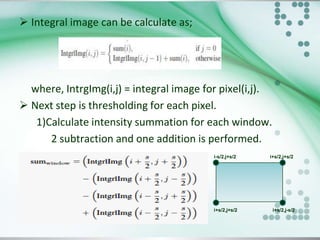
 Integral image can be calculate as;

where, IntrgImg(i,j) = integral image for pixel(i,j).
 Next step is thresholding for each pixel.
1)Calculate intensity summation for each window.
2 subtraction and one addition is performed.
i-s/2,j+s/2

i+s/2,j+s/2

i+s/2,j+s/2

i+s/2,j-s/2
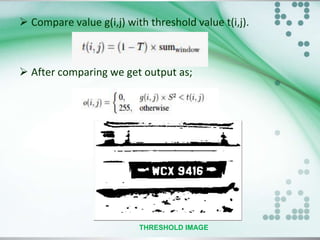
 Compare value g(i,j) with threshold value t(i,j).

 After comparing we get output as;

THRESHOLD IMAGE
2.VERTICAL EDGE EXTRACTION
 Extracting the data by distinguishing the plate region.
 Two steps:
a) Unwanted Line Elimination Algorithm
b) Vertical Edge Detection Algorithm
UNWANTED LINE ELIMINATION ALGORITHM

 To avoid long foreground lines and short noise edges
besides LP region(Unwanted Lines)
 Cases :
1) Horizontal with angle 0⁰(-).
2) Vertical with an angle 90⁰(|).
3) Line inclined at an angle 45⁰(/).
4) Line inclined at an angle 135⁰().
CONCEPT:
 Black pixel values are the background and White pixel
values are the foreground.
 A 3X3 mask is used throughout all image pixels from left
to right and from top to bottom
 Only black pixel values in the image are tested.

b(x,y)
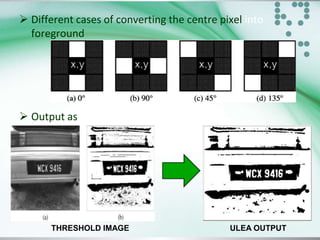
 Different cases of converting the centre pixel into
foreground

 Output as

THRESHOLD IMAGE

ULEA OUTPUT
VERTICAL EDGE BASED DETECTION ALGORITHM
 To find beginning and end of each character
 Concentrates on intersection of Black-White and WhiteBlack regions.
 A 2X4 mask is used to process the image
 Output is as;

 Comparing with old edge extraction method
SOBEL METHOD

VEDA
3.PLATE EXTRACTION
 To extract plate region and characters
 Four steps:
1) Highlight Desired Details(HDD).
2) Candidate Region Extraction(CRE).
3) Plate Region Selection(PRS).
4) Plate Detection(PD).
HIGHLIGHT DESIRED DETAILS
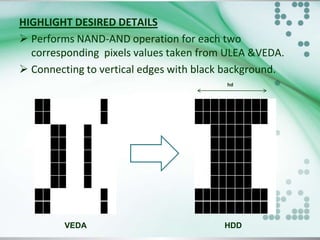
 Performs NAND-AND operation for each two
corresponding pixels values taken from ULEA &VEDA.
 Connecting to vertical edges with black background.
hd

VEDA

HDD
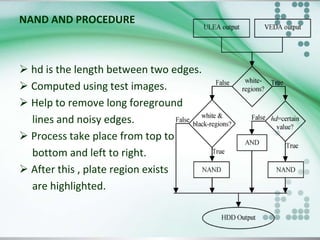
NAND AND PROCEDURE

 hd is the length between two edges.
 Computed using test images.
 Help to remove long foreground
lines and noisy edges.
 Process take place from top to
bottom and left to right.
 After this , plate region exists
are highlighted.
VEDA OUTPUT

HDD OUTPUT
CANDIDATE REGION EXTRACTION
 To find exact LP region from the image.
 Process divide into four steps.
COUNT THE DRAWN LINES PER EACH ROW
 No of horizontal lines in each rows are counted
 Stored in a matrix variable : lines[a] ;a=0,1……m-1
 Time consuming process.
DIVIDE THE IMAGE INTO MULTIGROUPS
 To avoid delay, images convert to multiple groups
 Stored value in a variable : groups
groups=height/C.
C=CRE Constant (10)
COUNT SATISFIED GROUP INDEXES AND BOUNDARIES
 To eliminate unsatisfied groups which exists in the LP

 A threshold value will be considered.
Threshold>=1/15 of image height
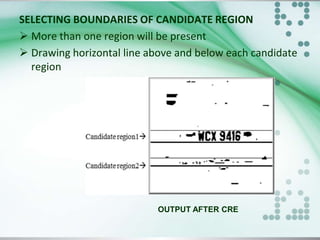
SELECTING BOUNDARIES OF CANDIDATE REGION
 More than one region will be present
 Drawing horizontal line above and below each candidate
region

OUTPUT AFTER CRE
PLATE REGION SELECTION AND DETECTION
 To extract one correct LP
 Two steps
1. Selection of LP region
2. Making a vote.
SELECTION OF LP REGION
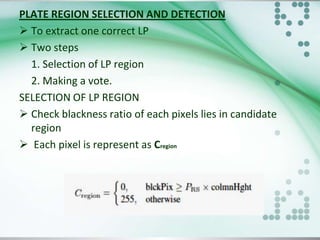
 Check blackness ratio of each pixels lies in candidate
region
 Each pixel is represent as Cregion
 PRS factor is fixed and it was normally 0.5,0.4&0.3
 After detecting region, the region will replaced by vertical
lines.

LP REGION
CODE

FLOW CHART
MAKING A VOTE
 Column with top and bottom neighbor have high
blackness ratio will give a vote.
 After voting section, the candidate region which have
highest vote will be selected.
 Finally plate will be detect and extracted.
EXPERIMENTAL SETUP
 Web camera should be in live condition.
 2-4 meter distance.
 IMAGES

CLASSIFICATIONS

EXPERIMENTAL CONDITIONS
RESULT AND COMPARISON
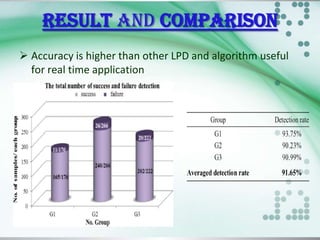
 Accuracy is higher than other LPD and algorithm useful
for real time application
Computation time of each stages

Comparing with existing system
CONCLUSION
 Using web camera is for monitoring vehicles and also
low resolution images are used
 New and fast algorithm which is useful for real time
requirements
 Computation time is of 47.7 ms with an efficiency of
91.4%

 Five to nine times faster than existing system
REFERENCES
 License plate recognition (LPR) technology : impact
evaluation and community assessment for law
enforcement
 A Real-Time Mobile Vehicle License Plate Detection and
Recognition; Kuo-Ming Hung and Ching-Tang Hsieh
 Comparison of feature extractors in LPR; S N Hinda,K
Marsuki,Y Rubiyah,O Kharuddin
 www.wikipedia.com
Automatic vehicle license plate detection using VEDA

Automatic vehicle license plate detection using VEDA

  • 1.
    AUTOMATIC VEHICLE IDENTIFICATION USING VEDA GUIDEDBY; MRS. MERCY MATHEW ASST. PROFESSOR CAARMEL ENGG. COLLEGE PRESENTED BY; ROJITH THOMAS MTECH-CE ROLL NO: 18
  • 2.
    INTRODUCTION  As numberof automobiles grows rapidly, the traffic problems increase as well, for example, car theft, over speeding and running on the red light.  To avoid these problems, an efficient real time working vehicle identification system is needed.  Most widely accepted technique is License Plate Detection(LPD).  Based on Image processing by capturing license plate using cameras.  Applications: 1) crime prevention 2) parking and toll fee system 3) traffic data collections
  • 3.
    BASIC DIAGRAM  Threeparts: 1) License Plate Detection 2) Character Segmentation 3) Recognition
  • 4.
    EXISTING algorithm  Difficultto process under complex conditions.  Kim et al Algorithm: statistical features and templates  Zimmermann and Mattas Algorithm: fuzzy logic  Sobel Algorithm: vertical edge extraction  Canny Algorithm: Vertical edge extraction  Abolghashemi Algorithm: low quality input  Zhang et al Algorithm: reduce complexity  Bai et al Algorithm: stationary and fixed background
  • 5.
    PROPOSED algorithm  Detectionis by extracting vertical edges.  Low quality images are produced by using web camera.  Resolution is of 352 X 258 with 30 fps.  Steps: 1) Pre-processing. 2) Vertical Edge Detection. 3) Plate Extraction.
  • 6.
    1. Pre processing Process of generating binarized image from color image.  Two steps; 1) Color to gray image inversion(C2G). 2) Adaptive Thresholding. COLOR TO GRAY IMAGE CONVERSION  Converting color image into grayscale image. CAPTUARED IMAGE GRAY IMAGE
  • 7.
    ADAPTIVE THRESHOLDING  Grayimage is converted into binarized image.  To get good adaptive threshold image , Integral image technique is used.  Earlier technique: Wellner’s Algorithm. a)Pixel is compared with avg. of neighboring pixels(S). b)Value of S=1/8 of (image). c)If current pixel is T% lower than S, then set to Black. d)Otherwise set to White. e)Value of T=0.15 of (image).  Limitation: Not suitable when samples are not evenly distributed in all directions(Moving System).
  • 8.
    INTEGRAL IMAGE FORMULATION Window concept.  Image is as matrix with m rows and n columns.  Algorithm: Initially, summation of pixel values for every column is calculated as; sum(i)|j 1,0 ....... 1,n 2,0 g(x,y) = input values. sum(i) = all gray value for every column j through all rows i(i=0,1….m). . . . m,0 m,n
  • 9.
     Integral imagecan be calculate as; where, IntrgImg(i,j) = integral image for pixel(i,j).  Next step is thresholding for each pixel. 1)Calculate intensity summation for each window. 2 subtraction and one addition is performed. i-s/2,j+s/2 i+s/2,j+s/2 i+s/2,j+s/2 i+s/2,j-s/2
  • 10.
     Compare valueg(i,j) with threshold value t(i,j).  After comparing we get output as; THRESHOLD IMAGE
  • 11.
    2.VERTICAL EDGE EXTRACTION Extracting the data by distinguishing the plate region.  Two steps: a) Unwanted Line Elimination Algorithm b) Vertical Edge Detection Algorithm UNWANTED LINE ELIMINATION ALGORITHM  To avoid long foreground lines and short noise edges besides LP region(Unwanted Lines)  Cases : 1) Horizontal with angle 0⁰(-). 2) Vertical with an angle 90⁰(|). 3) Line inclined at an angle 45⁰(/). 4) Line inclined at an angle 135⁰().
  • 12.
    CONCEPT:  Black pixelvalues are the background and White pixel values are the foreground.  A 3X3 mask is used throughout all image pixels from left to right and from top to bottom  Only black pixel values in the image are tested. b(x,y)
  • 13.
     Different casesof converting the centre pixel into foreground  Output as THRESHOLD IMAGE ULEA OUTPUT
  • 14.
    VERTICAL EDGE BASEDDETECTION ALGORITHM  To find beginning and end of each character  Concentrates on intersection of Black-White and WhiteBlack regions.
  • 15.
     A 2X4mask is used to process the image
  • 16.
     Output isas;  Comparing with old edge extraction method SOBEL METHOD VEDA
  • 17.
    3.PLATE EXTRACTION  Toextract plate region and characters  Four steps: 1) Highlight Desired Details(HDD). 2) Candidate Region Extraction(CRE). 3) Plate Region Selection(PRS). 4) Plate Detection(PD).
  • 18.
    HIGHLIGHT DESIRED DETAILS Performs NAND-AND operation for each two corresponding pixels values taken from ULEA &VEDA.  Connecting to vertical edges with black background. hd VEDA HDD
  • 19.
    NAND AND PROCEDURE hd is the length between two edges.  Computed using test images.  Help to remove long foreground lines and noisy edges.  Process take place from top to bottom and left to right.  After this , plate region exists are highlighted.
  • 20.
  • 21.
    CANDIDATE REGION EXTRACTION To find exact LP region from the image.  Process divide into four steps. COUNT THE DRAWN LINES PER EACH ROW  No of horizontal lines in each rows are counted  Stored in a matrix variable : lines[a] ;a=0,1……m-1  Time consuming process. DIVIDE THE IMAGE INTO MULTIGROUPS  To avoid delay, images convert to multiple groups  Stored value in a variable : groups groups=height/C. C=CRE Constant (10)
  • 22.
    COUNT SATISFIED GROUPINDEXES AND BOUNDARIES  To eliminate unsatisfied groups which exists in the LP  A threshold value will be considered. Threshold>=1/15 of image height
  • 23.
    SELECTING BOUNDARIES OFCANDIDATE REGION  More than one region will be present  Drawing horizontal line above and below each candidate region OUTPUT AFTER CRE
  • 24.
    PLATE REGION SELECTIONAND DETECTION  To extract one correct LP  Two steps 1. Selection of LP region 2. Making a vote. SELECTION OF LP REGION  Check blackness ratio of each pixels lies in candidate region  Each pixel is represent as Cregion
  • 25.
     PRS factoris fixed and it was normally 0.5,0.4&0.3  After detecting region, the region will replaced by vertical lines. LP REGION
  • 26.
  • 27.
    MAKING A VOTE Column with top and bottom neighbor have high blackness ratio will give a vote.  After voting section, the candidate region which have highest vote will be selected.  Finally plate will be detect and extracted.
  • 28.
    EXPERIMENTAL SETUP  Webcamera should be in live condition.  2-4 meter distance.  IMAGES CLASSIFICATIONS EXPERIMENTAL CONDITIONS
  • 29.
    RESULT AND COMPARISON Accuracy is higher than other LPD and algorithm useful for real time application
  • 30.
    Computation time ofeach stages Comparing with existing system
  • 31.
    CONCLUSION  Using webcamera is for monitoring vehicles and also low resolution images are used  New and fast algorithm which is useful for real time requirements  Computation time is of 47.7 ms with an efficiency of 91.4%  Five to nine times faster than existing system
  • 32.
    REFERENCES  License platerecognition (LPR) technology : impact evaluation and community assessment for law enforcement  A Real-Time Mobile Vehicle License Plate Detection and Recognition; Kuo-Ming Hung and Ching-Tang Hsieh  Comparison of feature extractors in LPR; S N Hinda,K Marsuki,Y Rubiyah,O Kharuddin  www.wikipedia.com