Download to read offline
![International Research Journal of Engineering and Technology (IRJET) e-ISSN: 2395-0056
Volume: 09 Issue: 02 | Feb 2022 www.irjet.net p-ISSN: 2395-0072
© 2022, IRJET | Impact Factor value: 7.529 | ISO 9001:2008 Certified Journal | Page 223
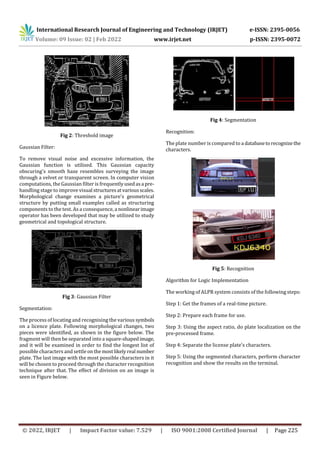
LICENSE PLATE RECOGNITION
Pooja1, Rashmitha2, Riya Fernandes3, Sneha S4, Assistant Prof. Narayan Naik5
1-4Student, Dept. of Information Science and Engineering, CEC, Karnataka, India
5AsstProfessor, Dept. of Information Science and Engineering, CEC, Karnataka, India
---------------------------------------------------------------------***----------------------------------------------------------------------
Abstract - Every country has faced difficulties with traffic
control and identifying vehicle owners. A driver driving too
fast or violating traffic rules can sometimes be challenging to
identify. Because of the speed of the vehicle, traffic officers
might not be able to identify the vehicle in order to catch and
punish people who commit such offenses. As one of the
solutions to this problem, we need the development of the
License Plate Recognition (LPR) system. Image processing
techniques are used to identify the number plates of the
vehicle. Character recognition is a four-step process that
includes capturing the image from a digital camera, pre-
processing, segmentation, and recognition of characters.
Python is used to implement the system, and real images are
used to test its performance.
1. INTRODUCTION
License Plate Recognition[LPR] is an important technology
for detecting a vehicle's plate number. LPR Systems
recognize the characters present on the number plates of
vehicles based on images of the plates, which are then
processed to process further information. For instance,they
can be helpful in finding missing vehicles or vehicles
involved in crimes and also to know about Vehicle owner’s
information. Typically, a license plate recognition system
uses a picture as an input, the output displays the characters
usually as text. This system consists of a camera to capture
the images of the vehicles. License Plate Recognition system
allows system users to scan 100s of license plates in less
duration of time. LPR is used by police forces around the
world for law enforcement purposes, including to check if a
vehicle is registered or licensed. It is also used to
electronically collect tolls on toll roads and as a method of
cataloging traffic movements, for example by road agencies.
1.1. LITERATURE SURVEY
[1] License Plate Recognition System Shally Gupta. The
License Plate Recognition (LPR) system has been proposed
for Ghanian license plates that are used for conveyance
based on plate characteristics and variation. Edge detection
and matching algorithms are the two candidate detection
algorithms used for this ANPR designmodel.Afterdetection,
the next step is character segmentation, which prevents
noise, character skewing, and character arrangementissues.
Finally, the character recognition was conducted using a
tesseract OCR engine.
[2] M. M. Shidore,” Number Plate Recognition”. This paper
presents an algorithm for extracting vehicle number plates,
segmenting characters, and recognizing them. Various
variations of size, background, illumination, camera angle,
distance, and other attributes make up the image database.
Number plates can be extracted faithfullywith an85percent
success rate by using vertical edge detection and connected
component algorithms. Character segmentation is effective
with an 80 percent success rate based on connected
component analysis and vertical projection analysis.
Recognizing characters has a success rate of 79.84 percent.
[3] Aniruddh Puranic, ”Number Plate Recognition System”
Vehicle ownership has become a necessity in urban India
because of its growing affluence. Traffic controlling issues
have resulted from this unanticipated event. Several aspects
of their application are reviewed in this paper. It was found
that the ANPR system is 80.8% accurate for Indian plates
when using template matching.
[4] "NumberPlateRecognitionUsingTemplateMatching,"by
Nighat Naaz. We propose in this research to recognise
characters on a car license plate. License plates may be
identified based on their characters using template-
matching. This technique takes a picture of a license plate as
input and then performs pre-processing procedures to
reduce noise. Grayscale conversion, dilation, erosion, and
convolution are some of the phasesinvolved.The nextstepis
to use linked components to segment the characters. After
the characters have beensplit,matchingtemplatestothemis
used to recognise them. Based on their relationships, the
templates are matched with segmentedcharacters.Atext file
displays the number and character detected from the input
picture in the last stage.
[5] Automatic Number Plate Recognition System (ANPR).
Sahar S. Tabrizi explains a technique for License plate
acknowledgment frameworks that expands the exactness
and lessening of frameworks. k- Nearest Neighbors
calculation and Multi-Class Support Vector Machines (KNN-
SVM) are the algorithms used here. K-NN is used as the
primary characterization display as it is basic. Comparative
characters issue has been overcome by utilizing the various
SVMs characterization display.
[6] Riazul Islam, Satyen Biswas. The authors of this paper
presented an effective method for identifying vehicle
number plates. To improve the object area, a semantic
operation based on several groupings is applied to infer the
locality of a region,whichultimatelypreventsnon-interested](https://image.slidesharecdn.com/irjet-v9i239-220913091310-413ac302/85/LICENSE-PLATE-RECOGNITION-1-320.jpg)
![International Research Journal of Engineering and Technology (IRJET) e-ISSN: 2395-0056
Volume: 09 Issue: 02 | Feb 2022 www.irjet.net p-ISSN: 2395-0072
© 2022, IRJET | Impact Factor value: 7.529 | ISO 9001:2008 Certified Journal | Page 223
LICENSE PLATE RECOGNITION
Pooja1, Rashmitha2, Riya Fernandes3, Sneha S4, Assistant Prof. Narayan Naik5
1-4Student, Dept. of Information Science and Engineering, CEC, Karnataka, India
5AsstProfessor, Dept. of Information Science and Engineering, CEC, Karnataka, India
---------------------------------------------------------------------***----------------------------------------------------------------------
Abstract - Every country has faced difficulties with traffic
control and identifying vehicle owners. A driver driving too
fast or violating traffic rules can sometimes be challenging to
identify. Because of the speed of the vehicle, traffic officers
might not be able to identify the vehicle in order to catch and
punish people who commit such offenses. As one of the
solutions to this problem, we need the development of the
License Plate Recognition (LPR) system. Image processing
techniques are used to identify the number plates of the
vehicle. Character recognition is a four-step process that
includes capturing the image from a digital camera, pre-
processing, segmentation, and recognition of characters.
Python is used to implement the system, and real images are
used to test its performance.
1. INTRODUCTION
License Plate Recognition[LPR] is an important technology
for detecting a vehicle's plate number. LPR Systems
recognize the characters present on the number plates of
vehicles based on images of the plates, which are then
processed to process further information. For instance,they
can be helpful in finding missing vehicles or vehicles
involved in crimes and also to know about Vehicle owner’s
information. Typically, a license plate recognition system
uses a picture as an input, the output displays the characters
usually as text. This system consists of a camera to capture
the images of the vehicles. License Plate Recognition system
allows system users to scan 100s of license plates in less
duration of time. LPR is used by police forces around the
world for law enforcement purposes, including to check if a
vehicle is registered or licensed. It is also used to
electronically collect tolls on toll roads and as a method of
cataloging traffic movements, for example by road agencies.
1.1. LITERATURE SURVEY
[1] License Plate Recognition System Shally Gupta. The
License Plate Recognition (LPR) system has been proposed
for Ghanian license plates that are used for conveyance
based on plate characteristics and variation. Edge detection
and matching algorithms are the two candidate detection
algorithms used for this ANPR designmodel.Afterdetection,
the next step is character segmentation, which prevents
noise, character skewing, and character arrangementissues.
Finally, the character recognition was conducted using a
tesseract OCR engine.
[2] M. M. Shidore,” Number Plate Recognition”. This paper
presents an algorithm for extracting vehicle number plates,
segmenting characters, and recognizing them. Various
variations of size, background, illumination, camera angle,
distance, and other attributes make up the image database.
Number plates can be extracted faithfullywith an85percent
success rate by using vertical edge detection and connected
component algorithms. Character segmentation is effective
with an 80 percent success rate based on connected
component analysis and vertical projection analysis.
Recognizing characters has a success rate of 79.84 percent.
[3] Aniruddh Puranic, ”Number Plate Recognition System”
Vehicle ownership has become a necessity in urban India
because of its growing affluence. Traffic controlling issues
have resulted from this unanticipated event. Several aspects
of their application are reviewed in this paper. It was found
that the ANPR system is 80.8% accurate for Indian plates
when using template matching.
[4] "NumberPlateRecognitionUsingTemplateMatching,"by
Nighat Naaz. We propose in this research to recognise
characters on a car license plate. License plates may be
identified based on their characters using template-
matching. This technique takes a picture of a license plate as
input and then performs pre-processing procedures to
reduce noise. Grayscale conversion, dilation, erosion, and
convolution are some of the phasesinvolved.The nextstepis
to use linked components to segment the characters. After
the characters have beensplit,matchingtemplatestothemis
used to recognise them. Based on their relationships, the
templates are matched with segmentedcharacters.Atext file
displays the number and character detected from the input
picture in the last stage.
[5] Automatic Number Plate Recognition System (ANPR).
Sahar S. Tabrizi explains a technique for License plate
acknowledgment frameworks that expands the exactness
and lessening of frameworks. k- Nearest Neighbors
calculation and Multi-Class Support Vector Machines (KNN-
SVM) are the algorithms used here. K-NN is used as the
primary characterization display as it is basic. Comparative
characters issue has been overcome by utilizing the various
SVMs characterization display.
[6] Riazul Islam, Satyen Biswas. The authors of this paper
presented an effective method for identifying vehicle
number plates. To improve the object area, a semantic
operation based on several groupings is applied to infer the
locality of a region,whichultimatelypreventsnon-interested](https://image.slidesharecdn.com/irjet-v9i239-220913091310-413ac302/75/LICENSE-PLATE-RECOGNITION-1-2048.jpg)
![International Research Journal of Engineering and Technology (IRJET) e-ISSN: 2395-0056
Volume: 09 Issue: 02 | Feb 2022 www.irjet.net p-ISSN: 2395-0072
© 2022, IRJET | Impact Factor value: 7.529 | ISO 9001:2008 Certified Journal | Page 224
regions from being included. Simulated results will
demonstrate the major improvements over other current
systems since this system is adapted using a database of
number plates.
[7] Muhammad Tahir Qadri's (author) goal is to create an
effective approved vehicleidentificationsystembasedon the
vehicle number plate. The system is installed at the entry to
a highly restricted region, such as military zones or areas
around major government facilities, such as Parliament and
the Supreme Court. The created technology will first detect
the car before taking a picture of it. Picture segmentation is
used to extract the vehicle number plate portionofanimage.
Character recognition is done using an optical character
recognition approach. The obtained data is then compared
against database entries in order to determine the specific
information.
[8] Byung-Gil Han's automated license plate identification
approach for high-resolution moviesisdemonstratedinreal-
time. Since the 1970s, substantial research has been
conducted on the detection of licenseplates. Theapproaches
presented in the research, on the other hand, are ineffective
for analyzing high-resolution imagery in real time. Using a
new cascade structure, this research presents the quickest
classifier by effectively discarding false positives. We train
the classifier utilizing the fundamental patterns of several
types of license plates to increase both the computationload
and the accuracy of license plate detection. Theadvantage of
our technique is demonstrated by comparing several
approaches. In compared to existing state-of-the-art
methodologies, the suggested method minimizescomputing
effort while maintaining equivalent accuracy.
[9] The author(Shally Guptha) presented a Mask-RCNN and
Yolov2-based three-stage license plate recognition system.
To identify the license plate number and position, Yolov2 is
used twice in phase 1 and 2. Phase 2 involves capturing a
19x19 grid picture. The Mask-RCNN is used in the last phase
for character recognition. The map rating was 91 percent as
a consequence of this model, and it was able to categorize
vehicle number plates with bevel angles of 0-60 degrees.
[10] This study discussescharacterrecognitionaswell asthe
process of converting a picture to text format by recognizing
the image. Almost all number plate recognition algorithms
employ a single mechanism for character recognition.
Character segmentation and recognition are acquired at the
same time in this approach. The system divides the image
into parts, and the segmentation procedure divides the
words into segments, each of whichmustbeletters,andeach
segment is handed to a classifier.
2. PROPOSED SYSTEM
LPR recognition requires a number of difficult tasks,
including detecting, segmenting, and recognizing number
plates. Processing photographs of registration plates at
varying angulation angles or photos of plates with noise
becomes more difficult as these activities grow more
demanding. Because it is a common problem, its use in real-
time systems requires accuracy, but also speed.
Furthermore, the processing is rapid.
Image Acquisition:
A camera that can take infrared photos and is enabled by
ANoIR. This camera can also capture video in 1080p30 and
720p60 resolutions, which is great quality. A camera setup
that captures photos with just 640x480 pixels can be
employed to reduce the computing strain on the system. A
sample image is preloaded to check and test the algorithm
before starting to test the system with a “ real - time ” image,
as illustrated in Figure 1.
Fig 1: Image Acquisition
Desaturation:
A colour image is turned to a grayscale image via image
desaturation. OpenCV is virtually flawless at converting
colour images to grayscale, and the importance of this
capability is shown.
Thresholding:
Thresholding is a technique for convertinga grayscaleimage
into a two-plane image. Edge detection is made easier with
this image. It does not identify the principal items,butrather
isolates them from the background in order to extract the
data we need. When it comes to thresholding, it's critical to
choose the right value for the threshold that will best
identify a pixel as an object or a background. To do this, we
use OpenCV's Threshold.](https://image.slidesharecdn.com/irjet-v9i239-220913091310-413ac302/85/LICENSE-PLATE-RECOGNITION-2-320.jpg)
![International Research Journal of Engineering and Technology (IRJET) e-ISSN: 2395-0056
Volume: 09 Issue: 02 | Feb 2022 www.irjet.net p-ISSN: 2395-0072
© 2022, IRJET | Impact Factor value: 7.529 | ISO 9001:2008 Certified Journal | Page 226
Fig 6: License Plate Recognition System.
3. CONCLUSION
The results of the License Plate Recognition system are
obtained by analysing several metrics for the identification
of a certain set of characters and digits, such as recognition
of individual characters and digit success rates. The system
will be tested on static images of the vehicle. Testing the
invariance of the algorithms on random images that were
classified to the sets according to their properties is not
meant to find a set of snapshots that are 100% recognizable.
REFERENCES
[1] A Review Paper on License Plate Recognition System
Shally Gupta*, Rajesh Singh, H.L. Mandoria
Andrew S. Agbemenu et. al (2018)
[2] M. M. Shidore, S. P. Narote,” Number Plate Recognition
for Indian Vehicles” IJCSNS International Journal of
Computer Science and Network Security, VOL.11 No.2,
Feb. 2011
[3] Aniruddh Puranic “Vehicle Number Plate Recognition
System: A Literature Review and Implementation using
Template Matching” .
[4] Nighat Naaz , Ajay Kumar “License Number Plate
Recognition using Template Matching” International
Journal of Computer Trends and Technology (IJCTT) –
Volume 35 Number 4- May 2016
[5] Automatic Number Plate RecognitionSystem(ANPR)(A
Survey Article in International Journal of Computer
Applications) International Journal ofComputerScience
Trends and Technology (IJCST) – Volume 5 Issue 2, Mar
– Apr 2017
[6] Riazul Islam, Kazi Fatima Sharif and Satyen Biswas,
“Automatic Vehicle Number Plate Recognition Using
Structured Elements”, IEEE Conference on Systems,
Process and Control December 2015, pp 44-48.
[7] Muhammad Tahir Qadri, Muhammad Asif “Automatic
Number Plate Recognition System for Vehicle
Identification using Optical CharacterRecognition”IEEE
2009
[8] Byung-Gil Han, Jong Taek Lee, Kil-Taek Lim, and Yunsu
Chung “Real-Time License Plate Detection in High
Resolution Videos Using Fastest Available Cascade
Classifier and Core Patterns” ETRI Journal, Volume 37,
Number 2, April 2015
[9] A Review Paper on License Plate Recognition System
Shally Gupta*, Rajesh Singh, H.L. Mandoria Cheng-Hung
Lin et. al (2019)
[10] Automatic Number Plate Recognition System Using
Optical Character Recognition](https://image.slidesharecdn.com/irjet-v9i239-220913091310-413ac302/85/LICENSE-PLATE-RECOGNITION-4-320.jpg)

This document describes a license plate recognition system developed by students at CEC, Karnataka, India. It begins with an abstract that outlines license plate recognition and the key steps: capturing images, pre-processing, segmentation, and character recognition using Python. The introduction provides more details on license plate recognition systems and their uses. A literature review summarizes 10 relevant papers on license plate recognition techniques. The proposed system is then described, outlining the steps of image acquisition, desaturation, thresholding, morphological operations, segmentation, and character recognition.


