David Wheable, Forrester & itSMF USA, @DavidWheable
Stuart Rance, Optimal Service Management, @StuartRance
Tweeting today? Please follow #ITSMSummit
Questions? Submit them via the question box on your screen
The Evolution of Service
Transition
 David Wheable
David is a principal consultant within Forrester's Infrastructure &
Operations practice. He provides research-based consulting services to
I&O Professionals, helping them leverage Forrester's proprietary research
and expertise to meet the ever-changing needs and expectations of their
stakeholders. David specializes in helping clients create effective and
efficient strategies for their IT Service Management challenges including
integrating cloud services, bring your own device (BYOD), and mobility.
 Stuart Rance
Stuart is a strategist, consultant, trainer and author with an international
reputation as an expert in IT service management. He has worked with a
wide variety of clients in many countries, helping them use service
management to create business value for themselves and their
customers. Stuart is the author of ITIL Service Transition, 2011 edition
and the ITIL Glossary, 2007 edition, as well as many ITSM pocket guides.
2
 What
– Support rate of change needed by the
business and minimize any negative
impact
– Your people are your greatest assets
 How
– Changes are packaged into releases
– Changes and releases tested before
deployment
– Changes reviewed and authorized before
actions are initiated
 With what?
– CAB and authorization levels
– Change and release windows
– SACM, definitive media library and
baselines
Important Principles of
Service Transition
3
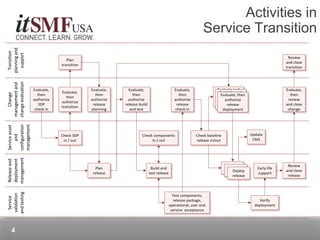
Activities in
Service Transition
4
Transition
planningand
support
Change
managementand
changeevaluation
Releaseand
deployment
management
Service
validation
andtesting
Serviceasset
and
configuration
management
Evaluate,
then
authorize
transition
Plan
transition
Plan
release
Evaluate,
then
authorize
release
planning
Evaluate,
then
authorize
release build
and test
Test components,
release package,
operational, user and
service acceptance
Evaluate,
then
authorize
release
check in
Build and
test release
Check components
in / out
Evaluate and
authorize
release
deployment
Evaluate and
authorize
release
deployment
Evaluate, then
authorize
release
deployment
Deploy
release
Deploy
release
Deploy
release
Review
and close
release
Evaluate,
then
review
and close
change
Review
and close
transition
Check baseline
release in/out
Verify
deployment
Early life
support
Check SDP
in / out
Evaluate,
then
authorize
SDP
check in
Update
CMS
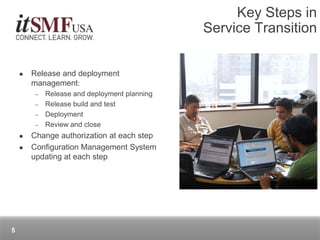
 Release and deployment
management:
– Release and deployment planning
– Release build and test
– Deployment
– Review and close
 Change authorization at each step
 Configuration Management System
updating at each step
Key Steps in
Service Transition
5
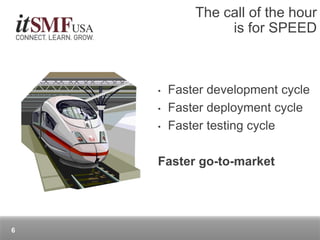
• Faster development cycle
• Faster deployment cycle
• Faster testing cycle
Faster go-to-market
The call of the hour
is for SPEED
6
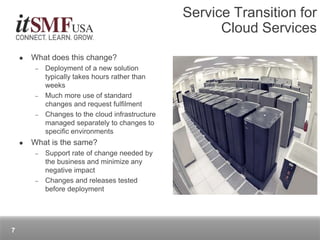
 What does this change?
– Deployment of a new solution
typically takes hours rather than
weeks
– Much more use of standard
changes and request fulfilment
– Changes to the cloud infrastructure
managed separately to changes to
specific environments
 What is the same?
– Support rate of change needed by
the business and minimize any
negative impact
– Changes and releases tested
before deployment
Service Transition for
Cloud Services
7
 Either as a way to improve existing IT processes . . .
 . . . or as a way to support new internal stakeholders (such as product
development leadership)
“We were jaded with our traditional waterfall approach using fixed
contracts. Our business requirements are changing so rapidly, we
needed an approach with far greater feedback loops.”
(SVM professional in the utilities sector)
. . . which is causing increased
interest in Agile development
methodologies
8
 What is Agile?
― A development methodology
― Small, frequent releases – minimum functionality to meet a customer need
― Each release typically delivered by a cross-functional team in a period of 1 to 4
weeks
 What does this change?
― Service Transition must support frequent small releases
― Automated testing integrated into s/w lifecycle
 What is the same?
― Support rate of change needed by the business and minimize any negative
impact
― Changes and releases tested before deployment
Service Transition
and Agile
9
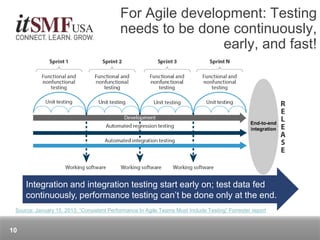
For Agile development: Testing
needs to be done continuously,
early, and fast!
10
Integration and integration testing start early on; test data fed
continuously, performance testing can’t be done only at the end.
Source: January 15, 2013, “Consistent Performance In Agile Teams Must Include Testing” Forrester report
End-to-end
integration
 What is DevOps?
– A movement within IT that is driven
by a need to improve the
collaboration between development
and operations
 What does this change?
– Operations staff involved earlier in
the lifecycle
– Development staff involved later in
the lifecycle
– Requires significant ITSM process
automation
 What is the same?
– Support rate of change needed by
the business and minimize any
negative impact
– Changes and releases tested before
deployment
DevOps is a True Collaboration
of Development and Operations
11
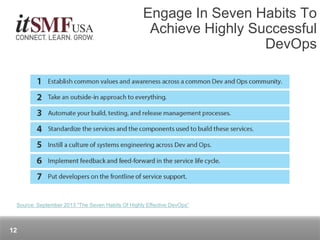
Engage In Seven Habits To
Achieve Highly Successful
DevOps
12
Source: September 2013 “The Seven Habits Of Highly Effective DevOps”
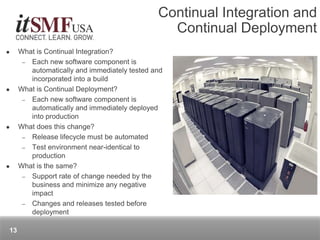
 What is Continual Integration?
– Each new software component is
automatically and immediately tested and
incorporated into a build
 What is Continual Deployment?
– Each new software component is
automatically and immediately deployed
into production
 What does this change?
– Release lifecycle must be automated
– Test environment near-identical to
production
 What is the same?
– Support rate of change needed by the
business and minimize any negative
impact
– Changes and releases tested before
deployment
Continual Integration and
Continual Deployment
13
 Automate end-to-end testing as part of continual integration / deployment
― Continually refine and improve the automated testing as you learn about real
failures (exploratory testing)
― Test deployment and backout as part of the automated testing
 Run game days
― Simulate failure modes and rehearse your responses
 Design anti-fragile solutions
― Expect failure, design solutions that will continue to operate despite failures
― You can’t predict “black swan” failures so learn to cope with them
 Use Chaos Monkey and other members of the Simian Army
― Intentionally cause random failures to ensure that your solution really is anti-
fragile (http://techblog.netflix.com/2012/07/chaos-monkey-released-into-
wild.html)
How Do You Do Testing
In This New World?
14
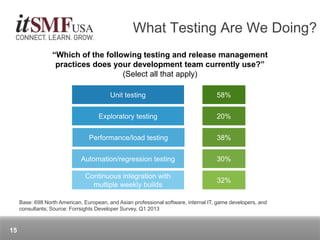
What Testing Are We Doing?
15
“Which of the following testing and release management
practices does your development team currently use?”
(Select all that apply)
Unit testing
Exploratory testing
Performance/load testing
Automation/regression testing
Continuous integration with
multiple weekly builds
58%
20%
38%
30%
32%
Base: 698 North American, European, and Asian professional software, internal IT, game developers, and
consultants; Source: Forrsights Developer Survey, Q1 2013
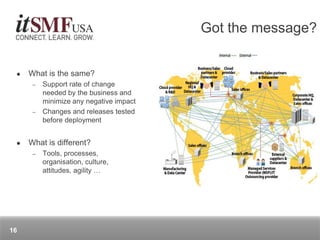
 What is the same?
– Support rate of change
needed by the business and
minimize any negative impact
– Changes and releases tested
before deployment
 What is different?
– Tools, processes,
organisation, culture,
attitudes, agility …
Got the message?
16
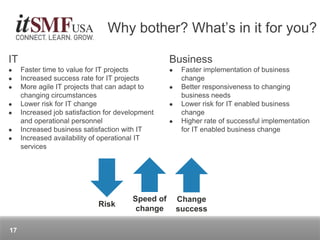
IT
 Faster time to value for IT projects
 Increased success rate for IT projects
 More agile IT projects that can adapt to
changing circumstances
 Lower risk for IT change
 Increased job satisfaction for development
and operational personnel
 Increased business satisfaction with IT
 Increased availability of operational IT
services
Business
 Faster implementation of business
change
 Better responsiveness to changing
business needs
 Lower risk for IT enabled business
change
 Higher rate of successful implementation
for IT enabled business change
Why bother? What’s in it for you?
17
Risk
Speed of
change
Change
success
 There are no quick and easy answers
― Make sure you understand the real business need for change (agility and
stability)
― Talk to your counterparts in development and understand their perspective
― Simplify your processes, and remove steps that don’t add enough value
― Integrate processes from requirements through projects and development to
operations
― Automate everything that you sensibly can, but only where things are simple
and well understood
 The biggest changes are not to processes, but to attitudes, behaviour and
culture
What changes should you make
to your processes?
18
Further Reading
19
David Wheable
Principal Consultant
dwheable@forrester.com
Twitter @DavidWheable | LinkedIn Profile
Stuart Rance
ITSM Consultant, Trainer, Author
StuartR@rances.net
Twitter @StuartRance | LinkedIn Profile
Thank You
20

Evolution of service transition

  • 1.
    David Wheable, Forrester& itSMF USA, @DavidWheable Stuart Rance, Optimal Service Management, @StuartRance Tweeting today? Please follow #ITSMSummit Questions? Submit them via the question box on your screen The Evolution of Service Transition
  • 2.
     David Wheable Davidis a principal consultant within Forrester's Infrastructure & Operations practice. He provides research-based consulting services to I&O Professionals, helping them leverage Forrester's proprietary research and expertise to meet the ever-changing needs and expectations of their stakeholders. David specializes in helping clients create effective and efficient strategies for their IT Service Management challenges including integrating cloud services, bring your own device (BYOD), and mobility.  Stuart Rance Stuart is a strategist, consultant, trainer and author with an international reputation as an expert in IT service management. He has worked with a wide variety of clients in many countries, helping them use service management to create business value for themselves and their customers. Stuart is the author of ITIL Service Transition, 2011 edition and the ITIL Glossary, 2007 edition, as well as many ITSM pocket guides. 2
  • 3.
     What – Supportrate of change needed by the business and minimize any negative impact – Your people are your greatest assets  How – Changes are packaged into releases – Changes and releases tested before deployment – Changes reviewed and authorized before actions are initiated  With what? – CAB and authorization levels – Change and release windows – SACM, definitive media library and baselines Important Principles of Service Transition 3
  • 4.
    Activities in Service Transition 4 Transition planningand support Change managementand changeevaluation Releaseand deployment management Service validation andtesting Serviceasset and configuration management Evaluate, then authorize transition Plan transition Plan release Evaluate, then authorize release planning Evaluate, then authorize releasebuild and test Test components, release package, operational, user and service acceptance Evaluate, then authorize release check in Build and test release Check components in / out Evaluate and authorize release deployment Evaluate and authorize release deployment Evaluate, then authorize release deployment Deploy release Deploy release Deploy release Review and close release Evaluate, then review and close change Review and close transition Check baseline release in/out Verify deployment Early life support Check SDP in / out Evaluate, then authorize SDP check in Update CMS
  • 5.
     Release anddeployment management: – Release and deployment planning – Release build and test – Deployment – Review and close  Change authorization at each step  Configuration Management System updating at each step Key Steps in Service Transition 5
  • 6.
    • Faster developmentcycle • Faster deployment cycle • Faster testing cycle Faster go-to-market The call of the hour is for SPEED 6
  • 7.
     What doesthis change? – Deployment of a new solution typically takes hours rather than weeks – Much more use of standard changes and request fulfilment – Changes to the cloud infrastructure managed separately to changes to specific environments  What is the same? – Support rate of change needed by the business and minimize any negative impact – Changes and releases tested before deployment Service Transition for Cloud Services 7
  • 8.
     Either asa way to improve existing IT processes . . .  . . . or as a way to support new internal stakeholders (such as product development leadership) “We were jaded with our traditional waterfall approach using fixed contracts. Our business requirements are changing so rapidly, we needed an approach with far greater feedback loops.” (SVM professional in the utilities sector) . . . which is causing increased interest in Agile development methodologies 8
  • 9.
     What isAgile? ― A development methodology ― Small, frequent releases – minimum functionality to meet a customer need ― Each release typically delivered by a cross-functional team in a period of 1 to 4 weeks  What does this change? ― Service Transition must support frequent small releases ― Automated testing integrated into s/w lifecycle  What is the same? ― Support rate of change needed by the business and minimize any negative impact ― Changes and releases tested before deployment Service Transition and Agile 9
  • 10.
    For Agile development:Testing needs to be done continuously, early, and fast! 10 Integration and integration testing start early on; test data fed continuously, performance testing can’t be done only at the end. Source: January 15, 2013, “Consistent Performance In Agile Teams Must Include Testing” Forrester report End-to-end integration
  • 11.
     What isDevOps? – A movement within IT that is driven by a need to improve the collaboration between development and operations  What does this change? – Operations staff involved earlier in the lifecycle – Development staff involved later in the lifecycle – Requires significant ITSM process automation  What is the same? – Support rate of change needed by the business and minimize any negative impact – Changes and releases tested before deployment DevOps is a True Collaboration of Development and Operations 11
  • 12.
    Engage In SevenHabits To Achieve Highly Successful DevOps 12 Source: September 2013 “The Seven Habits Of Highly Effective DevOps”
  • 13.
     What isContinual Integration? – Each new software component is automatically and immediately tested and incorporated into a build  What is Continual Deployment? – Each new software component is automatically and immediately deployed into production  What does this change? – Release lifecycle must be automated – Test environment near-identical to production  What is the same? – Support rate of change needed by the business and minimize any negative impact – Changes and releases tested before deployment Continual Integration and Continual Deployment 13
  • 14.
     Automate end-to-endtesting as part of continual integration / deployment ― Continually refine and improve the automated testing as you learn about real failures (exploratory testing) ― Test deployment and backout as part of the automated testing  Run game days ― Simulate failure modes and rehearse your responses  Design anti-fragile solutions ― Expect failure, design solutions that will continue to operate despite failures ― You can’t predict “black swan” failures so learn to cope with them  Use Chaos Monkey and other members of the Simian Army ― Intentionally cause random failures to ensure that your solution really is anti- fragile (http://techblog.netflix.com/2012/07/chaos-monkey-released-into- wild.html) How Do You Do Testing In This New World? 14
  • 15.
    What Testing AreWe Doing? 15 “Which of the following testing and release management practices does your development team currently use?” (Select all that apply) Unit testing Exploratory testing Performance/load testing Automation/regression testing Continuous integration with multiple weekly builds 58% 20% 38% 30% 32% Base: 698 North American, European, and Asian professional software, internal IT, game developers, and consultants; Source: Forrsights Developer Survey, Q1 2013
  • 16.
     What isthe same? – Support rate of change needed by the business and minimize any negative impact – Changes and releases tested before deployment  What is different? – Tools, processes, organisation, culture, attitudes, agility … Got the message? 16
  • 17.
    IT  Faster timeto value for IT projects  Increased success rate for IT projects  More agile IT projects that can adapt to changing circumstances  Lower risk for IT change  Increased job satisfaction for development and operational personnel  Increased business satisfaction with IT  Increased availability of operational IT services Business  Faster implementation of business change  Better responsiveness to changing business needs  Lower risk for IT enabled business change  Higher rate of successful implementation for IT enabled business change Why bother? What’s in it for you? 17 Risk Speed of change Change success
  • 18.
     There areno quick and easy answers ― Make sure you understand the real business need for change (agility and stability) ― Talk to your counterparts in development and understand their perspective ― Simplify your processes, and remove steps that don’t add enough value ― Integrate processes from requirements through projects and development to operations ― Automate everything that you sensibly can, but only where things are simple and well understood  The biggest changes are not to processes, but to attitudes, behaviour and culture What changes should you make to your processes? 18
  • 19.
  • 20.
    David Wheable Principal Consultant dwheable@forrester.com Twitter@DavidWheable | LinkedIn Profile Stuart Rance ITSM Consultant, Trainer, Author StuartR@rances.net Twitter @StuartRance | LinkedIn Profile Thank You 20

Editor's Notes

  • #4 Provide the context and background to Service Transition. Introduce key concepts and terminology.
  • #5 Set the context on what goes on with Service Transition. This should be positioned at the current ITIL 2011 Edition POVDO NOT discuss this slide in detail, but ensure the audience know this diagram from the book is an example of one possible flow through the ST processes, and that other flows may be appropriate for other types of transition
  • #6 The previous diagram is complex and difficult to assimilate – reinforce the key steps
  • #8 Key discussion points:Authorisation levels and RACIThe role of standard changes and request fulfilmentCI type and instance distinction – test the type but deploy the instance (+ examples)The need to consider both the physical and virtual aspects
  • #10 Note: We talk about Continuous integration in later slideEssential to test backout plans in a really good test environment that is very close to productionFix-forward or back-out.BoS story – CA Scheduler backout without having tested/documented/automated the backout resulted in a major loss of business reputationWaterfall and v-model. How this relates to business analysis and requirements
  • #12 These are Stuart Rance definitions, but I find it very helpful to distinguish these things. Some people will describe DevOps as including everything in this slide set, but it is helpful to distinguish the different aspects.Agile is a development methodologyDevOps is an organisational and cultural approach (ABC)DevOps supports Agile very well, but can also be used with Waterfall or any other development methodologyDevOps is often associated with continual deployment (see next slide) but that is technology not org and cultureFull copy of the ops environment available to the development team not just ops staffEarly life support is much more important – call a developer out at 2am – makes it real makes developers code for ops “Build to run”Large organisation where part of their change management process is they rate change requestors on the success of their change requests
  • #14 These are technology that support Agile and DevOps – but they are NOT Agile and DevOpsContinual Integration supports Agile – could be used with waterfall too depending on circumstancesContinual Deployment supports DevOpsAudience question: What is the maximum rate at which it is possible to deploy releases?
  • #15 Environment must be “change resilient”TDD = Test Driven Design / Development. Developers create the test first, then the code. Both are required for check in.
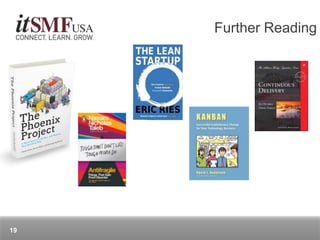
  • #20 The Phoenix Project - Gene Kim, Kevin Behr and George SpaffordAntifragile - Nassim Nicholas TalebThe Lean Startup – Eric RiesKanban – David J AndersonContinuous Delivery - Jez Humble and David Farley