AIR INDIA  and CRM March 2011
Human Factors Teamwork Communication Workload Management & automation Decision Making & Leadership Situational Awareness Fatigue Threat & Error Management CRM LOFT
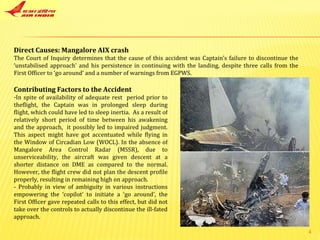
Direct Causes: Mangalore AIX crash The Court of Inquiry determines that the cause of this accident was Captain’s failure to discontinue the ‘unstabilised approach’ and his persistence in continuing with the landing, despite three calls from the First Officer to ‘go around’ and a number of warnings from EGPWS. Contributing Factors to the Accident In spite of availability of adequate rest  period prior to theflight, the Captain was in prolonged sleep during flight, which could have led to sleep inertia.  As a result of relatively short period of time between his awakening and the approach,  it possibly led to impaired judgment. This aspect might have got accentuated while flying in the Window of Circadian Low (WOCL). In the absence of Mangalore Area Control Radar (MSSR), due to unserviceability, the aircraft was given descent at a shorter distance on DME as compared to the normal. However, the flight crew did not plan the descent profile properly, resulting in remaining high on approach. - Probably in view of ambiguity in various instructions empowering the ‘copilot’ to initiate a ‘go around’, the First Officer gave repeated calls to this effect, but did not take over the controls to actually discontinue the ill-fated approach.
The captain (55, Serbian, ATPL, 10,215 hours as pilot in command, 2,844 hours on type) was described by collegues as a friendly person and ready to help the first officers with professional information. He was "assertive" and tended to indicate he was always right. The first officer (40, Indian, ATPL, 3,620 hours total flying experience, 3,319 on type) was known as a man of few words and meticulous in his adherence to standard operating procedures. He had filed a complaint about another of the foreign captains, the company had therefore instructed rostering personnel to not pair the two before counseling had taken place (which did not occur before the crash). Air India Express had mandated that due to the table top runway takeoffs and landings in Mangalore had to be flown by the captain. The crew had performed the outbound flight IX-811 to Dubai and was to conduct flight IX-812 back to Mangalore. Ground personnel in Dubai reported that both crew appeared normal and healthy. They had left the aircraft and gone to the terminal building and the duty free shop during their 82 minutes turn over in Dubai. The crew did perform all pre-departure checks according to observations by ground personnel. The flight was to depart at 01:15 local Dubai time (21:15Z), which is 02:45 local Mangalore time and was estimated to arrive at 06:30 local Mangalore time (01:00Z).
Data off the flight data recorder and ATC recordings show the departure, climb and cruise of the aircraft were uneventful. The cockpit voice recorder featured a capacity of 125 minutes. During the first 100 minutes of the recording there was no communication between the pilots however, all radio communication was done by the first officer. The captain's microphone occasionally recorded sounds consistent with deep breathing and mild snoring, at the later stages sounds of clearing the throat and coughing. The first officer reported to Mangalore Area Control Center while overflying waypoint IGAMA at FL370 and requested radar identification at which time he was told that Mangalore's radar was out of service (starting May 20th 2010). About 5 minutes later, about 130nm before Mangalore, the first officer requested the type of approach to expect, was told to expect the ILS DME Arc approach to runway 24, and requested descent. ATC denied the descent however due to procedural control available only and instructed IX-812 to report at 80 DME on radial 287 of Mangalore's VOR MML.  About 9 minutes after reporting over IGAMA - and about 25 minutes before the overrun of the runway - the first verbal communication ("What?") by the captain was captured by the captain's microphone.  About 13 minutes after overflying IGAMA the first officer reported 80 DME on radial 287 and was cleared to 7000 feet ,  the descent commenced at 77nm from Mangalore VOR .
While the aircraft descended through FL295 an incomplete approach briefing was carried out, no standard approach briefing was conducted. At some stage during the descent, the actual time not mentioned in the report, the speed brake handle was placed in the flight detent and speed brakes deployed accordingly. About 25nm before Mangalore the airplane was descending through FL184, still substantially above the descent profile, when the air traffic controller cleared the aircraft to 2900 feet. The aircraft was subsequently handed to Mangalore Tower, who requested the crew to report once established on the 10 DME Arc. At about that time yawning was recorded by the first officer's microphone. After the crew reported established on the Arc ATC requested to report when established on the ILS. At that time it is obvious the captain realised the airplane was too high on the approach. He had the gear lowered while descending through 8500 feet, speed brakes were still extended. The aircraft continued to be high, intercepted the localizer beam and captured the false glideslope beam at double the correct approach angle (6 instead of 3 degrees descent). There was no cross check between actual altitudes/heights with the descent profile provided in the approach chart conducted by the crew.
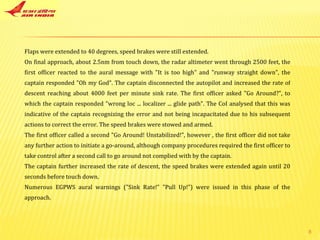
Flaps were extended to 40 degrees, speed brakes were still extended. On final approach, about 2.5nm from touch down, the radar altimeter went through 2500 feet, the first officer reacted to the aural message with "It is too high" and "runway straight down", the captain responded "Oh my God". The captain disconnected the autopilot and increased the rate of descent reaching about 4000 feet per minute sink rate. The first officer asked "Go Around?", to which the captain responded "wrong loc ... localizer ... glide path". The CoI analysed that this was indicative of the captain recognizing the error and not being incapacitated due to his subsequent actions to correct the error. The speed brakes were stowed and armed. The first officer called a second "Go Around! Unstabilized!", however , the first officer did not take any further action to initiate a go-around, although company procedures required the first officer to take control after a second call to go around not complied with by the captain. The captain further increased the rate of descent, the speed brakes were extended again until 20 seconds before touch down. Numerous EGPWS aural warnings ("Sink Rate!" "Pull Up!") were issued in this phase of the approach.
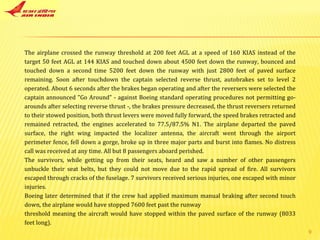
The airplane crossed the runway threshold at 200 feet AGL at a speed of 160 KIAS instead of the target 50 feet AGL at 144 KIAS and touched down about 4500 feet down the runway, bounced and touched down a second time 5200 feet down the runway with just 2800 feet of paved surface remaining. Soon after touchdown the captain selected reverse thrust, autobrakes set to level 2 operated. About 6 seconds after the brakes began operating and after the reversers were selected the captain announced "Go Around" - against Boeing standard operating procedures not permitting go-arounds after selecting reverse thrust -, the brakes pressure decreased, the thrust reversers returned to their stowed position, both thrust levers were moved fully forward, the speed brakes retracted and remained retracted, the engines accelerated to 77.5/87.5% N1. The airplane departed the paved surface, the right wing impacted the localizer antenna, the aircraft went through the airport perimeter fence, fell down a gorge, broke up in three major parts and burst into flames. No distress call was received at any time. All but 8 passengers aboard perished. The survivors, while getting up from their seats, heard and saw a number of other passengers unbuckle their seat belts, but they could not move due to the rapid spread of fire. All survivors escaped through cracks of the fuselage. 7 survivors received serious injuries, one escaped with minor injuries. Boeing later determined that if the crew had applied maximum manual braking after second touch down, the airplane would have stopped 7600 feet past the runway threshold meaning the aircraft would have stopped within the paved surface of the runway (8033 feet long).
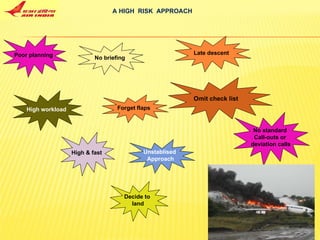
Unstablised  Approach No briefing No standard Call-outs or deviation calls Omit check list High & fast Decide to  land Runway  Over run Forget flaps Late descent A HIGH   RISK  APPROACH High workload Poor planning
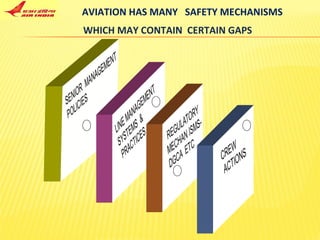
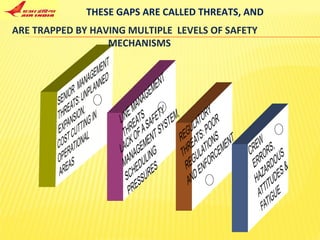
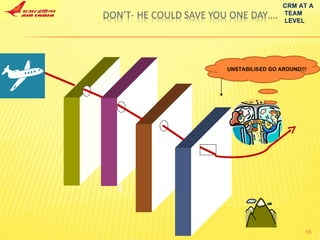
AVIATION HAS MANY  SAFETY MECHANISMS  WHICH MAY CONTAIN  CERTAIN GAPS
THESE GAPS ARE CALLED THREATS, AND  ARE TRAPPED BY HAVING MULTIPLE  LEVELS OF SAFETY  MECHANISMS
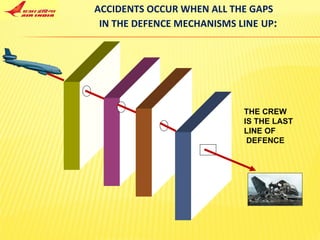
ACCIDENTS OCCUR WHEN ALL THE GAPS IN THE DEFENCE MECHANISMS LINE   UP : THE CREW IS THE LAST  LINE OF DEFENCE
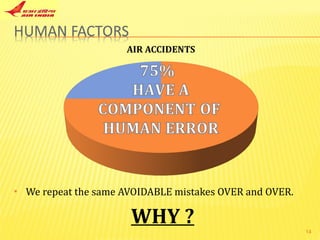
We repeat the same AVOIDABLE mistakes OVER and OVER.  WHY ?
Multiple Crew Based Operations Unfamiliar Crews from different backgrounds and cultures Unusual Operating Environment: Large network with diverse destinations- Terrain, Weather & ATC variations. Scheduling pressures and  irregular rosters Different time zones and jet lag Fatigue Contributing Factors to the Accident I- Probably in view of ambiguity in various instructions empowering the ‘copilot’ to initiate a ‘go around’, the First Officer gave repeated calls to this effect, but did not take over the controls to actually discontinue the ill-fated approach.
Modern technology has ensured reliable  fail-safe hardware. Operating Environment is now  More Demanding, which Requires Better Decision Making By Pilots The  Human Factor is now  The Weakest Link
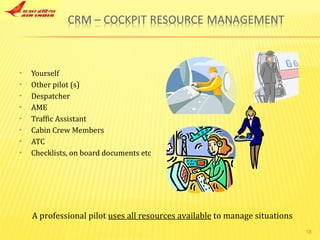
Yourself Other pilot (s) Despatcher AME Traffic Assistant Cabin Crew Members ATC Checklists, on board documents etc A professional pilot  uses all resources available  to manage situations
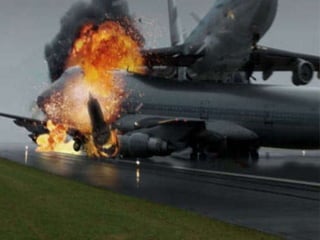
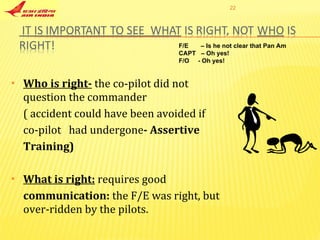
CAPT  – What do you say ? F/O  – Yup ! F/E  – Is he not clear that Pan Am CAPT  – Oh yes! F/O  - Oh yes! [Pan Am] B-747 Pan American CAPT  – Let’s get the hell out of here ! F/O  – Yeh, he’s anxious isn’t he. F/E  – Yeh, after he held us up for an hour & a half.. Now he’s in a rush CAPT  – There he is ..look at him Goddamn .. That son-of-a-bitch is coming ! Get off Get off ! Get off ! Ground collision between two 747’s  after KLM crew took off without clearance.  583 Die as Jumbos hit
Captain was possessed of that double-edge sword, male egotism. He was KLM’s chief flying instructor, a man of great prestige in the company. A man to be respected and trusted . Flying with management captain is never relaxing. The Co-pilot did not question the Captain and  assumed that the captain was always right. That concept can, combined with factors like time pressure, conformity and the desire to please, produce a lethal situation.
Who is right-   the co-pilot did not  question the commander ( accident could have been avoided if  co-pilot  had undergone - Assertive  Training) What is right:   requires good communication:  the F/E was right, but over-ridden by the pilots. F/E  – Is he not clear that Pan Am CAPT  – Oh yes! F/O  - Oh yes!
HUMAN FACTORS Personality and  Attitudes  Team Building Communication (Information Transfer) and Behaviour Workload management and use of automation  Decision Making Maintaining Situational Awareness THREAT AND ERROR MANAGEMENT
Extract of  the Court of Inquiry Report: The captain (2,844 hours on type) was described by colleagues as a friendly person and ready to help the first officers with professional information. He was "assertive" and tended to indicate he was always right. The first officer (40, Indian, ATPL, 3,620 hours total flying experience, 3,319 on type) was known as a man of few words and meticulous in his adherence to standard operating procedures.
CRM AT AN INDIVIDUAL LEVEL
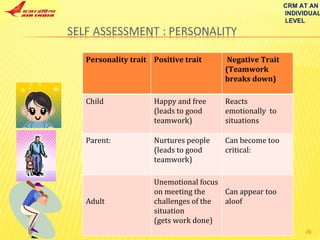
CRM AT AN INDIVIDUAL LEVEL Personality trait Positive trait Negative Trait (Teamwork breaks down) Child Happy and free (leads to good teamwork) Reacts emotionally  to situations  Parent:  Nurtures people (leads to good teamwork) Can become too critical: Adult Unemotional focus on meeting the challenges of the situation (gets work done) Can appear too aloof
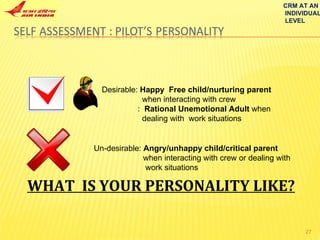
Desirable:  Happy  Free child/nurturing parent  when interacting with crew :   Rational Unemotional Adult  when  dealing with  work situations WHAT  IS YOUR PERSONALITY LIKE? Un-desirable:  Angry/unhappy child/critical parent  when interacting with crew or dealing with  work situations CRM AT AN INDIVIDUAL LEVEL
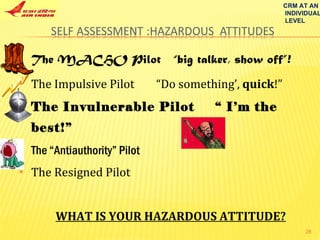
The MACHO Pilot  “big talker, show off”! The Impulsive Pilot  “Do something’,  quick !” The Invulnerable Pilot  “ I’m the best!” The “Antiauthority” Pilot The Resigned Pilot WHAT IS YOUR HAZARDOUS ATTITUDE? CRM AT AN INDIVIDUAL LEVEL
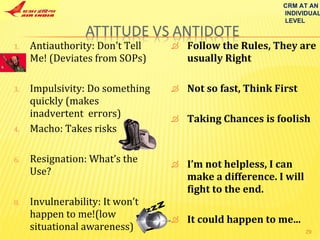
Antiauthority: Don’t Tell Me! (Deviates from SOPs) Impulsivity: Do something quickly (makes inadvertent  errors) Macho: Takes risks Resignation: What’s the Use? Invulnerability: It won’t happen to me!(low situational awareness) Follow the Rules, They are usually Right Not so fast, Think First Taking Chances is foolish I’m not helpless, I can make a difference. I will fight to the end. It could happen to me... CRM AT AN INDIVIDUAL LEVEL
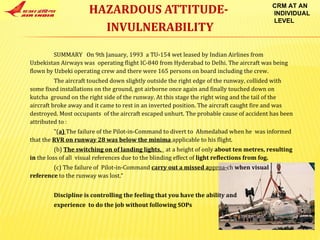
HAZARDOUS ATTITUDE-  INVULNERABILITY CRM AT AN INDIVIDUAL LEVEL SUMMARY  On 9th January, 1993  a TU-154 wet leased by Indian Airlines from Uzbekistan Airways was  operating flight IC-840 from Hyderabad to Delhi. The aircraft was being flown by Uzbeki operating crew and there were 165 persons on board including the crew.  The aircraft touched down slightly outside the right edge of the runway, collided with some fixed installations on the ground, got airborne once again and finally touched down on kutcha  ground on the right side of the runway. At this stage the right wing and the tail of the aircraft broke away and it came to rest in an inverted position. The aircraft caught fire and was destroyed. Most occupants  of the aircraft escaped unhurt. The probable cause of accident has been attributed to : "( a)  The failure of the Pilot-in-Command to divert to  Ahmedabad when he  was informed that the  RVR on runway 28 was below the minima  applicable to his flight. (b)  The switching on of landing lights,  at a height of only  about ten metres, resulting in  the loss of all  visual references due to the blinding effect of  light reflections from fog. (c) The failure of  Pilot-in-Command  carry out a missed a pproa- ch  when visual reference  to the runway was lost.“ Discipline is controlling the feeling that you have the ability and experience  to do the job without following SOPs
Pilots  can avoid accidents  by controlling  their hazardous  attitudes CRM AT AN INDIVIDUAL LEVEL
Extract of  the Court of Inquiry Report: : Ground personnel in Dubai reported that both crew appeared normal and healthy. They had left the aircraft and gone to the terminal building and the duty free shop during their 82 minutes turn over in Dubai. The crew did perform all pre-departure checks according to observations by ground personnel. •  synergy •  authority vs leadership •  assertiveness •  barriers •  cultural influence •  roles- leader/follower •  credibility •  team responsibility CRM AT A TEAM LEVEL
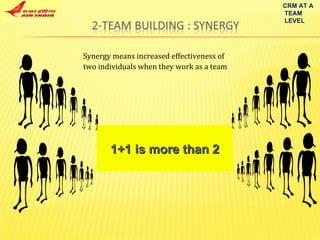
1+1 is more than 2 Synergy means increased effectiveness of two individuals when they work as a team CRM AT A TEAM LEVEL
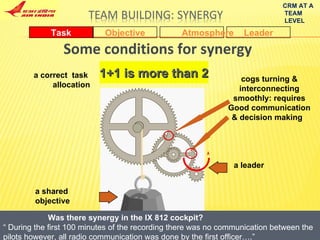
Some conditions for synergy cogs turning & interconnecting smoothly: requires Good communication & decision making  a leader a shared objective a correct  task  allocation  Objective Task Leader Atmosphere 1+1 is more than 2 CRM AT A TEAM LEVEL Was there synergy in the IX 812 cockpit? “  During the first 100 minutes of the recording there was no communication between the pilots however, all radio communication was done by the first officer….”
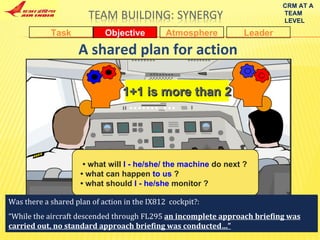
•  what will  I - he/she/ the machine  do next ? •  what can happen  to us  ? •  what should  I - he/she  monitor ? A shared plan for action Objective Task Leader Atmosphere 1+1 is more than 2 CRM AT A TEAM LEVEL Was there a shared plan of action in the IX812  cockpit?: “ While the aircraft descended through FL295  an incomplete approach briefing was carried out, no standard approach briefing was conducted…”
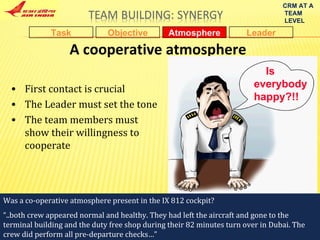
A cooperative atmosphere First contact is crucial The Leader must set the tone The team members must show their willingness to cooperate Objective Task Leader Atmosphere Is everybody happy?!! CRM AT A TEAM LEVEL Was a co-operative atmosphere present in the IX 812 cockpit? “ ..both crew appeared normal and healthy. They had left the aircraft and gone to the terminal building and the duty free shop during their 82 minutes turn over in Dubai. The crew did perform all pre-departure checks…”
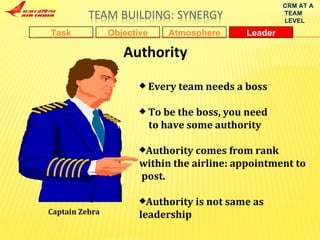
Authority Objective Task Leader Atmosphere Every team needs a boss To be the boss, you need   to have some authority Authority comes from rank within the airline: appointment to  post. Authority is not same as leadership Captain Zebra CRM AT A TEAM LEVEL
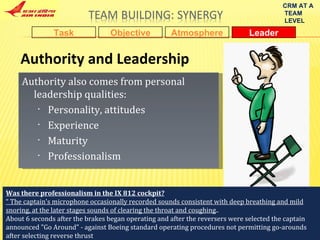
Authority and Leadership Objective Task Leader Atmosphere Authority also comes from personal leadership qualities:  Personality, attitudes Experience Maturity Professionalism CRM AT A TEAM LEVEL Was there professionalism in the IX 812 cockpit? “  The captain's microphone occasionally recorded sounds consistent with deep breathing and mild snoring, at the later stages sounds of clearing the throat and coughing .. About 6 seconds after the brakes began operating and after the reversers were selected the captain announced "Go Around" - against Boeing standard operating procedures not permitting go-arounds after selecting reverse thrust
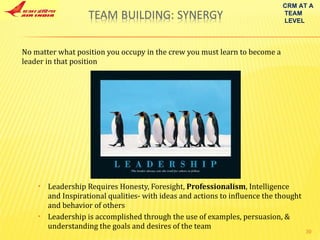
No matter what position you occupy in the crew you must learn to become a leader in that position Leadership Requires Honesty, Foresight,  Professionalism , Intelligence and Inspirational qualities- with ideas and actions to influence the thought and behavior of others Leadership is accomplished through the use of examples, persuasion, &  understanding the goals and desires of the team CRM AT A TEAM LEVEL
Motivating crew members Directing and coordinating crew activities Structured Decision making involving all crew Ensuring  information flow Using non-confrontational “key phrases”  “ I’m uncomfortable” and gradually escalated action if required ARE YOU JUST  A COMMANDER/FIRST OFFICER IN THE AIRLINE HIERARCHY OR A TRUE LEADER ? CRM AT A TEAM LEVEL
Requires  setting  and  achievement of  high standards of  timely, error free performance. Aviation is a 12 sigma industry- 1.5 errors per million cycles. Accurate and logical reasoning  and good decisions Is achieved only after  extensive  training, comprehension and application, (not rote  memorisation techniques)  and preparation based  on study and research. Requires ability to think out of the box when required. Requires high ethical standards HOW PROFESSIONAL ARE YOU? CRM AT A TEAM LEVEL
In the end… it is the attention to detail that makes the difference It is the thing that separates the winners from the losers, the men from the boys, and very often the living from the dead.
Aggressive High task oriented & low relationship oriented First consideration to the task or goal Can become autocratic, intimidating and abusive Relationship Oriented First consideration to the feeling of others Caring or nurturing style of behavior  Can become ineffective with inadequate focus on task achievement. CRM AT A TEAM LEVEL
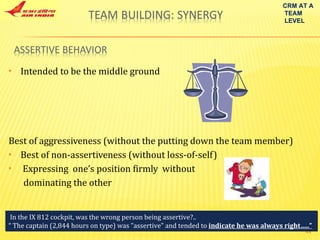
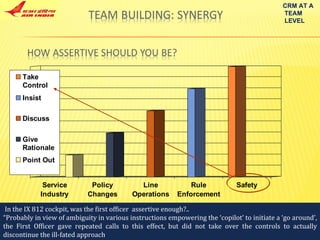
Intended to be the middle ground Best of aggressiveness (without the putting down the team member) Best of non-assertiveness (without loss-of-self) Expressing  one’s position firmly  without dominating the other CRM AT A TEAM LEVEL In the IX 812 cockpit, was the wrong person being assertive?.. “  The captain (2,844 hours on type) was "assertive" and tended to  indicate he was always right…..”
CRM AT A TEAM LEVEL In the IX 812 cockpit, was the first officer  assertive enough?.. “ Probably in view of ambiguity in various instructions empowering the ‘copilot’ to initiate a ‘go around’, the First Officer gave repeated calls to this effect, but did not take over the controls to actually discontinue the ill-fated approach .
As a crew member, you have the right to assure that your life will not be compromised by any action / inaction, miscommunication, or misunderstanding. Assertive behavior in the cockpit does not challenge authority; it clarifies position, understanding or intent, and as a result enhances the safe operation of the flight. CRM AT A TEAM LEVEL
Contributing Factors to the Accident I- Probably in view of ambiguity in various instructions empowering the ‘copilot’ to initiate a ‘go around’, the First Officer gave repeated calls to this effect, but did not take over the controls to actually discontinue the ill-fated approach. CRM AT A TEAM LEVEL
CRM AT A TEAM LEVEL Power distance refers to the  degree of democracy in human relationships.  In a high power-distance culture (e.g., India,  Malaysia,  &  Philippines), leaders are  more likely  to be expected  to  be decisive, and subordinates  are expected  to be more submissive . In countries with lowerpower distance, such as the United Kingdom, Australia and Denmark, subordinates feel more comfortable about approaching superiors and, if necessary, contradicting them . Medium Power Distance is considered to be desirable in multi-crew cockpits
Individualism vs. Collectivism:  Individualistic societies, such as the United Kingdom, United States and Australia, emphasize personal initiative and individual achievement. Collectivist societies, such as  India, Brazil, Taiwan and Korea, emphasize the importance of group membership and cohesiveness of the group over individual achievement.  In collectivist societies, there is a tendency to avoid open conflicts.  A first officer from a collectivist society would be less likely to challenge a captain who is doing something that the first officer feels uncomfortable with.  CRM AT A TEAM LEVEL
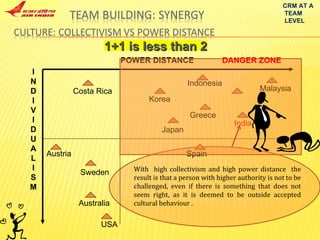
POWER DISTANCE I N D I V I D U A L I S M India Japan Greece Korea Indonesia Malaysia Spain USA Austria Sweden Costa Rica Australia DANGER ZONE With  high collectivism and high power distance  the result is that a person with higher authority is not to be challenged, even if there is something that does not seem right, as it is deemed to be outside accepted cultural behaviour . 1+1 is less than 2 CRM AT A TEAM LEVEL
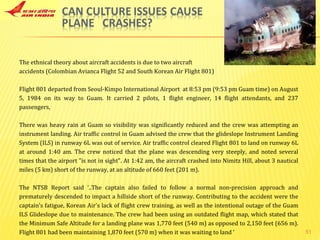
The ethnical theory about aircraft accidents is due to two aircraft  accidents (Colombian Avianca Flight 52 and South Korean Air Flight 801) Flight 801 departed from Seoul-Kimpo International Airport  at 8:53 pm (9:53 pm Guam time) on August 5, 1984 on its way to Guam. It carried 2 pilots, 1 flight engineer, 14 flight attendants, and 237 passengers, There was heavy rain at Guam so visibility was significantly reduced and the crew was attempting an instrument landing. Air traffic control in Guam advised the crew that the glideslope Instrument Landing System (ILS) in runway 6L was out of service. Air traffic control cleared Flight 801 to land on runway 6L at around 1:40 am. The crew noticed that the plane was descending very steeply, and noted several times that the airport "is not in sight". At 1:42 am, the aircraft crashed into Nimitz Hill, about 3 nautical miles (5 km) short of the runway, at an altitude of 660 feet (201 m). The NTSB Report said ‘..The captain also failed to follow a normal non-precision approach and prematurely descended to impact a hillside short of the runway. Contributing to the accident were the captain's fatigue, Korean Air's lack of flight crew training, as well as the intentional outage of the Guam ILS Glideslope due to maintenance. The crew had been using an outdated flight map, which stated that the Minimum Safe Altitude for a landing plane was 1,770 feet (540 m) as opposed to 2,150 feet (656 m). Flight 801 had been maintaining 1,870 feet (570 m) when it was waiting to land ’
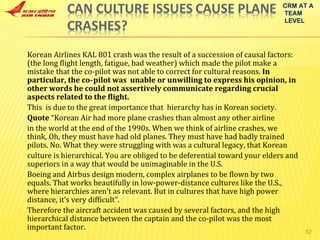
Korean Airlines KAL 801 crash was the result of a succession of causal factors: (the long flight length, fatigue, bad weather) which made the pilot make a mistake that the co‐pilot was not able to correct for cultural reasons.  In particular, the co‐pilot was  unable or unwilling to express his opinion, in other words he could not assertively communicate regarding crucial aspects related to the flight. This  is due to the great importance that  hierarchy has in Korean society. Quote  “Korean Air had more plane crashes than almost any other airline in the world at the end of the 1990s. When we think of airline crashes, we think, Oh, they must have had old planes. They must have had badly trained pilots. No. What they were struggling with was a cultural legacy, that Korean culture is hierarchical. You are obliged to be deferential toward your elders and superiors in a way that would be unimaginable in the U.S.  Boeing and Airbus design modern, complex airplanes to be flown by two equals. That works beautifully in low‐power‐distance cultures like the U.S., where hierarchies aren't as relevant. But in cultures that have high power distance, it’s very difficult”. Therefore the aircraft accident was caused by several factors, and the high hierarchical distance between the captain and the co‐pilot was the most important factor. CRM AT A TEAM LEVEL
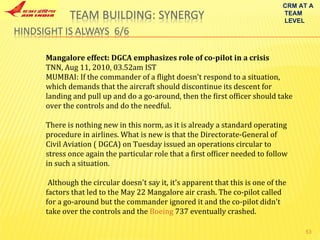
Mangalore effect: DGCA emphasizes role of co-pilot in a crisis TNN, Aug 11, 2010, 03.52am IST MUMBAI: If the commander of a flight doesn't respond to a situation, which demands that the aircraft should discontinue its descent for landing and pull up and do a go-around, then the first officer should take over the controls and do the needful. There is nothing new in this norm, as it is already a standard operating procedure in airlines. What is new is that the Directorate-General of Civil Aviation ( DGCA) on Tuesday issued an operations circular to stress once again the particular role that a first officer needed to follow in such a situation. Although the circular doesn't say it, it's apparent that this is one of the factors that led to the May 22 Mangalore air crash. The co-pilot called for a go-around but the commander ignored it and the co-pilot didn't take over the controls and the  Boeing  737 eventually crashed. CRM AT A TEAM LEVEL
CRM AT A TEAM LEVEL
2 ! UNSTABILISED GO AROUND!!! CRM AT A TEAM LEVEL
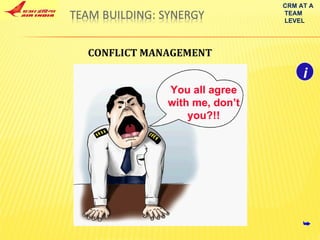
CONFLICT MANAGEMENT  You all agree with me, don’t you?!! CRM AT A TEAM LEVEL i
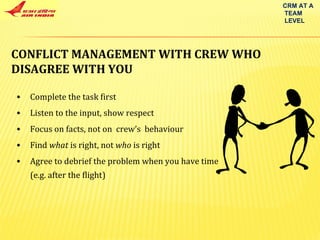
CONFLICT MANAGEMENT WITH CREW WHO  DISAGREE WITH YOU  Complete the task first Listen to the input, show respect Focus on facts, not on  crew’s  behaviour Find  what  is right, not  who  is right Agree to debrief the problem when you have time (e.g. after the flight) CRM AT A TEAM LEVEL
I like it when the... Captain …  Is professional Shows respect Shares workload Sets a good example Listens Keeps a good atmosphere Is a good teacher First Officer … Is professional Follows SOP’s Is disciplined Asks questions Is a good monitor Knows his / her limits Is well prepared Checks my actions CRM AT A TEAM LEVEL
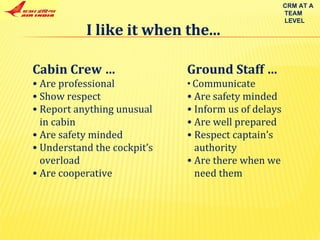
I like it when the... Cabin Crew …  Are professional Show respect Report anything unusual in cabin Are safety minded Understand the cockpit’s overload Are cooperative Ground Staff … Communicate Are safety minded Inform us of delays Are well prepared Respect captain’s  authority Are there when we  need them CRM AT A TEAM LEVEL
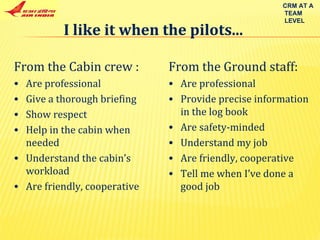
I like it when the pilots... From the Cabin crew : Are professional  Give a thorough briefing  Show respect Help in the cabin when needed Understand the cabin’s workload  Are friendly, cooperative From the Ground staff:  Are professional Provide precise information in the log book Are safety-minded  Understand my job Are friendly, cooperative Tell me when I’ve done a good job CRM AT A TEAM LEVEL
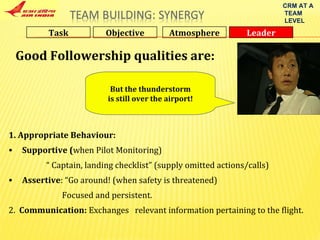
Good Followership qualities are:  1. Appropriate Behaviour: Supportive ( when Pilot Monitoring) “  Captain, landing checklist” (supply omitted actions/calls)  Assertive : “Go around! (when safety is threatened) Focused and persistent. 2.  Communication:  Exchanges  relevant information pertaining to the flight. But the thunderstorm is still over the airport! Objective Task Leader Atmosphere CRM AT A TEAM LEVEL
GO AROUND! CRM AT A TEAM LEVEL
Communication is   BOTH Transmit AND Receive Builds shared mental model of problems Enables shared problem solving & effective decision making CRM AT A TEAM LEVEL
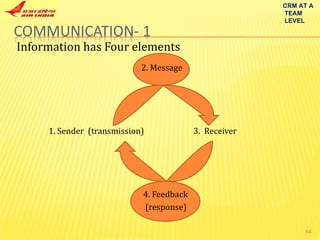
Information has Four elements 2. Message 1. Sender  (transmission)  3.  Receiver 4. Feedback  (response) CRM AT A TEAM LEVEL
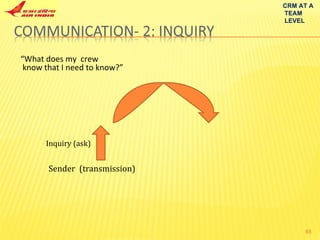
Sender  (transmission)  Inquiry (ask) “ What does my  crew  know that I need to know?” CRM AT A TEAM LEVEL
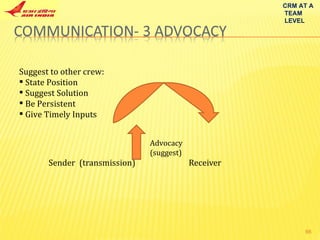
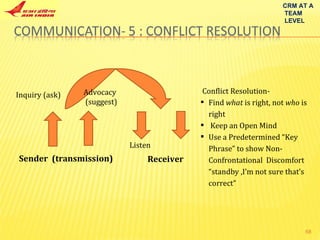
Sender  (transmission)  Receiver Advocacy (suggest)  Suggest to other crew:  State Position Suggest Solution Be Persistent Give Timely Inputs CRM AT A TEAM LEVEL
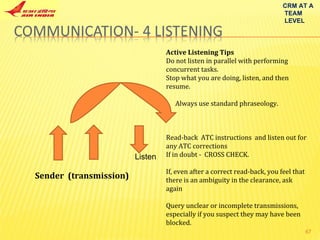
Listen  Active Listening Tips Do not listen in parallel with performing concurrent tasks.  Stop what you are doing, listen, and then resume. Always use standard phraseology.  Read-back  ATC instructions  and listen out for any ATC corrections If in doubt -  CROSS CHECK.  If, even after a correct read-back, you feel that there is an ambiguity in the clearance, ask again  Query unclear or incomplete transmissions, especially if you suspect they may have been blocked.  CRM AT A TEAM LEVEL Sender  (transmission)
Inquiry (ask) Advocacy (suggest)  Listen  Conflict Resolution- Find  what  is right, not  who  is right Keep an Open Mind Use a Predetermined “Key Phrase” to show Non-Confrontational  Discomfort “standby ,I’m not sure that’s correct” CRM AT A TEAM LEVEL Sender  (transmission) Receiver
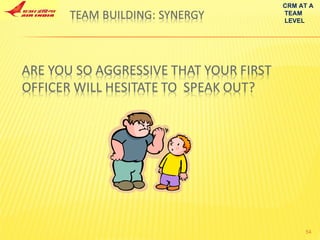
Transmission: Wrong  Perception of what is being said/ of the problem Inadequate  Education- which determines  Tone and rate of speech Speech pattern Clarity Choice of words Reception Intimidation- stops all communication.  Stems from  Position/background (i.e Commanders, TRE/TRI/Check Pilots Pilot vs. Non-Pilot Crew Personality type: Aggressive,  child ego state etc Flight pressure (distracting events in the cockpit) Body Language  and Attitude- can stop or encourage good communication CRM AT A TEAM LEVEL
CRM AT A TEAM LEVEL Fatigue:  The cockpit voice recorder featured a capacity of 125 minutes. During the first 100 minutes of the recording there was no communication between the pilots however, all radio communication was done by the first officer. The captain's microphone occasionally recorded sounds consistent with deep breathing and mild snoring, at the later stages sounds of clearing the throat and coughing. Poor Workload management:  While the aircraft descended through FL295 an incomplete approach briefing was carried out, no standard approach briefing was conducted Unprofessionalism:  The aircraft continued to be high, intercepted the localizer beam and captured the false glideslope beam at double the correct approach angle (6 instead of 3 degrees descent). There was no cross check between actual altitudes/heights with the descent profile provided in the approach chart conducted by the crew
Conduct Take off and Approach  briefings the way you intend to fly, and fly  the way the briefing is being done. Fly using SOP so there are no surprises for  other crew. Empower crew to speak out- “ Call out clearly and precisely any  abnormality or malfunction  affecting safety of the flight”  is an SOP key phrase Brief other crew to give  two warnings, then escalate to corrective  action if needed Adhere to “Sterile cockpit” procedure CRM AT A TEAM LEVEL
Prioritise & address  all tasks, with priority  given to most critical D elegate  tasks to avoid task overload and receive acknowledgement  When in an abnormal condition, make time by joining hold/long radar vectors. Avoid ask fixation Maintain communication receptivity  during high workload phases Use appropriate level of automation for phase and complexity of flight.  Acknowledge all FCU changes and be aware of FMA at all times with emphasise on FMA callouts. Cross check with raw data at all times. OPERAT-IONAL LEVEL CRM
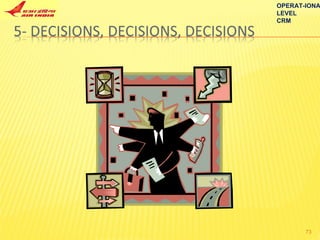
OPERAT-IONAL LEVEL CRM
Begins with Good Situational Awareness. Anticipate problems. Evaluate Situation What is wrong (Identify)? What resources do you have? How can the resources be best used (Action)? Consider consequences of possible actions Make decision, inform all involved Evaluate decision, repeat as needed Quick decisions aren’t always correct !
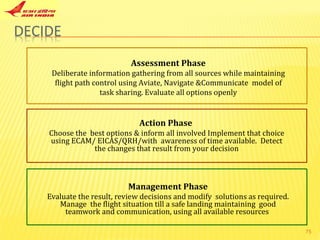
Management Phase Evaluate the result,  review decisions and modify  solutions as required. Manage  the flight situation till a safe landing maintaining  good teamwork and communication, using all available resources  Assessment Phase Deliberate information gathering from all sources  while maintaining flight path control using Aviate, Navigate &Communicate  model of task sharing.  Evaluate all options o penly Action Phase   Choose the  best options & inform all involved Implement that choice  using ECAM/ EICAS/QRH/with  awareness of time available.  Detect the changes that result from your decision
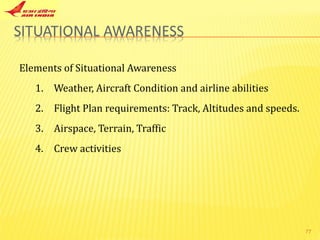
Elements of Situational Awareness Weather, Aircraft Condition and airline abilities Flight Plan requirements: Track, Altitudes and speeds. Airspace, Terrain, Traffic Crew activities
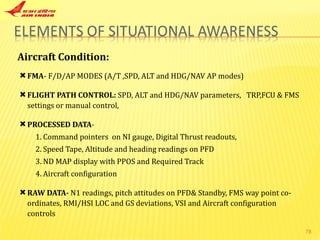
FMA - F/D/AP MODES (A/T ,SPD, ALT and HDG/NAV AP modes) FLIGHT PATH CONTROL:  SPD, ALT and HDG/NAV parameters,  TRP,FCU & FMS settings or manual control,  PROCESSED DATA -  Command pointers  on NI gauge, Digital Thrust readouts,  Speed Tape, Altitude and heading readings on PFD ND MAP display with PPOS and Required Track Aircraft configuration RAW DATA-  N1 readings, pitch attitudes on PFD& Standby, FMS way point co-ordinates, RMI/HSI LOC and GS deviations, VSI and Aircraft configuration controls Aircraft Condition:
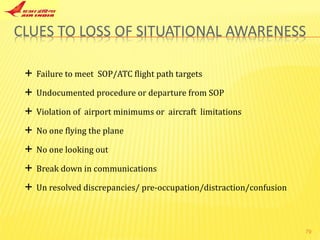
Failure to meet  SOP/ATC flight path targets Undocumented procedure or departure from SOP Violation of  airport minimums or  aircraft  limitations No one flying the plane No one looking out Break down in communications Un resolved discrepancies/ pre-occupation/distraction/confusion
Accomplish adequate pre-flight planning. Set and accomplish flight targets Stay ahead of the aircraft by being prepared for unforeseen contingencies Use good communication to maintain situational awareness. Recognise error chain clues and break links in the chain. Recover situational awareness  first and trouble shoot (what happened) later. Revert to last known safe position or configuration
Personality Fatigue and Stress Alcohol Medication and Health
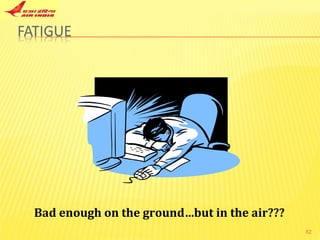
Bad enough on the ground…but in the air???
Loss of as little as one hour sleep begins a person’s sleep debt Eight hours of disturbed sleep can produce effect of too little sleep Only cure for sleep debt is to sleep
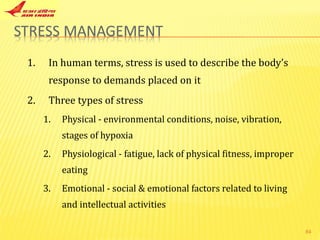
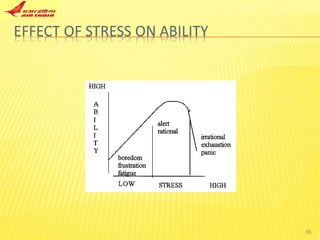
In human terms, stress is used to describe the body’s response to demands placed on it Three types of stress Physical - environmental conditions, noise, vibration, stages of hypoxia Physiological - fatigue, lack of physical fitness, improper eating Emotional - social & emotional factors related to living and intellectual activities
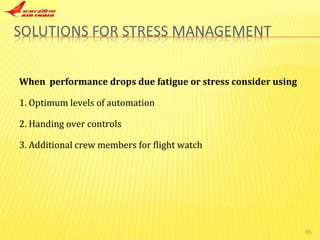
When  performance drops due fatigue or stress consider using  1. Optimum levels of automation 2. Handing over controls 3. Additional crew members for flight watch
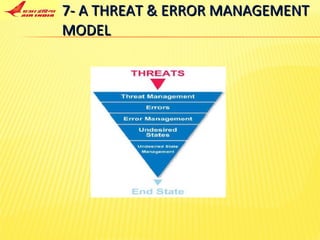
7- A THREAT & ERROR MANAGEMENT MODEL
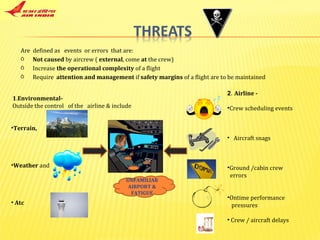
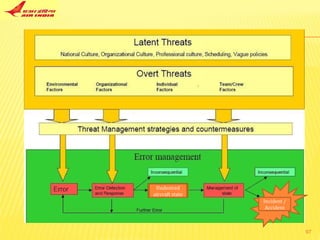
Are  defined as  events  or errors  that are: Not caused  by aircrew (  external , come  at  the crew) Increase  the operational complexity  of a flight Require   attention and management  if  safety margins  of a flight are to be maintained  1 . Environmental- Outside the control  of the  airline & include Terrain,  Weather  and Atc 2 .  Airline -  Crew scheduling events Aircraft snags Ground /cabin crew  errors  Ontime performance  pressures Crew / aircraft delays UNFAMILIAR AIRPORT & FATIGUE
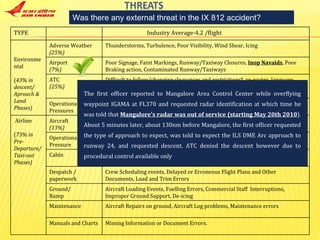
Was there any external threat in the IX 812 accident? The first officer reported to Mangalore Area Control Center while overflying waypoint IGAMA at FL370 and requested radar identification at which time he was told that  Mangalore's radar was out of service (starting May 20th 2010 ). About 5 minutes later, about 130nm before Mangalore, the first officer requested the type of approach to expect, was told to expect the ILS DME Arc approach to runway 24, and requested descent. ATC denied the descent however due to procedural control available only TYPE Industry Average-4.2 /flight Environmental ( 43% in descent/  Aproach & Land Phases) Adverse Weather  (25%) Thunderstorms, Turbulence, Poor Visibility, Wind Shear, Icing Airport (7%) Poor Signage, Faint Markings, Runway/Taxiway Closures,  Inop Navaids , Poor Braking action, Contaminated Runway/Taxiways ATC (25%) Difficult to follow/changing clearances and restrictions* , re-routes, language difficulties, Controller Errors (*most problematic threat) Operational Pressures Terrain, Traffic, TCAS  TA/RA, Radio Congestion Airline ( 73% in Pre-Departure/Taxi-out Phases) Aircraft (13%) System Malfunctions, MEL with Operational Procedures Operational Pressure On Time Performance Pressure, Delays, Late arrival  Aircraft/Aircrew Cabin Cabin Events and  Cabin Crew Errors, Distractions and Interruptions. Despatch / paperwork Crew Scheduling events, Delayed or Erroneous Flight Plans and Other Documents, Load and Trim Errors Ground/ Ramp Aircraft Loading Events, Fuelling Errors, Commercial Staff  Interruptions, Improper Ground Support, De-icing Maintenance Aircraft Repairs on ground, Aircraft Log problems, Maintenance errors Manuals and Charts Missing Information or Document Errors.
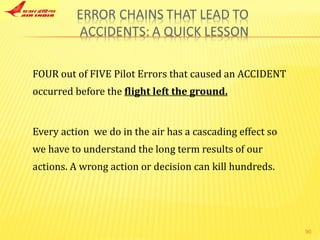
FOUR out of FIVE Pilot Errors that caused an ACCIDENT occurred before the  flight left the ground. Every action  we do in the air has a cascading effect so we have to understand the long term results of our actions. A wrong action or decision can kill hundreds.
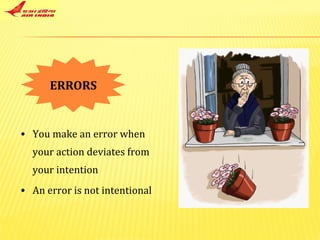
ERRORS You make an error when your action deviates from your intention An error is not intentional
ERRORS & THEIR CONSEQUENCES
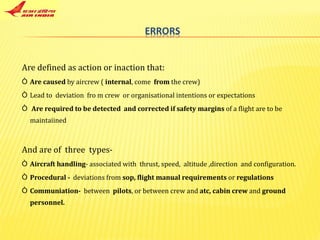
Are defined as action or inaction that: Are caused  by aircrew (  internal , come  from  the crew) Lead to  deviation  fro m crew  or organisational intentions or expectations Are required to be detected  and corrected if safety margins  of a flight are to be maintaiined And are of  three  types- Aircraft handling - associated with  thrust, speed,  altitude ,direction  and configuration. Procedural   -  deviations from  sop, flight manual requirements  or  regulations Communiation-  between  pilots , or between crew and  atc, cabin crew  and  ground personnel.
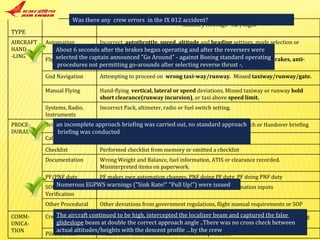
Was there any  crew errors  in the IX 812 accident? Numerous EGPWS warnings ("Sink Rate!" "Pull Up!") were issued The aircraft continued to be high, intercepted the localizer beam and captured the false  glideslope  beam at double the correct approach angle ..There was no cross check between actual altitudes/heights with the descent profile …by the crew an incomplete approach briefing was carried out, no standard approach briefing was conducted About 6 seconds after the brakes began operating and after the reversers were  selected the captain announced "Go Around" - against Boeing standard operating procedures not permitting go-arounds after selecting reverse thrust -, TYPE Industry Average-4.2 /flight AIRCRAFT HAND -LING Automation Incorrect  autothrottle, speed, altitude  and  heading  settings, mode selection or entries Flight Control Incorrect  thrust,   thrust reverser, flaps/slats, speed-brakes ,  auto-brakes, anti-skid, parking brake  and  trim  settings Gnd Navigation Attempting to proceed on  wrong taxi-way/runway .  Missed  taxiway/runway/gate. Manual Flying Hand-flying  vertical, lateral or speed  deviations. Missed taxiway or runway  hold short clearance(runway incursion) , or taxi above  speed limit. Systems, Radio, Instruments Incorrect Pack, altimeter, radio or fuel switch setting. PROCE-DURAL Briefings Missed items in briefing- omitted Departure, Takeoff, Approach or Handover briefing Callouts Omitted takeoff, descent or approach callouts Checklist Performed checklist from memory or omitted a checklist Documentation Wrong Weight and Balance, fuel information, ATIS or clearance recorded. Misinterpreted items on paperwork. PF/PNF duty PF makes own automation changes, PNF doing PF duty, PF doing PNF duty SOP Cross-Verification Intentional and unintentional failure to cross-verify automation inputs Other Procedural Other deviations from government regulations, flight manual requirements or SOP COMM-UNICA-TION Crew to External Missed Calls, misinterpretation of instructions or incorrect read-backs to ATC, Wrong Clearance, Taxiway, gate or runway communicated Pilot to Pilot Within crew miscommunication or misinterpretation
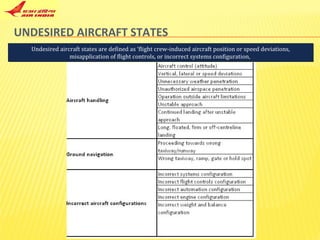
UNDESIRED AIRCRAFT STATES   Undesired aircraft states are defined as ‘flight crew-induced aircraft position or speed deviations, misapplication of flight controls, or incorrect systems configuration,
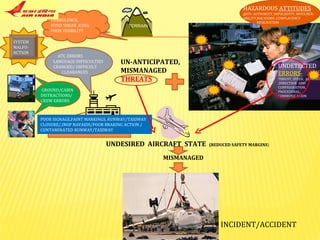
UNDESIRED  AIRCRAFT  STATE  (REDUCED SAFETY MARGINS ) MISMANAGED INCIDENT/ACCIDENT UN-ANTICIPATED, MISMANAGED  THREATS UNDETECTED ERRORS- THRUST, SPEED,  ALTITUDE ,DIRECTION  AND CONFIGURATION, PROCEDURAL, COMMUNICATION HAZARDOUS   ATTITUDES A NTI- AUTHORITY, IMPULSIVITY, INVULNER-ABILITY,MACHISMO ,COMPLACENCY RESIGNATION SYSTEM  MALFU-NCTION TURBULENCE, WIND SHEAR ,ICING POOR VISIBILITY ATC ERRORS LANGUAGE DIFFICULTIES CHANGED/ DIFFICULT  CLEARANCES GROUND/CABIN DISTRACTIONS/ CREW ERRORS POOR SIGNAGE,FAINT MARKINGS, RUNWAY/TAXIWAY CLOSURE/,INOP NAVAIDS/POOR BRAKING ACTION /  CONTAMINATED RUNWAY/TAXIWAY TERRAIN
Undesired aircraft state Incident / Accident
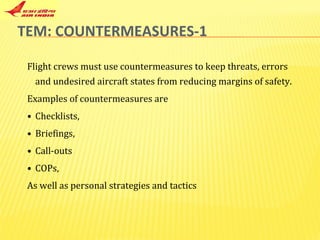
TEM: COUNTERMEASURES-1 Flight crews must use countermeasures to keep threats, errors and undesired aircraft states from reducing margins of safety. Examples of countermeasures are  Checklists,  Briefings, Call-outs  COPs,  As well as personal strategies and tactics
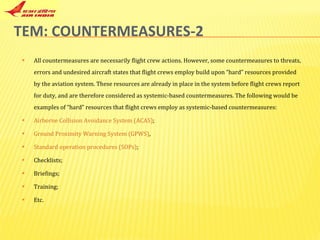
TEM: COUNTERMEASURES-2 All countermeasures are necessarily flight crew actions. However, some countermeasures to threats, errors and undesired aircraft states that flight crews employ build upon “hard” resources provided by the aviation system. These resources are already in place in the system before flight crews report for duty, and are therefore considered as systemic-based countermeasures. The following would be examples of “hard” resources that flight crews employ as systemic-based countermeasures:  Airborne Collision Avoidance System (ACAS) ;  Ground Proximity Warning System (GPWS) ,  Standard operation procedures (SOPs) ;  Checklists;  Briefings;  Training;  Etc.
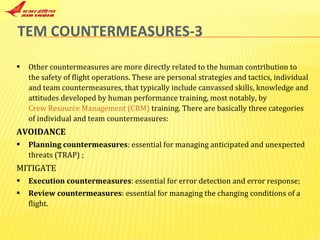
TEM COUNTERMEASURES-3 Other countermeasures are more directly related to the human contribution to the safety of flight operations. These are personal strategies and tactics, individual and team countermeasures, that typically include canvassed skills, knowledge and attitudes developed by human performance training, most notably, by  Crew Resource Management (CRM)  training. There are basically three categories of individual and team countermeasures:  AVOIDANCE  Planning countermeasures : essential for managing anticipated and unexpected threats (TRAP) ;  MITIGATE Execution countermeasures : essential for error detection and error response;  Review countermeasures : essential for managing the changing conditions of a flight.
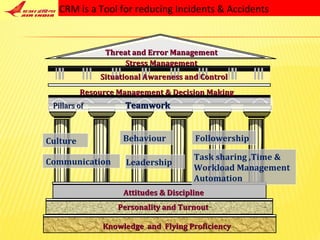
Culture Behaviour Followership Communication Leadership Pillars of  Teamwork Resource Management & Decision Making Attitudes & Discipline Personality and Turnout Task sharing ,Time &  Workload Management Automation Threat and Error Management Stress Management Knowledge  and  Flying Proficiency CRM is a Tool for reducing Incidents & Accidents Situational Awareness and Control
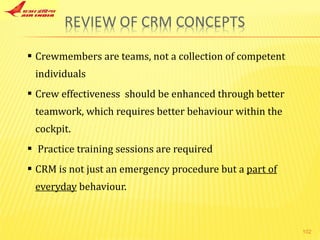
Crewmembers are teams, not a collection of competent individuals Crew effectiveness  should be enhanced through better teamwork, which requires better behaviour within the cockpit. Practice training sessions are required CRM is not just an emergency procedure but a  part of everyday  behaviour.
A CASE STUDY 15 YEARS BEFORE THE MANGALORE CRASH, A SIMILAR INCIDENT TOOK PLACE..
Indian Airlines B-737 aircraft VT-ECS was operating flight IC-492 of 2.12.95 . The flight upto  Jaipur was uneventful.  The aircraft took-off from Jaipur with 98+4 passengers  and  landed at Delhi at 1253 hrs. There was a NOTAM pertaining to airport closure at  VIDP . After landing the aircraft could not be stopped within the available runway length and went beyond the runway into overrun area. The aircraft was substantially damaged. There was minor fire. There were no casualties but six passengers received minor injuries. DFDR analysis revealed that the crew made an un-stabilised approach and landed deep down the runway. The captain had forgotten to arm the speedbrakes and  there were no deviation calls made by the PNF.
THREATS & ERRORS What  are some of the  External Threats   in the Delhi Accident? ? ? ? ? External Threat
The Flight Crew was under pressure to land at Delhi   hastily  to complete the flight in the inadequate time available before the notified closure of Delhi airport for a VVIP flight, . There was one external threat:  THREATS & ERRORS External Threat
What  are some of the  Errors  in the Accident? ? ? ? ? THREATS & ERRORS Unexpected Events/Risks External Threats
What  are some of the Errors  in the Delhi Accident? The dangerously unstabilised approach made by the Pilot-in- Command, primarily due to his failure to decelerate the aircraft in time, The failure of the First Officer to call out significant deviations from the stipulated approach parameters The failure of the Pilot-in- Command to carry out a missed approach in spite of his approach being grossly unstabilised The inadvertent omission of the Pilot-in-Command to arm the speed brake before landing, Touch-down of the aircraft at excessive speed and too far down the runway,  Failure of the First Officer and Pilot-in- Command to monitor the automatic deployment of the speed brake, and failure of the Pilot-in-Command to deploy it manually,  DGCA  attributed  the crash due to disregard of procedures, regulations and instructions THREATS & ERRORS Unexpected Events/Risks External Threat
Lack of Technical and Flying proficiency Indiscipline, Complacency & other Hazardous Attitudes Emotional  non-adult mental states Intimidating other crew Inability to communicate and a break down in teamwork Hesitation to Speak Out Hasty un-informed decisions Loss of Situational Awareness Fatigue Overlooking of threats and crew errors AVOID:
CREDITS: OPERATIONS TRAINING DIVISION, MUMBAI AIR INDIA LTD. MARCH 2011

Culture & air crashes3

  • 1.
    AIR INDIA and CRM March 2011
  • 2.
    Human Factors TeamworkCommunication Workload Management & automation Decision Making & Leadership Situational Awareness Fatigue Threat & Error Management CRM LOFT
  • 4.
    Direct Causes: MangaloreAIX crash The Court of Inquiry determines that the cause of this accident was Captain’s failure to discontinue the ‘unstabilised approach’ and his persistence in continuing with the landing, despite three calls from the First Officer to ‘go around’ and a number of warnings from EGPWS. Contributing Factors to the Accident In spite of availability of adequate rest period prior to theflight, the Captain was in prolonged sleep during flight, which could have led to sleep inertia. As a result of relatively short period of time between his awakening and the approach, it possibly led to impaired judgment. This aspect might have got accentuated while flying in the Window of Circadian Low (WOCL). In the absence of Mangalore Area Control Radar (MSSR), due to unserviceability, the aircraft was given descent at a shorter distance on DME as compared to the normal. However, the flight crew did not plan the descent profile properly, resulting in remaining high on approach. - Probably in view of ambiguity in various instructions empowering the ‘copilot’ to initiate a ‘go around’, the First Officer gave repeated calls to this effect, but did not take over the controls to actually discontinue the ill-fated approach.
  • 5.
    The captain (55,Serbian, ATPL, 10,215 hours as pilot in command, 2,844 hours on type) was described by collegues as a friendly person and ready to help the first officers with professional information. He was "assertive" and tended to indicate he was always right. The first officer (40, Indian, ATPL, 3,620 hours total flying experience, 3,319 on type) was known as a man of few words and meticulous in his adherence to standard operating procedures. He had filed a complaint about another of the foreign captains, the company had therefore instructed rostering personnel to not pair the two before counseling had taken place (which did not occur before the crash). Air India Express had mandated that due to the table top runway takeoffs and landings in Mangalore had to be flown by the captain. The crew had performed the outbound flight IX-811 to Dubai and was to conduct flight IX-812 back to Mangalore. Ground personnel in Dubai reported that both crew appeared normal and healthy. They had left the aircraft and gone to the terminal building and the duty free shop during their 82 minutes turn over in Dubai. The crew did perform all pre-departure checks according to observations by ground personnel. The flight was to depart at 01:15 local Dubai time (21:15Z), which is 02:45 local Mangalore time and was estimated to arrive at 06:30 local Mangalore time (01:00Z).
  • 6.
    Data off theflight data recorder and ATC recordings show the departure, climb and cruise of the aircraft were uneventful. The cockpit voice recorder featured a capacity of 125 minutes. During the first 100 minutes of the recording there was no communication between the pilots however, all radio communication was done by the first officer. The captain's microphone occasionally recorded sounds consistent with deep breathing and mild snoring, at the later stages sounds of clearing the throat and coughing. The first officer reported to Mangalore Area Control Center while overflying waypoint IGAMA at FL370 and requested radar identification at which time he was told that Mangalore's radar was out of service (starting May 20th 2010). About 5 minutes later, about 130nm before Mangalore, the first officer requested the type of approach to expect, was told to expect the ILS DME Arc approach to runway 24, and requested descent. ATC denied the descent however due to procedural control available only and instructed IX-812 to report at 80 DME on radial 287 of Mangalore's VOR MML. About 9 minutes after reporting over IGAMA - and about 25 minutes before the overrun of the runway - the first verbal communication ("What?") by the captain was captured by the captain's microphone. About 13 minutes after overflying IGAMA the first officer reported 80 DME on radial 287 and was cleared to 7000 feet , the descent commenced at 77nm from Mangalore VOR .
  • 7.
    While the aircraftdescended through FL295 an incomplete approach briefing was carried out, no standard approach briefing was conducted. At some stage during the descent, the actual time not mentioned in the report, the speed brake handle was placed in the flight detent and speed brakes deployed accordingly. About 25nm before Mangalore the airplane was descending through FL184, still substantially above the descent profile, when the air traffic controller cleared the aircraft to 2900 feet. The aircraft was subsequently handed to Mangalore Tower, who requested the crew to report once established on the 10 DME Arc. At about that time yawning was recorded by the first officer's microphone. After the crew reported established on the Arc ATC requested to report when established on the ILS. At that time it is obvious the captain realised the airplane was too high on the approach. He had the gear lowered while descending through 8500 feet, speed brakes were still extended. The aircraft continued to be high, intercepted the localizer beam and captured the false glideslope beam at double the correct approach angle (6 instead of 3 degrees descent). There was no cross check between actual altitudes/heights with the descent profile provided in the approach chart conducted by the crew.
  • 8.
    Flaps were extendedto 40 degrees, speed brakes were still extended. On final approach, about 2.5nm from touch down, the radar altimeter went through 2500 feet, the first officer reacted to the aural message with "It is too high" and "runway straight down", the captain responded "Oh my God". The captain disconnected the autopilot and increased the rate of descent reaching about 4000 feet per minute sink rate. The first officer asked "Go Around?", to which the captain responded "wrong loc ... localizer ... glide path". The CoI analysed that this was indicative of the captain recognizing the error and not being incapacitated due to his subsequent actions to correct the error. The speed brakes were stowed and armed. The first officer called a second "Go Around! Unstabilized!", however , the first officer did not take any further action to initiate a go-around, although company procedures required the first officer to take control after a second call to go around not complied with by the captain. The captain further increased the rate of descent, the speed brakes were extended again until 20 seconds before touch down. Numerous EGPWS aural warnings ("Sink Rate!" "Pull Up!") were issued in this phase of the approach.
  • 9.
    The airplane crossedthe runway threshold at 200 feet AGL at a speed of 160 KIAS instead of the target 50 feet AGL at 144 KIAS and touched down about 4500 feet down the runway, bounced and touched down a second time 5200 feet down the runway with just 2800 feet of paved surface remaining. Soon after touchdown the captain selected reverse thrust, autobrakes set to level 2 operated. About 6 seconds after the brakes began operating and after the reversers were selected the captain announced "Go Around" - against Boeing standard operating procedures not permitting go-arounds after selecting reverse thrust -, the brakes pressure decreased, the thrust reversers returned to their stowed position, both thrust levers were moved fully forward, the speed brakes retracted and remained retracted, the engines accelerated to 77.5/87.5% N1. The airplane departed the paved surface, the right wing impacted the localizer antenna, the aircraft went through the airport perimeter fence, fell down a gorge, broke up in three major parts and burst into flames. No distress call was received at any time. All but 8 passengers aboard perished. The survivors, while getting up from their seats, heard and saw a number of other passengers unbuckle their seat belts, but they could not move due to the rapid spread of fire. All survivors escaped through cracks of the fuselage. 7 survivors received serious injuries, one escaped with minor injuries. Boeing later determined that if the crew had applied maximum manual braking after second touch down, the airplane would have stopped 7600 feet past the runway threshold meaning the aircraft would have stopped within the paved surface of the runway (8033 feet long).
  • 10.
    Unstablised ApproachNo briefing No standard Call-outs or deviation calls Omit check list High & fast Decide to land Runway Over run Forget flaps Late descent A HIGH RISK APPROACH High workload Poor planning
  • 11.
    AVIATION HAS MANY SAFETY MECHANISMS WHICH MAY CONTAIN CERTAIN GAPS
  • 12.
    THESE GAPS ARECALLED THREATS, AND ARE TRAPPED BY HAVING MULTIPLE LEVELS OF SAFETY MECHANISMS
  • 13.
    ACCIDENTS OCCUR WHENALL THE GAPS IN THE DEFENCE MECHANISMS LINE UP : THE CREW IS THE LAST LINE OF DEFENCE
  • 14.
    We repeat thesame AVOIDABLE mistakes OVER and OVER. WHY ?
  • 15.
    Multiple Crew BasedOperations Unfamiliar Crews from different backgrounds and cultures Unusual Operating Environment: Large network with diverse destinations- Terrain, Weather & ATC variations. Scheduling pressures and irregular rosters Different time zones and jet lag Fatigue Contributing Factors to the Accident I- Probably in view of ambiguity in various instructions empowering the ‘copilot’ to initiate a ‘go around’, the First Officer gave repeated calls to this effect, but did not take over the controls to actually discontinue the ill-fated approach.
  • 16.
    Modern technology hasensured reliable fail-safe hardware. Operating Environment is now More Demanding, which Requires Better Decision Making By Pilots The Human Factor is now The Weakest Link
  • 18.
    Yourself Other pilot(s) Despatcher AME Traffic Assistant Cabin Crew Members ATC Checklists, on board documents etc A professional pilot uses all resources available to manage situations
  • 19.
    CAPT –What do you say ? F/O – Yup ! F/E – Is he not clear that Pan Am CAPT – Oh yes! F/O - Oh yes! [Pan Am] B-747 Pan American CAPT – Let’s get the hell out of here ! F/O – Yeh, he’s anxious isn’t he. F/E – Yeh, after he held us up for an hour & a half.. Now he’s in a rush CAPT – There he is ..look at him Goddamn .. That son-of-a-bitch is coming ! Get off Get off ! Get off ! Ground collision between two 747’s after KLM crew took off without clearance. 583 Die as Jumbos hit
  • 20.
    Captain was possessedof that double-edge sword, male egotism. He was KLM’s chief flying instructor, a man of great prestige in the company. A man to be respected and trusted . Flying with management captain is never relaxing. The Co-pilot did not question the Captain and assumed that the captain was always right. That concept can, combined with factors like time pressure, conformity and the desire to please, produce a lethal situation.
  • 22.
    Who is right- the co-pilot did not question the commander ( accident could have been avoided if co-pilot had undergone - Assertive Training) What is right: requires good communication: the F/E was right, but over-ridden by the pilots. F/E – Is he not clear that Pan Am CAPT – Oh yes! F/O - Oh yes!
  • 23.
    HUMAN FACTORS Personalityand Attitudes Team Building Communication (Information Transfer) and Behaviour Workload management and use of automation Decision Making Maintaining Situational Awareness THREAT AND ERROR MANAGEMENT
  • 24.
    Extract of the Court of Inquiry Report: The captain (2,844 hours on type) was described by colleagues as a friendly person and ready to help the first officers with professional information. He was "assertive" and tended to indicate he was always right. The first officer (40, Indian, ATPL, 3,620 hours total flying experience, 3,319 on type) was known as a man of few words and meticulous in his adherence to standard operating procedures.
  • 25.
    CRM AT ANINDIVIDUAL LEVEL
  • 26.
    CRM AT ANINDIVIDUAL LEVEL Personality trait Positive trait Negative Trait (Teamwork breaks down) Child Happy and free (leads to good teamwork) Reacts emotionally to situations Parent: Nurtures people (leads to good teamwork) Can become too critical: Adult Unemotional focus on meeting the challenges of the situation (gets work done) Can appear too aloof
  • 27.
    Desirable: Happy Free child/nurturing parent when interacting with crew : Rational Unemotional Adult when dealing with work situations WHAT IS YOUR PERSONALITY LIKE? Un-desirable: Angry/unhappy child/critical parent when interacting with crew or dealing with work situations CRM AT AN INDIVIDUAL LEVEL
  • 28.
    The MACHO Pilot “big talker, show off”! The Impulsive Pilot “Do something’, quick !” The Invulnerable Pilot “ I’m the best!” The “Antiauthority” Pilot The Resigned Pilot WHAT IS YOUR HAZARDOUS ATTITUDE? CRM AT AN INDIVIDUAL LEVEL
  • 29.
    Antiauthority: Don’t TellMe! (Deviates from SOPs) Impulsivity: Do something quickly (makes inadvertent errors) Macho: Takes risks Resignation: What’s the Use? Invulnerability: It won’t happen to me!(low situational awareness) Follow the Rules, They are usually Right Not so fast, Think First Taking Chances is foolish I’m not helpless, I can make a difference. I will fight to the end. It could happen to me... CRM AT AN INDIVIDUAL LEVEL
  • 30.
    HAZARDOUS ATTITUDE- INVULNERABILITY CRM AT AN INDIVIDUAL LEVEL SUMMARY On 9th January, 1993 a TU-154 wet leased by Indian Airlines from Uzbekistan Airways was operating flight IC-840 from Hyderabad to Delhi. The aircraft was being flown by Uzbeki operating crew and there were 165 persons on board including the crew. The aircraft touched down slightly outside the right edge of the runway, collided with some fixed installations on the ground, got airborne once again and finally touched down on kutcha ground on the right side of the runway. At this stage the right wing and the tail of the aircraft broke away and it came to rest in an inverted position. The aircraft caught fire and was destroyed. Most occupants of the aircraft escaped unhurt. The probable cause of accident has been attributed to : "( a) The failure of the Pilot-in-Command to divert to Ahmedabad when he was informed that the RVR on runway 28 was below the minima applicable to his flight. (b) The switching on of landing lights, at a height of only about ten metres, resulting in the loss of all visual references due to the blinding effect of light reflections from fog. (c) The failure of Pilot-in-Command carry out a missed a pproa- ch when visual reference to the runway was lost.“ Discipline is controlling the feeling that you have the ability and experience to do the job without following SOPs
  • 31.
    Pilots canavoid accidents by controlling their hazardous attitudes CRM AT AN INDIVIDUAL LEVEL
  • 32.
    Extract of the Court of Inquiry Report: : Ground personnel in Dubai reported that both crew appeared normal and healthy. They had left the aircraft and gone to the terminal building and the duty free shop during their 82 minutes turn over in Dubai. The crew did perform all pre-departure checks according to observations by ground personnel. • synergy • authority vs leadership • assertiveness • barriers • cultural influence • roles- leader/follower • credibility • team responsibility CRM AT A TEAM LEVEL
  • 33.
    1+1 is morethan 2 Synergy means increased effectiveness of two individuals when they work as a team CRM AT A TEAM LEVEL
  • 34.
    Some conditions forsynergy cogs turning & interconnecting smoothly: requires Good communication & decision making a leader a shared objective a correct task allocation  Objective Task Leader Atmosphere 1+1 is more than 2 CRM AT A TEAM LEVEL Was there synergy in the IX 812 cockpit? “ During the first 100 minutes of the recording there was no communication between the pilots however, all radio communication was done by the first officer….”
  • 35.
    • whatwill I - he/she/ the machine do next ? • what can happen to us ? • what should I - he/she monitor ? A shared plan for action Objective Task Leader Atmosphere 1+1 is more than 2 CRM AT A TEAM LEVEL Was there a shared plan of action in the IX812 cockpit?: “ While the aircraft descended through FL295 an incomplete approach briefing was carried out, no standard approach briefing was conducted…”
  • 36.
    A cooperative atmosphereFirst contact is crucial The Leader must set the tone The team members must show their willingness to cooperate Objective Task Leader Atmosphere Is everybody happy?!! CRM AT A TEAM LEVEL Was a co-operative atmosphere present in the IX 812 cockpit? “ ..both crew appeared normal and healthy. They had left the aircraft and gone to the terminal building and the duty free shop during their 82 minutes turn over in Dubai. The crew did perform all pre-departure checks…”
  • 37.
    Authority Objective TaskLeader Atmosphere Every team needs a boss To be the boss, you need to have some authority Authority comes from rank within the airline: appointment to post. Authority is not same as leadership Captain Zebra CRM AT A TEAM LEVEL
  • 38.
    Authority and LeadershipObjective Task Leader Atmosphere Authority also comes from personal leadership qualities: Personality, attitudes Experience Maturity Professionalism CRM AT A TEAM LEVEL Was there professionalism in the IX 812 cockpit? “ The captain's microphone occasionally recorded sounds consistent with deep breathing and mild snoring, at the later stages sounds of clearing the throat and coughing .. About 6 seconds after the brakes began operating and after the reversers were selected the captain announced "Go Around" - against Boeing standard operating procedures not permitting go-arounds after selecting reverse thrust
  • 39.
    No matter whatposition you occupy in the crew you must learn to become a leader in that position Leadership Requires Honesty, Foresight, Professionalism , Intelligence and Inspirational qualities- with ideas and actions to influence the thought and behavior of others Leadership is accomplished through the use of examples, persuasion, & understanding the goals and desires of the team CRM AT A TEAM LEVEL
  • 40.
    Motivating crew membersDirecting and coordinating crew activities Structured Decision making involving all crew Ensuring information flow Using non-confrontational “key phrases” “ I’m uncomfortable” and gradually escalated action if required ARE YOU JUST A COMMANDER/FIRST OFFICER IN THE AIRLINE HIERARCHY OR A TRUE LEADER ? CRM AT A TEAM LEVEL
  • 41.
    Requires setting and achievement of high standards of timely, error free performance. Aviation is a 12 sigma industry- 1.5 errors per million cycles. Accurate and logical reasoning and good decisions Is achieved only after extensive training, comprehension and application, (not rote memorisation techniques) and preparation based on study and research. Requires ability to think out of the box when required. Requires high ethical standards HOW PROFESSIONAL ARE YOU? CRM AT A TEAM LEVEL
  • 42.
    In the end…it is the attention to detail that makes the difference It is the thing that separates the winners from the losers, the men from the boys, and very often the living from the dead.
  • 43.
    Aggressive High taskoriented & low relationship oriented First consideration to the task or goal Can become autocratic, intimidating and abusive Relationship Oriented First consideration to the feeling of others Caring or nurturing style of behavior Can become ineffective with inadequate focus on task achievement. CRM AT A TEAM LEVEL
  • 44.
    Intended to bethe middle ground Best of aggressiveness (without the putting down the team member) Best of non-assertiveness (without loss-of-self) Expressing one’s position firmly without dominating the other CRM AT A TEAM LEVEL In the IX 812 cockpit, was the wrong person being assertive?.. “ The captain (2,844 hours on type) was "assertive" and tended to indicate he was always right…..”
  • 45.
    CRM AT ATEAM LEVEL In the IX 812 cockpit, was the first officer assertive enough?.. “ Probably in view of ambiguity in various instructions empowering the ‘copilot’ to initiate a ‘go around’, the First Officer gave repeated calls to this effect, but did not take over the controls to actually discontinue the ill-fated approach .
  • 46.
    As a crewmember, you have the right to assure that your life will not be compromised by any action / inaction, miscommunication, or misunderstanding. Assertive behavior in the cockpit does not challenge authority; it clarifies position, understanding or intent, and as a result enhances the safe operation of the flight. CRM AT A TEAM LEVEL
  • 47.
    Contributing Factors tothe Accident I- Probably in view of ambiguity in various instructions empowering the ‘copilot’ to initiate a ‘go around’, the First Officer gave repeated calls to this effect, but did not take over the controls to actually discontinue the ill-fated approach. CRM AT A TEAM LEVEL
  • 48.
    CRM AT ATEAM LEVEL Power distance refers to the degree of democracy in human relationships. In a high power-distance culture (e.g., India, Malaysia, & Philippines), leaders are more likely to be expected to be decisive, and subordinates are expected to be more submissive . In countries with lowerpower distance, such as the United Kingdom, Australia and Denmark, subordinates feel more comfortable about approaching superiors and, if necessary, contradicting them . Medium Power Distance is considered to be desirable in multi-crew cockpits
  • 49.
    Individualism vs. Collectivism: Individualistic societies, such as the United Kingdom, United States and Australia, emphasize personal initiative and individual achievement. Collectivist societies, such as India, Brazil, Taiwan and Korea, emphasize the importance of group membership and cohesiveness of the group over individual achievement. In collectivist societies, there is a tendency to avoid open conflicts. A first officer from a collectivist society would be less likely to challenge a captain who is doing something that the first officer feels uncomfortable with. CRM AT A TEAM LEVEL
  • 50.
    POWER DISTANCE IN D I V I D U A L I S M India Japan Greece Korea Indonesia Malaysia Spain USA Austria Sweden Costa Rica Australia DANGER ZONE With high collectivism and high power distance the result is that a person with higher authority is not to be challenged, even if there is something that does not seem right, as it is deemed to be outside accepted cultural behaviour . 1+1 is less than 2 CRM AT A TEAM LEVEL
  • 51.
    The ethnical theoryabout aircraft accidents is due to two aircraft accidents (Colombian Avianca Flight 52 and South Korean Air Flight 801) Flight 801 departed from Seoul-Kimpo International Airport at 8:53 pm (9:53 pm Guam time) on August 5, 1984 on its way to Guam. It carried 2 pilots, 1 flight engineer, 14 flight attendants, and 237 passengers, There was heavy rain at Guam so visibility was significantly reduced and the crew was attempting an instrument landing. Air traffic control in Guam advised the crew that the glideslope Instrument Landing System (ILS) in runway 6L was out of service. Air traffic control cleared Flight 801 to land on runway 6L at around 1:40 am. The crew noticed that the plane was descending very steeply, and noted several times that the airport "is not in sight". At 1:42 am, the aircraft crashed into Nimitz Hill, about 3 nautical miles (5 km) short of the runway, at an altitude of 660 feet (201 m). The NTSB Report said ‘..The captain also failed to follow a normal non-precision approach and prematurely descended to impact a hillside short of the runway. Contributing to the accident were the captain's fatigue, Korean Air's lack of flight crew training, as well as the intentional outage of the Guam ILS Glideslope due to maintenance. The crew had been using an outdated flight map, which stated that the Minimum Safe Altitude for a landing plane was 1,770 feet (540 m) as opposed to 2,150 feet (656 m). Flight 801 had been maintaining 1,870 feet (570 m) when it was waiting to land ’
  • 52.
    Korean Airlines KAL801 crash was the result of a succession of causal factors: (the long flight length, fatigue, bad weather) which made the pilot make a mistake that the co‐pilot was not able to correct for cultural reasons. In particular, the co‐pilot was unable or unwilling to express his opinion, in other words he could not assertively communicate regarding crucial aspects related to the flight. This is due to the great importance that hierarchy has in Korean society. Quote “Korean Air had more plane crashes than almost any other airline in the world at the end of the 1990s. When we think of airline crashes, we think, Oh, they must have had old planes. They must have had badly trained pilots. No. What they were struggling with was a cultural legacy, that Korean culture is hierarchical. You are obliged to be deferential toward your elders and superiors in a way that would be unimaginable in the U.S. Boeing and Airbus design modern, complex airplanes to be flown by two equals. That works beautifully in low‐power‐distance cultures like the U.S., where hierarchies aren't as relevant. But in cultures that have high power distance, it’s very difficult”. Therefore the aircraft accident was caused by several factors, and the high hierarchical distance between the captain and the co‐pilot was the most important factor. CRM AT A TEAM LEVEL
  • 53.
    Mangalore effect: DGCAemphasizes role of co-pilot in a crisis TNN, Aug 11, 2010, 03.52am IST MUMBAI: If the commander of a flight doesn't respond to a situation, which demands that the aircraft should discontinue its descent for landing and pull up and do a go-around, then the first officer should take over the controls and do the needful. There is nothing new in this norm, as it is already a standard operating procedure in airlines. What is new is that the Directorate-General of Civil Aviation ( DGCA) on Tuesday issued an operations circular to stress once again the particular role that a first officer needed to follow in such a situation. Although the circular doesn't say it, it's apparent that this is one of the factors that led to the May 22 Mangalore air crash. The co-pilot called for a go-around but the commander ignored it and the co-pilot didn't take over the controls and the Boeing 737 eventually crashed. CRM AT A TEAM LEVEL
  • 54.
    CRM AT ATEAM LEVEL
  • 55.
    2 ! UNSTABILISEDGO AROUND!!! CRM AT A TEAM LEVEL
  • 56.
    CONFLICT MANAGEMENT You all agree with me, don’t you?!! CRM AT A TEAM LEVEL i
  • 57.
    CONFLICT MANAGEMENT WITHCREW WHO DISAGREE WITH YOU Complete the task first Listen to the input, show respect Focus on facts, not on crew’s behaviour Find what is right, not who is right Agree to debrief the problem when you have time (e.g. after the flight) CRM AT A TEAM LEVEL
  • 58.
    I like itwhen the... Captain … Is professional Shows respect Shares workload Sets a good example Listens Keeps a good atmosphere Is a good teacher First Officer … Is professional Follows SOP’s Is disciplined Asks questions Is a good monitor Knows his / her limits Is well prepared Checks my actions CRM AT A TEAM LEVEL
  • 59.
    I like itwhen the... Cabin Crew … Are professional Show respect Report anything unusual in cabin Are safety minded Understand the cockpit’s overload Are cooperative Ground Staff … Communicate Are safety minded Inform us of delays Are well prepared Respect captain’s authority Are there when we need them CRM AT A TEAM LEVEL
  • 60.
    I like itwhen the pilots... From the Cabin crew : Are professional Give a thorough briefing Show respect Help in the cabin when needed Understand the cabin’s workload Are friendly, cooperative From the Ground staff: Are professional Provide precise information in the log book Are safety-minded Understand my job Are friendly, cooperative Tell me when I’ve done a good job CRM AT A TEAM LEVEL
  • 61.
    Good Followership qualitiesare: 1. Appropriate Behaviour: Supportive ( when Pilot Monitoring) “ Captain, landing checklist” (supply omitted actions/calls) Assertive : “Go around! (when safety is threatened) Focused and persistent. 2. Communication: Exchanges relevant information pertaining to the flight. But the thunderstorm is still over the airport! Objective Task Leader Atmosphere CRM AT A TEAM LEVEL
  • 62.
    GO AROUND! CRMAT A TEAM LEVEL
  • 63.
    Communication is BOTH Transmit AND Receive Builds shared mental model of problems Enables shared problem solving & effective decision making CRM AT A TEAM LEVEL
  • 64.
    Information has Fourelements 2. Message 1. Sender (transmission) 3. Receiver 4. Feedback (response) CRM AT A TEAM LEVEL
  • 65.
    Sender (transmission) Inquiry (ask) “ What does my crew know that I need to know?” CRM AT A TEAM LEVEL
  • 66.
    Sender (transmission) Receiver Advocacy (suggest) Suggest to other crew: State Position Suggest Solution Be Persistent Give Timely Inputs CRM AT A TEAM LEVEL
  • 67.
    Listen ActiveListening Tips Do not listen in parallel with performing concurrent tasks. Stop what you are doing, listen, and then resume. Always use standard phraseology. Read-back ATC instructions and listen out for any ATC corrections If in doubt - CROSS CHECK. If, even after a correct read-back, you feel that there is an ambiguity in the clearance, ask again Query unclear or incomplete transmissions, especially if you suspect they may have been blocked. CRM AT A TEAM LEVEL Sender (transmission)
  • 68.
    Inquiry (ask) Advocacy(suggest) Listen Conflict Resolution- Find what is right, not who is right Keep an Open Mind Use a Predetermined “Key Phrase” to show Non-Confrontational Discomfort “standby ,I’m not sure that’s correct” CRM AT A TEAM LEVEL Sender (transmission) Receiver
  • 69.
    Transmission: Wrong Perception of what is being said/ of the problem Inadequate Education- which determines Tone and rate of speech Speech pattern Clarity Choice of words Reception Intimidation- stops all communication. Stems from Position/background (i.e Commanders, TRE/TRI/Check Pilots Pilot vs. Non-Pilot Crew Personality type: Aggressive, child ego state etc Flight pressure (distracting events in the cockpit) Body Language and Attitude- can stop or encourage good communication CRM AT A TEAM LEVEL
  • 70.
    CRM AT ATEAM LEVEL Fatigue: The cockpit voice recorder featured a capacity of 125 minutes. During the first 100 minutes of the recording there was no communication between the pilots however, all radio communication was done by the first officer. The captain's microphone occasionally recorded sounds consistent with deep breathing and mild snoring, at the later stages sounds of clearing the throat and coughing. Poor Workload management: While the aircraft descended through FL295 an incomplete approach briefing was carried out, no standard approach briefing was conducted Unprofessionalism: The aircraft continued to be high, intercepted the localizer beam and captured the false glideslope beam at double the correct approach angle (6 instead of 3 degrees descent). There was no cross check between actual altitudes/heights with the descent profile provided in the approach chart conducted by the crew
  • 71.
    Conduct Take offand Approach briefings the way you intend to fly, and fly the way the briefing is being done. Fly using SOP so there are no surprises for other crew. Empower crew to speak out- “ Call out clearly and precisely any abnormality or malfunction affecting safety of the flight” is an SOP key phrase Brief other crew to give two warnings, then escalate to corrective action if needed Adhere to “Sterile cockpit” procedure CRM AT A TEAM LEVEL
  • 72.
    Prioritise & address all tasks, with priority given to most critical D elegate tasks to avoid task overload and receive acknowledgement When in an abnormal condition, make time by joining hold/long radar vectors. Avoid ask fixation Maintain communication receptivity during high workload phases Use appropriate level of automation for phase and complexity of flight. Acknowledge all FCU changes and be aware of FMA at all times with emphasise on FMA callouts. Cross check with raw data at all times. OPERAT-IONAL LEVEL CRM
  • 73.
  • 74.
    Begins with GoodSituational Awareness. Anticipate problems. Evaluate Situation What is wrong (Identify)? What resources do you have? How can the resources be best used (Action)? Consider consequences of possible actions Make decision, inform all involved Evaluate decision, repeat as needed Quick decisions aren’t always correct !
  • 75.
    Management Phase Evaluatethe result, review decisions and modify solutions as required. Manage the flight situation till a safe landing maintaining good teamwork and communication, using all available resources Assessment Phase Deliberate information gathering from all sources while maintaining flight path control using Aviate, Navigate &Communicate model of task sharing. Evaluate all options o penly Action Phase Choose the best options & inform all involved Implement that choice using ECAM/ EICAS/QRH/with awareness of time available. Detect the changes that result from your decision
  • 77.
    Elements of SituationalAwareness Weather, Aircraft Condition and airline abilities Flight Plan requirements: Track, Altitudes and speeds. Airspace, Terrain, Traffic Crew activities
  • 78.
    FMA - F/D/APMODES (A/T ,SPD, ALT and HDG/NAV AP modes) FLIGHT PATH CONTROL: SPD, ALT and HDG/NAV parameters, TRP,FCU & FMS settings or manual control, PROCESSED DATA - Command pointers on NI gauge, Digital Thrust readouts, Speed Tape, Altitude and heading readings on PFD ND MAP display with PPOS and Required Track Aircraft configuration RAW DATA- N1 readings, pitch attitudes on PFD& Standby, FMS way point co-ordinates, RMI/HSI LOC and GS deviations, VSI and Aircraft configuration controls Aircraft Condition:
  • 79.
    Failure to meet SOP/ATC flight path targets Undocumented procedure or departure from SOP Violation of airport minimums or aircraft limitations No one flying the plane No one looking out Break down in communications Un resolved discrepancies/ pre-occupation/distraction/confusion
  • 80.
    Accomplish adequate pre-flightplanning. Set and accomplish flight targets Stay ahead of the aircraft by being prepared for unforeseen contingencies Use good communication to maintain situational awareness. Recognise error chain clues and break links in the chain. Recover situational awareness first and trouble shoot (what happened) later. Revert to last known safe position or configuration
  • 81.
    Personality Fatigue andStress Alcohol Medication and Health
  • 82.
    Bad enough onthe ground…but in the air???
  • 83.
    Loss of aslittle as one hour sleep begins a person’s sleep debt Eight hours of disturbed sleep can produce effect of too little sleep Only cure for sleep debt is to sleep
  • 84.
    In human terms,stress is used to describe the body’s response to demands placed on it Three types of stress Physical - environmental conditions, noise, vibration, stages of hypoxia Physiological - fatigue, lack of physical fitness, improper eating Emotional - social & emotional factors related to living and intellectual activities
  • 85.
    When performancedrops due fatigue or stress consider using 1. Optimum levels of automation 2. Handing over controls 3. Additional crew members for flight watch
  • 87.
    7- A THREAT& ERROR MANAGEMENT MODEL
  • 88.
    Are definedas events or errors that are: Not caused by aircrew ( external , come at the crew) Increase the operational complexity of a flight Require attention and management if safety margins of a flight are to be maintained 1 . Environmental- Outside the control of the airline & include Terrain, Weather and Atc 2 . Airline - Crew scheduling events Aircraft snags Ground /cabin crew errors Ontime performance pressures Crew / aircraft delays UNFAMILIAR AIRPORT & FATIGUE
  • 89.
    Was there anyexternal threat in the IX 812 accident? The first officer reported to Mangalore Area Control Center while overflying waypoint IGAMA at FL370 and requested radar identification at which time he was told that Mangalore's radar was out of service (starting May 20th 2010 ). About 5 minutes later, about 130nm before Mangalore, the first officer requested the type of approach to expect, was told to expect the ILS DME Arc approach to runway 24, and requested descent. ATC denied the descent however due to procedural control available only TYPE Industry Average-4.2 /flight Environmental ( 43% in descent/ Aproach & Land Phases) Adverse Weather (25%) Thunderstorms, Turbulence, Poor Visibility, Wind Shear, Icing Airport (7%) Poor Signage, Faint Markings, Runway/Taxiway Closures, Inop Navaids , Poor Braking action, Contaminated Runway/Taxiways ATC (25%) Difficult to follow/changing clearances and restrictions* , re-routes, language difficulties, Controller Errors (*most problematic threat) Operational Pressures Terrain, Traffic, TCAS TA/RA, Radio Congestion Airline ( 73% in Pre-Departure/Taxi-out Phases) Aircraft (13%) System Malfunctions, MEL with Operational Procedures Operational Pressure On Time Performance Pressure, Delays, Late arrival Aircraft/Aircrew Cabin Cabin Events and Cabin Crew Errors, Distractions and Interruptions. Despatch / paperwork Crew Scheduling events, Delayed or Erroneous Flight Plans and Other Documents, Load and Trim Errors Ground/ Ramp Aircraft Loading Events, Fuelling Errors, Commercial Staff Interruptions, Improper Ground Support, De-icing Maintenance Aircraft Repairs on ground, Aircraft Log problems, Maintenance errors Manuals and Charts Missing Information or Document Errors.
  • 90.
    FOUR out ofFIVE Pilot Errors that caused an ACCIDENT occurred before the flight left the ground. Every action we do in the air has a cascading effect so we have to understand the long term results of our actions. A wrong action or decision can kill hundreds.
  • 91.
    ERRORS You makean error when your action deviates from your intention An error is not intentional
  • 92.
    ERRORS & THEIRCONSEQUENCES
  • 93.
    Are defined asaction or inaction that: Are caused by aircrew ( internal , come from the crew) Lead to deviation fro m crew or organisational intentions or expectations Are required to be detected and corrected if safety margins of a flight are to be maintaiined And are of three types- Aircraft handling - associated with thrust, speed, altitude ,direction and configuration. Procedural - deviations from sop, flight manual requirements or regulations Communiation- between pilots , or between crew and atc, cabin crew and ground personnel.
  • 94.
    Was there any crew errors in the IX 812 accident? Numerous EGPWS warnings ("Sink Rate!" "Pull Up!") were issued The aircraft continued to be high, intercepted the localizer beam and captured the false glideslope beam at double the correct approach angle ..There was no cross check between actual altitudes/heights with the descent profile …by the crew an incomplete approach briefing was carried out, no standard approach briefing was conducted About 6 seconds after the brakes began operating and after the reversers were selected the captain announced "Go Around" - against Boeing standard operating procedures not permitting go-arounds after selecting reverse thrust -, TYPE Industry Average-4.2 /flight AIRCRAFT HAND -LING Automation Incorrect autothrottle, speed, altitude and heading settings, mode selection or entries Flight Control Incorrect thrust, thrust reverser, flaps/slats, speed-brakes , auto-brakes, anti-skid, parking brake and trim settings Gnd Navigation Attempting to proceed on wrong taxi-way/runway . Missed taxiway/runway/gate. Manual Flying Hand-flying vertical, lateral or speed deviations. Missed taxiway or runway hold short clearance(runway incursion) , or taxi above speed limit. Systems, Radio, Instruments Incorrect Pack, altimeter, radio or fuel switch setting. PROCE-DURAL Briefings Missed items in briefing- omitted Departure, Takeoff, Approach or Handover briefing Callouts Omitted takeoff, descent or approach callouts Checklist Performed checklist from memory or omitted a checklist Documentation Wrong Weight and Balance, fuel information, ATIS or clearance recorded. Misinterpreted items on paperwork. PF/PNF duty PF makes own automation changes, PNF doing PF duty, PF doing PNF duty SOP Cross-Verification Intentional and unintentional failure to cross-verify automation inputs Other Procedural Other deviations from government regulations, flight manual requirements or SOP COMM-UNICA-TION Crew to External Missed Calls, misinterpretation of instructions or incorrect read-backs to ATC, Wrong Clearance, Taxiway, gate or runway communicated Pilot to Pilot Within crew miscommunication or misinterpretation
  • 95.
    UNDESIRED AIRCRAFT STATES Undesired aircraft states are defined as ‘flight crew-induced aircraft position or speed deviations, misapplication of flight controls, or incorrect systems configuration,
  • 96.
    UNDESIRED AIRCRAFT STATE (REDUCED SAFETY MARGINS ) MISMANAGED INCIDENT/ACCIDENT UN-ANTICIPATED, MISMANAGED THREATS UNDETECTED ERRORS- THRUST, SPEED, ALTITUDE ,DIRECTION AND CONFIGURATION, PROCEDURAL, COMMUNICATION HAZARDOUS ATTITUDES A NTI- AUTHORITY, IMPULSIVITY, INVULNER-ABILITY,MACHISMO ,COMPLACENCY RESIGNATION SYSTEM MALFU-NCTION TURBULENCE, WIND SHEAR ,ICING POOR VISIBILITY ATC ERRORS LANGUAGE DIFFICULTIES CHANGED/ DIFFICULT CLEARANCES GROUND/CABIN DISTRACTIONS/ CREW ERRORS POOR SIGNAGE,FAINT MARKINGS, RUNWAY/TAXIWAY CLOSURE/,INOP NAVAIDS/POOR BRAKING ACTION / CONTAMINATED RUNWAY/TAXIWAY TERRAIN
  • 97.
    Undesired aircraft stateIncident / Accident
  • 98.
    TEM: COUNTERMEASURES-1 Flightcrews must use countermeasures to keep threats, errors and undesired aircraft states from reducing margins of safety. Examples of countermeasures are Checklists, Briefings, Call-outs COPs, As well as personal strategies and tactics
  • 99.
    TEM: COUNTERMEASURES-2 Allcountermeasures are necessarily flight crew actions. However, some countermeasures to threats, errors and undesired aircraft states that flight crews employ build upon “hard” resources provided by the aviation system. These resources are already in place in the system before flight crews report for duty, and are therefore considered as systemic-based countermeasures. The following would be examples of “hard” resources that flight crews employ as systemic-based countermeasures: Airborne Collision Avoidance System (ACAS) ; Ground Proximity Warning System (GPWS) , Standard operation procedures (SOPs) ; Checklists; Briefings; Training; Etc.
  • 100.
    TEM COUNTERMEASURES-3 Othercountermeasures are more directly related to the human contribution to the safety of flight operations. These are personal strategies and tactics, individual and team countermeasures, that typically include canvassed skills, knowledge and attitudes developed by human performance training, most notably, by Crew Resource Management (CRM) training. There are basically three categories of individual and team countermeasures: AVOIDANCE Planning countermeasures : essential for managing anticipated and unexpected threats (TRAP) ; MITIGATE Execution countermeasures : essential for error detection and error response; Review countermeasures : essential for managing the changing conditions of a flight.
  • 101.
    Culture Behaviour FollowershipCommunication Leadership Pillars of Teamwork Resource Management & Decision Making Attitudes & Discipline Personality and Turnout Task sharing ,Time & Workload Management Automation Threat and Error Management Stress Management Knowledge and Flying Proficiency CRM is a Tool for reducing Incidents & Accidents Situational Awareness and Control
  • 102.
    Crewmembers are teams,not a collection of competent individuals Crew effectiveness should be enhanced through better teamwork, which requires better behaviour within the cockpit. Practice training sessions are required CRM is not just an emergency procedure but a part of everyday behaviour.
  • 103.
    A CASE STUDY15 YEARS BEFORE THE MANGALORE CRASH, A SIMILAR INCIDENT TOOK PLACE..
  • 104.
    Indian Airlines B-737aircraft VT-ECS was operating flight IC-492 of 2.12.95 . The flight upto Jaipur was uneventful. The aircraft took-off from Jaipur with 98+4 passengers and landed at Delhi at 1253 hrs. There was a NOTAM pertaining to airport closure at VIDP . After landing the aircraft could not be stopped within the available runway length and went beyond the runway into overrun area. The aircraft was substantially damaged. There was minor fire. There were no casualties but six passengers received minor injuries. DFDR analysis revealed that the crew made an un-stabilised approach and landed deep down the runway. The captain had forgotten to arm the speedbrakes and there were no deviation calls made by the PNF.
  • 105.
    THREATS & ERRORSWhat are some of the External Threats in the Delhi Accident? ? ? ? ? External Threat
  • 106.
    The Flight Crewwas under pressure to land at Delhi hastily to complete the flight in the inadequate time available before the notified closure of Delhi airport for a VVIP flight, . There was one external threat: THREATS & ERRORS External Threat
  • 107.
    What aresome of the Errors in the Accident? ? ? ? ? THREATS & ERRORS Unexpected Events/Risks External Threats
  • 108.
    What aresome of the Errors in the Delhi Accident? The dangerously unstabilised approach made by the Pilot-in- Command, primarily due to his failure to decelerate the aircraft in time, The failure of the First Officer to call out significant deviations from the stipulated approach parameters The failure of the Pilot-in- Command to carry out a missed approach in spite of his approach being grossly unstabilised The inadvertent omission of the Pilot-in-Command to arm the speed brake before landing, Touch-down of the aircraft at excessive speed and too far down the runway, Failure of the First Officer and Pilot-in- Command to monitor the automatic deployment of the speed brake, and failure of the Pilot-in-Command to deploy it manually, DGCA attributed the crash due to disregard of procedures, regulations and instructions THREATS & ERRORS Unexpected Events/Risks External Threat
  • 109.
    Lack of Technicaland Flying proficiency Indiscipline, Complacency & other Hazardous Attitudes Emotional non-adult mental states Intimidating other crew Inability to communicate and a break down in teamwork Hesitation to Speak Out Hasty un-informed decisions Loss of Situational Awareness Fatigue Overlooking of threats and crew errors AVOID:
  • 110.
    CREDITS: OPERATIONS TRAININGDIVISION, MUMBAI AIR INDIA LTD. MARCH 2011

Editor's Notes

  • #2 Welcome! The purpose of this presentation is to introduce the concept of Crew Resource Management, and how it applies to activities in AIR INDIA.
  • #3 We will start with a very brief description of how Human Factors relates to accidents in aviation. Then we will take a sobering look at why Air INDIA needs to consider ways to reduce our accident rate. Crew Resource Management is broken down into several facets. Each of these areas could merit a course unto itself, and we will only focus on the high points here. AIR INDIA flies twin engine aircraft with crew drawn from different regions, religions and nationalities. So, we will look at applying CRM to the unique AIR INDIA environment, and some of the related specific concerns. Finally, we will wrap up with a discussion of how to spread CRM throughout the organization, and with a practical exercise showing the value of CRM. Let’s get started…
  • #15 Human Factors has been shown to play a significant role in aviation accidents… READ SLIDE
  • #16 AIR INDIA is comprised of a LOT of very talented people. However, in some ways we still may practice methods that are not exactly the most up-to-date, and this can have an adverse affect on safety. Consider the following with an open mind… NEXT SLIDE
  • #17 So, where did CRM come from? READ SLIDE CRM came from reaching the conclusion that we, the humans in the cockpit, now represent the weak link in aviation safety. CRM is a way to help address that weakness.
  • #18 So, what is CRM? “Can’t Remember Much?”
  • #19 Any others???
  • #30 The FAA has also prescribed some ideas on how to deal with these hazardous attitudes… READ SLIDE More information on these hazardous personalities can be found in the FAA CFI Handbook.
  • #32 We’re getting near the end  ! Crew Resource Management is all about attitude… READ SLIDE
  • #40 Effective Leadership is fostering the right attitude at the Crew level. All crew members are leaders, and all must work together for true leadership to prevail. READ SLIDE
  • #41 Working together, with each crew member serving as a leader in their position and exercising leadership skills leads to the most effective Crew.
  • #42 The pinnacle of any career is to be considered a “Professional”. All of us must strive to become Professionals in our lives, and in our roles as AIR INDIA Crew Members. READ SLIDE
  • #43 In the end… READ SLIDE
  • #44 In addition to personality, each one of us has behavioral styles. Sometimes our styles change with circumstance. Each style has strengths and weaknesses, too. NEXT SLIDE
  • #45 An assertive behavior can be an effective style for CRM if… READ SLIDE
  • #47 Bottom line…when you are serving as a crew member… READ SLIDE Remember, Assertive Behavior can be constructive if done properly.
  • #64 Communication is an important part of situational awareness. CLICK But, remember, Communication is BOTH Transmit and Receive. One, without the other, is not communication? If a tree falls, and no one is there to hear it, did it really make a sound?
  • #65 It is surprising that only a small fraction of communication is verbal…less than 10%!!! Our actions usually say much more than our words! All four elements of communication must be present for the path to be complete.
  • #66 It is surprising that only a small fraction of communication is verbal…less than 10%!!! Our actions usually say much more than our words! All four elements of communication must be present for the path to be complete.
  • #67 It is surprising that only a small fraction of communication is verbal…less than 10%!!! Our actions usually say much more than our words! All four elements of communication must be present for the path to be complete.
  • #68 It is surprising that only a small fraction of communication is verbal…less than 10%!!! Our actions usually say much more than our words! All four elements of communication must be present for the path to be complete.
  • #70 There are many things that contribute to effective communication. READ and DISCUSS SLIDE
  • #71 There are natural barriers to effective communication. Many of these barrier reside in our “human differences” that come through in our various personalities. AIR INDIA has an added burden of rank or position intimidation, as well as flight completion pressure, and occasionally an attitude between the “licensed crew” and “non pilot” crew members. We need to guard against these factors inhibiting communication.
  • #72 Professionalism starts long before the aircraft engine is ever started. The Crew Briefing is critical to obtaining the desired outcome of the flight. It is important to establish a Crew Atmosphere. Identifying key phrases like “I’m uncomfortable” can help to put you at ease with your crew, and establish a non-confrontational way to identify potential hazards and thereby enhance communication effectiveness and safety. Brief that one warning will be given using non-confrontational methods. If no action is taken, then stronger steps may be taken depending upon the situation.
  • #74 Ever feel this way? Either with too much or too little information? CRM can help!
  • #75 READ SLIDE CLICK Remember, one bad decision can literally end a lifetime…a sobering thought…
  • #76 The DECIDE process is another acronym like ANDS (Accelerate North, Decelerate South) It can help us organize our decision making process. READ SLIDE
  • #77 The simplest definition of Situational Awareness is SEEING THE BIG PICTURE
  • #78 A more complicated definition is READ SLIDE Ask if there are any other elements of situational awareness…
  • #79 What do we base our assessment of the situation on? READ SLIDE
  • #80 Looking at a few additional clues to loss of situational awareness from a slightly different perspective may also remind you of situations you have faced in the past? Does anyone have examples of when they felt like this? CONTINUE TO NEXT SLIDE…MORE THERE…
  • #81 There are more tools that we can place in our tool box, too!
  • #82 There are many factors that affect a human’s ability to make a decision. Here are some of the negative factors… READ SLIDE
  • #83 This was me writing this presentation last night  !!! CLICK Seriously, this is bad enough safely on the ground, but while flying?!?
  • #84 What causes Fatigue to occur in general? READ SLIDE Any other ideas?
  • #85 Stress is a very significant fatigue factor. So, what is Stress? READ SLIDE
  • #87 Stress can be good up to a point. Slower search airspeeds are also good, up to a point. See the similarity? Either one taken too far can lead to a crash. Manage stress margin like you manage stall margin…
  • #91 Human Factors represents many links in the “Accident Chain”… READ SLIDE
  • #92 Salutation.
  • #93 Salutation.