International Journal of Modern Engineering Research (IJMER)
                   www.ijmer.com         Vol.2, Issue.6, Nov-Dec. 2012 pp-4102-4104       ISSN: 2249-6645

                             Variant Origin and Course of Ulnar Artery
              Dr. Sharadkumar Pralhad Sawant1, Dr. Shaguphta T. Shaikh2, Dr. Rakhi M. More3
1, 2, 3
          Department of Anatomy, K. J. Somaiya Medical College, Somaiya Ayurvihar, Eastern Express Highway, Sion, Mumbai-
                                                            400 022.

Abstract: During routine dissection for Ist MBBS students on 65 year old donated embalmed male cadaver in the
Department of Anatomy, K.J.Somaiya Medical College, Sion, Mumbai, India, we observed an unusual branch of the brachial
artery. The brachial artery terminated in the cubital fossa into radial and common interosseous arteries. The radial artery
had normal course and branches. The common interosseous artery was deeper and gave anterior and posterior ulnar
recurrent arteries, and terminated into anterior and posterior interosseous arteries. The unusual large branch from the
brachial artery was a variant of ulnar artery, arose from the lateral side of the brachial artery, descended on the lateral side
upto the cubital fossa and crossed the fossa from lateral to medial, superficial to median nerve. It then descended superficial
to the muscles arising from medial epicondyle of the humerus and was covered by the deep fascia of the forearm, pierced the
deep fascia proximal to the wrist, crossed the flexor retinaculum, and formed the superficial palmar arch. Throughout its
course, this artery gave no branch. There were no associated altered anatomy of the nerves observed in the specimen. The
left upper limb of the same cadaver was normal. The photographs of the variations were taken for proper documentation and
for ready reference. The embryological basis of the variation is presented.

Key words: Brachial artery, superficial antebrachial artery, superficial brachial artery, superficial ulnar artery, ulnar
artery.
                                                      I. Introduction:
          The brachial artery ends in the cubital fossa by dividing into radial and ulnar arteries. At the elbow, the ulnar artery
sinks deeply into the cubital fossa and reaches the medial side of the forearm midway between elbow and wrist. The
common interosseous artery is a short branch of the ulnar, passes back to the proximal border of the interosseous membrane
and divides into anterior and posterior interosseous arteries. Anterior interosseous artery descends on the anterior aspect of
the interosseous membrane with the median nerve's anterior interosseous branch. Median artery, a slender branch from
anterior interosseous artery, accompanies and supplies the median nerve. (Williams et al, 1995)

                                                      II. Case Report:
         During routine dissection for Ist MBBS students on 65 year old donated embalmed male cadaver in the Department
of Anatomy, K.J.Somaiya Medical College, Sion, Mumbai, India, we observed an unusual branch of the right brachial artery.
The brachial artery terminated in the cubital fossa into radial and common interosseous arteries. The radial artery had normal
course and branches. The common interosseous artery was deeper and gave anterior and posterior ulnar recurrent arteries,
and terminated into anterior and posterior interosseous arteries. The unusual large branch from the brachial artery was a
variant of ulnar artery, arose from the lateral side of the brachial artery, descended on the lateral side upto the cubital fossa
and crossed the fossa from lateral to medial, superficial to median nerve. It then descended superficial to the muscles arising
from medial epicondyle of the humerus and was covered by the deep fascia of the forearm, pierced the deep fascia proximal
to the wrist, crossed the flexor retinaculum, and formed the superficial palmar arch. Throughout its course, this artery gave
no branch. There were no associated altered anatomy of the nerves observed in the specimen. The left upper limb of the
same cadaver was normal. The photographs of the variations were taken for proper documentation and for ready reference.
The photographs were taken for proper documentation.

                                                      III. Observations:
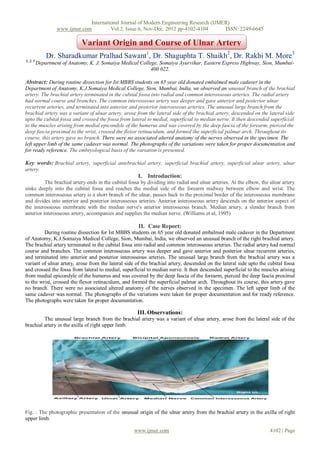
         The unusual large branch from the brachial artery was a variant of ulnar artery, arose from the lateral side of the
brachial artery in the axilla of right upper limb.


Fig. : The photographic presentation of the unusual origin of the ulnar artery from the brachial artery in the axilla of right
upper limb.

                                                    www.ijmer.com                                                     4102 | Page
International Journal of Modern Engineering Research (IJMER)
               www.ijmer.com         Vol.2, Issue.6, Nov-Dec. 2012 pp-4102-4104       ISSN: 2249-6645
                                                       IV. Discussion:
          The variations in branching pattern of axillary artery are a rule rather than exception (2, 3, 4, 5, 6, 7, 8, 9, 10, 11,
12, 13, 14, 15, 16). Variant branches may arise from the brachial artery (17). Ulnar artery was found to deviate from its usual
mode of origin in one in thirteen cases; frequently it sprang from the lower part of the brachial artery; the position of the
ulnar artery in the forearm was more frequently altered; in cases of high origin, it invariably descended over the muscles
arising from the medial epicondyle of the humerus and was covered by the deep fascia of the forearm (2). The present case
of ulnar artery is somewhat similar to the variations presented in Quain's Anatomy (2). If the brachial artery is taken to
terminate into radial and ulnar arteries, the embryological basis of the existing ulnar artery and the origin and course of the
unusual branch of the brachial artery, replacing the ulnar artery in the present case, is as follows. Primitive axis artery and
superficial brachial artery are implicated in the morphogenesis of the arteries of the upper limb (3, 18). The seventh cervical
intersegmental artery forms the axis artery of the upper limb and persists in the adult to form the axillary, brachial, and
interosseous arteries. Transiently, the median artery arises as a branch of the interosseous artery, begins to regress and
remains as a residual artery accompanying the median nerve (18). Radial and ulnar arteries are later additions to the axis
artery. An ulnar artery and a median artery are branches of the axis artery (8). A superficial brachial artery is a consistent
embryonic vessel, coexisting or not with the brachial artery (19). It has two terminal branches, a lateral that continues as a
part of the definitive radial artery (20) and a medial, superficial antebrachial artery, which divides into median and ulnar
artery branches, which are the trunks of origin of the median and ulnar arteries. These trunks of deep origin predominate and
the superficial arteries regress (8). In the present case, the axis artery had formed the interosseous artery and given the trunks
of the median and ulnar arteries. The ulnar branch of the superficial antebrachial artery persists independently, without its
usual anastomosis to the branch of the axis atery, as the large lateral branch of the brachial artery and the superficial ulnar
atery, which is found in the distal part of the forearm and joins the superficial palmar arch. If the brachial artery is taken to
terminate into radial and interosseous arteries, the simpler embryological basis of the interosseous artery and the origin and
course of the unusual branch of the brachial artery, replacing the ulnar artery, is the following. It appears probable that the
abnormal arrangement results from early obstruction of the ulnar artery below the origin of the interosseous, and the
development of a superficial vas aberrans, which replaces the portion of vessel below the obstrution and unites with the
brachial. The interosseous artery in such cases of abnormality thus comprises not only the interosseous artery but also the
portion of ulnar artery above the obstruction. and, in accordance with this view, the recurrent branches are derived from it
(2). The present anomaly is very rare and does not seem to have been reported. This case is of significance. Such an artery
may present a superficial pulse and a hazard to venipuncture (21) and lead to intra-arterial injections or ligature instead of the
vein in the cubital fossa (22, 23) Variation in the branching pattern of the brachial artery is of significance in cardiac
catheterization for angioplasty, pedicle flaps, arterial grafting or brachial pulse.

                                                       V. Conclusion:
          The knowledge of presence of the unusual origin of the ulnar artery from the brachial artery in the axilla may be
clinically important for clinicians, surgeons, orthopaedicians and radiologists performing angiographic studies. Undoubtedly,
such variations are important for diagnostic evaluation and surgical management of vascular diseases and injuries. These
variations are compared with the earlier data & it is concluded that variations in branching pattern of axillary artery are a rule
rather than exception. Therefore both the normal and abnormal anatomy of the region should be well known for accurate
diagnostic interpretation and therapeutic intervention.

Competing Interests:
The authors declare that they have no competing interest.

Authors' contributions:
SPS wrote the case report, performed the literature review & obtained the photograph for the study. RMM performed the
literature search and assisted with writing the paper. STS conceived the study and helped to draft the manuscript. All authors
have read and approved the final version manuscript.

                                                  VI. Acknowledgement:
         All the authors wish to convey thanks to Dr. Arif A. Faruqui for his valuable support. We are also thankful to Mr.
M. Murugan. Authors also acknowledge the immense help received from the scholars whose articles are cited and included
in references of this manuscript. The authors are also grateful to authors / editors / publishers of all those articles, journals
and books from where the literature for this article has been reviewed and discussed.

                                                         References:
1.   Williams, P.L.; Bannister, L.H. Berry M.M; Collins, P., Dyson, M. Dussek, J.E., Ferguson, M.W.J.: Gray's Anatomy,
     In: Cardiovasular system. Gabella, G. Edr. 39th Edn, 2000, Churchill Livingstone, London, Edinburgh pp: 1537-1540.
2.   Thane, G. D. Quain's elements of Anatomy. In : Arthrology- Myology-Angiology. 10th Edn; 1892, Longman, Green,
     and Co. London: 445.
3.   Schwyzer, A.G. and DeGaris, C.F : Three diverse patterns of the arteria brachialis superficialis in man, 1935,
     Anatomical Record 63 : 405- 416.


                                                    www.ijmer.com                                                     4103 | Page
International Journal of Modern Engineering Research (IJMER)
               www.ijmer.com         Vol.2, Issue.6, Nov-Dec. 2012 pp-4102-4104       ISSN: 2249-6645
4.    Mc Cormack, L.J. Caldwell, M.D. and Anson, B.J.: Brachial antebrachial arterial patterns, 1953 Surgery Gynecology
      and Obstetrics 96 : 43-54.
5.    Coleman S.S. and Anson, B.J. : Arterial patterns in the hand based upon a study of 650 specimens Surgery Gynecology
      and Obstetrics, 196, 113 : 409-424.
6.    Lippert, H. and Pabst, R: Arterial variations in Man. Bergmann, Munich; 1985, pp. 66-73.
7.    Poteat, W.L. : Report of a rare human variation : Absence of the radial artery, 1986, Anatomical Record 214 : 89-95.
8.    Rodriguez-Baeza, A. Nebot, J., Ferreira, B., Reina, F, Perez, J., Sanudo, J.R. and Rolg, M. : An anatomical study and
      ontogenic explanation of 23 cases with variations in the main pattern of the human brachio-antebrachial arteries, 1995,
      Journal of Anatomy 187 : 473-479.
9.    Aharinejad S., Nourani F. and Hollensteiner H. : Rare case of high origin of ulnar artery from the brachial artery, 1997,
      Clinical Anatomy 10: 253-258.
10.   Patnaik, V.V.G., Kalsey, G. and Singla, R.K. : Anomalous course of radial artery and a variant of deep palmar arch: A
      case report. Journal of the Anatomical Society of India, 2000, 49(1) : 54-57.
11.   Patnaik, V.V.G., Kalsey, G. and Singla, R.K. : Superficial palmar arch duplication : A case report. Journal of the
      Anatomical Society of India, 2000, 49(1) : 63-66.
12.   Patnaik, V.V.G., Kalsey, G. and Singla, R.K. : Trifurcation of brachial artery-A case reportt. Journal of the Anatomical
      Society of India, 2001, 50(2) : 163-165.
13.   Patnaik V.V.G. Kalsey G. and Singla R.K. : Bifurcation of axillary artery in its 3rd part-A case report. Journal of the
      Anatomical Society of India, 2001, 50(2) : 166-169.
14.   Celik, H.H., Germus, G., Aldur, M.M. and Ozcelik, M. : Origin of the radial and ulnar arteries : variation in 81
      arteriograms, 2001, Morphologie 85 : 25-27.
15.   Clerve, A., Kahn M., Pangilinan, A.J. and Dardik, H. : Absence of the brachial artery : report of a rare human variation
      and review of upper extremity arterial anomalies, 2001, Journal of Vascular Surgery 33 : 191-194.
16.   Suganthy J., Koshy S., Indrasingh I. and Vettivel S. : A very rare absence of radial artery : A case report, 2002, Journal
      of the Anatomical society of India 51(1) : 61-64.
17.   Huber G.C.: Piersol's Human Anatomy. In : The vascular system 9th Edn. 1930, Vol 1, J. B. Lippincott Co.
      Philadelphia. pp. 767-791.
18.   Singer E.: Embryological pattern persisting in the arteries of the arm, 1933, Anatomical Record 55 : 403-409.
19.   Tountas, CH.P. And Bergman, R.A. : Anatomic Variations of the upper extremity. Churchill Livingstone, 1993, New
      York. pp. 196-210.
20.   Vancov V.: Une variete extremement complexe des arteres du member superiur chez un foetus humain, 1961,
      Anatomischer anzeiger 109 : 400-405.
21.   Hazlett J.W.: Superficial ulnar artery with reference to accidental intra-arterial injection, 1949, Canadian Medical
      Association Journal 61 : 289-293.
22.   Pabst R. and Lippert H. : Belderseitiges Vorkommen von A. brachialis superficiialis, ulnaris superficialis and A.
      mediana, 1968, Anatomischer Anzieger 123 : 223-226.
23.   Thoma, A. and Young, J.E.M. : The superficial ulnar artery "trap" and the free forearm flap, 1992, Annals of Plastic
      Surgery 28 : 370-372.


           Corresponding author full mailing address : Dr. Sharadkumar Pralhad Sawant, 25/2, Samrat Ashok Nagar
Society, Shell Colony Road, Chembur, Mumbai – 400 071, Maharashtra, India.


                                                   www.ijmer.com                                                    4104 | Page

Variant Origin and Course of Ulnar Artery

  • 1.
    International Journal ofModern Engineering Research (IJMER) www.ijmer.com Vol.2, Issue.6, Nov-Dec. 2012 pp-4102-4104 ISSN: 2249-6645 Variant Origin and Course of Ulnar Artery Dr. Sharadkumar Pralhad Sawant1, Dr. Shaguphta T. Shaikh2, Dr. Rakhi M. More3 1, 2, 3 Department of Anatomy, K. J. Somaiya Medical College, Somaiya Ayurvihar, Eastern Express Highway, Sion, Mumbai- 400 022. Abstract: During routine dissection for Ist MBBS students on 65 year old donated embalmed male cadaver in the Department of Anatomy, K.J.Somaiya Medical College, Sion, Mumbai, India, we observed an unusual branch of the brachial artery. The brachial artery terminated in the cubital fossa into radial and common interosseous arteries. The radial artery had normal course and branches. The common interosseous artery was deeper and gave anterior and posterior ulnar recurrent arteries, and terminated into anterior and posterior interosseous arteries. The unusual large branch from the brachial artery was a variant of ulnar artery, arose from the lateral side of the brachial artery, descended on the lateral side upto the cubital fossa and crossed the fossa from lateral to medial, superficial to median nerve. It then descended superficial to the muscles arising from medial epicondyle of the humerus and was covered by the deep fascia of the forearm, pierced the deep fascia proximal to the wrist, crossed the flexor retinaculum, and formed the superficial palmar arch. Throughout its course, this artery gave no branch. There were no associated altered anatomy of the nerves observed in the specimen. The left upper limb of the same cadaver was normal. The photographs of the variations were taken for proper documentation and for ready reference. The embryological basis of the variation is presented. Key words: Brachial artery, superficial antebrachial artery, superficial brachial artery, superficial ulnar artery, ulnar artery. I. Introduction: The brachial artery ends in the cubital fossa by dividing into radial and ulnar arteries. At the elbow, the ulnar artery sinks deeply into the cubital fossa and reaches the medial side of the forearm midway between elbow and wrist. The common interosseous artery is a short branch of the ulnar, passes back to the proximal border of the interosseous membrane and divides into anterior and posterior interosseous arteries. Anterior interosseous artery descends on the anterior aspect of the interosseous membrane with the median nerve's anterior interosseous branch. Median artery, a slender branch from anterior interosseous artery, accompanies and supplies the median nerve. (Williams et al, 1995) II. Case Report: During routine dissection for Ist MBBS students on 65 year old donated embalmed male cadaver in the Department of Anatomy, K.J.Somaiya Medical College, Sion, Mumbai, India, we observed an unusual branch of the right brachial artery. The brachial artery terminated in the cubital fossa into radial and common interosseous arteries. The radial artery had normal course and branches. The common interosseous artery was deeper and gave anterior and posterior ulnar recurrent arteries, and terminated into anterior and posterior interosseous arteries. The unusual large branch from the brachial artery was a variant of ulnar artery, arose from the lateral side of the brachial artery, descended on the lateral side upto the cubital fossa and crossed the fossa from lateral to medial, superficial to median nerve. It then descended superficial to the muscles arising from medial epicondyle of the humerus and was covered by the deep fascia of the forearm, pierced the deep fascia proximal to the wrist, crossed the flexor retinaculum, and formed the superficial palmar arch. Throughout its course, this artery gave no branch. There were no associated altered anatomy of the nerves observed in the specimen. The left upper limb of the same cadaver was normal. The photographs of the variations were taken for proper documentation and for ready reference. The photographs were taken for proper documentation. III. Observations: The unusual large branch from the brachial artery was a variant of ulnar artery, arose from the lateral side of the brachial artery in the axilla of right upper limb. Fig. : The photographic presentation of the unusual origin of the ulnar artery from the brachial artery in the axilla of right upper limb. www.ijmer.com 4102 | Page
  • 2.
    International Journal ofModern Engineering Research (IJMER) www.ijmer.com Vol.2, Issue.6, Nov-Dec. 2012 pp-4102-4104 ISSN: 2249-6645 IV. Discussion: The variations in branching pattern of axillary artery are a rule rather than exception (2, 3, 4, 5, 6, 7, 8, 9, 10, 11, 12, 13, 14, 15, 16). Variant branches may arise from the brachial artery (17). Ulnar artery was found to deviate from its usual mode of origin in one in thirteen cases; frequently it sprang from the lower part of the brachial artery; the position of the ulnar artery in the forearm was more frequently altered; in cases of high origin, it invariably descended over the muscles arising from the medial epicondyle of the humerus and was covered by the deep fascia of the forearm (2). The present case of ulnar artery is somewhat similar to the variations presented in Quain's Anatomy (2). If the brachial artery is taken to terminate into radial and ulnar arteries, the embryological basis of the existing ulnar artery and the origin and course of the unusual branch of the brachial artery, replacing the ulnar artery in the present case, is as follows. Primitive axis artery and superficial brachial artery are implicated in the morphogenesis of the arteries of the upper limb (3, 18). The seventh cervical intersegmental artery forms the axis artery of the upper limb and persists in the adult to form the axillary, brachial, and interosseous arteries. Transiently, the median artery arises as a branch of the interosseous artery, begins to regress and remains as a residual artery accompanying the median nerve (18). Radial and ulnar arteries are later additions to the axis artery. An ulnar artery and a median artery are branches of the axis artery (8). A superficial brachial artery is a consistent embryonic vessel, coexisting or not with the brachial artery (19). It has two terminal branches, a lateral that continues as a part of the definitive radial artery (20) and a medial, superficial antebrachial artery, which divides into median and ulnar artery branches, which are the trunks of origin of the median and ulnar arteries. These trunks of deep origin predominate and the superficial arteries regress (8). In the present case, the axis artery had formed the interosseous artery and given the trunks of the median and ulnar arteries. The ulnar branch of the superficial antebrachial artery persists independently, without its usual anastomosis to the branch of the axis atery, as the large lateral branch of the brachial artery and the superficial ulnar atery, which is found in the distal part of the forearm and joins the superficial palmar arch. If the brachial artery is taken to terminate into radial and interosseous arteries, the simpler embryological basis of the interosseous artery and the origin and course of the unusual branch of the brachial artery, replacing the ulnar artery, is the following. It appears probable that the abnormal arrangement results from early obstruction of the ulnar artery below the origin of the interosseous, and the development of a superficial vas aberrans, which replaces the portion of vessel below the obstrution and unites with the brachial. The interosseous artery in such cases of abnormality thus comprises not only the interosseous artery but also the portion of ulnar artery above the obstruction. and, in accordance with this view, the recurrent branches are derived from it (2). The present anomaly is very rare and does not seem to have been reported. This case is of significance. Such an artery may present a superficial pulse and a hazard to venipuncture (21) and lead to intra-arterial injections or ligature instead of the vein in the cubital fossa (22, 23) Variation in the branching pattern of the brachial artery is of significance in cardiac catheterization for angioplasty, pedicle flaps, arterial grafting or brachial pulse. V. Conclusion: The knowledge of presence of the unusual origin of the ulnar artery from the brachial artery in the axilla may be clinically important for clinicians, surgeons, orthopaedicians and radiologists performing angiographic studies. Undoubtedly, such variations are important for diagnostic evaluation and surgical management of vascular diseases and injuries. These variations are compared with the earlier data & it is concluded that variations in branching pattern of axillary artery are a rule rather than exception. Therefore both the normal and abnormal anatomy of the region should be well known for accurate diagnostic interpretation and therapeutic intervention. Competing Interests: The authors declare that they have no competing interest. Authors' contributions: SPS wrote the case report, performed the literature review & obtained the photograph for the study. RMM performed the literature search and assisted with writing the paper. STS conceived the study and helped to draft the manuscript. All authors have read and approved the final version manuscript. VI. Acknowledgement: All the authors wish to convey thanks to Dr. Arif A. Faruqui for his valuable support. We are also thankful to Mr. M. Murugan. Authors also acknowledge the immense help received from the scholars whose articles are cited and included in references of this manuscript. The authors are also grateful to authors / editors / publishers of all those articles, journals and books from where the literature for this article has been reviewed and discussed. References: 1. Williams, P.L.; Bannister, L.H. Berry M.M; Collins, P., Dyson, M. Dussek, J.E., Ferguson, M.W.J.: Gray's Anatomy, In: Cardiovasular system. Gabella, G. Edr. 39th Edn, 2000, Churchill Livingstone, London, Edinburgh pp: 1537-1540. 2. Thane, G. D. Quain's elements of Anatomy. In : Arthrology- Myology-Angiology. 10th Edn; 1892, Longman, Green, and Co. London: 445. 3. Schwyzer, A.G. and DeGaris, C.F : Three diverse patterns of the arteria brachialis superficialis in man, 1935, Anatomical Record 63 : 405- 416. www.ijmer.com 4103 | Page
  • 3.
    International Journal ofModern Engineering Research (IJMER) www.ijmer.com Vol.2, Issue.6, Nov-Dec. 2012 pp-4102-4104 ISSN: 2249-6645 4. Mc Cormack, L.J. Caldwell, M.D. and Anson, B.J.: Brachial antebrachial arterial patterns, 1953 Surgery Gynecology and Obstetrics 96 : 43-54. 5. Coleman S.S. and Anson, B.J. : Arterial patterns in the hand based upon a study of 650 specimens Surgery Gynecology and Obstetrics, 196, 113 : 409-424. 6. Lippert, H. and Pabst, R: Arterial variations in Man. Bergmann, Munich; 1985, pp. 66-73. 7. Poteat, W.L. : Report of a rare human variation : Absence of the radial artery, 1986, Anatomical Record 214 : 89-95. 8. Rodriguez-Baeza, A. Nebot, J., Ferreira, B., Reina, F, Perez, J., Sanudo, J.R. and Rolg, M. : An anatomical study and ontogenic explanation of 23 cases with variations in the main pattern of the human brachio-antebrachial arteries, 1995, Journal of Anatomy 187 : 473-479. 9. Aharinejad S., Nourani F. and Hollensteiner H. : Rare case of high origin of ulnar artery from the brachial artery, 1997, Clinical Anatomy 10: 253-258. 10. Patnaik, V.V.G., Kalsey, G. and Singla, R.K. : Anomalous course of radial artery and a variant of deep palmar arch: A case report. Journal of the Anatomical Society of India, 2000, 49(1) : 54-57. 11. Patnaik, V.V.G., Kalsey, G. and Singla, R.K. : Superficial palmar arch duplication : A case report. Journal of the Anatomical Society of India, 2000, 49(1) : 63-66. 12. Patnaik, V.V.G., Kalsey, G. and Singla, R.K. : Trifurcation of brachial artery-A case reportt. Journal of the Anatomical Society of India, 2001, 50(2) : 163-165. 13. Patnaik V.V.G. Kalsey G. and Singla R.K. : Bifurcation of axillary artery in its 3rd part-A case report. Journal of the Anatomical Society of India, 2001, 50(2) : 166-169. 14. Celik, H.H., Germus, G., Aldur, M.M. and Ozcelik, M. : Origin of the radial and ulnar arteries : variation in 81 arteriograms, 2001, Morphologie 85 : 25-27. 15. Clerve, A., Kahn M., Pangilinan, A.J. and Dardik, H. : Absence of the brachial artery : report of a rare human variation and review of upper extremity arterial anomalies, 2001, Journal of Vascular Surgery 33 : 191-194. 16. Suganthy J., Koshy S., Indrasingh I. and Vettivel S. : A very rare absence of radial artery : A case report, 2002, Journal of the Anatomical society of India 51(1) : 61-64. 17. Huber G.C.: Piersol's Human Anatomy. In : The vascular system 9th Edn. 1930, Vol 1, J. B. Lippincott Co. Philadelphia. pp. 767-791. 18. Singer E.: Embryological pattern persisting in the arteries of the arm, 1933, Anatomical Record 55 : 403-409. 19. Tountas, CH.P. And Bergman, R.A. : Anatomic Variations of the upper extremity. Churchill Livingstone, 1993, New York. pp. 196-210. 20. Vancov V.: Une variete extremement complexe des arteres du member superiur chez un foetus humain, 1961, Anatomischer anzeiger 109 : 400-405. 21. Hazlett J.W.: Superficial ulnar artery with reference to accidental intra-arterial injection, 1949, Canadian Medical Association Journal 61 : 289-293. 22. Pabst R. and Lippert H. : Belderseitiges Vorkommen von A. brachialis superficiialis, ulnaris superficialis and A. mediana, 1968, Anatomischer Anzieger 123 : 223-226. 23. Thoma, A. and Young, J.E.M. : The superficial ulnar artery "trap" and the free forearm flap, 1992, Annals of Plastic Surgery 28 : 370-372. Corresponding author full mailing address : Dr. Sharadkumar Pralhad Sawant, 25/2, Samrat Ashok Nagar Society, Shell Colony Road, Chembur, Mumbai – 400 071, Maharashtra, India. www.ijmer.com 4104 | Page