AUTONOMY, CRITICAL
THINKING AND FORMATIVE
ASSESSMENT
MATERIALS DESIGN AND CALL
YAMITH J. FANDIÑO
LA SALLE UNIVERSITY, BOGOTÁ, MARCH, 2015
INTRODUCTION
AUTONOMY: DEFINITION (Chitashvili, 2007)
Autonomy is a complex socio-cognitive system, manifested in
different degrees of independence and control of one’s own
learning process, involving capacities, abilities, attitudes,
willingness, decision making, choices, planning, actions, and
assessment either as a language learner or as a communicator
inside or outside the classroom.
AUTONOMY: ASPECTS
• Involvement of self-confidence
• Usage of individual learning strategies
• Learners’ willingness to take responsibility for their own learning
• Relation to meta cognitive strategies: planning, making decisions,
monitoring and evaluation.
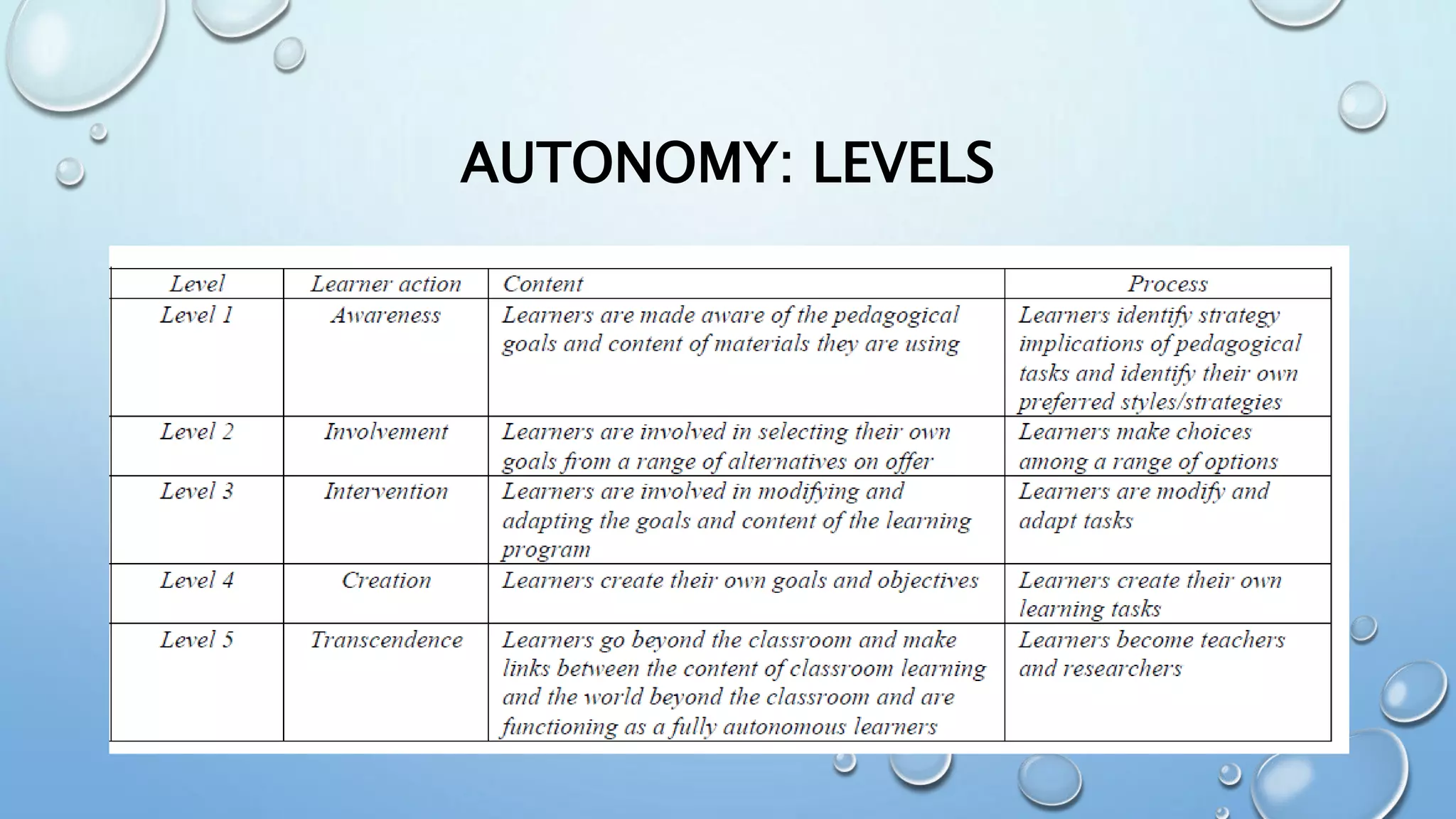
AUTONOMY: LEVELS
AUTONOMY: ACTIVITIES
• Self-reports
• Diaries and evaluation sheets
• Persuasive communication
• Strategy instruction
• Self-monitoring
• Learner-generated quizzes or exercises
CRITICAL THINKING: DEFINITION (Rezaei &
Derakhshan, 2011)
Two central components of critical thinking: the first one is the
ability to assess reasons properly and the second one is the
willingness, desire, and disposition to base one's actions and beliefs
on reasons.
CRITICAL THINKING: TASKS
Buskist and irons (2008) mention that such an enterprise requires
students to learn several subtasks which include:
a. Developing a skeptical approach to problem solving and decision
making;
b. Breaking down problems into their simplest outcomes;
c. Searching for evidence that both supports and refutes a given
conclusion;
d. Maintaining a vigilant attitude toward their personal bias,
assumptions, and values that may interfere with making an
objective decision.
CRITICAL THINKING: FEATURES
Have a strong intention to recognize the importance of good
thinking;
Accurately explain their decisions;
consider alternative explanations for any state of affairs;
Develop and present reasoned and persuasive arguments;
distinguish between primary and secondary sources of
information;
distinguish opinions from facts;
CRITICAL THINKING: ACTIVITIES
a. Engaging oneself in constant questioning in the reading process
by inquiring into the purpose, information, interpretation,
assumption and implication of an issue
b. Debate/forum/discussion
c. Media analysis
d. Problem solving tasks and activities
e. Self and peer assessment assignments
FORMATIVE ASSESSMENT: DEFINITION (Burke,
2002)
The monitoring of student process throughout the duration of a
course or unit of study. It shows how far students have progressed
along the path toward acquisition of the target language.
FORMATIVE ASSESSMENT: ACTIVITIES
The teacher may adopt a variety of tools for observing learner
advancement: written tasks, tests, student seminars, and
conferences, through to portfolios, presentations, and reading or
listening comprehension activities.
These activities may used formal (standardized - systematic) or
informal (spontaneous) procedures.
FORMATIVE ASSESSMENT: BENEFITS
• Opportunities to become active in planning the direction of the
learning process.
• Encouragement of autonomous learning, self-assessment and
awareness of instructional goals and objectives.
• Promotion of students’ monitoring of their use of language in and
outside the classroom.
REFERENCES
Burke, R. (2002). Formative assessment procedures and the second
language curriculum. TESL CANADA JOURNAL, 19(2), 87-91.
Chitashvili, N. (2007). The concept of autonomy in second language
learning. Georgian electronic scientific journal: Education science
and psychology, 2(11), 17-22.
Google images (2015). Characteristics of autonomy, critical
thinkers, and formative assessment. Retrieved from
https://images.google.com/
Rezaei, S., & Derakhshan, A. (2011). Critical thinking in language
education. Journal of language teaching and research, 2(4), 769-
777.

Autonomy, critical thinking and formative assessment

  • 1.
    AUTONOMY, CRITICAL THINKING ANDFORMATIVE ASSESSMENT MATERIALS DESIGN AND CALL YAMITH J. FANDIÑO LA SALLE UNIVERSITY, BOGOTÁ, MARCH, 2015
  • 2.
  • 3.
    AUTONOMY: DEFINITION (Chitashvili,2007) Autonomy is a complex socio-cognitive system, manifested in different degrees of independence and control of one’s own learning process, involving capacities, abilities, attitudes, willingness, decision making, choices, planning, actions, and assessment either as a language learner or as a communicator inside or outside the classroom.
  • 4.
    AUTONOMY: ASPECTS • Involvementof self-confidence • Usage of individual learning strategies • Learners’ willingness to take responsibility for their own learning • Relation to meta cognitive strategies: planning, making decisions, monitoring and evaluation.
  • 5.
  • 6.
    AUTONOMY: ACTIVITIES • Self-reports •Diaries and evaluation sheets • Persuasive communication • Strategy instruction • Self-monitoring • Learner-generated quizzes or exercises
  • 7.
    CRITICAL THINKING: DEFINITION(Rezaei & Derakhshan, 2011) Two central components of critical thinking: the first one is the ability to assess reasons properly and the second one is the willingness, desire, and disposition to base one's actions and beliefs on reasons.
  • 8.
    CRITICAL THINKING: TASKS Buskistand irons (2008) mention that such an enterprise requires students to learn several subtasks which include: a. Developing a skeptical approach to problem solving and decision making; b. Breaking down problems into their simplest outcomes; c. Searching for evidence that both supports and refutes a given conclusion; d. Maintaining a vigilant attitude toward their personal bias, assumptions, and values that may interfere with making an objective decision.
  • 9.
    CRITICAL THINKING: FEATURES Havea strong intention to recognize the importance of good thinking; Accurately explain their decisions; consider alternative explanations for any state of affairs; Develop and present reasoned and persuasive arguments; distinguish between primary and secondary sources of information; distinguish opinions from facts;
  • 10.
    CRITICAL THINKING: ACTIVITIES a.Engaging oneself in constant questioning in the reading process by inquiring into the purpose, information, interpretation, assumption and implication of an issue b. Debate/forum/discussion c. Media analysis d. Problem solving tasks and activities e. Self and peer assessment assignments
  • 11.
    FORMATIVE ASSESSMENT: DEFINITION(Burke, 2002) The monitoring of student process throughout the duration of a course or unit of study. It shows how far students have progressed along the path toward acquisition of the target language.
  • 12.
    FORMATIVE ASSESSMENT: ACTIVITIES Theteacher may adopt a variety of tools for observing learner advancement: written tasks, tests, student seminars, and conferences, through to portfolios, presentations, and reading or listening comprehension activities. These activities may used formal (standardized - systematic) or informal (spontaneous) procedures.
  • 13.
    FORMATIVE ASSESSMENT: BENEFITS •Opportunities to become active in planning the direction of the learning process. • Encouragement of autonomous learning, self-assessment and awareness of instructional goals and objectives. • Promotion of students’ monitoring of their use of language in and outside the classroom.
  • 14.
    REFERENCES Burke, R. (2002).Formative assessment procedures and the second language curriculum. TESL CANADA JOURNAL, 19(2), 87-91. Chitashvili, N. (2007). The concept of autonomy in second language learning. Georgian electronic scientific journal: Education science and psychology, 2(11), 17-22. Google images (2015). Characteristics of autonomy, critical thinkers, and formative assessment. Retrieved from https://images.google.com/ Rezaei, S., & Derakhshan, A. (2011). Critical thinking in language education. Journal of language teaching and research, 2(4), 769- 777.