So…
How do we start?
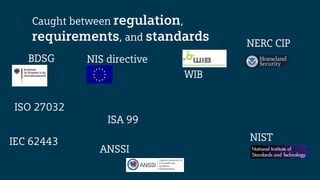
Caught between regulation,
requirements, and standards
IEC 62443
ISO 27032
ISA 99
NIST
ANSSI
NERC CIP
BDSG
WIB
NIS directive
IACS Cybersecurity Standards
Cybersecurity Standards Deliver:
✓ Common Industry Language and Terminology
✓ Standardized Methodology
✓ Guidance on how to answer:
What is my current risk?
What would be a more acceptable level of
risk for my organization?
How do I get to that more acceptable level?
IEC 62443
IEC 62443
gives us the ability to communicate
in an unambiguous way
Align with industry framework
Compliance & standards
Applies to those responsible for designing, manufacturing,
implementing or managing industrial control systems:
• End-users (i.e. asset owner)
• System integrators
• Security practitioners
• ICS product/systems vendors
ISA/IEC 62443: Series of standards that define procedures for
implementing electronically secure Industrial Automation and Control
Systems (IACS).
*Equivalence to ISO 27001 and NIST Cybersecurity Framework
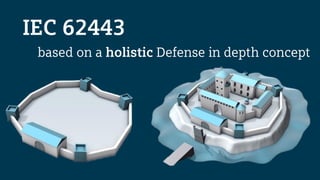
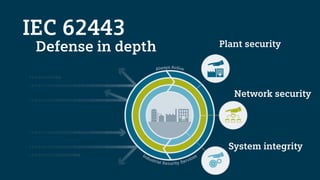
based on a holistic Defense in depth concept
IEC 62443
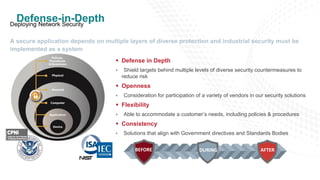
A secure application depends on multiple layers of diverse protection and industrial security must be
implemented as a system
Defense-in-Depth
Deploying Network Security
▪ Defense in Depth
▪ Shield targets behind multiple levels of diverse security countermeasures to
reduce risk
▪ Openness
▪ Consideration for participation of a variety of vendors in our security solutions
▪ Flexibility
▪ Able to accommodate a customer’s needs, including policies & procedures
▪ Consistency
▪ Solutions that align with Government directives and Standards Bodies
DURING
BEFORE AFTER
Plant security
Network security
System integrity
Defense in depth
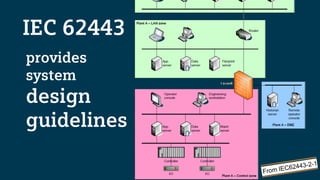
IEC 62443
provides
system
design
guidelines
IEC 62443
Addresses the entire life cycle
IEC 62443
provides a complete
Cyber Security
Management System
IEC 62443
The IEC62443/ISO27001 based method
Identification and
Business Impact Assessment
Definition of
Target Level
Risk
Assessment
Development and
Implementation of
Protection Concept
Definition of
Scope
Getting started
What’s at risk?
▪ Loss of Life
▪ Stolen Intellectual Property
▪ Production Loss
▪ Unscheduled Downtime
▪ Damaged Equipment
▪ Environmental Impact
Business rationale Risk identification classification and assessment
Risk analysis
Conformance Review, improve and maintain the CSMS
Monitoring and improving the CSMS
Understanding Risk
High-Level Security Risk Assessments 62443 3-2
What is your current level of risk?
Impact Remote Unlikely Possible Likely Certain
Trivial 1 2 3 4 5
Minor 2 4 6 8 10
Moderate 3 6 9 12 15
Major 4 8 12 16 20
Critical 5 10 18 20 25
“A good overview”
More info: https://www.ncsc.gov.uk/collection/risk-management-collection/component-system-driven-approaches/understanding-component-driven-risk-management
Risk methods and
frameworks
NIST
Cybersecurity
Framework
Detect
Organization understands what the current state
and risk is to systems, assets, and data
Implement safeguards to ensure delivery of
critical infrastructure services
Implement appropriate activities to
identify a cybersecurity event
Implement activities to take action
regarding a detected cybersecurity event
Implement activities to maintain plans for
resilience and to restore capabilities
The…
Standard
1-1 Terminology,
concepts and models
2-1 Security program
requirements for IACS asset
owners
4-1 Secure product
development lifecycle
requirements
3-1 Security technologies for
IACS
1-2 Master glossary
of terms and
abbreviations
2-2 IACS security
program ratings
4-2 Technical security
requirements for IACS
components
3-2 Security risk assessment
and system design
1-3 System security
compliance metrics
2-3 Patch
management in the
IACS environment
3-3 System security
requirements and security
levels
2-4 Security program
requirements for IACS service
providers
General
Policies
and
procedures
System
Compo-
nents
Definition and metrics
Processes / procedures
Functional requirements
1-4 IACS
security lifecycle and use-
cases
The structure of IEC 62443?
Protection Level
(PL)
• Based on IEC 62443-2-4
and ISO27001
• Maturity Level 1 - 4
Security process Security functions
• Based on IEC 62443-3-3
• Security Level 1 - 4
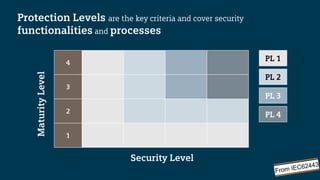
Protection Levels are the key criteria and cover security
functionalities and processes
Protection Levels are the key criteria and cover security
functionalities and processes
Maturity
Level
4
3
2
1
PL 2
PL 3
PL 4
PL 1
Security Level
Understanding Risk
High-Level Security Risk Assessment
What is your Target Security Level (SL-T)?
Protect Against Intentional Unauthorized Access by Entities using Sophisticated Means with
Extend Resources, IACS specific Skills & High Motivation
Security Level 4
Protect Against Intentional Unauthorized Access by Entities Using Sophisticated
Skills with Moderate Resources, IACS specific skills & Moderate Motivation
Security Level 3
Protect Against Intentional Unauthorized Access by Entities Using
Simple Means with Low Resources, Generic Skills, & Low Motivation
Security Level 2
Protect Against Casual or Incidental Access by
Unauthorized Entities
Security Level 1
Consequences –
Some randomly selected points
PL 2
A distributed Firewalls concept has to be implemented
Inventory and Network Management are mandatory
Capability to automate the backup are mandatory …
Even way more…
Even more…
PL 3
PL 4
PL 1
Use of VLAN, network hardening, managed switches and
capability to backup are mandatory …
IEC 62443 Security measures
It is unambiguous …
PL 1
PL 2
PL 3
PL 4
Revolving doors with
card reader and PIN;
Video Surveillance
and/or IRIS Scanner at
door
Revolving doors with
card reader
Doors with card reader
Locked building/doors
with keys
Awareness training (e.g.
Operator Aware. training) Network segmentation
(e.g. VLAN)
Security logging on all
systems
Backup / recovery
system
Mandatory rules on USB
sticks (e.g. Whitelisting) …
…
Automated backup /
recovery
No Email, No WWW, etc.
in Secure Cell
…
2 PCs (Secure Cell/outside)
…
Remote access with
cRSP or equivalent
Monitoring of all
human interactions
Dual approval for
critical actions Firewalls with Fail
Close(e.g. Next
Generation Firewall)
Monitoring of all
device activities
Online security
functionality
verification
…
Persons responsible for
security within own
organization
Continuous monitoring
(e.g. SIEM)
Backup verification
Mandatory security
education
…
Physical network
segmentation or
equivalent (e.g.
SCALANCE S) Remote access
restriction (e.g. need to
connect principle)
+
Organize
Security
Secure Solution
Design
Secure
Operations
Secure Lifecycle
management
Secure Physical
Access
+
+
Page 25
Cybersecurity Essentials
Equipment built
with security in
mind
Network Design
& Segmentation
Asset Inventory Vulnerability
Identification
Patch
Management
Password
Management
Phishing
Identification
Training
Disaster
Recovery
Upgrade Aging
Infrastructure
Limiting
Privileges
IEC62443
ISO27001
NIST 800-30
Well known IT-
security standard
The OT-security
standard
Risk assessment
framework
A piece of a bigger picture
The Functional
Safety standard
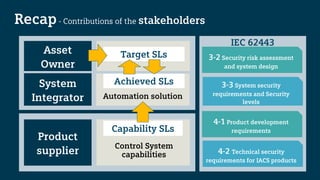
IEC 62443
3-3 System security
requirements and Security
levels
3-2 Security risk assessment
and system design
4-2 Technical security
requirements for IACS products
4-1 Product development
requirements
Achieved SLs
Target SLs
Automation solution
Capability SLs
Product
supplier
System
Integrator
Asset
Owner
Recap- Contributions of the stakeholders
Control System
capabilities
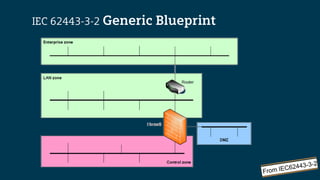
IEC 62443-3-2 Generic Blueprint
IEC62443-3-2 Zones and Conduits
Zone Enterprise Network
Zone Plant
Zone Control #1
Conduit
Zone Control #2
PL3
PL2
PL1
Trusted/Untrusted
IEC62443-3-2 Examples
Small Site
OT is Air
gaped
IEC62443-3-2 Examples
Medium sized Site
OT and IT
are
connected
Via one
Conduit..
IEC62443-3-2 Examples
Large Site
OT and IT
are
connected
Via DMZ..
Spørgsmål?

Industrial_Cyber_Security

  • 1.
  • 2.
    Caught between regulation, requirements,and standards IEC 62443 ISO 27032 ISA 99 NIST ANSSI NERC CIP BDSG WIB NIS directive
  • 3.
    IACS Cybersecurity Standards CybersecurityStandards Deliver: ✓ Common Industry Language and Terminology ✓ Standardized Methodology ✓ Guidance on how to answer: What is my current risk? What would be a more acceptable level of risk for my organization? How do I get to that more acceptable level?
  • 4.
  • 5.
    IEC 62443 gives usthe ability to communicate in an unambiguous way
  • 6.
    Align with industryframework Compliance & standards Applies to those responsible for designing, manufacturing, implementing or managing industrial control systems: • End-users (i.e. asset owner) • System integrators • Security practitioners • ICS product/systems vendors ISA/IEC 62443: Series of standards that define procedures for implementing electronically secure Industrial Automation and Control Systems (IACS). *Equivalence to ISO 27001 and NIST Cybersecurity Framework
  • 7.
    based on aholistic Defense in depth concept IEC 62443
  • 8.
    A secure applicationdepends on multiple layers of diverse protection and industrial security must be implemented as a system Defense-in-Depth Deploying Network Security ▪ Defense in Depth ▪ Shield targets behind multiple levels of diverse security countermeasures to reduce risk ▪ Openness ▪ Consideration for participation of a variety of vendors in our security solutions ▪ Flexibility ▪ Able to accommodate a customer’s needs, including policies & procedures ▪ Consistency ▪ Solutions that align with Government directives and Standards Bodies DURING BEFORE AFTER
  • 9.
    Plant security Network security Systemintegrity Defense in depth IEC 62443
  • 10.
  • 11.
    Addresses the entirelife cycle IEC 62443
  • 12.
    provides a complete CyberSecurity Management System IEC 62443
  • 13.
    The IEC62443/ISO27001 basedmethod Identification and Business Impact Assessment Definition of Target Level Risk Assessment Development and Implementation of Protection Concept Definition of Scope Getting started
  • 14.
    What’s at risk? ▪Loss of Life ▪ Stolen Intellectual Property ▪ Production Loss ▪ Unscheduled Downtime ▪ Damaged Equipment ▪ Environmental Impact
  • 15.
    Business rationale Riskidentification classification and assessment Risk analysis Conformance Review, improve and maintain the CSMS Monitoring and improving the CSMS
  • 16.
    Understanding Risk High-Level SecurityRisk Assessments 62443 3-2 What is your current level of risk? Impact Remote Unlikely Possible Likely Certain Trivial 1 2 3 4 5 Minor 2 4 6 8 10 Moderate 3 6 9 12 15 Major 4 8 12 16 20 Critical 5 10 18 20 25
  • 17.
    “A good overview” Moreinfo: https://www.ncsc.gov.uk/collection/risk-management-collection/component-system-driven-approaches/understanding-component-driven-risk-management Risk methods and frameworks
  • 18.
    NIST Cybersecurity Framework Detect Organization understands whatthe current state and risk is to systems, assets, and data Implement safeguards to ensure delivery of critical infrastructure services Implement appropriate activities to identify a cybersecurity event Implement activities to take action regarding a detected cybersecurity event Implement activities to maintain plans for resilience and to restore capabilities
  • 19.
  • 20.
    1-1 Terminology, concepts andmodels 2-1 Security program requirements for IACS asset owners 4-1 Secure product development lifecycle requirements 3-1 Security technologies for IACS 1-2 Master glossary of terms and abbreviations 2-2 IACS security program ratings 4-2 Technical security requirements for IACS components 3-2 Security risk assessment and system design 1-3 System security compliance metrics 2-3 Patch management in the IACS environment 3-3 System security requirements and security levels 2-4 Security program requirements for IACS service providers General Policies and procedures System Compo- nents Definition and metrics Processes / procedures Functional requirements 1-4 IACS security lifecycle and use- cases The structure of IEC 62443?
  • 21.
    Protection Level (PL) • Basedon IEC 62443-2-4 and ISO27001 • Maturity Level 1 - 4 Security process Security functions • Based on IEC 62443-3-3 • Security Level 1 - 4 Protection Levels are the key criteria and cover security functionalities and processes
  • 22.
    Protection Levels arethe key criteria and cover security functionalities and processes Maturity Level 4 3 2 1 PL 2 PL 3 PL 4 PL 1 Security Level
  • 23.
    Understanding Risk High-Level SecurityRisk Assessment What is your Target Security Level (SL-T)? Protect Against Intentional Unauthorized Access by Entities using Sophisticated Means with Extend Resources, IACS specific Skills & High Motivation Security Level 4 Protect Against Intentional Unauthorized Access by Entities Using Sophisticated Skills with Moderate Resources, IACS specific skills & Moderate Motivation Security Level 3 Protect Against Intentional Unauthorized Access by Entities Using Simple Means with Low Resources, Generic Skills, & Low Motivation Security Level 2 Protect Against Casual or Incidental Access by Unauthorized Entities Security Level 1
  • 24.
    Consequences – Some randomlyselected points PL 2 A distributed Firewalls concept has to be implemented Inventory and Network Management are mandatory Capability to automate the backup are mandatory … Even way more… Even more… PL 3 PL 4 PL 1 Use of VLAN, network hardening, managed switches and capability to backup are mandatory …
  • 25.
    IEC 62443 Securitymeasures It is unambiguous … PL 1 PL 2 PL 3 PL 4 Revolving doors with card reader and PIN; Video Surveillance and/or IRIS Scanner at door Revolving doors with card reader Doors with card reader Locked building/doors with keys Awareness training (e.g. Operator Aware. training) Network segmentation (e.g. VLAN) Security logging on all systems Backup / recovery system Mandatory rules on USB sticks (e.g. Whitelisting) … … Automated backup / recovery No Email, No WWW, etc. in Secure Cell … 2 PCs (Secure Cell/outside) … Remote access with cRSP or equivalent Monitoring of all human interactions Dual approval for critical actions Firewalls with Fail Close(e.g. Next Generation Firewall) Monitoring of all device activities Online security functionality verification … Persons responsible for security within own organization Continuous monitoring (e.g. SIEM) Backup verification Mandatory security education … Physical network segmentation or equivalent (e.g. SCALANCE S) Remote access restriction (e.g. need to connect principle) + Organize Security Secure Solution Design Secure Operations Secure Lifecycle management Secure Physical Access + + Page 25
  • 26.
    Cybersecurity Essentials Equipment built withsecurity in mind Network Design & Segmentation Asset Inventory Vulnerability Identification Patch Management Password Management Phishing Identification Training Disaster Recovery Upgrade Aging Infrastructure Limiting Privileges
  • 27.
    IEC62443 ISO27001 NIST 800-30 Well knownIT- security standard The OT-security standard Risk assessment framework A piece of a bigger picture The Functional Safety standard
  • 28.
    IEC 62443 3-3 Systemsecurity requirements and Security levels 3-2 Security risk assessment and system design 4-2 Technical security requirements for IACS products 4-1 Product development requirements Achieved SLs Target SLs Automation solution Capability SLs Product supplier System Integrator Asset Owner Recap- Contributions of the stakeholders Control System capabilities
  • 29.
  • 30.
    IEC62443-3-2 Zones andConduits Zone Enterprise Network Zone Plant Zone Control #1 Conduit Zone Control #2 PL3 PL2 PL1 Trusted/Untrusted
  • 31.
  • 32.
    IEC62443-3-2 Examples Medium sizedSite OT and IT are connected Via one Conduit..
  • 33.
    IEC62443-3-2 Examples Large Site OTand IT are connected Via DMZ..
  • 34.