HEY! It’s faster than walking!
A travel through time about man’s desire for propelled vehicles
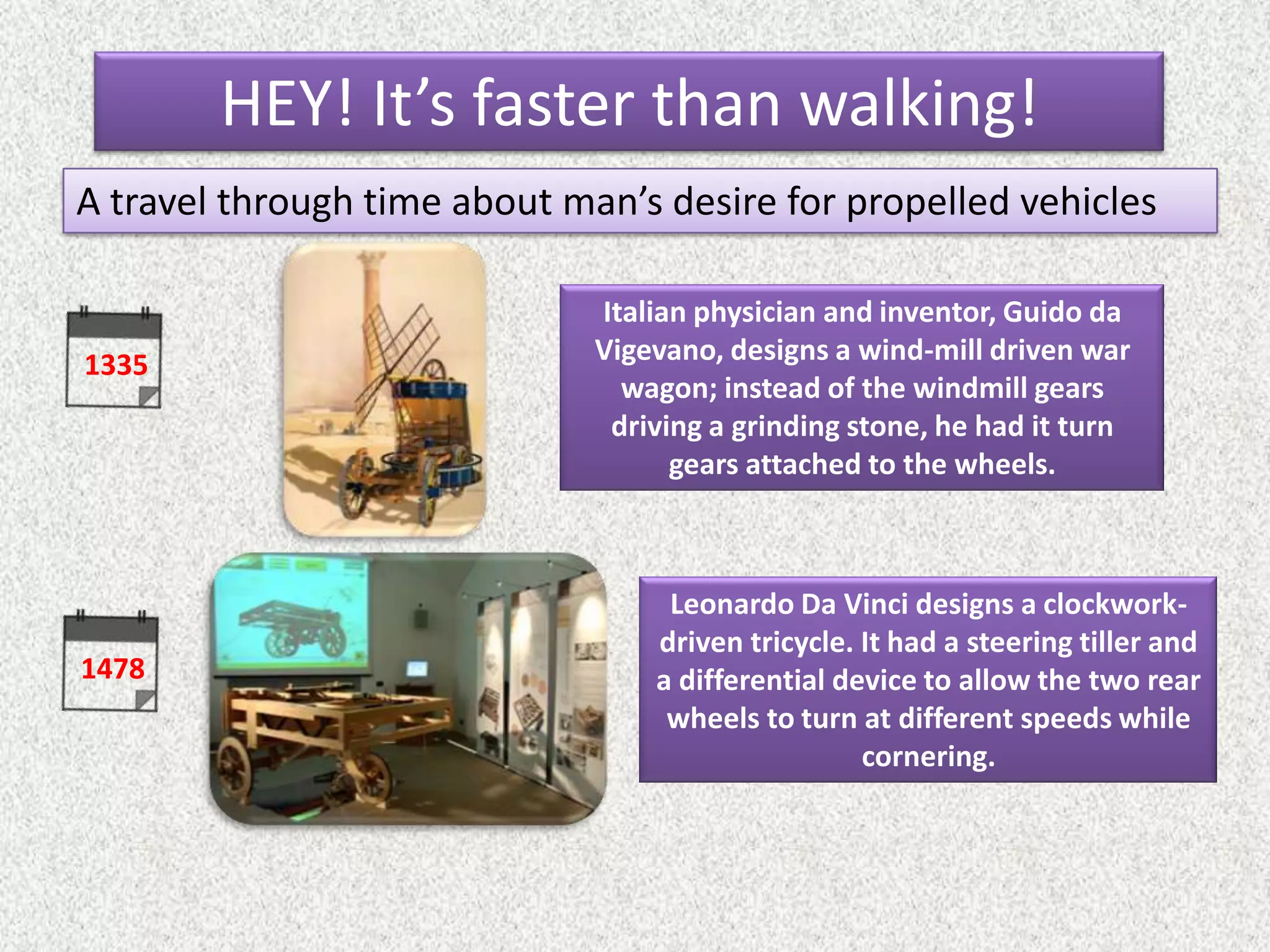
1335
Italian physician and inventor, Guido da
Vigevano, designs a wind-mill driven war
wagon; instead of the windmill gears
driving a grinding stone, he had it turn
gears attached to the wheels.
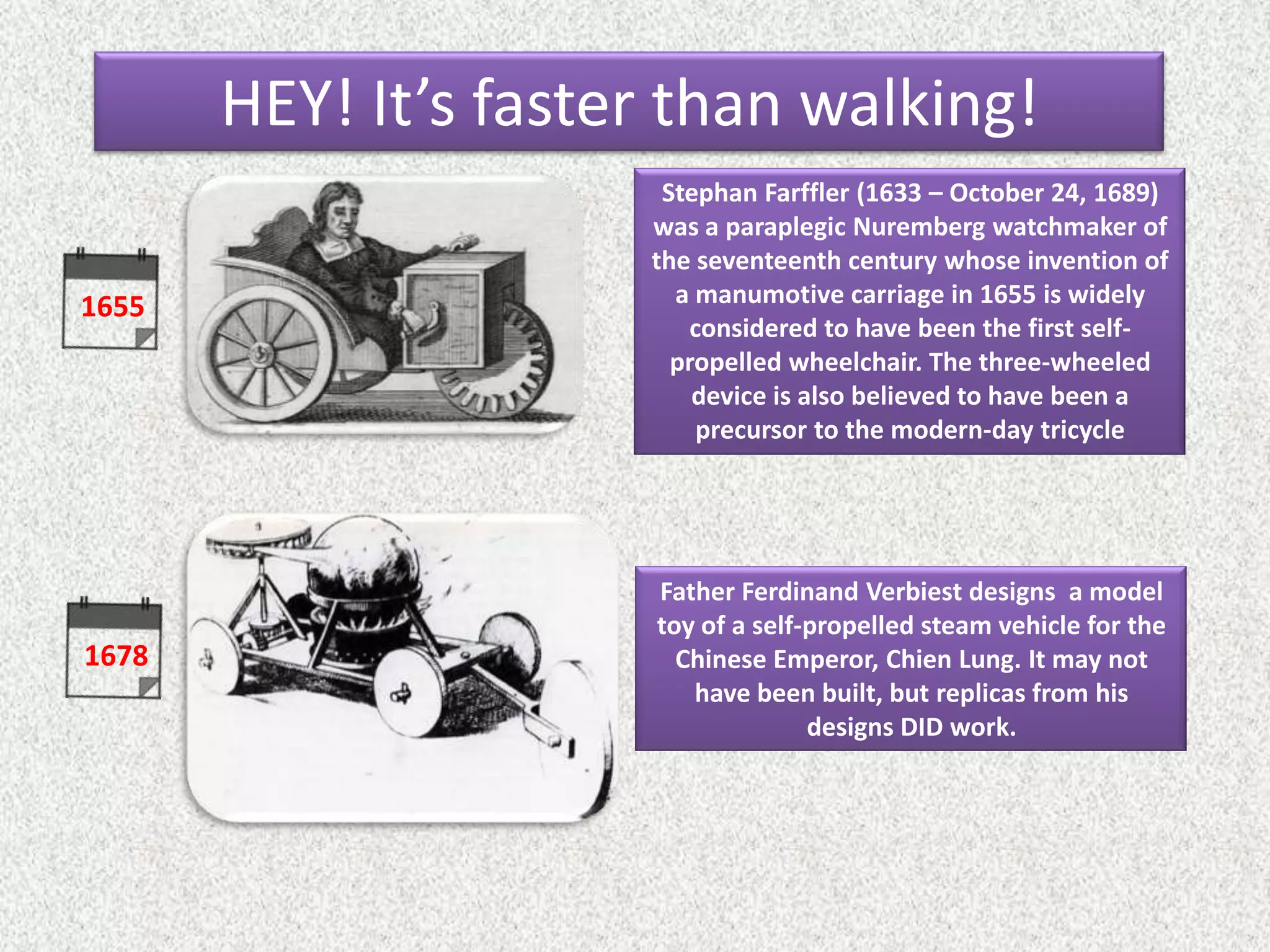
1478
Leonardo Da Vinci designs a clockwork-
driven tricycle. It had a steering tiller and
a differential device to allow the two rear
wheels to turn at different speeds while
cornering.
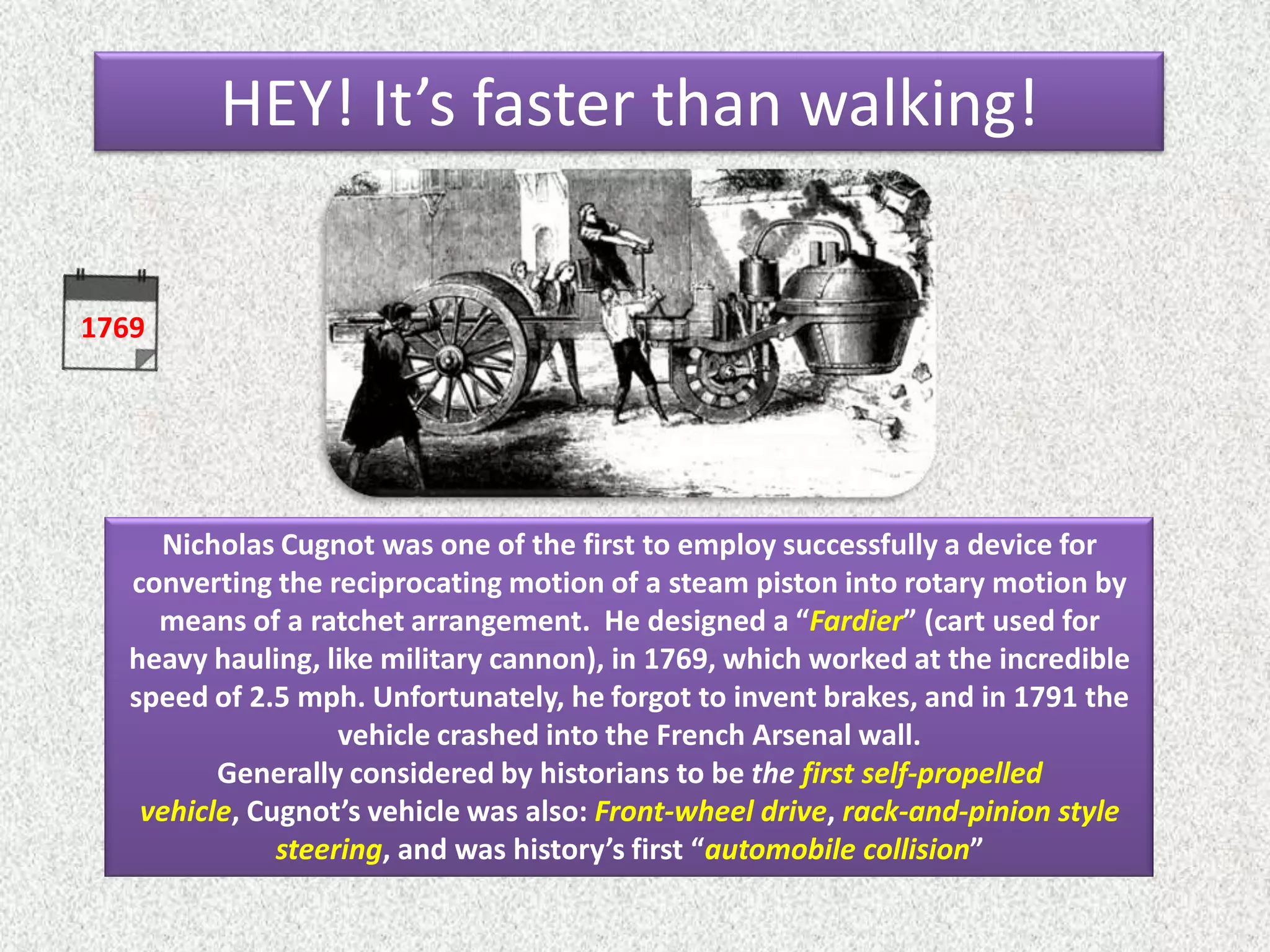
1655
Stephan Farffler (1633 – October 24, 1689)
was a paraplegic Nuremberg watchmaker of
the seventeenth century whose invention of
a manumotive carriage in 1655 is widely
considered to have been the first self-
propelled wheelchair. The three-wheeled
device is also believed to have been a
precursor to the modern-day tricycle
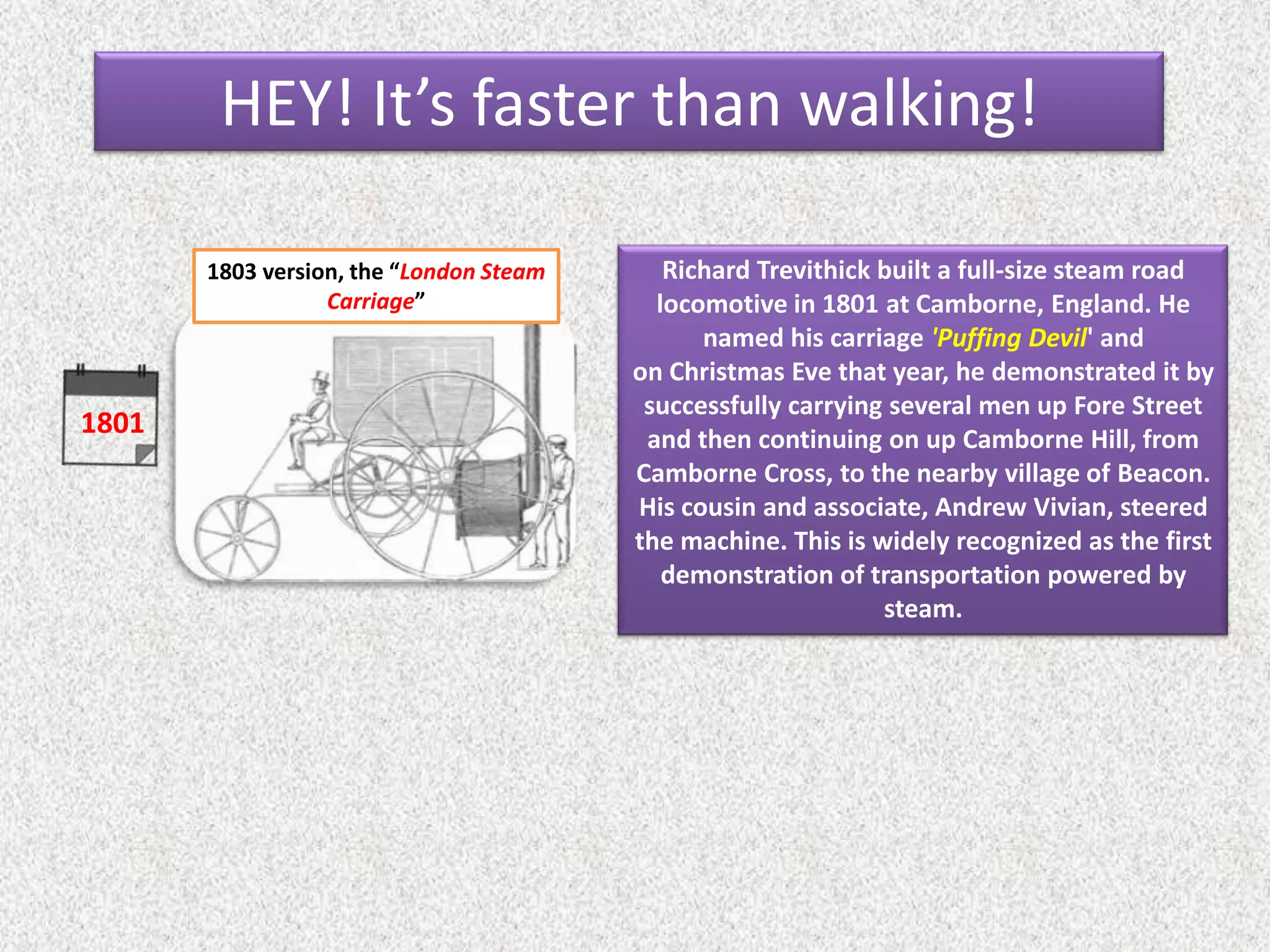
1678
Father Ferdinand Verbiest designs a model
toy of a self-propelled steam vehicle for the
Chinese Emperor, Chien Lung. It may not
have been built, but replicas from his
designs DID work.
HEY! It’s faster than walking!
1769
Nicholas Cugnot was one of the first to employ successfully a device for
converting the reciprocating motion of a steam piston into rotary motion by
means of a ratchet arrangement. He designed a “Fardier” (cart used for
heavy hauling, like military cannon), in 1769, which worked at the incredible
speed of 2.5 mph. Unfortunately, he forgot to invent brakes, and in 1791 the
vehicle crashed into the French Arsenal wall.
Generally considered by historians to be the first self-propelled
vehicle, Cugnot’s vehicle was also: Front-wheel drive, rack-and-pinion style
steering, and was history’s first “automobile collision”
HEY! It’s faster than walking!
1801
Richard Trevithick built a full-size steam road
locomotive in 1801 at Camborne, England. He
named his carriage 'Puffing Devil' and
on Christmas Eve that year, he demonstrated it by
successfully carrying several men up Fore Street
and then continuing on up Camborne Hill, from
Camborne Cross, to the nearby village of Beacon.
His cousin and associate, Andrew Vivian, steered
the machine. This is widely recognized as the first
demonstration of transportation powered by
steam.
1803 version, the “London Steam
Carriage”
HEY! It’s faster than walking!
1803
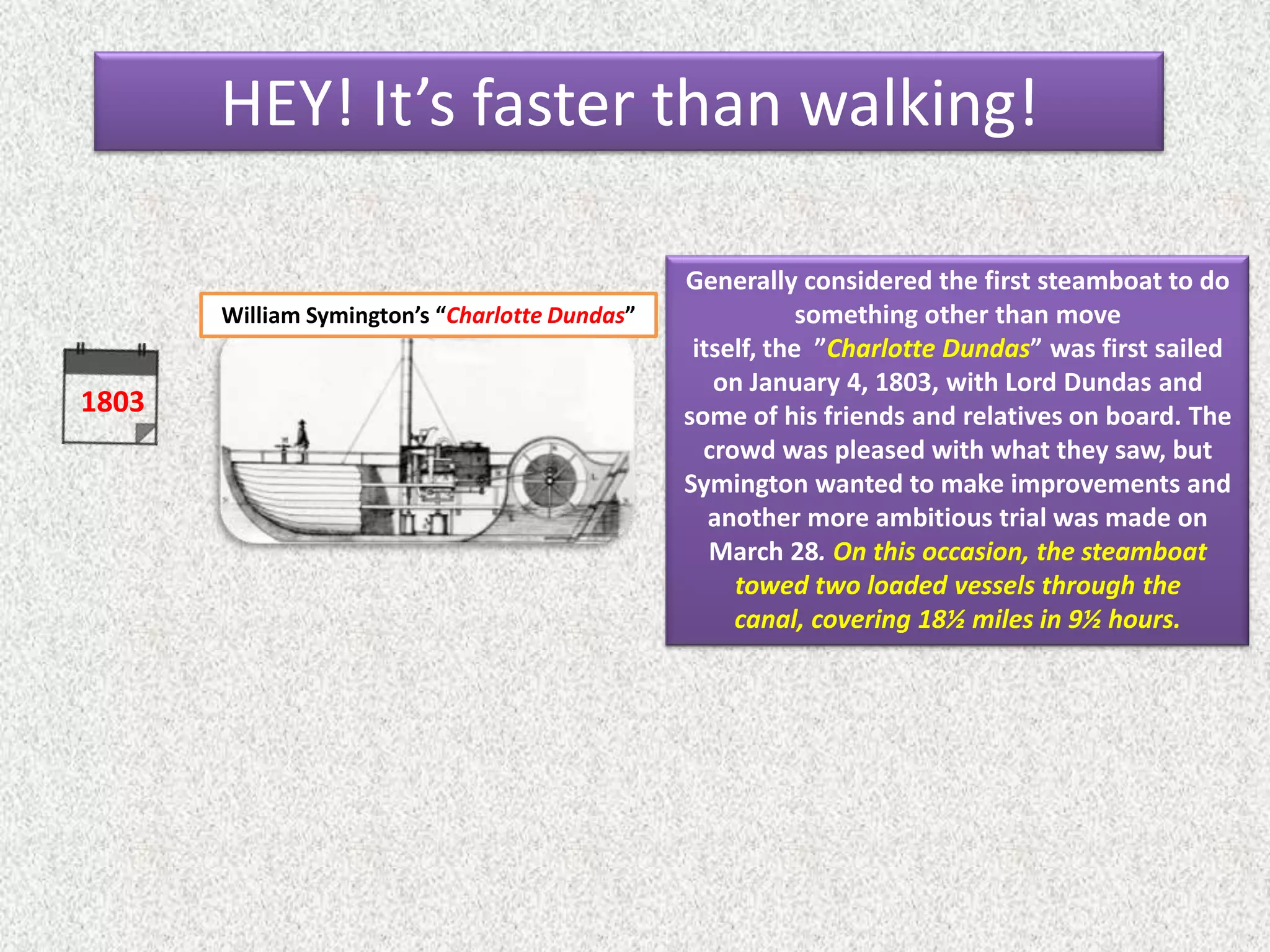
Generally considered the first steamboat to do
something other than move
itself, the ”Charlotte Dundas” was first sailed
on January 4, 1803, with Lord Dundas and
some of his friends and relatives on board. The
crowd was pleased with what they saw, but
Symington wanted to make improvements and
another more ambitious trial was made on
March 28. On this occasion, the steamboat
towed two loaded vessels through the
canal, covering 18½ miles in 9½ hours.
William Symington’s “Charlotte Dundas”
HEY! It’s faster than walking!
1804
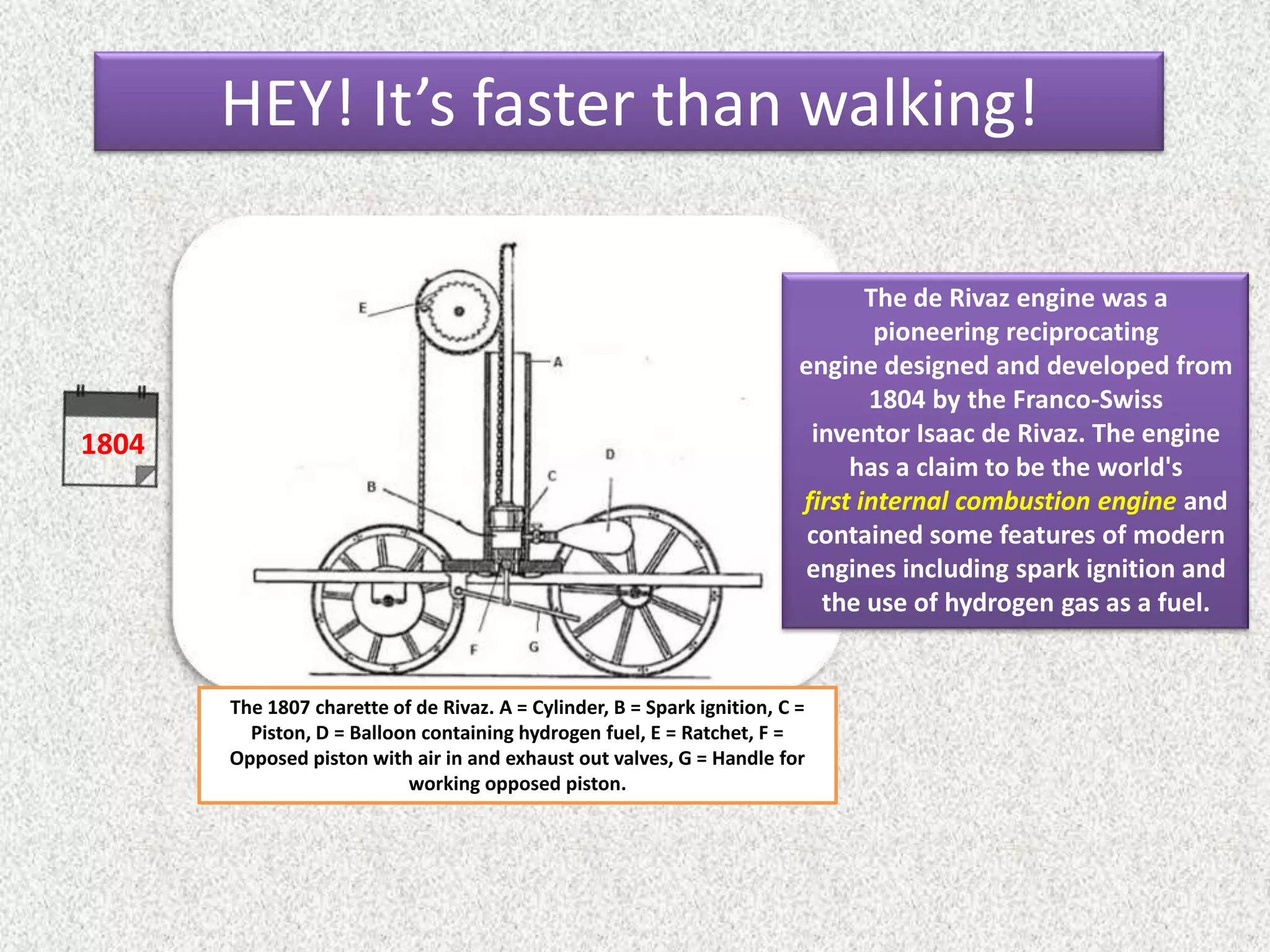
The 1807 charette of de Rivaz. A = Cylinder, B = Spark ignition, C =
Piston, D = Balloon containing hydrogen fuel, E = Ratchet, F =
Opposed piston with air in and exhaust out valves, G = Handle for
working opposed piston.
The de Rivaz engine was a
pioneering reciprocating
engine designed and developed from
1804 by the Franco-Swiss
inventor Isaac de Rivaz. The engine
has a claim to be the world's
first internal combustion engine and
contained some features of modern
engines including spark ignition and
the use of hydrogen gas as a fuel.
HEY! It’s faster than walking!
1817
1886
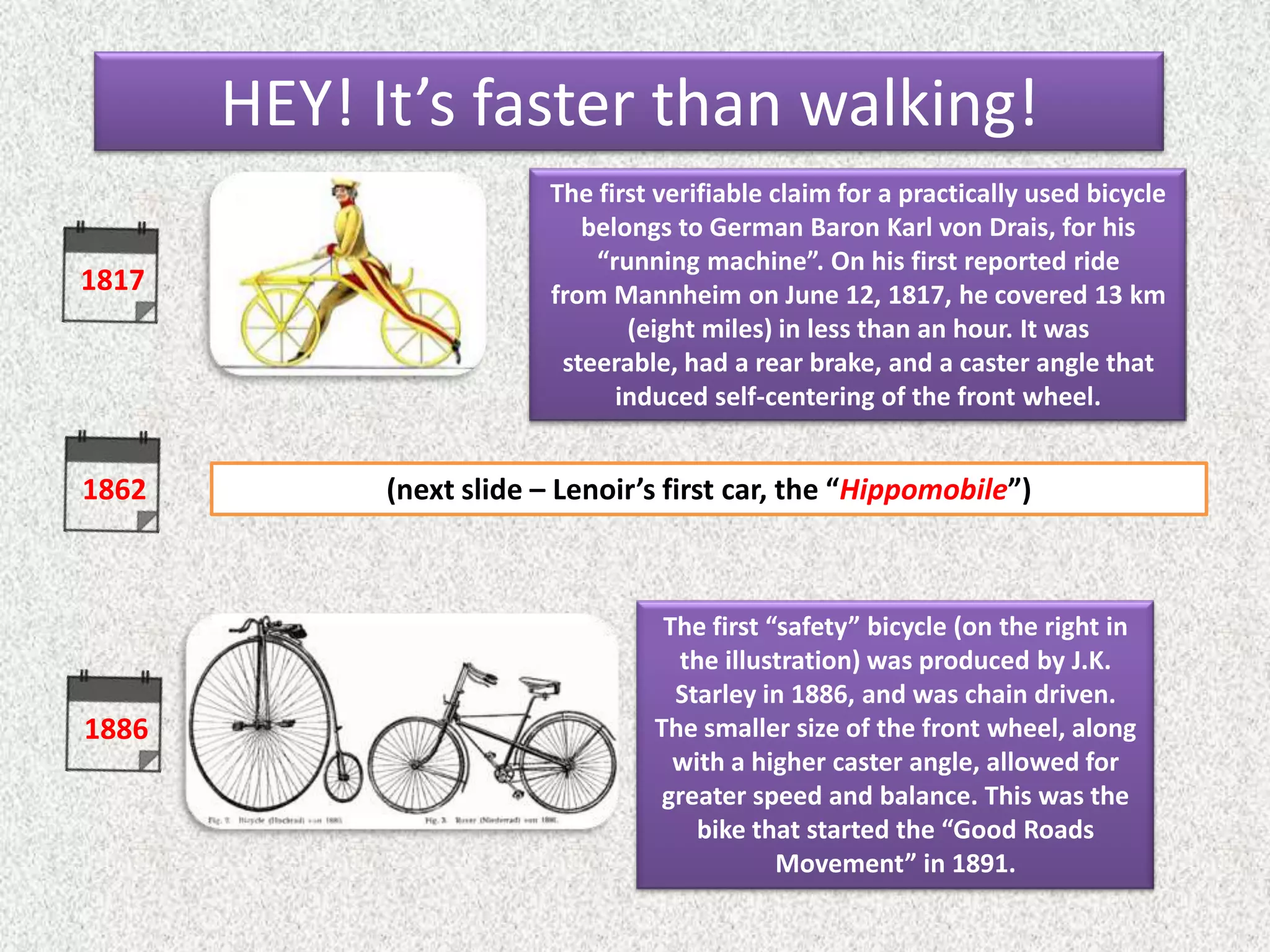
The first verifiable claim for a practically used bicycle
belongs to German Baron Karl von Drais, for his
“running machine”. On his first reported ride
from Mannheim on June 12, 1817, he covered 13 km
(eight miles) in less than an hour. It was
steerable, had a rear brake, and a caster angle that
induced self-centering of the front wheel.
The first “safety” bicycle (on the right in
the illustration) was produced by J.K.
Starley in 1886, and was chain driven.
The smaller size of the front wheel, along
with a higher caster angle, allowed for
greater speed and balance. This was the
bike that started the “Good Roads
Movement” in 1891.
1862 (next slide – Lenoir’s first car, the “Hippomobile”)
HEY! It’s faster than walking!
1862
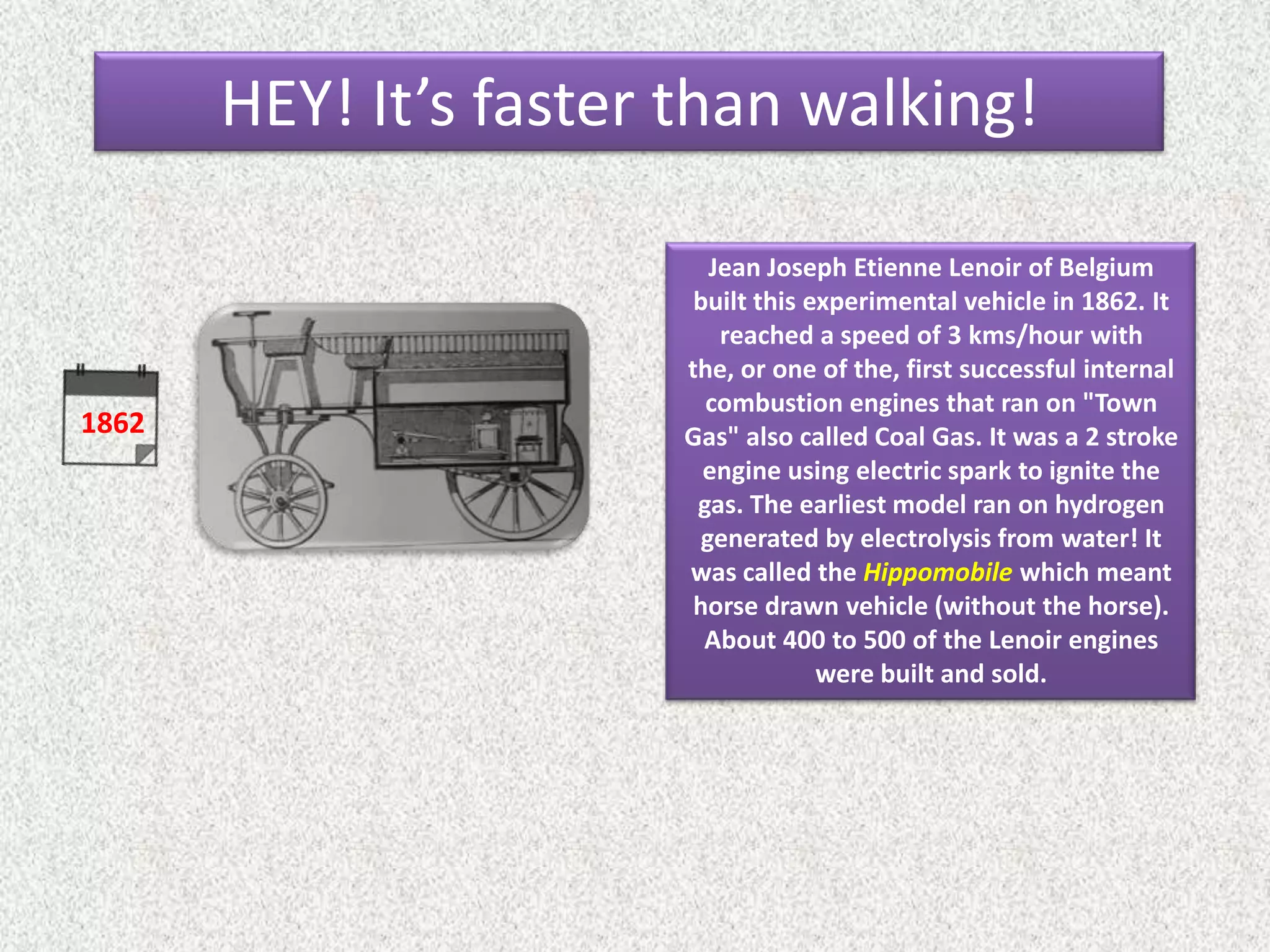
Jean Joseph Etienne Lenoir of Belgium
built this experimental vehicle in 1862. It
reached a speed of 3 kms/hour with
the, or one of the, first successful internal
combustion engines that ran on "Town
Gas" also called Coal Gas. It was a 2 stroke
engine using electric spark to ignite the
gas. The earliest model ran on hydrogen
generated by electrolysis from water! It
was called the Hippomobile which meant
horse drawn vehicle (without the horse).
About 400 to 500 of the Lenoir engines
were built and sold.
HEY! It’s faster than walking!
1867
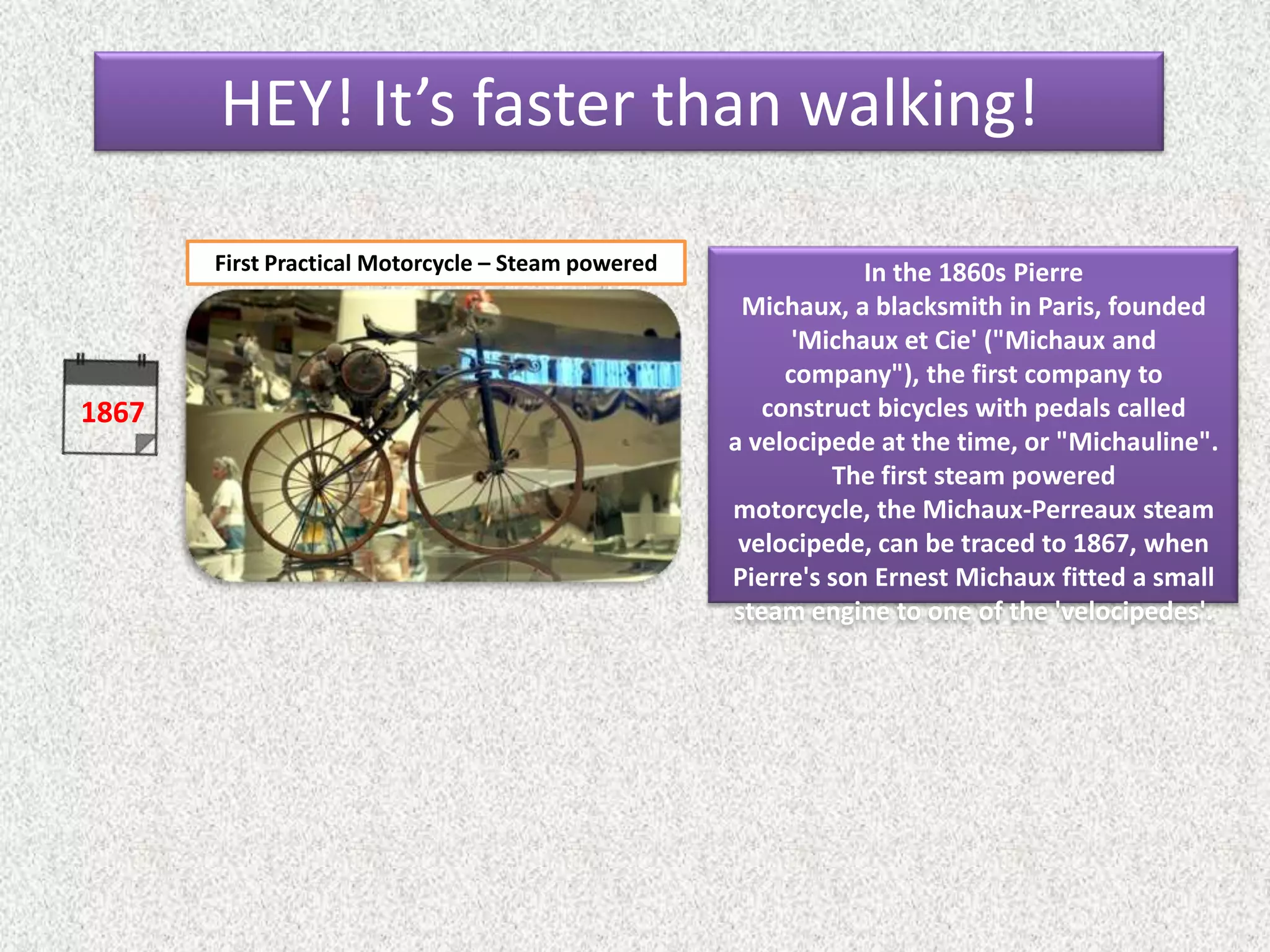
In the 1860s Pierre
Michaux, a blacksmith in Paris, founded
'Michaux et Cie' ("Michaux and
company"), the first company to
construct bicycles with pedals called
a velocipede at the time, or "Michauline".
The first steam powered
motorcycle, the Michaux-Perreaux steam
velocipede, can be traced to 1867, when
Pierre's son Ernest Michaux fitted a small
steam engine to one of the 'velocipedes'.
First Practical Motorcycle – Steam powered
HEY! It’s faster than walking!
1886
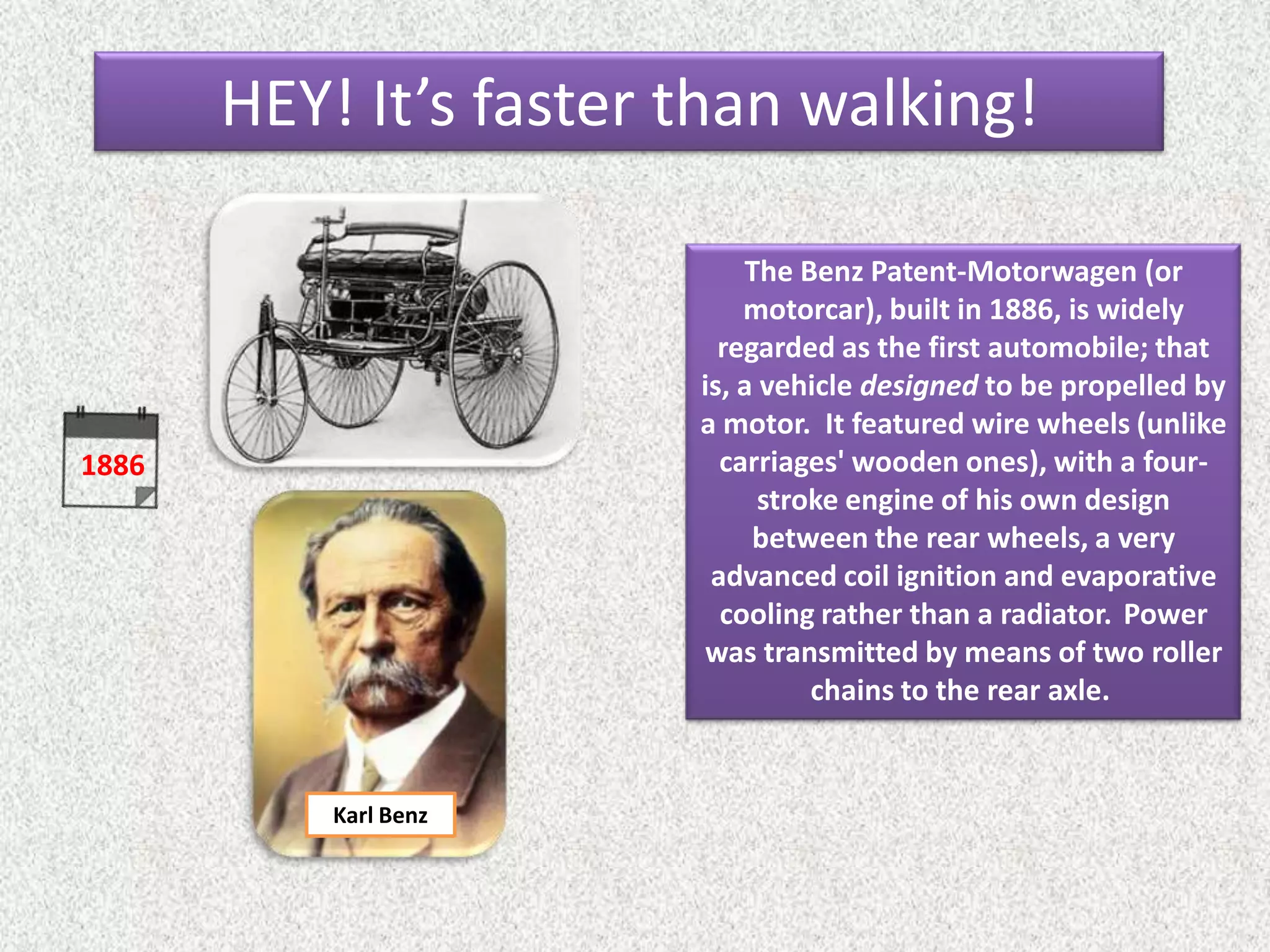
The Benz Patent-Motorwagen (or
motorcar), built in 1886, is widely
regarded as the first automobile; that
is, a vehicle designed to be propelled by
a motor. It featured wire wheels (unlike
carriages' wooden ones), with a four-
stroke engine of his own design
between the rear wheels, a very
advanced coil ignition and evaporative
cooling rather than a radiator. Power
was transmitted by means of two roller
chains to the rear axle.
Karl Benz
HEY! It’s faster than walking!
This slide show is designed as an interim piece to “The Expansion
Of The United States By Highways and Automobiles” (part 1) slide
show, which includes the automobiles contribution to our Nation’s
expansion in Part 2, and as such, does not include the history of
railroads, airplanes and such.
If you are interested in seeing more of a timeline in the history of
transportation, see:
Wikipedia's Timeline of Transportation Technology
HEY! It’s faster than walking!
ACKNOWLEDGEMENTS
DOT “America’s Highways, 1776-1976” from Internet Archives (BIG PDF file!) can also be read on-line at this location.
YouTube “How Our Country Grew” 10 minute video from Progressive Films, 1950
“The Conquest of Distance” by Steven Dutch, Natural and Applied Sciences, University of Wisconsin - Green Bay
Wikipedia various articles on military, Indian and colonial roads and trails.
USGenWeb – various articles and maps
US Postal Service Historian
Federal Highway Administration, “Public Roads” magazine series
Wikipedia's Timeline of Transportation Technology
http://www.machine-history.com/node/629
HEY! It’s faster than walking!
Mary Bellis’ articles on the history of the automobile on About.com

Hey its faster than walking

  • 1.
    HEY! It’s fasterthan walking! A travel through time about man’s desire for propelled vehicles 1335 Italian physician and inventor, Guido da Vigevano, designs a wind-mill driven war wagon; instead of the windmill gears driving a grinding stone, he had it turn gears attached to the wheels. 1478 Leonardo Da Vinci designs a clockwork- driven tricycle. It had a steering tiller and a differential device to allow the two rear wheels to turn at different speeds while cornering.
  • 2.
    1655 Stephan Farffler (1633– October 24, 1689) was a paraplegic Nuremberg watchmaker of the seventeenth century whose invention of a manumotive carriage in 1655 is widely considered to have been the first self- propelled wheelchair. The three-wheeled device is also believed to have been a precursor to the modern-day tricycle 1678 Father Ferdinand Verbiest designs a model toy of a self-propelled steam vehicle for the Chinese Emperor, Chien Lung. It may not have been built, but replicas from his designs DID work. HEY! It’s faster than walking!
  • 3.
    1769 Nicholas Cugnot wasone of the first to employ successfully a device for converting the reciprocating motion of a steam piston into rotary motion by means of a ratchet arrangement. He designed a “Fardier” (cart used for heavy hauling, like military cannon), in 1769, which worked at the incredible speed of 2.5 mph. Unfortunately, he forgot to invent brakes, and in 1791 the vehicle crashed into the French Arsenal wall. Generally considered by historians to be the first self-propelled vehicle, Cugnot’s vehicle was also: Front-wheel drive, rack-and-pinion style steering, and was history’s first “automobile collision” HEY! It’s faster than walking!
  • 4.
    1801 Richard Trevithick builta full-size steam road locomotive in 1801 at Camborne, England. He named his carriage 'Puffing Devil' and on Christmas Eve that year, he demonstrated it by successfully carrying several men up Fore Street and then continuing on up Camborne Hill, from Camborne Cross, to the nearby village of Beacon. His cousin and associate, Andrew Vivian, steered the machine. This is widely recognized as the first demonstration of transportation powered by steam. 1803 version, the “London Steam Carriage” HEY! It’s faster than walking!
  • 5.
    1803 Generally considered thefirst steamboat to do something other than move itself, the ”Charlotte Dundas” was first sailed on January 4, 1803, with Lord Dundas and some of his friends and relatives on board. The crowd was pleased with what they saw, but Symington wanted to make improvements and another more ambitious trial was made on March 28. On this occasion, the steamboat towed two loaded vessels through the canal, covering 18½ miles in 9½ hours. William Symington’s “Charlotte Dundas” HEY! It’s faster than walking!
  • 6.
    1804 The 1807 charetteof de Rivaz. A = Cylinder, B = Spark ignition, C = Piston, D = Balloon containing hydrogen fuel, E = Ratchet, F = Opposed piston with air in and exhaust out valves, G = Handle for working opposed piston. The de Rivaz engine was a pioneering reciprocating engine designed and developed from 1804 by the Franco-Swiss inventor Isaac de Rivaz. The engine has a claim to be the world's first internal combustion engine and contained some features of modern engines including spark ignition and the use of hydrogen gas as a fuel. HEY! It’s faster than walking!
  • 7.
    1817 1886 The first verifiableclaim for a practically used bicycle belongs to German Baron Karl von Drais, for his “running machine”. On his first reported ride from Mannheim on June 12, 1817, he covered 13 km (eight miles) in less than an hour. It was steerable, had a rear brake, and a caster angle that induced self-centering of the front wheel. The first “safety” bicycle (on the right in the illustration) was produced by J.K. Starley in 1886, and was chain driven. The smaller size of the front wheel, along with a higher caster angle, allowed for greater speed and balance. This was the bike that started the “Good Roads Movement” in 1891. 1862 (next slide – Lenoir’s first car, the “Hippomobile”) HEY! It’s faster than walking!
  • 8.
    1862 Jean Joseph EtienneLenoir of Belgium built this experimental vehicle in 1862. It reached a speed of 3 kms/hour with the, or one of the, first successful internal combustion engines that ran on "Town Gas" also called Coal Gas. It was a 2 stroke engine using electric spark to ignite the gas. The earliest model ran on hydrogen generated by electrolysis from water! It was called the Hippomobile which meant horse drawn vehicle (without the horse). About 400 to 500 of the Lenoir engines were built and sold. HEY! It’s faster than walking!
  • 9.
    1867 In the 1860sPierre Michaux, a blacksmith in Paris, founded 'Michaux et Cie' ("Michaux and company"), the first company to construct bicycles with pedals called a velocipede at the time, or "Michauline". The first steam powered motorcycle, the Michaux-Perreaux steam velocipede, can be traced to 1867, when Pierre's son Ernest Michaux fitted a small steam engine to one of the 'velocipedes'. First Practical Motorcycle – Steam powered HEY! It’s faster than walking!
  • 10.
    1886 The Benz Patent-Motorwagen(or motorcar), built in 1886, is widely regarded as the first automobile; that is, a vehicle designed to be propelled by a motor. It featured wire wheels (unlike carriages' wooden ones), with a four- stroke engine of his own design between the rear wheels, a very advanced coil ignition and evaporative cooling rather than a radiator. Power was transmitted by means of two roller chains to the rear axle. Karl Benz HEY! It’s faster than walking!
  • 11.
    This slide showis designed as an interim piece to “The Expansion Of The United States By Highways and Automobiles” (part 1) slide show, which includes the automobiles contribution to our Nation’s expansion in Part 2, and as such, does not include the history of railroads, airplanes and such. If you are interested in seeing more of a timeline in the history of transportation, see: Wikipedia's Timeline of Transportation Technology HEY! It’s faster than walking!
  • 12.
    ACKNOWLEDGEMENTS DOT “America’s Highways,1776-1976” from Internet Archives (BIG PDF file!) can also be read on-line at this location. YouTube “How Our Country Grew” 10 minute video from Progressive Films, 1950 “The Conquest of Distance” by Steven Dutch, Natural and Applied Sciences, University of Wisconsin - Green Bay Wikipedia various articles on military, Indian and colonial roads and trails. USGenWeb – various articles and maps US Postal Service Historian Federal Highway Administration, “Public Roads” magazine series Wikipedia's Timeline of Transportation Technology http://www.machine-history.com/node/629 HEY! It’s faster than walking! Mary Bellis’ articles on the history of the automobile on About.com