Application Automation with Habitat
Sydney Cloud Native Meetup
August 22, 2017
Matt Ray
Manager, Solutions Architect – APJ
Chef Software
matt@chef.io
@mattray
Consumption Models have Changed
● Standard “IT Shared Services” approach no longer viable
● Dev teams have spoken; they want agility and self-service
● Various dev teams assemble their own toolchains to move quickly
● Thrashing on toolchains prevents cross-organizational success
● Traditional centralized decision making isn’t going to work
Problems with Shared Services
● Slow
● Inflexible
● Enforce “control” vs enabling “access”
● Creates a barrier that slows down time to market
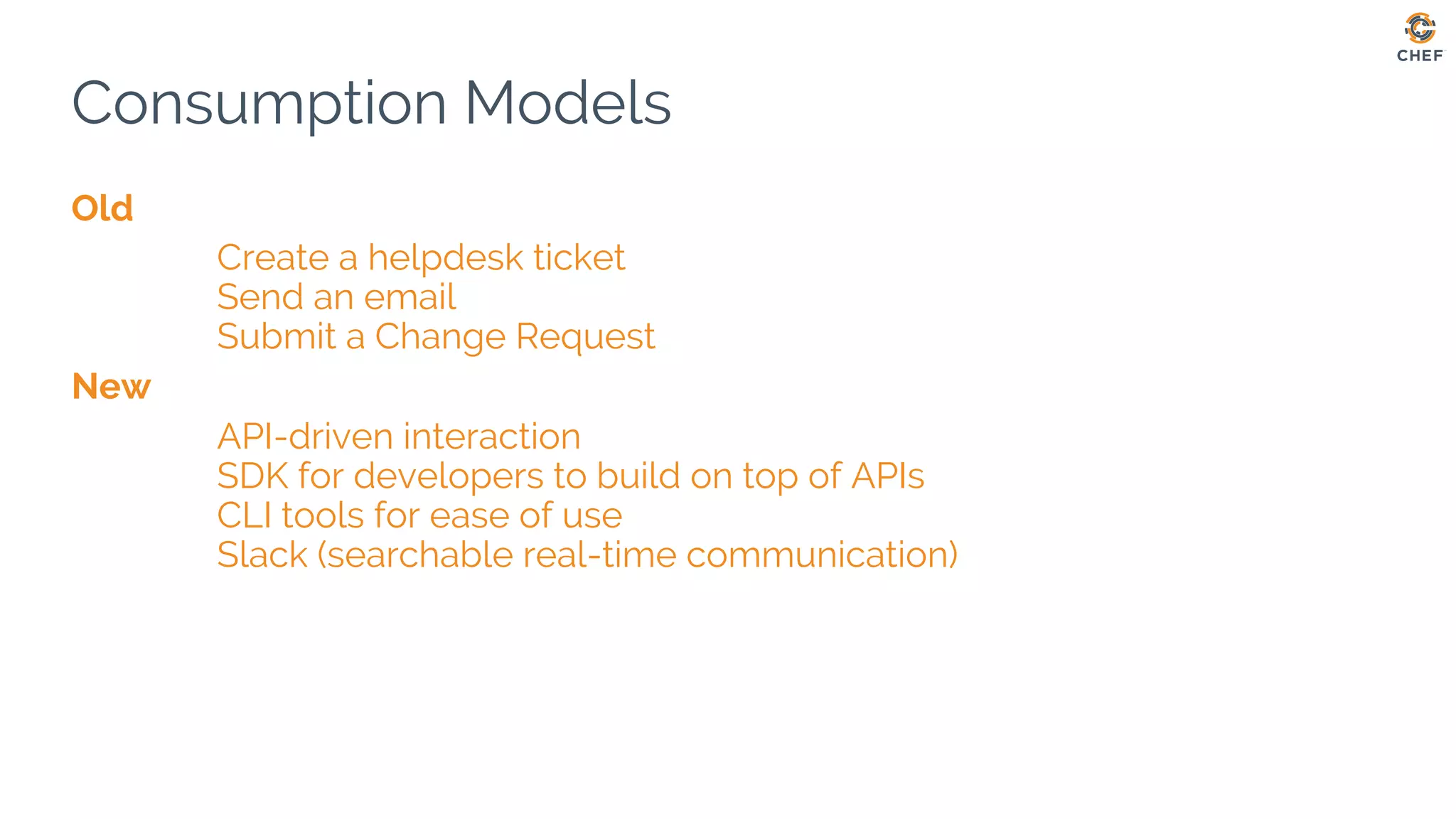
Consumption Models
Old
Create a helpdesk ticket
Send an email
Submit a Change Request
New
API-driven interaction
SDK for developers to build on top of APIs
CLI tools for ease of use
Slack (searchable real-time communication)
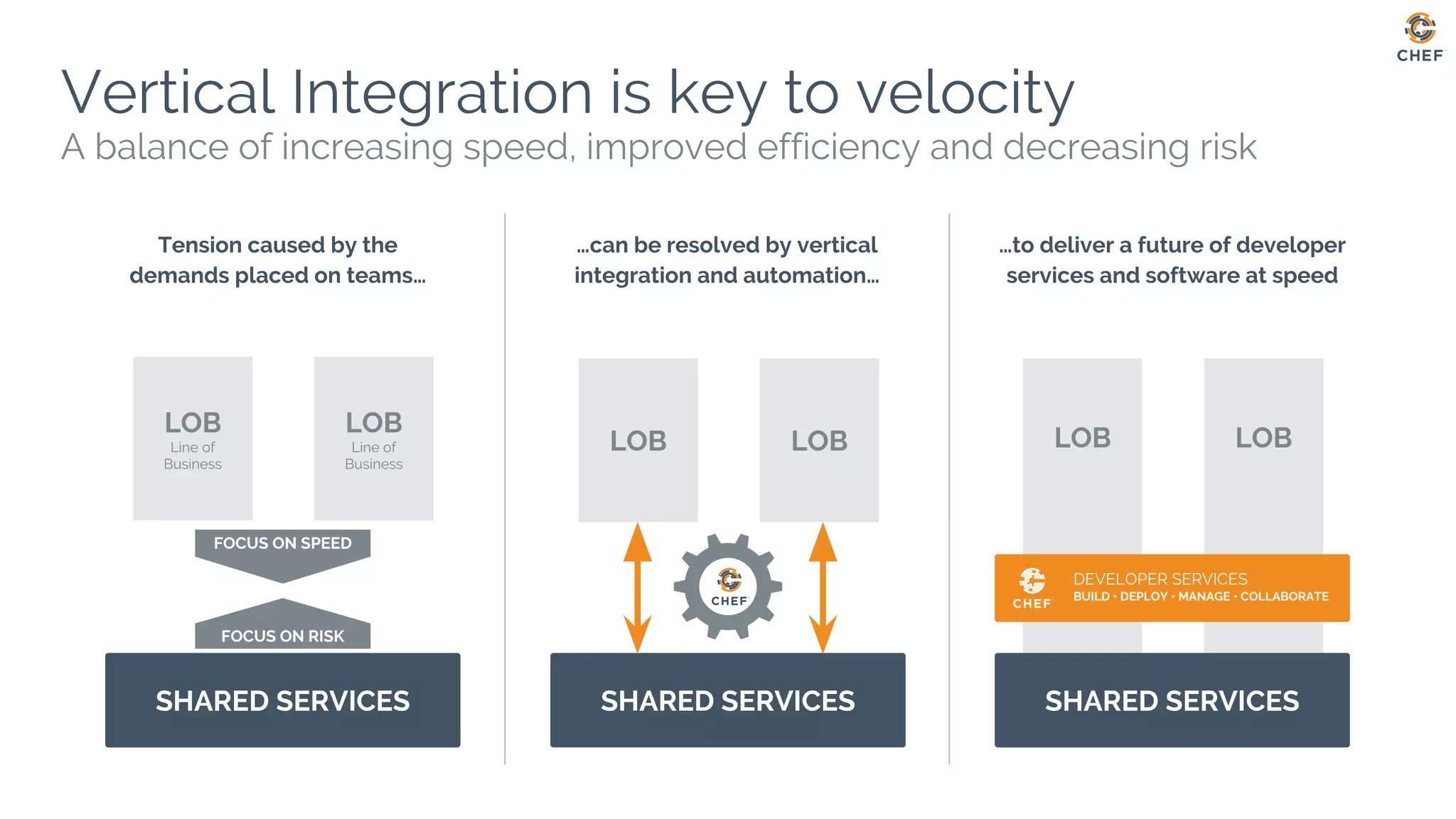
LOBLOB
FOCUS ON SPEED
Tension caused by the
demands placed on teams…
…can be resolved by vertical
integration and automation…
…to deliver a future of developer
services and software at speed
SHARED SERVICES
Vertical Integration is key to velocity
A balance of increasing speed, improved efficiency and decreasing risk
FOCUS ON RISK
SHARED SERVICES
LOB
Line of
Business
LOB
Line of
Business
LOB
SHARED SERVICES
LOB
DEVELOPER SERVICES
BUILD • DEPLOY • MANAGE • COLLABORATE
”
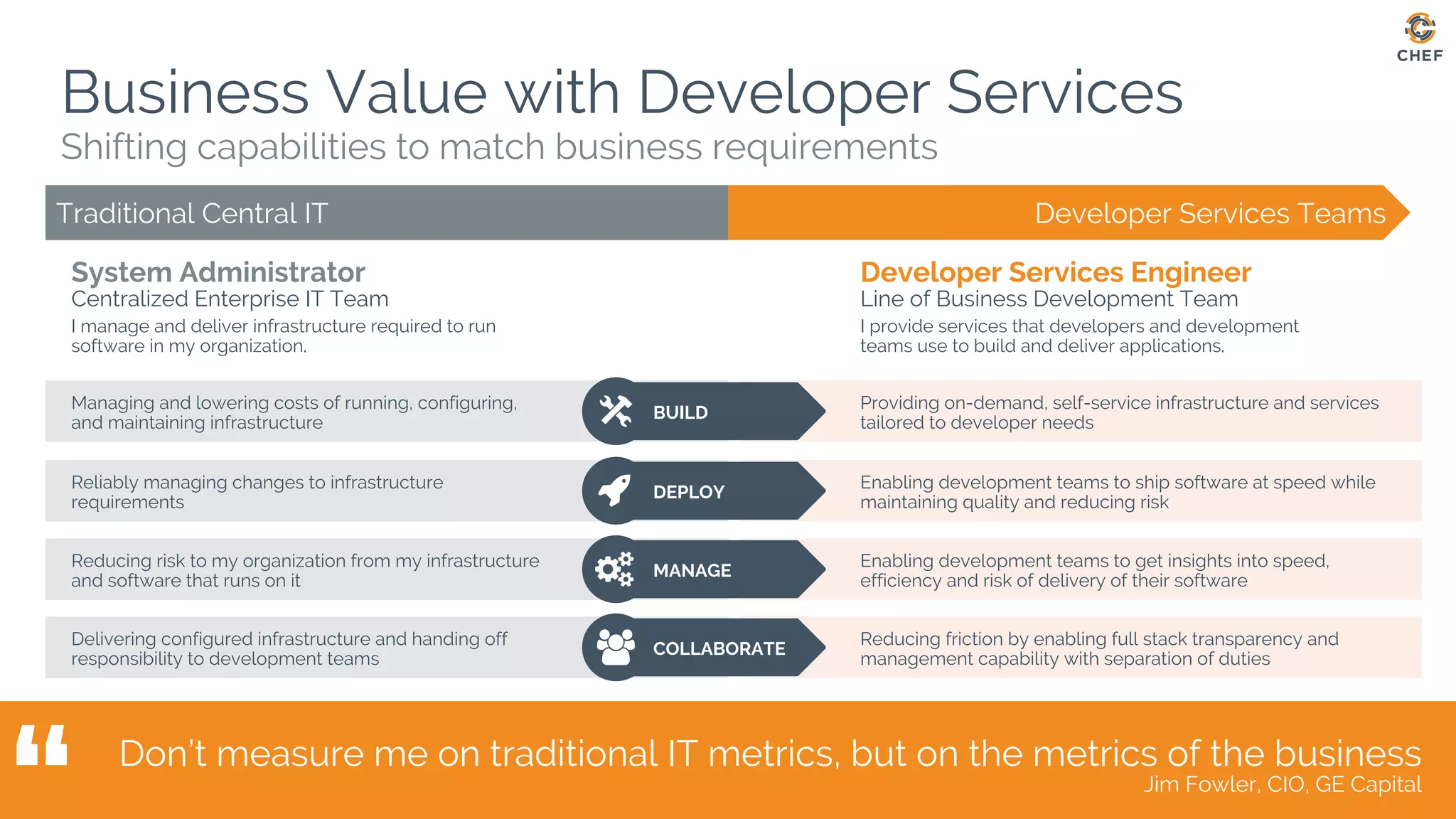
Business Value with Developer Services
Shifting capabilities to match business requirements
Developer Services Engineer
Line of Business Development Team
I provide services that developers and development
teams use to build and deliver applications.
Developer Services TeamsTraditional Central IT
System Administrator
Centralized Enterprise IT Team
I manage and deliver infrastructure required to run
software in my organization.
Enabling development teams to get insights into speed,
efficiency and risk of delivery of their software
Reducing risk to my organization from my infrastructure
and software that runs on it
Enabling development teams to ship software at speed while
maintaining quality and reducing risk
Reliably managing changes to infrastructure
requirements
Providing on-demand, self-service infrastructure and services
tailored to developer needs
Managing and lowering costs of running, configuring,
and maintaining infrastructure
DEPLOY
MANAGE
Don’t measure me on traditional IT metrics, but on the metrics of the business
Jim Fowler, CIO, GE Capital
BUILD
Reducing friction by enabling full stack transparency and
management capability with separation of duties
Delivering configured infrastructure and handing off
responsibility to development teams
COLLABORATE
Modern Architecture Trends
Modern Architecture Principles
12 Factor Apps/Cloud Native
Microservices
Serverless
Containers
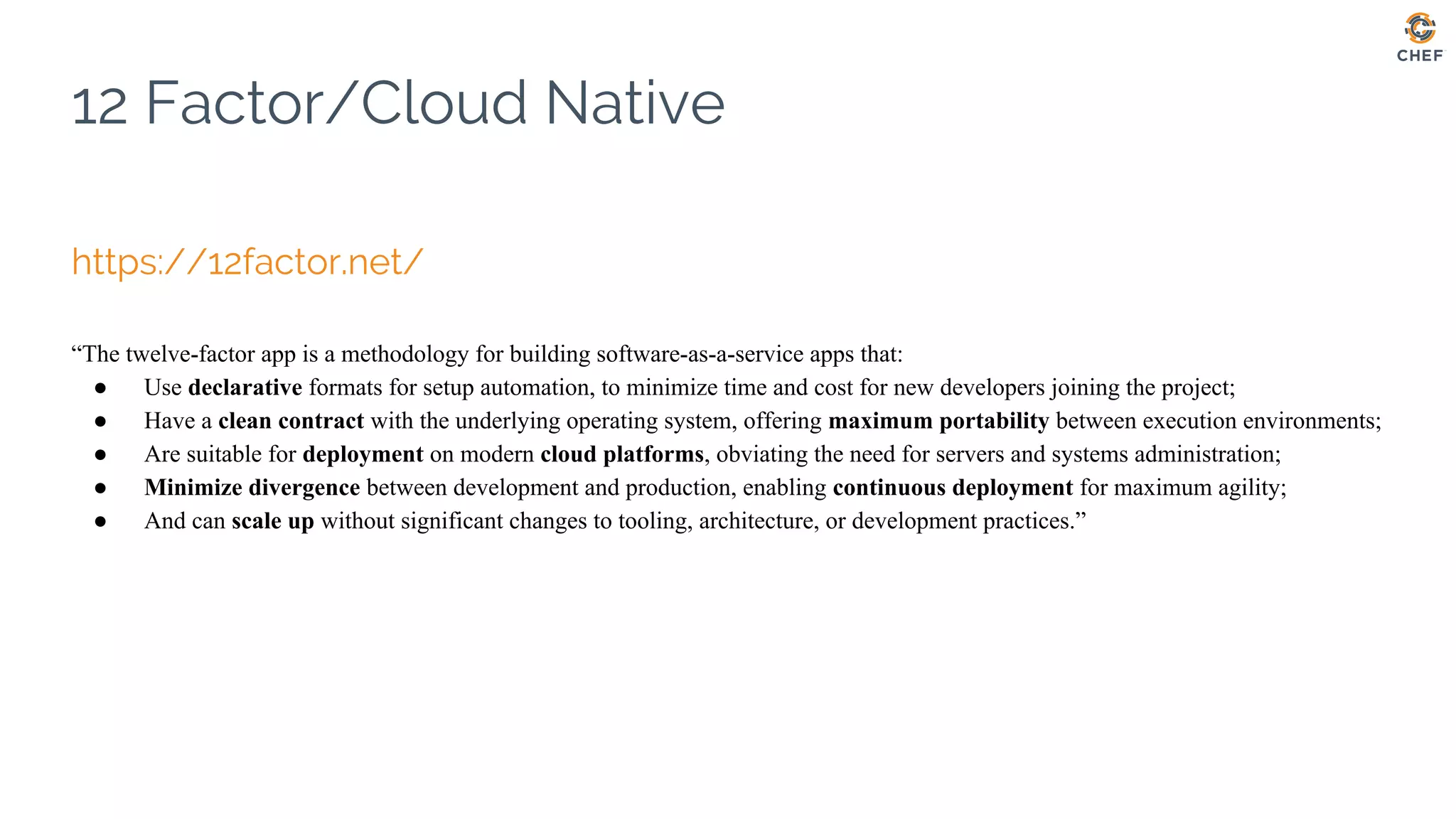
12 Factor/Cloud Native
https://12factor.net/
“The twelve-factor app is a methodology for building software-as-a-service apps that:
● Use declarative formats for setup automation, to minimize time and cost for new developers joining the project;
● Have a clean contract with the underlying operating system, offering maximum portability between execution environments;
● Are suitable for deployment on modern cloud platforms, obviating the need for servers and systems administration;
● Minimize divergence between development and production, enabling continuous deployment for maximum agility;
● And can scale up without significant changes to tooling, architecture, or development practices.”
Microservices
“…the microservice architectural style is an approach to developing a single
application as a suite of small services, each running in its own process and
communicating with lightweight mechanisms…”
- Martin Fowler and James Harris
https://martinfowler.com/articles/microservices.html
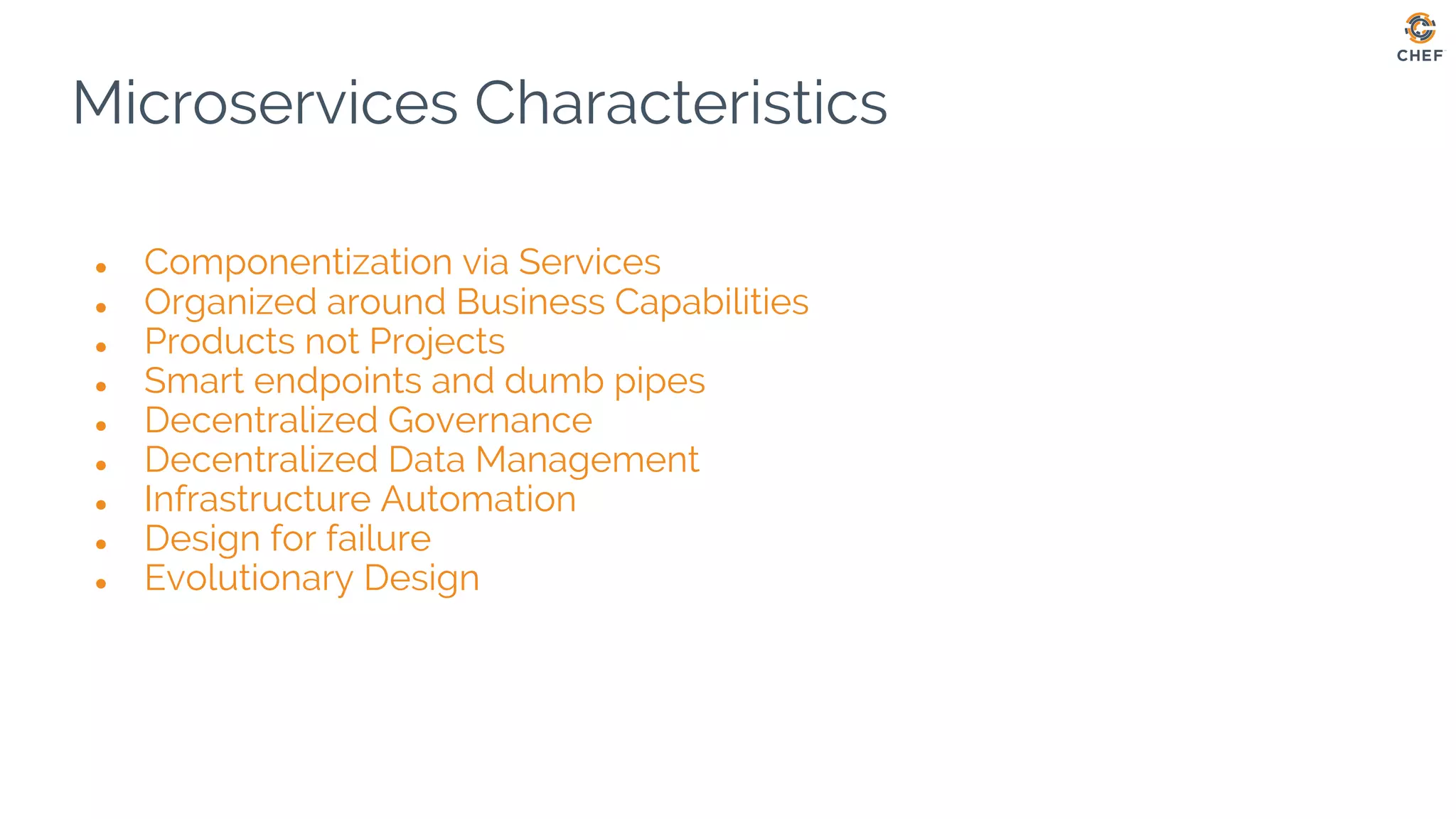
Microservices Characteristics
● Componentization via Services
● Organized around Business Capabilities
● Products not Projects
● Smart endpoints and dumb pipes
● Decentralized Governance
● Decentralized Data Management
● Infrastructure Automation
● Design for failure
● Evolutionary Design
Serverless
“Serverless architecture replaces long-running virtual machines with
ephemeral compute power that comes into existence on request and
disappears immediately after use.”
- Thoughtworks Tech Radar, March 2017
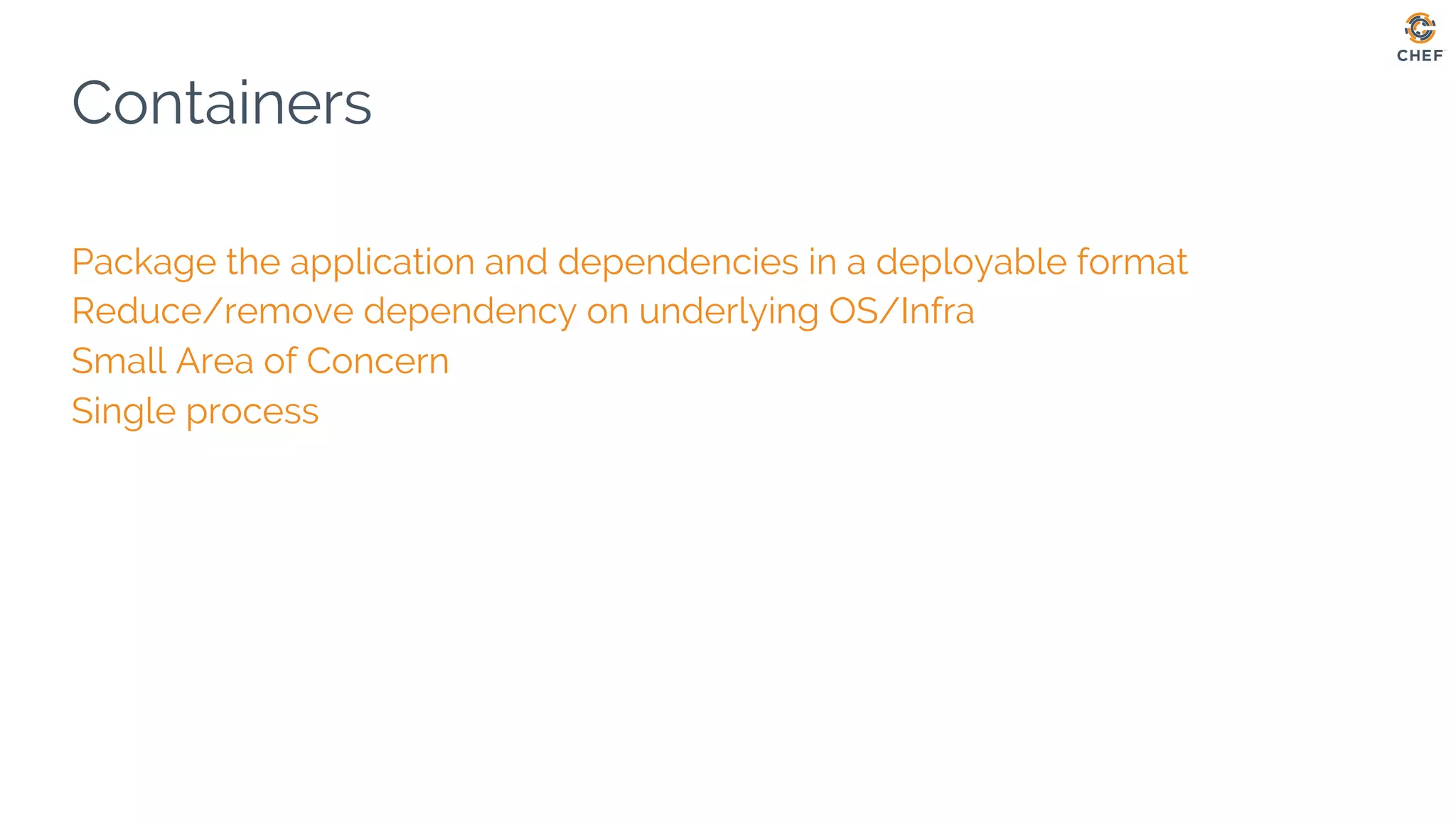
Containers
Package the application and dependencies in a deployable format
Reduce/remove dependency on underlying OS/Infra
Small Area of Concern
Single process
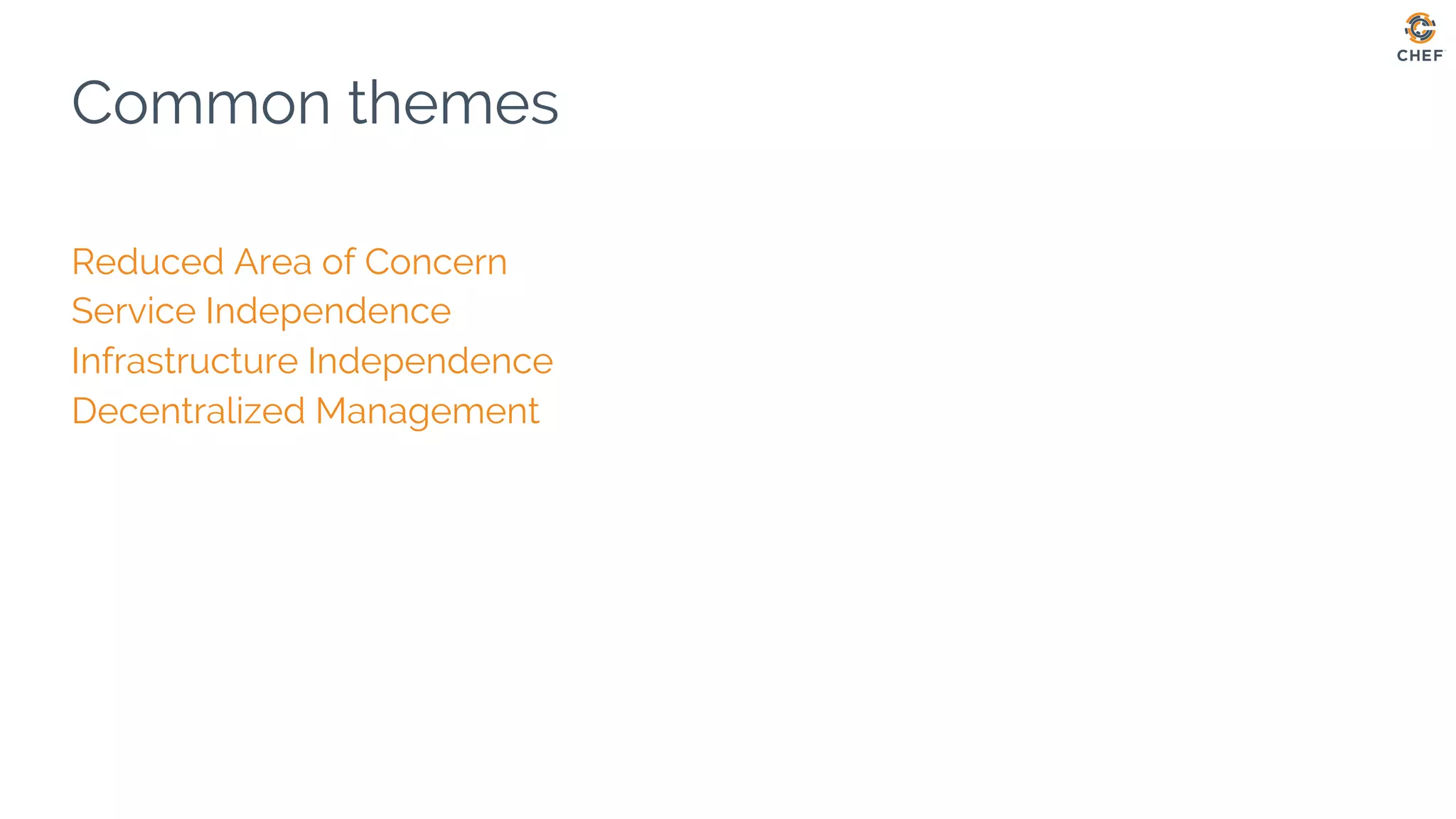
Common themes
Reduced Area of Concern
Service Independence
Infrastructure Independence
Decentralized Management
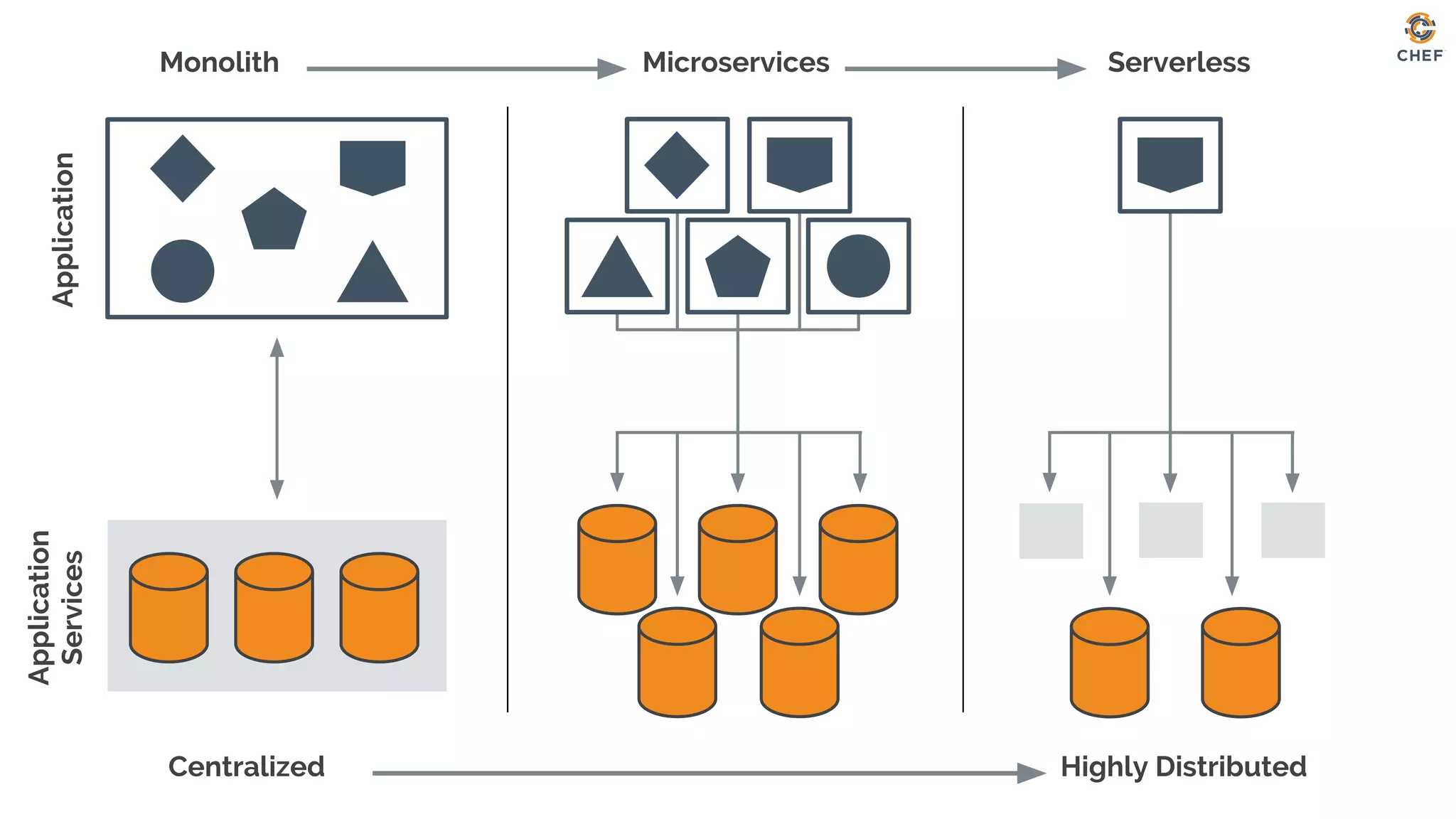
Monolith ServerlessMicroservicesApplication
Application
Services
Centralized Highly Distributed
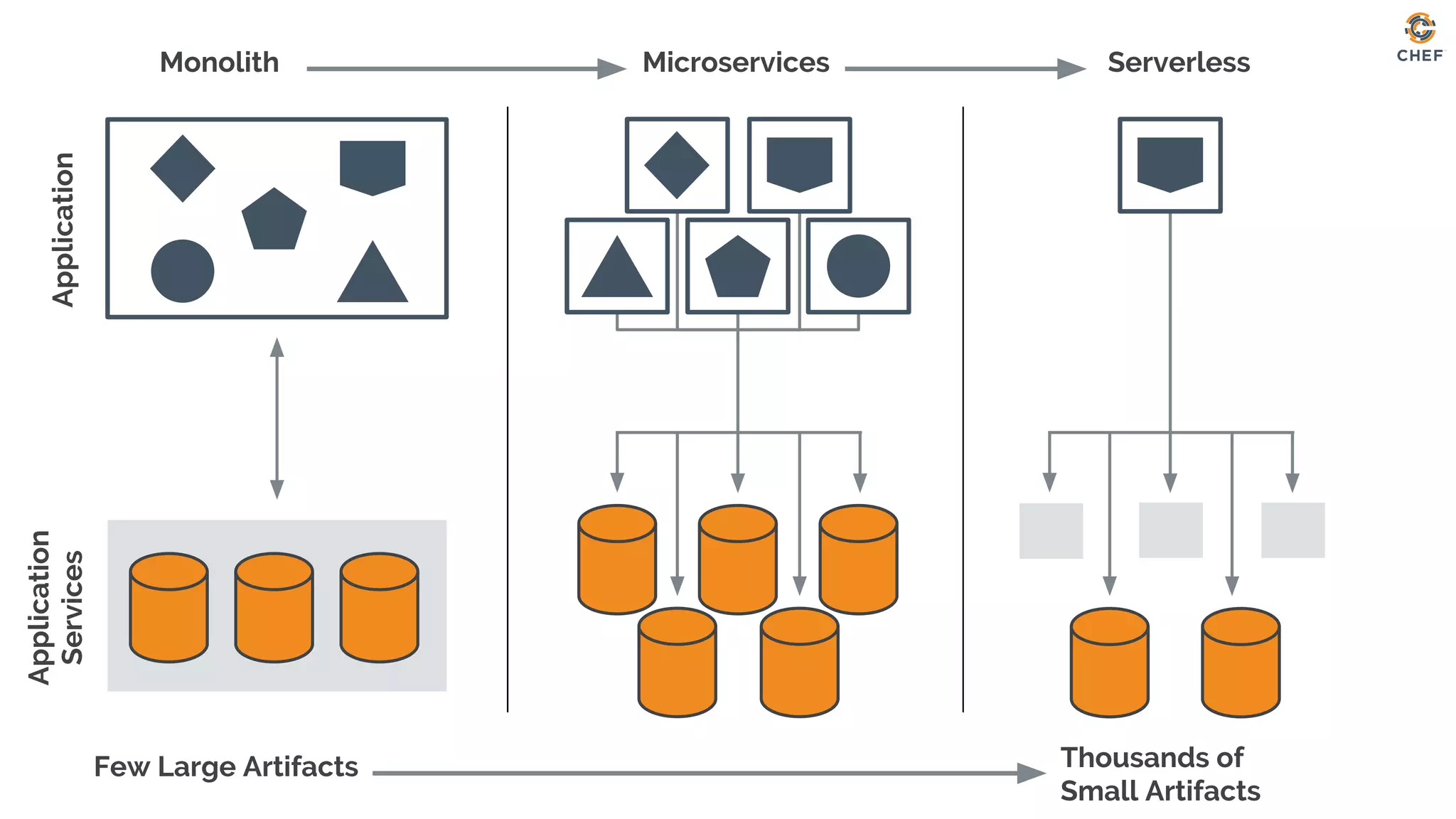
Monolith ServerlessMicroservicesApplication
Application
Services
Few Large Artifacts Thousands of
Small Artifacts
Complexity Cliff
Scale Increases -
Number of services under management increases
Efficiency Declines -
Number of ways to manage each service is different
Risk Exposure Increases -
Confidence that each service is secure, compliant, updated, etc.
Developer Services
“The services required for application developers to effectively run
applications. This consists of the underlying infrastructure, compute runtimes,
language runtimes, and application services to persist and retrieve data.
These services should be available via a common API, with a focus on making
the service easy to consume.”
- Me
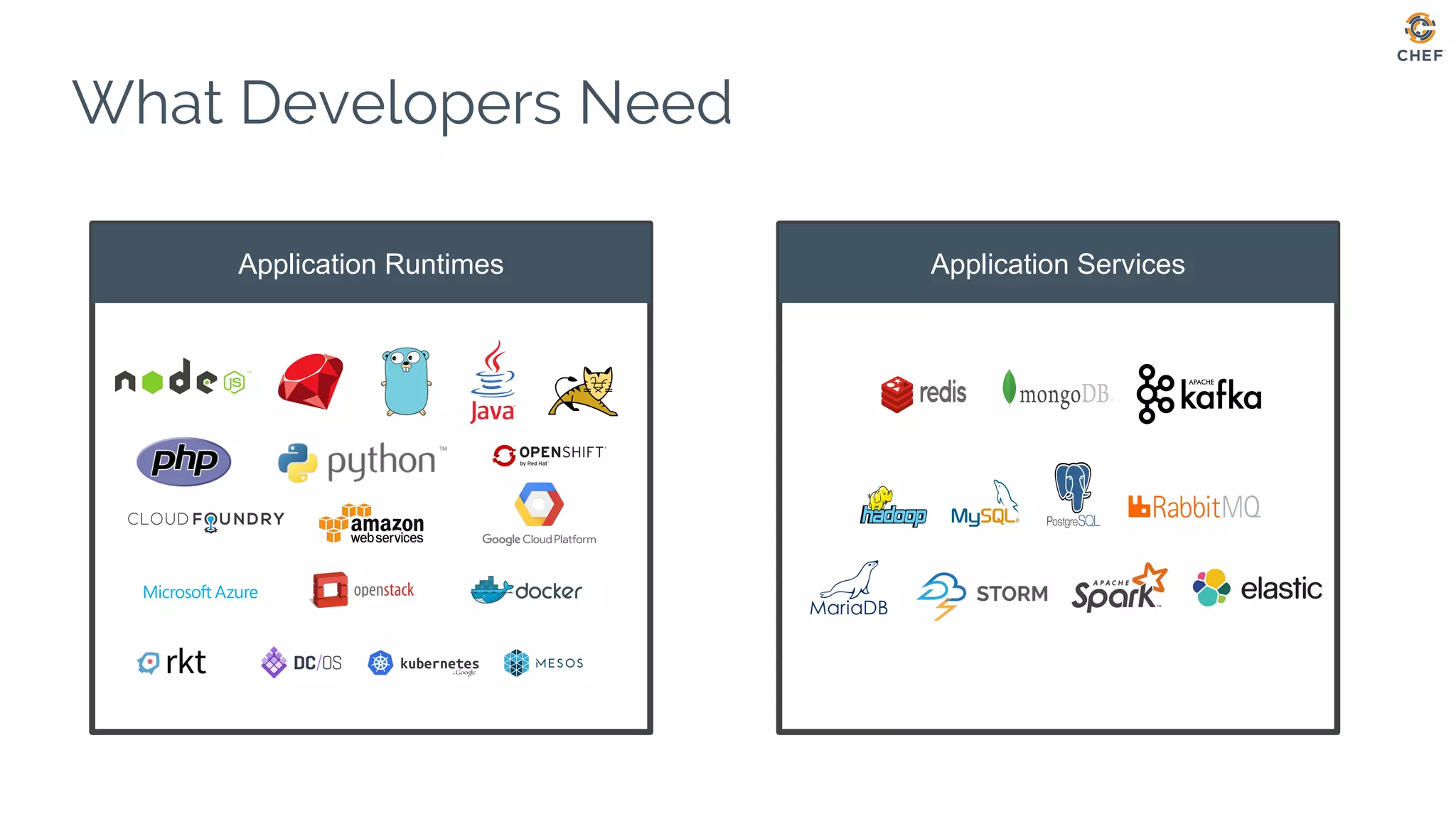
Application Services
What Developers Need
Application Runtimes
Habitat is automation for
Application Runtimes & Application Services
to deliver Cloud Native Developer Services
Building Developer Services
With Habitat
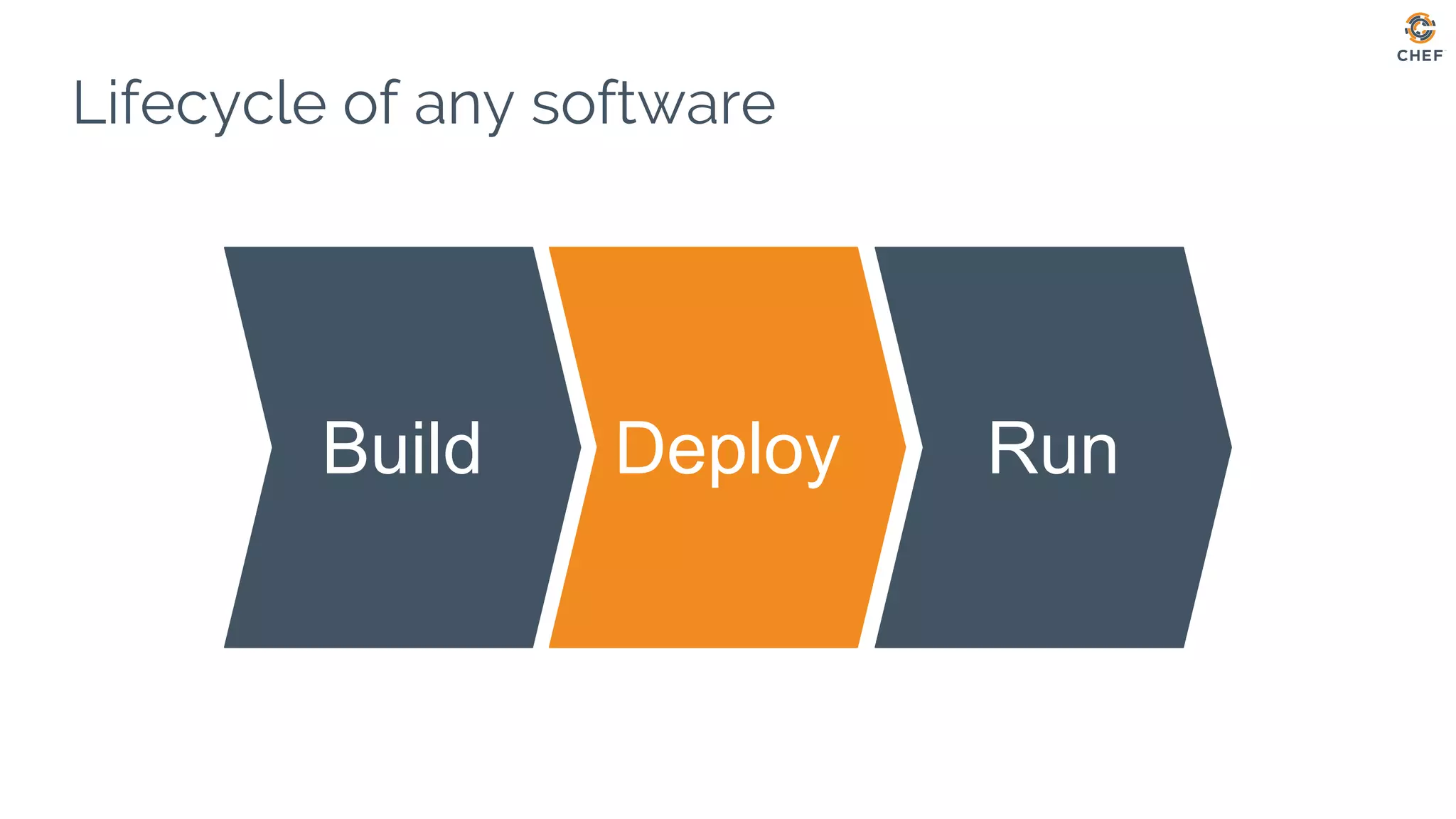
Lifecycle of any software
Build Deploy Run
Build Lifecycle
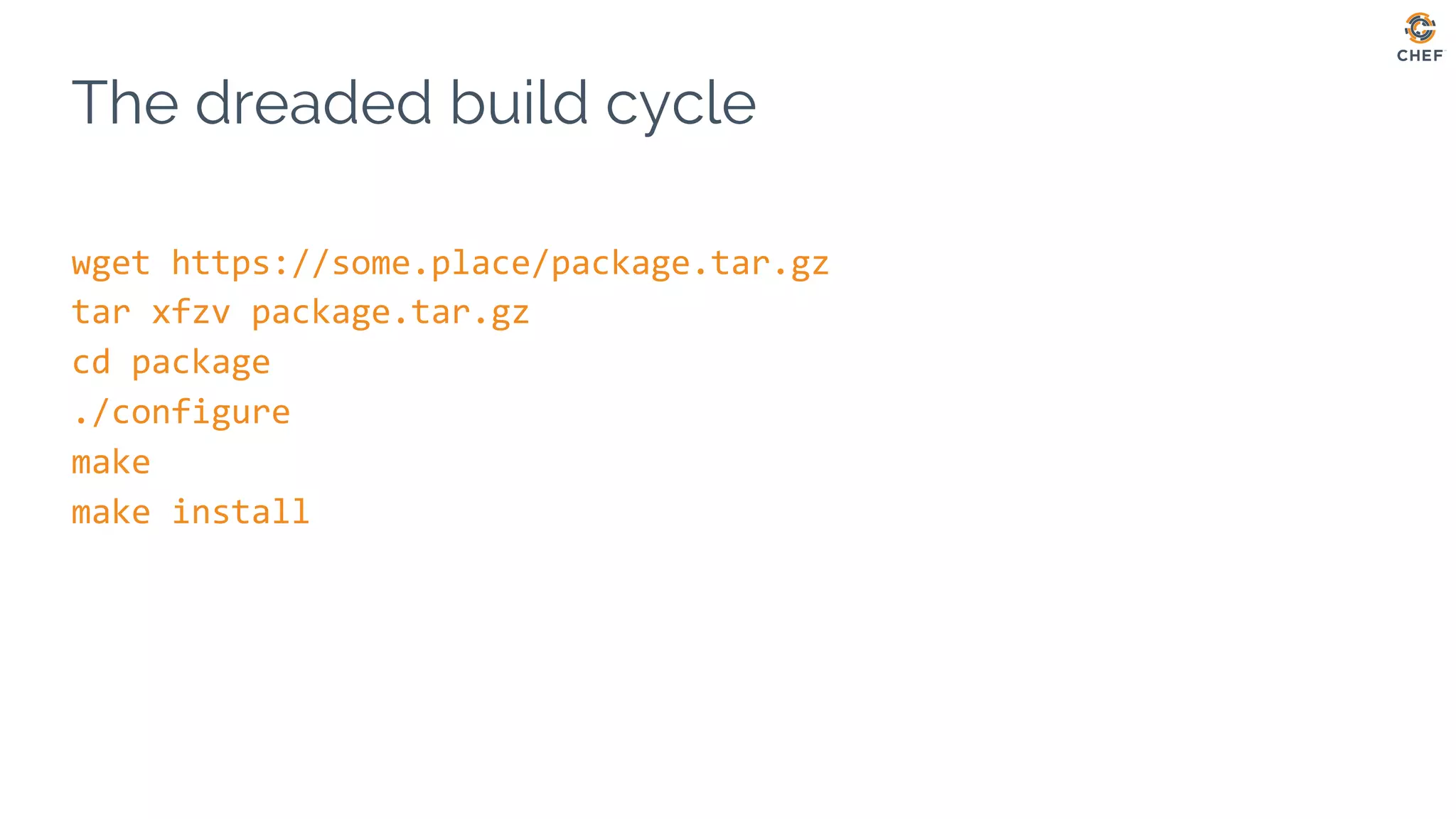
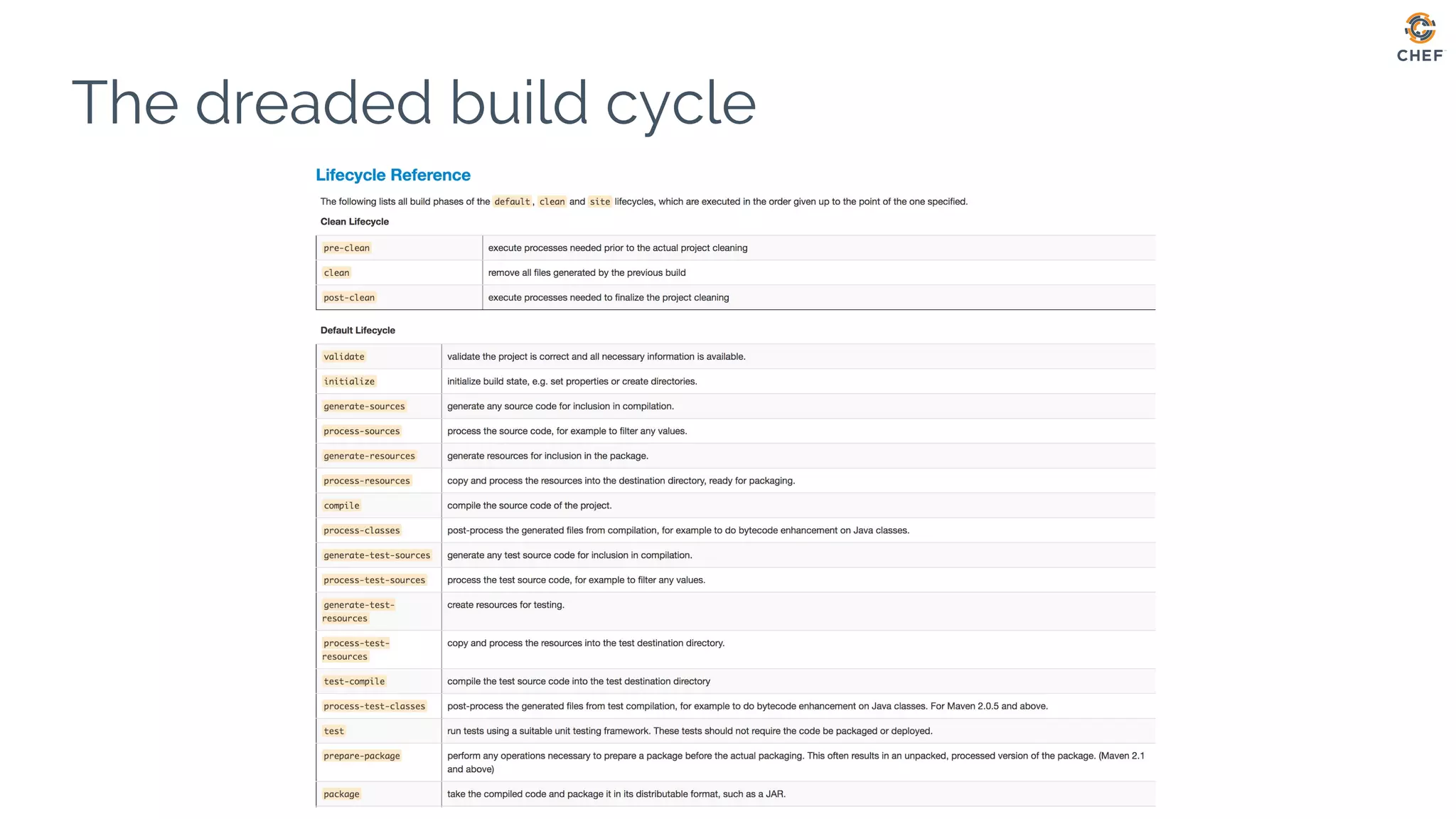
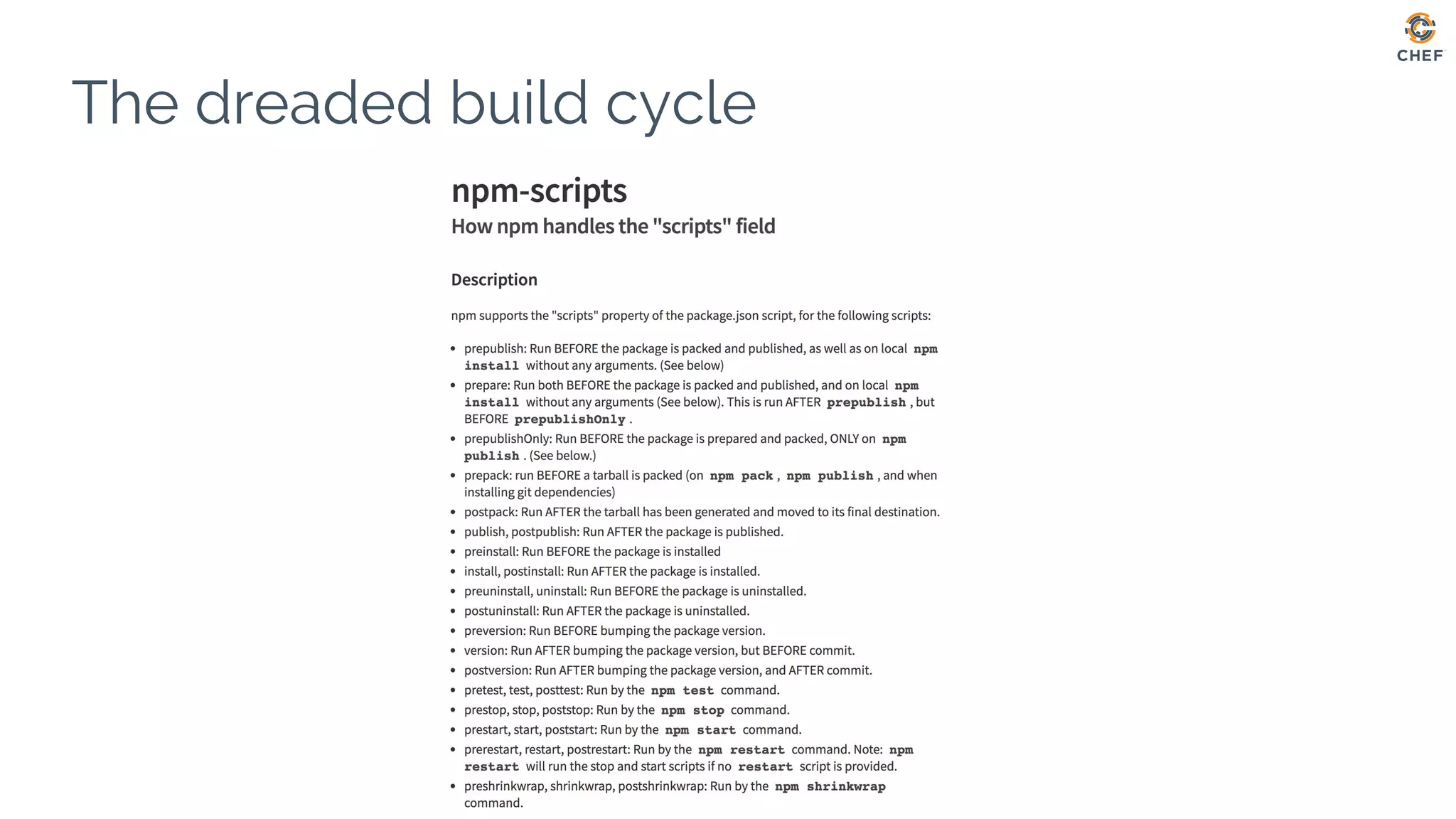
The dreaded build cycle
wget https://some.place/package.tar.gz
tar xfzv package.tar.gz
cd package
./configure
make
make install
The dreaded build cycle
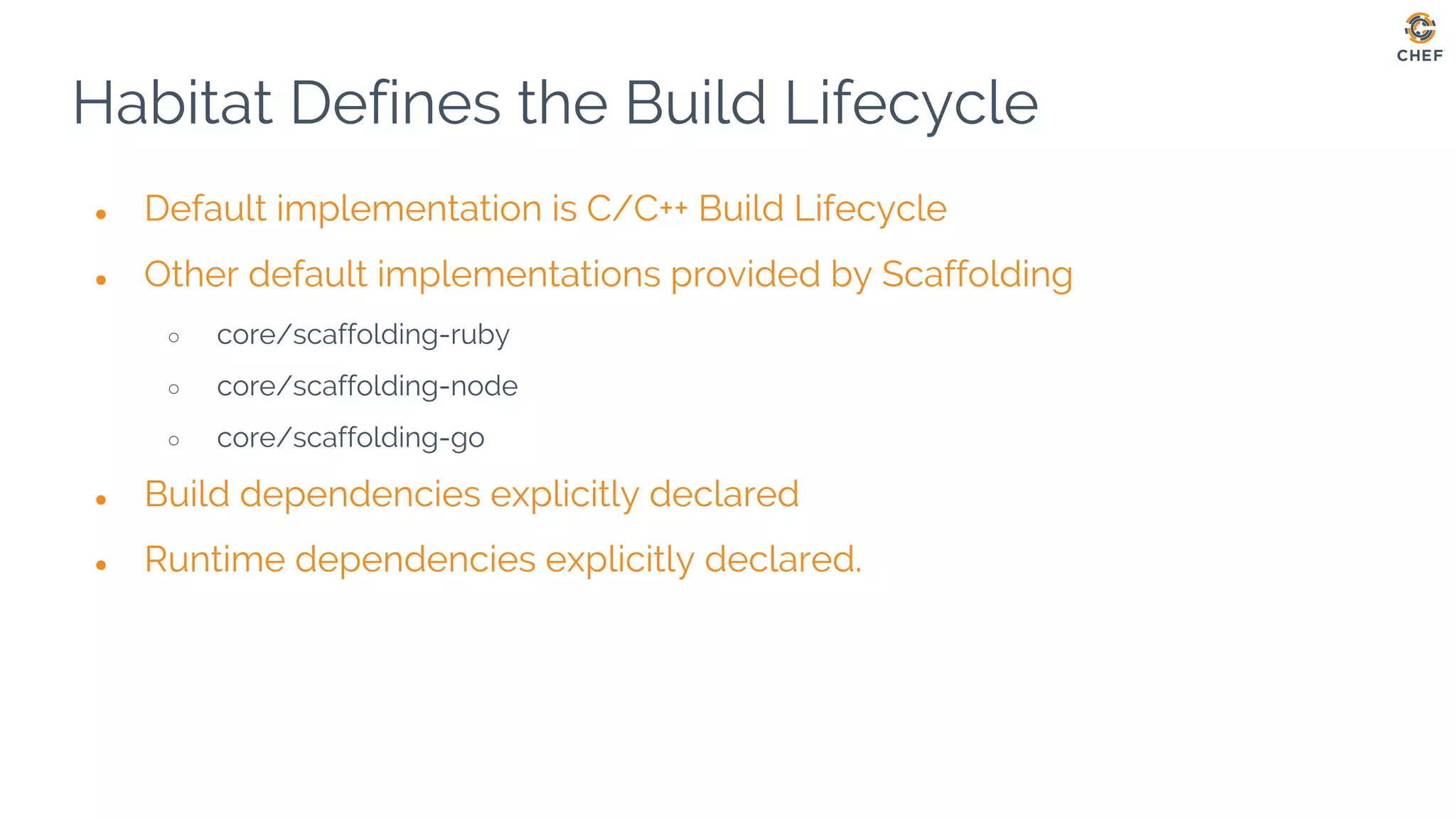
Habitat Defines the Build Lifecycle
● Default implementation is C/C++ Build Lifecycle
● Other default implementations provided by Scaffolding
○ core/scaffolding-ruby
○ core/scaffolding-node
○ core/scaffolding-go
● Build dependencies explicitly declared
● Runtime dependencies explicitly declared.
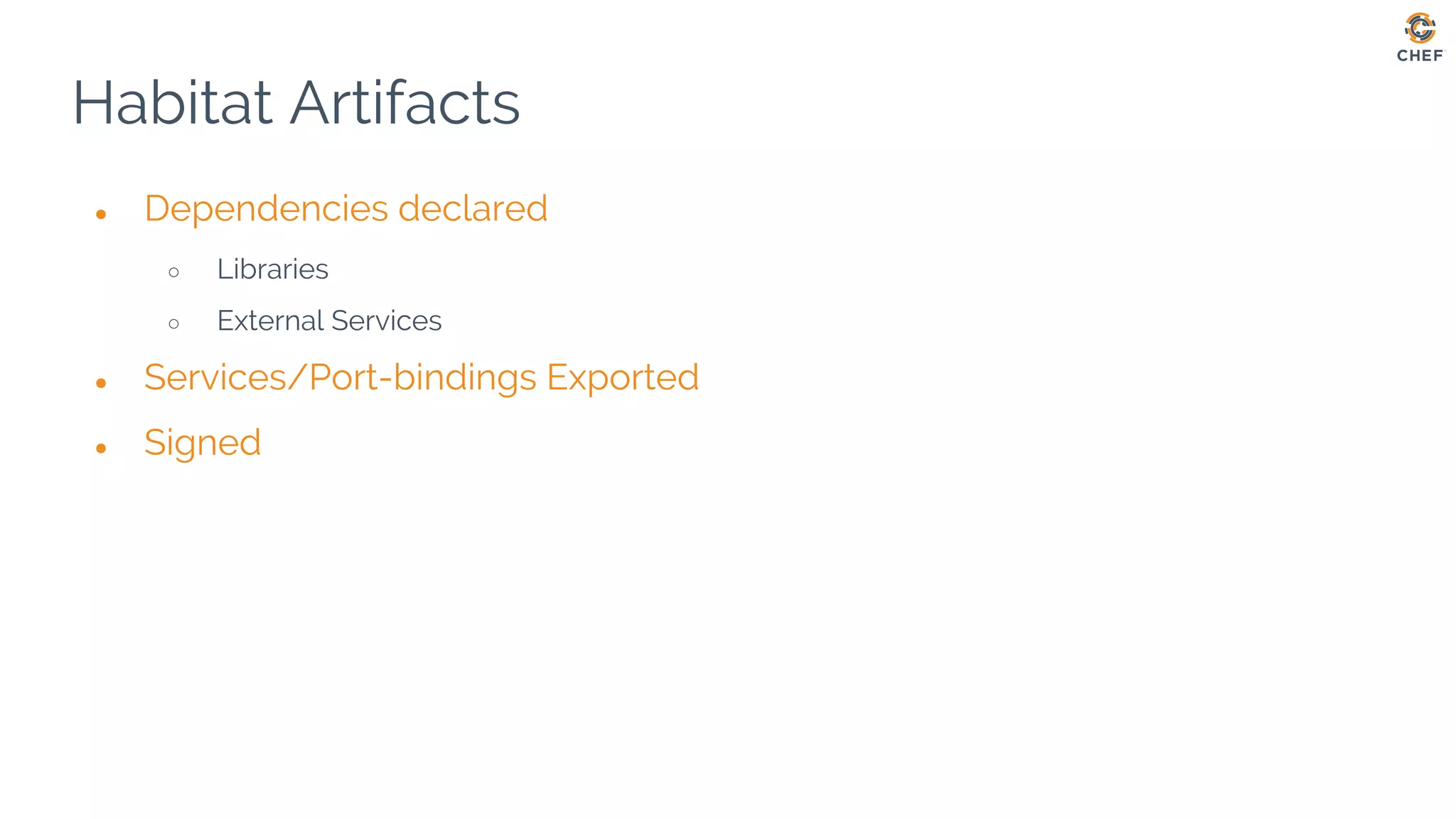
Habitat Artifacts
● Dependencies declared
○ Libraries
○ External Services
● Services/Port-bindings Exported
● Signed
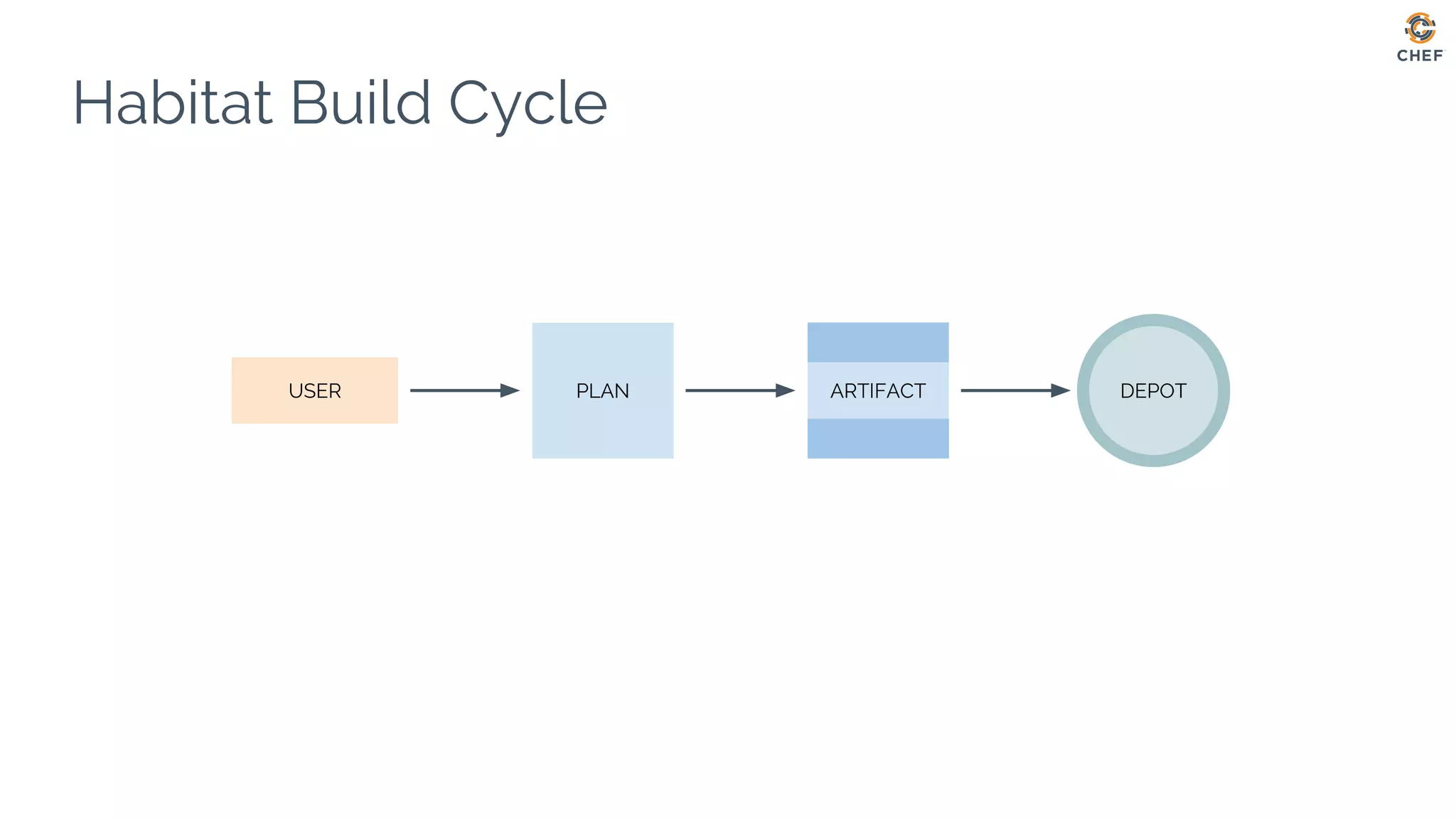
Habitat Build Cycle
USER ARTIFACTPLAN DEPOT
DEMO
Deploy Lifecycle
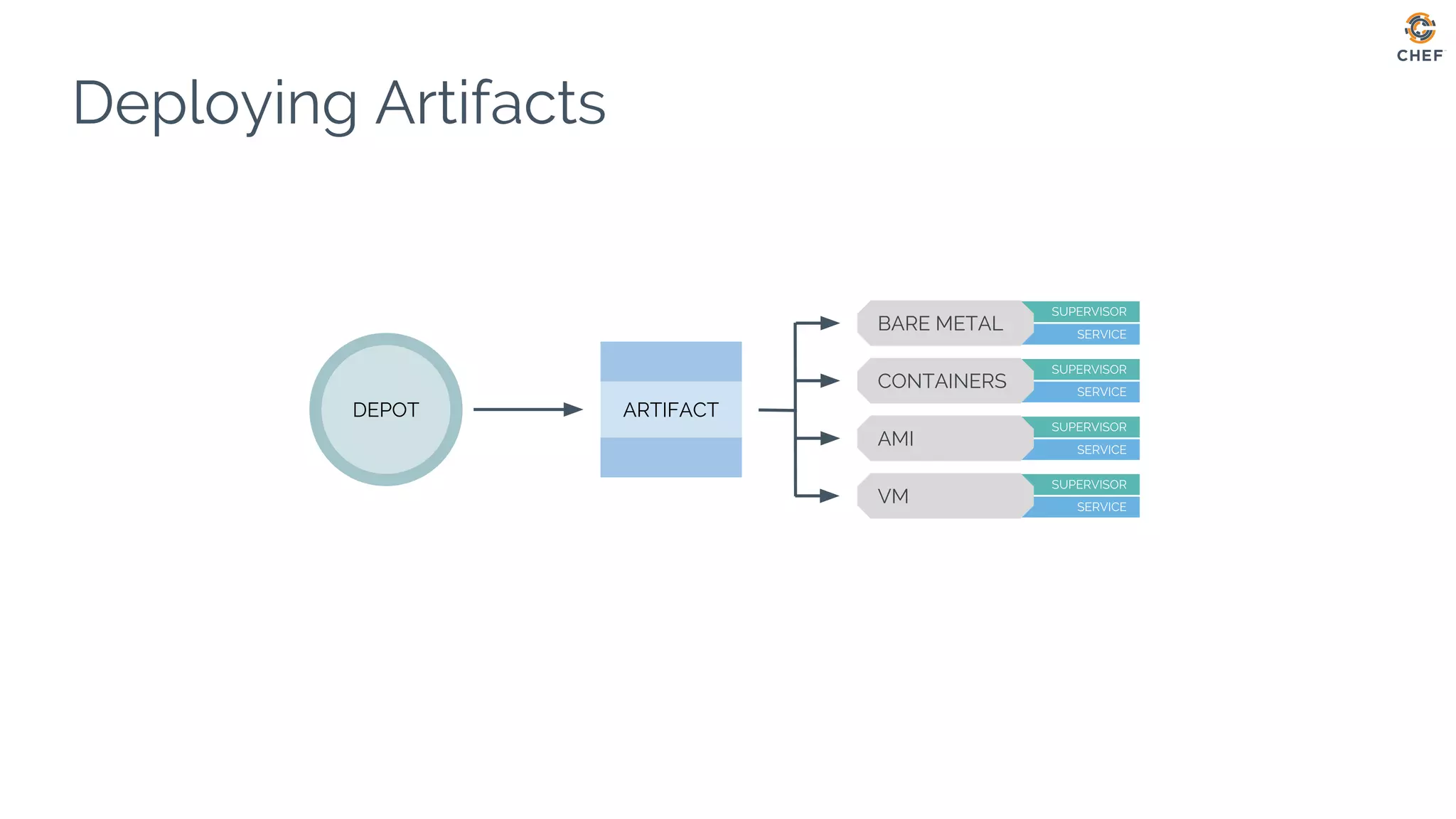
Deploying Artifacts
SERVICE
SUPERVISOR
SERVICE
SUPERVISOR
SERVICE
SUPERVISOR
SERVICE
SUPERVISOR
DEPOT ARTIFACT
BARE METAL
CONTAINERS
AMI
VM
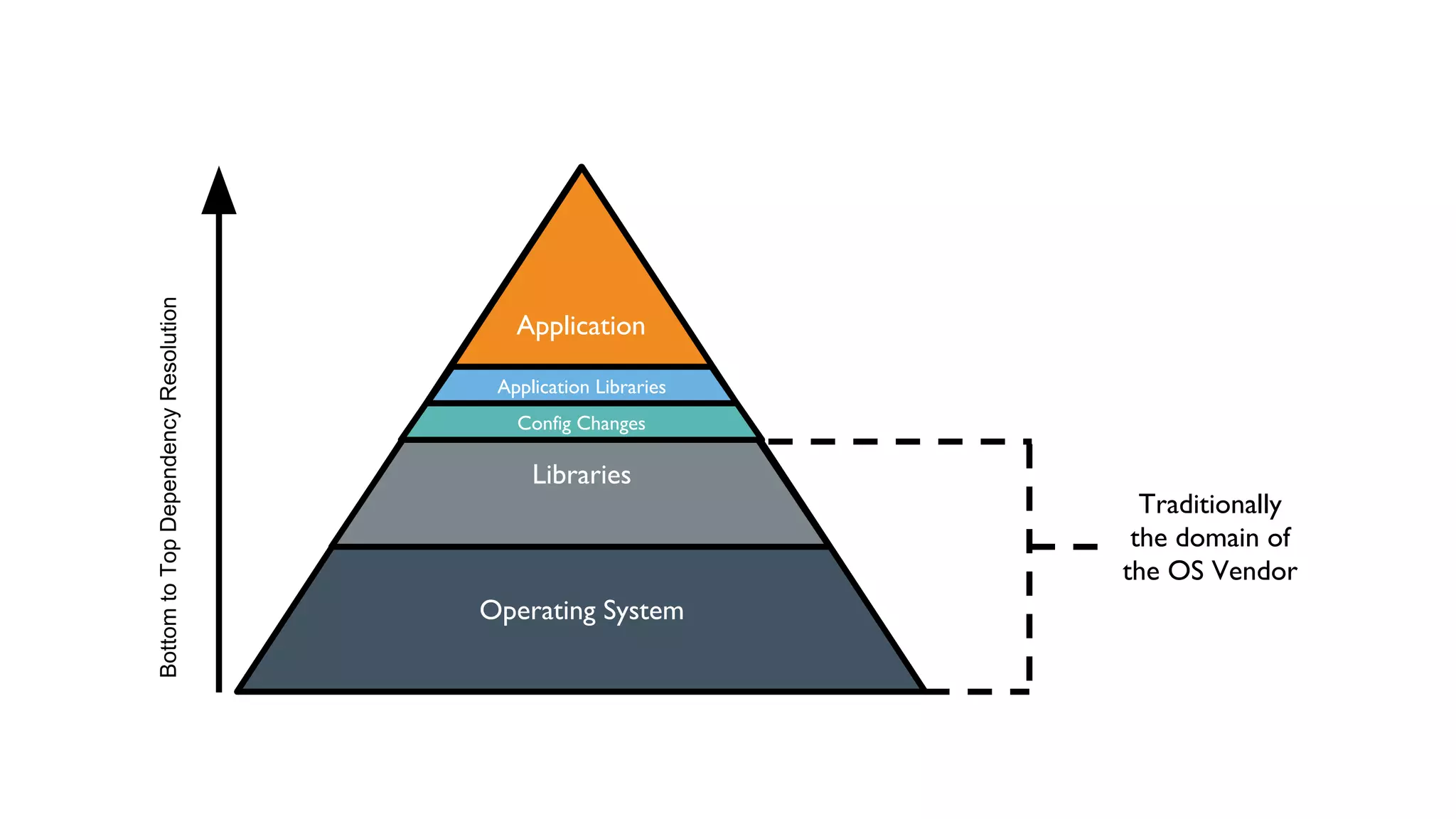
Libraries
Operating System
Application
Traditionally
the domain of
the OS Vendor
Application Libraries
Config Changes
BottomtoTopDependencyResolution
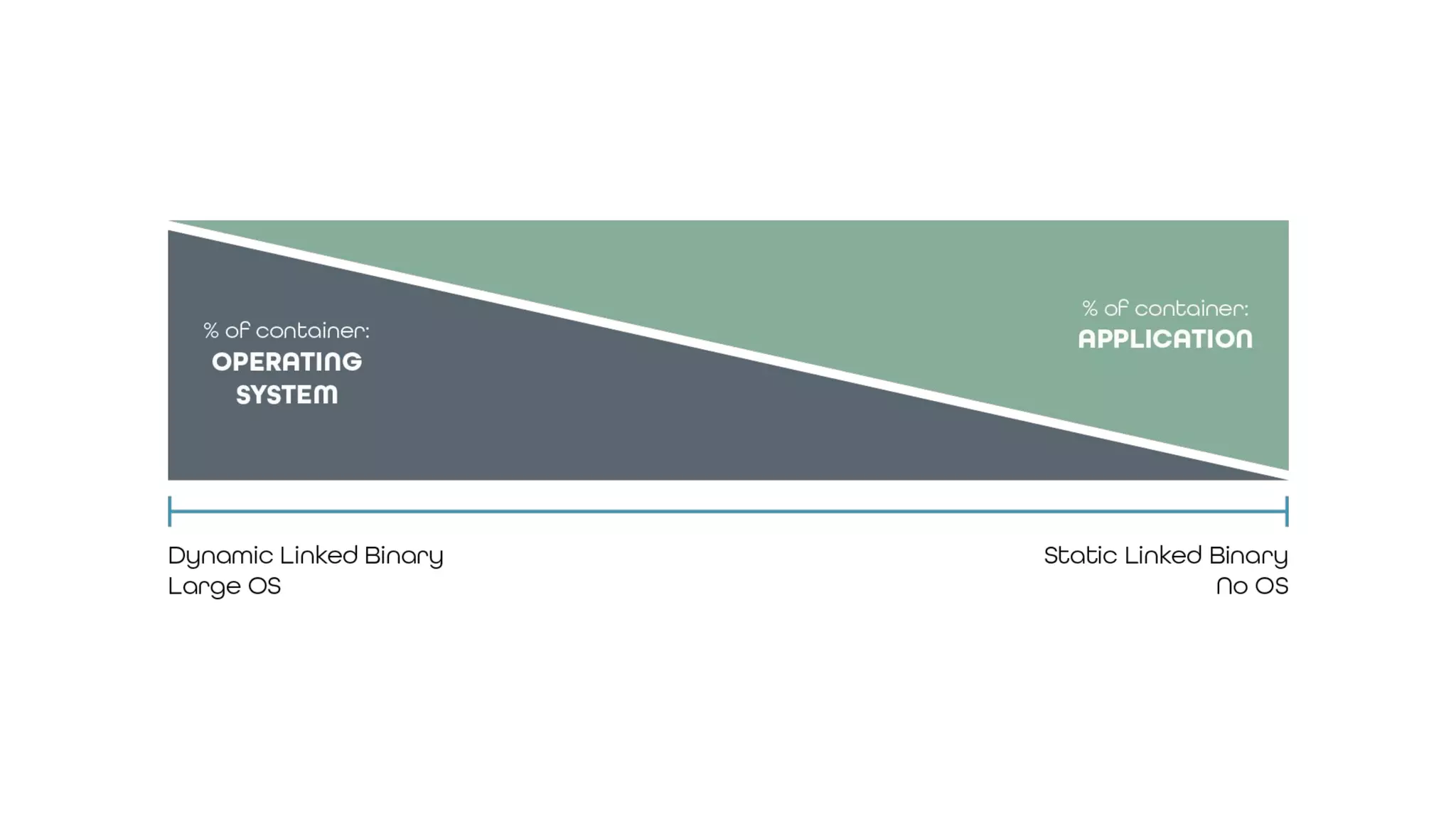
Application &
Libraries
Minimized OS
ToptoBottomDependencyResolution
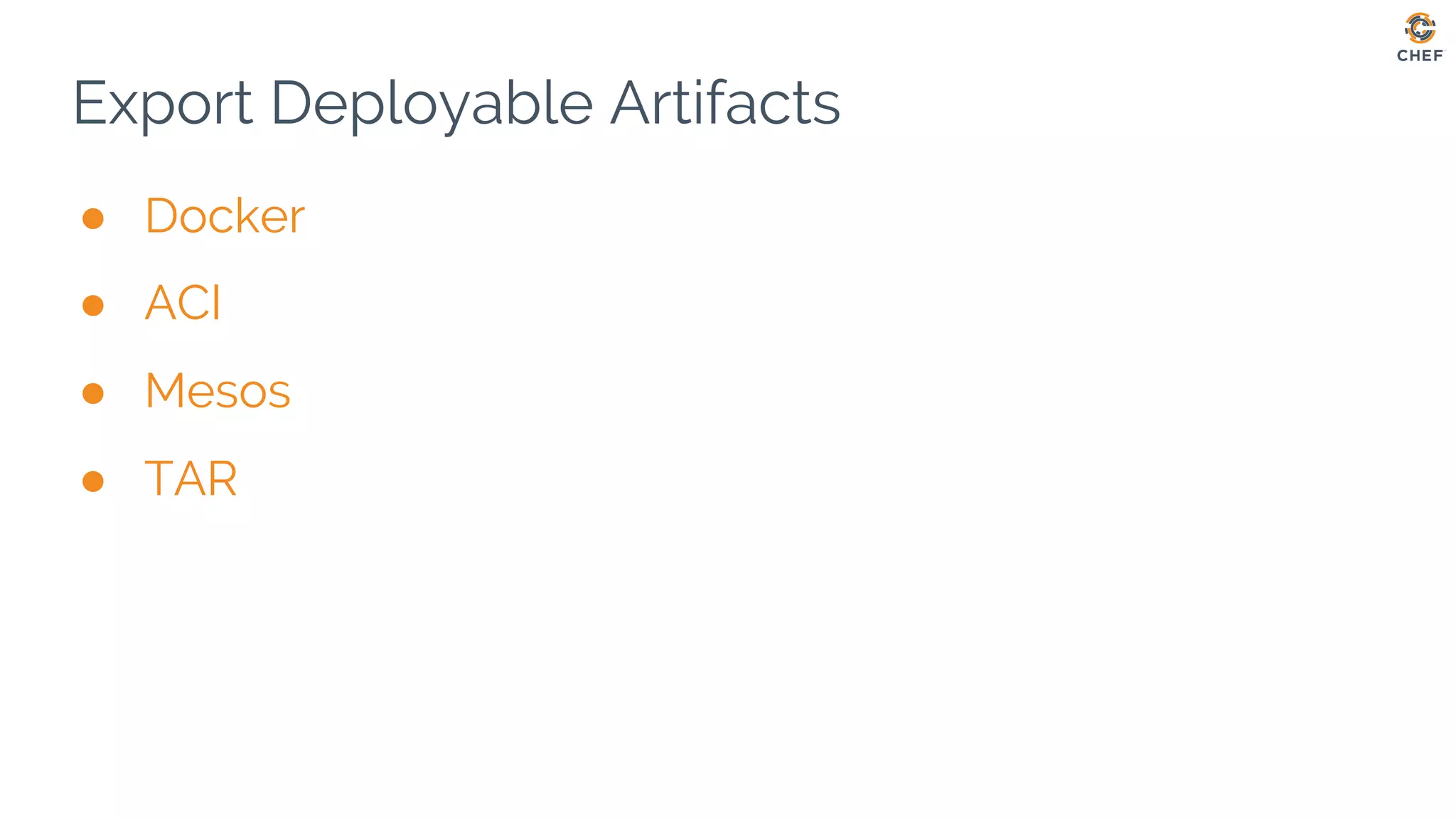
Export Deployable Artifacts
● Docker
● ACI
● Mesos
● TAR
Run Lifecycle
What do applications need to run?
• Process Supervisor
• Lifecycle events
• Start, Stop, Reconfigure, etc
• Environment specific configuration
• Knowledge of peers
• Knowledge of dependent services
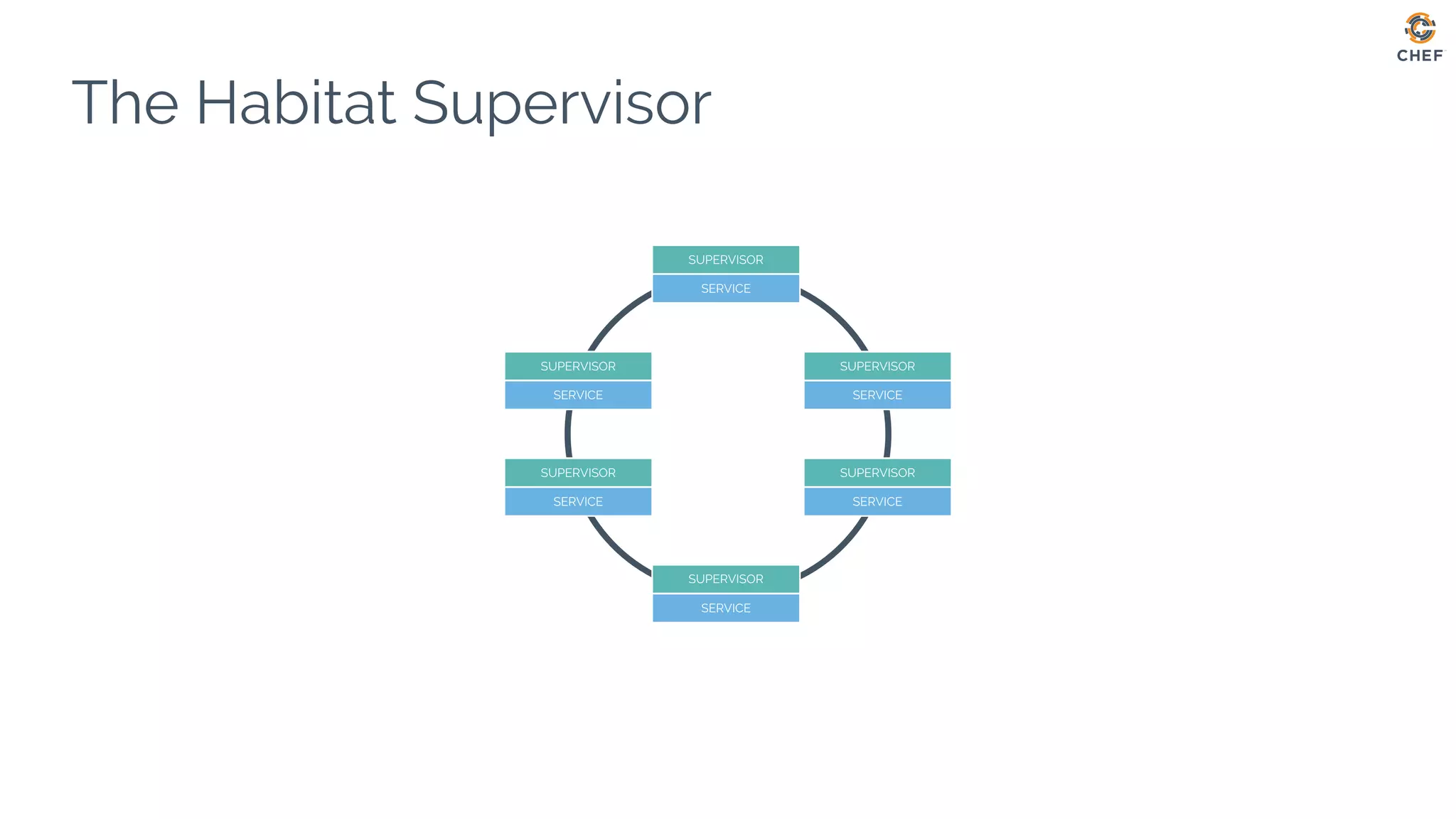
The Habitat Supervisor
SERVICE
SUPERVISOR
SERVICE
SUPERVISOR
SERVICE
SUPERVISOR
SERVICE
SUPERVISOR
SERVICE
SUPERVISOR
SERVICE
SUPERVISOR
Lifecycle Hooks
• init
• run
• health_check
• file_updated
• reload
• reconfigure
• post-run
• suitability
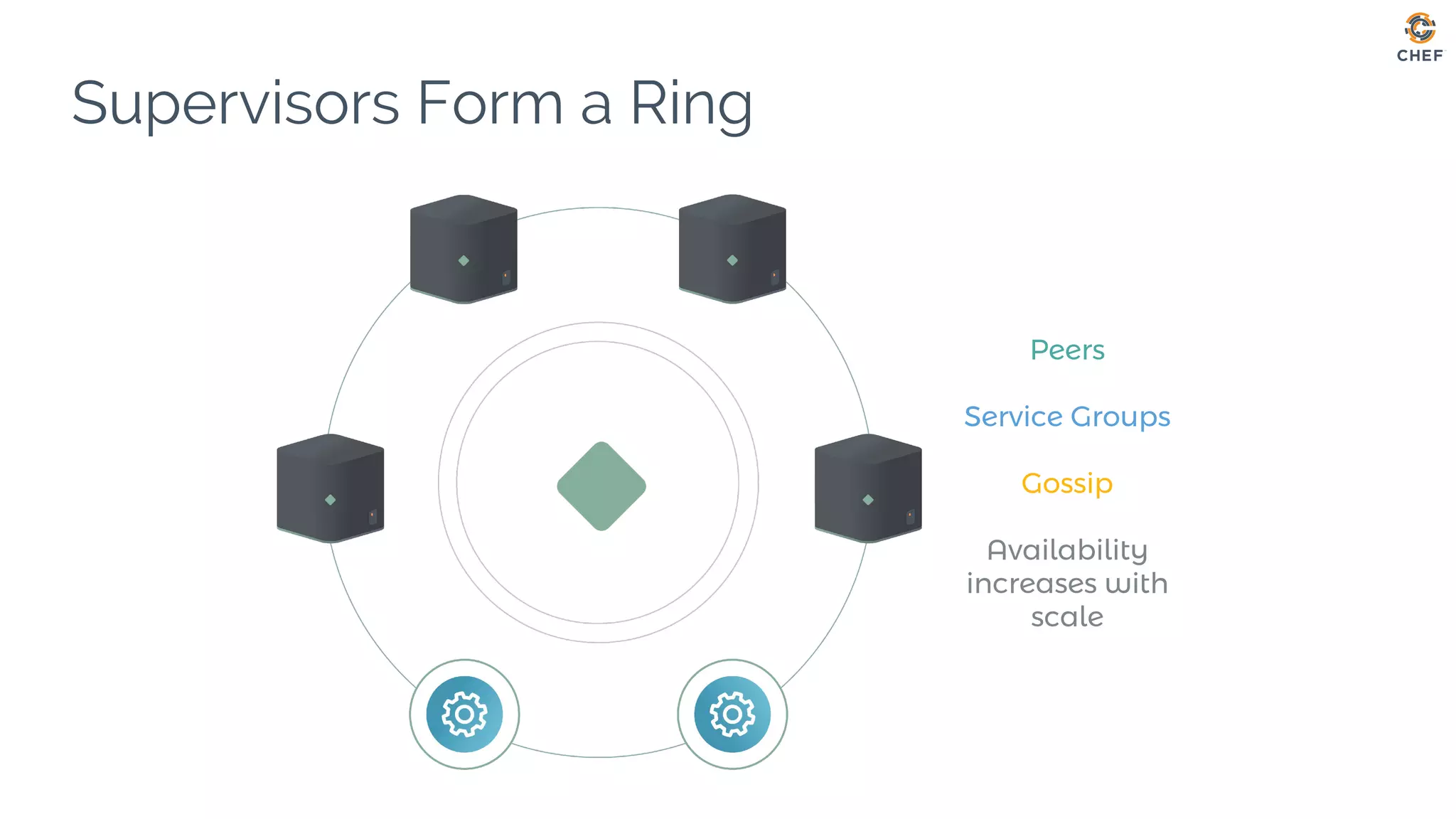
Peers
Service Groups
Gossip
Availability
increases with
scale
Supervisors Form a Ring
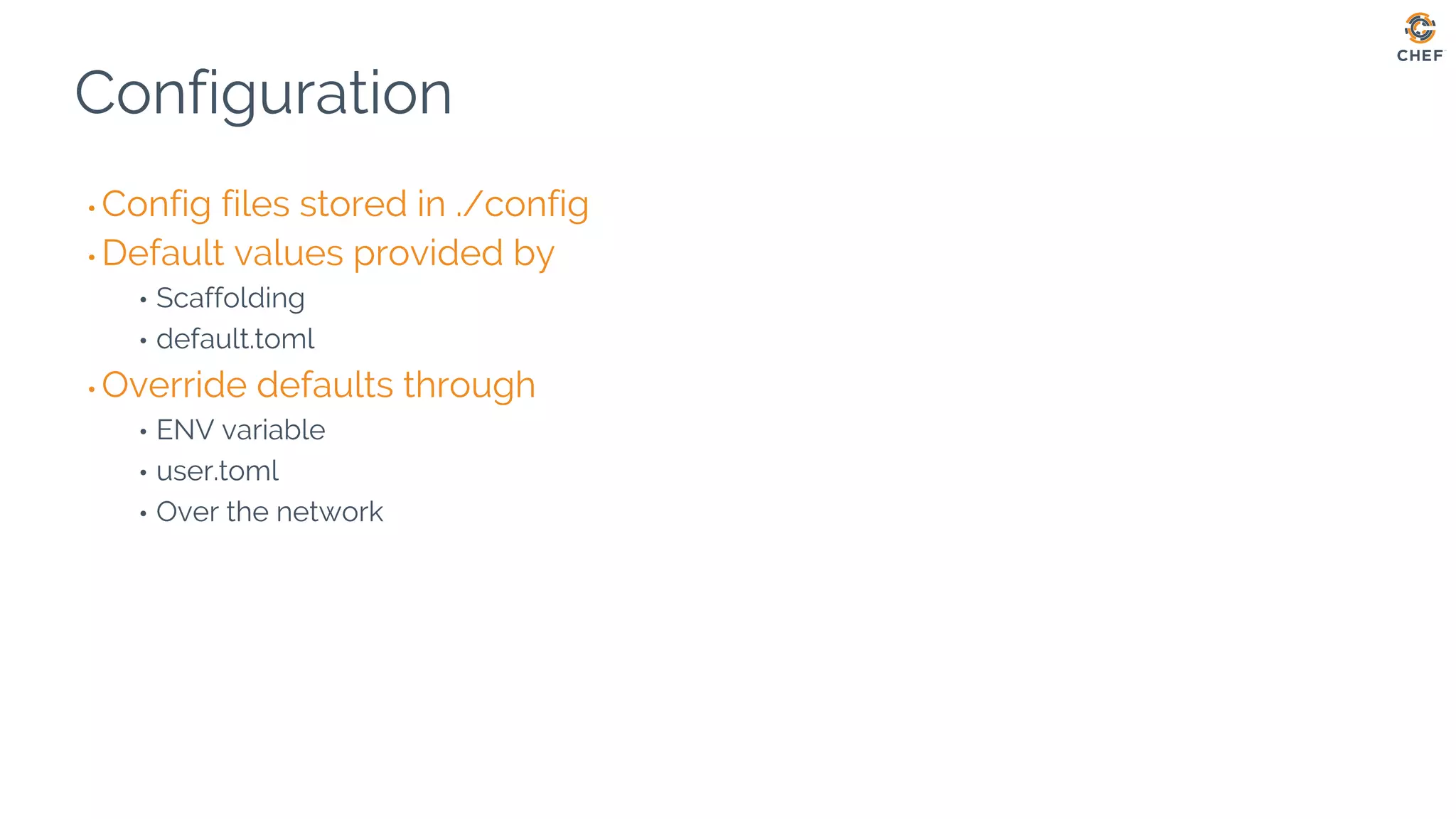
Configuration
• Config files stored in ./config
• Default values provided by
• Scaffolding
• default.toml
• Override defaults through
• ENV variable
• user.toml
• Over the network
What do applications need to run?
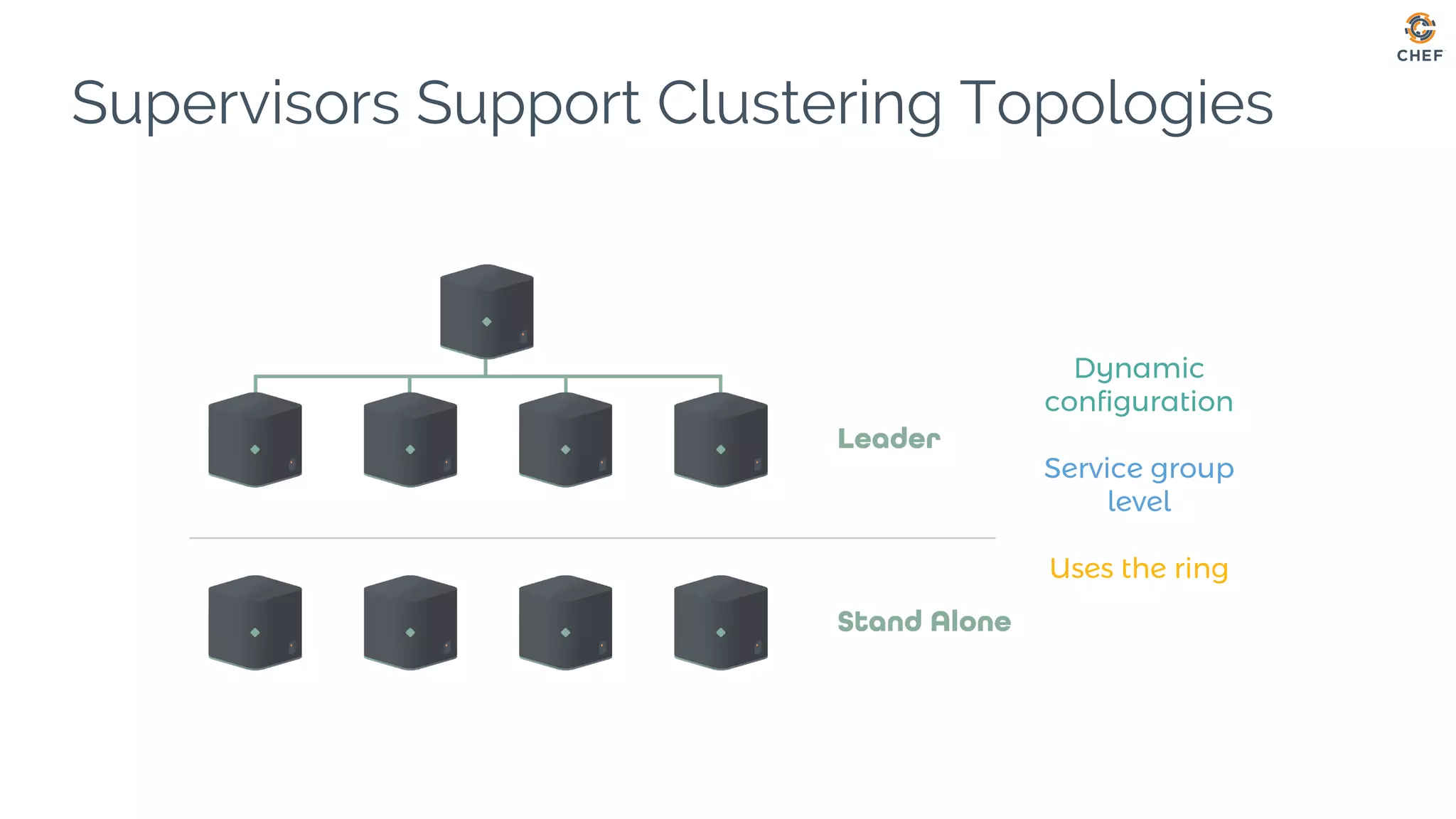
Dynamic
configuration
Service group
level
Uses the ring
Supervisors Support Clustering Topologies
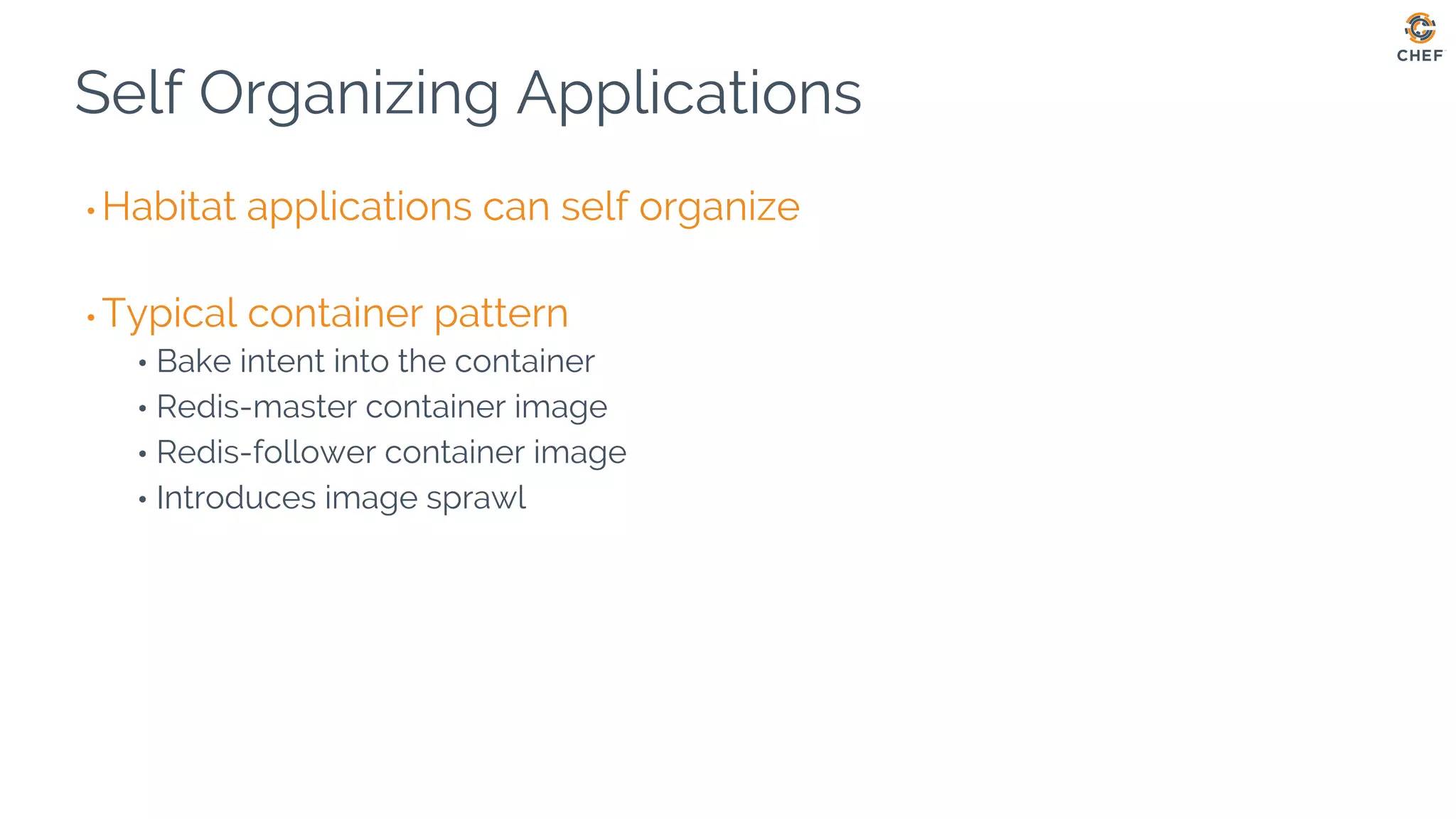
Self Organizing Applications
• Habitat applications can self organize
• Typical container pattern
• Bake intent into the container
• Redis-master container image
• Redis-follower container image
• Introduces image sprawl
Self Organizing Applications
•Habitat pattern
• One container image
• Launch images with knowledge of peers
• Application self organizes
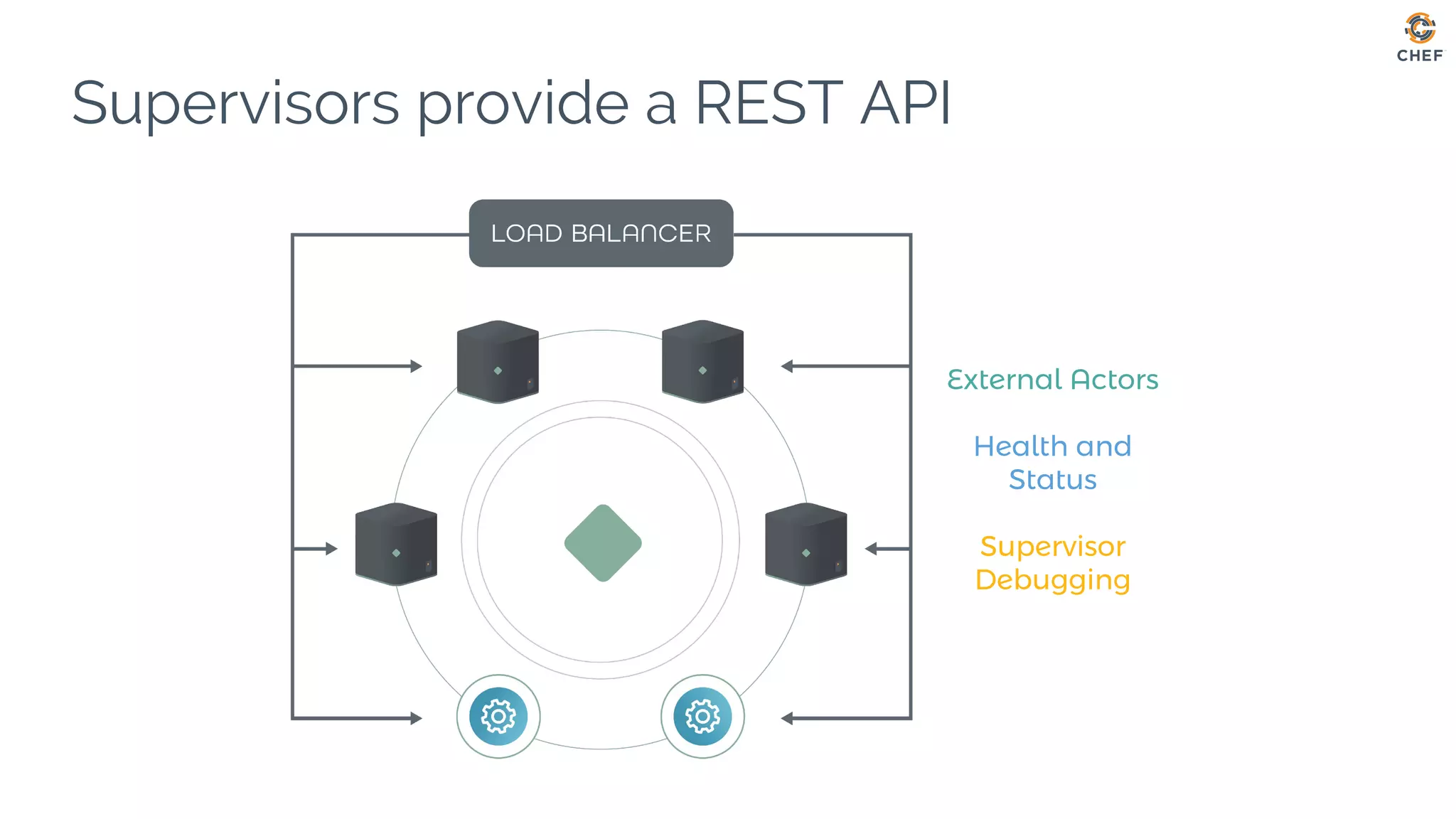
External Actors
Health and
Status
Supervisor
Debugging
Supervisors provide a REST API
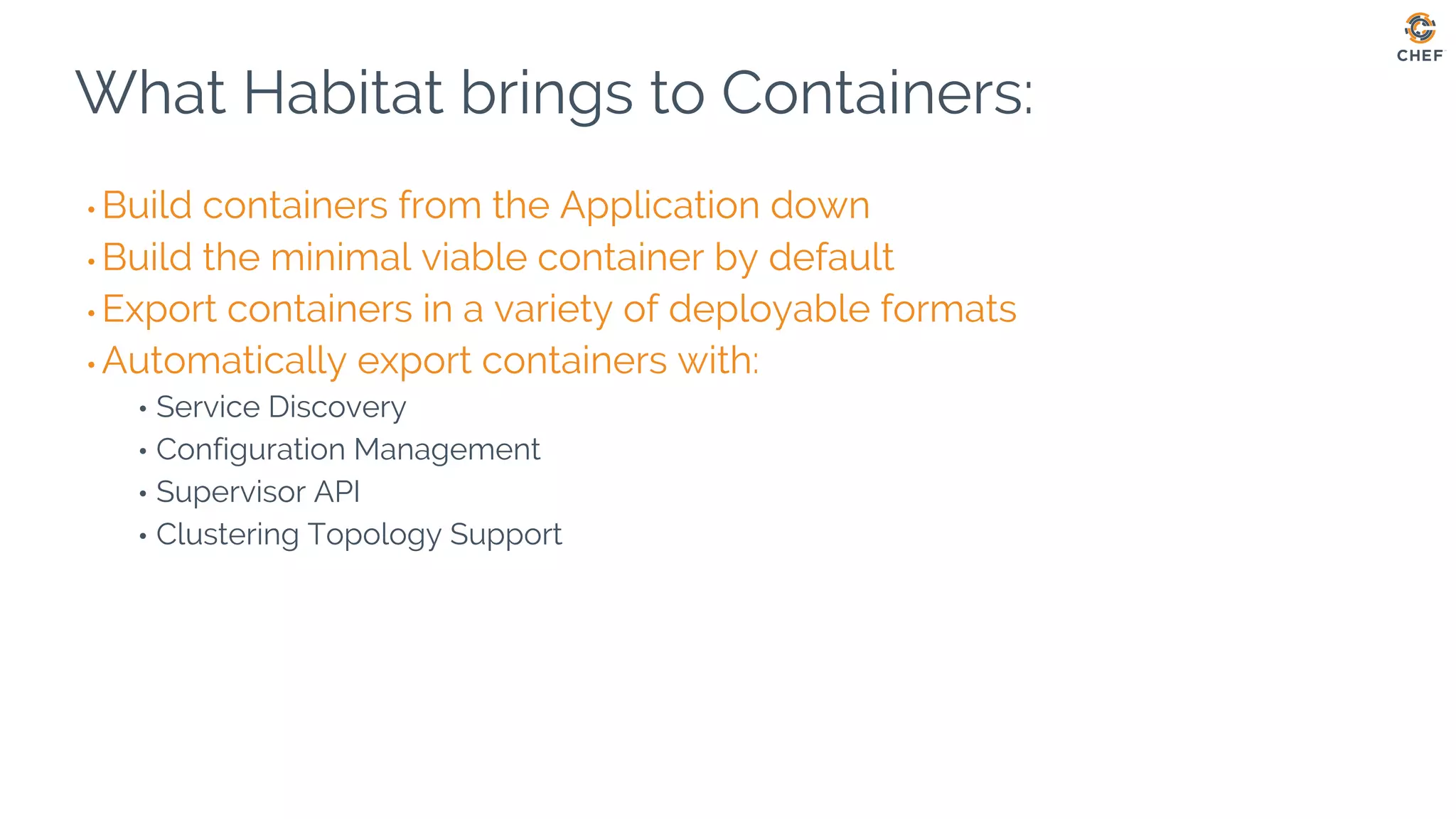
What Habitat brings to Containers:
• Build containers from the Application down
• Build the minimal viable container by default
• Export containers in a variety of deployable formats
• Automatically export containers with:
• Service Discovery
• Configuration Management
• Supervisor API
• Clustering Topology Support
What about those Developer Services?
Habitat and Developer Services
● Define How Software is Built
○ Language Agnostic
● Define How Software is Deployed
○ Export software to a variety of deployable formats (like containers)
● Define How Software is Run
○ Common management plane for any software
○ Common protocol for
■ Config
■ Cluster
○ Common API for monitoring
Habitat and Developer Services
Quickly and easily build, deploy, and run any
software across a variety of compute runtimes.
Habitat is automation for
Application Runtimes & Application Services
to deliver Cloud Native Developer Services
It’s all open source
Apache License
Questions
• Join the Habitat Slack Team - http://slack.habitat.sh/
• Work through the tutorial at https://www.habitat.sh/tutorials/
• Explore Habitat packages on the depot - https://app.habitat.sh/
• Explore the Habitat projects - https://github.com/habitat-sh
• Read Habitat Blog posts - https://blog.chef.io/?s=habitat
• Join the Habitat Forums - https://forums.habitat.sh/

Automating Applications with Habitat - Sydney Cloud Native Meetup

  • 1.
    Application Automation withHabitat Sydney Cloud Native Meetup August 22, 2017
  • 2.
    Matt Ray Manager, SolutionsArchitect – APJ Chef Software matt@chef.io @mattray
  • 3.
    Consumption Models haveChanged ● Standard “IT Shared Services” approach no longer viable ● Dev teams have spoken; they want agility and self-service ● Various dev teams assemble their own toolchains to move quickly ● Thrashing on toolchains prevents cross-organizational success ● Traditional centralized decision making isn’t going to work
  • 4.
    Problems with SharedServices ● Slow ● Inflexible ● Enforce “control” vs enabling “access” ● Creates a barrier that slows down time to market
  • 5.
    Consumption Models Old Create ahelpdesk ticket Send an email Submit a Change Request New API-driven interaction SDK for developers to build on top of APIs CLI tools for ease of use Slack (searchable real-time communication)
  • 6.
    LOBLOB FOCUS ON SPEED Tensioncaused by the demands placed on teams… …can be resolved by vertical integration and automation… …to deliver a future of developer services and software at speed SHARED SERVICES Vertical Integration is key to velocity A balance of increasing speed, improved efficiency and decreasing risk FOCUS ON RISK SHARED SERVICES LOB Line of Business LOB Line of Business LOB SHARED SERVICES LOB DEVELOPER SERVICES BUILD • DEPLOY • MANAGE • COLLABORATE
  • 7.
    ” Business Value withDeveloper Services Shifting capabilities to match business requirements Developer Services Engineer Line of Business Development Team I provide services that developers and development teams use to build and deliver applications. Developer Services TeamsTraditional Central IT System Administrator Centralized Enterprise IT Team I manage and deliver infrastructure required to run software in my organization. Enabling development teams to get insights into speed, efficiency and risk of delivery of their software Reducing risk to my organization from my infrastructure and software that runs on it Enabling development teams to ship software at speed while maintaining quality and reducing risk Reliably managing changes to infrastructure requirements Providing on-demand, self-service infrastructure and services tailored to developer needs Managing and lowering costs of running, configuring, and maintaining infrastructure DEPLOY MANAGE Don’t measure me on traditional IT metrics, but on the metrics of the business Jim Fowler, CIO, GE Capital BUILD Reducing friction by enabling full stack transparency and management capability with separation of duties Delivering configured infrastructure and handing off responsibility to development teams COLLABORATE
  • 8.
  • 9.
    Modern Architecture Principles 12Factor Apps/Cloud Native Microservices Serverless Containers
  • 10.
    12 Factor/Cloud Native https://12factor.net/ “Thetwelve-factor app is a methodology for building software-as-a-service apps that: ● Use declarative formats for setup automation, to minimize time and cost for new developers joining the project; ● Have a clean contract with the underlying operating system, offering maximum portability between execution environments; ● Are suitable for deployment on modern cloud platforms, obviating the need for servers and systems administration; ● Minimize divergence between development and production, enabling continuous deployment for maximum agility; ● And can scale up without significant changes to tooling, architecture, or development practices.”
  • 11.
    Microservices “…the microservice architecturalstyle is an approach to developing a single application as a suite of small services, each running in its own process and communicating with lightweight mechanisms…” - Martin Fowler and James Harris https://martinfowler.com/articles/microservices.html
  • 12.
    Microservices Characteristics ● Componentizationvia Services ● Organized around Business Capabilities ● Products not Projects ● Smart endpoints and dumb pipes ● Decentralized Governance ● Decentralized Data Management ● Infrastructure Automation ● Design for failure ● Evolutionary Design
  • 13.
    Serverless “Serverless architecture replaceslong-running virtual machines with ephemeral compute power that comes into existence on request and disappears immediately after use.” - Thoughtworks Tech Radar, March 2017
  • 14.
    Containers Package the applicationand dependencies in a deployable format Reduce/remove dependency on underlying OS/Infra Small Area of Concern Single process
  • 15.
    Common themes Reduced Areaof Concern Service Independence Infrastructure Independence Decentralized Management
  • 16.
  • 17.
  • 18.
    Complexity Cliff Scale Increases- Number of services under management increases Efficiency Declines - Number of ways to manage each service is different Risk Exposure Increases - Confidence that each service is secure, compliant, updated, etc.
  • 19.
    Developer Services “The servicesrequired for application developers to effectively run applications. This consists of the underlying infrastructure, compute runtimes, language runtimes, and application services to persist and retrieve data. These services should be available via a common API, with a focus on making the service easy to consume.” - Me
  • 20.
    Application Services What DevelopersNeed Application Runtimes
  • 21.
    Habitat is automationfor Application Runtimes & Application Services to deliver Cloud Native Developer Services
  • 22.
  • 23.
    Lifecycle of anysoftware Build Deploy Run
  • 24.
  • 25.
    The dreaded buildcycle wget https://some.place/package.tar.gz tar xfzv package.tar.gz cd package ./configure make make install
  • 26.
  • 27.
  • 28.
    Habitat Defines theBuild Lifecycle ● Default implementation is C/C++ Build Lifecycle ● Other default implementations provided by Scaffolding ○ core/scaffolding-ruby ○ core/scaffolding-node ○ core/scaffolding-go ● Build dependencies explicitly declared ● Runtime dependencies explicitly declared.
  • 29.
    Habitat Artifacts ● Dependenciesdeclared ○ Libraries ○ External Services ● Services/Port-bindings Exported ● Signed
  • 30.
    Habitat Build Cycle USERARTIFACTPLAN DEPOT
  • 31.
  • 32.
  • 33.
  • 34.
    Libraries Operating System Application Traditionally the domainof the OS Vendor Application Libraries Config Changes BottomtoTopDependencyResolution
  • 35.
  • 37.
    Export Deployable Artifacts ●Docker ● ACI ● Mesos ● TAR
  • 38.
  • 39.
  • 40.
    What do applicationsneed to run? • Process Supervisor • Lifecycle events • Start, Stop, Reconfigure, etc • Environment specific configuration • Knowledge of peers • Knowledge of dependent services
  • 41.
  • 42.
    Lifecycle Hooks • init •run • health_check • file_updated • reload • reconfigure • post-run • suitability
  • 43.
  • 44.
    Configuration • Config filesstored in ./config • Default values provided by • Scaffolding • default.toml • Override defaults through • ENV variable • user.toml • Over the network
  • 45.
  • 46.
    Dynamic configuration Service group level Uses thering Supervisors Support Clustering Topologies
  • 47.
    Self Organizing Applications •Habitat applications can self organize • Typical container pattern • Bake intent into the container • Redis-master container image • Redis-follower container image • Introduces image sprawl
  • 48.
    Self Organizing Applications •Habitatpattern • One container image • Launch images with knowledge of peers • Application self organizes
  • 49.
  • 50.
    What Habitat bringsto Containers: • Build containers from the Application down • Build the minimal viable container by default • Export containers in a variety of deployable formats • Automatically export containers with: • Service Discovery • Configuration Management • Supervisor API • Clustering Topology Support
  • 51.
    What about thoseDeveloper Services?
  • 52.
    Habitat and DeveloperServices ● Define How Software is Built ○ Language Agnostic ● Define How Software is Deployed ○ Export software to a variety of deployable formats (like containers) ● Define How Software is Run ○ Common management plane for any software ○ Common protocol for ■ Config ■ Cluster ○ Common API for monitoring
  • 53.
    Habitat and DeveloperServices Quickly and easily build, deploy, and run any software across a variety of compute runtimes.
  • 54.
    Habitat is automationfor Application Runtimes & Application Services to deliver Cloud Native Developer Services
  • 55.
    It’s all opensource Apache License
  • 56.
    Questions • Join theHabitat Slack Team - http://slack.habitat.sh/ • Work through the tutorial at https://www.habitat.sh/tutorials/ • Explore Habitat packages on the depot - https://app.habitat.sh/ • Explore the Habitat projects - https://github.com/habitat-sh • Read Habitat Blog posts - https://blog.chef.io/?s=habitat • Join the Habitat Forums - https://forums.habitat.sh/