Kim Clark
Integration Architect
A cloud native approach
to agile integration
1
© 2021 IBM Corporation
Webinar: https://ibm.biz/agile-integration-cloud-native
Slides: https://ibm.biz/agile-integration-cloud-native-pdf
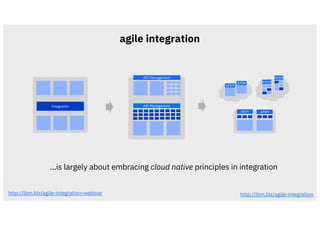
agile integration
APIM
APIM APIM
API Management
APIM
API Management
APIM
APIM
Integration
2
http://ibm.biz/agile-integration
…is largely about embracing cloud native principles in integration
http://ibm.biz/agile-integration-webinar
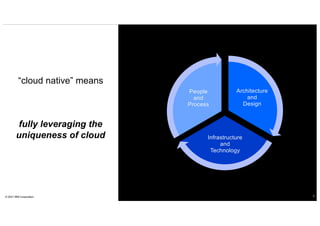
“cloud native” means
© 2021 IBM Corporation 3
People
and
Process
Architecture
and
Design
Infrastructure
and
Technology
fully leveraging the
uniqueness of cloud
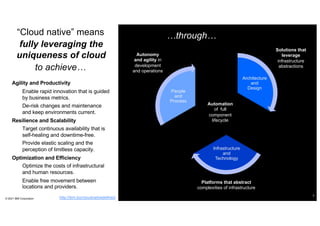
“Cloud native” means
Agility and Productivity
– Enable rapid innovation that is guided
by business metrics.
– De-risk changes and maintenance
and keep environments current.
Resilience and Scalability
– Target continuous availability that is
self-healing and downtime-free.
– Provide elastic scaling and the
perception of limitless capacity.
Optimization and Efficiency
– Optimize the costs of infrastructural
and human resources.
– Enable free movement between
locations and providers.
© 2021 IBM Corporation
4
People
and
Process
Architecture
and
Design
Infrastructure
and
Technology
Platforms that abstract
complexities of infrastructure
Solutions that
leverage
infrastructure
abstractions
Automation
of full
component
lifecycle
Autonomy
and agility in
development
and operations
fully leveraging the
uniqueness of cloud
…through…
to achieve…
http://ibm.biz/cloudnativedefined
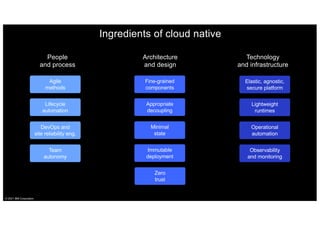
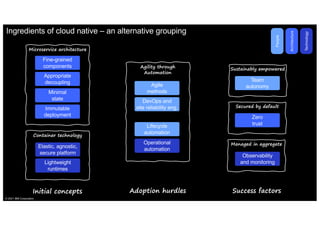
Ingredients of cloud native
Agile
methods
Lifecycle
automation
DevOps and
site reliability eng.
Team
autonomy
Fine-grained
components
Appropriate
decoupling
Minimal
state
Immutable
deployment
Zero
trust
Elastic, agnostic,
secure platform
Lightweight
runtimes
Operational
automation
Observability
and monitoring
People
and process
Architecture
and design
Technology
and infrastructure
© 2021 IBM Corporation
Microservice architecture
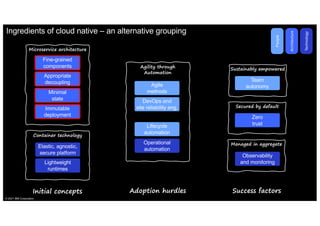
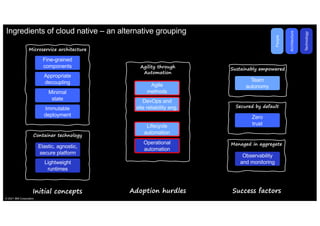
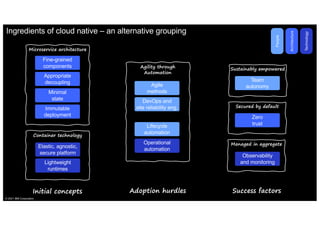
Ingredients of cloud native – an alternative grouping
Initial concepts Adoption hurdles Success factors
Agile
methods
Lifecycle
automation
DevOps and
site reliability eng.
Team
autonomy
Fine-grained
components
Appropriate
decoupling
Minimal
state
Immutable
deployment Zero
trust
Elastic, agnostic,
secure platform
Lightweight
runtimes
Operational
automation
Observability
and monitoring
Container technology
Agility through
Automation
Sustainably empowered
Secured by default
Managed in aggregate
People
Architecture
Technology
© 2021 IBM Corporation
Microservice architecture
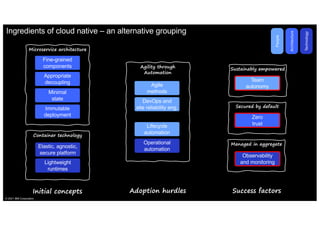
Ingredients of cloud native – an alternative grouping
Initial concepts Adoption hurdles Success factors
Agile
methods
Lifecycle
automation
DevOps and
site reliability eng.
Team
autonomy
Fine-grained
components
Appropriate
decoupling
Minimal
state
Immutable
deployment Zero
trust
Elastic, agnostic,
secure platform
Lightweight
runtimes
Operational
automation
Observability
and monitoring
Container technology
Agility through
Automation
Sustainably empowered
Secured by default
Managed in aggregate
People
Architecture
Technology
© 2021 IBM Corporation
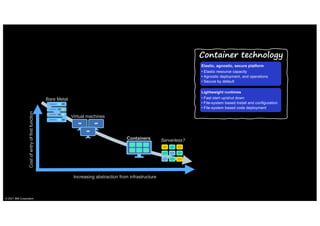
Container technology
Elastic, agnostic, secure platform
• Elastic resource capacity
• Agnostic deployment, and operations
• Secure by default
Lightweight runtimes
• Fast start up/shut down
• File-system based install and configuration
• File-system based code deployment
Cost
of
entry
of
first
function
Increasing abstraction from infrastructure
Bare Metal
Virtual machines
Serverless?
Containers
© 2021 IBM Corporation
C. C. C. C. C. C. C. C.
VM
O/S
VM Host
© 2021 IBM Corporation
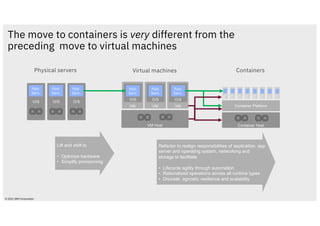
The move to containers is very different from the
preceding move to virtual machines
Physical servers
O/S
App.
Serv.
O/S
App.
Serv.
O/S
App.
Serv.
App.
Serv.
Container Host
Virtual machines Containers
VM
O/S
App.
Serv.
VM
O/S
App.
Serv.
Container Platform
Lift and shift to
• Optimize hardware
• Simplify provisioning
Refactor to realign responsibilities of application, app
server and operating system, networking and
storage to facilitate
• Lifecycle agility through automation
• Rationalized operations across all runtime types
• Discrete, agnostic resilience and scalability
Availability Zone A
Server PRD1
HA
Manager
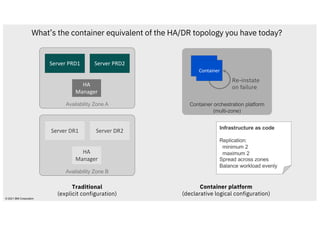
What’s the container equivalent of the HA/DR topology you have today?
Container orchestration platform
(multi-zone)
Container
Server PRD2
Availability Zone B
Server DR1
HA
Manager
Server DR2
Infrastructure as code
Replication:
minimum 2
maximum 2
Spread across zones
Balance workload evenly
Traditional
(explicit configuration)
Container platform
(declarative logical configuration)
Re-instate
on failure
© 2021 IBM Corporation
Microservice architecture
Ingredients of cloud native – an alternative grouping
Initial concepts Adoption hurdles Success factors
Agile
methods
Lifecycle
automation
DevOps and
site reliability eng.
Team
autonomy
Fine-grained
components
Appropriate
decoupling
Minimal
state
Immutable
deployment Zero
trust
Elastic, agnostic,
secure platform
Lightweight
runtimes
Operational
automation
Observability
and monitoring
Container technology
Agility through
Automation
Sustainably empowered
Secured by default
Managed in aggregate
People
Architecture
Technology
© 2021 IBM Corporation
Microservice architecture
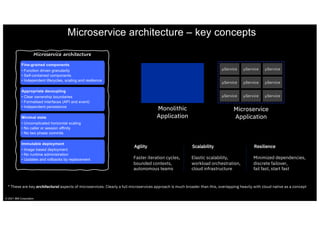
Microservice architecture – key concepts
Fine-grained components
• Function driven granularity
• Self-contained components
• Independent lifecycles, scaling and resilience
Appropriate decoupling
• Clear ownership boundaries
• Formalised interfaces (API and event)
• Independent persistence
Minimal state
• Uncomplicated horizontal scaling
• No caller or session affinity
• No two phase commits
Immutable deployment
• Image based deployment
• No runtime administration
• Updates and rollbacks by replacement Faster iteration cycles,
bounded contexts,
autonomous teams
Agility
Elastic scalability,
workload orchestration,
cloud infrastructure
Scalability
Minimized dependencies,
discrete failover,
fail fast, start fast
Resilience
Monolithic
Application
µService
µService
µService
µService
µService
µService
µService
µService
µService
Microservice
Application
* These are key architectural aspects of microservices. Clearly a full microservices approach is much broader than this, overlapping heavily with cloud native as a concept
© 2021 IBM Corporation
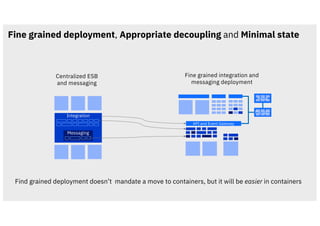
Integration
Fine grained deployment, Appropriate decoupling and Minimal state
13
Find grained deployment doesn’t mandate a move to containers, but it will be easier in containers
API and Event Gateway
Messaging
Centralized ESB
and messaging
Fine grained integration and
messaging deployment
Portal
Manager
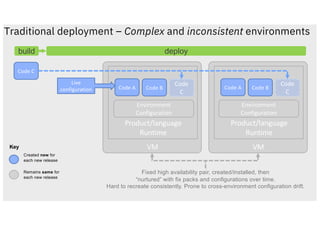
Traditional deployment – Complex and inconsistent environments
Key
Created new for
each new release
Remains same for
each new release
Code C
Fixed high availability pair, created/installed, then
“nurtured” with fix packs and configurations over time.
Hard to recreate consistently. Prone to cross-environment configuration drift.
VM
Product/language
Runtime
Environment
Configuration
Code A Code B
Code
C
VM
Product/language
Runtime
Environment
Configuration
Code A Code B
Code
C
build deploy
Live
configuration
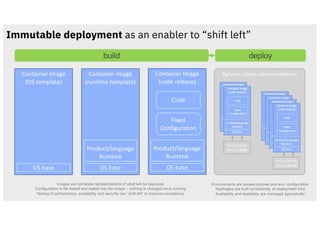
Agnostic, elastic container platform
Immutable deployment as an enabler to “shift left”
Container Image
(OS template)
OS base
Container Image
(runtime template)
Product/language
Runtime
OS base
Container Image
(code release)
Product/language
Runtime
Fixed
Configuration
Code
OS base
Environment
Config. (test)
Environment
Config. (prod)
build deploy
Images are complete representations of what will be deployed
Configuration is file based and baked into the image – nothing is changed once running
Testing of performance, availability and security can “shift left” to improve consistency
Environments are access policies and env. configuration
Topologies are built consistently, at deployment time
Availability and scalability are managed agnostically
Microservice architecture
Ingredients of cloud native – an alternative grouping
Initial concepts Adoption hurdles Success factors
Agile
methods
Lifecycle
automation
DevOps and
site reliability eng.
Team
autonomy
Fine-grained
components
Appropriate
decoupling
Minimal
state
Immutable
deployment Zero
trust
Elastic, agnostic,
secure platform
Lightweight
runtimes
Operational
automation
Observability
and monitoring
Container technology
Agility through
Automation
Sustainably empowered
Secured by default
Managed in aggregate
People
Architecture
Technology
© 2021 IBM Corporation
Microservice architecture
Ingredients of cloud native – an alternative grouping
Initial concepts Adoption hurdles Success factors
Agile
methods
Lifecycle
automation
DevOps and
site reliability eng.
Team
autonomy
Fine-grained
components
Appropriate
decoupling
Minimal
state
Immutable
deployment Zero
trust
Elastic, agnostic,
secure platform
Lightweight
runtimes
Operational
automation
Observability
and monitoring
Container technology
Agility through
Automation
Sustainably empowered
Secured by default
Managed in aggregate
People
Architecture
Technology
© 2021 IBM Corporation
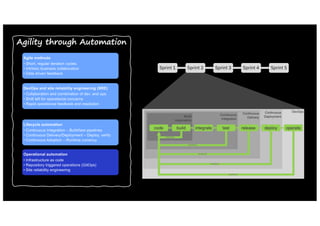
Agility through Automation
Agile methods
• Short, regular iteration cycles.
• Intrinsic business collaboration
• Data driven feedback
Lifecycle automation
• Continuous Integration – Build/test pipelines
• Continuous Delivery/Deployment – Deploy, verify
• Continuous Adoption – Runtime currency
DevOps and site reliability engineering (SRE)
• Collaboration and combination of dev. and ops.
• Shift left for operational concerns
• Rapid operational feedback and resolution
Operational automation
• Infrastructure as code
• Repository triggered operations (GitOps)
• Site reliability engineering
Sprint 1 Sprint 2 Sprint 3 Sprint 4 Sprint 5
19
© 2021 IBM Corporation
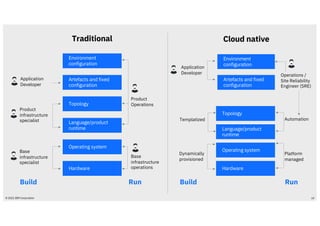
Hardware
Operating system
Language/product
runtime
Topology
Artefacts and fixed
configuration
Environment
configuration
Build Run
Traditional
Product
infrastructure
specialist
Base
infrastructure
specialist
Base
infrastructure
operations
Application
Developer
Product
Operations
Artefacts and fixed
configuration
Environment
configuration
Cloud native
Operations /
Site Reliability
Engineer (SRE)
Application
Developer
Hardware
Operating system
Language/product
runtime
Topology
Templatized
Dynamically
provisioned
Automation
Platform
managed
Build Run
Container
Platform
Git
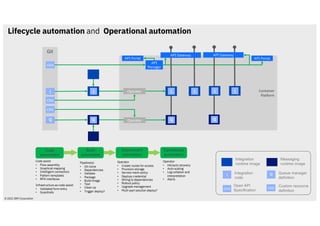
Lifecycle automation and Operational automation
Integration
runtime image
i
i
Code Build Operate
Deploy
i
Operator
Messaging
runtime image
q q
Integration
code
q Queue manager
definition
q Operator
CRD
CRD
API Portal
API
Manager
q
i
API Gateway
Pipeline(s)
• Git clone
• Dependencies
• Validate
• Package
• Build image
• Test
• Clean up
• Trigger deploy?
Operator
• Create routes for access
• Provision storage
• Service mesh policy
• Deploys credential
• Wiring to dependencies
• Rollout policy
• Upgrade management
• Multi-part solution deploy?
OAS
i i
Operator
• HA/auto recovery
• Auto scaling
• Log collation and
interpretation
• Alerts
i
API Gateway
API Portal
Open API
Specification
OAS
Operational
automation
Build
automation
CRD
Custom resource
definition
Deployment
automation
© 2021 IBM Corporation
Code assist
• Flow assembly
• Graphical mapping
• Intelligent connectors
• Pattern templates
• RPA interfaces
Code
automation
Infrastructure as code assist
• Validated form entry
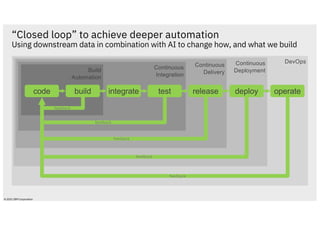
• Guardrails
“Closed loop” to achieve deeper automation
Using downstream data in combination with AI to change how, and what we build
DevOps
Continuous
Deployment
Continuous
Delivery
Continuous
Integration
Build
Automation
code build integrate test release deploy operate
feedback
feedback
feedback
feedback
feedback
© 2021 IBM Corporation
Microservice architecture
Ingredients of cloud native – an alternative grouping
Initial concepts Adoption hurdles Success factors
Agile
methods
Lifecycle
automation
DevOps and
site reliability eng.
Team
autonomy
Fine-grained
components
Appropriate
decoupling
Minimal
state
Immutable
deployment Zero
trust
Elastic, agnostic,
secure platform
Lightweight
runtimes
Operational
automation
Observability
and monitoring
Container technology
Agility through
Automation
Sustainably empowered
Secured by default
Managed in aggregate
People
Architecture
Technology
© 2021 IBM Corporation
Microservice architecture
Ingredients of cloud native – an alternative grouping
Initial concepts Adoption hurdles Success factors
Agile
methods
Lifecycle
automation
DevOps and
site reliability eng.
Team
autonomy
Fine-grained
components
Appropriate
decoupling
Minimal
state
Immutable
deployment Zero
trust
Elastic, agnostic,
secure platform
Lightweight
runtimes
Operational
automation
Observability
and monitoring
Container technology
Agility through
Automation
Sustainably empowered
Secured by default
Managed in aggregate
People
Architecture
Technology
© 2021 IBM Corporation
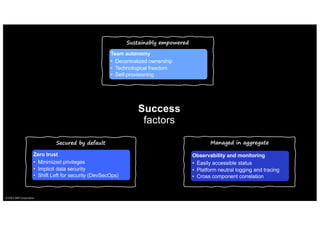
Success
factors
Sustainably empowered
Secured by default Managed in aggregate
Team autonomy
• Decentralized ownership
• Technological freedom
• Self-provisioning
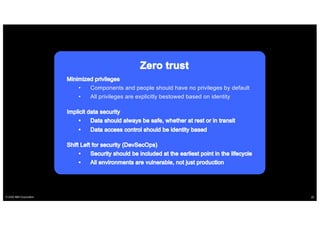
Zero trust
• Minimized privileges
• Implicit data security
• Shift Left for security (DevSecOps)
Observability and monitoring
• Easily accessible status
• Platform neutral logging and tracing
• Cross component correlation
© 2021 IBM Corporation
© 2020 IBM Corporation 25
• Components and people should have no privileges by default
• All privileges are explicitly bestowed based on identity
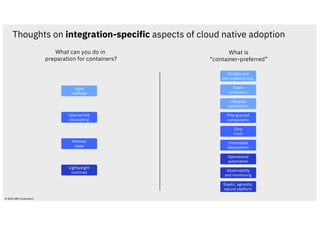
Agile
methods
DevOps and
site reliability eng.
Team
autonomy
Fine-grained
components
Appropriate
decoupling
Minimal
state
Immutable
deployment
Zero
trust
Elastic, agnostic,
secure platform
Lightweight
runtimes
Operational
automation
Observability
and monitoring
Lifecycle
automation
What can you do in
preparation for containers?
What is
“container-preferred”
© 2021 IBM Corporation
Thoughts on integration-specific aspects of cloud native adoption
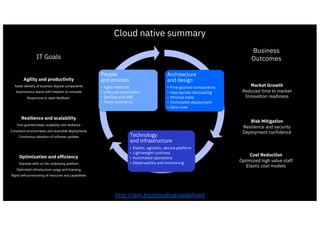
Cloud native summary
Business
Outcomes
Market Growth
Reduced time to market
Innovation readiness
Risk Mitigation
Resilience and security
Deployment confidence
Cost Reduction
Optimized high value staff
Elastic cost models
IT Goals
Agility and productivity
Faster delivery of business aligned components
Autonomous teams with freedom to innovate
Responsive to rapid feedback
Resilience and scalability
Fine-grained elastic scalability and resilience
Consistent environments and reversible deployments
Continuous adoption of software updates
Optimization and efficiency
Sharable skills on the underlying platform
Optimized infrastructure usage and licensing
Rapid self-provisioning of resources and capabilities
Architecture
and
Design
Infrastructure
and
Technology
People
and
Process
People
and process
• Agile methods
• Lifecycle automation
• DevOps and SRE
• Team Autonomy
Architecture
and design
• Fine-grained components
• Appropriate decoupling
• Minimal state
• Immutable deployment
• Zero trust
Technology
and infrastructure
• Elastic, agnostic, secure platform
• Lightweight runtimes
• Automated operations
• Observability and monitoring
http://ibm.biz/cloudnativedefined
© 2021 IBM Corporation
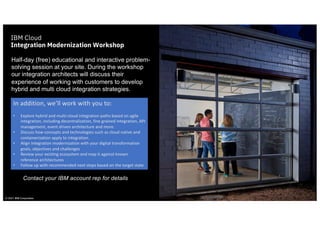
IBM Cloud
Integration Modernization Workshop
Half-day (free) educational and interactive problem-
solving session at your site. During the workshop
our integration architects will discuss their
experience of working with customers to develop
hybrid and multi cloud integration strategies.
In addition, we’ll work with you to:
• Explore hybrid and multi-cloud integration paths based on agile
integration, including decentralization, fine grained integration, API
management, event driven architecture and more.
• Discuss how concepts and technologies such as cloud native and
containerization apply to integration.
• Align integration modernization with your digital transformation
goals, objectives and challenges
• Review your existing ecosystem and map it against known
reference architectures
• Follow up with recommended next steps based on the target state
Contact your IBM account rep for details
More information
29
© 2021 IBM Corporation
Cloud Native
http://ibm.biz/cloudnativedefined
https://ibm.biz/agile-integration-cloud-native
Agile Integration
http://ibm.biz/agile-integration
http://ibm.biz/agile-integration-webinar
http://ibm.biz/agile-integration-redbook
http://ibm.biz/agile-integration-webcasts
Other key links on agile integration
http://ibm.biz/agile-integration-links
Staying up to date:
https://community.ibm.com/community/user/imwuc/globalgroups/cloudintegration
IBM Integration
https://developer.ibm.com/integration
Cloud Pak for Integration
https://www.ibm.com/cloud/cloud-pak-for-integration
Thank you
Kim Clark
Integration Architect
—
kim.clark@uk.ibm.com
30

Cloud native integration

  • 1.
    Kim Clark Integration Architect Acloud native approach to agile integration 1 © 2021 IBM Corporation Webinar: https://ibm.biz/agile-integration-cloud-native Slides: https://ibm.biz/agile-integration-cloud-native-pdf
  • 2.
    agile integration APIM APIM APIM APIManagement APIM API Management APIM APIM Integration 2 http://ibm.biz/agile-integration …is largely about embracing cloud native principles in integration http://ibm.biz/agile-integration-webinar
  • 3.
    “cloud native” means ©2021 IBM Corporation 3 People and Process Architecture and Design Infrastructure and Technology fully leveraging the uniqueness of cloud
  • 4.
    “Cloud native” means Agilityand Productivity – Enable rapid innovation that is guided by business metrics. – De-risk changes and maintenance and keep environments current. Resilience and Scalability – Target continuous availability that is self-healing and downtime-free. – Provide elastic scaling and the perception of limitless capacity. Optimization and Efficiency – Optimize the costs of infrastructural and human resources. – Enable free movement between locations and providers. © 2021 IBM Corporation 4 People and Process Architecture and Design Infrastructure and Technology Platforms that abstract complexities of infrastructure Solutions that leverage infrastructure abstractions Automation of full component lifecycle Autonomy and agility in development and operations fully leveraging the uniqueness of cloud …through… to achieve… http://ibm.biz/cloudnativedefined
  • 5.
    Ingredients of cloudnative Agile methods Lifecycle automation DevOps and site reliability eng. Team autonomy Fine-grained components Appropriate decoupling Minimal state Immutable deployment Zero trust Elastic, agnostic, secure platform Lightweight runtimes Operational automation Observability and monitoring People and process Architecture and design Technology and infrastructure © 2021 IBM Corporation
  • 6.
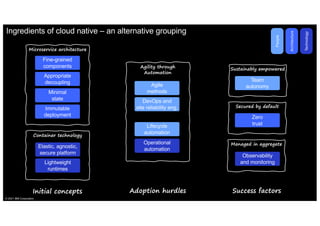
    Microservice architecture Ingredients ofcloud native – an alternative grouping Initial concepts Adoption hurdles Success factors Agile methods Lifecycle automation DevOps and site reliability eng. Team autonomy Fine-grained components Appropriate decoupling Minimal state Immutable deployment Zero trust Elastic, agnostic, secure platform Lightweight runtimes Operational automation Observability and monitoring Container technology Agility through Automation Sustainably empowered Secured by default Managed in aggregate People Architecture Technology © 2021 IBM Corporation
  • 7.
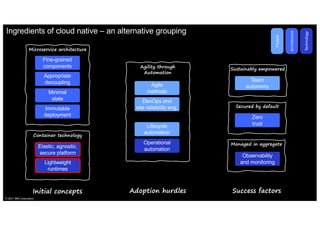
    Microservice architecture Ingredients ofcloud native – an alternative grouping Initial concepts Adoption hurdles Success factors Agile methods Lifecycle automation DevOps and site reliability eng. Team autonomy Fine-grained components Appropriate decoupling Minimal state Immutable deployment Zero trust Elastic, agnostic, secure platform Lightweight runtimes Operational automation Observability and monitoring Container technology Agility through Automation Sustainably empowered Secured by default Managed in aggregate People Architecture Technology © 2021 IBM Corporation
  • 8.
    Container technology Elastic, agnostic,secure platform • Elastic resource capacity • Agnostic deployment, and operations • Secure by default Lightweight runtimes • Fast start up/shut down • File-system based install and configuration • File-system based code deployment Cost of entry of first function Increasing abstraction from infrastructure Bare Metal Virtual machines Serverless? Containers © 2021 IBM Corporation
  • 9.
    C. C. C.C. C. C. C. C. VM O/S VM Host © 2021 IBM Corporation The move to containers is very different from the preceding move to virtual machines Physical servers O/S App. Serv. O/S App. Serv. O/S App. Serv. App. Serv. Container Host Virtual machines Containers VM O/S App. Serv. VM O/S App. Serv. Container Platform Lift and shift to • Optimize hardware • Simplify provisioning Refactor to realign responsibilities of application, app server and operating system, networking and storage to facilitate • Lifecycle agility through automation • Rationalized operations across all runtime types • Discrete, agnostic resilience and scalability
  • 10.
    Availability Zone A ServerPRD1 HA Manager What’s the container equivalent of the HA/DR topology you have today? Container orchestration platform (multi-zone) Container Server PRD2 Availability Zone B Server DR1 HA Manager Server DR2 Infrastructure as code Replication: minimum 2 maximum 2 Spread across zones Balance workload evenly Traditional (explicit configuration) Container platform (declarative logical configuration) Re-instate on failure © 2021 IBM Corporation
  • 11.
    Microservice architecture Ingredients ofcloud native – an alternative grouping Initial concepts Adoption hurdles Success factors Agile methods Lifecycle automation DevOps and site reliability eng. Team autonomy Fine-grained components Appropriate decoupling Minimal state Immutable deployment Zero trust Elastic, agnostic, secure platform Lightweight runtimes Operational automation Observability and monitoring Container technology Agility through Automation Sustainably empowered Secured by default Managed in aggregate People Architecture Technology © 2021 IBM Corporation
  • 12.
    Microservice architecture Microservice architecture– key concepts Fine-grained components • Function driven granularity • Self-contained components • Independent lifecycles, scaling and resilience Appropriate decoupling • Clear ownership boundaries • Formalised interfaces (API and event) • Independent persistence Minimal state • Uncomplicated horizontal scaling • No caller or session affinity • No two phase commits Immutable deployment • Image based deployment • No runtime administration • Updates and rollbacks by replacement Faster iteration cycles, bounded contexts, autonomous teams Agility Elastic scalability, workload orchestration, cloud infrastructure Scalability Minimized dependencies, discrete failover, fail fast, start fast Resilience Monolithic Application µService µService µService µService µService µService µService µService µService Microservice Application * These are key architectural aspects of microservices. Clearly a full microservices approach is much broader than this, overlapping heavily with cloud native as a concept © 2021 IBM Corporation
  • 13.
    Integration Fine grained deployment,Appropriate decoupling and Minimal state 13 Find grained deployment doesn’t mandate a move to containers, but it will be easier in containers API and Event Gateway Messaging Centralized ESB and messaging Fine grained integration and messaging deployment Portal Manager
  • 14.
    Traditional deployment –Complex and inconsistent environments Key Created new for each new release Remains same for each new release Code C Fixed high availability pair, created/installed, then “nurtured” with fix packs and configurations over time. Hard to recreate consistently. Prone to cross-environment configuration drift. VM Product/language Runtime Environment Configuration Code A Code B Code C VM Product/language Runtime Environment Configuration Code A Code B Code C build deploy Live configuration
  • 15.
    Agnostic, elastic containerplatform Immutable deployment as an enabler to “shift left” Container Image (OS template) OS base Container Image (runtime template) Product/language Runtime OS base Container Image (code release) Product/language Runtime Fixed Configuration Code OS base Environment Config. (test) Environment Config. (prod) build deploy Images are complete representations of what will be deployed Configuration is file based and baked into the image – nothing is changed once running Testing of performance, availability and security can “shift left” to improve consistency Environments are access policies and env. configuration Topologies are built consistently, at deployment time Availability and scalability are managed agnostically
  • 16.
    Microservice architecture Ingredients ofcloud native – an alternative grouping Initial concepts Adoption hurdles Success factors Agile methods Lifecycle automation DevOps and site reliability eng. Team autonomy Fine-grained components Appropriate decoupling Minimal state Immutable deployment Zero trust Elastic, agnostic, secure platform Lightweight runtimes Operational automation Observability and monitoring Container technology Agility through Automation Sustainably empowered Secured by default Managed in aggregate People Architecture Technology © 2021 IBM Corporation
  • 17.
    Microservice architecture Ingredients ofcloud native – an alternative grouping Initial concepts Adoption hurdles Success factors Agile methods Lifecycle automation DevOps and site reliability eng. Team autonomy Fine-grained components Appropriate decoupling Minimal state Immutable deployment Zero trust Elastic, agnostic, secure platform Lightweight runtimes Operational automation Observability and monitoring Container technology Agility through Automation Sustainably empowered Secured by default Managed in aggregate People Architecture Technology © 2021 IBM Corporation
  • 18.
    Agility through Automation Agilemethods • Short, regular iteration cycles. • Intrinsic business collaboration • Data driven feedback Lifecycle automation • Continuous Integration – Build/test pipelines • Continuous Delivery/Deployment – Deploy, verify • Continuous Adoption – Runtime currency DevOps and site reliability engineering (SRE) • Collaboration and combination of dev. and ops. • Shift left for operational concerns • Rapid operational feedback and resolution Operational automation • Infrastructure as code • Repository triggered operations (GitOps) • Site reliability engineering Sprint 1 Sprint 2 Sprint 3 Sprint 4 Sprint 5
  • 19.
    19 © 2021 IBMCorporation Hardware Operating system Language/product runtime Topology Artefacts and fixed configuration Environment configuration Build Run Traditional Product infrastructure specialist Base infrastructure specialist Base infrastructure operations Application Developer Product Operations Artefacts and fixed configuration Environment configuration Cloud native Operations / Site Reliability Engineer (SRE) Application Developer Hardware Operating system Language/product runtime Topology Templatized Dynamically provisioned Automation Platform managed Build Run
  • 20.
    Container Platform Git Lifecycle automation andOperational automation Integration runtime image i i Code Build Operate Deploy i Operator Messaging runtime image q q Integration code q Queue manager definition q Operator CRD CRD API Portal API Manager q i API Gateway Pipeline(s) • Git clone • Dependencies • Validate • Package • Build image • Test • Clean up • Trigger deploy? Operator • Create routes for access • Provision storage • Service mesh policy • Deploys credential • Wiring to dependencies • Rollout policy • Upgrade management • Multi-part solution deploy? OAS i i Operator • HA/auto recovery • Auto scaling • Log collation and interpretation • Alerts i API Gateway API Portal Open API Specification OAS Operational automation Build automation CRD Custom resource definition Deployment automation © 2021 IBM Corporation Code assist • Flow assembly • Graphical mapping • Intelligent connectors • Pattern templates • RPA interfaces Code automation Infrastructure as code assist • Validated form entry • Guardrails
  • 21.
    “Closed loop” toachieve deeper automation Using downstream data in combination with AI to change how, and what we build DevOps Continuous Deployment Continuous Delivery Continuous Integration Build Automation code build integrate test release deploy operate feedback feedback feedback feedback feedback © 2021 IBM Corporation
  • 22.
    Microservice architecture Ingredients ofcloud native – an alternative grouping Initial concepts Adoption hurdles Success factors Agile methods Lifecycle automation DevOps and site reliability eng. Team autonomy Fine-grained components Appropriate decoupling Minimal state Immutable deployment Zero trust Elastic, agnostic, secure platform Lightweight runtimes Operational automation Observability and monitoring Container technology Agility through Automation Sustainably empowered Secured by default Managed in aggregate People Architecture Technology © 2021 IBM Corporation
  • 23.
    Microservice architecture Ingredients ofcloud native – an alternative grouping Initial concepts Adoption hurdles Success factors Agile methods Lifecycle automation DevOps and site reliability eng. Team autonomy Fine-grained components Appropriate decoupling Minimal state Immutable deployment Zero trust Elastic, agnostic, secure platform Lightweight runtimes Operational automation Observability and monitoring Container technology Agility through Automation Sustainably empowered Secured by default Managed in aggregate People Architecture Technology © 2021 IBM Corporation
  • 24.
    Success factors Sustainably empowered Secured bydefault Managed in aggregate Team autonomy • Decentralized ownership • Technological freedom • Self-provisioning Zero trust • Minimized privileges • Implicit data security • Shift Left for security (DevSecOps) Observability and monitoring • Easily accessible status • Platform neutral logging and tracing • Cross component correlation © 2021 IBM Corporation
  • 25.
    © 2020 IBMCorporation 25 • Components and people should have no privileges by default • All privileges are explicitly bestowed based on identity
  • 26.
    Agile methods DevOps and site reliabilityeng. Team autonomy Fine-grained components Appropriate decoupling Minimal state Immutable deployment Zero trust Elastic, agnostic, secure platform Lightweight runtimes Operational automation Observability and monitoring Lifecycle automation What can you do in preparation for containers? What is “container-preferred” © 2021 IBM Corporation Thoughts on integration-specific aspects of cloud native adoption
  • 27.
    Cloud native summary Business Outcomes MarketGrowth Reduced time to market Innovation readiness Risk Mitigation Resilience and security Deployment confidence Cost Reduction Optimized high value staff Elastic cost models IT Goals Agility and productivity Faster delivery of business aligned components Autonomous teams with freedom to innovate Responsive to rapid feedback Resilience and scalability Fine-grained elastic scalability and resilience Consistent environments and reversible deployments Continuous adoption of software updates Optimization and efficiency Sharable skills on the underlying platform Optimized infrastructure usage and licensing Rapid self-provisioning of resources and capabilities Architecture and Design Infrastructure and Technology People and Process People and process • Agile methods • Lifecycle automation • DevOps and SRE • Team Autonomy Architecture and design • Fine-grained components • Appropriate decoupling • Minimal state • Immutable deployment • Zero trust Technology and infrastructure • Elastic, agnostic, secure platform • Lightweight runtimes • Automated operations • Observability and monitoring http://ibm.biz/cloudnativedefined
  • 28.
    © 2021 IBMCorporation IBM Cloud Integration Modernization Workshop Half-day (free) educational and interactive problem- solving session at your site. During the workshop our integration architects will discuss their experience of working with customers to develop hybrid and multi cloud integration strategies. In addition, we’ll work with you to: • Explore hybrid and multi-cloud integration paths based on agile integration, including decentralization, fine grained integration, API management, event driven architecture and more. • Discuss how concepts and technologies such as cloud native and containerization apply to integration. • Align integration modernization with your digital transformation goals, objectives and challenges • Review your existing ecosystem and map it against known reference architectures • Follow up with recommended next steps based on the target state Contact your IBM account rep for details
  • 29.
    More information 29 © 2021IBM Corporation Cloud Native http://ibm.biz/cloudnativedefined https://ibm.biz/agile-integration-cloud-native Agile Integration http://ibm.biz/agile-integration http://ibm.biz/agile-integration-webinar http://ibm.biz/agile-integration-redbook http://ibm.biz/agile-integration-webcasts Other key links on agile integration http://ibm.biz/agile-integration-links Staying up to date: https://community.ibm.com/community/user/imwuc/globalgroups/cloudintegration IBM Integration https://developer.ibm.com/integration Cloud Pak for Integration https://www.ibm.com/cloud/cloud-pak-for-integration
  • 30.
    Thank you Kim Clark IntegrationArchitect — kim.clark@uk.ibm.com 30