@chipchilders
Chip Childers, VP Technology
Cloud Foundry Foundation
Going Cloud Native with Cloud Foundry
Why does Cloud Native matter?
Since 2000, 52% of the Fortune
500 are no longer on the list
Continuous Innovation
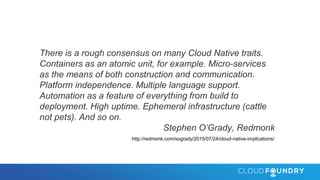
There is a rough consensus on many Cloud Native traits.
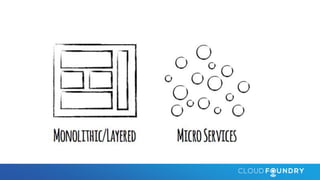
Containers as an atomic unit, for example. Micro-services
as the means of both construction and communication.
Platform independence. Multiple language support.
Automation as a feature of everything from build to
deployment. High uptime. Ephemeral infrastructure (cattle
not pets). And so on.
Stephen O’Grady, Redmonk
http://redmonk.com/sogrady/2015/07/24/cloud-native-implications/
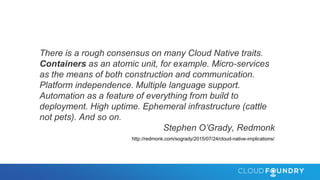
There is a rough consensus on many Cloud Native traits.
Containers as an atomic unit, for example. Micro-services
as the means of both construction and communication.
Platform independence. Multiple language support.
Automation as a feature of everything from build to
deployment. High uptime. Ephemeral infrastructure (cattle
not pets). And so on.
Stephen O’Grady, Redmonk
http://redmonk.com/sogrady/2015/07/24/cloud-native-implications/
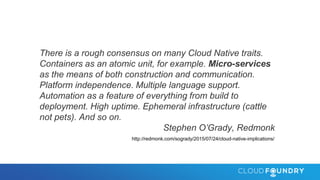
There is a rough consensus on many Cloud Native traits.
Containers as an atomic unit, for example. Micro-services
as the means of both construction and communication.
Platform independence. Multiple language support.
Automation as a feature of everything from build to
deployment. High uptime. Ephemeral infrastructure (cattle
not pets). And so on.
Stephen O’Grady, Redmonk
http://redmonk.com/sogrady/2015/07/24/cloud-native-implications/
There is a rough consensus on many Cloud Native traits.
Containers as an atomic unit, for example. Micro-services
as the means of both construction and communication.
Platform independence. Multiple language support.
Automation as a feature of everything from build to
deployment. High uptime. Ephemeral infrastructure (cattle
not pets). And so on.
Stephen O’Grady, Redmonk
http://redmonk.com/sogrady/2015/07/24/cloud-native-implications/
There is a rough consensus on many Cloud Native traits.
Containers as an atomic unit, for example. Micro-services
as the means of both construction and communication.
Platform independence. Multiple language support.
Automation as a feature of everything from build to
deployment. High uptime. Ephemeral infrastructure (cattle
not pets). And so on.
Stephen O’Grady, Redmonk
http://redmonk.com/sogrady/2015/07/24/cloud-native-implications/
There is a rough consensus on many Cloud Native traits.
Containers as an atomic unit, for example. Micro-services
as the means of both construction and communication.
Platform independence. Multiple language support.
Automation as a feature of everything from build to
deployment. High uptime. Ephemeral infrastructure (cattle
not pets). And so on.
Stephen O’Grady, Redmonk
http://redmonk.com/sogrady/2015/07/24/cloud-native-implications/
There is a rough consensus on many Cloud Native traits.
Containers as an atomic unit, for example. Micro-services
as the means of both construction and communication.
Platform independence. Multiple language support.
Automation as a feature of everything from build to
deployment. High uptime. Ephemeral infrastructure (cattle
not pets). And so on.
Stephen O’Grady, Redmonk
http://redmonk.com/sogrady/2015/07/24/cloud-native-implications/
The Cloud Native Advantage:
Simple Patterns
Highly Automated
Scaled with Ease
Fast, Safe, Scalable… Pick 3
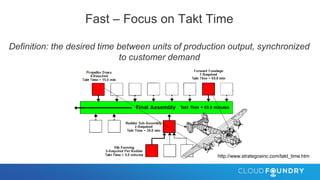
Fast – Focus on Takt Time
Definition: the desired time between units of production output, synchronized
to customer demand
http://www.strategosinc.com/takt_time.htm
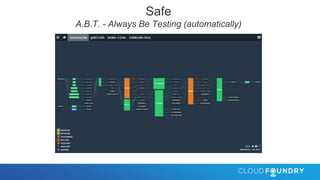
Safe
A.B.T. - Always Be Testing (automatically)
Safe – Runtime Characteristics Matter
• Visibility – Measure all the things. Translate data into knowledge. (see:
OODA loop)
• Fault Isolation – Smaller applications, released independently, isolate the
scope of a fault condition.
• Fault Tolerance – Failures happen (see: Circuit Breaker Pattern / Design
for Failure)
• Autonomic Recovery – Humans have better things to do at night
Scale – Prepare (as best you can) to Succeed
• Demand elastic infrastructure
• Separate concerns - Isolated ephemeral services, Solve persistence
independently
• Accept that the scalability of a system can be a series of plateaus
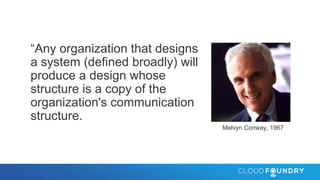
“Any organization that designs
a system (defined broadly) will
produce a design whose
structure is a copy of the
organization's communication
structure.
Melvyn Conway, 1967
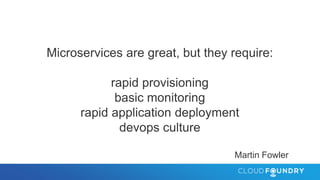
Microservices are great, but they require:
rapid provisioning
basic monitoring
rapid application deployment
devops culture
Martin Fowler
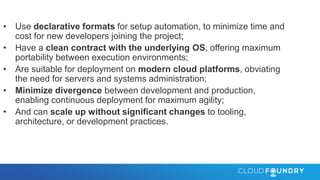
• Use declarative formats for setup automation, to minimize time and
cost for new developers joining the project;
• Have a clean contract with the underlying OS, offering maximum
portability between execution environments;
• Are suitable for deployment on modern cloud platforms, obviating
the need for servers and systems administration;
• Minimize divergence between development and production,
enabling continuous deployment for maximum agility;
• And can scale up without significant changes to tooling,
architecture, or development practices.
But even that’s not enough…
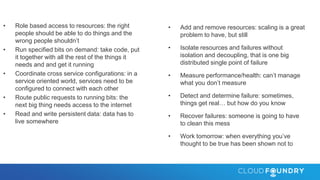
• Role based access to resources: the right
people should be able to do things and the
wrong people shouldn’t
• Run specified bits on demand: take code, put
it together with all the rest of the things it
needs and and get it running
• Coordinate cross service configurations: in a
service oriented world, services need to be
configured to connect with each other
• Route public requests to running bits: the
next big thing needs access to the internet
• Read and write persistent data: data has to
live somewhere
• Add and remove resources: scaling is a great
problem to have, but still
• Isolate resources and failures without
isolation and decoupling, that is one big
distributed single point of failure
• Measure performance/health: can’t manage
what you don’t measure
• Detect and determine failure: sometimes,
things get real… but how do you know
• Recover failures: someone is going to have
to clean this mess
• Work tomorrow: when everything you’ve
thought to be true has been shown not to
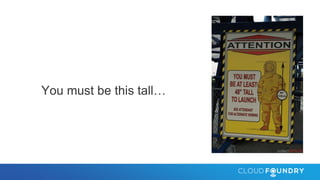
You must be this tall…
We’re going to need a platform
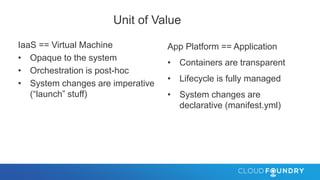
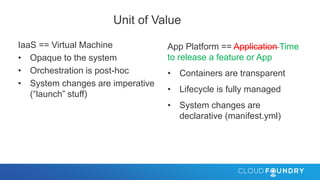
Unit of Value
IaaS == Virtual Machine
• Opaque to the system
• Orchestration is post-hoc
• System changes are imperative
(“launch” stuff)
App Platform == Application
• Containers are transparent
• Lifecycle is fully managed
• System changes are
declarative (manifest.yml)
Unit of Value
IaaS == Virtual Machine
• Opaque to the system
• Orchestration is post-hoc
• System changes are imperative
(“launch” stuff)
App Platform == Application Time
to release a feature or App
• Containers are transparent
• Lifecycle is fully managed
• System changes are
declarative (manifest.yml)
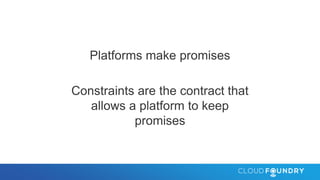
Platforms make promises
Constraints are the contract that
allows a platform to keep
promises
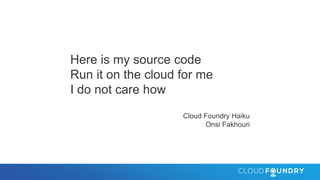
Here is my source code
Run it on the cloud for me
I do not care how
Cloud Foundry Haiku
Onsi Fakhouri
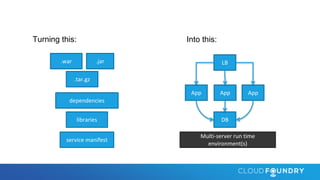
.war .jar
dependencies
libraries
service manifest
App App App
LB
DB
Multi-server run time
environment(s)
.tar.gz
Turning this: Into this:
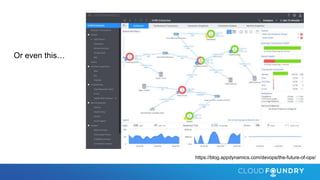
https://blog.appdynamics.com/devops/the-future-of-ops/
Or even this…
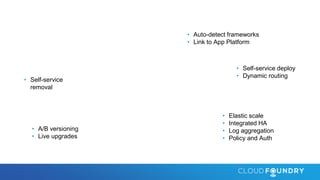
• Auto-detect frameworks
• Link to App Platform
• Self-service deploy
• Dynamic routing
• A/B versioning
• Live upgrades
• Self-service
removal
• Elastic scale
• Integrated HA
• Log aggregation
• Policy and Auth
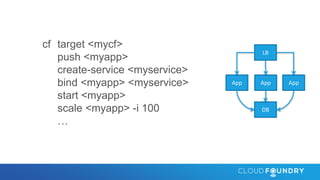
target <mycf>
push <myapp>
create-service <myservice>
bind <myapp> <myservice>
start <myapp>
scale <myapp> -i 100
…
cf
App
DB
LB
App App
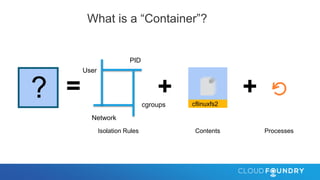
Where’s the container in this
story?
= + +
Contents Processes
?
?
Isolation Rules
PID
User
Network
cgroups cflinuxfs2
What is a “Container”?
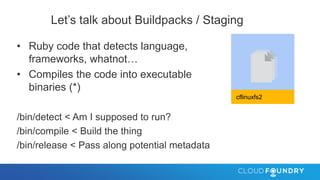
Let’s talk about Buildpacks / Staging
• Ruby code that detects language,
frameworks, whatnot…
• Compiles the code into executable
binaries (*)
/bin/detect < Am I supposed to run?
/bin/compile < Build the thing
/bin/release < Pass along potential metadata
cflinuxfs2
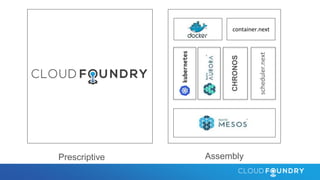
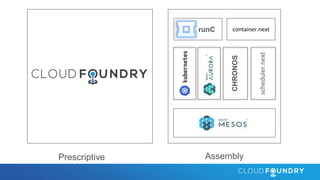
Prescriptive
CHRONOS
scheduler.next
container.next
Assembly
Prescriptive
CHRONOS
scheduler.next
container.next
Assembly
runC
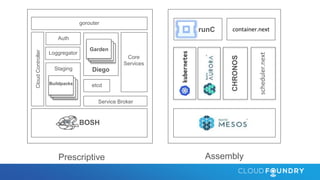
Prescriptive
CHRONOS
scheduler.next
gorouter
CloudController Auth
Loggregator
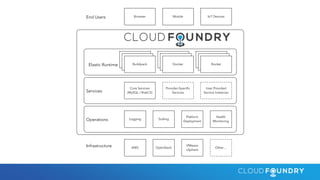
Staging
Buildpacks
BOSH
Service Broker
Diego
Garden
etcd
Core
Services
container.next
Assembly
runC
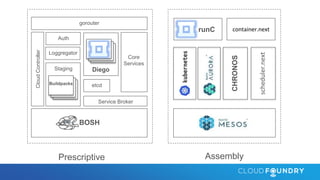
Prescriptive Assembly
CHRONOS
scheduler.next
gorouter
CloudController Auth
Loggregator
Staging
Buildpacks
BOSH
Service Broker
Diego
etcd
Core
Services
container.nextrunC
That was all about 12 factor
apps…
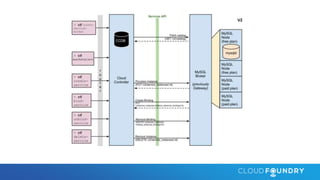
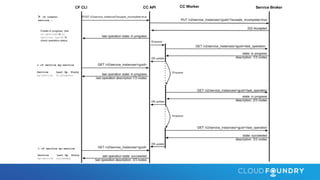
What about services?
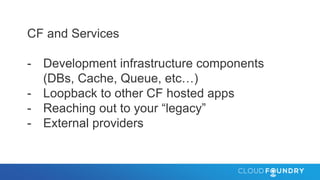
CF and Services
- Development infrastructure components
(DBs, Cache, Queue, etc…)
- Loopback to other CF hosted apps
- Reaching out to your “legacy”
- External providers
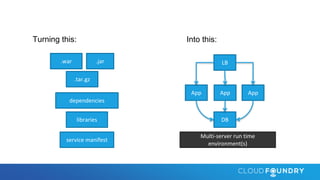
.war .jar
dependencies
libraries
service manifest
App App App
LB
DB
Multi-server run time
environment(s)
.tar.gz
Turning this: Into this:
The Cloud Native Advantage:
Simple Patterns
Highly Automated
Scaled with Ease
cloudfoundry.org

Going Cloud Native with Cloud Foundry

  • 1.
    @chipchilders Chip Childers, VPTechnology Cloud Foundry Foundation Going Cloud Native with Cloud Foundry
  • 2.
    Why does CloudNative matter?
  • 3.
    Since 2000, 52%of the Fortune 500 are no longer on the list
  • 4.
  • 5.
    There is arough consensus on many Cloud Native traits. Containers as an atomic unit, for example. Micro-services as the means of both construction and communication. Platform independence. Multiple language support. Automation as a feature of everything from build to deployment. High uptime. Ephemeral infrastructure (cattle not pets). And so on. Stephen O’Grady, Redmonk http://redmonk.com/sogrady/2015/07/24/cloud-native-implications/
  • 6.
    There is arough consensus on many Cloud Native traits. Containers as an atomic unit, for example. Micro-services as the means of both construction and communication. Platform independence. Multiple language support. Automation as a feature of everything from build to deployment. High uptime. Ephemeral infrastructure (cattle not pets). And so on. Stephen O’Grady, Redmonk http://redmonk.com/sogrady/2015/07/24/cloud-native-implications/
  • 7.
    There is arough consensus on many Cloud Native traits. Containers as an atomic unit, for example. Micro-services as the means of both construction and communication. Platform independence. Multiple language support. Automation as a feature of everything from build to deployment. High uptime. Ephemeral infrastructure (cattle not pets). And so on. Stephen O’Grady, Redmonk http://redmonk.com/sogrady/2015/07/24/cloud-native-implications/
  • 8.
    There is arough consensus on many Cloud Native traits. Containers as an atomic unit, for example. Micro-services as the means of both construction and communication. Platform independence. Multiple language support. Automation as a feature of everything from build to deployment. High uptime. Ephemeral infrastructure (cattle not pets). And so on. Stephen O’Grady, Redmonk http://redmonk.com/sogrady/2015/07/24/cloud-native-implications/
  • 9.
    There is arough consensus on many Cloud Native traits. Containers as an atomic unit, for example. Micro-services as the means of both construction and communication. Platform independence. Multiple language support. Automation as a feature of everything from build to deployment. High uptime. Ephemeral infrastructure (cattle not pets). And so on. Stephen O’Grady, Redmonk http://redmonk.com/sogrady/2015/07/24/cloud-native-implications/
  • 10.
    There is arough consensus on many Cloud Native traits. Containers as an atomic unit, for example. Micro-services as the means of both construction and communication. Platform independence. Multiple language support. Automation as a feature of everything from build to deployment. High uptime. Ephemeral infrastructure (cattle not pets). And so on. Stephen O’Grady, Redmonk http://redmonk.com/sogrady/2015/07/24/cloud-native-implications/
  • 11.
    There is arough consensus on many Cloud Native traits. Containers as an atomic unit, for example. Micro-services as the means of both construction and communication. Platform independence. Multiple language support. Automation as a feature of everything from build to deployment. High uptime. Ephemeral infrastructure (cattle not pets). And so on. Stephen O’Grady, Redmonk http://redmonk.com/sogrady/2015/07/24/cloud-native-implications/
  • 12.
    The Cloud NativeAdvantage: Simple Patterns Highly Automated Scaled with Ease
  • 13.
  • 14.
    Fast – Focuson Takt Time Definition: the desired time between units of production output, synchronized to customer demand http://www.strategosinc.com/takt_time.htm
  • 15.
    Safe A.B.T. - AlwaysBe Testing (automatically)
  • 16.
    Safe – RuntimeCharacteristics Matter • Visibility – Measure all the things. Translate data into knowledge. (see: OODA loop) • Fault Isolation – Smaller applications, released independently, isolate the scope of a fault condition. • Fault Tolerance – Failures happen (see: Circuit Breaker Pattern / Design for Failure) • Autonomic Recovery – Humans have better things to do at night
  • 17.
    Scale – Prepare(as best you can) to Succeed • Demand elastic infrastructure • Separate concerns - Isolated ephemeral services, Solve persistence independently • Accept that the scalability of a system can be a series of plateaus
  • 19.
    “Any organization thatdesigns a system (defined broadly) will produce a design whose structure is a copy of the organization's communication structure. Melvyn Conway, 1967
  • 20.
    Microservices are great,but they require: rapid provisioning basic monitoring rapid application deployment devops culture Martin Fowler
  • 22.
    • Use declarativeformats for setup automation, to minimize time and cost for new developers joining the project; • Have a clean contract with the underlying OS, offering maximum portability between execution environments; • Are suitable for deployment on modern cloud platforms, obviating the need for servers and systems administration; • Minimize divergence between development and production, enabling continuous deployment for maximum agility; • And can scale up without significant changes to tooling, architecture, or development practices.
  • 23.
    But even that’snot enough…
  • 24.
    • Role basedaccess to resources: the right people should be able to do things and the wrong people shouldn’t • Run specified bits on demand: take code, put it together with all the rest of the things it needs and and get it running • Coordinate cross service configurations: in a service oriented world, services need to be configured to connect with each other • Route public requests to running bits: the next big thing needs access to the internet • Read and write persistent data: data has to live somewhere • Add and remove resources: scaling is a great problem to have, but still • Isolate resources and failures without isolation and decoupling, that is one big distributed single point of failure • Measure performance/health: can’t manage what you don’t measure • Detect and determine failure: sometimes, things get real… but how do you know • Recover failures: someone is going to have to clean this mess • Work tomorrow: when everything you’ve thought to be true has been shown not to
  • 25.
    You must bethis tall…
  • 26.
    We’re going toneed a platform
  • 27.
    Unit of Value IaaS== Virtual Machine • Opaque to the system • Orchestration is post-hoc • System changes are imperative (“launch” stuff) App Platform == Application • Containers are transparent • Lifecycle is fully managed • System changes are declarative (manifest.yml)
  • 28.
    Unit of Value IaaS== Virtual Machine • Opaque to the system • Orchestration is post-hoc • System changes are imperative (“launch” stuff) App Platform == Application Time to release a feature or App • Containers are transparent • Lifecycle is fully managed • System changes are declarative (manifest.yml)
  • 29.
    Platforms make promises Constraintsare the contract that allows a platform to keep promises
  • 30.
    Here is mysource code Run it on the cloud for me I do not care how Cloud Foundry Haiku Onsi Fakhouri
  • 32.
    .war .jar dependencies libraries service manifest AppApp App LB DB Multi-server run time environment(s) .tar.gz Turning this: Into this:
  • 33.
  • 34.
    • Auto-detect frameworks •Link to App Platform • Self-service deploy • Dynamic routing • A/B versioning • Live upgrades • Self-service removal • Elastic scale • Integrated HA • Log aggregation • Policy and Auth
  • 35.
    target <mycf> push <myapp> create-service<myservice> bind <myapp> <myservice> start <myapp> scale <myapp> -i 100 … cf App DB LB App App
  • 36.
  • 38.
    = + + ContentsProcesses ? ? Isolation Rules PID User Network cgroups cflinuxfs2 What is a “Container”?
  • 39.
    Let’s talk aboutBuildpacks / Staging • Ruby code that detects language, frameworks, whatnot… • Compiles the code into executable binaries (*) /bin/detect < Am I supposed to run? /bin/compile < Build the thing /bin/release < Pass along potential metadata cflinuxfs2
  • 40.
  • 41.
  • 42.
  • 43.
  • 44.
    That was allabout 12 factor apps… What about services?
  • 45.
    CF and Services -Development infrastructure components (DBs, Cache, Queue, etc…) - Loopback to other CF hosted apps - Reaching out to your “legacy” - External providers
  • 48.
    .war .jar dependencies libraries service manifest AppApp App LB DB Multi-server run time environment(s) .tar.gz Turning this: Into this:
  • 49.
    The Cloud NativeAdvantage: Simple Patterns Highly Automated Scaled with Ease
  • 50.