International Research Journal of Engineering and Technology (IRJET) e-ISSN: 2395-0056
Volume: 09 Issue: 08 | Aug 2022 www.irjet.net p-ISSN: 2395-0072
© 2022, IRJET | Impact Factor value: 7.529 | ISO 9001:2008 Certified Journal | Page 1863
Automatic Solar Panel Cleaner using Arduino
Durgesh Paijanwar[1] , Avinash Musmande[2] , Shubham Pande[3] , Shrikant Mahajan[4],
Bipasa B Patra[5]
[1] – [4] UG Scholar Electrical Department,
[5] Assistant Professor, G.H.Raisoni Institute of Business Management Shirsoli Road Mohadi Jalgaon, Maharashtra
India
----------------------------------------------------------------------***---------------------------------------------------------------------
Abstract - -Solar energy is the most abundant source of
energy on the earth for all forms of life. With the use of solar
panels, we can convert solar energy into electrical energy.
However, keeping the solar panels clean presents numerous
issues, since it necessitates the use of labour and results in
lower efficiency. Our country's solar installed capacity is
around 30.709 GW, and the Indian government has set a
target of 100 GW by 2022.Nearly 42 solar parks have been
built in India to provide land to solar plant developers. Solar
panels' effectiveness decreases as a result of dust, grime, and
moisture, and they become less efficient as well as less
useful. Our project is a solution to these issues.
Key Words - Solar Cleaner, Arduino Solar Cleaner,
Automatic Solar Cleaner, Arduino based, dust cleaner,
panel efficiency
1. INTRODUCTION
This project is about a cleaning system for solar panels.
When dust collects on PV panels, these systems move
around the length of the panels and lean the surface using
various techniques such as brushing, watering, and
mopping. This project was chosen because of the working
circumstances that occur when dust collects on the panels.
Cleaning is done with the assistance of motors positioned
on the sloped panels. A mechanical system that combines
brushes and sponges with water sprinklers to effectively
clean dust and stains caused by water droplets. The Mulshi
solar power plant, a 3 MW solar
power plant planned and built by Tata Power Solar in
March 2011, supplies energy to over 2 million houses and
has created jobs in the surrounding area.
2. OVERVIEW
In March 2011, Tata Power Solar completed a 3 MW solar
power facility for the company, using cells and modules
developed in-house. The project was developed on 13 acres
of land, with the site's natural landscape intact. This solar
PV project in Mulshi, India, was completed in a record-
breaking nine months and put into service in two phases –
1 MW and 2 MW, respectively, in January and March 2011.
Carbon Project Power: 3 Mwproject Type: Power Producer
Footprint Reduced: 12 Tones Per Yeartime to Complete
Project: 16 Months Land Approximately 13 Acres module
Count: 16,000 Modules Crystalline Technology 230 Wp Si
3. CELL TEMPRETURE
As stated previously, expensive hazard: increased
possibilities of an accident Problems with the lungs and
respiratory organs are among the health issues that people
face. Unavailability of labors for these jobs: workers are
hesitant to take over work / jobs since they are not
interested in doing them. Factors impacting solar power
plant efficiency the state of the air According to new
research, a combination of airborne pollutants and dust
buildup can cause solar arrays to fail. Solar panels can only
absorb a small percentage of the sunlight that strikes them,
even in ideal conditions. The effectiveness of the solar
panels was monitored over time as they became dirtier.
They discovered that just a few weeks of build-up was
enough to block out most of the sunlight.
4. SOLUTION
You should make sure that the solar panels are installed in
such a way that they receive adequate airflow even as the
temperature rises. When the temperature changes, the I-V
and P-V properties at constant light are shown in the
diagram [4]. Temperature effects are a byproduct of
crystalline silicon cell-based modules' inherent
characteristics. When the temperature drops, they produce
more voltage, and when the temperature rises, they lose
voltage. This temperature effect must be factored into any
solar panel or system de-rating calculations.
5. SOLAR PITCH AND ORIENTATION
In the Northern Hemisphere, a non-tracking PV system
should face true south. If you live in Flagstaff, Arizona,
which is 35.2 degrees north of the equator, your panel
should face directly south at a 35.2-degree angle. If the
solar panels are to be mounted on a roof, remember to
account for the roof's pitch. Adjust your solar panels twice
a year for optimal performance. When the sun is high
overhead in the summer, tilt the solar panel at a lower
angle to catch more sunlight. Because the sun moves across
International Research Journal of Engineering and Technology (IRJET) e-ISSN: 2395-0056
Volume: 09 Issue: 08 | Aug 2022 www.irjet.net p-ISSN: 2395-0072
© 2022, IRJET | Impact Factor value: 7.529 | ISO 9001:2008 Certified Journal | Page 1864
the sky at a lower angle in the winter, solar panels should
be angled higher during this time. Solar tracking systems in
large commercial systems follow the sun automatically.
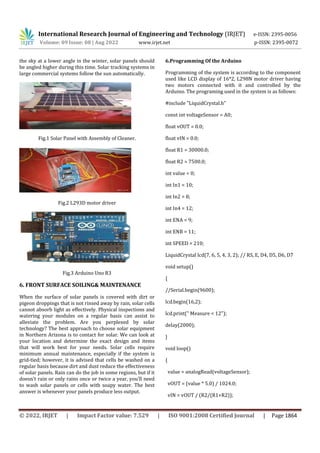
Fig.1 Solar Panel with Assembly of Cleaner.
Fig.2 L293D motor driver
Fig.3 Arduino Uno R3
6. FRONT SURFACE SOILING& MAINTENANCE
When the surface of solar panels is covered with dirt or
pigeon droppings that is not rinsed away by rain, solar cells
cannot absorb light as effectively. Physical inspections and
watering your modules on a regular basis can assist to
alleviate the problem. Are you perplexed by solar
technology? The best approach to choose solar equipment
in Northern Arizona is to contact for solar. We can look at
your location and determine the exact design and items
that will work best for your needs. Solar cells require
minimum annual maintenance, especially if the system is
grid-tied; however, it is advised that cells be washed on a
regular basis because dirt and dust reduce the effectiveness
of solar panels. Rain can do the job in some regions, but if it
doesn't rain or only rains once or twice a year, you'll need
to wash solar panels or cells with soapy water. The best
answer is whenever your panels produce less output.
6.Programming Of the Arduino
Programming of the system is according to the component
used like LCD display of 16*2, L298N motor driver having
two motors connected with it and controlled by the
Arduino. The programing used in the system is as follows:
#include "LiquidCrystal.h"
const int voltageSensor = A0;
float vOUT = 0.0;
float vIN = 0.0;
float R1 = 30000.0;
float R2 = 7500.0;
int value = 0;
int In1 = 10;
int In2 = 8;
int In4 = 12;
int ENA = 9;
int ENB = 11;
int SPEED = 210;
LiquidCrystal lcd(7, 6, 5, 4, 3, 2); // RS, E, D4, D5, D6, D7
void setup()
{
//Serial.begin(9600);
lcd.begin(16,2);
lcd.print(" Measure < 12");
delay(2000);
}
void loop()
{
value = analogRead(voltageSensor);
vOUT = (value * 5.0) / 1024.0;
vIN = vOUT / (R2/(R1+R2));
International Research Journal of Engineering and Technology (IRJET) e-ISSN: 2395-0056
Volume: 09 Issue: 08 | Aug 2022 www.irjet.net p-ISSN: 2395-0072
© 2022, IRJET | Impact Factor value: 7.529 | ISO 9001:2008 Certified Journal | Page 1865
//Serial.print("Input = ");
//Serial.println(vIN);
lcd.setCursor(0,0);
lcd.print("VOLTAGE = ");
lcd.setCursor(9,0);
lcd.print(vIN);
delay(500);
{
if(vIN < 1 )
{ pinMode(In1,OUTPUT);
pinMode(In2,OUTPUT);
pinMode(In4,OUTPUT);
pinMode(ENA,OUTPUT);
pinMode(ENB,OUTPUT);
digitalWrite(In4,HIGH);
analogWrite(ENB,250);
delay(1500);
digitalWrite(In4,LOW);
delay(200);
digitalWrite(In1,HIGH);
digitalWrite(In2,LOW);
analogWrite(ENA,250);
delay(450);
digitalWrite(In1,LOW);
digitalWrite(In2,LOW);
delay(200);
digitalWrite(In1,LOW);
digitalWrite(In2,HIGH);
delay(450);
}
}
7.WORKING SEQUIENCE OF THE SYSTEM
Our project is related to cleaning of the solar panel the
efficiency of the solar plant get reduced due to
accumulation of the dust on the panel, Due to the dusty
atmosphere the dust Gathered on the panel resist and
create the barrier to the sunlight falling the surface of the
panel. So as a remedy the automatic cleaning system is
used for the panel . by using the cleaning system, we can
increase the efficiency as well as increase the life of the
panel. So, if the dust accumulates on it the output voltage
of the panel can be reduced.
so, we connect the voltage sensor to the
system to sense the voltage level if the voltage level is
reduced the Arduino take signal from voltage sensor and
activate the motor and start, he sprays motor to make
panel somewhat wet and then activate another motor if
the wiper to clen the all the dust on the panel this process
will activate till the panel get clear and till recovery of the
reduced voltage level.
8. CONCLUSION
Existing automatic cleaners are primarily designed for big
arrays and are therefore unsuited for use on smaller arrays,
such as residential rooftops. For individuals with limited
space, this means that a smaller array can be installed,
which is a significant benefit for those with smaller sites.
Our technology can be used to connect solar panels to the
roof. The solar panel cleaning system was originally built
with the design requirements in mind. The following
observations were observed once our working model was
put to the test. The brush has a superb cleaning function,
scrubbing the dust that was sticky in nature. It is less
expensive to install and has a short payback period
ACKNOWLEDGMENT
It gives me great pleasure to deliver this project
dissertation, but we would be remiss if we did not thank
the contributions of a few individuals without whom this
work would not have been possible. We would want to
convey my heartfelt gratitude to our project guide and the
esteemed HOD of the electrical department
REFERENCES
[1] Nurul F. Zainuddin, M. N. Mohammed, S. Al-Zubeidi and
Sami I. Khogali. "Design And Development of Smart Self-
Cleaning Solar Panel System" 2019 IEEE International
Conference on Automatic Control and intelligent Systems
(12CACIS 2019), 29 June 2019.
[2] Falah Mustafa, Adeel And Sahb, A. Salam Al-Ammri,
Areej Ghazi "Self Cleaning Control System for PV Solar
International Research Journal of Engineering and Technology (IRJET) e-ISSN: 2395-0056
Volume: 09 Issue: 08 | Aug 2022 www.irjet.net p-ISSN: 2395-0072
© 2022, IRJET | Impact Factor value: 7.529 | ISO 9001:2008 Certified Journal | Page 1866
Panel Street Light" 978- 1- 4799-7947-9/15, 2015 6th
International Renewable Energy Congress (IREC)
[3] Rutvij P. Kulkarni, Mandar A. Kadam, Tushar T. Shinde,
Nitin B. Sonone, Prof. Atul D. Atalkar "Automatic Solar
Panel Cleaning System" International Journal of Advance
Research in Science and Engineering (IJARSE) Volume:07
Issue:07 ISSN: 2319-8354.
[4] Manju B, Abdul Bari, Pavan C M "Automatic Solar Panel
Cleaning System" International Journal of Advance in
Scientific Research and Engineering (IJASRE), Volume:04,
Issue:07, Julay-2018, E-ISSN: 2454-8006
[5] Masuda S, Aoyoma M. Characteristics of electric dust
collector based on electric curtain. Proceedings of the
General Conference of the Institute of Electronic
Engineers. Japan, 1971, No. 821 Proc. of Albany Conference
on Electrostatics (1971).
[6] Williams R B, Tanimoto R, Simonyan A, et al. Vibration
characterization of self-cleaning solarpanels with
piezoceramic actuation. Collection of Technical Papers-
48th AIAA/ASME/ASCE/AHS/ASC Structures, Structural
Dynamics, and Materials Conference ,2007; pp. 512-520.
[7] Park Y B, Im H, Im M, et al. Self-cleaning effect of highly
waterrepellent microshell structures for solar cell
applications. Journal of Materials Chemistry, 2011;
21:633–636.
[8] Zhu Jia, Hsu Ching Mei, Yu Zongfu, et al. Nanodome
solar cells with efficient light management and self-
cleaning. Nano Letter, 2010; 10:1979–1984.
[9] Masuda S, Aoyoma M. Characteristics of electric dust
collector based on electric curtain. Proceedings of the
General Conference of the Institute of Electronic
Engineers. Japan, 1971, No. 821 Proc. of Albany Conference
on Electrostatics (1971).
[10] Calle C I, McFall J L, Buhler C R, et al. Dust particle
removal by electrostatic and dielectrophoretic forces with
applications to NASA exploration missions. Proc. ESA
Annual Meeting on Electrostatics, 2008; Paper O1.
[11] Patra, Bipasa Bimalendu, "Smart Grid-Sustainable
Shaping of the Future Smarter Nation." In International
Journal of Emerging Technology and Advanced
Engineering, First International Conference on Innovations
& Engineering, vol. 8, pp. 101-107.
[12] Patra, B. B. "Smart Grid-Sustainable Shaping of the
Future Smarter Nation". In International Journal of
Emerging Technology and Advanced Engineering, First
International Conference on Innovations & Engineering
(Vol. 8, pp. 101-107).
[13] Patra, B. B. "Necessity for Future Smarter Nation with
a Sustainable Trend-Smart Grid", BUSINESS AND
TECHNOLOGY (IJSSBT), Volume 6, No. 2, September 2018
ISSN (Print) 2277-7261, 35. [14] Bipasa Patra,
YogeshGirase, Mayur N Patil, " Smart electricity
distribution control and relay synchronization system",
International Research Journal of Engineering and
Technology (IRJET), Volume 8 Issue 02 Feb 2021 pp. 1681-
1685, p - ISSN: 2395- 0072. [15] Bipasa Patra, Divyang R
Patil, Harish U Jawale, Paresh D Shirsath, "UV FLOOR
SANITIZATION", International Research Journal of
Engineering and Technology (IRJET), Volume 8 Issue 03
March 2021 pp. 419-422, p - ISSN: 2395-0072. [16] Bipasa
Patra, "Smart Electricity Generation Trends with Solar
Technology – A Transformation", International Journal of
Engineering Research in Electronics and Communication
Engineering, Volume 4 Issue 6, June 2017, pp 394-399,
ISSN (Online) 2394-6849

Automatic Solar Panel Cleaner using Arduino

  • 1.
    International Research Journalof Engineering and Technology (IRJET) e-ISSN: 2395-0056 Volume: 09 Issue: 08 | Aug 2022 www.irjet.net p-ISSN: 2395-0072 © 2022, IRJET | Impact Factor value: 7.529 | ISO 9001:2008 Certified Journal | Page 1863 Automatic Solar Panel Cleaner using Arduino Durgesh Paijanwar[1] , Avinash Musmande[2] , Shubham Pande[3] , Shrikant Mahajan[4], Bipasa B Patra[5] [1] – [4] UG Scholar Electrical Department, [5] Assistant Professor, G.H.Raisoni Institute of Business Management Shirsoli Road Mohadi Jalgaon, Maharashtra India ----------------------------------------------------------------------***--------------------------------------------------------------------- Abstract - -Solar energy is the most abundant source of energy on the earth for all forms of life. With the use of solar panels, we can convert solar energy into electrical energy. However, keeping the solar panels clean presents numerous issues, since it necessitates the use of labour and results in lower efficiency. Our country's solar installed capacity is around 30.709 GW, and the Indian government has set a target of 100 GW by 2022.Nearly 42 solar parks have been built in India to provide land to solar plant developers. Solar panels' effectiveness decreases as a result of dust, grime, and moisture, and they become less efficient as well as less useful. Our project is a solution to these issues. Key Words - Solar Cleaner, Arduino Solar Cleaner, Automatic Solar Cleaner, Arduino based, dust cleaner, panel efficiency 1. INTRODUCTION This project is about a cleaning system for solar panels. When dust collects on PV panels, these systems move around the length of the panels and lean the surface using various techniques such as brushing, watering, and mopping. This project was chosen because of the working circumstances that occur when dust collects on the panels. Cleaning is done with the assistance of motors positioned on the sloped panels. A mechanical system that combines brushes and sponges with water sprinklers to effectively clean dust and stains caused by water droplets. The Mulshi solar power plant, a 3 MW solar power plant planned and built by Tata Power Solar in March 2011, supplies energy to over 2 million houses and has created jobs in the surrounding area. 2. OVERVIEW In March 2011, Tata Power Solar completed a 3 MW solar power facility for the company, using cells and modules developed in-house. The project was developed on 13 acres of land, with the site's natural landscape intact. This solar PV project in Mulshi, India, was completed in a record- breaking nine months and put into service in two phases – 1 MW and 2 MW, respectively, in January and March 2011. Carbon Project Power: 3 Mwproject Type: Power Producer Footprint Reduced: 12 Tones Per Yeartime to Complete Project: 16 Months Land Approximately 13 Acres module Count: 16,000 Modules Crystalline Technology 230 Wp Si 3. CELL TEMPRETURE As stated previously, expensive hazard: increased possibilities of an accident Problems with the lungs and respiratory organs are among the health issues that people face. Unavailability of labors for these jobs: workers are hesitant to take over work / jobs since they are not interested in doing them. Factors impacting solar power plant efficiency the state of the air According to new research, a combination of airborne pollutants and dust buildup can cause solar arrays to fail. Solar panels can only absorb a small percentage of the sunlight that strikes them, even in ideal conditions. The effectiveness of the solar panels was monitored over time as they became dirtier. They discovered that just a few weeks of build-up was enough to block out most of the sunlight. 4. SOLUTION You should make sure that the solar panels are installed in such a way that they receive adequate airflow even as the temperature rises. When the temperature changes, the I-V and P-V properties at constant light are shown in the diagram [4]. Temperature effects are a byproduct of crystalline silicon cell-based modules' inherent characteristics. When the temperature drops, they produce more voltage, and when the temperature rises, they lose voltage. This temperature effect must be factored into any solar panel or system de-rating calculations. 5. SOLAR PITCH AND ORIENTATION In the Northern Hemisphere, a non-tracking PV system should face true south. If you live in Flagstaff, Arizona, which is 35.2 degrees north of the equator, your panel should face directly south at a 35.2-degree angle. If the solar panels are to be mounted on a roof, remember to account for the roof's pitch. Adjust your solar panels twice a year for optimal performance. When the sun is high overhead in the summer, tilt the solar panel at a lower angle to catch more sunlight. Because the sun moves across
  • 2.
    International Research Journalof Engineering and Technology (IRJET) e-ISSN: 2395-0056 Volume: 09 Issue: 08 | Aug 2022 www.irjet.net p-ISSN: 2395-0072 © 2022, IRJET | Impact Factor value: 7.529 | ISO 9001:2008 Certified Journal | Page 1864 the sky at a lower angle in the winter, solar panels should be angled higher during this time. Solar tracking systems in large commercial systems follow the sun automatically. Fig.1 Solar Panel with Assembly of Cleaner. Fig.2 L293D motor driver Fig.3 Arduino Uno R3 6. FRONT SURFACE SOILING& MAINTENANCE When the surface of solar panels is covered with dirt or pigeon droppings that is not rinsed away by rain, solar cells cannot absorb light as effectively. Physical inspections and watering your modules on a regular basis can assist to alleviate the problem. Are you perplexed by solar technology? The best approach to choose solar equipment in Northern Arizona is to contact for solar. We can look at your location and determine the exact design and items that will work best for your needs. Solar cells require minimum annual maintenance, especially if the system is grid-tied; however, it is advised that cells be washed on a regular basis because dirt and dust reduce the effectiveness of solar panels. Rain can do the job in some regions, but if it doesn't rain or only rains once or twice a year, you'll need to wash solar panels or cells with soapy water. The best answer is whenever your panels produce less output. 6.Programming Of the Arduino Programming of the system is according to the component used like LCD display of 16*2, L298N motor driver having two motors connected with it and controlled by the Arduino. The programing used in the system is as follows: #include "LiquidCrystal.h" const int voltageSensor = A0; float vOUT = 0.0; float vIN = 0.0; float R1 = 30000.0; float R2 = 7500.0; int value = 0; int In1 = 10; int In2 = 8; int In4 = 12; int ENA = 9; int ENB = 11; int SPEED = 210; LiquidCrystal lcd(7, 6, 5, 4, 3, 2); // RS, E, D4, D5, D6, D7 void setup() { //Serial.begin(9600); lcd.begin(16,2); lcd.print(" Measure < 12"); delay(2000); } void loop() { value = analogRead(voltageSensor); vOUT = (value * 5.0) / 1024.0; vIN = vOUT / (R2/(R1+R2));
  • 3.
    International Research Journalof Engineering and Technology (IRJET) e-ISSN: 2395-0056 Volume: 09 Issue: 08 | Aug 2022 www.irjet.net p-ISSN: 2395-0072 © 2022, IRJET | Impact Factor value: 7.529 | ISO 9001:2008 Certified Journal | Page 1865 //Serial.print("Input = "); //Serial.println(vIN); lcd.setCursor(0,0); lcd.print("VOLTAGE = "); lcd.setCursor(9,0); lcd.print(vIN); delay(500); { if(vIN < 1 ) { pinMode(In1,OUTPUT); pinMode(In2,OUTPUT); pinMode(In4,OUTPUT); pinMode(ENA,OUTPUT); pinMode(ENB,OUTPUT); digitalWrite(In4,HIGH); analogWrite(ENB,250); delay(1500); digitalWrite(In4,LOW); delay(200); digitalWrite(In1,HIGH); digitalWrite(In2,LOW); analogWrite(ENA,250); delay(450); digitalWrite(In1,LOW); digitalWrite(In2,LOW); delay(200); digitalWrite(In1,LOW); digitalWrite(In2,HIGH); delay(450); } } 7.WORKING SEQUIENCE OF THE SYSTEM Our project is related to cleaning of the solar panel the efficiency of the solar plant get reduced due to accumulation of the dust on the panel, Due to the dusty atmosphere the dust Gathered on the panel resist and create the barrier to the sunlight falling the surface of the panel. So as a remedy the automatic cleaning system is used for the panel . by using the cleaning system, we can increase the efficiency as well as increase the life of the panel. So, if the dust accumulates on it the output voltage of the panel can be reduced. so, we connect the voltage sensor to the system to sense the voltage level if the voltage level is reduced the Arduino take signal from voltage sensor and activate the motor and start, he sprays motor to make panel somewhat wet and then activate another motor if the wiper to clen the all the dust on the panel this process will activate till the panel get clear and till recovery of the reduced voltage level. 8. CONCLUSION Existing automatic cleaners are primarily designed for big arrays and are therefore unsuited for use on smaller arrays, such as residential rooftops. For individuals with limited space, this means that a smaller array can be installed, which is a significant benefit for those with smaller sites. Our technology can be used to connect solar panels to the roof. The solar panel cleaning system was originally built with the design requirements in mind. The following observations were observed once our working model was put to the test. The brush has a superb cleaning function, scrubbing the dust that was sticky in nature. It is less expensive to install and has a short payback period ACKNOWLEDGMENT It gives me great pleasure to deliver this project dissertation, but we would be remiss if we did not thank the contributions of a few individuals without whom this work would not have been possible. We would want to convey my heartfelt gratitude to our project guide and the esteemed HOD of the electrical department REFERENCES [1] Nurul F. Zainuddin, M. N. Mohammed, S. Al-Zubeidi and Sami I. Khogali. "Design And Development of Smart Self- Cleaning Solar Panel System" 2019 IEEE International Conference on Automatic Control and intelligent Systems (12CACIS 2019), 29 June 2019. [2] Falah Mustafa, Adeel And Sahb, A. Salam Al-Ammri, Areej Ghazi "Self Cleaning Control System for PV Solar
  • 4.
    International Research Journalof Engineering and Technology (IRJET) e-ISSN: 2395-0056 Volume: 09 Issue: 08 | Aug 2022 www.irjet.net p-ISSN: 2395-0072 © 2022, IRJET | Impact Factor value: 7.529 | ISO 9001:2008 Certified Journal | Page 1866 Panel Street Light" 978- 1- 4799-7947-9/15, 2015 6th International Renewable Energy Congress (IREC) [3] Rutvij P. Kulkarni, Mandar A. Kadam, Tushar T. Shinde, Nitin B. Sonone, Prof. Atul D. Atalkar "Automatic Solar Panel Cleaning System" International Journal of Advance Research in Science and Engineering (IJARSE) Volume:07 Issue:07 ISSN: 2319-8354. [4] Manju B, Abdul Bari, Pavan C M "Automatic Solar Panel Cleaning System" International Journal of Advance in Scientific Research and Engineering (IJASRE), Volume:04, Issue:07, Julay-2018, E-ISSN: 2454-8006 [5] Masuda S, Aoyoma M. Characteristics of electric dust collector based on electric curtain. Proceedings of the General Conference of the Institute of Electronic Engineers. Japan, 1971, No. 821 Proc. of Albany Conference on Electrostatics (1971). [6] Williams R B, Tanimoto R, Simonyan A, et al. Vibration characterization of self-cleaning solarpanels with piezoceramic actuation. Collection of Technical Papers- 48th AIAA/ASME/ASCE/AHS/ASC Structures, Structural Dynamics, and Materials Conference ,2007; pp. 512-520. [7] Park Y B, Im H, Im M, et al. Self-cleaning effect of highly waterrepellent microshell structures for solar cell applications. Journal of Materials Chemistry, 2011; 21:633–636. [8] Zhu Jia, Hsu Ching Mei, Yu Zongfu, et al. Nanodome solar cells with efficient light management and self- cleaning. Nano Letter, 2010; 10:1979–1984. [9] Masuda S, Aoyoma M. Characteristics of electric dust collector based on electric curtain. Proceedings of the General Conference of the Institute of Electronic Engineers. Japan, 1971, No. 821 Proc. of Albany Conference on Electrostatics (1971). [10] Calle C I, McFall J L, Buhler C R, et al. Dust particle removal by electrostatic and dielectrophoretic forces with applications to NASA exploration missions. Proc. ESA Annual Meeting on Electrostatics, 2008; Paper O1. [11] Patra, Bipasa Bimalendu, "Smart Grid-Sustainable Shaping of the Future Smarter Nation." In International Journal of Emerging Technology and Advanced Engineering, First International Conference on Innovations & Engineering, vol. 8, pp. 101-107. [12] Patra, B. B. "Smart Grid-Sustainable Shaping of the Future Smarter Nation". In International Journal of Emerging Technology and Advanced Engineering, First International Conference on Innovations & Engineering (Vol. 8, pp. 101-107). [13] Patra, B. B. "Necessity for Future Smarter Nation with a Sustainable Trend-Smart Grid", BUSINESS AND TECHNOLOGY (IJSSBT), Volume 6, No. 2, September 2018 ISSN (Print) 2277-7261, 35. [14] Bipasa Patra, YogeshGirase, Mayur N Patil, " Smart electricity distribution control and relay synchronization system", International Research Journal of Engineering and Technology (IRJET), Volume 8 Issue 02 Feb 2021 pp. 1681- 1685, p - ISSN: 2395- 0072. [15] Bipasa Patra, Divyang R Patil, Harish U Jawale, Paresh D Shirsath, "UV FLOOR SANITIZATION", International Research Journal of Engineering and Technology (IRJET), Volume 8 Issue 03 March 2021 pp. 419-422, p - ISSN: 2395-0072. [16] Bipasa Patra, "Smart Electricity Generation Trends with Solar Technology – A Transformation", International Journal of Engineering Research in Electronics and Communication Engineering, Volume 4 Issue 6, June 2017, pp 394-399, ISSN (Online) 2394-6849