S.Y.B.Sc. Sem.I Physics Skill Enhancement Course I
Solar Energy
1 Dr. Mrs. Pritee Raotole , MGSM’s, ASC, College, Chopda
UNIT – 2
SolarEnergy
Syllabus: Solar Energy, Its Importance, Storage of Solar Energy, Solar Pond, Non Convective
Solar Pond, Applications of Solar Pond and Solar Energy, Solar Water Heater, Flat Plate
Collector, Solar Distillation, Solar Cooker, Solar Green Houses, Solar Cell, Absorption Air
Conditioning. Need and Characteristics of Photovoltaic (PV) Systems, PV Models And
Equivalent Circuits, And Sun Tracking Systems. Solar Energy Utilization By Solar Roof
Panels. (06 L,12 M)
2.1 INTRODUCTION TO SOLAR ENERGY:
Solar energy is a safe alternative which can replace current fossil fuels like coal and
gas for generation of electricity that produce air, water, and land pollution. Electricity
generation from fossil fuels causes pollution of air leading to acid rain, damaged forest
areas, and affected agricultural production leading to loss of billions of dollars
worldwide. Solar energy is a major renewable energy source with the potential to meet
many of the challenges facing the world. Solar energy - a clean source. No greenhouse gas
emissions are released into the atmosphere when you use solar panels to create electricity.
And because the sun provides more energy than we'll ever need, electricity from solar
power is a very important energy source in the move to clean energy production.
2.2 IMPORTANCE OF SOLAR ENERGY:
 Photovoltaic systems (PV systems) are a renewable energy technology which
transforms the energy from the sun into electricity using photovoltaics. These
photovoltaics, also known as solar panels, provide a reliable green energy solution.
 A solar PV system is a sustainable, low-maintenance option for anyone who wants
to contribute to a greener environment, as the system does not cause any pollution
or emissions and has numerous advantages.
 Photovoltaic systems use photovoltaic cells to collect solar energy from the
sunlight, and converts it into direct current (DC) electricity. The reflection of the
S.Y.B.Sc. Sem.I Physics Skill Enhancement Course I
Solar Energy
2 Dr. Mrs. Pritee Raotole , MGSM’s, ASC, College, Chopda
sunlight will create an electric field across photovoltaic systems, causing electricity
to flow.
 The DC electricity will be transported to an inverter, which will convert this DC
power into alternating current (AC). This AC power is the type of electricity which
is used for the electric appliances in your home, also referred to as AC load.
2.3 STORAGE OF SOLAR ENERGY:
For solar electricity, it is stored using either batteries or the grid. For solar heating, it
is stored using thermal mass, water tanks, or swimming pool water. One of the drawbacks
of solar energy systems is that the Sun doesn't provide a constant stream of energy.
Homeowners are able to generate solar electricity by using a photovoltaic solar
power system. There are two primary methods of Energy Storage with a PV solar
power system-
 Battery Banks
 Grid Inter-Tie
One way solar power storage can be accomplished is by using a battery bank to store the
electricity generated by the PV solar power system. A battery solar power storage system is
used in a grid-tied PV system with battery backup and stand-alone PV systems.
The major components of a battery solar power system are...
 Charge Controller: Prevents the battery bank from overcharging by interrupting
the flow of electricity from the PV panels when the battery bank is full.
 Battery Bank: A group of batteries wired together. The batteries are similar to car
batteries, but designed specifically to endure the type of charging and discharging
they'll need to handle in a solar power system.
 System Meter: Measures and displays your solar PV systems performance and
status.
 Main DC Disconnect: A DC rated breaker between the batteries and the inverter.
Allows the inverter to be quickly disconnected from the battery bank for service.
The third type of PV solar power system is a grid-tied PV system. This system can actually
use the grid as its solar energy storage system. This is done using net-metering. With net-
S.Y.B.Sc. Sem.I Physics Skill Enhancement Course I
Solar Energy
3 Dr. Mrs. Pritee Raotole , MGSM’s, ASC, College, Chopda
metering, when you produce excess solar electricity, you send it to the grid and your
electric meter rolls backwards. Later on, at night for example, when your system is not
producing electricity, you can pull electricity from the grid and your electric meter will roll
forward. You are essentially using the grid to store your solar electricity!
Solar Thermal Storage
There are three solar heating applications-
 Solar Space Heating
 Solar Water Heating
 Solar Pool Heating
Each of these solar heating applications uses their own methods for Solar Thermal Energy
Storage.
Thermal mass and water tanks are the two primary methods of storing solar energy in solar
space heating systems.
 Thermal Mass: Used in both passive and active space heating systems. Absorbs
heat during the day and slowly releases it at night.
 Water Tanks: Used in active liquid systems. A heat-exchanger transfers the heat
from the heat-transfer fluid to the water in the tank.
 Solar water heating systems use water tanks for the storage of solar energy. Both
passive and active solar water heating use water tanks. Active indirect systems use a
heat-exchanger to transfer the heat from the heat-transfer fluid. The other solar
water heating systems use the actual household water and therefore do not need a
water tank with a heat-exchanger.
 Solar pool heating uses the swimming pool water for solar energy storage. By
circulating your swimming pool water through solar pool collectors, you will be
able to extend your swimming season.
2.4 SOLAR POND:
A solar pond is, simply, a pool of saltwater which collects and stores solar thermal
energy. The saltwater naturally forms a vertical salinity gradient also known as a
S.Y.B.Sc. Sem.I Physics Skill Enhancement Course I
Solar Energy
4 Dr. Mrs. Pritee Raotole , MGSM’s, ASC, College, Chopda
"halocline", in which low-salinity water floats on top of high-salinity water. The
layers of salt solutions increase in concentration (and therefore density) with depth.
Below a certain depth, the solution has a uniformly high salt concentration.
The solar pond works on a very simple principle. It is well-known that water or air
is heated they become lighter and rise upward e.g. a hot air balloon. Similarly, in an
ordinary pond, the sun’s rays heat the water and the heated water from within the
pond rises and reaches the top but loses the heat into the atmosphere. The net result
is that the pond water remains at the atmospheric temperature. The solar pond
restricts this tendency by dissolving salt in the bottom layer of the pond making it
too heavy to rise.
A solar pond has three zones. The top zone is the surface zone, or UCZ (Upper
Convective Zone), which is at atmospheric temperature and has little salt content.
The bottom zone is very hot, 70°– 85° C, and is very salty. It is this zone that
collects and stores solar energy in the form of heat, and is, therefore, known as the
storage zone or LCZ (Lower Convective Zone). Separating these two zones is the
important gradient zone or NCZ (Non-Convective Zone). Here the salt content
increases as depth increases, thereby creating a salinity or density gradient. If we
consider a particular layer in this zone, water of that layer cannot rise, as the layer of
water above has less salt content and is, therefore, lighter. Similarly, the water from
this layer cannot fall as the water layer below has a higher salt content and is,
therefore, heavier. This gradient zone acts as a transparent insulator permitting
sunlight to reach the bottom zone but also
Fresh water
Salty water
Very salty
S.Y.B.Sc. Sem.I Physics Skill Enhancement Course I
Solar Energy
5 Dr. Mrs. Pritee Raotole , MGSM’s, ASC, College, Chopda
2.5 NON CONVECTIVE SOLAR POND:
The more common non-convective solar pond reduces heat loss by
preventing convection (the transfer of heat from one place to another by the
movement of fluids) with the addition of a concentration of 20–30 % salt to the
bottom level (lower convective zone) of the pond. When saturated with high
amounts of salt in the form of concentrated brine, the temperature of the bottom
level rises to about 100 °C (212 °F) as heat from the Sun is trapped. The middle
level (non-convective zone) receives a lower amount of salt than the bottom level.
Because it is lighter than the bottom level but heavier than the top level, the water in
the middle level is unable to rise or sink. The middle level, therefore, halts
convection currents and acts as an insulator, trapping sunlight in the bottom level. In
the top level (upper convective zone), where there is little salt, the water remains
cold. Fresh water is added to that level, and saline water is drained. Finally, heat
from the bottom level is transferred to pipes circulating through the pond to
extract thermal energy. So simply Non-convective solar pond is a potential large
surface area solar collector device. It has additional advantage of long term storage
capacity. It is a shallow body of water of about a meter deep containing dissolved
salts to generate a stable density gradient (fresh water on top and denser salt at the
bottom).
2.6 APPLICATIONS OF SOLAR POND AND SOLAR ENERGY:
Is effective method trap solar heat by using ponds. Another way is the use of
hydrodynamic layer flow principle where by the hot fluid is removed at one end into a
heat-exchanger external to the pond and then returns the solution to the other end of the
pond.
Some applications of solar ponds are for heating and cooling of buildings, and power
production. Heat energy stored in the pond may be used for space heating during the
harmattan season. The heat energy is transferred into Air Handling Unit (AHU)
containing heat exchanger coil and fan that blows heated air into the space. This
S.Y.B.Sc. Sem.I Physics Skill Enhancement Course I
Solar Energy
6 Dr. Mrs. Pritee Raotole , MGSM’s, ASC, College, Chopda
arrangement can be incorporated into office complex and estate in the future. Also, hot
water can be extracted from the pond for domestic or industrial needs.
A typical application is heating of greenhouse in U.S.A. Cooling can be achieved by
absorption refrigeration system with generator heated with solar pond. The chiller side
of the refrigerator will then be part of A.H.U. With suitable fluid (Freons) and two heat
exchangers-one on the upper cold water and one on the lower hot water, it is possible to
operate a heat engine for power production. This is the most promising application of
solar pond especially for small developing countries.
2.7 SOLAR WATER HEATER:
A solar water heater is a device that can be used to capture sunlight in order to heat the
water in your pipes to be used for baths, showers, etc.
It consists mainly of:
A thermal panel (solar collector) installed on the roof;
A tank to store hot water;
Accessories, such as a circulating pump to carry the solar energy from the collector
to the tank, and a thermal regulator.
However, a back-up heating system is required for times when there is insufficient
luminosity. The solar water heater absorbs light by means of a collector placed on the
roof and converts it into heat. It passes this heat to a water tank by means of a
circulating pump. This exchange is triggered by the thermal regulator, but only when
the collector is hotter than the water in the tank. This prevents the circulating pumps
using electricity needlessly. Conversely, it also prevents overheating.
The efficiency of the collectors is at its highest at midday, in summer, when the sky is
cloudless, and when the collectors face south. However, the collectors also work well in
other seasons, when the sky is cloudy, for a good part of the day, even if they face east
or west. Likewise, the efficiency is best at a gradient of 35° to the horizon, but good
results can be achieved with collectors fitted vertically to a façade.
When there is insufficient sunlight, the water is preheated and a back-up system takes
over to bring the water to the required temperature. This system can therefore be used to
S.Y.B.Sc. Sem.I Physics Skill Enhancement Course I
Solar Energy
7 Dr. Mrs. Pritee Raotole , MGSM’s, ASC, College, Chopda
produce hot water at a constant temperature throughout the year without emitting any
CO2.
2.8 FLAT-PLATE COLLECTOR:
The flat-plate solar collectors are probably the most fundamental and most studied
technology for solar-powered domestic hot water systems. The overall idea behind this
technology is pretty simple. The Sun heats a dark flat surface, which collect as much
energy as possible, and then the energy is transferred to water, air, or other fluid for
further use.
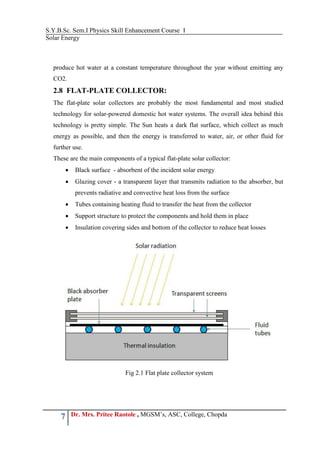
These are the main components of a typical flat-plate solar collector:
 Black surface - absorbent of the incident solar energy
 Glazing cover - a transparent layer that transmits radiation to the absorber, but
prevents radiative and convective heat loss from the surface
 Tubes containing heating fluid to transfer the heat from the collector
 Support structure to protect the components and hold them in place
 Insulation covering sides and bottom of the collector to reduce heat losses
Fig 2.1 Flat plate collector system
S.Y.B.Sc. Sem.I Physics Skill Enhancement Course I
Solar Energy
8 Dr. Mrs. Pritee Raotole , MGSM’s, ASC, College, Chopda
The flat-plate systems normally operate and reach the maximum efficiency within the
temperature range from 30 to 80 0
C. however, some new types of collectors that employ
vacuum insulation can achieve higher temperatures (up to 100 0
C). Due to the
introduction of selective coatings, the stagnant fluid temperature in flat-plate collectors
has been shown to reach 200 0
C.
Some advantages of the flat-plate collectors are that they are:
i. Easy to manufacture
ii. Low cost
iii. Collect both beam and diffuse radiation
iv. Permanently fixed (no sophisticated positioning or tracking equipment is
required)
v. Little maintenance
The flat plate collectors can involve liquid or air heat transport.
Water is one of the common options as liquid fluid due to its accessibility and good thermal
properties: It has a relatively high volumetric heat capacity, It is incompressible (or almost
incompressible), It has a high mass density (which allows using small tubes and pipes for
transport)
2.9 SOLAR DISTILLATION:
 Fresh and clean water is the basic need for sustenance of human life and their
prosperity.
 The availability of fresh water from rivers, lakes and ponds is becoming scarce due
to the pollutants discharged by various industries & by washing & bathing in these
resources.
 Solar energy is available in abundance every where and this energy can be utilized
to convert the saline water into distilled water.
 The device which is used to convert saline water into pure water by using solar
energy is called solar still which is also known as “basin type solar still”.
S.Y.B.Sc. Sem.I Physics Skill Enhancement Course I
Solar Energy
9 Dr. Mrs. Pritee Raotole , MGSM’s, ASC, College, Chopda
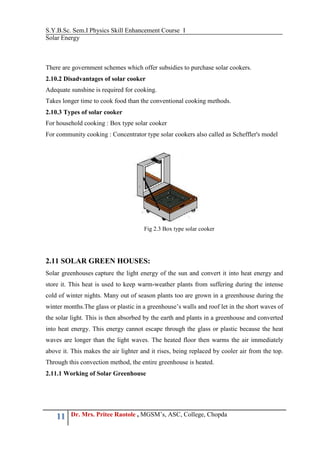
Fig. 2.2 Solar distillation system
 It is a shallow basin with blackened surface called basin liner. The saline water is
supplied to the basin by a filler.
 An overflow pipe allows the excess water to flow out from the basin. The top of the
basin is covered with a sloping air tight transparent cover that encloses the space
above the basin.
 The cover is made of glass or plastic. The cover is roof like and the slope is
provided towards a collection trough.
 Solar radiations pass through the glass cover and these radiations are absorbed &
converted into heat by the basin liner.
 The saline water is than heated & the water vapour is produced inside the solar still.
The water vapour comes in contact with cooler interior surface of the transparent
cover & it gets condensed.
 The condensed water vapors flow down the sloping roof & it is collected in a tray or
through as distilled water.
 The performance of a solar still mainly depends on the available intensity of solar
radiations. It also depends of the atmospheric conditions like ambient air
temperature, humidity, sky conditions ,wind speeds etc.
 The efficiency of basin type solar still is generally in the range of 35% to 50%.
S.Y.B.Sc. Sem.I Physics Skill Enhancement Course I
Solar Energy
10 Dr. Mrs. Pritee Raotole , MGSM’s, ASC, College, Chopda
The efficiency of solar still can be expressed as
where,
m=mass of distill water produced/m2
/day
∆ h=enthalapy change of inlet cold water to water vapour = 2480 KJ/Kg
H=Intensity of solar radiations per m2
area/day, KJ.
2.10 SOLAR COOKER:
A solar cooker is a device that uses sunlight for energy. They use no fuel and cost nothing
to run. They also help slow deforestation and desertification. Another benefit to solar
cooking is that unlike cooking with fire, Solar cookers don't pollute the air.
Solar cooking is done by means of the suns UV rays. A solar cooker lets the UV light rays
in and then converts them to longer infrared light rays that cannot escape. Infrared radiation
has the right energy to make the water, fat and protein molecules in food vibrate vigorously
and heat up. It is not the sun’s heat that cooks the food, nor is it the outside ambient
temperature, though this can somewhat affect the rate or time required to cook, but rather it
is the sun rays that are converted to heat energy that cook the food; and this heat energy is
then retained by the pot and the food by the means of a covering or lid.This occurs in much
the same way that a greenhouse retains heat or a car with its windows rolled up. An
effective solar cooker will use the energy of the sun to heat a cooking vessel and efficiently
retain the energy (heat) for maximum cooking effectiveness.
2.10.1 Advantages of solar cooker
No requirement of cooking gas or kerosene, electricity, coal or wood.
No need to spend on fuel, as solar energy is available free.
Food cooked in solar cooker is nutritious. About 10-20% of protein retention is more as
compared to that in conventional cooking .Vitamin thiamine retention is about 20 to 30%
more whereas vitamin A is retained 5 to 10% more when food is cooked in solar cooker.
Solar cooking is pollution free and safe.
Solar cookers come in various sizes. Based on the number of family members, the size of
the cooker can be chosen.
All cooking activities (like boiling, roasting) can be done using a solar cooker.
S.Y.B.Sc. Sem.I Physics Skill Enhancement Course I
Solar Energy
11 Dr. Mrs. Pritee Raotole , MGSM’s, ASC, College, Chopda
There are government schemes which offer subsidies to purchase solar cookers.
2.10.2 Disadvantages of solar cooker
Adequate sunshine is required for cooking.
Takes longer time to cook food than the conventional cooking methods.
2.10.3 Types of solar cooker
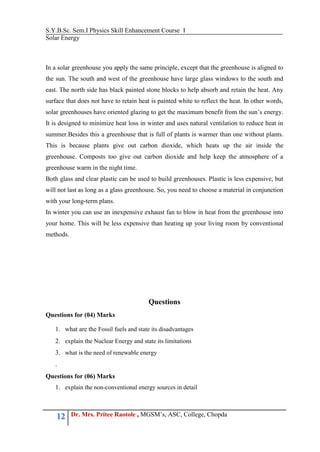
For household cooking : Box type solar cooker
For community cooking : Concentrator type solar cookers also called as Scheffler's model
2.11 SOLAR GREEN HOUSES:
Solar greenhouses capture the light energy of the sun and convert it into heat energy and
store it. This heat is used to keep warm-weather plants from suffering during the intense
cold of winter nights. Many out of season plants too are grown in a greenhouse during the
winter months.The glass or plastic in a greenhouse’s walls and roof let in the short waves of
the solar light. This is then absorbed by the earth and plants in a greenhouse and converted
into heat energy. This energy cannot escape through the glass or plastic because the heat
waves are longer than the light waves. The heated floor then warms the air immediately
above it. This makes the air lighter and it rises, being replaced by cooler air from the top.
Through this convection method, the entire greenhouse is heated.
2.11.1 Working of Solar Greenhouse
Fig 2.3 Box type solar cooker
S.Y.B.Sc. Sem.I Physics Skill Enhancement Course I
Solar Energy
12 Dr. Mrs. Pritee Raotole , MGSM’s, ASC, College, Chopda
In a solar greenhouse you apply the same principle, except that the greenhouse is aligned to
the sun. The south and west of the greenhouse have large glass windows to the south and
east. The north side has black painted stone blocks to help absorb and retain the heat. Any
surface that does not have to retain heat is painted white to reflect the heat. In other words,
solar greenhouses have oriented glazing to get the maximum benefit from the sun’s energy.
It is designed to minimize heat loss in winter and uses natural ventilation to reduce heat in
summer.Besides this a greenhouse that is full of plants is warmer than one without plants.
This is because plants give out carbon dioxide, which heats up the air inside the
greenhouse. Composts too give out carbon dioxide and help keep the atmosphere of a
greenhouse warm in the night time.
Both glass and clear plastic can be used to build greenhouses. Plastic is less expensive, but
will not last as long as a glass greenhouse. So, you need to choose a material in conjunction
with your long-term plans.
In winter you can use an inexpensive exhaust fan to blow in heat from the greenhouse into
your home. This will be less expensive than heating up your living room by conventional
methods.
Questions
Questions for (04) Marks
1. what are the Fossil fuels and state its disadvantages
2. explain the Nuclear Energy and state its limitations
3. what is the need of renewable energy
.
Questions for (06) Marks
1. explain the non-conventional energy sources in detail
S.Y.B.Sc. Sem.I Physics Skill Enhancement Course I
Solar Energy
13 Dr. Mrs. Pritee Raotole , MGSM’s, ASC, College, Chopda
************

2.solar energy

  • 1.
    S.Y.B.Sc. Sem.I PhysicsSkill Enhancement Course I Solar Energy 1 Dr. Mrs. Pritee Raotole , MGSM’s, ASC, College, Chopda UNIT – 2 SolarEnergy Syllabus: Solar Energy, Its Importance, Storage of Solar Energy, Solar Pond, Non Convective Solar Pond, Applications of Solar Pond and Solar Energy, Solar Water Heater, Flat Plate Collector, Solar Distillation, Solar Cooker, Solar Green Houses, Solar Cell, Absorption Air Conditioning. Need and Characteristics of Photovoltaic (PV) Systems, PV Models And Equivalent Circuits, And Sun Tracking Systems. Solar Energy Utilization By Solar Roof Panels. (06 L,12 M) 2.1 INTRODUCTION TO SOLAR ENERGY: Solar energy is a safe alternative which can replace current fossil fuels like coal and gas for generation of electricity that produce air, water, and land pollution. Electricity generation from fossil fuels causes pollution of air leading to acid rain, damaged forest areas, and affected agricultural production leading to loss of billions of dollars worldwide. Solar energy is a major renewable energy source with the potential to meet many of the challenges facing the world. Solar energy - a clean source. No greenhouse gas emissions are released into the atmosphere when you use solar panels to create electricity. And because the sun provides more energy than we'll ever need, electricity from solar power is a very important energy source in the move to clean energy production. 2.2 IMPORTANCE OF SOLAR ENERGY:  Photovoltaic systems (PV systems) are a renewable energy technology which transforms the energy from the sun into electricity using photovoltaics. These photovoltaics, also known as solar panels, provide a reliable green energy solution.  A solar PV system is a sustainable, low-maintenance option for anyone who wants to contribute to a greener environment, as the system does not cause any pollution or emissions and has numerous advantages.  Photovoltaic systems use photovoltaic cells to collect solar energy from the sunlight, and converts it into direct current (DC) electricity. The reflection of the
  • 2.
    S.Y.B.Sc. Sem.I PhysicsSkill Enhancement Course I Solar Energy 2 Dr. Mrs. Pritee Raotole , MGSM’s, ASC, College, Chopda sunlight will create an electric field across photovoltaic systems, causing electricity to flow.  The DC electricity will be transported to an inverter, which will convert this DC power into alternating current (AC). This AC power is the type of electricity which is used for the electric appliances in your home, also referred to as AC load. 2.3 STORAGE OF SOLAR ENERGY: For solar electricity, it is stored using either batteries or the grid. For solar heating, it is stored using thermal mass, water tanks, or swimming pool water. One of the drawbacks of solar energy systems is that the Sun doesn't provide a constant stream of energy. Homeowners are able to generate solar electricity by using a photovoltaic solar power system. There are two primary methods of Energy Storage with a PV solar power system-  Battery Banks  Grid Inter-Tie One way solar power storage can be accomplished is by using a battery bank to store the electricity generated by the PV solar power system. A battery solar power storage system is used in a grid-tied PV system with battery backup and stand-alone PV systems. The major components of a battery solar power system are...  Charge Controller: Prevents the battery bank from overcharging by interrupting the flow of electricity from the PV panels when the battery bank is full.  Battery Bank: A group of batteries wired together. The batteries are similar to car batteries, but designed specifically to endure the type of charging and discharging they'll need to handle in a solar power system.  System Meter: Measures and displays your solar PV systems performance and status.  Main DC Disconnect: A DC rated breaker between the batteries and the inverter. Allows the inverter to be quickly disconnected from the battery bank for service. The third type of PV solar power system is a grid-tied PV system. This system can actually use the grid as its solar energy storage system. This is done using net-metering. With net-
  • 3.
    S.Y.B.Sc. Sem.I PhysicsSkill Enhancement Course I Solar Energy 3 Dr. Mrs. Pritee Raotole , MGSM’s, ASC, College, Chopda metering, when you produce excess solar electricity, you send it to the grid and your electric meter rolls backwards. Later on, at night for example, when your system is not producing electricity, you can pull electricity from the grid and your electric meter will roll forward. You are essentially using the grid to store your solar electricity! Solar Thermal Storage There are three solar heating applications-  Solar Space Heating  Solar Water Heating  Solar Pool Heating Each of these solar heating applications uses their own methods for Solar Thermal Energy Storage. Thermal mass and water tanks are the two primary methods of storing solar energy in solar space heating systems.  Thermal Mass: Used in both passive and active space heating systems. Absorbs heat during the day and slowly releases it at night.  Water Tanks: Used in active liquid systems. A heat-exchanger transfers the heat from the heat-transfer fluid to the water in the tank.  Solar water heating systems use water tanks for the storage of solar energy. Both passive and active solar water heating use water tanks. Active indirect systems use a heat-exchanger to transfer the heat from the heat-transfer fluid. The other solar water heating systems use the actual household water and therefore do not need a water tank with a heat-exchanger.  Solar pool heating uses the swimming pool water for solar energy storage. By circulating your swimming pool water through solar pool collectors, you will be able to extend your swimming season. 2.4 SOLAR POND: A solar pond is, simply, a pool of saltwater which collects and stores solar thermal energy. The saltwater naturally forms a vertical salinity gradient also known as a
  • 4.
    S.Y.B.Sc. Sem.I PhysicsSkill Enhancement Course I Solar Energy 4 Dr. Mrs. Pritee Raotole , MGSM’s, ASC, College, Chopda "halocline", in which low-salinity water floats on top of high-salinity water. The layers of salt solutions increase in concentration (and therefore density) with depth. Below a certain depth, the solution has a uniformly high salt concentration. The solar pond works on a very simple principle. It is well-known that water or air is heated they become lighter and rise upward e.g. a hot air balloon. Similarly, in an ordinary pond, the sun’s rays heat the water and the heated water from within the pond rises and reaches the top but loses the heat into the atmosphere. The net result is that the pond water remains at the atmospheric temperature. The solar pond restricts this tendency by dissolving salt in the bottom layer of the pond making it too heavy to rise. A solar pond has three zones. The top zone is the surface zone, or UCZ (Upper Convective Zone), which is at atmospheric temperature and has little salt content. The bottom zone is very hot, 70°– 85° C, and is very salty. It is this zone that collects and stores solar energy in the form of heat, and is, therefore, known as the storage zone or LCZ (Lower Convective Zone). Separating these two zones is the important gradient zone or NCZ (Non-Convective Zone). Here the salt content increases as depth increases, thereby creating a salinity or density gradient. If we consider a particular layer in this zone, water of that layer cannot rise, as the layer of water above has less salt content and is, therefore, lighter. Similarly, the water from this layer cannot fall as the water layer below has a higher salt content and is, therefore, heavier. This gradient zone acts as a transparent insulator permitting sunlight to reach the bottom zone but also Fresh water Salty water Very salty
  • 5.
    S.Y.B.Sc. Sem.I PhysicsSkill Enhancement Course I Solar Energy 5 Dr. Mrs. Pritee Raotole , MGSM’s, ASC, College, Chopda 2.5 NON CONVECTIVE SOLAR POND: The more common non-convective solar pond reduces heat loss by preventing convection (the transfer of heat from one place to another by the movement of fluids) with the addition of a concentration of 20–30 % salt to the bottom level (lower convective zone) of the pond. When saturated with high amounts of salt in the form of concentrated brine, the temperature of the bottom level rises to about 100 °C (212 °F) as heat from the Sun is trapped. The middle level (non-convective zone) receives a lower amount of salt than the bottom level. Because it is lighter than the bottom level but heavier than the top level, the water in the middle level is unable to rise or sink. The middle level, therefore, halts convection currents and acts as an insulator, trapping sunlight in the bottom level. In the top level (upper convective zone), where there is little salt, the water remains cold. Fresh water is added to that level, and saline water is drained. Finally, heat from the bottom level is transferred to pipes circulating through the pond to extract thermal energy. So simply Non-convective solar pond is a potential large surface area solar collector device. It has additional advantage of long term storage capacity. It is a shallow body of water of about a meter deep containing dissolved salts to generate a stable density gradient (fresh water on top and denser salt at the bottom). 2.6 APPLICATIONS OF SOLAR POND AND SOLAR ENERGY: Is effective method trap solar heat by using ponds. Another way is the use of hydrodynamic layer flow principle where by the hot fluid is removed at one end into a heat-exchanger external to the pond and then returns the solution to the other end of the pond. Some applications of solar ponds are for heating and cooling of buildings, and power production. Heat energy stored in the pond may be used for space heating during the harmattan season. The heat energy is transferred into Air Handling Unit (AHU) containing heat exchanger coil and fan that blows heated air into the space. This
  • 6.
    S.Y.B.Sc. Sem.I PhysicsSkill Enhancement Course I Solar Energy 6 Dr. Mrs. Pritee Raotole , MGSM’s, ASC, College, Chopda arrangement can be incorporated into office complex and estate in the future. Also, hot water can be extracted from the pond for domestic or industrial needs. A typical application is heating of greenhouse in U.S.A. Cooling can be achieved by absorption refrigeration system with generator heated with solar pond. The chiller side of the refrigerator will then be part of A.H.U. With suitable fluid (Freons) and two heat exchangers-one on the upper cold water and one on the lower hot water, it is possible to operate a heat engine for power production. This is the most promising application of solar pond especially for small developing countries. 2.7 SOLAR WATER HEATER: A solar water heater is a device that can be used to capture sunlight in order to heat the water in your pipes to be used for baths, showers, etc. It consists mainly of: A thermal panel (solar collector) installed on the roof; A tank to store hot water; Accessories, such as a circulating pump to carry the solar energy from the collector to the tank, and a thermal regulator. However, a back-up heating system is required for times when there is insufficient luminosity. The solar water heater absorbs light by means of a collector placed on the roof and converts it into heat. It passes this heat to a water tank by means of a circulating pump. This exchange is triggered by the thermal regulator, but only when the collector is hotter than the water in the tank. This prevents the circulating pumps using electricity needlessly. Conversely, it also prevents overheating. The efficiency of the collectors is at its highest at midday, in summer, when the sky is cloudless, and when the collectors face south. However, the collectors also work well in other seasons, when the sky is cloudy, for a good part of the day, even if they face east or west. Likewise, the efficiency is best at a gradient of 35° to the horizon, but good results can be achieved with collectors fitted vertically to a façade. When there is insufficient sunlight, the water is preheated and a back-up system takes over to bring the water to the required temperature. This system can therefore be used to
  • 7.
    S.Y.B.Sc. Sem.I PhysicsSkill Enhancement Course I Solar Energy 7 Dr. Mrs. Pritee Raotole , MGSM’s, ASC, College, Chopda produce hot water at a constant temperature throughout the year without emitting any CO2. 2.8 FLAT-PLATE COLLECTOR: The flat-plate solar collectors are probably the most fundamental and most studied technology for solar-powered domestic hot water systems. The overall idea behind this technology is pretty simple. The Sun heats a dark flat surface, which collect as much energy as possible, and then the energy is transferred to water, air, or other fluid for further use. These are the main components of a typical flat-plate solar collector:  Black surface - absorbent of the incident solar energy  Glazing cover - a transparent layer that transmits radiation to the absorber, but prevents radiative and convective heat loss from the surface  Tubes containing heating fluid to transfer the heat from the collector  Support structure to protect the components and hold them in place  Insulation covering sides and bottom of the collector to reduce heat losses Fig 2.1 Flat plate collector system
  • 8.
    S.Y.B.Sc. Sem.I PhysicsSkill Enhancement Course I Solar Energy 8 Dr. Mrs. Pritee Raotole , MGSM’s, ASC, College, Chopda The flat-plate systems normally operate and reach the maximum efficiency within the temperature range from 30 to 80 0 C. however, some new types of collectors that employ vacuum insulation can achieve higher temperatures (up to 100 0 C). Due to the introduction of selective coatings, the stagnant fluid temperature in flat-plate collectors has been shown to reach 200 0 C. Some advantages of the flat-plate collectors are that they are: i. Easy to manufacture ii. Low cost iii. Collect both beam and diffuse radiation iv. Permanently fixed (no sophisticated positioning or tracking equipment is required) v. Little maintenance The flat plate collectors can involve liquid or air heat transport. Water is one of the common options as liquid fluid due to its accessibility and good thermal properties: It has a relatively high volumetric heat capacity, It is incompressible (or almost incompressible), It has a high mass density (which allows using small tubes and pipes for transport) 2.9 SOLAR DISTILLATION:  Fresh and clean water is the basic need for sustenance of human life and their prosperity.  The availability of fresh water from rivers, lakes and ponds is becoming scarce due to the pollutants discharged by various industries & by washing & bathing in these resources.  Solar energy is available in abundance every where and this energy can be utilized to convert the saline water into distilled water.  The device which is used to convert saline water into pure water by using solar energy is called solar still which is also known as “basin type solar still”.
  • 9.
    S.Y.B.Sc. Sem.I PhysicsSkill Enhancement Course I Solar Energy 9 Dr. Mrs. Pritee Raotole , MGSM’s, ASC, College, Chopda Fig. 2.2 Solar distillation system  It is a shallow basin with blackened surface called basin liner. The saline water is supplied to the basin by a filler.  An overflow pipe allows the excess water to flow out from the basin. The top of the basin is covered with a sloping air tight transparent cover that encloses the space above the basin.  The cover is made of glass or plastic. The cover is roof like and the slope is provided towards a collection trough.  Solar radiations pass through the glass cover and these radiations are absorbed & converted into heat by the basin liner.  The saline water is than heated & the water vapour is produced inside the solar still. The water vapour comes in contact with cooler interior surface of the transparent cover & it gets condensed.  The condensed water vapors flow down the sloping roof & it is collected in a tray or through as distilled water.  The performance of a solar still mainly depends on the available intensity of solar radiations. It also depends of the atmospheric conditions like ambient air temperature, humidity, sky conditions ,wind speeds etc.  The efficiency of basin type solar still is generally in the range of 35% to 50%.
  • 10.
    S.Y.B.Sc. Sem.I PhysicsSkill Enhancement Course I Solar Energy 10 Dr. Mrs. Pritee Raotole , MGSM’s, ASC, College, Chopda The efficiency of solar still can be expressed as where, m=mass of distill water produced/m2 /day ∆ h=enthalapy change of inlet cold water to water vapour = 2480 KJ/Kg H=Intensity of solar radiations per m2 area/day, KJ. 2.10 SOLAR COOKER: A solar cooker is a device that uses sunlight for energy. They use no fuel and cost nothing to run. They also help slow deforestation and desertification. Another benefit to solar cooking is that unlike cooking with fire, Solar cookers don't pollute the air. Solar cooking is done by means of the suns UV rays. A solar cooker lets the UV light rays in and then converts them to longer infrared light rays that cannot escape. Infrared radiation has the right energy to make the water, fat and protein molecules in food vibrate vigorously and heat up. It is not the sun’s heat that cooks the food, nor is it the outside ambient temperature, though this can somewhat affect the rate or time required to cook, but rather it is the sun rays that are converted to heat energy that cook the food; and this heat energy is then retained by the pot and the food by the means of a covering or lid.This occurs in much the same way that a greenhouse retains heat or a car with its windows rolled up. An effective solar cooker will use the energy of the sun to heat a cooking vessel and efficiently retain the energy (heat) for maximum cooking effectiveness. 2.10.1 Advantages of solar cooker No requirement of cooking gas or kerosene, electricity, coal or wood. No need to spend on fuel, as solar energy is available free. Food cooked in solar cooker is nutritious. About 10-20% of protein retention is more as compared to that in conventional cooking .Vitamin thiamine retention is about 20 to 30% more whereas vitamin A is retained 5 to 10% more when food is cooked in solar cooker. Solar cooking is pollution free and safe. Solar cookers come in various sizes. Based on the number of family members, the size of the cooker can be chosen. All cooking activities (like boiling, roasting) can be done using a solar cooker.
  • 11.
    S.Y.B.Sc. Sem.I PhysicsSkill Enhancement Course I Solar Energy 11 Dr. Mrs. Pritee Raotole , MGSM’s, ASC, College, Chopda There are government schemes which offer subsidies to purchase solar cookers. 2.10.2 Disadvantages of solar cooker Adequate sunshine is required for cooking. Takes longer time to cook food than the conventional cooking methods. 2.10.3 Types of solar cooker For household cooking : Box type solar cooker For community cooking : Concentrator type solar cookers also called as Scheffler's model 2.11 SOLAR GREEN HOUSES: Solar greenhouses capture the light energy of the sun and convert it into heat energy and store it. This heat is used to keep warm-weather plants from suffering during the intense cold of winter nights. Many out of season plants too are grown in a greenhouse during the winter months.The glass or plastic in a greenhouse’s walls and roof let in the short waves of the solar light. This is then absorbed by the earth and plants in a greenhouse and converted into heat energy. This energy cannot escape through the glass or plastic because the heat waves are longer than the light waves. The heated floor then warms the air immediately above it. This makes the air lighter and it rises, being replaced by cooler air from the top. Through this convection method, the entire greenhouse is heated. 2.11.1 Working of Solar Greenhouse Fig 2.3 Box type solar cooker
  • 12.
    S.Y.B.Sc. Sem.I PhysicsSkill Enhancement Course I Solar Energy 12 Dr. Mrs. Pritee Raotole , MGSM’s, ASC, College, Chopda In a solar greenhouse you apply the same principle, except that the greenhouse is aligned to the sun. The south and west of the greenhouse have large glass windows to the south and east. The north side has black painted stone blocks to help absorb and retain the heat. Any surface that does not have to retain heat is painted white to reflect the heat. In other words, solar greenhouses have oriented glazing to get the maximum benefit from the sun’s energy. It is designed to minimize heat loss in winter and uses natural ventilation to reduce heat in summer.Besides this a greenhouse that is full of plants is warmer than one without plants. This is because plants give out carbon dioxide, which heats up the air inside the greenhouse. Composts too give out carbon dioxide and help keep the atmosphere of a greenhouse warm in the night time. Both glass and clear plastic can be used to build greenhouses. Plastic is less expensive, but will not last as long as a glass greenhouse. So, you need to choose a material in conjunction with your long-term plans. In winter you can use an inexpensive exhaust fan to blow in heat from the greenhouse into your home. This will be less expensive than heating up your living room by conventional methods. Questions Questions for (04) Marks 1. what are the Fossil fuels and state its disadvantages 2. explain the Nuclear Energy and state its limitations 3. what is the need of renewable energy . Questions for (06) Marks 1. explain the non-conventional energy sources in detail
  • 13.
    S.Y.B.Sc. Sem.I PhysicsSkill Enhancement Course I Solar Energy 13 Dr. Mrs. Pritee Raotole , MGSM’s, ASC, College, Chopda ************